If you search “benefits of ai seo for businesses,” most of what comes back is a traditional SEO benefits list with a few AI mentions bolted on. That’s not what AI SEO is, and it’s not why it matters to a business making an investment decision.
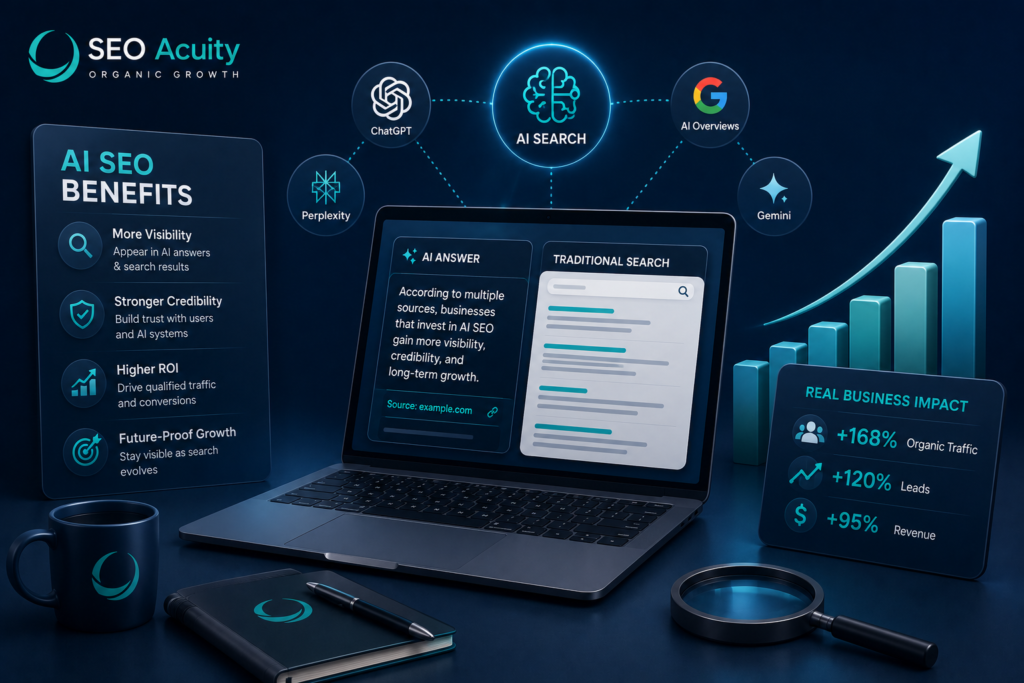
What is AI SEO? It’s the practice of structuring your site, content, and off-site presence so you’re retrievable by AI search engines:
- ChatGPT
- Google’s AI Overviews.
- Perplexity, and similar tools.
- In addition to ranking in traditional search.
It’s not a separate discipline you fund on top of SEO.
This isn’t a SEO vs AI Visibility trade-off — it’s one system, two outputs. Businesses that understand this distinction invest correctly. Businesses that don’t end up buying “AI SEO” as a bolt-on service and getting very little for it.
What you’ll learn?
- What AI SEO is and how it differs from traditional SEO, in one clear definition?
- The specific business advantages of AI SEO — visibility, credibility, ROI, and channel-wide leverage.
- Why strong SEO often still fails to earn AI citations, and what actually causes that?
- A practical framework for deciding if your business needs to invest in AI SEO now.
What is AI SEO, and how is it different from traditional SEO?
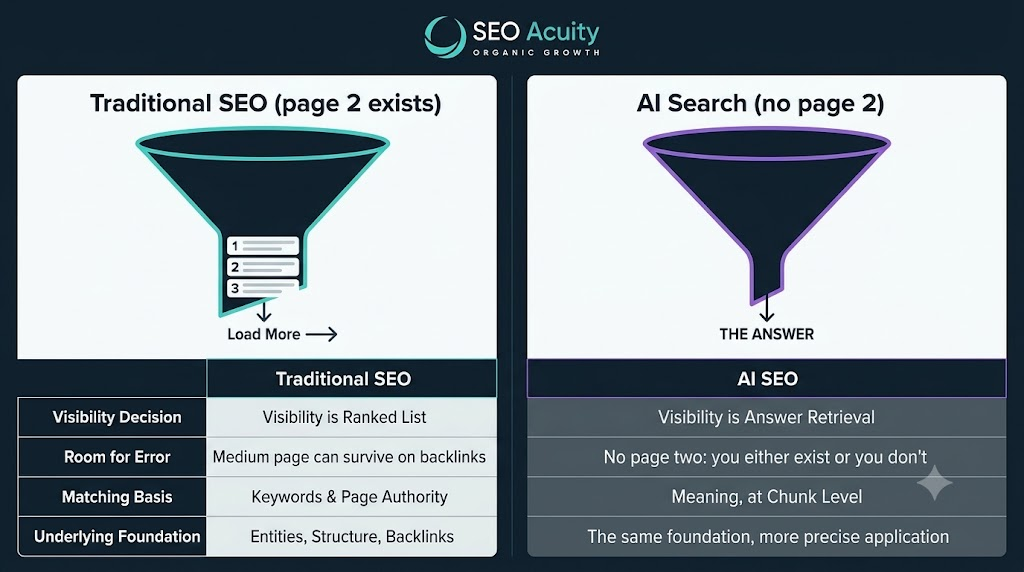
AI SEO vs traditional SEO isn’t really a competition between two toolkits — it’s the same discipline applied with a higher enforcement standard.
AI SEO is the practice of optimizing your content and site architecture so AI systems can retrieve, understand, and cite your business when users ask questions in your domain — using the same foundational levers as SEO (technical health, content quality, authority signals), applied with more precision.
| Traditional SEO | AI SEO | |
| What decides visibility | Ranking position in a list of results | Retrieval into a small set of answer chunks |
| Room for error | A mediocre page can survive on backlink strength alone | No page two — you’re either in the answer or you don’t exist for that query |
| What’s being matched | Keywords and page-level authority | Meaning, at the chunk level |
| Underlying infrastructure | Organic foundation: entity clarity, structured content, credible backlinks | The same organic foundation, applied with higher precision |
The difference isn’t the toolkit. It’s the enforcement level.
If you’re asking whether SEO still matters as AI search keeps growing — the honest answer is that it matters more, not less, because AI retrieval depends entirely on the same organic infrastructure SEO has always built.
We break this down fully in Is Google Dead?.
Why “AI SEO” shouldn’t be bought as a separate line item:
- If your organic foundation — entity clarity, structured content, semantic depth, credible backlinks — is done properly, AI search visibility is a downstream result.
- If it isn’t, no amount of AI-specific tactics layered on top will compensate.
If you’re weighing GEO vs. SEO or AEO vs. SEO as separate investments, see the FAQ below — the short answer is that they’re not separate at all. For the fuller argument, read Do AI and GEO / AEO Replace SEO?
AI SEO extends your visibility into AI search and LLMs
The most direct advantage of AI SEO is being present where your buyers are increasingly asking questions — inside Google AI Overviews, ChatGPT, Perplexity, and similar tools, not only in the traditional ten blue links.
Understanding what Google AI Overviews are for SEO and how to rank in them — what used to be discussed under the name SGE (Search Generative Experience) SEO — is now a core part of any organic strategy, not a side project.
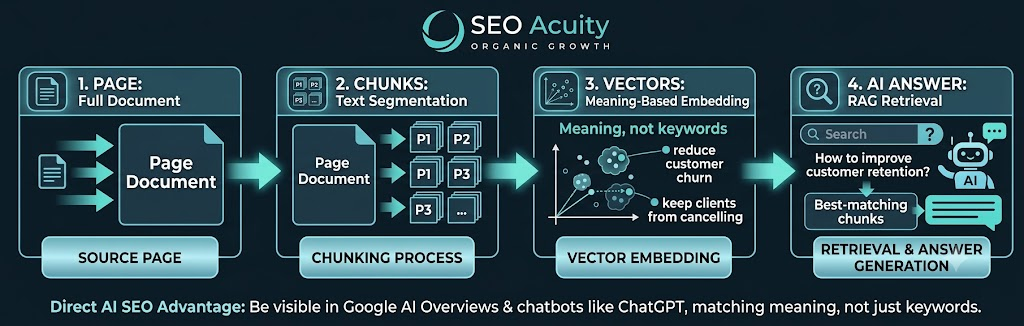
This works because AI systems don’t store your page as a single unit. They:
- Split it into small chunks rather than treating the page as one document.
- Convert each chunk into a vector representing meaning, not keywords.
- Retrieve the best-matching chunks for a given question.
That’s why two phrases with zero words in common — “reduce customer churn” and “keep clients from cancelling” — can sit close together in that vector space: the system is matching meaning, not keywords.
This is the mechanism behind a few related disciplines worth naming directly, since each shows up as its own search term:
| Term | What it means |
| LLM SEO | Optimizing content specifically for how large language models retrieve and cite it |
| ChatGPT SEO strategy | Optimization built around how ChatGPT sources and surfaces answers |
| Perplexity SEO optimization | Optimization built around how Perplexity sources and attributes its answers |
Ready to Dominate Search Engine Rankings?
Accelerate your organic growth and scale your business leads with our data-driven SEO strategies.
Get a Free Quote NOW!The business implication: a well-structured page from a smaller site can out-compete a high-authority page with a vague chunk. Retrievability, not domain size alone, decides who gets cited.
AI SEO increases your credibility with both users and AI systems
People trust businesses that show up in search results, and AI systems weight brands with a stronger organic footprint more heavily when deciding who to mention.
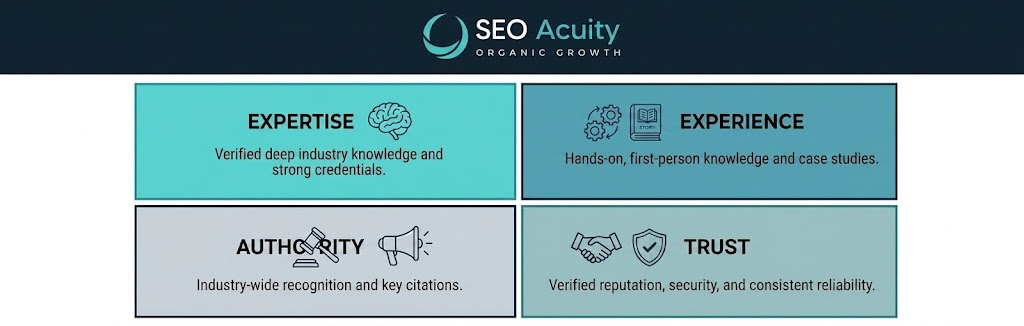
This isn’t a coincidence — the same E-E-A-T signals (Experience, Expertise, Authority, Trust) that build user trust are the signals AI systems use to score which sources are reliable enough to cite.
In practice, that means:
- Experience — real case studies, named results, and practitioner detail, not generic claims.
- Expertise — content that demonstrates industry knowledge rather than summarizing what’s already been said elsewhere.
- Authority — depth of coverage across your core topic, not a handful of disconnected posts.
- Trust — information that’s accurate, current, and doesn’t contradict itself across pages.
A brand that’s inconsistent about how it describes its own offering — different definitions on different pages — actively damages this. AI systems read that inconsistency as unreliability and downgrade the source.
AI SEO can earn you citations even without a top ranking
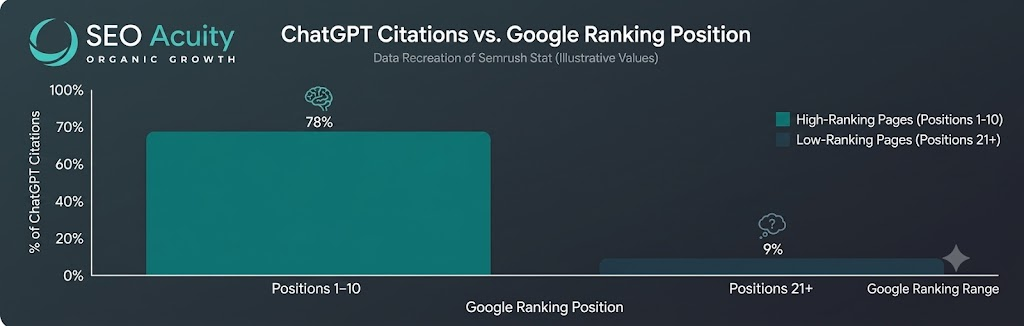
One of the more counterintuitive advantages of AI SEO: you don’t need a first-page Google ranking to get cited by an AI system.
A 2025 Semrush study found that ChatGPT search cited URLs ranking at position 21 or lower on Google roughly 90% of the time — meaning the content AI tools pull from is often far outside what a human would ever scroll to.
This is the core of what Generative Engine Optimization SEO Benefits for Businesses actually means in practice — ranking position and AI citation are no longer the same scoreboard.
That changes how you should prioritize content investment. It means:
- Long-tail and even lower-volume keywords are worth targeting if they let you answer a specific question completely, because LLMs often pull from narrow, highly specific passages rather than broad, competitive pages.
- High-competition keywords still matter — not because you’ll outrank everyone, but because publishing depth on the topic increases your odds of being the source an AI system pulls from.
- Consistency of publishing across your core topic area matters more than chasing any single ranking.
This is a real shift in how “SEO success” should be measured for a business — visibility in an AI answer is now a legitimate outcome in its own right, separate from ranking position.
AI SEO delivers compounding ROI, not a traffic spike
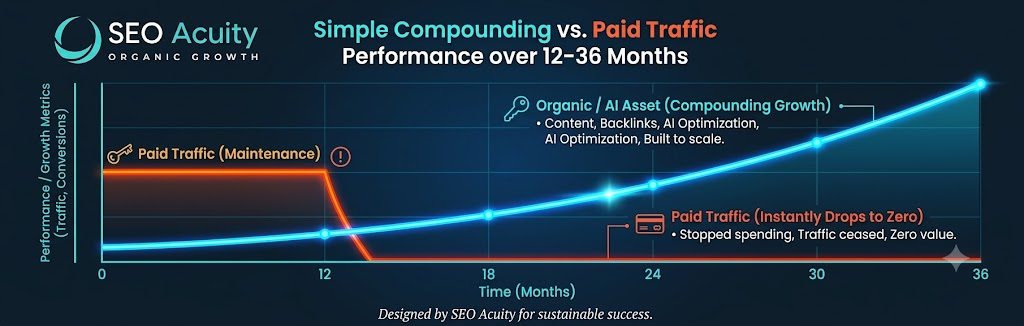
SEO Acuity’s position on this is blunt: rankings are a means, revenue is the measure. The same applies to AI SEO — the financial case isn’t “more mentions,” it’s what those mentions do to your pipeline over time.
A properly built GEO SEO Strategy for AI Search is designed exactly around this: compounding, not campaign-based, return.
Why AI SEO behaves like infrastructure, not a campaign?
The two behave nothing alike once you stop actively funding them:
| Paid placement | Organic / AI SEO asset |
| Disappears the moment you stop paying | Keeps earning after the initial build cost |
| Resets to zero each new budget cycle | Compounds — pays out in more channels over time |
| One channel, one payoff | One asset, multiple payoffs: search ranking, AI citation, repurposed content |
The numbers back this up. Independent research (First Page Sage) found SEO campaigns delivering ROI in the range of 317% to 1,389% across industries over a three-year period.
Content built for AI retrieval extends that same asset’s earning life into a second channel — AI citation — without a second production cost.
The core case, in short
Strip away the mechanics, and the ROI argument for AI SEO comes down to four facts:
- Organic clicks are free once the content exists.
- An AI citation or organic ranking doesn’t vanish when you stop spending.
- One properly architected asset pays out across traditional search, AI search, and every channel it gets repurposed into.
- Return compounds — it doesn’t reset with each new budget cycle.
For the full framework, see Organic Growth Strategy to Win AI Search and SEO SERP.
AI SEO strengthens every other marketing channel you run
Content built for AI retrieval tends to be tighter, more structured, and more directly useful — which makes it more valuable everywhere else it goes. A well-built AI-SEO asset repurposes cleanly:
- Into an email campaign, because the core argument is already stated in one clean paragraph rather than buried in narrative.
- Into social snippets, because each point is already self-contained.
- Into a gated resource or sales enablement asset, because the depth is already there.
There’s also a technical spillover: the site-speed and structural fixes that support AI retrievability (clean HTML, fast load times, clear heading hierarchy) tend to reduce bounce rates on paid traffic too, and they feed directly into conversion.
You’re not funding two separate improvement efforts — you’re funding one, and multiple channels get the benefit.
What common mistakes make businesses invisible to AI search despite good SEO?
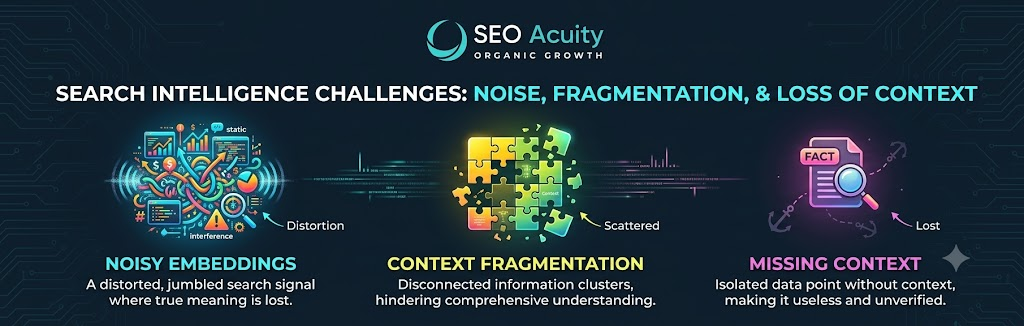
This is the pattern SEO Acuity sees most often in new client engagements: a business with years of content, a solid backlink profile, and respectable traffic — that’s still completely absent from AI-generated answers.
Three specific failures cause it, and none of them are about authority:
| Failure | What it is | Why it breaks retrieval |
| Noisy embeddings | A page contains contradictory information, unclear definitions, or drifts from one subject into another without a clear break. | The resulting vector becomes incoherent. The system can’t cleanly represent what the page is saying, so it doesn’t trust the chunk enough to use it — no matter how authoritative the domain is. |
| Context fragmentation | A single fact is scattered across multiple pages or sections instead of stated fully in one place. | The system may retrieve one incomplete chunk and never assemble the full picture. If your best answer requires reading three different paragraphs to understand, it functionally doesn’t exist for retrieval purposes. |
| Missing context | Content is technically accurate but not clearly tied to the question it’s meant to answer. | It gets retrieved and then discarded, because the system can’t confirm relevance. |
Authority is a page-level signal. AI search operates at the chunk level. A business can be genuinely authoritative and still be invisible in AI answers if its content isn’t built to survive being read one paragraph at a time.
How do you know if your business needs to invest in AI SEO now?
Not every business needs to move on this today, and it’s worth being honest about that rather than manufacturing urgency.
Part of this is also knowing how to adapt your SEO budget for AI search — rather than assuming a bigger budget automatically helps, the right question is where the budget goes, not how much of it there is.
Signals worth checking before you commit budget:
| Signal | What it means if true |
| Your buyers are already asking AI tools questions in your category | If prospects research on ChatGPT or AI Overviews before ever visiting a vendor site, delaying costs you visibility every month you wait |
| Competitors already show up in AI answers where you don’t | That’s a market-capture gap, not a vanity metric |
| Your existing content is thin or templated rather than genuinely deep | AI SEO work will mostly mean rebuilding the content itself, which is a bigger engagement than a technical tune-up |
| Your team lacks the internal capacity to sustain the work | AI SEO compounds — it doesn’t deliver overnight, so this isn’t the right lever yet if you need traffic within 30 days |
How does this apply differently at enterprise vs. SaaS scale?
Scale changes what “AI SEO” actually means to execute, even though the underlying signals of your business case stay the same.
1. LLM SEO for enterprise businesses
It is primarily an entity-architecture problem, not a content-volume problem.
The work is coordinating retrieval across dozens or hundreds of product and category pages at once, so each one is independently retrievable rather than dependent on the page next to it.
2. LLM SEO for SaaS
LLM SEO for SaaS hinges on feature and use-case pages being retrievable on their own. SaaS buyers ask AI tools narrow, comparison-style questions — “which tool handles X” — far more often than broad category questions, so each feature page needs to stand as a complete answer by itself.
3. The threshold to act
if two or more of the first three signals above are true, the business case for investing now is strong. SEO Acuity’s Organic Growth Foundation™ starts every engagement by mapping exactly this — where your entity gaps are, what’s fragmenting your context, and whether your current content can be re-architected or needs to be rebuilt from the ground up.
The honest case for AI SEO
AI SEO isn’t a separate budget line, and it isn’t a shortcut. It’s what a properly built organic growth system produces once it’s engineered for retrieval instead of just for ranking:
- Visibility across AI-generated responses, not only in conventional search rankings.
- Stronger E-E-A-T signals — credibility that both users and AI systems recognize.
- Citations independent of ranking position — you don’t need #1 to be cited.
- Marketing assets that compound — instead of resetting every quarter.
The businesses losing ground here aren’t losing to smarter competitors. They’re losing to their own noisy, fragmented, context-poor content — while a competitor with a smaller site but a cleaner chunk gets cited instead. That’s a fixable, structural problem, not a budget problem.
Ready to see where your content is losing retrievability? Talk to SEO Acuity about an Organic Growth Foundation™ assessment — a full map of your entity gaps, technical blockers, and AI-retrieval readiness before you commit to a strategy.

Ready to Dominate Search Engine Rankings?
Accelerate your organic growth and scale your business leads with our data-driven SEO strategies.
Get a Free Quote NOW!This isn’t a service you buy — it’s a system you architect
Most “AI SEO” offers today are the same old SEO retainer with a few AI buzzwords stapled on top. That’s not how SEO Acuity works — and here’s why that actually matters for the results in this article:
- We build infrastructure, not tactics. Retrievability is designed in from day one, not bolted on later.
- We map before we build. Blueprint first — entity gaps, structural weaknesses, retrieval readiness — before any page gets touched.
- Revenue is the scoreboard. A citation that doesn’t move pipeline is just a vanity metric in an AI costume.
- We know the GCC market, not just the language. Western-style content often fails to retrieve for Gulf buyers, even with solid SEO.
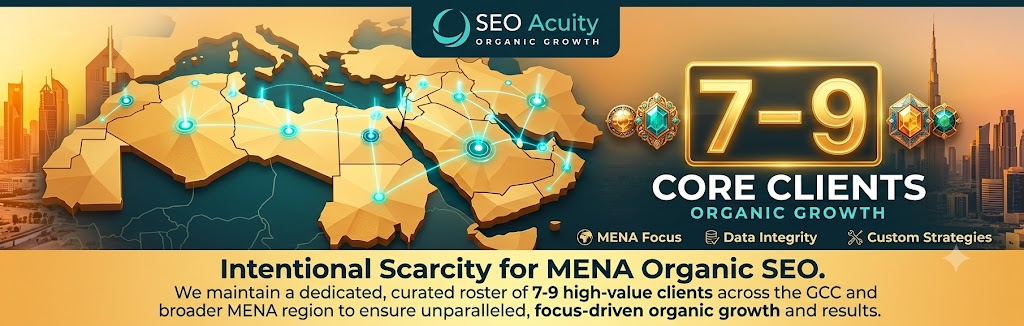
- We stay small on purpose. 7–9 core clients at a time — AI-ready architecture doesn’t scale to fifty accounts.
Proof, not promises
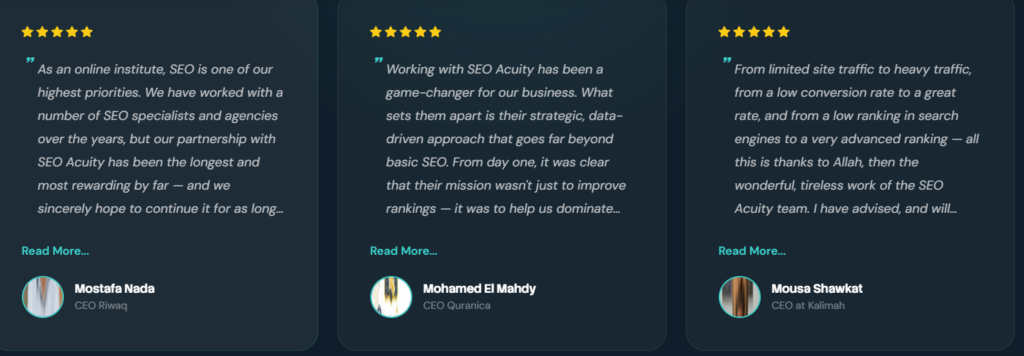
- 50+ brands scaled globally
- 91% of clients stay — most agencies can’t say that
- $3M+ in organic revenue traced directly back to this work
- GCC+ is where this architecture was built to win
If your content is thin, inconsistent, or built for keywords instead of entities — no amount of “AI SEO tactics” on top will fix that. An Organic Growth Foundation™ assessment maps exactly where those gaps are before anything gets rebuilt.
Talk to SEO Acuity about an Organic Growth Foundation™ assessment.
Ready to Dominate Search Engine Rankings?
Accelerate your organic growth and scale your business leads with our data-driven SEO strategies.
Get a Free Quote NOW!Conclusion
AI SEO isn’t a separate budget line, and it isn’t a shortcut — it’s what a properly built organic growth system produces once it’s engineered for retrieval instead of just for ranking.
Visibility in AI answers, stronger E-E-A-T signals, citations independent of ranking position, and marketing assets that compound instead of resetting every quarter: none of that is a bonus feature. It’s what happens when the foundation is actually built correctly, the first time.
The businesses losing ground here aren’t losing to smarter competitors. They’re losing to their own noisy, fragmented, context-poor content — while a competitor with a smaller site but a cleaner chunk gets cited instead.
The businesses that move now — while most competitors are still treating AI SEO as an afterthought — are the ones that will own the answer when their buyers ask the question. That’s the difference between renting attention and architecting a defensible position.
Curious about what’s preventing your content from being easily retrieved by AI? Talk to SEO Acuity about an Organic Growth Foundation™ assessment — a full map of your entity gaps, technical blockers, and AI-retrieval readiness before you commit to a strategy.
Frequently asked questions
Before you go, here are the specific questions businesses ask us most often when they’re deciding whether — and how — to invest in AI SEO.
What is AI SEO?
AI SEO is the practice of structuring content, technical architecture, and off-site signals so AI search engines — ChatGPT, Google AI Overviews, Perplexity, and similar tools — can retrieve, understand, and cite a business, using the same foundational SEO levers applied with AI-specific precision.
What is GEO vs SEO, and what about AEO vs SEO?
GEO (Generative Engine Optimization) and AEO (Answer Engine Optimization) are the specific practices inside AI SEO — GEO focuses on earning citations in generative answers, AEO on structuring content to directly answer questions. Both are outputs of a well-built SEO foundation, not separate disciplines requiring separate strategies.
Will SEO remain important as AI-powered search becomes more common?
Yes — AI search retrieval runs on the same organic infrastructure SEO has always built: technical health, indexed content, and authority signals.
As AI search grows, the foundation SEO provides becomes more important, not less. Full argument: Is Google Dead?
How long does it take to see results from AI SEO?
AI search systems evaluate many of the same authority and content-structure signals used by traditional search engines, so meaningful improvements typically take time rather than happening overnight.
A realistic engagement typically starts with a multi-week architecture and content audit, followed by a sustained minimum six-month build-out before compounding visibility becomes clearly measurable.
Do I need a separate budget for AI SEO?
No. If your SEO program already builds entity clarity, structured content, and genuine authority, AI search visibility follows as a downstream result.
A separate “AI SEO” budget usually signals that the underlying SEO foundation is being skipped, not supplemented.
Can small or mid-sized businesses benefit from AI SEO?
Yes — retrievability depends on how clearly and completely a chunk answers a question, not on domain size alone.
A smaller business with tightly structured, specific content can out-perform a larger competitor whose content is authoritative but vague.