
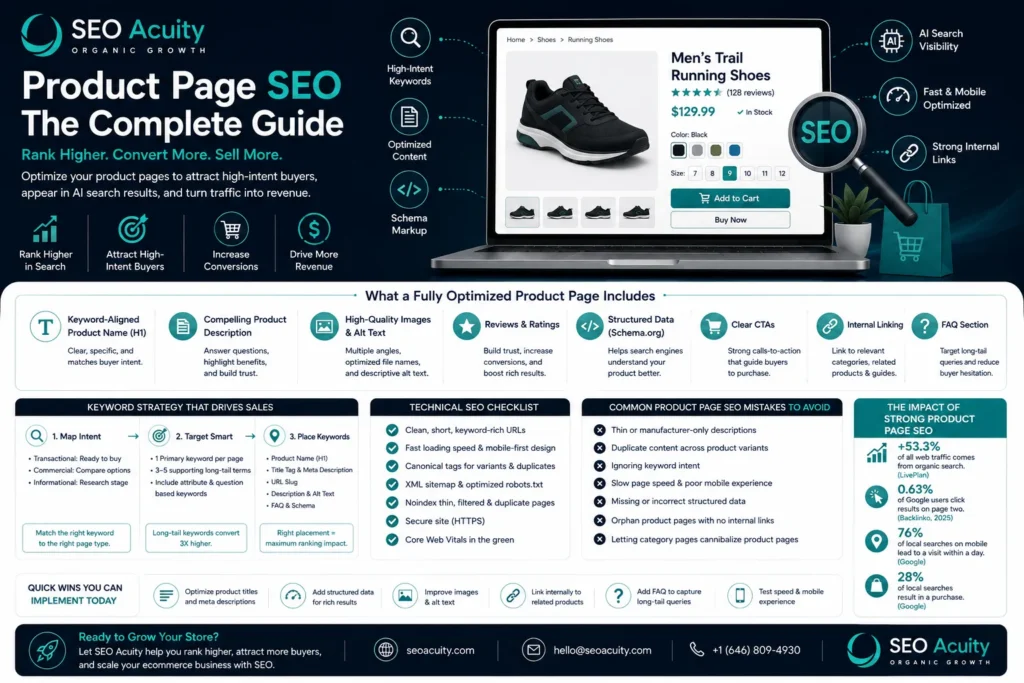
Your product pages are where buyers make decisions — and where most ecommerce stores quietly lose money. They rank poorly, fail to answer purchase intent, and send high-intent visitors straight to a competitor.
Product page SEO is the practice of optimizing ecommerce product detail pages so they rank higher in search engines, appear in AI-generated results, and convert the traffic they earn.
This guide covers what actually moves the needle in 2026: keyword alignment, content depth, structured data, AI search signals, and the technical foundations that hold everything together.
Whether you’re managing a Shopify store with 50 SKUs or a catalogue with thousands, the principles here apply — and the order they’re applied in matters.
Explore SEO Acuity’s Shopify SEO Services
What you’ll learn in this article:
- How to align product names and URLs with high-intent keyword strategy
- What a fully optimized product page looks like, from H1 to schema markup
- Why AI search retrieves product pages differently than Google — and how to win both
- Which technical mistakes silently drain product page rankings
- How to handle duplicate variants, discontinued products, and orphan pages without losing authority
Product Page SEO Meaning
Product pages aren’t just deeper pages on your site. They’re the pages that attract buyers at the exact moment they’re ready to purchase — not researchers, not browsers, but people with transactional intent and, frequently, a payment method already loaded.
Despite that, most ecommerce SEO strategies pour effort into homepages and category pages, leaving product pages under-optimized, thin, and structurally weak. That’s a significant missed opportunity, because a visitor who arrives on a well-optimized product page directly from a search result needs far less convincing than one who navigates down through your site.
There’s also a critical misconception worth addressing: many store owners assume visitors enter through the homepage and navigate downward to products. In reality, product pages regularly draw direct organic traffic from buyers who searched for a specific product name, model, or attribute combination. If those pages don’t rank, that revenue simply doesn’t arrive.
Read More About: What Is An SEO Specialist? Role, Responsibilities, Skills, and When to Hire One
The Challenges of Product Pages Optimization
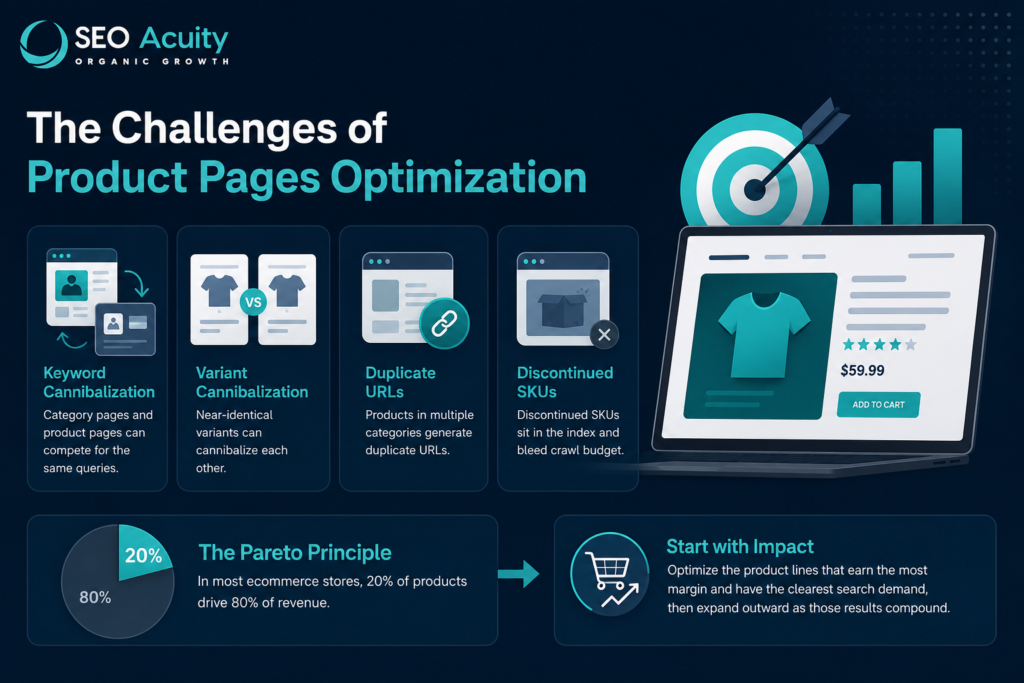
Optimizing a product page in isolation is straightforward. The challenge comes from the interconnected nature of an ecommerce site. Category pages and product pages can compete for the same queries.
Near-identical variants can cannibalize each other. Products in multiple categories generate duplicate URLs. Discontinued SKUs sit in the index and bleed crawl budget.
The Pareto principle applies here. In most ecommerce stores, 20% of products drive 80% of revenue. Start with those. Optimize the product lines that earn the most margin and have the clearest search demand, then expand outward as those results compound.
Read also: Is Google Dead?
Keyword Strategy for Product Pages
Keyword research for product pages is not the same as keyword research for blog content. The intent is fundamentally different: you are not trying to attract someone curious about a topic — you are trying to intercept someone ready to buy a specific thing.
1. Picking The Right Keywords for Each Product Page
Start with one primary keyword per product page — the phrase that most precisely matches what a buyer types when they’re ready to purchase. Then build out three to five supporting terms: long-tail variants, attribute combinations (color, size, material, model number), and question-based phrases that appear in Google’s People Also Ask.
A practical method: search your target keyword in incognito mode and read the first page of results. If Google returns product pages, your page should be a product page optimized for that keyword. If it returns comparison guides or informational articles, that keyword belongs on a different content type — not your product page.
The division of keyword responsibility across your site structure matters. A brand overview page targets brand-level queries. A category page targets brand-plus-product-type queries.
A product page targets only product-specific queries: model names, SKUs, specific attribute combinations. Letting product pages compete with category pages for the same queries causes cannibalization — and neither page wins.
2. The Place Of Keywords
Once your keyword set is confirmed, it belongs in these places, in order of ranking impact: the product name (H1), the page title tag, the meta description, the URL slug, the product description body, and the image alt text.
The URL slug should be clean, lowercase, hyphenated, and built around the primary keyword — no auto-generated parameters, no product IDs standing alone.
Start Your SEO / GEO / AEO Journey Today With a FREE Consultation

On-Page SEO for Ecommerce Product Pages
On-page optimization is where most of the controllable ranking variables live. Getting this layer right is the foundation everything else builds on.
1. Title Tags and Meta Descriptions
The title tag is the primary clickable link in search results and one of the strongest on-page ranking signals. Place the primary keyword near the beginning, keep the title between 30 and 60 characters, include the brand name where it fits, and write it to be read by a person — not assembled for an algorithm.
The meta description doesn’t directly affect rankings, but it drives click-through rate, which affects rankings indirectly. Write it as a short sales pitch: what the product is, who it’s for, and a concrete reason to click — free shipping, next-day delivery, a specific benefit.
Keep it between 70 and 155 characters. For large catalogues where writing descriptions manually isn’t scalable, use templates that pull from product attributes, with the ability to override manually for high-priority SKUs.
Explore SEO Acuity’s SEO Consultant Services
Ready to Dominate Search Engine Rankings?
Accelerate your organic growth and scale your business leads with our data-driven SEO strategies.
Get a Free Quote NOW!2. Product Descriptions That Sell and Rank
A common mistake across ecommerce is copying manufacturer descriptions verbatim. When five retailers use the same copy, none of them rank above the others — and all of them lose to any store that writes original content. Even a short original paragraph added above a manufacturer base description is enough to differentiate.
Descriptions should answer the questions a buyer has before committing: what the product is made of, who it’s for, what problem it solves, and what distinguishes it from similar options. Lead with key features, list specifications (size, weight, materials, compatibility), and keep it skimmable. Use bold to highlight the most important details. Write for the buyer first; keyword integration is secondary.
3. Headings, Attributes, and Internal Architecture
Use the H1 for the product name. Use H2s for the major sections of the page: product features, technical specifications, reviews, and FAQs. Where the product name can be woven into a section heading naturally, do it — but never at the cost of readability.
Linked product attributes are one of the most underused internal linking tools in ecommerce SEO. Linking the brand name to the brand overview page, the series name to the series listing, the capacity range to the relevant category — each of these is a contextual internal link that strengthens site structure, aids crawlability, and distributes link equity to pages that earn it.
Structured Data and Schema Markup for Product Pages
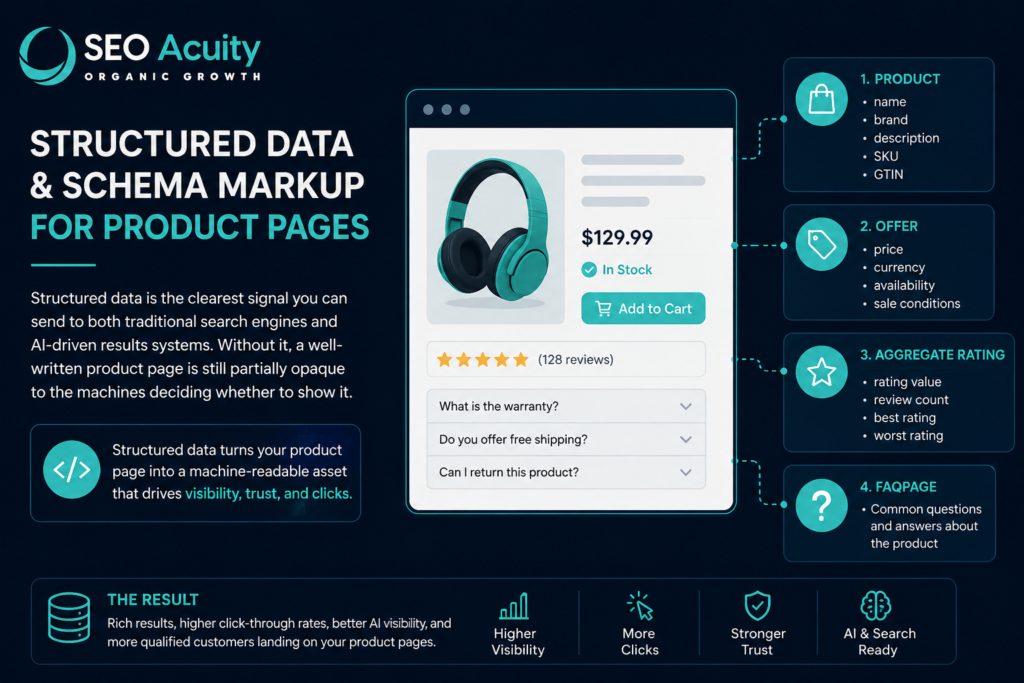
Structured data is the clearest signal you can send to both traditional search engines and AI-driven results systems. Without it, a well-written product page is still partially opaque to the machines deciding whether to show it.
1. The Four Schema Types Every Product Page Needs
The four schema types that matter most for ecommerce product pages are Product, Offer, Aggregate Rating, and FAQPage. Product schema declares what you’re selling — name, brand, description, SKU, GTIN. Offer schema specifies price, currency, availability, and sale conditions.
Aggregate Rating schema surfaces star ratings in search results, which consistently increases click-through rates against unrated results. FAQPage schema gives AI systems a clearly structured question-and-answer format to extract and cite.
All four should be implemented in JSON-LD format and validated with Google’s Rich Results Test before going live. After deployment, monitor schema integrity regularly — template updates, price changes, or missing review data can break rich results silently.
A practical note on Offer schema: if a product goes out of stock, remove the Offer property from the markup rather than leaving it with incorrect availability data. Incorrect schema can trigger manual actions in Google Search Console.
Book your consultation session now.
2. Breadcrumbs and Site Structure Signals
Breadcrumb navigation helps both visitors and search engines understand where a product page sits within the store hierarchy. Mark them up with BreadcrumbList schema. A poorly structured breadcrumb — “Home > Product Name” — fails to convey hierarchy.
A well-structured one — “Home > Backpacks > Hiking Backpacks > Women’s Hiking Backpacks > Osprey Kyte 46” — tells Google exactly how the product relates to every parent category, reinforcing topical relevance at each level.
AI Search Optimization for Product Pages
In 2026, Google’s AI Overviews, ChatGPT Shopping, and Perplexity surface product recommendations directly in their responses. A product page that ranks well in traditional search but lacks the structured signals AI systems require will miss a growing share of buyer intent. The goal is a page that works across both: ranked on Google, cited by AI.
AI systems don’t read product pages the way a human buyer does. They extract structured signals — schema fields, FAQ blocks, specification data, attribute completeness — and use those to decide which products to recommend.
A page with rich structured data and complete attribute coverage is far more likely to be cited than a page with well-written prose and nothing structured behind it.
Explore Our SEO Acuity’s Amazon SEO Services
The Three Signals AI Retrieval Rewards Most
Completeness matters first. AI systems prefer pages that answer purchase-intent questions fully: what is it made of, what problem does it solve, who is it for, what are the dimensions, is it in stock, what does it cost. Any attribute left blank is a gap in the signal.
Entity clarity matters second. Every key concept should be defined in one direct sentence — product name, brand, category, and use case — early on the page. AI retrieves chunks of content in isolation; each paragraph should be understandable when extracted without context.
FAQ structure matters third. The FAQ block is the highest-value section for AI retrieval. Each question should have a direct answer in the first sentence, use the key terms from the question inside the answer, and stay under four lines.
This format mirrors how AI Overviews and voice search pull answers — and a page with six well-constructed FAQs has six additional retrieval opportunities beyond the main body.
If you want to understand how to build an organic strategy that shows up in both AI search and traditional Google results at the same time, this step-by-step framework from SEO Acuity covers the integrated approach in detail.
Read Also: Organic Growth Strategy to Win AI Search and SEO SERP

Technical SEO Foundations for Product Pages
On-page content and structured data only work if the technical layer underneath them is sound. The most common product page SEO failures are technical — and they’re often invisible until a ranking drops.
Page Speed and Core Web Vitals
Page load time affects both rankings and revenue directly. A site that loads in one second converts at five times the rate of a site that loads in ten. For product pages specifically, the Core Web Vitals benchmarks to hit are: Largest Contentful Paint under 2.5 seconds, Cumulative Layout Shift below 0.1, and Interaction to Next Paint under 200 milliseconds.
The three changes that produce the largest speed improvements are: using a CDN to serve content from the nearest endpoint to each visitor, optimizing images (compress, resize, serve in WebP or JPG, lazy-load below-the-fold images), and minifying JavaScript and CSS while deferring non-critical scripts. In practice, these three account for the majority of page speed gains on most ecommerce platforms.
A common technical SEO mistake worth calling out: on large ecommerce migrations, old URLs get redirected — but internal navigation isn’t updated. The redirects work, but internal links still point to the old URLs, burning unnecessary crawl budgets and diluting link equity through an extra redirect hop. Always update internal links, not just redirects.
XML Sitemaps and Crawl Management
Create separate XML sitemaps for different content types: product pages, category pages, brand pages, and blog content. Submit each to Google Search Console separately so you can monitor indexing status by content type. Include only canonical URLs returning HTTP 200 status. Use the <lastmod> tag to signal recent updates — price changes, new reviews, updated availability — which prompts faster recrawling.
Keep each sitemap to 50,000 URLs. For very large catalogues, there’s evidence that keeping sitemaps smaller (around 10,000 URLs) and grouping newer content together improves indexing velocity, as search engines tend to prioritize crawling the freshest URLs in a sitemap.
Not sure which side of that gap you’re on? Get a free consultation and find out!
Handling Duplicate Variants and Canonical Tags
Product variants — same item, different colors, sizes, or finishes — are one of the most persistent sources of duplicate content in ecommerce.
Creating separate indexable pages for each variant only makes sense when two conditions are both true: there is meaningful search demand for the specific variant (e.g., “pink handheld fan”), and you have the resources to write genuinely unique product descriptions for each.
When those conditions aren’t met, pick a primary variant, set a self-referencing canonical URL on it, and point all other variant URLs to that canonical. This prevents the variant pages from competing against each other for the same queries and keeps ranking authority consolidated on one page.
The same logic applies to products that live in multiple category paths. A backpack that appears under hiking, sale, and mountain biking categories generates three different URLs for the same product. Canonicalize the non-primary URLs to the one you want to rank, and make sure that primary URL is the one in your XML sitemap and internal links.
Managing Discontinued and Orphaned Product Pages
Discontinued products are treated as a pure liability by most stores — they get deleted or 404’d without a second thought. That’s leaving real value behind. Product pages for discontinued items often carry inbound links from review sites, forums, and affiliate pages built up over years. Deleting those pages destroys that equity.
Handling The Discontinued Products
If the product is temporarily out of stock and expected to return: keep the page indexed, flag it as out of stock, remove the Offer property from schema, hide the price and add-to-cart functionality, show alternative products, and pause any PPC campaigns pointing to that URL.
If the product is permanently discontinued but has link equity or residual search demand, the approach depends on what’s available. If search demand is still for that specific model, a “What happened to [product]?” page that explains the discontinuation and recommends alternatives preserves the traffic and the link equity through a 301 redirect to the new page. If demand was for a more general query (brand + product type), redirect directly to the nearest current equivalent.
If the product has no links and negligible search demand, return a 410 (Gone) status code rather than a 404. It signals to Google that the removal is intentional, which speeds up de-indexing.
إزاي الـ CRO بيخلي الـ SEO يبيع فعلاً — الـ conversion path — الحلقة المفقودة في كل SEO strategy

Preventing Orphan Pages
Orphan pages are product pages with no internal links pointing to them. They exist in the index but not in the site’s navigational structure, which means Google treats them as low-priority — and sometimes de-indexes them entirely. On large catalogues with frequent product changes, orphan pages accumulate silently.
The fix requires a SEO audit: crawl your site and compare indexed product URLs against URLs that receive at least one internal link. Any indexed product page with zero internal links is an orphan. Add it to the relevant category page, feature it in a related products section, or redirect it to a live equivalent.
User-Generated Content, Reviews, and Trust Signals
Customer reviews contribute to product page SEO in two distinct ways. First, they add fresh, keyword-rich content to the page continuously over time — the kind of content Google reads as a freshness signal.
Second, they feed the Aggregate Rating schema that produces star ratings in search results. A product listing with a 4.7-star rating visible in the SERP will consistently outperform an otherwise identical listing without one.
Beyond reviews, trust signals reduce bounce rates — and lower bounce rates send positive engagement signals to search engines. Visitors who land on a product page and immediately see clear return policies, delivery guarantees, and payment security logos are less likely to leave without converting.
This matters not just for revenue but for the behavioral signals that influence rankings over time. The practical rule: earn the click with SEO, earn the conversion with trust signals.
Ready to Dominate Search Engine Rankings?
Accelerate your organic growth and scale your business leads with our data-driven SEO strategies.
Get a Free Quote NOW!SEO Acuity Builds Product Page SEO into an Organic Growth System
Most ecommerce stores treat product page SEO as a one-time checklist: optimize the title, add a description, move on. The stores that consistently grow organic revenue treat it as a system — one where keyword strategy, content depth, technical health, and structured data are all maintained and refined continuously.
At SEO Acuity, the approach starts with what matters most: identifying the 20% of product pages that drive 80% of revenue potential, and building a foundation that earns rankings, survives algorithm updates, and converts the traffic it generates.
That means keyword architecture that prevents cannibalization, technical SEO that search engines can actually crawl, and content that answers both buyer intent and AI retrieval signals.
The Bakkah case study illustrates what this looks like in practice. SEO Acuity worked with Bakkah’s educational platform to restructure their content architecture, align page-level keyword targeting, and implement structured data at scale. The result was a sustained increase in organic traffic that compounded over time — the kind of outcome that comes from treating SEO as a system rather than a campaign.
If you’re building an SEO strategy and wondering where technical gaps are costing you rankings, the most common technical SEO mistakes — and how to fix them — are worth understanding before investing further in content. Equally, if your pages rank but don’t convert, the connection between CRO and SEO is the piece most strategies miss entirely.
Start Your SEO / GEO / AEO Journey Today With a FREE Consultation

Ready to Dominate Search Engine Rankings?
Accelerate your organic growth and scale your business leads with our data-driven SEO strategies.
Get a Free Quote NOW!Conclusion
Product page SEO is not about ticking a list of optimization tasks. It’s about building pages that serve two audiences simultaneously: the search engine that decides whether to show the page, and the buyer who decides whether to convert on it. In 2026, a third audience has been added — AI systems that decide whether to recommend the product in a generated response.
The stores that win on all three fronts share the same practices: precise keyword targeting matched to transactional intent, original and attribute-rich product content, complete and validated schema markup, fast and mobile-optimized pages, and a clean internal architecture that keeps authority consolidated rather than diluted across duplicate URLs and orphaned pages.
Start with your highest-revenue products, build the technical foundation correctly, and expand systematically. Product pages that earn rankings don’t just drive traffic — they drive the kind of traffic that converts.
Frequently Asked Questions
What is product page SEO?
Product page SEO is the practice of optimizing ecommerce product detail pages to rank in search engine results and AI-driven discovery systems. It includes keyword targeting, structured data implementation, technical performance optimization, and content that matches transactional buyer intent.
How many keywords should a product page target?
Target one primary keyword and three to five supporting terms per product page. The primary keyword should match what a buyer searches when ready to purchase — not a broad informational query.
Does duplicate content hurt product page rankings?
Yes. When multiple pages use identical product descriptions — or when manufacturer copy is reproduced across multiple retailers — Google struggles to determine which page is the original. Rankings can drop across all affected pages.
What structured data types matter most for product pages?
The four most important schema types are Product, Offer, Aggregate Rating, and FAQPage. Product and Offer schema unlock rich results showing price and availability. Aggregate Rating schema displays star ratings in search results.
FAQ Page schema increases the likelihood of your page being cited in AI-generated answers by giving AI systems a structured question-and-answer format to extract.
How do AI search systems like ChatGPT and Google AI Overviews affect product pages?
AI systems extract structured signals rather than reading pages the way a human does. They prioritize attribute completeness, schema markup, FAQ content, and entity clarity.
A product page optimized only for traditional search may rank on Google but remain invisible in AI-driven results. The fix is the same: complete, well-structured product data with proper schema and a well-formed FAQ section.
What should I do with discontinued product pages?
If the product is temporarily out of stock, keep the page live but remove the Offer schema, hide the price and cart functionality, and show alternatives. If the product is permanently discontinued and the page has link equity or residual traffic, redirect it to the most relevant live equivalent via a 301 redirect. If there’s no traffic and no links, return a 410 status code to signal intentional removal to Google.