If you’ve searched “what is an SEO agency,” you’re not looking for a dictionary definition — you’re deciding whether to hand a stranger control over how your business gets found online, and you want to know what you’re actually paying for before you commit.
An SEO agency is a company that improves a business’s visibility in search engines and AI-powered answer engines by optimizing its website, content, and off-site authority, so it appears in front of people already searching for what it sells. Whether you’re searching for what is seo agency or what is a seo agency, the answer goes beyond rankings—it’s about building sustainable organic growth that supports real business results.
This guide covers what an SEO agency actually does, what it should cost, and how to separate a genuine strategic partner from a vendor selling you a keyword list.
What Is an SEO Agency?
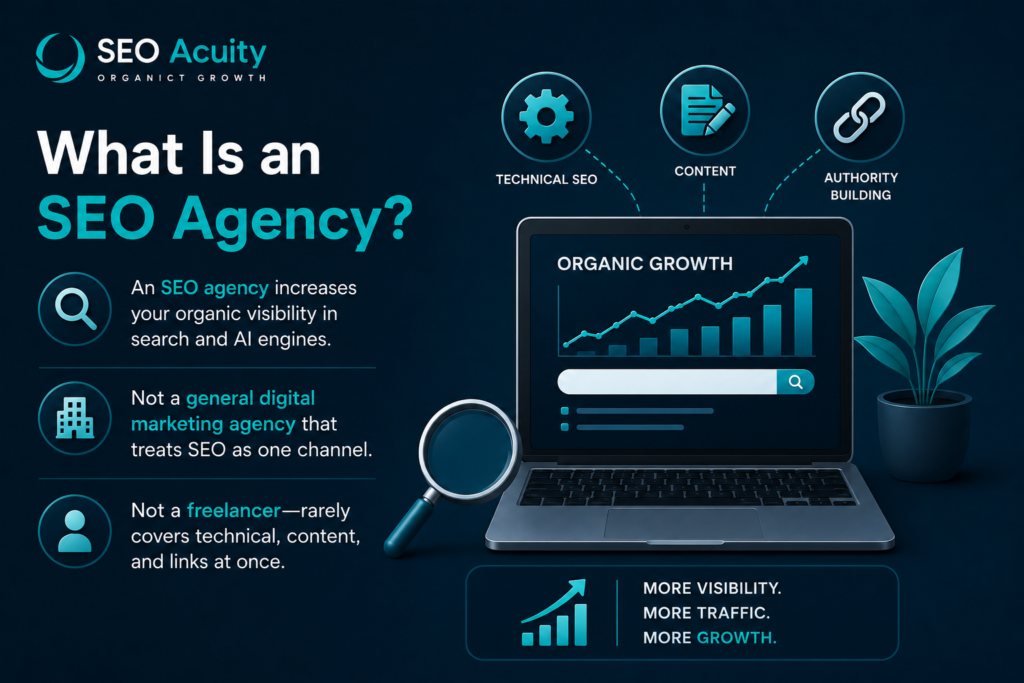
An SEO agency is a specialist company hired to increase a business’s organic — non-paid — visibility in search engines and AI answer engines, using technical, content, and authority-building work.
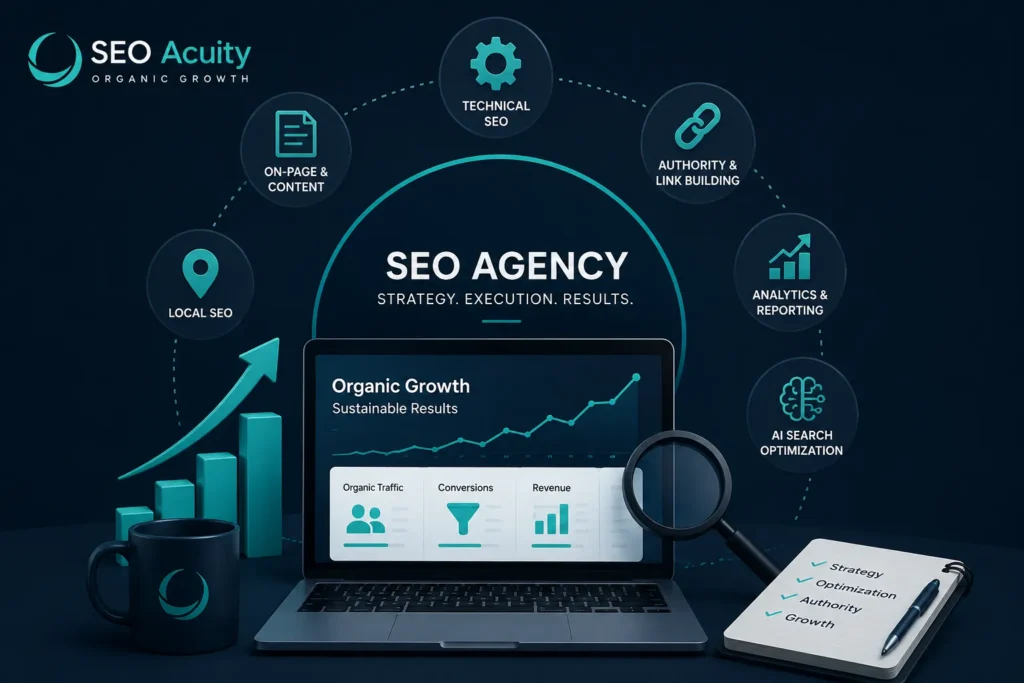
A professional SEO service agency provides end-to-end SEO agency services that combine technical SEO, content strategy, authority building, and performance reporting.
That’s distinct from a general digital marketing agency, which usually treats SEO as one channel among several — paid ads, social, email — rather than the core discipline. It’s also distinct from a single freelancer, who can execute a narrow task well but rarely covers technical SEO, content, and link-building at the depth a growing site needs simultaneously.
What Does an SEO Agency Actually Do?
An SEO agency operates across three connected layers: technical SEO, on-page content, and off-page authority — plus reporting that ties results back to the business.
Most SEO agency services include technical optimization, content planning, on-page improvements, link acquisition, analytics, and continuous strategy refinement.
1. Technical SEO Services
Technical SEO is the work that makes sure search engines and AI crawlers can actually read a site — covering site speed, mobile-friendliness, crawlability, indexation, schema markup, and Core Web Vitals.
2. On-Page SEO and Content
On-page SEO is the practice of building content and metadata around what people are actually searching for, based on keyword and search-intent research, rather than around internal product language.
3. Off-Page Authority
Off-page authority is the trust a business earns through backlinks, brand mentions, and PR — the signals that tell search engines, and increasingly AI models, that it’s credible in its category. This is also where E-E-A-T (experience, expertise, authoritativeness, trustworthiness) gets built — it’s earned off-page as much as it’s demonstrated on-page.
4. AI Search Optimization (GEO & AEO)
Search is rapidly evolving beyond traditional rankings. We optimize your website for AI-powered search platforms like ChatGPT, Perplexity, and Google AI Overviews by structuring content for retrieval, improving entity relationships, implementing schema markup, and creating answer-focused content that is more likely to be cited by AI systems.
5. Organic Growth Strategy
SEO is most effective when every optimization supports long-term business growth rather than short-term rankings. We build integrated organic growth strategies that combine technical SEO, content marketing, authority building, AI search optimization, and conversion optimization into a single system designed to generate qualified traffic, leads, and sustainable revenue.
6. SEO Analytics & Revenue Reporting
Our reporting goes beyond rankings and traffic by measuring qualified leads, conversions, customer acquisition, and revenue, giving you a clear understanding of the business impact and return on your SEO investment.
7. Link Building & Digital PR
Strong authority is built through trusted backlinks, digital PR, and brand mentions. Our strategies focus on earning high-quality links that improve domain authority, strengthen credibility, and support sustainable search performance.
8. Local SEO
Our local SEO strategies help businesses dominate local search results through Google Business Profile optimization, citation management, location pages, review optimization, and localized content that attracts nearby customers.
Read More About: Search Engine Optimization (SEO) Services
Ready to Dominate Search Engine Rankings?
Accelerate your organic growth and scale your business leads with our data-driven SEO strategies.
Get a Free Quote NOW!What Are The Missed Points That SEO Agency Fail in?
Most SEO agency failures aren’t a knowledge gap — they’re an execution gap. The strategy sounds right in the pitch; what gets built, measured, and owned afterward is where the gaps show up. Here’s where that happens most often, and what closing each gap actually requires.
1. Building for the site, not for search demand
A developer builds pages that make sense from a product perspective. An SEO strategist builds pages that make sense from a search-demand perspective. When SEO gets layered on after a site is already built, the result is predictable: pages exist for topics with no real search volume, while pages are missing for the keywords actually driving demand. Closing this gap means mapping demand and keyword-to-page fit before architecture is finalized — not auditing it in afterward.
2. Technical debt that stays invisible until it’s expensive
A site can look completely functional and still be unreadable to the systems that matter. Noindex tags left on commercial pages, JavaScript rendering that displays fine for a user but returns an empty page to a crawler, internal links that don’t route authority to commercial pages — none of these show up by looking at the site in a browser. They show up in flat rankings and thin AI citations months later, once the cause is harder to trace.
3. Strategy that stops before conversion
Rankings and traffic can climb while revenue stays flat. This happens when the conversion path — what a page asks for, how it qualifies the visitor, what it does with intent — gets treated as a post-launch detail instead of a structural part of the SEO build. A technically sound site that doesn’t sell isn’t a marketing problem; it’s an unfinished SEO engagement.
4. Reporting traffic instead of revenue
Sessions and impressions are easy to report and easy to make look good. An agency measured on traffic optimizes for traffic. Reporting organic revenue contribution, conversion rate from organic search, and qualified demand captured is what keeps the program honest — and what ties SEO back to the business result it was hired to produce.
5. Treating AI search readiness as an add-on
AI systems retrieve chunks of a page, not the page as a whole — so content written only to rank, not to stand independently in a single paragraph, tends to get skipped in AI-generated answers even when the page ranks well in Google. GEO and AEO aren’t a separate service to bolt on later; they’re what a properly structured SEO build already produces.
6. Running one playbook across every market
In multilingual or multi-region work, a translated strategy isn’t a localized one. Search behavior and commercial-intent query patterns differ by market — an agency applying the same strategy everywhere isn’t saving effort, it’s using the wrong model for at least some of the markets it’s charging for.
None of these require a bigger budget to fix — they require the strategy and the execution to be owned by the same architecture from the start, not split across disconnected phases. See how the Organic Growth Foundation™ is built to close these gaps before execution begins →
Why Do Businesses Hire an SEO Agency?
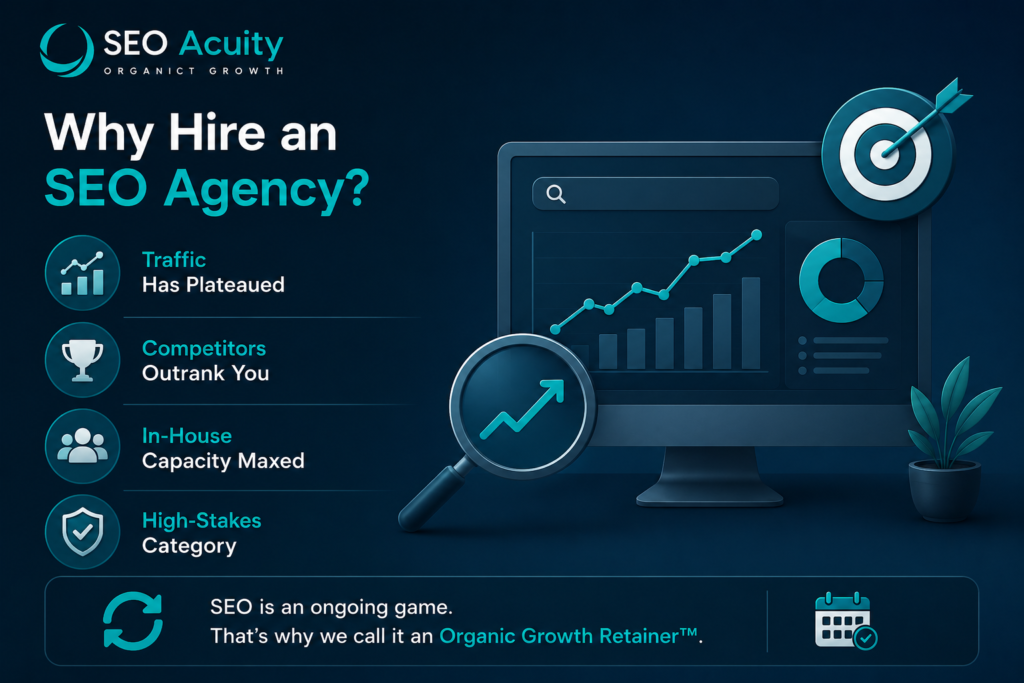
Search is where buying decisions start. Four signals typically drive the decision to hire:
- Traffic has plateaued despite consistent publishing — usually a technical or structural issue, not a content-volume one.
- Smaller competitors are outranking you — usually a technical and structural gap, not a budget gap.
- In-house capacity is maxed out — SEO is a full discipline that shifts constantly, not a side task for a generalist marketer.
- The category is high-stakes — financial services, healthcare, and other trust-sensitive niches live or die on E-E-A-T, where generic SEO doesn’t hold up.
Seeing two or more of these is a real signal to bring in outside expertise, rather than a reason to hire the first agency that pitches you.
Most agencies price this as an ongoing engagement — what SEO Acuity calls an Organic Growth Retainer™ — because SEO compounds over months, not a single project sprint.
The Difference Between SEO Execution and SEO Strategy
An execution-focused SEO vendor is hired to complete a defined scope of work—keyword research, content creation, link building, and reporting. Their approach is often similar across clients because the focus is on delivering tasks.
A modern SEO web agency or web SEO agency should focus on business outcomes rather than simply completing SEO tasks.
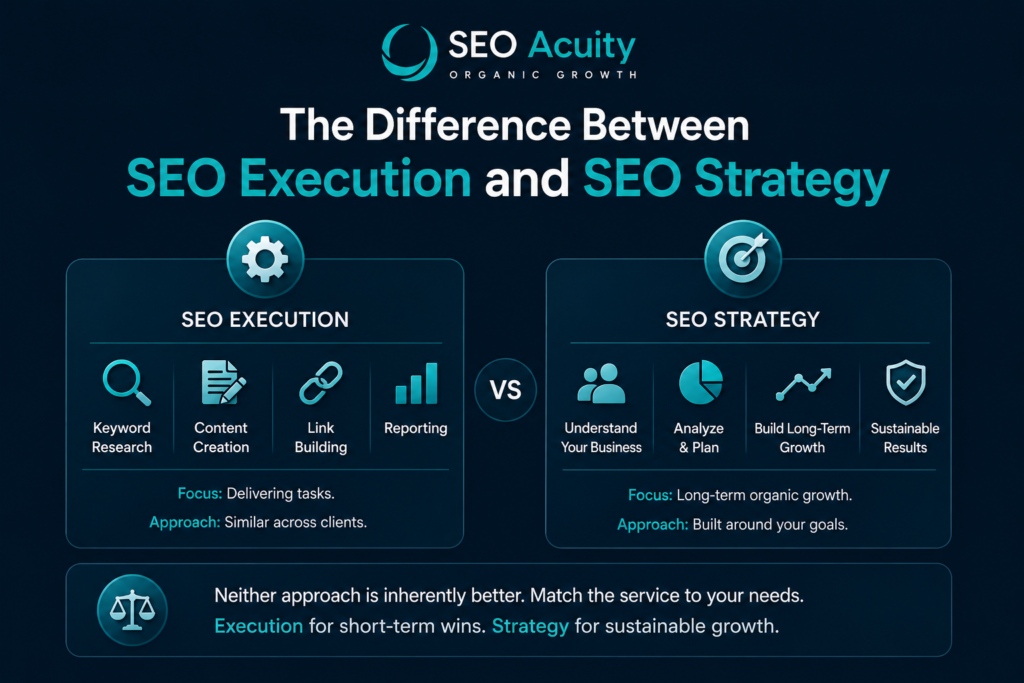
A strategic SEO partner starts with the business, not the tactics. They first seek to understand your goals, profit margins, sales cycle, and competitive landscape before recommending a strategy. Their objective is to build long-term organic growth, not just improve rankings for a handful of keywords.
Neither approach is inherently better. Businesses with short-term needs may only require execution, while companies focused on sustainable growth often benefit from a strategic partner. The key is making sure your expectations match the type of service you’re paying for.
How Much Does an SEO Agency Cost?
There’s no honest single number, and any agency quoting one before understanding your market is guessing. Three pricing models are standard:
- Retainer-based — an ongoing monthly engagement covering strategy, execution, and reporting; the standard model for businesses treating SEO as infrastructure rather than a project.
- Project-based — a fixed-scope engagement (an audit, a site migration, a content sprint) with a defined start and end.
- Performance-tied — pricing partly linked to agreed KPIs, shifting some of the risk onto the agency rather than entirely onto the client.
The lowest bid is rarely the cheapest option over 12 months — underpriced SEO usually means less experienced hands running a generic playbook, and rework that gets paid for twice.
A strategic engagement is typically structured for a minimum commitment window — usually six months or more — because organic growth compounds; it isn’t priced or delivered like a 30-day sprint.
Read also: Do AI and GEO / AEO Replace SEO?
How to Choose the Right SEO Agency?
Choosing the right SEO agency is about more than comparing prices or service lists. The best partner understands your business goals, builds a strategy around them, and sets realistic expectations for long-term growth. Here are the key qualities to look for when evaluating your options.
Reviewing an SEO agency website can reveal a great deal about the agency’s expertise, transparency, case studies, and overall strategic approach.
1. Look for a Discovery-First Approach
A reputable SEO agency takes time to understand your business model, goals, target audience, and budget before recommending a strategy. Tailored advice is usually a sign of a thoughtful, long-term approach.
2. Evaluate Their Strategic Thinking
The best agencies explain how your website, content, and search strategy will work together to support business growth—not just which keywords they’ll target or how many backlinks they’ll build.
3. Prioritize Business Outcomes
SEO should contribute to measurable business results, such as qualified leads, sales, or revenue. Rankings matter, but they are only valuable when they support your broader objectives.
4. Expect Realistic Timelines
Sustainable SEO takes time. Agencies that set realistic expectations are generally more trustworthy than those promising rapid first-page rankings or guaranteed results.
5. Check for Transparency
A reliable agency is clear about what is included, what isn’t, and where SEO may have limitations. Transparency builds stronger partnerships than unrealistic promises.
6. Consider Long-Term Fit
Choose an agency whose communication style, experience, and strategic approach align with your business goals. The right partnership should support growth over time, not just deliver short-term tasks.
This is the standard we hold ourselves to before we take on any client.
See how SEO Acuity evaluates fit →
Does AI Search Change What an SEO Agency Does?
Increasingly, “what is an SEO agency” is a question people ask an AI engine, not just Google — and understanding how that engine decides what to show is the clearest way to see why SEO hasn’t gone away.
AI search engines surface content through three stages. First, baseline model understanding — the content that shaped a model’s training data is disproportionately the same content that already ranked and earned authority in traditional search. Second, retrieval — when an AI engine pulls real-time web content to ground an answer, it’s reading from an index, favoring the same crawlability and structural clarity that technical SEO has always optimized for. Third, precision refinement — the engine weighs retrieved content by authority, recency, and structural completeness, which maps directly onto off-page signals: backlinks, brand mentions, and credible sourcing.
There’s no page two in this process: content is either retrieved into the answer, or it doesn’t exist for that query at all.
This doesn’t replace SEO — it raises the bar on the same fundamentals: clear definitions, clean structure, and real authority signals. An agency still writing keyword-stuffed content was already behind before AI search entered the picture; this just made the gap visible faster.
Read more: AI Search Optimization Services (GEO & AEO)
Ready to Dominate Search Engine Rankings?
Accelerate your organic growth and scale your business leads with our data-driven SEO strategies.
Get a Free Quote NOW!Common Mistakes Businesses Make When Hiring an SEO Agency
Many SEO problems begin long before any optimization work starts. Avoiding a few common mistakes during the hiring process can save both time and budget.
A. Ignoring Conflicts of Interest
If an agency already works with a direct competitor in the same niche and market, consider how that could affect your competitive advantage before signing a contract.
B. Delaying Access to Essential Data
An SEO agency needs access to tools such as Google Search Console, analytics, and your CMS from the beginning. Without that visibility, it’s difficult to build or validate an effective strategy.
C. Expecting One Tactic to Deliver Results
SEO is a combination of technical optimization, high-quality content, and authority building. Relying on a single tactic rarely produces sustainable organic growth.
D. Choosing Based on Price Alone
The lowest-priced proposal isn’t always the best value. Compare agencies based on their strategy, scope of work, experience, and expected outcomes—not just the cost.
Why Is SEO Acuity the Right SEO Agency to Choose?
SEO Acuity is an Organic Growth Architecture firm that builds strategy before execution. Every engagement starts with our Organic Growth Foundation™, aligning technical SEO, content, authority, AI search optimization, and site architecture into a unified growth system.
Unlike agencies that rely on generic SEO checklists, we develop customized strategies based on your industry, market, competitors, and business objectives. This ensures every optimization supports long-term organic growth while adapting to both traditional search engines and AI-powered search experiences.
Rather than focusing on rankings alone, we measure success through qualified traffic, leads, conversions, and revenue. With deep expertise across the GCC and MENA markets, transparent processes, and AI-ready SEO strategies built from day one, we help businesses achieve sustainable organic growth—not just temporary ranking improvements.
Start Your SEO / GEO / AEO Journey Today
Ready to Dominate Search Engine Rankings?
Accelerate your organic growth and scale your business leads with our data-driven SEO strategies.
Get a Free Quote NOW!Conclusion
Choosing an SEO agency isn’t just about finding someone to improve your rankings—it’s about selecting a partner that understands your business and can turn organic search into a long-term growth channel. The right agency combines technical expertise, strategic thinking, transparent communication, and a clear focus on business outcomes. Taking the time to evaluate your options carefully can save you from costly mistakes and help you build sustainable organic visibility for years to come.
Remember that SEO is an investment in long-term growth, not a quick fix. Sustainable results come from consistent optimization, high-quality content, and a strategy that evolves alongside your business and the search landscape. By choosing an agency that prioritizes your business objectives over short-term metrics, you’ll be in a stronger position to generate qualified traffic, attract more customers, and build a lasting competitive advantage.
Frequently Asked Questions
What is an SEO agency?
An SEO agency is a company that improves a business’s visibility in search engines and AI answer engines by optimizing its website, content, and off-site authority, so it appears when people search for what the business offers.
Is hiring an SEO agency worth it?
It’s worth it for businesses with an established product, a real marketing budget, and a search-driven customer journey — the return comes from compounding visibility that keeps producing traffic without ongoing ad spend. It’s a weaker fit for pre-revenue businesses or anyone expecting results within weeks.
Can I do SEO myself?
Basic SEO — fixing obvious technical errors, writing intent-matched content, claiming a Google Business Profile — is doable in-house, especially early on. It gets harder to sustain once technical audits, backlink strategy, and content need to run at scale alongside a full-time job.
How long does SEO take?
Meaningful movement typically starts within a few months, with results compounding over 6–12 months and beyond. Any promise of first-page rankings inside 30 days doesn’t reflect how organic search actually works.
Should I hire a freelancer or an agency?
A freelancer can work well for a narrow, well-defined task on a limited budget. An agency fits better once multiple disciplines — technical, content, authority-building — need to work together, with accountability if something breaks.
What’s the difference between an SEO agency and a digital marketing agency?
An SEO agency specializes specifically in organic search visibility. A digital marketing agency typically covers a broader mix of channels — paid ads, social, email — with SEO as one service among several rather than the core focus.