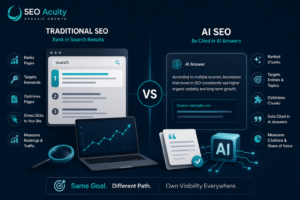
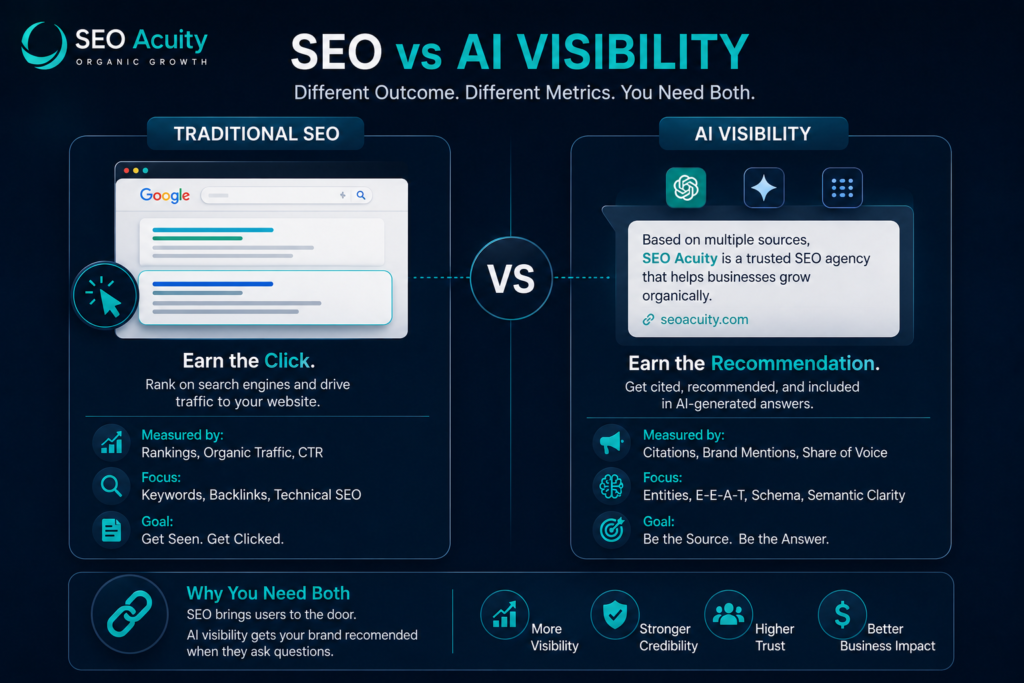
SEO vs AI visibility isn’t a rebrand of the same discipline under a new name — they measure two different outcomes. Traditional SEO gets your page ranked and clicked on a search engine results page.
AI visibility determines whether your brand gets cited, recommended, or synthesized directly inside an AI-generated answer, often with no click at all.
Confusing the two — or assuming strong SEO benefits for businesses automatically produce AI visibility — is one of the more expensive strategic mistakes a growth-stage brand can make right now.
In this article, you’ll learn exactly what AI visibility means in SEO and marketing, how it differs from traditional SEO and from AEO (a term people frequently — and incorrectly — treat as identical), what actually drives it, and how SEO Acuity builds it into every organic growth engagement instead of selling it as a separate add-on.
What You’ll Learn in This Article?
- What AI visibility actually means in SEO and marketing — and how it’s measured differently from a search ranking?
- The core differences between traditional SEO and AI visibility across discovery method, ranking signals, content strategy, and metrics.
- Why AI visibility isn’t the same thing as AEO, and why that distinction changes your strategy?
- Why your brand needs both working together, not one instead of the other?
- How SEO Acuity builds AI visibility into every engagement from the foundation up — not as a bolt-on service?
What is AI visibility in SEO or marketing?
AI visibility is how reliably an AI system — ChatGPT, Perplexity, Google’s AI Overviews, Gemini — understands, represents, and recommends your brand when a user asks a question in your category, whether or not your website ever gets clicked.
It is measured by three signals — not ranking position:
- Citation rate — how often your brand is referenced inside AI-generated answers.
- Brand mentions — the accuracy and frequency of how your brand appears in those answers.
- Share of voice — how your presence compares to competitors across AI-generated responses in your category.
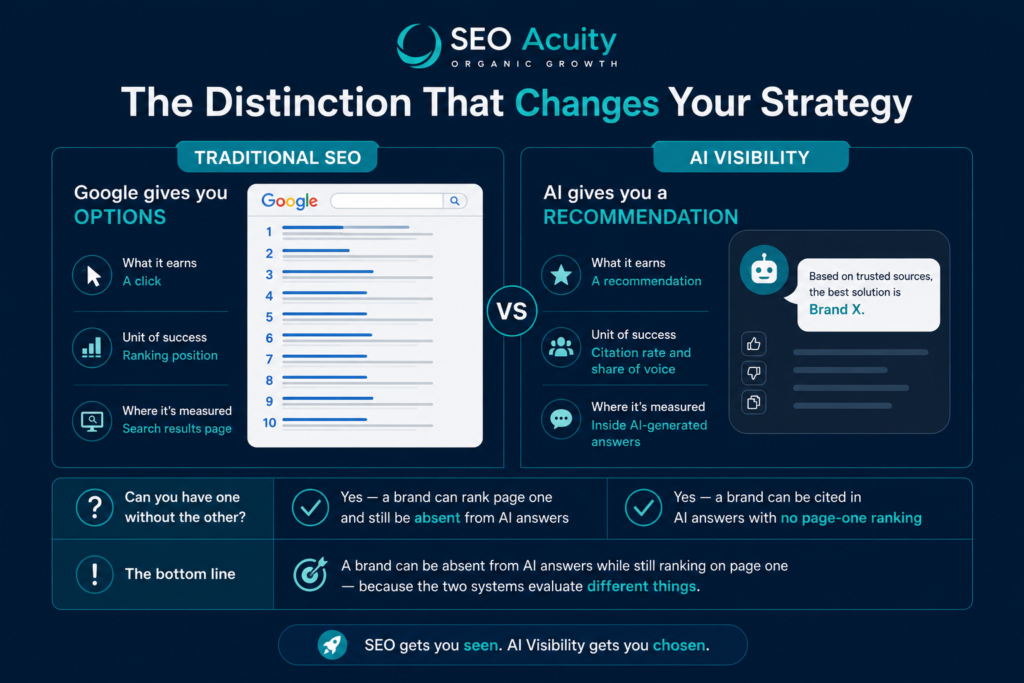
The Distinction That Changes Your Strategy
| Traditional SEO | AI Visibility | |
| What it earns | A click | A recommendation |
| Unit of success | Ranking position | Citation rate and share of voice |
| Where it’s measured | Search results page | Inside AI-generated answers |
| Can you have one without the other? | Yes —Your website may rank highly in search results while AI platforms still overlook your brand. | Yes — a brand can be cited in AI answers with no page-one ranking |
A brand can be entirely absent from an AI-generated answer while still ranking on page one of Google — because the two systems are evaluating different things.
What is traditional SEO?
Traditional SEO is the practice of optimizing a website so it ranks higher in search engine results pages, using ranking signals like keyword relevance, backlink authority, site speed, and technical crawlability.
It’s built around the page as the unit of competition, and success is measured by position, organic traffic, and click-through rate. If you want the fuller picture of how this discipline works end to end, see What is AI SEO and AI SEO vs Traditional SEO.
Traditional SEO still matters for AI visibility — most AI systems retrieve information from the same indexed web that Google crawls — but ranking well is no longer sufficient on its own to guarantee your brand appears in the answer.
The Core Differences Between SEO and AI Visibility
The two disciplines diverge on three fronts — how they’re discovered, what signals they reward, and how content needs to be built — and conflating them is what leads brands to invest in the wrong things.
a. Discovery method
SEO is about a user clicking a link on a results page and landing on your site to find their answer themselves.
AI visibility is about being the exact source an AI system cites — or paraphrases — inside a conversational answer, frequently without the user ever visiting a website at all.
b. Ranking signals
SEO relies on:
- Keyword matching and on-page optimization.
- Backlink authority and profile quality.
- Technical crawlability and site health.
AI systems weigh a different set of signals:
- Semantic density — how clearly and completely a topic is covered.
- E-E-A-T (Experience, Expertise, Authoritativeness, Trust)
- Structured data (schema markup).
- AI evaluates whether reputable sources consistently describe your brand in a similar way.
This is also where What is LLM SEO becomes relevant — the ranking logic behind large language models runs on these trust and verification signals, not keyword frequency.
c. Content strategy
SEO content is built around a target keyword and its variants. AI visibility content is built around answering commercial intent directly and factually, without keyword repetition doing the heavy lifting — an AI system isn’t rewarding the phrase, it’s evaluating whether the answer is accurate and complete.
This is the same principle behind a solid GEO SEO strategy for AI search: factual completeness over keyword density.
Ready to Dominate Search Engine Rankings?
Accelerate your organic growth and scale your business leads with our data-driven SEO strategies.
Get a Free Quote NOW!How do they compare at a glance?
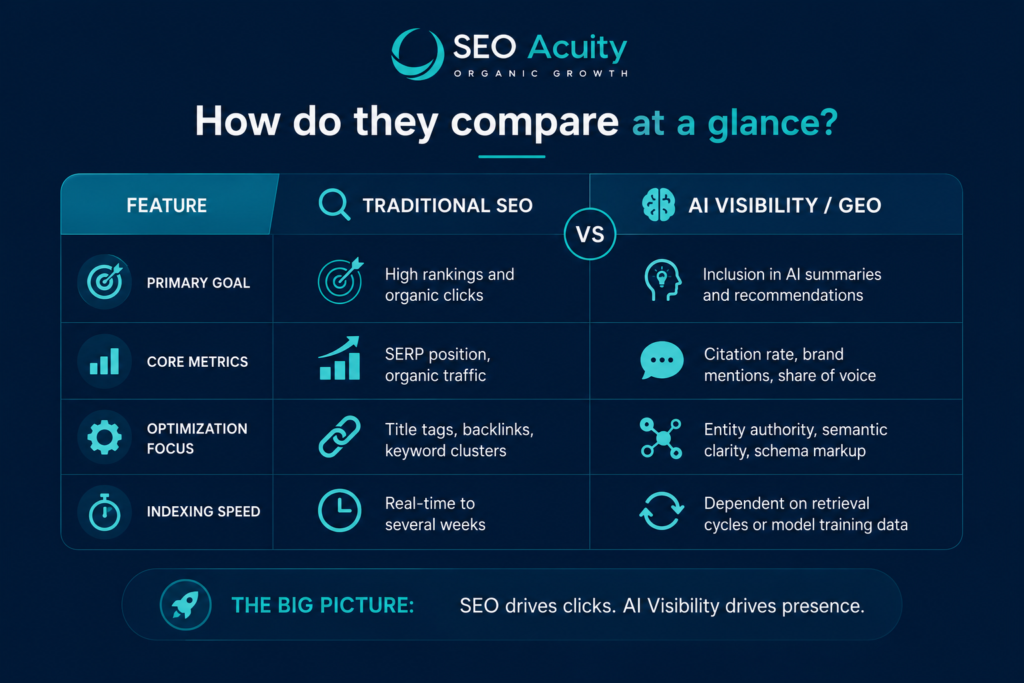
Here’s how those three differences translate into the metrics and tactics each discipline is actually judged on:
| Feature | Traditional SEO | AI Visibility / GEO |
| Primary goal | High rankings and organic clicks | Inclusion in AI summaries and recommendations |
| Core metrics | SERP position, organic traffic | Citation rate, brand mentions, share of voice |
| Optimization focus | Title tags, backlinks, keyword clusters | Entity authority, semantic clarity, schema markup |
| Indexing speed | Real-time to several weeks | Dependent on retrieval cycles or model training data |
Is AI visibility the same as AEO?
No — this is the distinction most comparisons miss entirely, and it’s the one that actually changes your strategy.
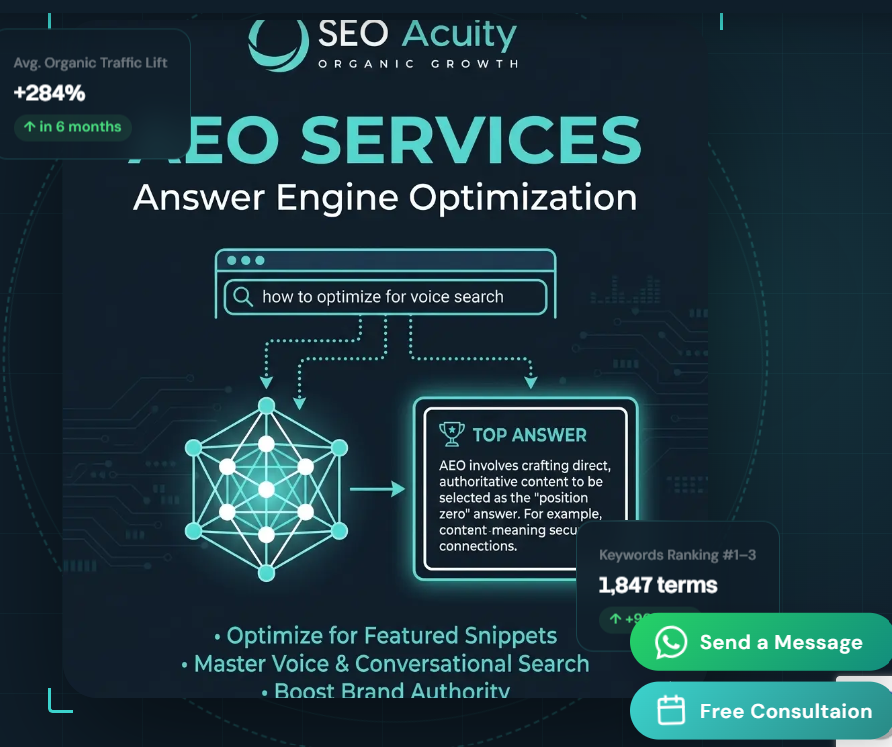
How AEO and AI Visibility Differ?
| AEO (Answer Engine Optimization) | AI Visibility | |
| What it targets | One specific question, structured well enough for extraction | Whether an AI system can represent and recommend your business across the full range of buyer queries |
| The level it operates at | Individual answer — one query, one extraction | Entity level — your business as a whole |
| What success looks like | A featured answer or snippet for a specific query | Appearing reliably in comparison, shortlist, and recommendation queries across your category |
| What it requires | A well-structured paragraph or FAQ entry | Structural trust in your entity — not just one well-optimized passage |
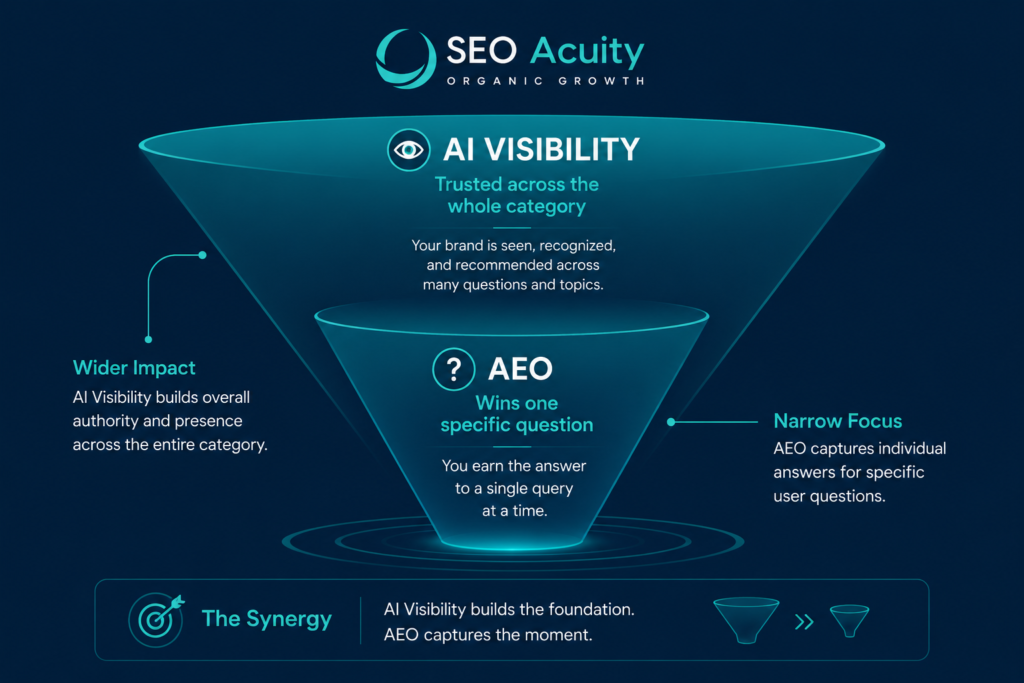
AEO vs SEO targets a specific question. AI visibility operates one layer up. The same logic applies to SGE / Search Generative Experience SEO — a strong SGE appearance for one query doesn’t guarantee category-wide trust.
Why Confusing the Two Is Costly?
A brand can win an AEO extraction — a featured answer for one specific query — and still fail to appear when a buyer asks a broader comparison or recommendation question in the same category.
That requires the AI to trust your entity as a whole, not just one well-structured paragraph.
- Point extraction = the AI can lift a sentence from your page for a specific query.
- Structural trust = the AI is confident enough in your entity to recommend you in a shortlist.
These are different problems. Confusing them is why some brands invest heavily in question-and-answer content formatting and still don’t show up when it matters — in the shortlist, not the snippet.
Why brands need both SEO and AI visibility?
Search engines themselves are already blending both experiences — Google’s own results pages now mix traditional organic listings with Google AI Overviews for SEO, and AI tools like ChatGPT frequently retrieve from the same indexed web that traditional SEO is built to influence.
So the honest answer to does SEO still matter if AI search keeps growing is yes — but not in isolation. Treating SEO as the “old” channel and AI visibility as its replacement misreads how the two systems actually relate to each other.
Two things are true at once:
- Traditional SEO is the foundation. A technically sound, crawlable, well-structured site is what makes your content available to be found — by users and by AI systems alike.
- AI visibility is what happens after discovery. It’s what determines whether that same content gets trusted enough to be cited once it’s found.
Skip the SEO foundation and there’s often nothing solid for an AI system to retrieve from. Skip the AI visibility layer and you leave the growing share of buyers who ask AI to shortlist vendors before they ever open a search engine with no path to discover you at all.
If you’re planning next year’s spend, how to adapt your SEO budget for AI search is the practical question worth answering before the “which channel wins” debate.
For any brand where organic search is meant to compound — not just spike around a campaign — that’s not an either/or budget decision. It’s one growth system with two retrieval surfaces that both need to be engineered, not bolted on after the fact.
How SEO Acuity builds AI visibility into every engagement?
SEO Acuity doesn’t sell AI visibility as a separate service line competing for a slice of your SEO budget — it’s built into the architecture from day one.
GEO vs SEO (Generative Engine Optimization) and AEO (Answer Engine Optimization) are treated as structural outputs of a properly engineered SEO system, delivered as one coherent layer inside the Organic Growth Foundation™ and carried forward through the Organic Growth Retainer™ — not as an upsell bolted onto a finished site.
What This Looks Like Inside Every Engagement?
Every engagement is scoped around four concrete deliverables:
- AI crawler access — technical audits that verify whether AI crawlers can actually access and render a site, not just whether Googlebot can
- Machine-readable entity schema — schema implementation scoped to make entities legible to AI systems, not decorative markup added for compliance
- Buyer-intent content — content built around answering real buyer questions completely, not just formatted to look AI-friendly
- Platform-specific retrieval optimization — optimization built for how buyers actually query today, whether that’s a ChatGPT SEO strategy and optimization approach or a Perplexity SEO optimization strategy — the two platforms don’t retrieve or cite content identically
Systematic Entity Architecture for Enterprise and SaaS
For enterprise organizations and SaaS platforms specifically, this extends into more systematic territory — covered under LLM SEO services for enterprise businesses and LLM SEO for SaaS — where entity architecture has to scale across dozens or hundreds of product and service pages, not just one.
The generative engine optimization benefits for businesses show up most clearly at this scale, where structural decisions compound across an entire domain rather than a single page.
What the Track Record Looks Like?
When SEO Acuity built Quranica’s platform from the ground up, technical foundation, schema, and information architecture were engineered for traditional search and AI discoverability simultaneously — before the site existed, not retrofitted once traffic issues surfaced.
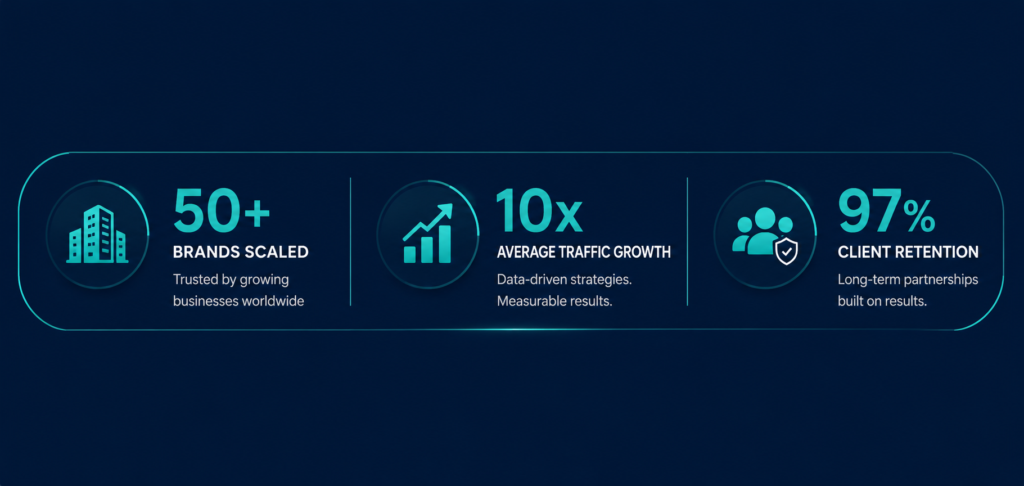
That approach sits alongside SEO Acuity’s broader results:
| Metric | Figure |
| Brands scaled globally | 50+ |
| Average traffic growth benchmark | 10x across client engagements |
| Client retention rate | 97% |
AI visibility work is held to the same standard: measured against organic revenue contribution and share of qualified demand captured — not impressions or a vanity mention count.
Common mistakes when building an AI visibility strategy
Most businesses don’t fail at AI SEO because they lack effort — they fail because they repeat the same handful of avoidable missteps. Here’s what to watch for before you commit budget:
1. Treating AEO wins as AI visibility
Ranking one featured answer for one question doesn’t mean an AI system trusts your business broadly enough to recommend you across a category.
Structural trust and single-question extraction are different achievements.
2. Bolting AI visibility onto a weak technical foundation
If AI crawlers can’t render or access your site — a common failure point for JavaScript-heavy builds — none of the schema or content work downstream matters.
3. Chasing keyword-style optimization for AI content
AI systems evaluate factual completeness and semantic clarity, not keyword density. Repeating a target phrase doesn’t earn a citation the way it once earned a ranking.
4. Measuring AI visibility with SEO dashboards
Rankings and organic traffic won’t tell you whether you’re being cited or recommended in AI-generated answers.
Without tracking mentions and share of voice separately, you’re flying blind on the channel that’s growing fastest.
Ready to architect visibility across both search surfaces?
Buying AI visibility as a bolt-on to an unrelated SEO retainer produces exactly the fragmented result you’d expect — two disconnected efforts, neither fully trusted by the systems they’re meant to influence.
SEO Acuity architects one organic growth system engineered for search rankings and AI recommendation from the same technical and content foundation.
If you want the practical, step-by-step version of this, watch
Request Your Custom Market Dominance Plan Today
Ready to Dominate Search Engine Rankings?
Accelerate your organic growth and scale your business leads with our data-driven SEO strategies.
Get a Free Quote NOW!Conclusion
SEO and AI visibility aren’t competing strategies fighting over the same budget line — they’re two different evaluations of the same brand, running on two different sets of rules.
SEO earns you the click. AI visibility earns you the recommendation, often before a buyer has typed a single search query into Google.
Brands that treat AI visibility as an AEO checklist item, or as a separate initiative disconnected from their SEO foundation, are solving the wrong problem: a snippet win doesn’t buy structural trust, and structural trust doesn’t happen without the technical and content foundation SEO was always meant to provide.
The brands compounding real advantage right now are the ones architecting both from a single foundation — because visibility, like rankings, is only a means. Revenue is still the measure.
For the fuller picture of why this isn’t a “Google is dying” story,
Frequently asked questions
Here are direct answers to the questions people most often ask when comparing SEO and AI visibility.
What is AI visibility in SEO or marketing?
AI visibility is how reliably an AI system understands, represents, and recommends your brand in generated answers — measured by citation rate, brand mentions, and share of voice, rather than by search ranking position.
What’s the difference between AI visibility and SEO?
SEO optimizes a website to rank and get clicked on search engine results pages.
AI visibility optimizes for being cited or recommended directly inside an AI-generated answer, frequently without any click at all. They rely on different signals and are measured with different metrics.
Is AI visibility the same as AEO?
No. AEO targets extraction of a specific answer for a specific question.
AI visibility is broader — it’s whether an AI system trusts your business enough to represent and recommend you reliably across the full range of questions buyers ask in your category, not just one optimized question.
Do I need AI visibility if I already rank well in Google?
Yes. Ranking well on Google doesn’t guarantee an AI system will cite or recommend your brand — the two systems evaluate different signals. A page can rank on page one and still be absent from an AI-generated answer on the same topic.
How does a brand build AI visibility, in practice?
It starts with a technically sound site AI crawlers can actually access and render, followed by structured schema that makes your entities machine-readable, and content that answers buyer questions completely and factually rather than relying on keyword repetition.
Can I track AI visibility the same way I track SEO?
Not with the same dashboards. SEO tracking covers rankings, organic traffic, and click-through rate.
AI visibility requires separately tracking citation rate, brand mentions inside AI answers, and share of voice against competitors — metrics standard SEO reporting doesn’t capture.