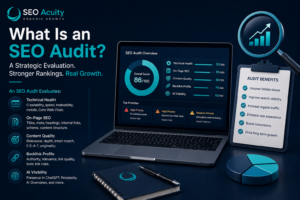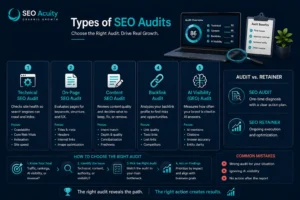
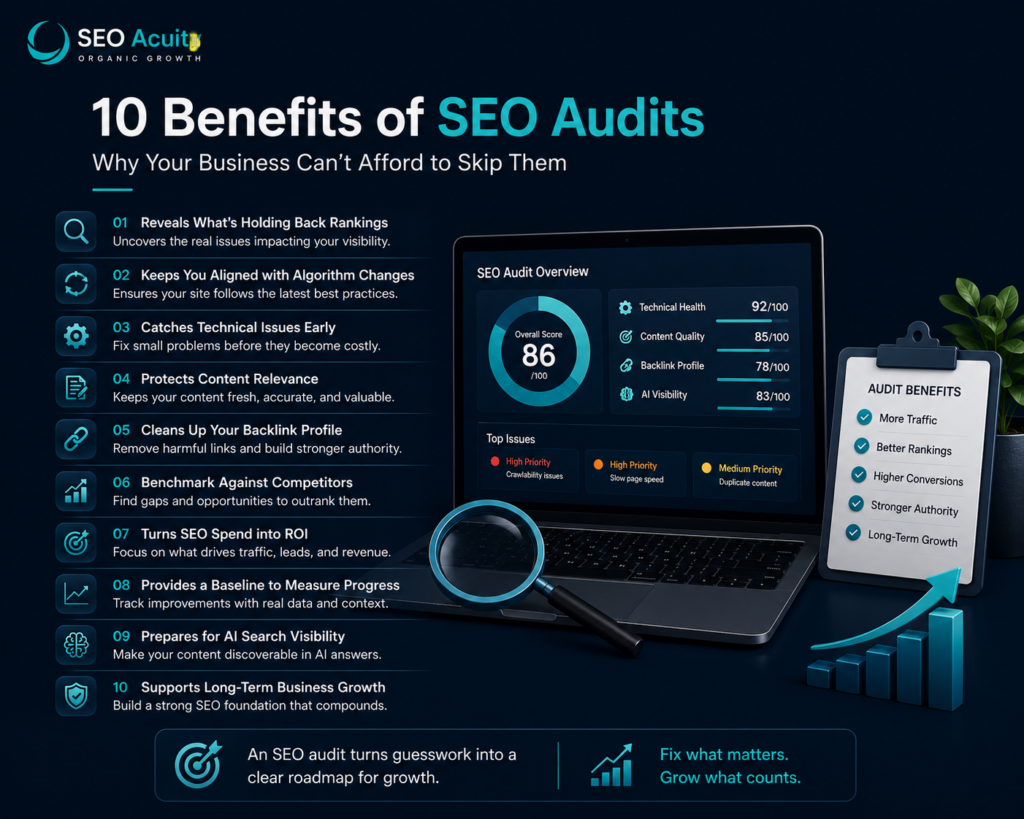
An SEO audit is a structured diagnostic of your website’s technical health, content quality, and off-page authority — and it’s the single most reliable way to know whether your site is actually working for you or quietly working against you. Businesses that skip regular audits aren’t avoiding SEO work; they’re just doing it blind, guessing at fixes instead of prioritizing them by revenue impact.
Below are ten specific, concrete reasons a regular SEO audit matters — not as a compliance exercise, but as a growth decision.
At SEO Acuity we deliver SEO Audit services that genuinely retrieve your website visibilit and ranking. View our Audit services
.
1. It reveals exactly what’s blocking your rankings
An SEO audit’s core function is diagnostic clarity: it tells you precisely which of the many ranking factors — technical, content, or off-page — are actively suppressing your visibility, instead of leaving you to guess.
Most businesses without an audit are making SEO decisions on instinct: publishing more content, tweaking a title tag, hoping something moves the needle. An audit replaces that guesswork with a prioritized list of specific, fixable issues, ranked by how much they’re actually costing you. That’s the difference between “doing SEO” and having a strategy.
2. It keeps you aligned with algorithm and guideline changes
Search engines update their ranking systems continuously, and an SEO audit is how you confirm your site still matches what’s currently being rewarded rather than what worked years ago.
Practices like keyword density and exact-match domains have lost their weight; E-E-A-T (experience, expertise, authoritativeness, trustworthiness) and Core Web Vitals now carry far more of it. A site built to older standards doesn’t fail dramatically — it just quietly falls behind competitors who’ve kept pace. An audit catches that drift before it shows up as a ranking drop.
3. It catches technical issues before they compound
Technical SEO problems — broken links, crawl errors, slow load times, indexing gaps — get more expensive to fix the longer they go unnoticed, because they compound as your site grows.
A single broken redirect might cost you one page’s ranking today. Left unaddressed for a year, it can multiply across every page that inherited that link structure, and by the time it shows up in your traffic numbers, the fix is far more involved than it would have been at month one. An audit surfaces these issues while they’re still small and isolated.
4. It protects your content’s relevance over time
Content that ranked well two years ago can become a liability if it’s never revisited, because search engines increasingly reward freshness, depth, and demonstrated expertise over static, aging pages.
An audit assesses whether your existing content still answers the query it targets, still reflects current facts, and still holds up against newer, more thorough competitor pages. This isn’t about publishing more — it’s about knowing which existing pages need updating, which need consolidating, and which are actively holding your site back.
At SEO Acuity, we treat content refresh as an architecture decision, not a publishing habit — knowing exactly which pages to update, merge, or retire before they quietly cost you rankings.
Don’t let yesterday’s content decide today’s rankings — let’s find out what’s aging and fix it.

Ready to Dominate Search Engine Rankings?
Accelerate your organic growth and scale your business leads with our data-driven SEO strategies.
Get a Free Quote NOW!5. It cleans up your backlink profile
Your backlink profile is a factor search engines actively evaluate, and an audit is the mechanism for identifying which links are strengthening your authority and which are quietly damaging it.
Low-quality or spammy backlinks can suppress rankings even while your on-page work is excellent. An audit surfaces these so you can disavow or address them, while also identifying where competitors are earning authority you currently aren’t — turning off-page SEO from a passive metric into an active strategy.
6. It shows you where you stand against competitors
An SEO audit doesn’t just evaluate your own site in isolation — it benchmarks your keyword rankings, content depth, and backlink profile against the competitors actually contesting your market.
This matters because “improving” in a vacuum isn’t the goal — outperforming the sites your customers are choosing instead of you is. Competitor analysis inside an audit tells you which gaps in their strategy are worth capitalizing on, and which of their strengths you genuinely need to match before you can compete for the same rankings.
7. It turns SEO spend into a measurable investment
An audit connects SEO activity directly to business outcomes by prioritizing fixes according to their likely impact on qualified traffic and revenue, not just technical correctness.
Without that prioritization, it’s easy to spend weeks fixing low-impact issues — a missing alt tag here, a meta description there — while the fault actually suppressing your rankings sits untouched further down an unranked list. An audit is what makes SEO defensible as a line item: every fix is tied to a reason, and every reason is tied to an outcome.
8. It gives you a baseline to actually measure progress
An audit establishes the “before” picture your future results get measured against — without one, you have no reliable way to prove whether your SEO efforts are actually working.
If you don’t know your starting rankings, traffic levels, and technical health, later improvements are impossible to attribute with confidence. This matters whether you’re managing SEO in-house or evaluating an agency: the initial audit is what lets you hold any subsequent work accountable to a real number, not a vague sense that “things seem better.”
9. It prepares your site to be retrieved by AI search, not just ranked by Google
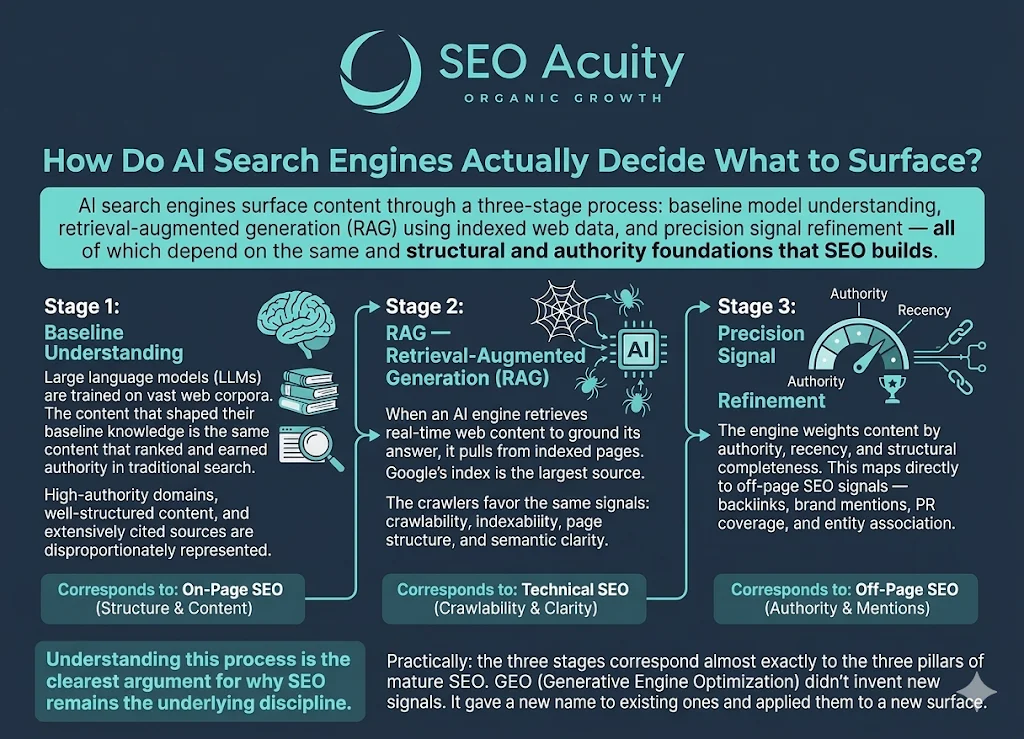
A modern SEO audit has to evaluate whether your content is structurally retrievable by AI systems, because tools like ChatGPT, Perplexity, and Google’s AI Overviews don’t rank your page — they break it into chunks and pull only the clearest, most self-contained pieces.
A page can pass every traditional technical check — fast load time, clean sitemap, solid backlinks — and still be functionally invisible in AI search if its key ideas are buried in vague, scattered paragraphs an AI system can’t extract cleanly. This is the audit layer most agencies still skip entirely, and it’s quickly becoming the one that determines whether you exist in AI-generated answers at all.
10. It prevents redesigns and migrations from silently breaking your SEO
A pre- and post-launch audit is the safeguard against the single most common cause of sudden ranking collapse: a redesign, replatform, or migration that unintentionally breaks URL structures, redirects, or indexation.
Businesses regularly rebuild their websites for good reasons — better UX, new branding, a platform switch — and lose months of ranking equity in the process, not because the new site is worse, but because nobody audited what the old site was doing right before it changed. An audit run before and after a major site change is what protects the SEO value you’ve already built.
If any of these ten reasons sound like a gap in your current strategy, that gap is exactly what a proper audit is built to close — and closing it is the first real step toward treating SEO as an architecture, not an afterthought.
An audit alone won’t move your rankings — acting on its findings will. But you can’t prioritize what you haven’t diagnosed. If it’s been more than six months since your last audit, or you’ve never had one, that’s the starting point.
Ready to Dominate Search Engine Rankings?
Accelerate your organic growth and scale your business leads with our data-driven SEO strategies.
Get a Free Quote NOW!Your Website Isn’t Broken. It’s Just Never Been Diagnosed.
At SEO Acuity, this is exactly the kind of diagnostic work we build every engagement around — not a checklist run to produce a report, but a structured audit that connects technical health, content quality, and AI-search readiness back to what actually moves revenue. We’re an Organic Growth Architecture firm, not an execution vendor, which means the audit isn’t the deliverable — it’s the groundwork for a defensible strategy that compounds over time.
Stop guessing what’s broken. Let’s find out — and fix what’s actually costing you customers!

Ready to Dominate Search Engine Rankings?
Accelerate your organic growth and scale your business leads with our data-driven SEO strategies.
Get a Free Quote NOW!Conclusion
Every benefit above traces back to one thing: an audit replaces assumption with evidence. Blocked rankings, aging content, an unmanaged backlink profile, a competitor pulling ahead, content AI systems never retrieve — none of these are strategy problems. They’re visibility problems, and they compound the longer they go undiagnosed. Treating the audit as a recurring discipline, not a one-time report, is what lets a business catch these issues while they’re still cheap to fix — and what turns SEO spend into a measurable, revenue-connected investment instead of a guess.
At SEO Acuity, this is exactly the kind of diagnostic work every engagement starts with — not a checklist run to produce a report, but a structured audit that connects technical health, content, and AI-retrieval readiness back to what actually grows revenue.
Your competitors are optimizing for last year’s algorithm. Let’s find out what yours is missing — and build what actually dominates next.
Book your company’s free session now!

FAQs
Why are SEO audits important?
SEO audits are important because they replace guesswork with a prioritized, revenue-connected view of exactly what’s blocking your rankings — across technical health, content, backlinks, and AI-search readiness.
What is the single biggest benefit of an SEO audit?
The biggest benefit is diagnostic clarity: knowing precisely which issues are suppressing your rankings and which fixes will actually move traffic and revenue, instead of guessing at improvements.
Do SEO audits actually improve rankings?
An audit itself doesn’t move rankings — implementing its findings does. What the audit provides is the prioritized roadmap that makes those fixes targeted instead of scattered.
How often should you get an SEO audit?
Most businesses benefit from a full audit every 6–12 months, with more frequent check-ins for fast-growing or high-traffic sites where issues compound faster and cost more to leave unaddressed.
Is an SEO audit worth it for a small business?
Yes — an audit is a low-risk way to confirm whether your current SEO efforts are working before committing further budget, regardless of business size.