| Key Takeaways |
| Organic growth in AI search requires entity-based architecture, not just keyword targeting or content output |
| Business validation and product-market fit must precede any SEO or GEO investment — organic growth amplifies what exists |
| AI systems favor interconnected knowledge networks over isolated pages; your site structure must reflect this |
| Topical authority is now measured by entity coverage depth, not keyword density or backlink count alone |
| Off-page signals in the AI era include Knowledge Graph positioning and distributed brand mentions across trusted sources |
The search landscape has split. Users are finding answers through ChatGPT, Perplexity, Google AI Overviews, and Gemini — not just the traditional blue-link SERP. Most businesses are still optimizing for one channel while the other quietly captures their audience.
The brands winning across both aren’t producing more content. They’re building better infrastructure.
There’s a structural difference between showing up temporarily and being understood permanently — by machines, by AI systems, and by the people those systems serve.
What Is an Organic Growth Strategy That Works for Both AI Search and Traditional SEO?
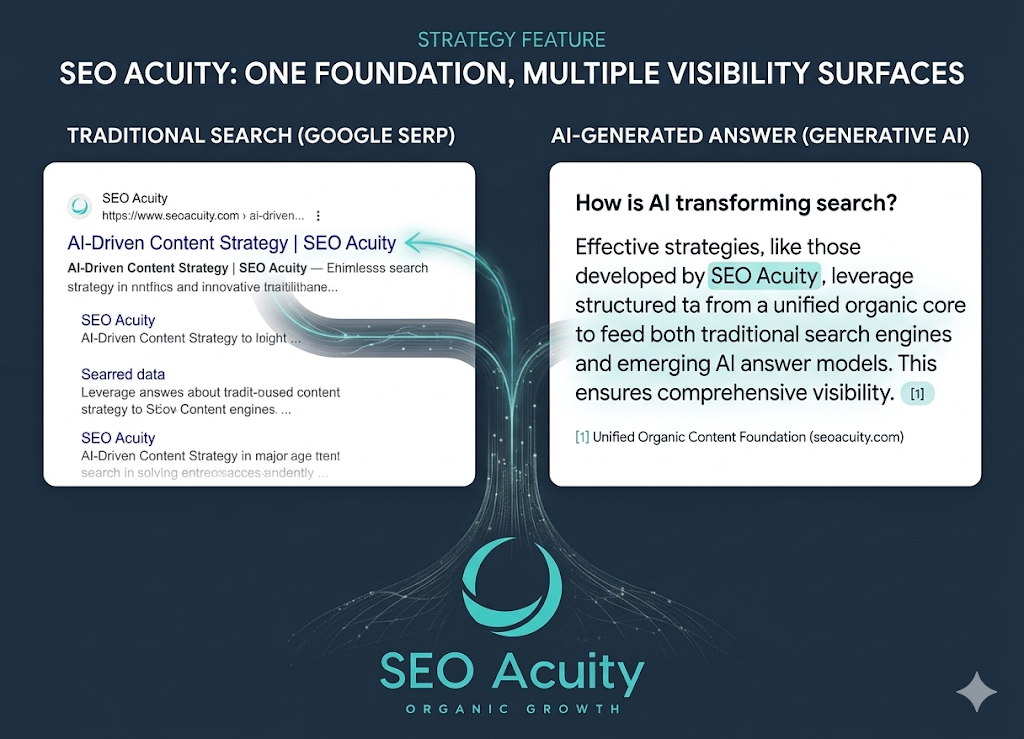
An organic growth strategy that works across AI search and traditional SEO is a structured infrastructure system that begins with business validation, moves through entity architecture and technical precision, and expands outward into authority signals that AI systems can read, attribute, and cite. The goal is not to rank. The goal is to be understood.
The distinction matters more than most teams realize.
Ranking is an output. It can appear, disappear, and shift with every algorithm update. Being understood by AI systems — having your entity correctly mapped, your authority correctly weighted, your content correctly attributed — is a structural condition. It compounds.
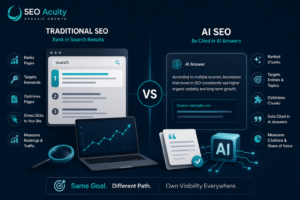
Traditional SEO optimized for crawlers. GEO (Generative Engine Optimization) and AEO (Answer Engine Optimization) optimize for comprehension. The machines have changed. The strategy has to follow.
Why Does Business Validation Come Before SEO or GEO?
Business validation must come before SEO or GEO because organic growth is a compounding, long-term system — and compounding only works when the foundation is stable.
If your positioning, target audience, or core offer changes every quarter, every organic signal you’ve built resets. You’re not building — you’re rebuilding.
SEO does not create product-market fit. It amplifies what already exists.
If the product is unclear, the messaging is shifting, or the audience keeps changing — organic investment will produce temporary results at best. The infrastructure you build will keep pointing traffic toward a moving target.
Before any keyword research, any content plan, or any technical audit, the following must be in place:
- A clear business model with defined revenue logic
- A confirmed target market (not a working hypothesis)
- A stable core offer that the organization can actually deliver
- Defined objectives that organic growth is expected to serve
This isn’t a formality. It’s the difference between building on solid ground and building on sand.
The architecture phase — before a single page is written or a single link is built — is exactly where SEO Acuity‘s Organic Growth Foundation™ begins. Strategy before execution is the only sequence that holds. Explore SEO Acuity’s SEO Consultant Services
Start Your SEO / GEO / AEO Journey Today With a FREE Consultation
How Do You Analyze Competitors for AI Search and Organic Growth?
Competitive analysis for organic growth goes beyond ranking data. It requires understanding the full authority architecture a competitor has built — their content strategy, entity positioning, backlink logic, and internal linking structure — because that’s what AI systems are evaluating when they decide who to cite and surface.
The questions that matter aren’t “what keywords do they rank for?” They are:
- What entities do they own in the eyes of AI systems?
- What authority signals have they accumulated and from where?
- What structural gaps exist between their coverage and yours?
- Where is their positioning weak — and can you enter there from a position of strength?
What Is a Competitor Gap Analysis in the Context of SEO?
A competitor gap analysis maps the distance between your current organic authority and a competitor’s — across content depth, backlink profile, technical structure, and entity positioning.
The point isn’t to copy. It’s to identify where you can enter the market from your own strengths rather than trying to out-execute someone who has a three-year head start.
Entry from strength beats entry from imitation. Always.
Read also: Do AI and GEO / AEO Replace SEO?
How Do You Measure Online Demand Before Building an Organic Strategy?
Online demand analysis answers three questions before any organic investment begins: Is there enough search demand in this market? Is SEO the right channel for this demand? And does the expected ROI justify the timeline and resource commitment?
Without these answers, you’re optimizing for a target you haven’t confirmed exists.
This is Online Market Research — applied to organic channels.
From this phase, you can derive:
- TAM (Total Addressable Market) — the full online demand for your category
- SAM (Serviceable Available Market) — the portion you can realistically reach
- SOM (Serviceable Obtainable Market) — the realistic organic market share target
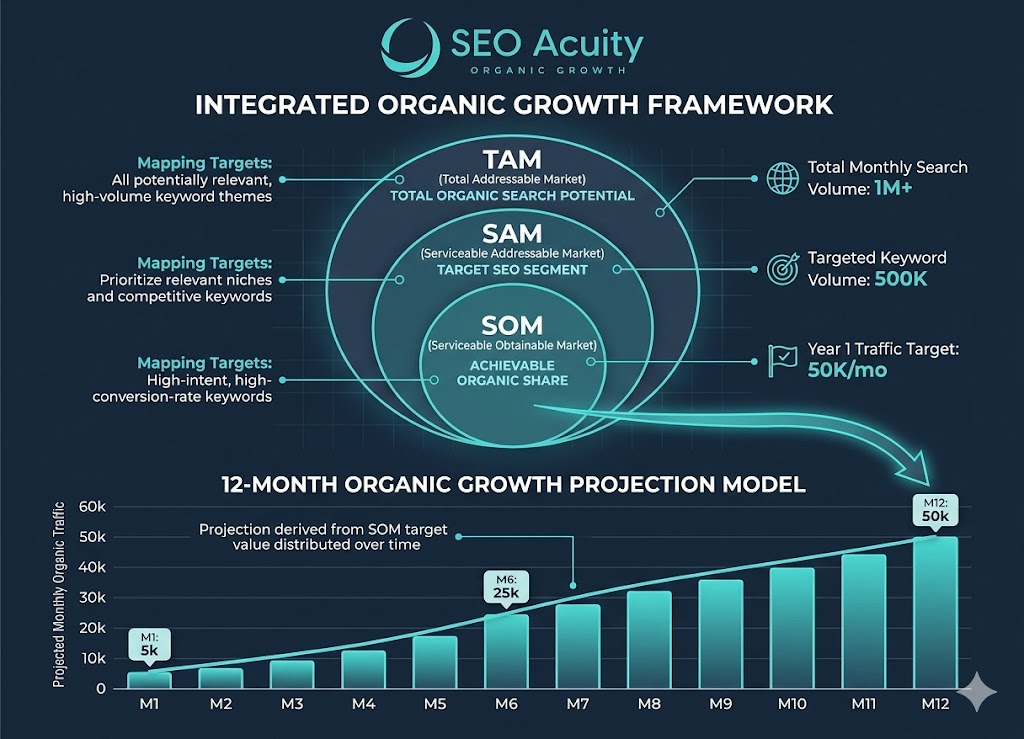
From SOM, you build a projection model: expected traffic, conversion rates, customer lifetime value, and revenue contribution from organic.
This is where SEO Acuity‘s approach to Revenue Modeling separates from standard keyword planning — every projection maps back to a revenue outcome, not a traffic number.
What Is Entity Architecture and Why Does It Matter for AI Search?
Entity architecture is the structured map of concepts, topics, relationships, and identities that define what your business is — in a form that AI systems can read, connect, and attribute correctly.
Entity architecture is the foundation of how generative AI decides who to cite, what to surface, and which brands to treat as authoritative within a knowledge domain.
Traditional SEO built topic clusters. Entity architecture builds knowledge networks.
AI systems don’t evaluate pages in isolation. They evaluate how well a site’s content maps to a coherent set of entities and how those entities connect to each other and to the broader Knowledge Graph. Isolated pages are invisible to this logic. Connected networks are not.
What Should a Brand Entity Map Include?
A well-built entity map covers:
- Primary entities — the core concepts your business owns or wants to own
- Supporting entities — the surrounding topics that give context to your primary entities
- Adjacent entities — related concepts that expand your authority without diluting your focus
- Brand entity signals — About pages, team profiles, mission statements, company history — the signals that help AI systems identify who is speaking, not just what is being said
The last category is consistently underbuilt. Pages like About Us and Team aren’t supplementary. They’re identity signals. AI systems use them to establish entity credibility before they decide whether to surface your content.
How Does Information Architecture Translate Entity Maps Into Site Structure?
Information architecture (IA) is the practical translation of your entity map into a navigable, crawlable, logically hierarchical website.
IA is not the navigation menu. IA is the structural expression of your knowledge model — hierarchy, parent-child relationships, and internal linking logic all working together.
A site where the IA reflects the entity map is a site where every page strengthens every other page. That’s the compounding effect that makes organic growth sustainable.
If your site’s structure doesn’t reflect a coherent entity model, AI systems will struggle to understand what you are — regardless of how much content you publish. SEO Acuity‘s Technical SEO Services include a full structural audit that identifies exactly where that misalignment is happening.
Start Your SEO / GEO / AEO Journey Today With a FREE Consultation
What Technical Foundation Does an Organic Growth Strategy Require?
A solid technical foundation ensures that everything else — content, authority, entity architecture — is actually accessible to search engines and AI systems.
If the machine can’t crawl and index your site accurately, no other investment compounds. Technical SEO is not a checklist. It’s a precision system.
The components that matter most:
- URL structure that mirrors your information hierarchy
- Schema strategy mapped to each page type — not applied generically
- Robots.txt configured to protect crawl budget, not restrict legitimate content
- Server-Side Rendering (SSR) where JavaScript-heavy implementations would otherwise block content discovery
- Crawlability and indexability treated as the primary technical KPIs — everything else serves these two
For sites using programmatic SEO services, the technical layer becomes even more critical. Variable structures, template logic, and canonical handling must be precise — or scale becomes a liability rather than an asset.
Read also: Is Google Dead?
How Do Page Structure and UX Affect Organic Growth Performance?
Page anatomy — the structural layout of content before a single word is written — determines how effectively a page serves both users and machines.
HTML structure, content hierarchy, and the placement of primary versus supporting content all affect how AI systems extract answers and how users convert.
The practical benefit of designing page wireframes before content: development and content teams can work in parallel. The dev team builds the structure. The content team fills it with the right material in the right positions. Neither is blocked by the other.
Within this structure, every page needs a defined role in the conversion funnel. Traffic without conversion architecture is an expensive hobby.
Each page should address:
- Page intent alignment — does the content match what the user actually came to do?
- Micro-conversions — small commitment actions that move users forward before the primary CTA
- Trust signals — reviews, credentials, case evidence — placed where hesitation typically occurs
- Use-case framing — helping users see themselves in the solution, not just understand the product
How Do You Build Topical Authority for AI Search and SEO?
Topical authority in the AI era is built by covering a primary entity from every relevant angle — not by targeting a list of keywords. AI systems assess authority by evaluating the depth and coherence of your entity coverage, not the volume of your content output.
The framing shift that changes everything:
Old question: “What keywords do I want to rank for?” Right question: “What entities do I want to own?”
What Is Intent Space Mapping?
Intent space mapping is the practice of identifying every question, comparison, and decision that orbits a given entity — and building content that addresses that complete intent space. It is the operational method for achieving topical authority.
For each primary entity, you map:
- Questions users ask at awareness stage
- Comparisons users make at evaluation stage
- Decision signals users need at conversion stage
For early-stage organic growth, concentrating on TOFU (Top of Funnel) and MOFU (Middle of Funnel) content first achieves two things simultaneously: it teaches AI systems what your brand is about, and it moves real buyers closer to a decision.
What Role Do Off-Page Signals Play in AI Search Visibility?
Off-page signals in the AI era extend well beyond backlink acquisition. AI systems evaluate a brand’s position within the broader Digital Knowledge Graph — which includes backlinks, but also brand mentions, external citations, Knowledge Panel data, and the consistency of entity signals across the web. A site with strong on-page architecture but weak off-page entity signals will still underperform in generative search.
The off-page layer for AI-era organic growth includes:
- Strategic backlinks that reflect topical relevance, not just domain authority
- Brand mentions — cited or uncited — across authoritative publications in your industry
- External citations that connect your entity to the topics you want to own
- Knowledge Graph signals — structured data, Wikipedia presence, entity disambiguation — that help AI systems place your brand correctly within a knowledge domain
SEO Acuity’s Off-Page SEO Services address this layer as an integrated system — not a link-building campaign disconnected from the broader entity strategy.
Start Your SEO / GEO / AEO Journey Today With a FREE Consultation
How Does Content Distribution Affect AI Search Performance?
Content distribution is no longer optional for organic growth. AI systems like ChatGPT, Perplexity, and Google’s AI Overviews are trained on and influenced by signals across the entire web — not just your domain. If your brand’s content exists only on your own site, your entity authority is narrower than it needs to be.
Distributed Authority Signals come from:
- Industry publications and editorial placements
- Community participation in forums and niche platforms
- YouTube content that reinforces your entity positioning
- Social media presence that generates consistent brand signal volume
The brands that AI systems cite most reliably are the brands that appear most consistently across trusted external contexts — not just the brands with the most content on their own domain.
Conclusion
Organic growth across AI search and traditional SEO is an infrastructure problem — not a content volume problem.
Winning AI search and traditional SEO requires the same foundation: a structured organic growth system built on business clarity, entity architecture, and technical precision — not content volume.
The brands that will own this space in the next three years are the ones building entity architecture, technical precision, and distributed authority signals right now. The foundation is the strategy.
Build an Organic Growth System That’s Tied to Your Results With SEO Acuity
Most organic strategies fail not because the tactics are wrong — but because the foundation was never built correctly. SEO Acuity designs that foundation before a single page is written or a single link is built.
Here’s what working with SEO Acuity actually looks like:
- Architecture before execution. We design your organic growth system before we touch a single page — structure, demand mapping, and revenue alignment first.
- We share the risk. Our engagements are tied to specific, agreed KPIs. If you don’t hit the targets, we don’t call it a success.
- GCC-native strategy. We work at the behavioral level — understanding how searchers in KSA, UAE, and across the Gulf actually discover, evaluate, and convert.
- Revenue alignment, not traffic theater. Every decision maps back to your business outcomes, not a vanity dashboard.
- Focused attention. We work with 7–9 clients at a time — by design. You get a growth partner, not an account manager.
If you’re building for long-term organic visibility — in AI search and traditional SEO — this is where that work starts.
Start Your SEO / GEO / AEO Journey Today With a FREE Consultation
Frequently Asked Questions
How long does it take for an organic growth strategy to produce results?
Most businesses operating in competitive verticals should plan for meaningful traction in 6–12 months and compounding returns from 12–24 months onward. Shortcutting the foundation phase consistently extends this timeline rather than compressing it.
Does my business need product-market fit before investing in SEO?
Yes, your business needs product-market fit before investing in SEO. SEO amplifies existing demand and positioning — it does not create them. If your offer, audience, or positioning is still being tested and refined, organic investment will produce inconsistent results because the signals being amplified keep changing. Confirming product-market fit and business model clarity before organic investment is not a delay — it’s what makes the investment defensible.
How does topical authority differ from keyword targeting?
Keyword targeting optimizes individual pages to rank for specific search queries. Topical authority builds a site’s entire content architecture around owning a set of entities — covering every relevant question, comparison, and use case within a knowledge domain. In the context of AI search, topical authority is what determines whether an AI system treats your brand as a credible source worth citing — keyword targeting alone does not achieve this.
What are Knowledge Graph signals and why do they matter for AI search?
Knowledge Graph signals are structured data points and external references that help AI systems correctly identify and position your brand within a broader knowledge network. These include structured schema markup, consistent entity information across directories and publications, Knowledge Panel data, and external citations from authoritative sources. AI systems use these signals to determine entity credibility before surfacing content in generative responses — brands with weak Knowledge Graph signals are frequently overlooked even when their on-page content is strong.