| Key Takeaways |
| GEO (Generative Engine Optimization) is not an independent framework — it is a subset of established SEO practice. |
| AI search engines rely on indexed web content, structured data, and authority signals that SEO has always targeted. |
| Shallow SEO built on keyword stuffing and AI-generated content without strategy was already failing before GEO existed. |
| Real SEO starts with market understanding, information architecture, and authority — not surface-level optimization tactics. |
| Businesses that build on Organic Growth foundations are better positioned for AI search than those chasing GEO shortcuts. |
Every few months, a new acronym arrives and someone declares SEO dead. GEO is the latest. And unlike most of those announcements, this one at least asks a serious question.
The problem isn’t the question. It’s that most people answer it without first defining their terms. What they call “SEO” and what serious practitioners mean by it are often two entirely different things.
Do AI and GEO Replace SEO?
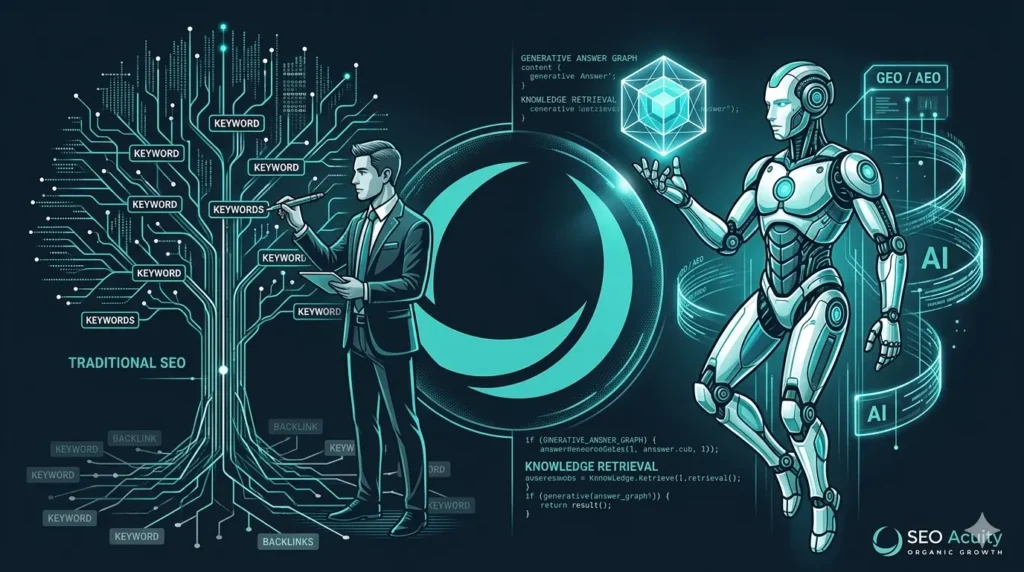
No, AI and GEO do not replace SEO — they reinforce it. GEO is a focused extension of existing SEO practices, not a separate discipline, and AI search engines rely on the same structural and authority signals SEO has always built.
What Is SEO?
SEO is the process of capturing existing online demand through search engines — traditional or AI-powered — by building structural visibility, content authority, and technical accessibility that scales organically over time. This definition matters because most SEO criticism targets a shallow version of the discipline.
What Is Not SEO?
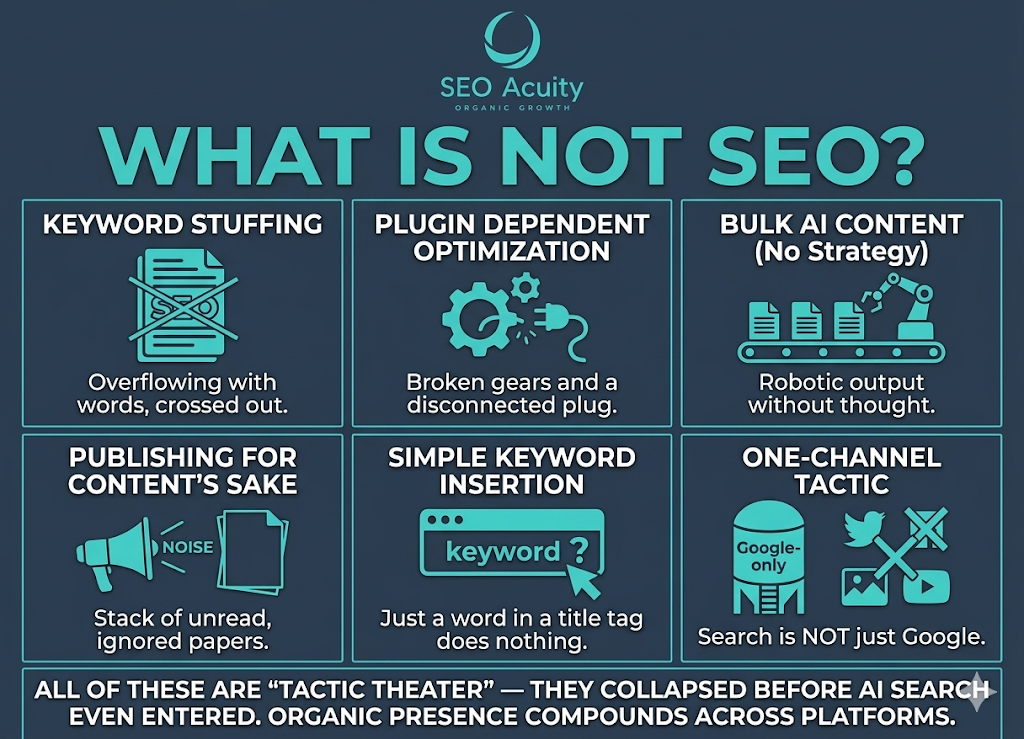
Keyword stuffing, meta tag manipulation, plugin-dependent optimization, and bulk AI content without a supporting strategy — none of that is SEO in any meaningful sense. It’s tactic theater. It was already collapsing before AI search entered the conversation.
SEO is not publishing content for content’s sake. Volume without relevance is noise. A thousand blog posts that answer questions nobody is asking — and that nobody links to — build nothing.
SEO is not keyword insertion. Placing a target phrase in a title tag does not make a page rank. It never did, and it certainly does not now.
SEO is not a one-channel tactic. The brands that treat SEO as a Google-only activity miss the point entirely. Search behavior happens across platforms. A strong organic presence compounds across all of them.
What Does Serious SEO Actually Involve?
Real SEO begins long before a single page is written. It starts with understanding the market:
- TAM / SAM / SOM analysis — sizing the addressable market and the realistic organic capture within it
- Keyword Universe Design — building a complete demand map, not just a list of high-volume terms
- Information Architecture — structuring the entire site around how demand clusters, not how it’s convenient to organize content internally
- Content Clustering — grouping content by topic authority, not by publishing schedule
- Authority Building — earning signals from external sources that confirm topical expertise and domain credibility
The goal was never traffic. It was Qualified Visibility — appearing in front of people who are already looking for what you offer, at the moment they’re looking.
That goal hasn’t changed. The surface where it happens has.
If your current SEO strategy is missing any of these foundational layers, SEO Acuity’s SEO Audit Services can identify exactly where the structural gaps are before you invest further in execution.
Start Your SEO / GEO / AEO Journey Today With a FREE Consultation

What Is GEO?
GEO, or Generative Engine Optimization, is the practice of structuring content so that AI-powered answer engines — ChatGPT, Perplexity, Google AI Overviews, Gemini — surface and cite it in their responses. It is not a replacement for SEO; it is an emphasis layer within it.
When you examine the tactics listed under the GEO label, a pattern becomes visible immediately.
| What GEO Recommends | What SEO Has Always Required |
| Clear headings, lists, and schema markup | On-page structure and Schema implementation |
| Conversational keyword research and intent analysis | Long-tail keyword research and search intent mapping |
| Crawlability, indexability, Core Web Vitals | Technical SEO fundamentals |
| Authoritative content with citations and brand mentions | EEAT, backlinks, PR, and off-page authority signals |
| AI-assisted content production | Tool-agnostic content quality standards |
None of these are new. Every item in that left column has an established SEO equivalent that predates generative AI by years.
Why GEO Feels New When It Isn’t
The novelty of GEO isn’t in the tactics. It’s on the surface. AI search engines present answers differently than a list of blue links — but they extract those answers from the same web. The same indexed content. The same authority signals.
A company that recently built its entire offering around GEO as a distinct service category eventually shut it down.
There was no meaningful separation between what GEO required and what brand authority and solid SEO practice had always required. Strong content, trusted mentions, genuine expertise, clear structure. That’s not a GEO formula. That’s just SEO done correctly.
Read also: Organic Growth Strategy to Win AI Search and SEO SERP
How Do AI Search Engines Actually Decide What to Surface?
AI search engines surface content through a three-stage process: baseline model understanding, retrieval-augmented generation (RAG) using indexed web data, and precision signal refinement — all of which depend on the same structural and authority foundations that SEO builds.
Understanding this process is the clearest argument for why SEO remains the underlying discipline.
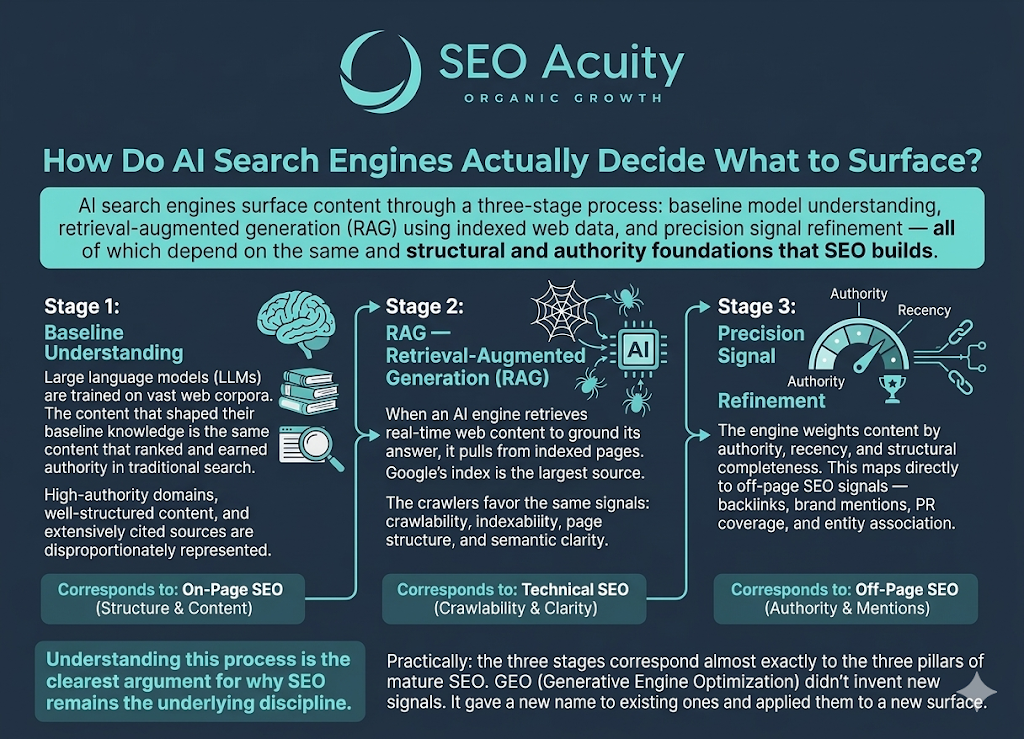
Stage 1: Baseline Understanding
Large language models are trained on vast web corpora. The content that shaped their baseline knowledge is the same content that ranked and earned authority in traditional search.
High-authority domains, well-structured content, and extensively cited sources are disproportionately represented in training data.
Stage 2: RAG — Retrieval-Augmented Generation
When an AI engine retrieves real-time web content to ground its answer, it is pulling from indexed pages. Google’s index remains the largest and most comprehensive source.
The crawlers that feed RAG systems favor the same signals that Technical SEO has always optimized for: crawlability, indexability, page structure, and semantic clarity.
Stage 3: Precision Signal Refinement
At this stage, the engine weights content by authority, recency, and structural completeness. This maps directly to off-page SEO signals — backlinks, brand mentions, PR coverage, and entity association.
What this means practically: the three stages of AI answer generation correspond almost exactly to the three pillars of mature SEO — on-page structure, technical foundation, and off-page authority.
GEO didn’t invent new signals. It gave a new name to existing ones and applied them to a new surface.
For businesses building toward AI search visibility, the foundation is the same. SEO Acuity’s Technical SEO Services address the crawlability, indexability, and structural signals that AI engines favor at the retrieval stage.
Start Your SEO / GEO / AEO Journey Today With a FREE Consultation

What Does a Correct SEO Foundation Look Like in the AI Era?
An SEO foundation that performs in the AI era is built on market intelligence, structural architecture, and authority signals — in that order. Tactics applied without this foundation produce visibility that is temporary, shallow, and unextractable by generative systems.
This is the sequence that produces durable organic visibility — across both traditional and AI-powered search.
Phase 1: Market and Demand Intelligence
Before any page is written or any technical element is configured, the market must be mapped.
- TAM / SAM / SOM estimation defines the real scale of addressable online demand
- Competitive demand analysis identifies where authority gaps can be entered
- Intent mapping distinguishes which queries belong on money pages versus content clusters
This work determines the entire structural direction. Without it, everything downstream is guesswork.
Phase 2: Information Architecture and Site Structure
Information Architecture is where strategy becomes structure. The IA determines:
- How the site’s pages are organized and interlinked
- Which topics are served by landing pages versus editorial content
- How topical clusters are built to signal depth of expertise
AI engines favor domains that demonstrate concentrated, structured expertise in a specific area. A site with clear IA communicates topical authority at a structural level — before a single word of content is evaluated.
Phase 3: Technical Foundation
The technical layer must support the structural layer. This includes:
Schema markup, URL structure, breadcrumb hierarchy, XML sitemaps, robots.txt configuration, HTML structure, internal link paths, and Core Web Vitals — all of which affect how crawlers and AI retrieval systems read and index the site.
These are not GEO inventions. They are Technical SEO fundamentals that carry more weight now because AI retrieval systems are more precise about structural quality than earlier search algorithms were.
Phase 4: Authority and Brand Signals
The final layer is off-page. EEAT signals — expertise, experience, authoritativeness, and trustworthiness — are communicated through:
- Backlinks from credible, relevant domains
- Brand mentions across editorial and industry sources
- PR coverage and external citations
- Named entity association within the model’s knowledge base
AI systems cite sources they assess as credible. Credibility is built the same way it always was — through consistent, visible authority in a specific domain.
Read also: Is Google Dead?
Does GEO Add Anything Real to SEO Practice?
GEO does not introduce new strategic categories, but it does sharpen the prioritization of specific SEO elements — particularly structured content, semantic clarity, and authority signals — making them more consequential in AI-powered search environments.
The honest answer: GEO raises the stakes on things SEO should have been doing well already. It is a useful lens, not a new framework.
Think of it this way. Before AI Overviews and generative answer engines, a page with weak structure could still rank if its backlink profile was strong enough. AI retrieval systems are less forgiving.
They favor content that is structured for extraction — clear headings, complete answers at the top of sections, schema-marked entities, and citations from trusted sources.
That’s not a new requirement. It’s the same requirement with higher enforcement.
What GEO has done is expose which SEO practitioners were cutting corners. The businesses that built on real foundations — market-aligned content, clean architecture, and genuine domain authority — are seeing their AI search visibility reflect the work they already did.
The businesses that chased shortcuts are discovering those shortcuts didn’t transfer.
Where you build on the Organic Growth Foundation™ — starting with demand mapping and structural architecture — visibility in AI search becomes a downstream outcome rather than a separate project. SEO Acuity’s On-Page SEO Services address the structural and content layers that AI systems extract from most readily.
Start Your SEO / GEO / AEO Journey Today With a FREE Consultation

Conclusion
AI search didn’t replace SEO. It raised the bar for what SEO needs to be. The practitioners who treated keyword lists as strategy and plugins as architecture are the ones facing disruption — not because of AI, but because their work was always fragile.
GEO is one emphasis within a complete Organic Growth system — not a parallel discipline, not a replacement, and not a shortcut.
The businesses that will win in AI search are the ones that built on real foundations: market intelligence, structural depth, and earned authority. That work is what SEO Acuity has been designed to do.
Build an Organic Growth System That’s Tied to Your Results With SEO Acuity
If AI search has exposed gaps in your current organic strategy — in structure, authority, or market alignment — the answer isn’t a new acronym. It’s building the foundation that should have been there from the start.
Here’s what working with SEO Acuity actually looks like:
- Architecture before execution. We design your organic growth system before we touch a single page — structure, demand mapping, and revenue alignment first.
- We share the risk. Our engagements are tied to specific, agreed KPIs. If you don’t hit the targets, we don’t call it a success.
- GCC-native strategy. We work at the behavioral level — understanding how searchers in KSA, UAE, and across the Gulf actually discover, evaluate, and convert.
- Revenue alignment, not traffic theater. Every decision maps back to your business outcomes, not a vanity dashboard.
- Focused attention. We work with 7–9 clients at a time — by design. You get a growth partner, not an account manager.
If you’re serious about organic growth that compounds — not traffic that evaporates — this is the place to start.
Start Your SEO / GEO / AEO Journey Today With a FREE Consultation

Frequently Asked Questions
Does GEO replace SEO?
No, GEO does not replace SEO because it operates on the same structural and authority foundations that SEO has always built. Generative Engine Optimization is best understood as a prioritization lens within SEO — it highlights which established practices matter most for AI search visibility, rather than introducing new ones.
How do AI search engines decide which content to cite?
AI search engines surface content through a three-stage process: baseline model understanding shaped by training data, retrieval-augmented generation that pulls from indexed web content, and precision refinement using authority and structural signals. All three stages depend on the same on-page, technical, and off-page signals that SEO has always optimized for.
What is the difference between GEO and SEO?
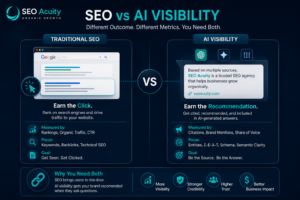
The difference between GEO and SEO is surface, not substance. SEO optimizes for ranked link results in search engines like Google. GEO focuses on appearing within AI-generated answers. However, both rely on structured content, technical accessibility, and domain authority — which means a well-executed SEO strategy already addresses the requirements of both.
What makes content more likely to be cited by AI search engines?
AI systems favor content that is structured for extraction: clear heading hierarchies, direct answers at the top of each section, schema markup, specific and concrete claims, and strong off-page authority signals like backlinks and brand mentions. Vague or poorly structured content is rarely surfaced, regardless of how much of it exists.
Is GEO worth investing in separately from SEO?
No — investing in GEO as a separate initiative without a complete SEO foundation is likely to produce weak results. The structural and authority signals that drive AI visibility are the same ones that SEO builds systematically. Isolated GEO tactics applied without market alignment, information architecture, and technical depth will not compound or sustain.