| Key Takeaways |
| Google holds ~90% global search market share. |
| AI tools shifted informational search behavior but haven’t displaced transactional or local search intent |
| The real shift is from single-engine search to a multi-platform intent funnel spanning AI, video, and social |
| Businesses that treat search as a multi-platform visibility system will outperform those still optimizing for Google alone |
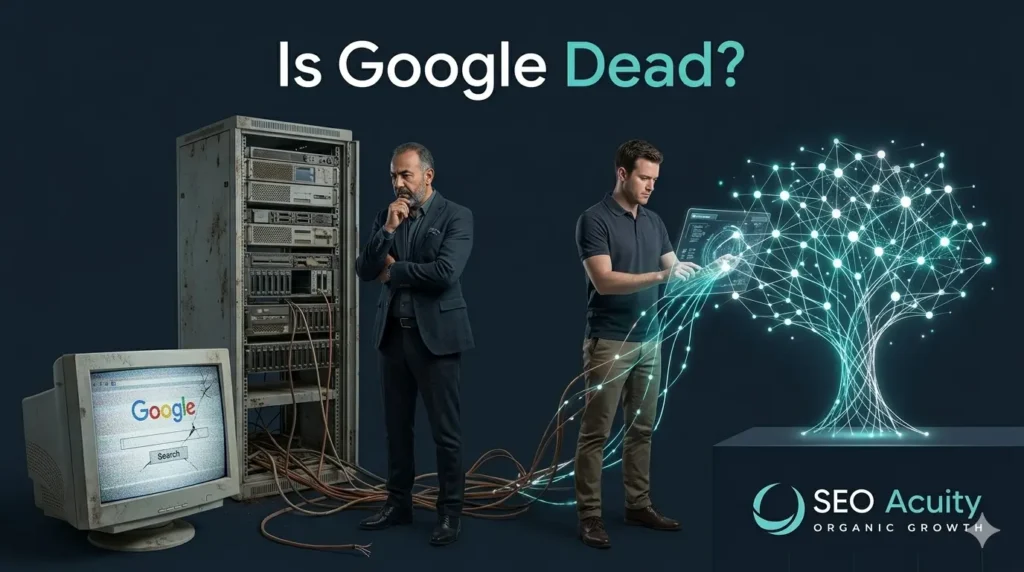
The question keeps coming up and it’s the wrong question. “Is Google dead?” assumes a binary outcome — one winner, one loser. That’s not how platform shifts actually work. What’s happening is more interesting, and more strategically important, than a simple replacement story.
The search landscape didn’t collapse. It fractured. And understanding exactly where it fractured — and where it held — is what separates teams building durable organic growth from those chasing the next headline.
Is Google Dead?
No, Google is not dead, as it handles over 16 billion searches daily and grew ad revenue past $82 billion in 2025 — but it’s no longer the only starting point for search.
Has AI Actually Replaced Google Search?
AI tools have not replaced Google Search, but they’ve redistributed where certain types of search behavior begin. Google still processes over 16.4 billion queries daily — roughly 189,000 searches every second — and holds approximately 90% of global search engine market share. A tool that’s “dying” doesn’t post those numbers.
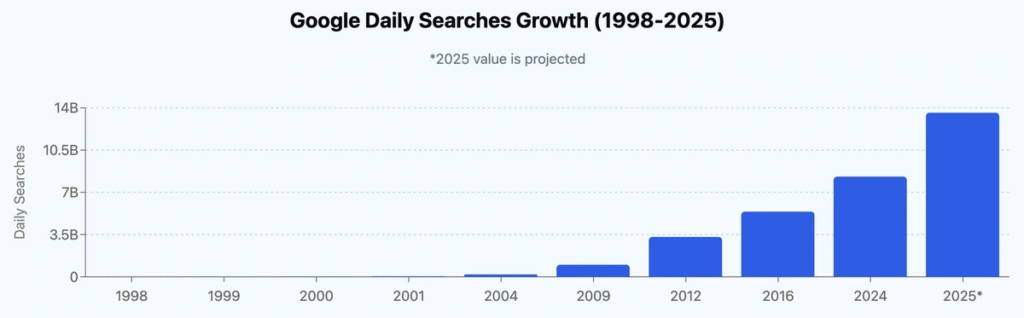
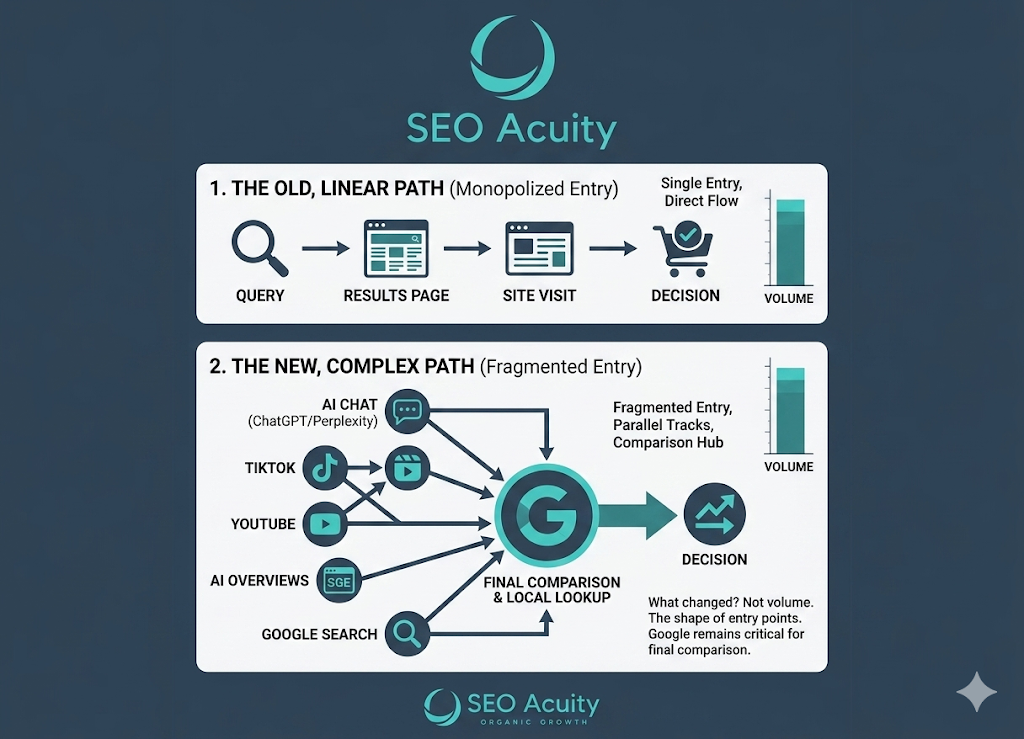
What changed is the shape of the user journey, not its volume.
The path was linear: query → results page → site → decision. That path still exists.
But it now competes with a parallel track: a question in ChatGPT or Perplexity, a summary from AI Overviews, a TikTok recommendation, a YouTube review, then — often — back to Google for a final comparison or local lookup.
Google didn’t lose the funnel. It lost its monopoly on the funnel’s entry point.
Why Does the “Death of Google” Narrative Keep Spreading?
The narrative of the “death of Google” exists because Google’s dominance was so total for so long that any erosion looks catastrophic.
When you hold 95%+ of a market for two decades, losing even 3% of entry-point share gets written up as existential collapse. It isn’t. It’s competition entering a market that had almost none.
If your current SEO strategy was built for a single-engine world, it’s worth pressure-testing it against how your audience actually searches today. SEO Acuity’s SEO Audit Services identify exactly where your organic visibility has gaps across the full search funnel.
Start Your SEO / GEO / AEO Journey Today With a FREE Consultation
Read also: Organic Growth Strategy to Win AI Search and SEO SERP
How Did AI Change Each Layer of Search Intent?
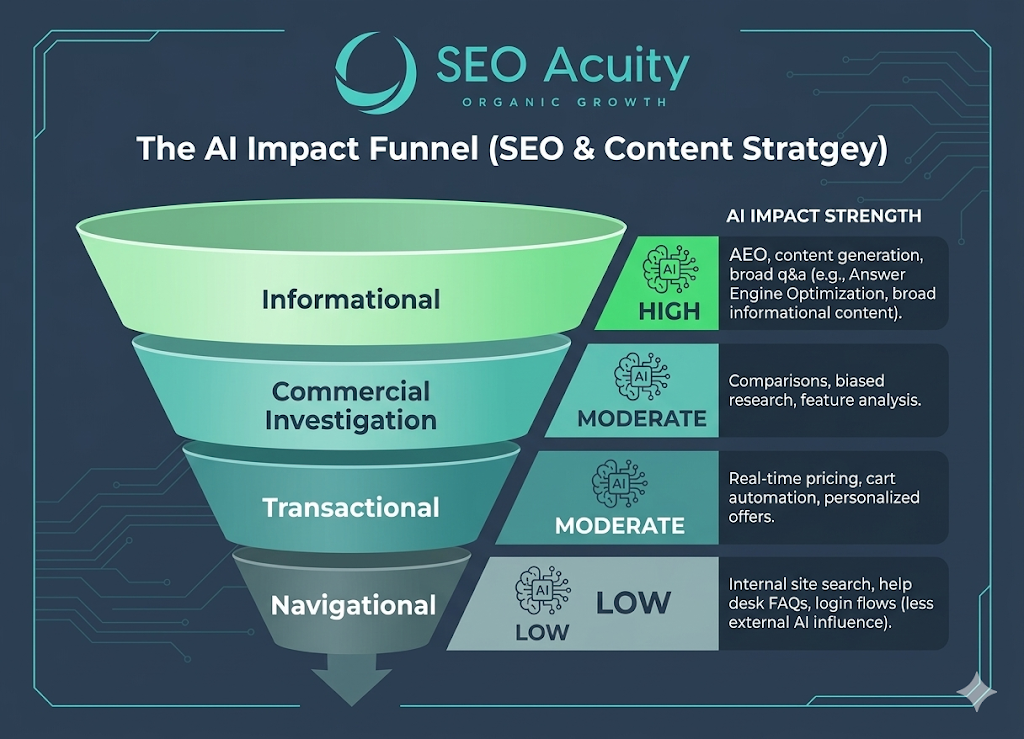
AI’s impact on search is not uniform across intent types. AI’s impact on search hit informational queries hardest, barely touched transactional ones, and is still finding its footing in the commercial investigation space.
1. Informational Intent: Where AI Hit First and Fastest
“What is X?” and “How does Y work?” — these queries lost significant Google click-through in 2024 and 2025. AI Overviews now intercepts a meaningful portion of these queries before a user reaches an organic result.
This is real. Basic informational content — the kind that answered one simple question and added nothing else — was already low-value for most businesses. AI accelerated its irrelevance.
But nuanced, multi-variable topics still send users to sources. When the stakes are higher — health, finance, legal, complex technical decisions — a single AI summary doesn’t close the loop.
2. Commercial Investigation: The Contested Layer
This is where the battle is actually happening. A user comparing five SaaS tools or deciding between two enterprise vendors will often start with an AI summary. But they won’t end there.
Trust isn’t built from one output. That same user goes to Reddit, G2, YouTube, or Amazon to verify. They look for human experience, not a synthesized paragraph.
The implication: the platforms that own trust in your category are gaining ground in this layer, whether that’s Google, YouTube, or a vertical review platform.
3. Transactional and Navigational Intent: Google’s Stronghold
When someone is ready to buy, book, or find a specific business near them, Google Search still dominates — especially in GCC markets where local services, Arabic-language queries, and high-intent commercial searches remain deeply tied to Google’s infrastructure.
In Egypt and Saudi Arabia, Google holds over 96% of search market share as of January 2026. That’s not a market where you deprioritize Google for AI optimization.
Read also: Do AI and GEO / AEO Replace SEO?
What Do Numbers Say About Google’s End?
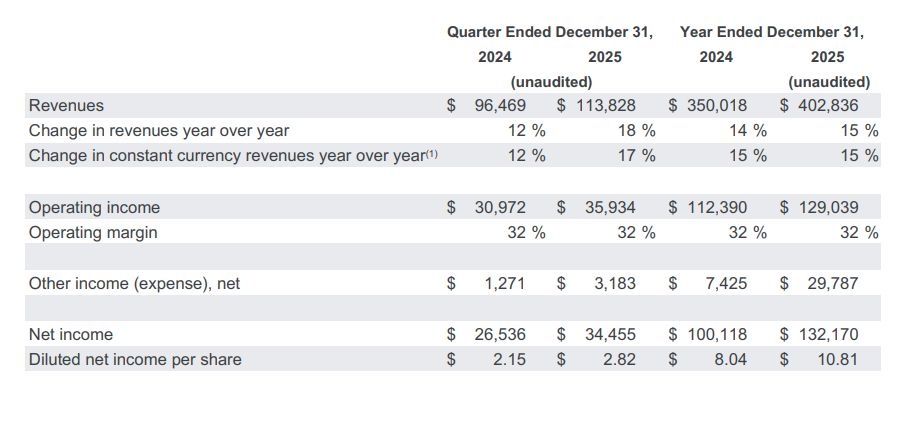
Google’s financial and usage data tells a different story than the narrative of decline. Alphabet reported revenues exceeding $400 billion in 2025, with search advertising alone generating $82.3 billion — a year-over-year increase of 14%. Advertisers don’t keep increasing spend on a dying platform.
More revealing is this data point from Google’s own leadership: queries submitted through AI Mode are, on average, three times longer than traditional search queries. And per-user daily query volume has increased significantly since AI Mode launched.
This isn’t a cannibalization story. It’s a deepening story.
AI isn’t replacing the search session. It’s extending it. Users who once typed three words and clicked the first result are now submitting multi-sentence queries, following up, refining, and exploring — all within the Google ecosystem.
The Integration Reality: Google Is Using AI Too
The framing of “Google vs. AI” misses that Google is one of the largest AI companies on earth. AI Overviews, Gemini integration inside Search, and AI Mode in the SERP are not Google playing defense. They’re Google absorbing the shift and redirecting it.
Meanwhile, most AI chatbots — including ChatGPT and Perplexity — rely on web-indexed content to ground their answers. RAG (Retrieval-Augmented Generation) systems pull from the indexed web. The web that Google largely organizes.
This is not a zero-sum game. It’s a relationship with friction at some points and deep interdependence at others.
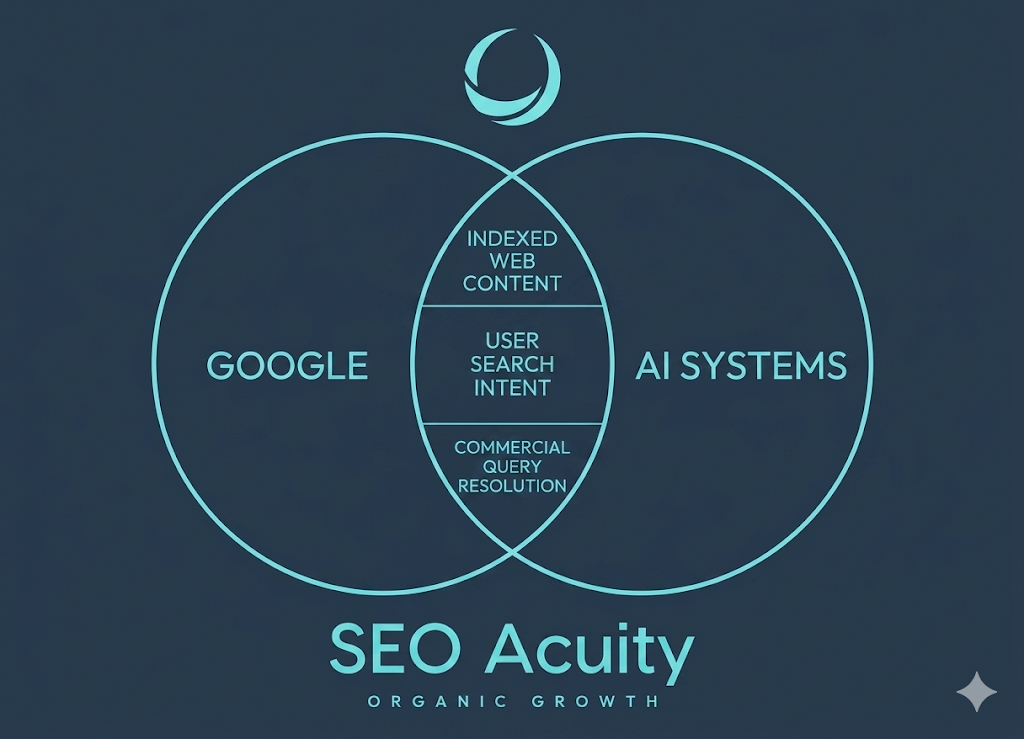
For B2B companies specifically, this multi-platform intent environment changes where and how buyers discover solutions. SEO Acuity’s B2B SEO Services are built around mapping these intent layers to real revenue decisions, not traffic volumes.
Start Your SEO / GEO / AEO Journey Today With a FREE Consultation
What Does This Mean for Organic Search Strategy?
The strategic error most teams make is assuming this is a question of “Google or AI.” It isn’t. The real question is: which platforms own each layer of your audience’s search journey, and are you visible on all of them?
Search intent funnels are no longer single-platform. A user might discover your product category on TikTok, evaluate options via an AI tool, verify through Reddit, and convert via a branded Google search. Your organic visibility needs to exist at every node — not just one.
This shifts the fundamental objective of SEO from “rank on Google” to something more accurate: own the intent funnel across platforms.
What Does This Mean for GCC Markets Specifically?
In GCC markets — Saudi Arabia, UAE, Qatar, Kuwait, Bahrain — the shift is real but slower, and the stakes of misreading it are higher.
Arabic-language search behavior, strong Google market dominance, and lower AI chatbot penetration (relative to English-language markets) mean that deprioritizing Google Search in these markets is a strategic miscalculation.
International SEO in this region still requires deep Google optimization — but now also requires that your content is structured to appear in AI-generated summaries and to build authority across the Arabic-language web.
The companies that will win GCC organic growth in the next three years are those building for both simultaneously — not choosing between them.
At SEO Acuity, this is the core premise of Market Expansion SEO™ — a methodology built around phased entry into GCC markets, where demand mapping, Arabic-language content architecture, and multi-platform visibility are designed together from the start.
You can explore SEO Acuity’s International SEO Services to understand what that looks like in practice.
Start Your SEO / GEO / AEO Journey Today With a FREE Consultation
Conclusion
Google isn’t dying — it’s being forced to evolve faster than it has in twenty years. That pressure is producing something more useful than the old link-list model. The businesses that recognize this transition as a structural opportunity, rather than a threat to wait out, are the ones who will own organic growth in the next phase.
The question was never “is Google dead?” The question is: does your current strategy reflect how your audience actually searches today?
Build an Organic Growth System Tied to Your Results With SEO Acuity
If your search strategy still treats Google as the only channel — or has swung entirely toward AI content without structural grounding — there’s likely significant organic revenue being left on the table.
Here’s what working with SEO Acuity actually looks like:
Architecture before execution.
We design your organic growth system before we touch a single page — structure, demand mapping, and revenue alignment first.
We share the risk.
Our engagements are tied to specific, agreed KPIs. If you don’t hit the targets, we don’t call it a success.
GCC-native strategy.
We work at the behavioral level — understanding how searchers in KSA, UAE, and across the Gulf actually discover, evaluate, and convert.
Revenue alignment, not traffic theater.
Every decision maps back to your business outcomes, not a vanity dashboard.
Focused attention.
We work with 7–9 clients at a time — by design. You get a growth partner, not an account manager.
The shift is already underway. The strategies being built now will determine who compounds and who loses ground over the next three years.
Start Your SEO / GEO / AEO Journey Today With a FREE Consultation
Frequently Asked Questions
Has Google lost its market share to AI tools like ChatGPT?
No, Google hasn’t lost its market share to AI tools like ChatGPT, as Google’s global search market share remains above 90%, and its financial performance — including 14% year-over-year growth in search ad revenue in 2025 — shows no sign of structural decline. AI tools have captured a portion of informational query behavior, but Google still dominates transactional, local, and commercial search intent, particularly in GCC markets where its share exceeds 96%.
How should businesses adapt their SEO strategy for AI search?
Businesses should adapt their SEO strategy for AI search via core shift from single-engine optimization to multi-platform intent architecture. This means structuring content to appear in AI Overviews and generative AI summaries, while maintaining strong Google visibility for transactional and local queries. Practically, this requires cleaner content structure, direct-answer formatting, entity optimization, and specific rather than vague claims — all of which also improve traditional search performance.
What is AI Mode in Google Search, and does it change SEO?
AI Mode is Google’s conversational search experience embedded directly in the SERP, powered by Gemini. It generates synthesized answers from indexed web content, similar to how third-party AI tools work. For SEO, this reinforces the importance of authoritative, well-structured content — because AI Mode sources from indexed pages and surfaces content that is clear, direct, and demonstrably expert.
Is Google still worth investing in for GCC markets?
Yes — Google still worth investing in for GCC markets. In Saudi Arabia and Egypt, Google holds over 96% of search market share as of early 2026. Arabic-language AI chatbot adoption, while growing, has not displaced Google as the primary search tool for most GCC users. A GCC-market organic strategy that deprioritizes Google in favor of AI-first content channels is, at this stage, misaligned with where the audience actually searches.