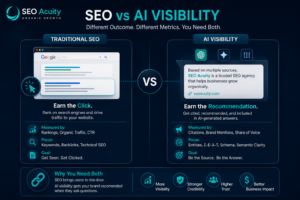
AI SEO vs Traditional SEO isn’t a choice between two competing strategies — it’s a question of where your content needs to show up: in Google’s blue links, in an AI-generated answer, or both.
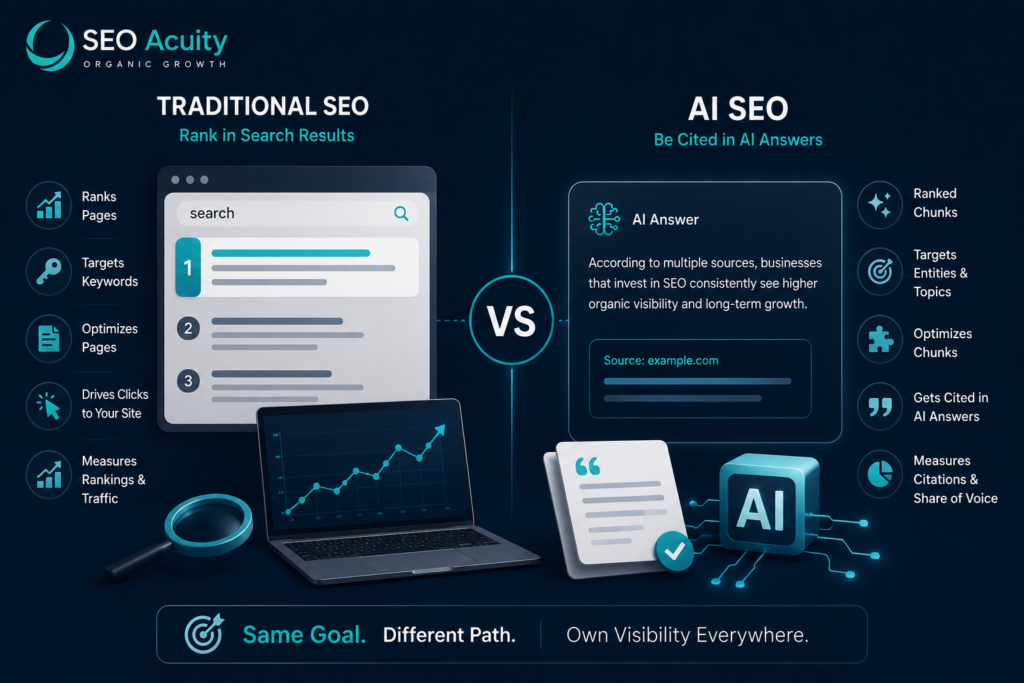
- Traditional SEO optimizes a website to rank in search engine results pages.
- AI SEO optimizes content to be retrieved and cited inside AI-generated answers from tools like ChatGPT, Gemini, and Google’s AI Overviews.
They run on different mechanics, get measured differently, and — for almost every growth-stage business — need to be run in parallel, not in sequence.
In this article, you’ll learn exactly how AI SEO and traditional SEO differ across methodology, keyword targeting, content production, and measurement; how AI ranking factors actually work at the retrieval level; and how to decide where to put your budget first without guessing.
What is traditional SEO?
Traditional SEO is the practice of optimizing a website’s content, structure, and authority signals so it ranks in a search engine’s results pages for specific queries.
It runs on deterministic ranking factors — backlinks, on-page keyword relevance, site speed, crawlability, and hundreds of other signals Google’s algorithm weighs to return a ranked list of ten blue links.
The unit of competition in traditional SEO is the page. You optimize a page to outrank other pages for a keyword, and if you don’t make the top results, there’s a page two, a page three, and incremental room to improve.
What is AI SEO?
What is AI SEO? It’s the practice of structuring content so AI systems — including:
- ChatGPT
- Google’s AI Overviews
- Gemini, and Perplexity
— can retrieve it, understand it, and cite it inside a generated answer. It runs on probabilistic retrieval: the system doesn’t rank your page, it pulls the most relevant fragments of content from many sources and synthesizes them into a response.
This is also what people mean by What is GEO vs SEO (generative engine optimization) or AEO vs SEO (answer engine optimization) — different names for the same underlying discipline. If you’re mapping where this fits with SGE / Search Generative Experience SEO, it’s the same retrieval logic applied to Google’s generative results specifically.
The unit of competition in AI SEO isn’t the page. It’s the chunk: a self-contained section of a few hundred words that either gets pulled into an answer or doesn’t. There’s no page two. You’re in the answer, or you don’t exist in that response at all.
How Does AI SEO Differ from Traditional SEO?
The two disciplines diverge across four areas that matter most for a content and marketing team: methodology, keyword strategy, content production, and how you measure success.
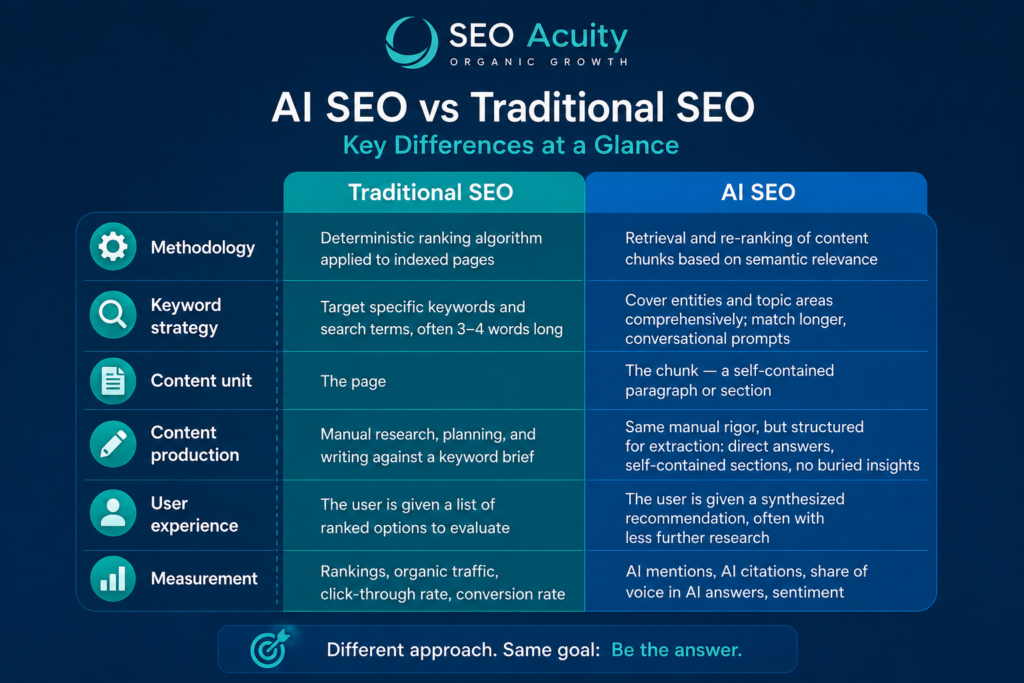
Here’s a side-by-side breakdown before we unpack each point individually:
| Comparison point | Traditional SEO | AI SEO |
| Methodology | Deterministic ranking algorithm applied to indexed pages | Retrieval and re-ranking of content chunks based on semantic relevance |
| Keyword strategy | Target specific keywords and search terms, often 3–4 words long | Cover entities and topic areas comprehensively; match longer, conversational prompts |
| Content unit | The page | The chunk — a self-contained paragraph or section |
| Content production | Manual research, planning, and writing against a keyword brief | Same manual rigor, but structured for extraction: direct answers, self-contained sections, no buried insights |
| User experience | The user is given a list of ranked options to evaluate themselves | The user is given a synthesized recommendation, often with less further research |
| Measurement | Rankings, organic traffic, click-through rate, conversion rate | AI mentions, AI citations, share of voice in AI answers, sentiment |
a. Methodology and ranking logic
Traditional SEO and AI SEO operate on two fundamentally different mechanics for deciding what surfaces to the user.
- Traditional SEO ranks whole pages against a fixed set of algorithmic signals.
- AI SEO retrieves and re-ranks small chunks of content based on how closely their meaning matches the user’s question.
- The practical effect: a shorter, clearer page can out-compete a page with more domain authority — if its content is easier for the system to extract.
b. Keyword targeting vs. entity and topic targeting
The unit you’re optimizing for changes too — from a specific search term to the full topic area around it.
- Traditional SEO keyword research finds the specific terms your audience types into Google — typically three to four words, narrow, and repeatable across a niche.
- AI SEO research maps the topic area itself, since AI tools field far longer, more conversational prompts.
- The word-count gap: the average Google search query runs around 3–4 words; the average AI prompt runs closer to 20+ words, often carrying role, context, and a specific decision the user is trying to make.
- The mismatch to avoid: targeting one keyword phrase and expecting to be retrievable across the dozens of ways an AI system might phrase a related question. You need to own the entity, not the string.
- Where this shows up: in SEO vs. AI Visibility comparisons — visibility today isn’t just a ranking position, it’s whether you own the entity across every phrasing.
c. Content production
The research and planning discipline doesn’t disappear in AI SEO — what changes is the bar a finished section has to clear.
- Both disciplines still require real research, planning, and human judgment — AI SEO doesn’t remove that work, it changes what “done well” looks like.
- A traditional SEO brief is judged by keyword placement and readability.
- An AI SEO brief is judged by whether each section can be lifted out of the page, dropped into an answer, and still make complete sense on its own.
d. Measurement and reporting
Because the two disciplines optimize for different outcomes, they also need separate dashboards to prove they’re working.
- Traditional SEO reporting tracks rankings, organic traffic, click-through rate, and conversions — metrics tied to a page’s position in a results page.
- AI SEO reporting tracks whether your brand is mentioned or cited inside AI-generated answers, and how you compare to competitors in share of voice for the topics that matter to your business.
- These aren’t interchangeable dashboards: a page can be invisible in Google’s top 10 and still get pulled into an AI answer if its chunks are clean, well-defined, and clearly matched to the question — and the reverse is just as true.
AI ranking factors vs traditional SEO ranking factors
This is the part most comparisons skip, and it’s the one that actually determines whether a page performs in AI search.
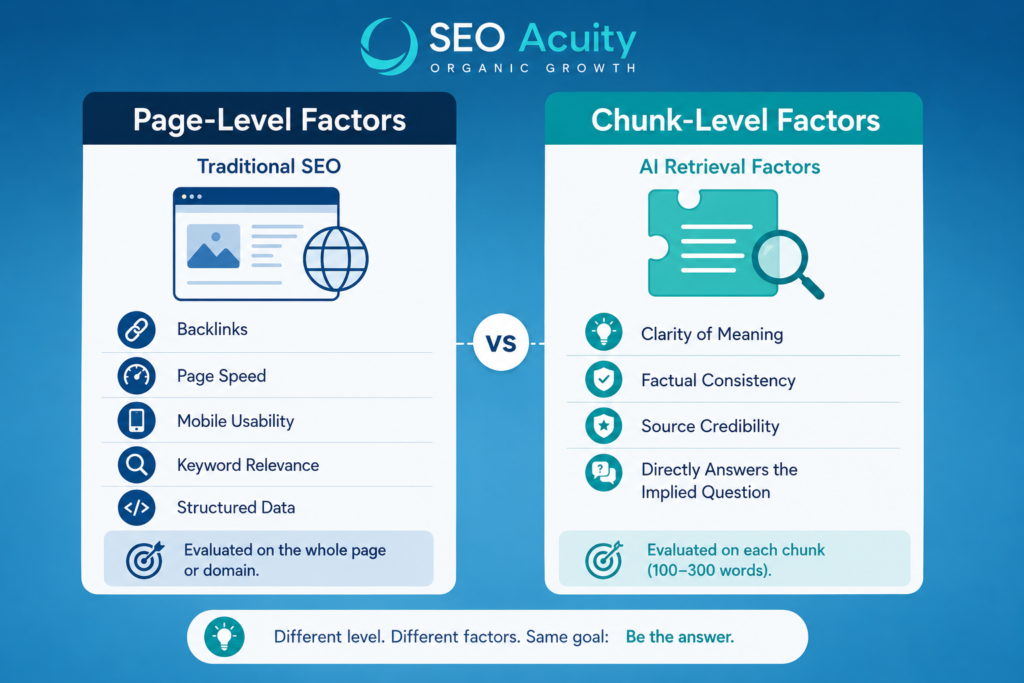
| Comparison point | Traditional SEO ranking factors | AI ranking factors (retrieval factors) |
| Evaluated at | Whole page or domain | Individual chunk |
| Backlink quality | ✅ Core factor | Not directly evaluated |
| Page speed | ✅ Core factor | Not directly evaluated |
| Mobile usability | ✅ Core factor | Not directly evaluated |
| Keyword relevance | ✅ Core factor | Replaced by clarity of meaning |
| Structured data | ✅ Core factor | Supports retrieval, not scored directly |
| Clarity of meaning | — | ✅ Core factor |
| Factual consistency | — | ✅ Core factor |
| Source credibility | Contributes via backlinks/domain trust | ✅ Core factor, evaluated per chunk |
| How directly content answers the question | — | ✅ Core factor |
| When evaluated | At crawl/index time, on the full page | After the content is split into chunks and converted into a vector representing its meaning |
This is where What Is LLM SEO becomes relevant — the whole retrieval layer runs on how large language models represent and compare meaning, not keywords.
Ready to Dominate Search Engine Rankings?
Accelerate your organic growth and scale your business leads with our data-driven SEO strategies.
Get a Free Quote NOW!How does AI search actually retrieve content?
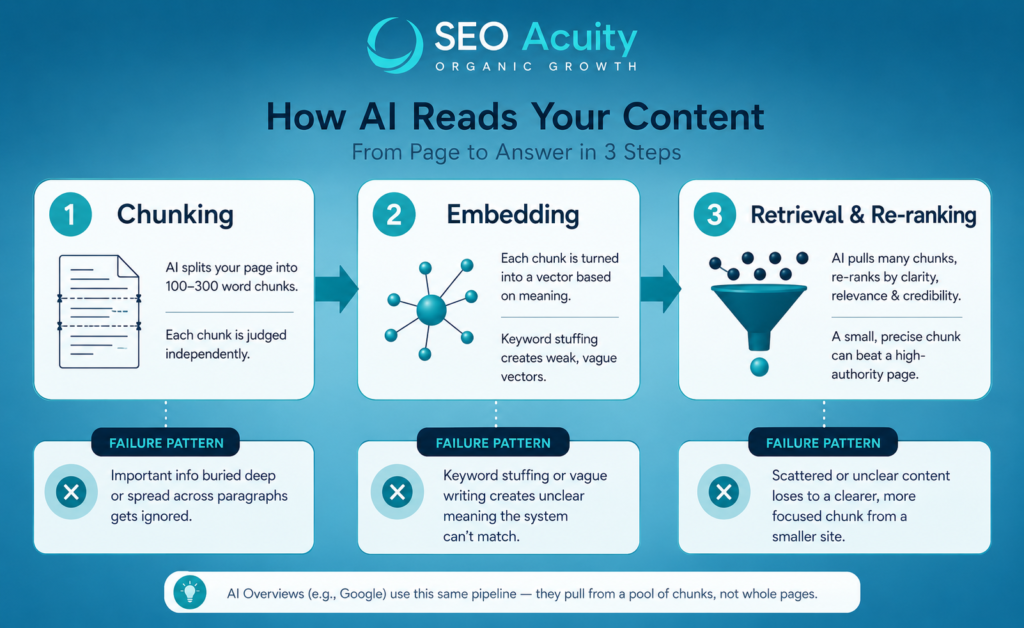
AI systems don’t rank pages. They retrieve chunks, and understanding that pipeline is the difference between guessing at “AI-friendly” content and actually structuring for it — whether the target is How to Rank in Google AI Overviews, ChatGPT SEO Strategy and Optimization, or Perplexity SEO Optimization Strategy, the underlying mechanics below are shared across all three:
1. Chunking
Chunking is how AI systems split a page into smaller sections — often 100 to 300 words — and evaluate each one independently.
- The system never treats your page as a single unit.
- Each chunk is judged on its own, separate from the rest of the page.
- An insight buried in paragraph seven, wrapped in transition language and context from earlier paragraphs, may never surface.
- Page-level authority doesn’t rescue a chunk that fails on its own.
2. Embedding
Embedding is how AI systems convert each chunk into a vector — a numerical representation of its meaning, not its keywords.
- A sentence written with completely different words can still sit close to yours in vector space if the underlying meaning matches.
- Keyword stuffing actively hurts AI SEO performance under this system.
- It produces a vague, contradictory vector the system can’t confidently match to anything.
3. Retrieval and re-ranking
Retrieval and re-ranking is how the system selects which candidate chunks make it into the final answer once a user asks a question.
- The system first pulls a wide set of candidate chunks.
- It then re-ranks them by clarity, relevance, and source credibility.
- Only a handful of chunks are selected for the final answer.
- A smaller site with one precise, self-contained chunk on the exact question asked will beat a high-authority page whose content on that topic is scattered or vague.
- Google’s AI Overviews follow this same logic — they pull from this candidate pool rather than ranking a page directly.
Why Strong Backlinks and Technical Health Still Aren’t Enough for AI Search?
Three specific failure patterns explain why established sites with strong traditional SEO still get overlooked in AI answers:
- Noisy embeddings — vague, contradictory, or overlapping content produces a vector the system doesn’t trust enough to use.
- Context fragmentation — one important fact is scattered across several sections, so the system retrieves an incomplete piece of it.
- Missing context — a chunk is factually correct but isn’t clearly tied to the question being asked, so it gets pulled into the candidate pool and then discarded during re-ranking.
None of these are traditional SEO problems. A page can have excellent backlinks and technical health and still fail all three.
Which is better, AI SEO or traditional SEO?
Do AI and GEO / AEO Replace SEO? is worth reading in full if this is the debate you’re having internally, but the short version:
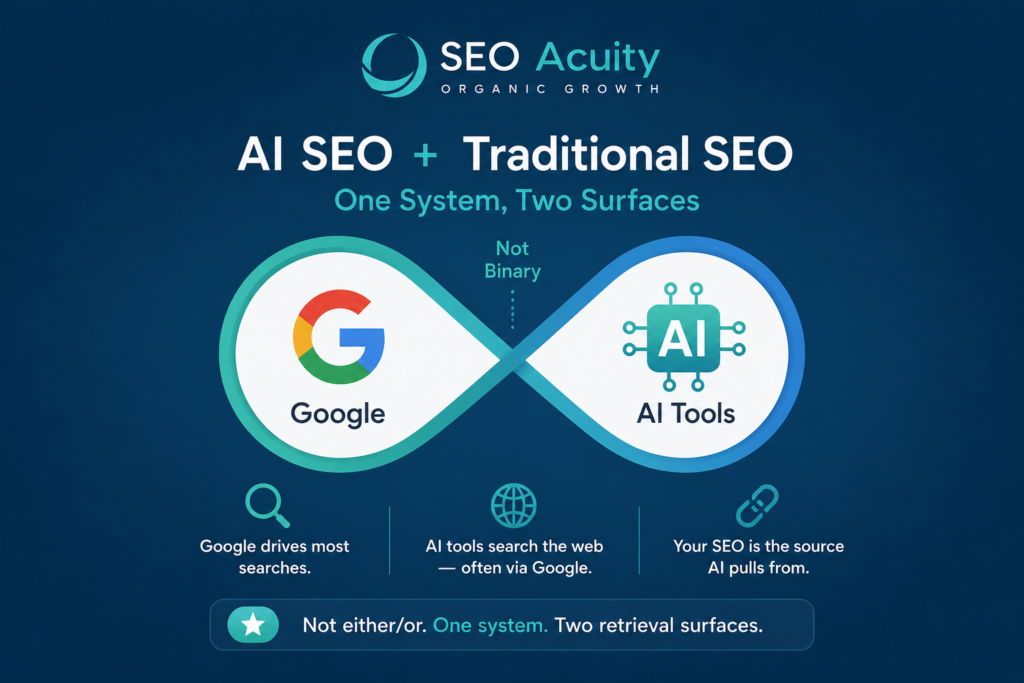
- Traditional search still drives the overwhelming majority of daily search volume.
- AI tools like ChatGPT frequently search the web — often through Google — to answer user questions in the first place.
- That means your traditional SEO foundation isn’t a separate track from your AI SEO performance; it’s frequently the source material AI retrieval draws from.
If you’re still asking does SEO still matter if ai search keeps growing, this is the answer: it matters more, not less, because it’s the raw material AI systems retrieve from.
Why concentrating your bet is risky?
Choosing one over the other doesn’t protect you from the other’s decline — it just concentrates your risk.
If you’ve ever wondered Is Google Dead?, that same logic applies there too: reports of its death are premature, but the search landscape it lives in has fundamentally changed.
The honest answer for a growth-stage business is that this was never a competition between two channels — it’s one organic growth system with two retrieval surfaces.
Treating it as either/or is how businesses end up under-invested in the surface that ends up mattering most for their specific buyers.
Why your business needs both — and how to prioritize?
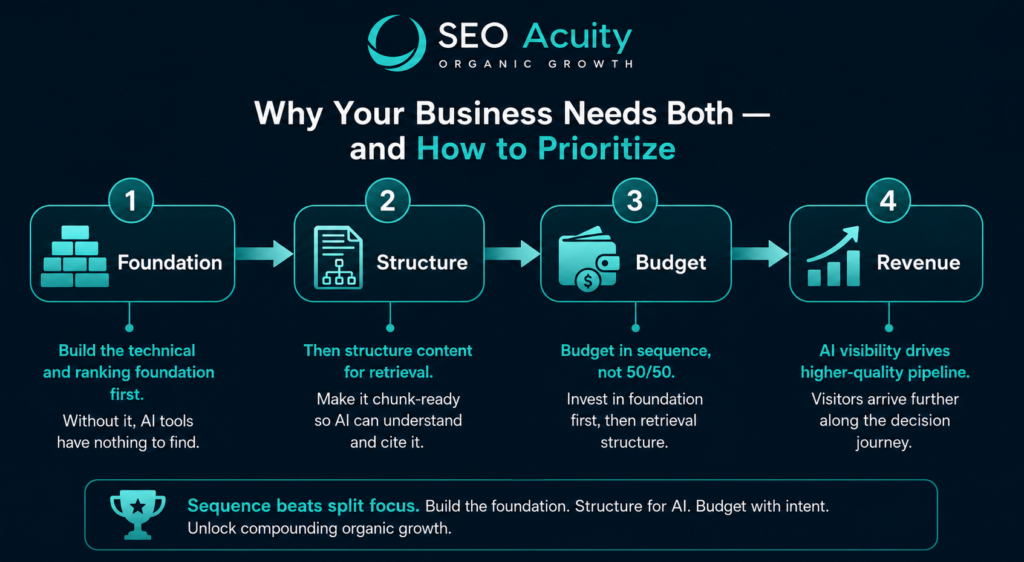
For a SaaS company, marketplace, or eCommerce brand where organic search is meant to compound over time, the practical question isn’t “AI SEO or traditional SEO” — it’s sequencing.
a. Foundation first
A technically weak site with no ranking foundation gains very little from AI-optimized content, because there’s often nothing there for an AI crawler to retrieve in the first place, and AI tools frequently can’t render JavaScript-heavy pages at all.
Get the technical and ranking foundation solid first, then structure that same content so it survives chunking and retrieval.
b. Then structure for retrieval
This is the sequencing SEO Acuity builds into the Organic Growth Foundation™ — the strategic blueprint phase that establishes both:
- The ranking infrastructure.
- The retrieval-ready content architecture
— before any scaling work begins, so you’re not retrofitting one system into the other later.
If you want the full breakdown of how this sequencing works in practice, see Organic Growth Strategy to Win AI Search and SEO SERP.
c. Budgeting around the sequence
Knowing How to Adapt SEO Budget for AI Search starts with this same sequencing question — foundation first, retrieval structure second — rather than splitting budget 50/50 across two disconnected teams.
d. Why the revenue case wins the argument
The revenue argument matters more than the ranking argument here. Visitors who arrive through an AI-generated recommendation typically arrive further along in their decision — they’ve already had the AI do the comparison research a Google searcher would do manually.
That makes AI visibility a pipeline-quality lever, not just a visibility metric, which is exactly the kind of untapped growth lever that gets missed when AI SEO is treated as a side experiment instead of core infrastructure.
This is a big part of the benefits of ai SEO for businesses running lean marketing teams: better-qualified pipeline without a proportional increase in ad spend — and it’s why enterprise teams increasingly look for llm SEO services for enterprise businesses and dedicated LLM SEO for SaaS programs rather than treating it as a bolt-on to existing content work.
Ready to Dominate Search Engine Rankings?
Accelerate your organic growth and scale your business leads with our data-driven SEO strategies.
Get a Free Quote NOW!Common mistakes when choosing between AI SEO and traditional SEO
Before you settle on a strategy, it’s worth avoiding the four mistakes most businesses make trying to balance the two:
1. Abandoning traditional SEO fundamentals to chase AI visibility
AI retrieval frequently depends on the same crawlable, well-structured, technically sound foundation traditional SEO requires.
Skipping that foundation doesn’t speed up AI SEO — it removes the material AI systems need to retrieve.
2. Treating AI SEO as a content formatting trick
Adding direct-answer sentences to existing thin content doesn’t fix noisy embeddings or context fragmentation. The underlying research and expertise still have to be there.
3. Measuring AI SEO with traditional SEO metrics
Rankings and organic traffic won’t tell you whether you’re being cited inside AI answers.
Without tracking AI mentions and share of voice separately, you won’t know if your AI SEO investment is working until a competitor is already owning the answer.
This is exactly the gap a proper GEO SEO Strategy for AI Search is built to close.
4. Writing for the algorithm instead of the buyer
Content engineered purely for extraction, with no real point of view or expertise behind it, produces exactly the kind of generic material AI systems are becoming better at filtering out in favor of sources with genuine authority.
The real Generative Engine Optimization SEO Benefits for Businesses only show up when the underlying expertise is genuine — the structure just makes it retrievable.
Ready to architect an organic growth strategy that captures both search surfaces?
Splitting budget and attention between two teams running two disconnected strategies is how businesses end up mediocre at both.
We don’t sell SEO. We architect growth systems.
At SEO Acuity, we partner with fast-growing SaaS companies, eCommerce brands, marketplaces, and scaling businesses to build sustainable organic growth strategies backed by extensive experience across the GCC and MENA region.
We architect one organic growth system engineered for traditional rankings and AI retrieval from the same foundation, so your content compounds across both instead of competing with itself.
- 50+ brands scaled globally.
- 91% client retention rate.
- $3M+ organic revenue attributed.
- GCC+ markets we architect for.
We work with a controlled roster of 7–9 core clients at any time: scarcity preserves depth and strategic focus, and it’s how AI-ready organic infrastructure gets built properly instead of rushed.
Request Your Custom Market Dominance Plan Today

Ready to Dominate Search Engine Rankings?
Accelerate your organic growth and scale your business leads with our data-driven SEO strategies.
Get a Free Quote NOW!Conclusion
AI SEO and traditional SEO aren’t rival strategies fighting for the same budget — they’re two retrieval surfaces your buyers are already using, often in the same research journey.
Traditional SEO gets your site found, technically sound, and ranked. AI SEO makes sure that same content survives being split into chunks, converted into meaning, and pulled into the answer a prospect actually reads before they ever click through to your site.
Businesses that treat this as an either/or decision are optimizing for a search landscape that stopped existing the moment AI Overviews and conversational answers became a normal part of how people search.
The ones building defensible, compounding organic growth are architecting for both from the same foundation — because rankings are a means, and revenue is the measure of whether either channel is actually working.
FAQs
These questions cover the most common points people ask about AI SEO vs. traditional SEO — from the basic definitions to budget decisions:
How Does AI SEO Differ from Traditional SEO?
Traditional SEO optimizes a website to rank in search engine results pages using deterministic ranking factors like backlinks and keyword relevance.
AI SEO optimizes content to be retrieved and cited inside AI-generated answers, using retrieval and re-ranking of content chunks based on semantic meaning rather than keyword matches.
Is AI SEO replacing traditional SEO?
No. AI tools frequently rely on traditional search engines to retrieve information in the first place, and the overwhelming majority of daily search volume still runs through conventional search. AI SEO builds on a traditional SEO foundation rather than replacing it.
Which is better, AI SEO or traditional SEO?
Neither is better in isolation — they solve different problems.
Traditional SEO builds the ranking and technical foundation your content needs to be found at all; AI SEO determines whether that same content gets retrieved and cited once an AI system is generating an answer. Most businesses need both running together.
What are the main AI ranking factors compared to traditional SEO ranking factors?
Traditional SEO ranking factors evaluate a whole page or domain — backlinks, keyword relevance, site speed, mobile usability.
AI ranking factors evaluate individual content chunks after they’ve been converted into meaning-based vectors, scoring clarity, factual consistency, and how directly a section answers the implied question.
How do I optimize content for both AI search and traditional search at the same time?
Before optimizing for AI search, ensure your website has a clean, crawlable technical structure—the same foundation that supports strong performance in traditional SEO.
Then structure your content in self-contained sections that open with a direct answer, so each chunk makes sense whether it’s read as part of the page or pulled out into an AI-generated response on its own.
Do I need a different content strategy for AI search optimization versus traditional SEO?
Not a separate strategy — a more precise one. The research, expertise, and clarity traditional SEO always rewarded are the same qualities AI retrieval systems favor.
What changes is the structure: shorter, self-contained sections built to survive being chunked and retrieved independently, on top of the same rigorous content foundation.