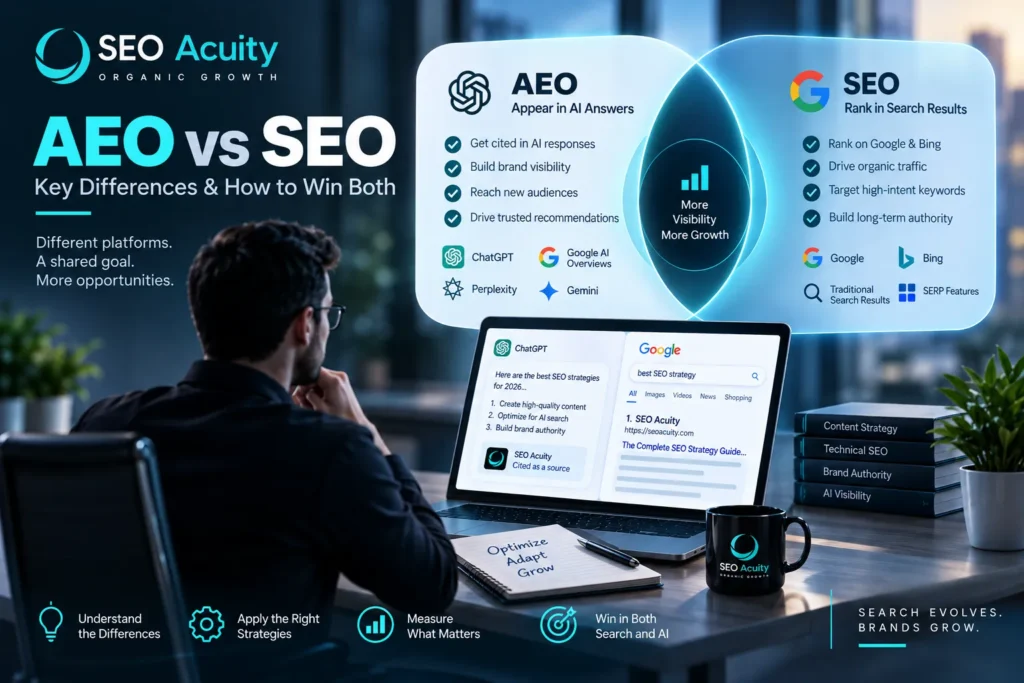
Search has fundamentally changed. Not too long ago, appearing on page one of Google was the undisputed goal of every digital marketing team. Today, that goal still matters — but it is no longer the whole picture.
With AI-powered platforms like ChatGPT, Google AI Overviews, Perplexity, and Gemini now answering user questions directly, a growing share of searches never result in a click to any website at all. In fact, 60% of searches now end without a click, driven entirely by AI-generated answers that appear above the traditional results.
This shift has introduced a new discipline alongside traditional SEO: Answer Engine Optimization (AEO).
So what exactly is AEO vs SEO? How do they differ, where do they overlap, and what does a winning 2026 strategy look like for both? This guide covers everything you need to know — including how SEO vs AEO vs GEO fits into the bigger picture.
What Will You Learn in This Article
- What SEO and AEO are — the platforms, tactics, and metrics each targets.
- The core differences between AEO vs SEO — mapped side by side.
- How SEO, AEO, and GEO fit together — three connected layers, not competing strategies.
- Why AEO depends on SEO — how the two reinforce each other.
- Practical tactics to optimize for both — content, schema, and entity strategies.
- How to measure performance — the right metrics for each channel.
- Key 2026 trends — zero-click search, AI agents, and brand-level visibility.
What Is SEO?
Search engine optimization (SEO) is the practice of improving your website so it ranks higher in traditional search engine results pages (SERPs) — primarily Google and Bing.
The goal is straightforward: attract organic traffic by appearing prominently when users search for topics related to your business.
SEO has evolved continuously over the past two decades, expanding to encompass a growing range of surfaces and tactics. Its core pillars include:
- Keyword research and on-page optimization — targeting the queries your audience actually uses.
- Link building — earning backlinks from reputable sources to signal authority.
- Technical site health — ensuring fast load times, clean crawlability, and proper indexing.
- Content quality — producing accurate, useful, and authoritative information.
- SERP features — optimizing for featured snippets, People Also Ask boxes, knowledge panels, local packs, and more recently Google AI Overviews and AI Mode.
What has stayed constant throughout is the core principle: build authoritative, relevant, well-structured content that earns trust from both users and search engines.
Read also: Generative Engine Optimization SEO Benefits for Businesses
What Is AEO?
Answer engine optimization (AEO) is the practice of optimizing your content so that AI-powered platforms can understand, reference, and cite it when generating direct answers to user questions.
Where SEO helps you appear in Google’s blue links, AEO helps you appear inside the answer itself — whether that’s a ChatGPT response, a Google AI Overview, a voice assistant reply from Alexa or Siri, or a summary panel on Perplexity.
With 77% of ChatGPT users in the USA treating it like a search engine, and nearly 60% of consumers using AI tools to shop, the stakes of AEO are high and growing. If a potential customer asks an AI, “What’s the best SEO agency for e-commerce brands?” — and your brand isn’t cited — you’ve missed a prime opportunity before any click was even possible.
Answer engine optimization is not about gaming AI systems. It’s about making your expertise so clearly structured and authoritatively expressed that AI models have no reason not to cite you. To understand how this differs from traditional optimization, read our guide on AI SEO vs Traditional SEO.
“A Practical Step-by-Step Framework for Appearing in AI Search Results Like ChatGPT and Gemini” .
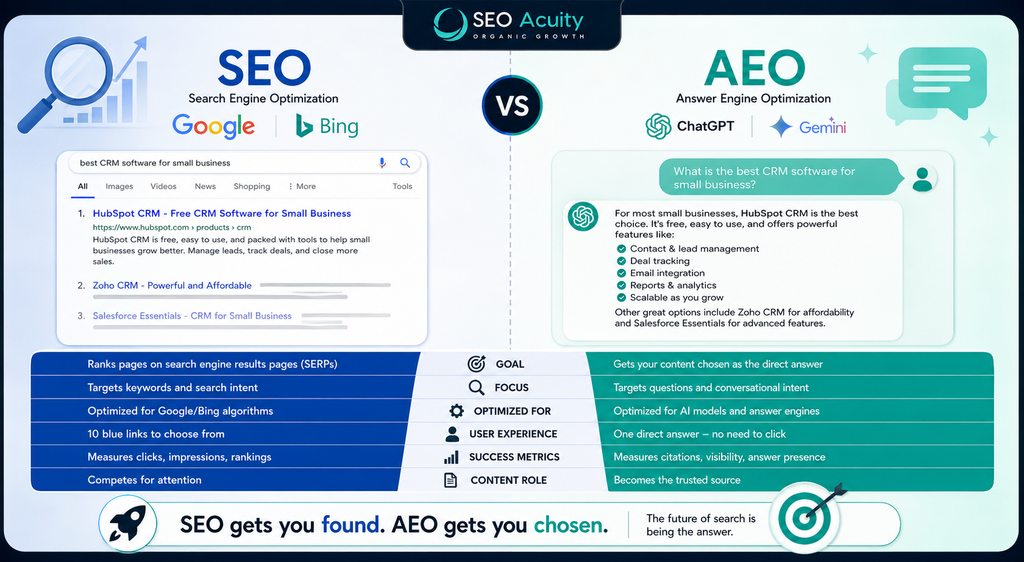
AEO vs SEO — Core Differences at a Glance
Understanding the answer engine optimization AEO vs SEO distinction starts with recognizing that these two strategies target fundamentally different surfaces — and measure success in fundamentally different ways.
The table below maps out where each channel stands across the dimensions that matter most to your strategy:
| SEO | AEO | |
| Primary goal | Rank in traditional SERPs and AI-powered SERP features to drive organic traffic | Get cited or mentioned in AI-generated answers to grow brand visibility and drive traffic |
| Target platforms | Google, Bing | Google AI Overviews, ChatGPT, Gemini, Perplexity, Claude, AI Mode, Copilot |
| User behavior | Users browse results and choose which link to click | Users ask a question and read the AI-generated answer; may then explore citations |
| Content format | Long-form, keyword-focused pages, blogs, landing pages | Structured, concise, answer-first content; FAQs, schema markup, clear entities |
| Core tactics | Keyword research, backlink building, technical SEO, metadata optimization | Structured data, semantic clarity, entity optimization, authoritative sourcing |
| Success metrics | Rankings, organic traffic, click-through rate (CTR), dwell time | AI brand mentions, citation frequency, share of voice in AI answers, prompt coverage |
| User intent served | Navigate to a site for detail or explore a topic | Get a direct, complete answer without necessarily visiting a site |
The most important takeaway: these are not competing strategies — they are complementary ones. Strong SEO fuels AEO success, and AEO amplifies the value of your existing SEO investment.
Read also: GEO SEO Strategy for AI Search – The Complete 2026 Guide to Getting Cited by AI
SEO, AEO, and GEO — Understanding the Full Spectrum
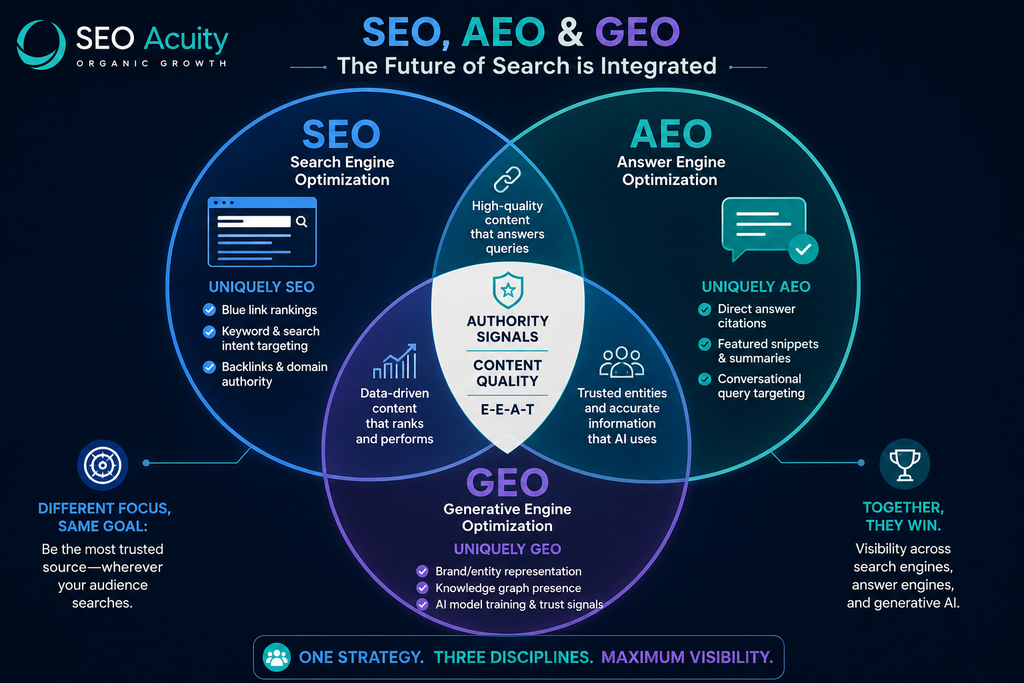
One question that comes up frequently in 2026 is how SEO vs AEO vs GEO relate to each other. Rather than three separate strategies, think of them as three layers of the same visibility system:
- SEO (Search Engine Optimization) focuses on ranking in traditional search engines — primarily Google and Bing — to drive traffic through organic links. It targets users who browse results and actively choose where to click.
- AEO (Answer Engine Optimization) targets the AI layer within traditional search (AI Overviews, AI Mode) as well as standalone AI search engines (ChatGPT, Perplexity, Gemini). Its goal is to get content cited or surfaced inside direct AI-generated answers.
- GEO (Generative Engine Optimization) goes one step further. While AEO focuses on individual answer citations, GEO is about influencing the parametric memory of AI models at a broader brand level — ensuring that when an AI “thinks” about your product category, your brand is mathematically associated with it. GEO SEO Strategy for AI Search aims for the AI to consistently recommend your brand across synthesized responses about an entire vertical, not just for individual queries.
Explore the full breakdown in our guide on What is GEO vs SEO and the Generative Engine Optimization SEO Benefits for Businesses.
In practice, all three overlap significantly. The content and authority signals that help you rank in Google also increase your chances of being cited in AI responses. And the entity clarity that powers GEO reinforces AEO citation frequency.
How AEO and SEO Work Together
The relationship between answer engine optimization and traditional SEO is symbiotic — and understanding it is the key to allocating your marketing investment wisely.
The benefits of AI SEO for businesses come precisely from this integration, not from treating the two as separate tracks.
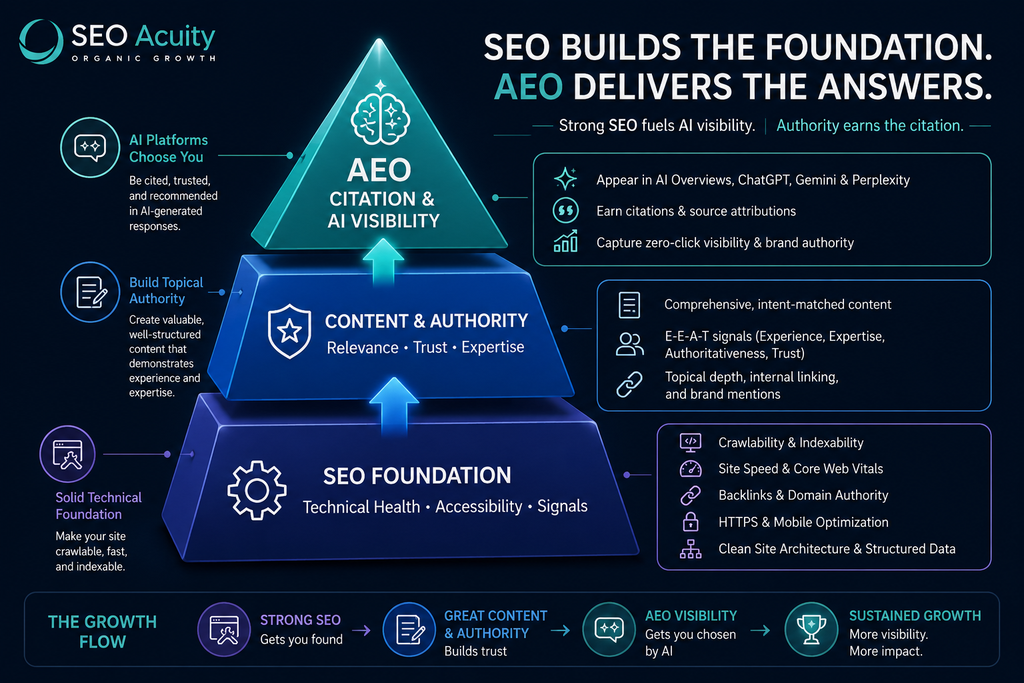
1. SEO builds the foundation that AEO requires: AI models can only cite content they can find, crawl, and understand. If your technical SEO is weak — slow pages, broken indexing, thin content — AI engines simply won’t include you in their answers. SEO is what makes your site legible to machines in the first place.
2. AEO amplifies the authority that SEO creates: A site with strong organic rankings and backlink authority is significantly more likely to be cited by AI platforms. Research consistently shows that AI systems favor trusted domains — even when they pull different pages than Google’s top-ranked URLs. Your domain’s authority matters more than any single page’s ranking.
3. Neither replaces the other: Even as zero-click searches rise, transactional traffic — users who have already been educated by an AI summary and are ready to buy — is more valuable than ever. SEO captures that high-intent click. AEO earns the brand mention that precedes it.
For brands, the question is never seo vs aeo in terms of which to choose. The question is how to structure your efforts so that each strategy reinforces the other.
“How to Build an Organic Growth Strategy That Ranks in Both AI Search and SEO, Step by Step”.
How to Optimize for Both AEO and SEO
The good news is that AEO and SEO optimization strategies overlap heavily. The following approaches move the needle on both channels simultaneously.
For a deeper look at building a complete search strategy, explore What is AI SEO and How to Rank in Google AI Overviews.
a. Create Original, Research-Backed Content
AI models and traditional search engines share a preference for content that contains something genuinely new — original data, first-hand experience, or expert insights that can’t be found anywhere else.
This is not about length. It’s about information gain: does your content add something to the existing conversation, or does it simply repeat what dozens of other pages have already said?
To create content that succeeds in both SEO and AEO:
- Write from direct experience. Share what you’ve actually tested, built, or learned through real client work. Even small insights help your content stand out.
- Use original data. Internal benchmarks, proprietary studies, and client case studies are gold for both search engines and AI citations.
- Add verified author bios with clear credentials. AI models assess who is behind the content as part of determining whether to cite it. Include each author’s role, area of expertise, and hands-on experience.
- Quote recognized experts. Third-party expert voices add depth and signal trust to both human readers and AI systems.
b. Build Authority Through Backlinks and Brand Mentions
Both traditional SEO rankings and AI citation frequency are heavily influenced by how authoritative your brand is perceived to be across the web.
- Backlinks remain a core ranking signal for traditional search engines. They indicate that other reputable sites consider your content worth referencing.
- Brand mentions — even unlinked ones — carry growing weight with AI platforms. LLMs process text patterns: if your brand name consistently appears alongside trusted sources and relevant topics, that co-occurrence trains the model to associate your brand with authority in your space.
Practical ways to build both:
- Publish original research that journalists, bloggers, and industry analysts naturally want to cite
- Contribute expert commentary to publications in your niche
- Collaborate with authoritative brands on co-created studies or interviews
- Pitch guest content to high-authority industry outlets
c. Use Entities to Reinforce Topical Relevance
An entity is any clearly defined concept — a person, brand, product, place, or idea — that search engines and AI models can recognize and connect to related topics. Google’s Knowledge Graph maps these relationships.
LLMs use entity associations to understand what your content is about and whether it belongs in a given conversation.
For example, if you’re writing about AI-powered SEO tools, consistently referencing related entities like “Google AI Overviews,” “structured data,” “schema markup,” and “citation sources” helps both Google and AI engines understand your page’s topical scope — and match it to relevant queries.
Practical entity optimization tips:
- Use consistent terminology throughout your site — don’t alternate between “AI Overviews” and “AIOs”; pick one and use it everywhere.
- Name your brand and products clearly near key value propositions.
- Include related subtopics, examples, and comparisons to broaden semantic context.
Read also: What Is GEO vs SEO? A Complete Guide for Digital Marketers
d. Structure Content for Both Readers and Reasoning Engines
Well-structured content is easier for humans to scan and easier for AI to parse and cite. The principles are almost identical:
- Use a clear H1 → H2 → H3 heading hierarchy that reflects logical topic relationships.
- Lead with the answer. Place your direct response to a question in the first 40–60 words of each section — the “inverted pyramid” approach. AI models are impatient and prefer content that doesn’t bury the lead..
- Use numbered lists for steps or ranked items; bulleted lists for related concepts.
- Implement structured data markup (schema.org) for FAQs, articles, products, and reviews.
- Maintain consistent formatting throughout — inconsistency signals low quality to both bots and readers
The 8 Most Common Technical Mistakes”
Ready to Dominate Search Engine Rankings?
Accelerate your organic growth and scale your business leads with our data-driven SEO strategies.
Get a Free Quote NOW!e. Use Schema Markup as a Trust Signal
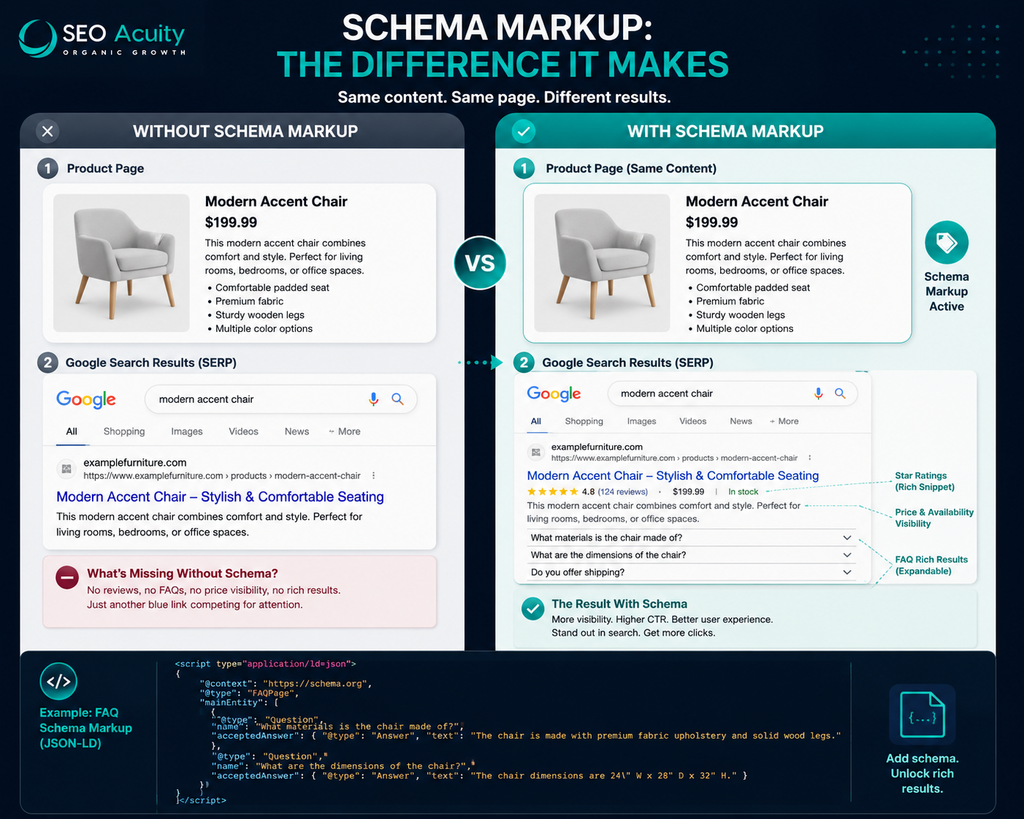
Structured data is a must-have for AEO. Schema markup is the code you add to your HTML that tells search engines and AI models exactly what your content means — not just what words it contains.
For LLM SEO services for enterprise businesses, schema implementation is consistently one of the highest-impact technical investments.
For AEO, the highest-priority schema types are:
- FAQ schema — formats common questions and answers in a way AI engines can extract directly.
- HowTo schema — structures step-by-step processes for direct citation.
- Article schema — establishes authorship, publication date, and content type.
- Product schema — gives AI models verifiable specs, pricing, and availability to cite with confidence.
For traditional SEO, schema enables rich results like featured snippets, star ratings, and dropdown FAQs that improve click-through rates from standard search results.
f. Keep Content Fresh and Factually Current
Stale content is a liability in both channels. Search engines reward freshness, especially for topics where relevance changes quickly. And AI models show a clear preference for pages that are recent and trustworthy.
A regular content audit cadence should include:
- Updating statistics, examples, and data to reflect current reality.
- Refreshing screenshots and visual references to show current interfaces.
- Adding new sections covering recent developments in your topic area.
- Removing references to discontinued tools or outdated practices.
- Re-optimizing for emerging search intents and keyword patterns.
How to Measure AEO vs SEO Performance
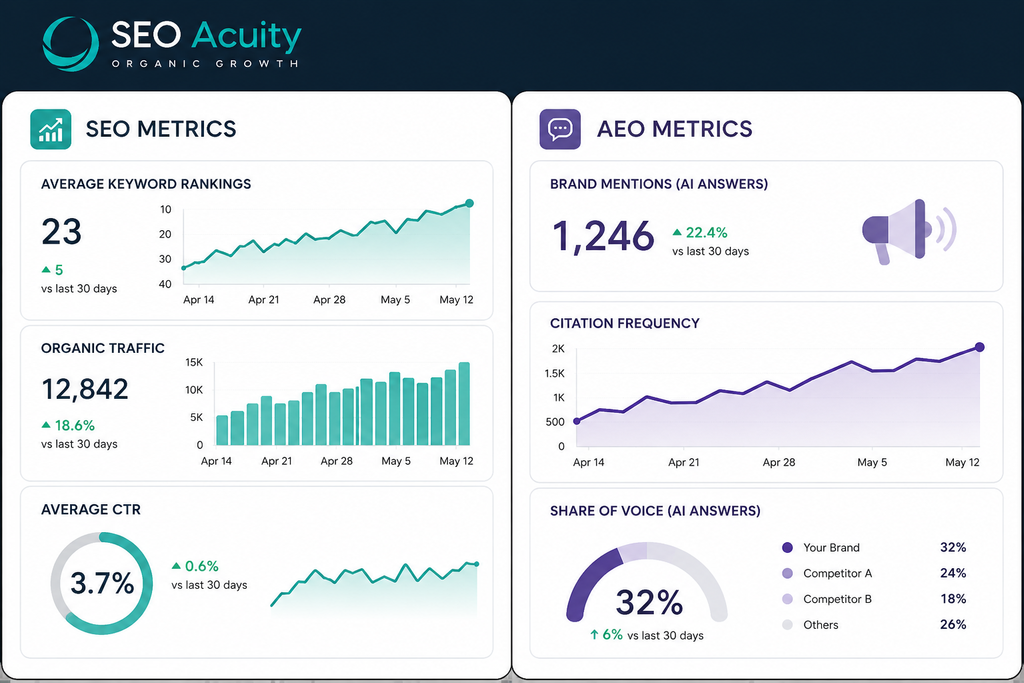
Measuring SEO vs AI Visibility performance requires a two-track approach — because the success signals are fundamentally different for each channel. Tools like Semrush’s AI Visibility Toolkit and emerging platforms purpose-built for AI monitoring can help track AEO metrics alongside traditional SEO data.
Tracking both side by side reveals where organic traffic may be declining while AI-driven brand visibility is rising — a pattern that’s increasingly common as search behavior shifts.
For SEO, track:
- Keyword rankings across target SERP positions.
- Organic traffic volume and quality (engagement, conversion rate).
- Click-through rate from search results.
- Domain authority and backlink growth.
- Appearances in featured snippets, People Also Ask, and AI Overviews.
For AEO, track:
- AI brand mentions across ChatGPT, Perplexity, Gemini, and Google AI Mode.
- Citation frequency — how often AI systems cite your pages as sources.
- Share of voice — what percentage of AI answers in your topic area reference your brand.
- Prompt coverage — which target prompts you appear in vs. which you’re missing.
- Traffic from AI referral sources as they become more trackable.
AEO vs SEO Trends to Watch in 2026
The AEO vs SEO landscape is evolving at speed. Here’s what’s shaping search strategy in 2026:
- Zero-click searches are now the norm. With the majority of informational queries answered directly on the SERP or in AI chat interfaces, brands can no longer rely solely on click-through traffic. Brand imprinting — being cited as the authority before the click happens — is becoming the primary value of AEO. Learn more about does SEO still matter if AI search keeps growing and how to respond strategically.
- AI agents are emerging. Beyond answering questions, AI platforms are beginning to take actions on behalf of users: finding products, comparing options, and completing purchases. This shift from “informational search” to “agentic commerce” will require brands to ensure their content and product data are accessible not just to human readers but to automated reasoning systems.
- Voice search remains significant. With over a billion monthly voice searches globally, optimizing for conversational, question-based queries continues to matter — and AEO strategies (clear Q&A structure, direct answers, schema) are precisely what makes content voice-search friendly.
- GEO is becoming a strategic priority. As AI models become more capable of synthesizing brand-level associations, investing in consistent entity coverage and co-occurrence signals across authoritative sources will determine which brands are “top of mind” for AI — not just which pages rank highest.
- Authority signals are converging. The gap between “what makes content rank in Google” and “what makes content get cited by AI” is narrowing. Both prioritize trustworthiness, expertise, and structured clarity. Brands that have invested in genuine E-E-A-T (Experience, Expertise, Authoritativeness, Trustworthiness) are consistently the ones winning on both surfaces. Consider how to Adapt Your SEO Budget for AI Search in light of these shifts.
“Is Google Dead? The Full Truth About AI Search”
Ready to Dominate Search Engine Rankings?
Accelerate your organic growth and scale your business leads with our data-driven SEO strategies.
Get a Free Quote NOW!Ready to make your brand visible everywhere your audience is searching?
AEO and SEO Are Two Sides of the Same Coin! The AEO vs SEO debate often gets framed as a choice — as if brands must pick one direction and abandon the other. The reality is more straightforward: you need both, and they reinforce each other.
Search in 2026 is no longer a single channel. It’s a layered ecosystem of traditional results pages, AI-powered summaries, voice interfaces, and emerging agentic experiences. Being visible only in Google’s blue links while your competitors are being cited in AI answers means ceding ground in an increasingly influential part of the decision journey.
At SEO Acuity, we help brands build the kind of authority, structure, and content quality that succeeds across all of these surfaces — because the signals that earn trust from Google are the same signals that earn citations from AI.
Whether you need LLM SEO services for enterprise businesses or a full cross-channel organic growth strategy, the brands that understand this integration are the ones writing the playbook for the next decade of search.
Ready to make your brand visible everywhere your audience is searching? Get in touch with the SEO Acuity team to find out how we can build a strategy that wins in both AEO and SEO.

Ready to Dominate Search Engine Rankings?
Accelerate your organic growth and scale your business leads with our data-driven SEO strategies.
Get a Free Quote NOW!Conclusion
The AEO vs SEO conversation is often framed as a fork in the road — pick one, abandon the other. That framing is not just wrong, it’s strategically dangerous. The two disciplines are not competitors; they are dependent on each other, and treating them as separate tracks is the fastest way to fall behind on both.
A few core truths are worth carrying forward from this guide:
- SEO is the foundation, AEO is the amplifier. AI models can only cite content they can find, crawl, and trust — and that trust is built through the same signals that have always driven organic rankings: technical health, backlink authority, and content quality. Neglect your SEO foundation, and your AEO visibility collapses with it.
- The tactics overlap more than they diverge. Original, research-backed content; clear entity usage; structured data; answer-first formatting; consistent freshness — nearly every action that improves your AEO performance also strengthens your traditional SEO, and vice versa. This isn’t two workstreams competing for budget; it’s one integrated content strategy serving two surfaces.
- Measurement has to evolve to match the shift. Rankings and organic traffic alone no longer capture your full visibility. Brand mentions, citation frequency, and share of voice inside AI-generated answers are now part of the same performance picture — and ignoring them means missing where a growing share of your audience’s decisions are actually being made.
- GEO is the next layer, not a replacement. As generative engines mature, the brands that win won’t just be cited in individual answers — they’ll be the ones AI models associate with their entire category by default. Building toward that now, while most competitors are still thinking in terms of keywords alone, is where the real long-term advantage lies.
Search in 2026 is a layered ecosystem — traditional results, AI-powered summaries, voice interfaces, and increasingly, autonomous agents acting on a user’s behalf.
Being visible in only one of these layers while your competitors are visible across all of them isn’t a minor gap. It’s ceding an increasingly influential part of the customer journey before it even begins.
The brands that treat SEO and AEO as one integrated discipline — built on the same foundation of authority, structure, and genuine expertise — are the ones writing the playbook for the next decade of search.
The question isn’t whether to invest in AEO or SEO. It’s how quickly you can align both under a single, coherent strategy before the gap between you and your competitors becomes difficult to close.
Frequently Asked Questions About AEO vs SEO
If you’re navigating the shift to AI-driven search, you’re not alone — below are the questions we hear most often from brands working to align their strategies across both traditional and AI-powered channels.
1. What is AEO vs SEO in simple terms?
SEO (search engine optimization) helps your content appear in Google and Bing when users search for relevant keywords.
AEO (answer engine optimization) helps your content get cited inside AI-generated answers on platforms like ChatGPT, Google AI Overviews, Gemini, and Perplexity.
SEO drives traffic through clicks; AEO builds visibility through citations — and both are needed in 2026.
2. Will AEO replace SEO?
No. AEO depends on SEO. AI engines can only cite content they can find, crawl, and trust — and that trust is built through the same authority signals that drive traditional SEO: backlinks, technical integrity, content quality, and domain authority.
Think of SEO as the foundation and AEO as the layer built on top of it. Brands that abandon SEO in favour of pure AEO will quickly find their AI visibility declining alongside their organic authority.
3. What is the difference between SEO, AEO, and GEO?
SEO targets traditional search engine results pages to drive organic traffic. AEO targets the AI answer layer — optimizing content to be cited in AI-generated responses on both traditional search engines (via AI Overviews) and standalone AI platforms.
GEO (generative engine optimization) takes a broader brand-level approach, aiming to ensure AI models consistently associate your brand with your category across all generative responses — not just for individual queries.
See the What is GEO vs SEO guide for a complete breakdown and the Generative Engine Optimization SEO Benefits for Businesses to understand what GEO can deliver.
4. Can you optimize one page for both SEO and AEO?
Yes — and you should. The best-performing content in 2026 is structured to serve both: clear headings that answer questions directly, authoritative information grounded in original research, clean schema markup, consistent entity usage, and regular freshness updates.
A single well-optimized page can rank in Google, appear in featured snippets, surface in AI Overviews, and be cited by ChatGPT — all at once.
5. How does SEO vs AEO differ for brands specifically?
For brands, SEO focuses on driving qualified traffic to your site through search rankings — building awareness, leads, and conversions through the click.
AEO is about brand-level visibility and trust: ensuring that when a potential customer asks an AI which brand to trust in your category, your name is part of the answer.
Both matter for seo vs aeo for brands because they influence different parts of the decision journey — AEO shapes perception before the search, while SEO captures intent during it.
6. Is answer engine optimization the same as SEO?
Answer engine optimization and traditional SEO share many foundational tactics — quality content, authoritative backlinks, technical site health — but they differ in target platform, content format, and success metrics.
Answer engine optimization vs traditional SEO: the former optimizes specifically for AI-generated responses and zero-click surfaces, while the latter focuses on ranking positions and organic clicks.