Google has always been in the business of answering questions. But with the launch of Search Generative Experience (SGE), it has fundamentally changed how those answers are delivered — and that shift has enormous implications for every business that depends on organic search traffic.
SGE places an AI-generated answer at the very top of the results, synthesised from multiple sources and designed to answer the query without the user leaving Google. For millions of searches every day, the click to your website is no longer the first thing that happens — or necessarily something that happens at all.
That’s a significant problem if your SEO strategy hasn’t kept pace. It’s also a significant opportunity if you understand the rules of this new environment before your competitors do.
This guide covers everything you need to know about Search Generative Experience SEO: what SGE is, how it works, how it’s already reshaping organic traffic, and — most importantly — what you need to do differently to stay visible and competitive.
What Is Search Generative Experience (SGE)?
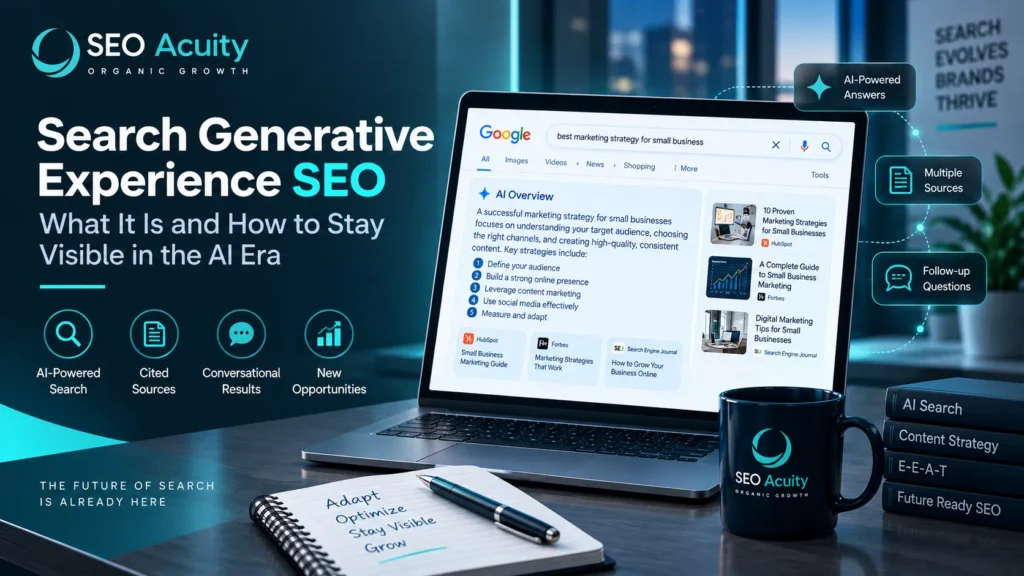
Search Generative Experience (SGE) is Google’s integration of generative AI directly into the search results page.
Rather than returning a ranked list of links and leaving the user to piece together an answer, SGE generates a conversational, AI-written summary at the top of the SERP — drawing on information from multiple webpages to give users a direct, synthesised response to their query.
Google officially launched SGE to the US public in May 2024, following an extended testing period through Search Labs. The technology is built on Google’s most advanced language models — PaLM 2 and MuM — working alongside the same search infrastructure Google has refined over 25 years.
The result isn’t a replacement for traditional search; it’s a new layer sitting above it, fundamentally changing how users interact with results.
To understand the difference in practice, consider this scenario. A user searching for “what to consider when choosing a business energy supplier” used to get a list of articles and comparison pages — they’d click through to one or two, skim for relevance, and piece together an answer.
With SGE, Google now presents an AI-generated overview at the top of the page, covering switching costs, contract lengths, tariff types, and green credentials — pulling from several sources simultaneously.
Those sources appear as cards alongside the snapshot, and below the overview, users can ask natural follow-up questions like “which suppliers are best for small businesses?” without starting a new search.
For users, this is a faster, richer, more conversational experience. For businesses that rely on organic search traffic, it’s a structural shift in how value flows through the SERP — and understanding that shift is the foundation of effective Search Generative Experience SEO.
Read also: How to Rank in Google AI Overviews – A Complete 2026 Guide
How Google SGE Works – The Technology Behind the Answer
You don’t need to be an AI engineer to optimise for SGE, but understanding the basic mechanics of how it selects and synthesises content changes how you think about your own pages.
SGE’s development traces back to a series of AI research models Google has built since 2020 — evolving through REALM (Retrieval-Augmented Language Model Pre-Training), RETRO (Retrieval-Enhanced Transformer), and RARR (Retrofit Attribution using Research and Revision).
Each iteration improved Google’s ability to accurately retrieve and synthesise information from real web documents, rather than generating responses purely from statistical patterns in training data alone.
The SGE you see today combines PaLM 2 and MuM with Google’s established search infrastructure — the document index, Knowledge Vault, and quality-evaluation systems — producing a model that corroborates answers with real source material and attributes information to specific pages.
This is a crucial point for What is AI SEO: SGE doesn’t operate on a separate ranking logic to traditional search. It draws from the same pool of high-quality, well-optimised, trustworthy content that performs well organically.
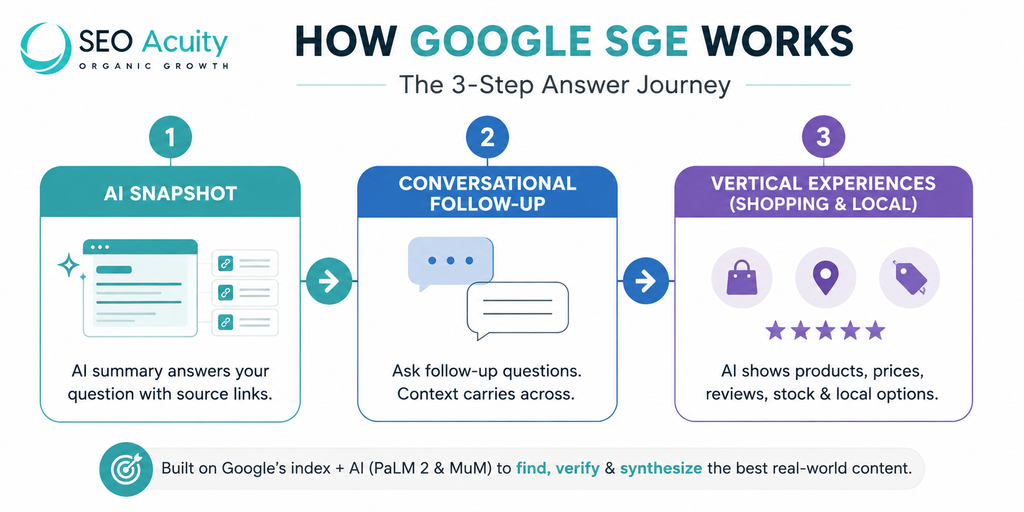
The difference is in what happens next — instead of sending users to those pages, it extracts, synthesises, and presents the most relevant information directly on the SERP. SGE surfaces results in three main formats:
1. The AI Snapshot
For most queries, SGE surfaces a structured overview answering the core query, with supporting source cards displayed alongside. This snapshot is the mode most relevant to informational and research-based queries, and the one most likely to reduce click-through rates on traditional results.
It’s designed as a starting point, not a final destination — users can expand it, verify its sources, or move into a follow-up conversation from here.
2. The Conversational Follow-Up Mode
After the initial overview, users can ask follow-up questions in natural language. Context is carried across the conversation, so a user can move from a general question to increasingly specific queries without restating their situation.
This mirrors the experience of talking to a knowledgeable expert — and it’s actively training users to search in longer, more descriptive, and more conversational terms.
3. Vertical Experiences for Shopping and Local Queries
For shopping and local queries, SGE integrates product data from Google’s Shopping Graph — which holds over 35 billion product listings, refreshed at a rate of 1.8 billion listings per hour — to produce results that include ratings, pricing, reviews, and stock availability.
This is where the impact on What Are Google AI Overviews for SEO results is beginning to be felt most directly for transactional content.
Read also: What Are Google AI Overviews for SEO? A Complete Guide
How SGE Is Already Reshaping Organic Search
The effects of SGE on organic traffic aren’t theoretical — they’re already showing up in analytics dashboards across industries, and the full impact, particularly outside the US, is still unfolding. Understanding what’s changing is the first step toward adapting to it.
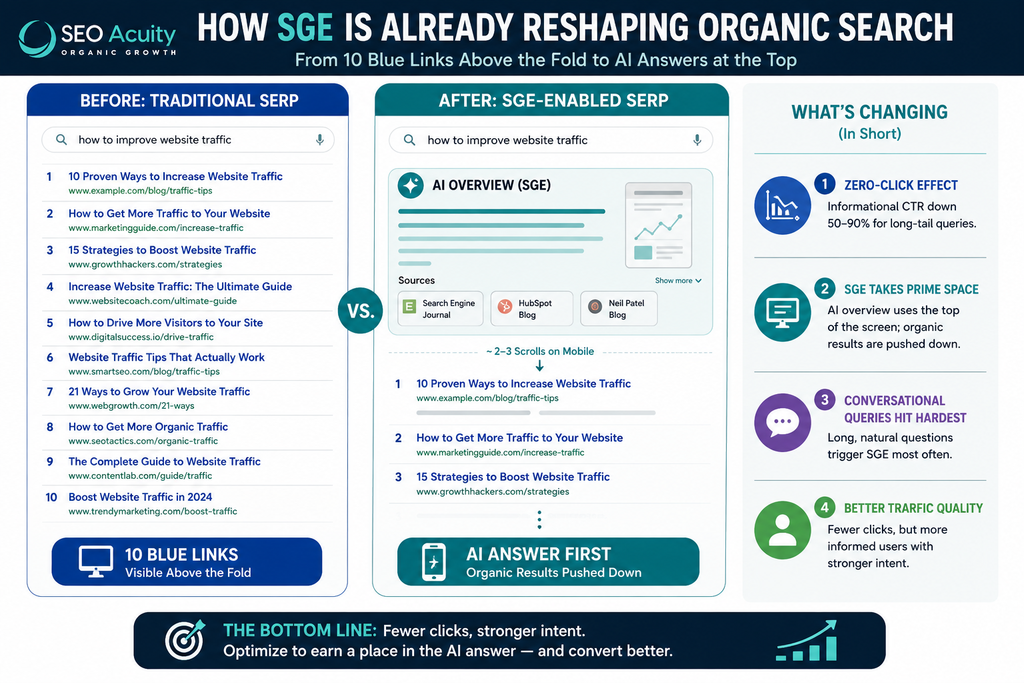
1. The Zero-Click Effect – Informational CTR Is in Decline
When an AI overview satisfies a user’s query entirely, there’s no reason to click. For informational content — “what is,” “how to,” “why does,” “which is better” — this effect is most pronounced.
Research conducted by Brightedge in early 2024, ahead of the full US launch, indicated potential CTR reductions of 50 to 90 percent for long-tail informational queries where SGE generates a complete answer.
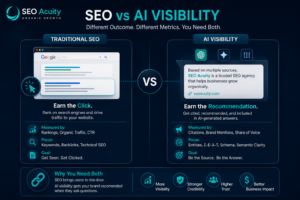
For businesses whose content strategy was built on capturing top-of-funnel traffic through educational content, this is not an incremental change — it’s a category-level disruption. Understanding the full picture of SEO vs AI Visibility is now essential for any business competing in organic search.
2. SGE Occupies Prime SERP Real Estate
The traditional “above the fold” position has moved further down the page:
- On desktop, the SGE snapshot can occupy several inches of screen space before traditional results appear.
- On mobile, the effect is more dramatic — often requiring two or three full scrolls before a user reaches the first organic link.
If your content isn’t featured inside the AI overview, it’s now competing from a structurally weaker position than it occupied twelve months ago.
Read also: How to Adapt SEO Budget for AI Search Optimization
3. Long-Tail and Conversational Queries Are Most Affected
SGE excels at handling complex, multi-part questions in natural language. Shorter, transactional keyword phrases are holding up better — if someone searches for “buy accountancy software” or “Manchester plumber near me,” SGE is currently less likely to intervene with a full AI summary.
But as the technology develops, even those query types will be affected, and the shift toward conversational search behaviour is already accelerating across all categories.
4. Post-Click Traffic Quality Is Improving for Optimised Sites
There’s a real upside embedded in this change. Users who navigate past the AI overview and click through to your website have already received a surface-level summary of the topic. They arrive:
- Better informed, with clearer intent.
- Further along in a consideration or purchase journey.
- More likely to convert on the right offer.
For businesses whose content is genuinely helpful and whose conversion pathways are well-designed, this can translate into higher-quality leads even from lower traffic volumes.
Exploring the benefits of AI SEO for businesses in this context reveals a story that raw traffic numbers alone would miss.
What Makes Content SGE-Citation-Worthy?
This is the most practical question in Search Generative Experience SEO, and it’s the one most businesses haven’t yet asked clearly enough.
SGE doesn’t randomly select sources — it exhibits consistent patterns in the content it cites, and those patterns align closely with what Google has always prioritised, just with the stakes raised considerably.
The five factors below determine whether your content gets referenced in an AI overview or bypassed entirely.
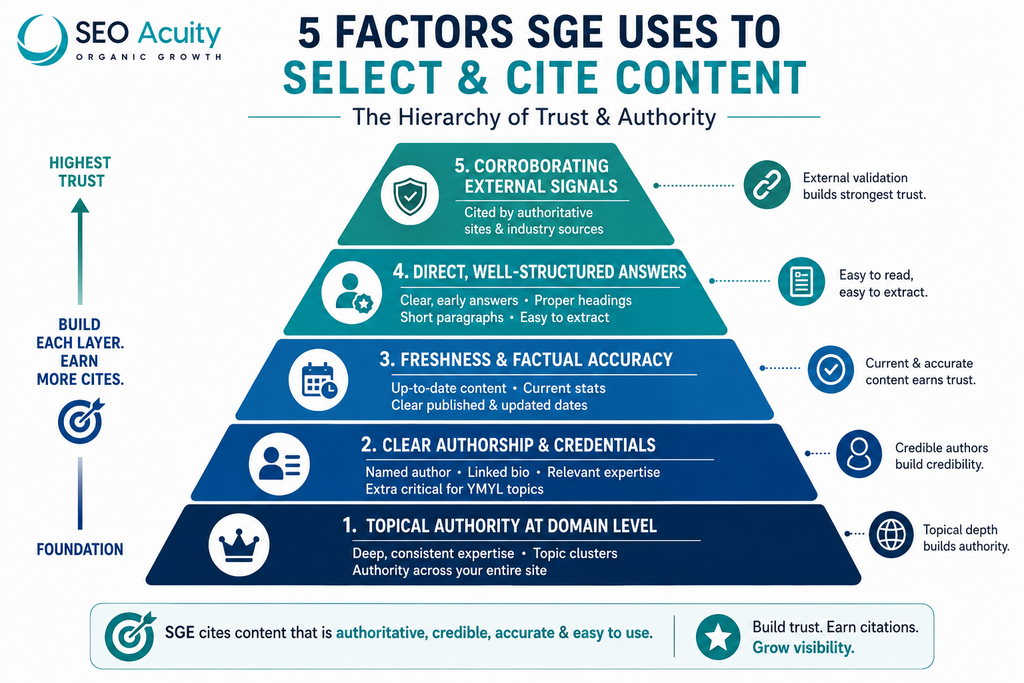
1. Topical Authority at the Domain Level
SGE favours sites that demonstrate deep, consistent expertise in a subject area. A single well-written article on a generalist site is far less likely to be cited than a similar article on a site that has built a coherent body of content around that topic.
This is the clearest argument for a topic-cluster content strategy: it signals authority not just at the page level, but across the entire domain.
2. Clear Authorship and Expert Credentials
Pages that identify the author, include biographical information, and link to their relevant expertise perform better in SGE citation:
- Named authors with linked bios strengthen credibility signals significantly.
- For YMYL topics — health, finance, legal matters — this signal carries extra weight.
- SGE carries the same caution Google applies to traditional results: it is reluctant to cite content on sensitive topics that lacks identifiable, credible authorship.
3. Freshness and Factual Accuracy
SGE prioritises content that is up to date and accurate:
- Include recent data and current statistics wherever relevant.
- Clearly mark publication and last-reviewed dates on every page.
- Avoid claims that can be contradicted by high-authority sources — these can actively harm your overall trust profile.
Content that is factually accurate and demonstrably current is significantly more likely to be selected and retained as a citation source over time.
4. Direct, Well-Structured Answers
SGE works by extracting relevant passages from web content. Pages that:
- Answer questions clearly and early, without long preambles.
- Use structured language with proper H2 and H3 hierarchy.
- Write in short paragraphs with explicit topic sentences.
…give the model far more to work with. Dense, jargon-heavy prose or buried answers make your content harder to parse and less likely to be selected.
This is also why understanding How to Rank in Google AI Overviews starts with content architecture, not just keyword targeting.
5. Corroborating Signals from External Sources
If your content is linked to, cited by, and referenced across authoritative domains in your industry, Google’s systems interpret this as real-world validation — the digital equivalent of peer review.
This is one of the strongest signals in the entire SGE selection process and one of the hardest to shortcut.
Building genuine authority through editorial coverage, expert citations, and high-quality links remains as important as ever — arguably more so.
Ready to Dominate Search Engine Rankings?
Accelerate your organic growth and scale your business leads with our data-driven SEO strategies.
Get a Free Quote NOW!Search Generative Experience SEO – How to Optimise Your Strategy
Knowing what SGE rewards is one thing — building a strategy around it is another. The fundamentals of strong SEO still apply, but the following seven priorities demand a higher level of execution than what was previously sufficient.
For a broader view of how GEO SEO Strategy for AI Search is evolving in parallel with traditional optimisation, these actions form the shared foundation.
“A Practical Step-by-Step Framework for Appearing in AI Search Results Like ChatGPT and Gemini” .
1. Deepen Your E-E-A-T Signals Across the Site
Experience, Expertise, Authoritativeness, and Trustworthiness aren’t abstract concepts — they translate into specific, auditable on-page and off-page elements. To strengthen E-E-A-T across your site:
- Ensure every piece of content has a named, credentialled author with a linked bio.
- Include original research, firsthand experience, and expert quotes wherever relevant.
- Build and maintain a detailed About page with clear, verifiable contact information.
- Demonstrate consistent topical depth across your content library, not just individual pages.
These signals tell both users and Google’s AI systems that your content comes from a real, accountable source — and that distinction is increasingly what determines whether you appear in an AI-generated result or get bypassed entirely.
Understanding the Generative Engine Optimization SEO Benefits for Businesses fully begins with getting E-E-A-T right at the foundation.
2. Align Every Piece of Content with Search Intent
SGE’s primary function is intent satisfaction. Before writing any piece of content, identify not just the keyword but the reason someone searches for it — because the same keyword from different users can signal completely different needs.
Map your content explicitly to one of four intent types:
- Informational — the user wants to learn something (e.g. “what is SGE SEO”).
- Commercial — the user is comparing options before a decision (e.g. “best SGE SEO agency”).
- Navigational — the user is looking for a specific brand or page.
- Transactional — the user wants to take an action (e.g. “SGE SEO audit service”).
Ensure the format, depth, and structure of the page match what that intent demands.
This is foundational to How to Adapt SEO Budget for AI Search effectively: resources should follow intent-value, not just raw traffic volume.
3. Rewrite for Conversational and Question-Based Queries
SGE is actively encouraging users to search in longer, more natural language. To align your content with this shift:
- Review existing content and make the specific questions it answers explicit in the structure.
- Use question-based subheadings — H2s and H3s phrased as the actual questions users ask.
- Include a dedicated FAQ section addressing the most common follow-up queries on each topic.
- Write in the direct, natural language your audience uses — not the formal register of a marketing brochure.
This structural approach makes your content easier for SGE to extract from, and positions you for the growing volume of conversational, long-tail queries that the feature is actively driving.
4. Build Out Topic Clusters, Not Just Individual Pages
A single authoritative article is a starting point. A network of interconnected, mutually supporting pages is a domain-level authority signal. To build effectively:
- Create pillar pages that provide comprehensive overviews of your core topics.
- Surround each pillar with cluster content that goes deeper on specific subtopics.
- Ensure every cluster page links back to the pillar and across to related cluster pages.
- Maintain thematic consistency across the cluster — avoid drifting into loosely related territory.
This structure tells Google that your site doesn’t just have one good piece of content — it carries real, systematic expertise across a subject area. That’s precisely what SGE looks for when selecting citation sources.
“How to Build an Organic Growth Strategy That Ranks in Both AI Search and SEO, Step by Step”.
5. Implement Structured Data Throughout Your Site
Schema markup is the clearest signal you can send to Google about the nature and context of your content. For a Search Generative Experience SEO strategy, the highest-priority schema types are:
- FAQ schema — especially effective for question-based and conversational content.
- How-To schema — for instructional and step-by-step content.
- Article schema — with author and date properties fully populated.
- Product and Review schema — for commercial pages and shopping-intent content.
Structured data won’t guarantee inclusion in an AI overview, but it meaningfully increases the likelihood that Google can correctly interpret and categorise your content — which is the prerequisite for being cited at all.
6. Pursue High-Quality Citations and Editorial Coverage
Links and brand mentions from respected publications remain among the strongest trust signals in the SGE environment. To build citation authority:
- Actively pursue opportunities for editorial coverage in authoritative industry publications.
- Contribute expert guest content to well-regarded sites in your niche.
- Seek genuine citation by recognised subject-matter experts and thought leaders.
- Build a PR and content strategy that generates real coverage of your original research or insights.
If respected voices in your space reference your content, Google’s systems register this as a validation signal — one of the clearest indicators that your content meets the real-world credibility standard SGE is designed to reflect.
7. Evolve Your Measurement Framework
Standard organic performance reporting no longer tells a complete story in the SGE era. Expand your tracking to include:
- CTR by query type — to identify where zero-click effects are hitting hardest.
- Brand search volume — as a proxy for overall visibility even when direct clicks are declining.
- Engagement metrics — time on page, scroll depth, pages per session.
- Conversion rate as a share of sessions — not just absolute conversion numbers.
A lower traffic volume with a higher conversion rate is a success story, not a failure — but only if you’re measuring the right things.
This reframing is central to How to Adapt SEO Budget for AI Search in a way that demonstrates genuine business value to stakeholders.
Ready to Dominate Search Engine Rankings?
Accelerate your organic growth and scale your business leads with our data-driven SEO strategies.
Get a Free Quote NOW!The Known Limitations of SGE
It would be misleading to discuss SGE without acknowledging that the technology is still maturing.
Google’s own documentation states plainly that “Search, even today, will not always get it right.” What is LLM SEO begins with understanding this reality: language models can hallucinate — producing confident, grammatically fluent responses that are factually wrong.
Since SGE’s launch, there have been widely reported examples of the system providing dangerous advice — recommending that a user add glue to pizza to keep the cheese in place (pulled from a years-old satirical Reddit comment), and — more seriously — generating a response to a mental health query that included a suggestion to jump off a bridge.
For YMYL topics, SGE adds explicit disclaimers and limits the types of queries where AI overviews appear at all. Google’s quality systems and additional guardrails are actively being improved.
But these incidents highlight something important for SEO strategy: the AI is specifically looking for content it can trust.
SGE vs. Traditional SEO – What Changes, What Stays the Same
A question worth answering directly: does SEO still matter if AI search keeps growing?
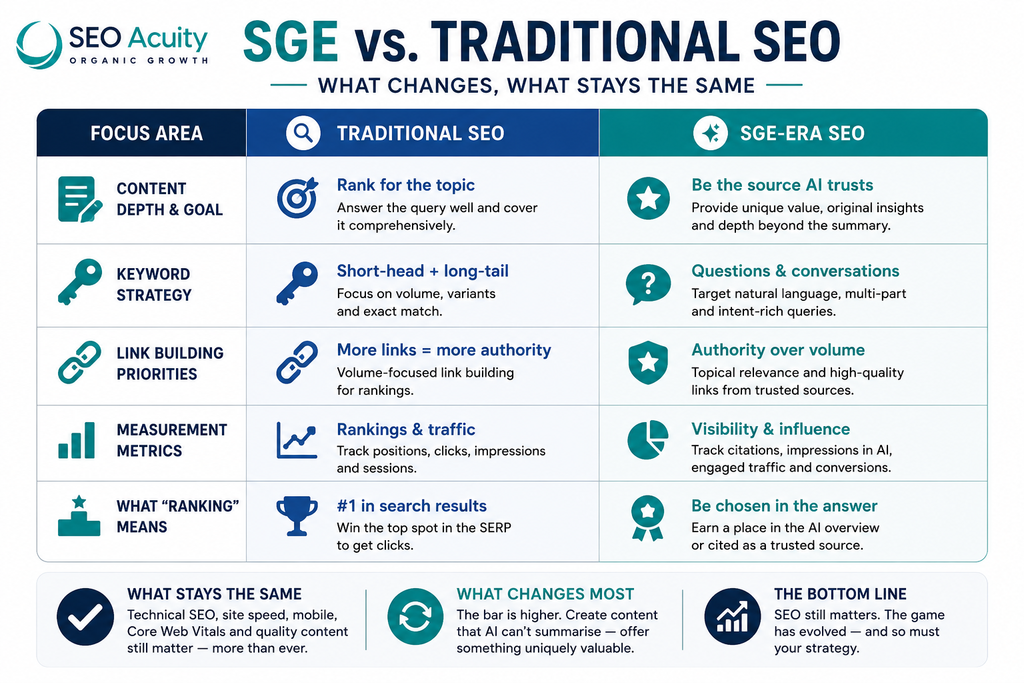
No — SGE does not make traditional SEO obsolete. But it shifts the balance of what matters, and understanding that distinction clearly is where AI SEO vs Traditional SEO analysis becomes genuinely useful.
What stays the same:
- Technical SEO — Page speed, crawlability, mobile optimisation, and Core Web Vitals remain foundational. SGE draws from the same index that depends on them. A slow, poorly structured site won’t be cited in an AI overview regardless of how good the content is.
The 8 Most Common Technical Mistakes”]
- Keyword research — Still essential, but the scope needs to expand. Short-head keywords remain important, but long-tail and question-based keyword research is now more commercially valuable than it’s ever been, given how SGE is rewiring user search behaviour.
- Link building — Still important, but the emphasis shifts firmly from volume to authority and topical relevance. A handful of links from genuinely authoritative, relevant sources outperforms a large volume of lower-quality links in the SGE environment.
What changes most fundamentally:
In a world where the AI summary answers a user’s surface-level question, the content that earns a click has to offer something the summary can’t — original research, unique expertise, a specific perspective, interactive tools, or a transaction that requires actually visiting the page. The bar for “good enough” has risen sharply and will continue to rise.
Exploring What is GEO vs SEO and aeo vs seo alongside this shift helps contextualise where SGE sits within the broader movement toward generative and answer-engine-optimised search — a direction the entire industry is moving in, not a temporary experiment.
Partner with SEO Acuity for the AI Search Era
Staying visible in Google’s AI-driven results isn’t something that happens by accident — it requires a strategy built specifically for how SGE selects, synthesises, and cites content.
At SEO Acuity, we specialise in exactly that. Our team conducts in-depth SGE SEO audits that map your existing keyword portfolio, content architecture, E-E-A-T signals, and structured data against what Google’s AI systems actually reward — then builds a practical, prioritised roadmap to close the gaps.
Whether you’re a growing business trying to understand how the SGE Era is reshaping your organic traffic, or an established brand looking for a dedicated Google SGE SEO agency to lead a full strategic overhaul, our process is designed around one outcome: making sure your business is the source Google’s AI chooses to cite, not the one it quietly bypasses.
Book a free consultation with SEO Acuity today and find out exactly where your visibility stands in the AI search landscape — before your competitors get there first.

Ready to Dominate Search Engine Rankings?
Accelerate your organic growth and scale your business leads with our data-driven SEO strategies.
Get a Free Quote NOW!Conclusion
Search Generative Experience has changed the mechanics of how visibility works — but not the fundamentals of what earns it. The businesses that treat this moment as a reason to abandon SEO are misreading the shift; the businesses that treat it as a reason to finally do SEO properly are the ones who will own the next decade of search.
A few truths are worth holding onto as you move from understanding SGE to acting on it:
- SGE draws from the same pool of quality signals traditional search has always rewarded — E-E-A-T, topical authority, structured content, and genuine credibility. There is no separate, secret ranking system to game. There is only a higher bar for the same fundamentals.
- The cost of invisibility has gone up. Zero-click searches, a shrinking above-the-fold, and increasingly conversational queries mean that content sitting just outside the AI overview is now competing from a structurally weaker position than it was twelve months ago.
- The opportunity is asymmetric. Most competitors haven’t adapted yet. Deepening authorship signals, restructuring content around real search intent, building topic clusters instead of isolated pages, and implementing structured data are still underused levers in most industries — which means acting now creates a lead that’s harder to close later.
- Measurement has to evolve alongside strategy. Rankings and sessions alone no longer tell the full story. Tracking brand search volume, engagement depth, and conversion rate as a share of sessions is how you’ll actually see whether your SGE strategy is working.
The core discipline hasn’t changed: build content that’s genuinely expert, clearly sourced, well-structured, and worth citing. What’s changed is the audience for that discipline — it’s no longer just users scrolling a results page, it’s the AI systems deciding who gets to speak first.
The businesses that internalise that distinction now, and build a deliberate strategy around it, won’t just survive the SGE era — they’ll be the ones the AI turns to when it answers the question their customers are asking.
Frequently Asked Questions About Search Generative Experience SEO
Below are the questions we hear most often from businesses navigating the shift to AI-powered search — with direct, practical answers to help you move forward with clarity.
Does SGE affect all types of searches?
No. SGE is most active on informational and research-based queries — “what is,” “how to,” “best options for,” and comparison searches.
Navigational queries (where a user is looking for a specific site) and clearly transactional queries are currently less likely to trigger a full AI overview, though this is evolving as Google refines the system.
Can paid search ads still appear with SGE?
Yes. Google has confirmed that Search ads continue to appear in dedicated slots on the SERP alongside SGE results. Ad placements are clearly labelled and distinct from the AI-generated overview.
For businesses currently running paid search campaigns, the presence of SGE changes the organic landscape but doesn’t directly affect paid ad inventory — at least not in its current form.
How do I know if SGE is affecting my organic traffic?
The clearest signals are declining CTR on informational pages alongside stable or growing impressions, and a drop in sessions for top-of-funnel content without any accompanying ranking movement.
A specialist SGE SEO audit can provide a systematic assessment of where SGE is intersecting with your current keyword portfolio and what the measurable traffic impact has been.
Is SGE the same as Google’s AI Overviews?
What Are Google AI Overviews for SEO and SGE (Search Generative Experience) refer to the same feature — “AI Overviews” is the term Google now uses more broadly; SGE was the original experimental name from the Search Labs testing phase. For practical SEO purposes, they require the same strategic response.
How does SGE affect local SEO?
Local and shopping queries are handled through SGE’s vertical experience mode, which integrates structured product and business data from Google’s Shopping Graph and Business Profile information.
Keeping your Google Business Profile fully updated — with accurate categories, services, photos, reviews, and attributes — is increasingly important for appearing in SGE’s local and shopping results.
Is Your Business Ready for the SGE Era?
The businesses that will thrive in the next phase of search are not the ones who try to find shortcuts around the AI.
They’re the ones investing in real expertise, credible content, and a systematic understanding of how Google’s evolving systems evaluate and reward quality.
If you’re questioning whether the moment to act has passed, it hasn’t — but the window to get ahead of competitors still waiting is narrowing.
هل جوجل مات؟ الحقيقة الكاملة عن AI Search
At SEO Acuity, our Google SGE SEO service is built around this reality. We combine comprehensive SGE SEO audits — examining your keyword portfolio, content architecture, E-E-A-T signals, and structured data implementation — with a practical optimisation strategy designed to position your business as a trusted citation source within AI-generated results.