Search behavior changed the moment Google started answering questions directly on the results page instead of just listing links to them. If you’ve noticed a summarized answer sitting above the usual blue links — often with a few bullet points and source citations — you’ve already encountered the feature this guide explains.
Google AI Overviews for SEO refers to how these AI-generated summaries affect visibility, traffic, and ranking strategy for website owners. Understanding what triggers them, how they’re built, and how to appear in them has become a core part of modern search optimization — not a side consideration.
This guide covers what AI Overviews are, how they’re generated, which queries trigger them, and the specific actions that improve your chances of being cited in one.
What You’ll Learn in This Article
- What Google AI Overviews are and how they differ from featured snippets.
- The mechanics behind how Google generates and cites content in an Overview.
- Which search intents and industries see AI Overviews most often.
- The concrete, actionable steps for optimizing content for AI Overview visibility.
- How AI Overviews affect organic traffic, click-through rates, and revenue.
What Are Google AI Overviews?
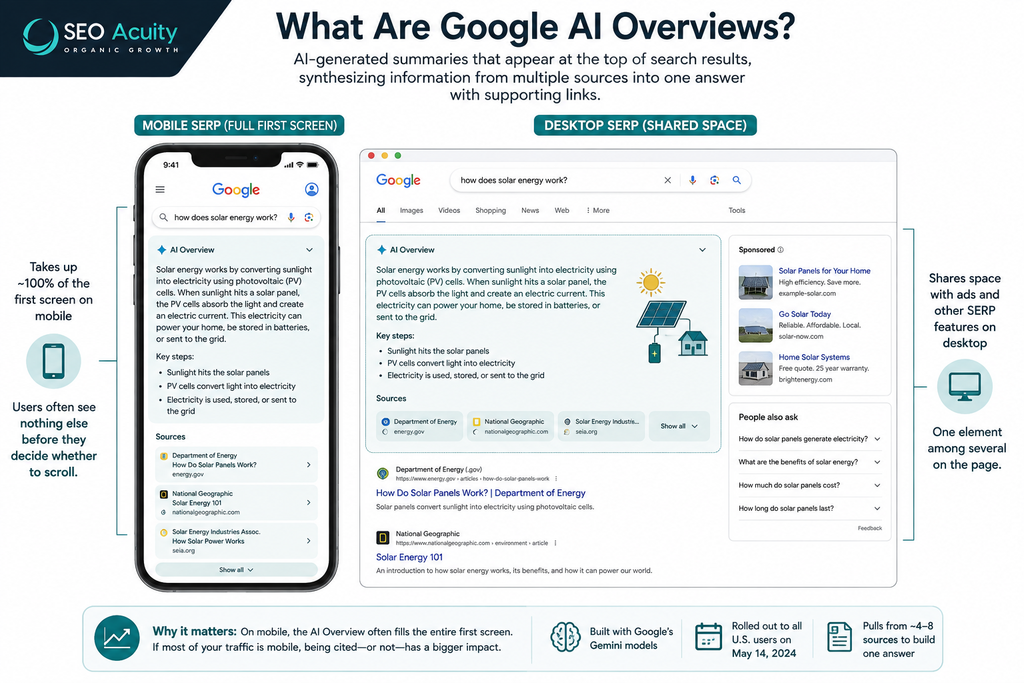
Google AI Overviews are AI-generated summaries that appear near the top of search results, synthesizing information from multiple web pages into a single written answer with supporting source links.
They are built using Google’s Gemini large language models and were rolled out to all U.S. users on May 14, 2024, after starting as an experimental feature called Search Generative Experience (SGE) — the foundational research behind what’s now broadly discussed as SGE / Search Generative Experience SEO.
An AI Overview typically includes three components:
- A written explanation (often a mix of paragraphs and bullet points).
- A set of cited source links.
- A fixed position at or near the top of the search results page.
Unlike a standard organic listing, which ranks a single page, an AI Overview draws from several sources at once — usually between four and eight pages — to construct its answer.
On desktop, the Overview shares the page with ads and other SERP features, so it reads as one element among several. On mobile, it frequently fills the entire first screen, which means a phone user often reads nothing else before deciding whether to scroll.
If most of your traffic for a given topic is mobile, the practical stakes of being cited — or not — are considerably higher than desktop data alone would suggest.
a. AI Overviews vs. AI Mode
AI Overviews are not the same feature as AI Mode, a separate and more conversational AI search experience Google introduced in 2025.
- AI Overviews sit on the standard search results page and answer a single query with a summary.
- AI Mode functions more like a back-and-forth chat, letting users ask follow-up questions and refine their search conversationally.
- Both draw on the same underlying web content, but they serve different moments in a user’s search journey — AI Overviews for quick orientation, AI Mode for extended exploration.
b. AI Overviews vs. Featured Snippets
The two features are often confused, but they’re built differently. A featured snippet pulls a short extract — a paragraph, list, or table — from a single web page and displays it at the top of results.
An AI Overview synthesizes information across multiple pages into a new, generated summary rather than quoting one source verbatim.
This distinction matters for optimization. Ranking for a featured snippet means writing the single best, most extractable answer on the page that currently holds position one.
Ranking for an AI Overview means having content that Google’s systems judge to be a reliable input among several sources — you don’t need to outrank everyone; you need to be one of the trusted few in the mix. As AI Overviews have expanded, featured snippet visibility has declined for broader, synthesis-friendly queries, though snippets still appear for narrow, single-fact questions.
Decision rule:
If your target query has one correct, static answer (a definition, a date, a single number), optimize for the snippet format first. If the query has multiple valid answers depending on context (a comparison, a “best for” question, anything with trade-offs), optimize for Overview citation instead — the formats reward different structures, and writing for both at once usually weakens both.
This is one of the core distinctions our team maps out when we explain AEO vs SEO for clients building out a full search-visibility plan.
Read also: How to Adapt SEO Budget for AI Search Optimization
How Google AI Overviews Work
Google’s systems generate an AI Overview through three connected steps: query fan-out, source synthesis, and citation. Understanding this sequence explains why the page that ranks #1 for your target keyword isn’t always the page Google cites.
a. Query Fan-Out
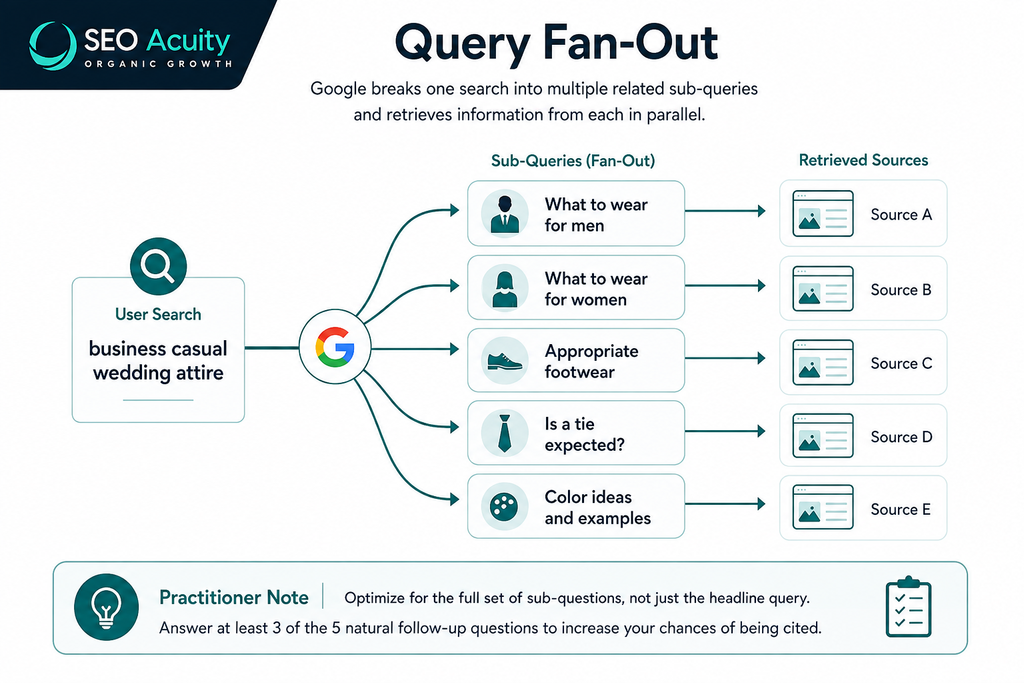
When a user submits a search, Google doesn’t run one query — it runs several. This process, called query fan-out, breaks the original search into multiple related sub-queries and retrieves information for each in parallel.
A search for “business casual wedding attire,” for example, might fan out into separate searches covering:
- What to wear for men.
- What to wear for women.
- Appropriate footwear.
- Whether a tie is expected.
Practitioner note:
This is the single most misunderstood mechanic in AI Overview optimization. Teams often optimize one page for one exact-match keyword and then can’t understand why a competitor’s subtopic page gets cited instead. If your content only answers the headline query and ignores the adjacent sub-questions a reader would naturally have, you’re invisible to most of the fan-out.
A useful diagnostic: before publishing, list the five questions a genuinely curious reader would ask right after getting your headline answer. If your page doesn’t address at least three of them — even briefly — you’ve built a single-query page competing in a multi-query retrieval system.
We walk through exactly this kind of diagnostic in our video — watch it here: A Practical Step-by-Step Framework for Appearing in AI Search Results Like ChatGPT and Gemini — which breaks the process into a repeatable step-by-step framework.
b. Content Synthesis and Citation
Once Google has gathered results across all sub-queries, its systems identify shared facts, consistent explanations, and the most relevant information, then compress that into a single structured answer.
The summary includes citation links back to the source pages — both inline within the text and in a sidebar panel users can expand.
Because the answer draws from sub-queries rather than the original keyword alone, a supporting blog post or subtopic page can get cited even if it wasn’t built to target the primary term.
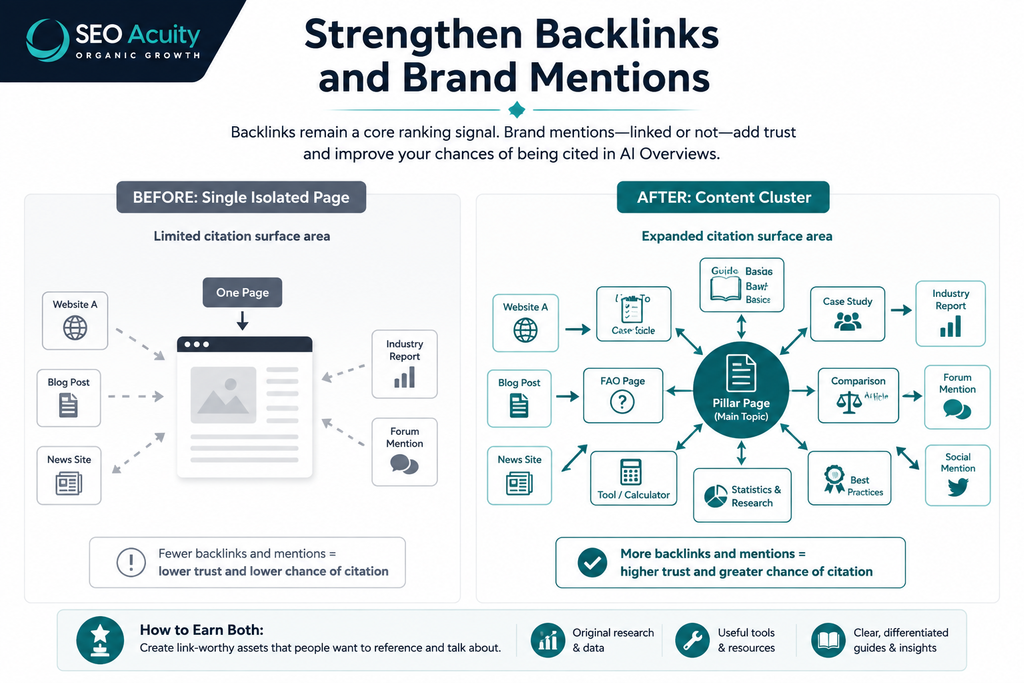
This is why building topical clusters — a hub page plus several supporting pages covering each subtopic in depth — increases your total surface area for citation, rather than betting everything on one page ranking for one phrase.
c. Why the Same Page Can Get Cited for Some Queries and Not Others
A page can be a strong source for one sub-query and completely absent from a related one, even within the same topic cluster.
This happens because Google evaluates each fan-out branch somewhat independently — a page might have the clearest explanation of “how X is made” but weak, thin, or outdated coverage of “how much X costs,” so it gets cited for the first branch and skipped for the second.
Treating a single page as a comprehensive answer to an entire topic, rather than checking whether every sub-branch is genuinely covered in depth, is a common gap between pages that get cited consistently and pages that get cited sporadically.
Read also: SEO Strategy Agency – The 5 Best Options for Data-Driven Organic Growth
Ready to Dominate Search Engine Rankings?
Accelerate your organic growth and scale your business leads with our data-driven SEO strategies.
Get a Free Quote NOW!When and Why AI Overviews Appear
Google displays an AI Overview when its systems determine that synthesizing information across sources would be more helpful to the user than a plain list of links. This decision depends heavily on search intent.
a. Informational Queries Trigger AI Overviews Most Often
Informational searches — where someone is trying to understand a concept for the first time — remain the most common trigger.
Reported figures vary by source and by month, but AI Overviews have consistently appeared across a meaningful share of search queries overall, with informational intent making up the largest portion.
Semrush data shows this composition shifting, however: keywords triggering AI Overviews were 89.03% informational in October 2024, dropping to 57.16% informational by October 2025 — meaning the feature is expanding well beyond simple “what is” queries into commercial, transactional, and navigational territory.
That roughly 32-point shift in twelve months is the most important trend line in this entire topic. It means any keyword strategy built on the assumption that “AI Overviews only matter for top-of-funnel content” is already outdated.
Commercial and transactional pages that were safe from Overview disruption eighteen months ago are increasingly in scope now — one of the core reasons does SEO still matter if AI search keeps growing comes up so often in client strategy calls.
b. Commercial and Comparison Queries Are Growing Fast
Commercial searches — “best X for Y,” “X vs. Y” — are now the second most common trigger category. These queries benefit from synthesis because the user is weighing multiple options and an AI Overview can surface differences across products or approaches in one place.
This is a meaningful shift for any business writing comparison or buying-guide content: structure and even-handed nuance now carry more weight than persuasive copy.
c. Navigational and Transactional Queries Rarely Trigger Them
When a user already knows exactly where they want to go — a navigational search like “[brand] website” — or is ready to act immediately — a transactional search like “buy magnesium glycinate near me” — an AI Overview adds friction rather than removing it. Google tends to step aside in these cases and let direct links or shopping results take priority.
Branded queries occupy a middle case worth noting separately: a search like “does [brand] help with sleep” still triggers an Overview because the brand is being evaluated, not yet navigated to.
The moment a query shifts from evaluation to destination-seeking, the Overview tends to disappear.
d. Local Queries Depend on Informational Layering
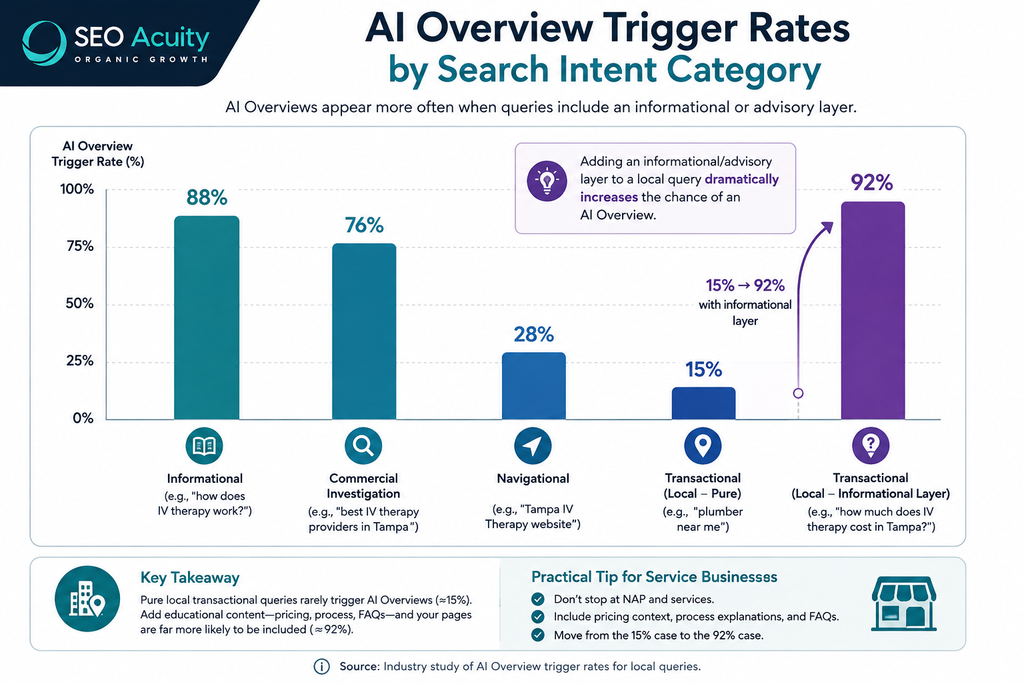
Local intent behaves differently depending on how the query is phrased. Purely transactional local searches (“plumber near me”) rarely trigger an Overview — one industry study found this figure sits around 15% for pure local-intent queries.
But once a local query includes an educational or advisory layer — “how much does IV therapy cost in Tampa,” for instance — an Overview is far more likely to appear, with the same study placing that figure near 92%. The Overview typically sits above the local map pack rather than replacing it.
If you run a service business, the practical implication is that your location pages benefit from including genuine informational content — pricing context, process explanations, FAQs — not just a name, address, and phone number.
A location page that only lists services and a contact form is optimized for the 15% case. Adding a pricing-context section and a short FAQ moves it toward the 92% case as well.
If your team is still deciding where to prioritize content investment, this is exactly the kind of intent-mapping analysis SEO Acuity builds into every content audit — matching each target keyword to its real trigger likelihood before a single word gets written.
How AI Overviews Impact SEO Performance
Here are the measurable effects that AI Overviews have on visibility, traffic, and revenue:
a. Visibility Shifts Toward the Top Three Citations
AI Overviews occupy significant space at the top of the results page. Sites cited among the top links inside the Overview gain visibility, while sites further down the traditional results see reduced exposure — research has found organic listings pushed down the page by more than 140% in some analyses once an Overview appears.
Being cited in the Overview correlates with also ranking well in traditional results underneath it, so strong foundational SEO remains the entry ticket.
b. Traffic Behavior Diverges by Query Type
Not all traffic loss is equal, and this is where many teams misread the data.
- For simple, fully self-contained queries — a symptom list, a basic definition — the Overview often satisfies the user completely, producing a zero-click search with no benefit to any single site.
- For comparison and decision-driven queries, the opposite tends to happen: users read the Overview to orient themselves, then click through for depth on dosage specifics, edge cases, or an expert opinion the summary couldn’t fully capture.
- Google itself has noted that clicks originating from AI Overview results tend to reflect more engaged, higher-intent visits.
Common mistake:
Treating every keyword’s traffic drop as equally alarming. A 40% click decline on a simple “what is X” page and a 40% decline on a detailed comparison page mean very different things — the first may reflect genuine query satisfaction, the second may signal a content or citation problem worth investigating.
Evaluation criteria for triaging a traffic drop:
Before reacting to a decline, check three things in order:
- Did an AI Overview newly appear for that keyword in Search Console’s SERP feature data or a rank tracker.
- Is your page still cited as a source inside it.
- Does the query type match the “simple/self-contained” pattern or the “comparison/decision” pattern described above.
A drop on a self-contained query with no citation is expected behavior, not a problem to fix. A drop on a decision-driven query where you’re absent from the citation list is the case worth investigating.
This is exactly the kind of triage we cover in our video — watch it here: How CRO Makes SEO Actually Sell — The Conversion Path, the Missing Link in Every SEO Strategy — where traffic-quality diagnosis feeds directly into conversion decisions.
c. Revenue Impact Depends on Baseline SEO Health
Sites already practicing strong, consistent SEO are considerably more likely to be cited. Independent analyses have found that roughly three-quarters of domains appearing in AI Overviews also rank in the traditional top 10 for the same query.
Businesses that pause SEO investment or rely on bare-minimum optimization are the ones most exposed to declining visibility — not because AI Overviews specifically penalize them, but because the underlying ranking signals were never strong enough to be selected as a source in the first place.
Read also: Best Seo Content Agency – 7 Agencies To Grow Organic Visibility
How to Optimize Content for AI Overviews
There are specific, actionable steps improve the odds of being cited which are:
a. Confirm Your Pages Are Crawlable and Indexable
Before any content can appear in an AI Overview, Google has to be able to crawl and index it. Check for the issues that most commonly block this:
- A robots.txt file unintentionally blocking key pages.
- Accidental noindex tags left on live pages.
- 4XX errors on important URLs.
- A site structure disorganized enough that Google struggles to find everything efficiently.
This is foundational — no amount of content quality compensates for a page Google never sees.
These are exactly the kind of issues we break down in this video, covering the most common technical mistakes that quietly block crawling and indexing.
b. Target Long-Tail, Specific Queries
AI Overviews are designed to answer increasingly complex, specific questions, which makes long-tail keyword targeting more valuable than it was for traditional rankings alone.
A page built around “best magnesium supplement for anxiety” has a clearer path to citation than one built around the single broad word “magnesium,” because the long-tail phrasing matches how fan-out sub-queries are actually structured.
Building the right keyword set for this starts with proper research — the kind of systematic approach we walk through in our video — watch it here: How to Build a Keyword Universe for Your Website — A New Approach to Keyword Research.
c. Build Genuine Information Gain, Not Length
Google’s quality systems reward content that is accurate, original, grounded in real expertise, and genuinely useful to the specific question asked — not content that is simply longer than competitors.
Add unique value through named frameworks, first-hand-style implementation notes, or an angle competing pages haven’t covered. Content that reads like a summary of what everyone else already said has nothing new to synthesize into a citation.
A practical filter for this: before publishing, ask whether a paragraph could be deleted from your page and pasted into any of your five closest competitors’ pages without anyone noticing.
If yes, it’s consensus filler, not information gain. Rewrite it with a specific number, a named mechanism, or a decision rule your competitors didn’t include.
Spotting these exact gaps in competing content is the core of proper keyword gap analysis — see our full walkthrough in:
d. Anticipate the Reader’s Next Three Questions
Because AI Overviews are built from fan-out sub-queries, a single page that only answers its target keyword is competing against pages that answer the whole surrounding question cluster.
A search for “what is cold brew,” for example, typically resolves into sub-questions about how it’s made, what it tastes like, where it originated, and how to brew it — meaning a page addressing only the first question is structurally incomplete relative to what Google is actually retrieving for.
e. Use Structured Data Where It Applies
Structured data (schema markup) gives Google explicit, machine-readable signals about what a page contains — Product, FAQ, Recipe, and Article schema are the most commonly cited types.
This isn’t a ranking shortcut on its own, but it does reduce ambiguity for Google’s systems when they’re deciding what a page is actually about and whether it’s a reliable input for synthesis.
f. Strengthen Backlinks and Brand Mentions
Backlinks remain a core ranking signal for the underlying organic results AI Overviews draw from. Brand mentions — even unlinked ones — appear to carry independent weight for AI visibility specifically, likely because they act as an additional trust signal Google’s systems can cross-reference across the web.
Earning both usually comes from the same source: publishing something genuinely worth referencing, whether that’s original research, a useful tool, or a clearly differentiated guide.
Auditing an entire content cluster for fan-out coverage and structured data gaps by hand takes most in-house teams weeks. SEO Acuity’s technical SEO audits map this out in days, flagging exactly which subtopic pages are missing before a competitor fills that gap first.

A Practical Framework for Prioritizing AI Overview Work
Not every page in a content library deserves equal AI Overview investment, and treating them equally wastes resources on pages that were never going to be cited regardless of effort. A simple two-factor filter narrows the list fast.
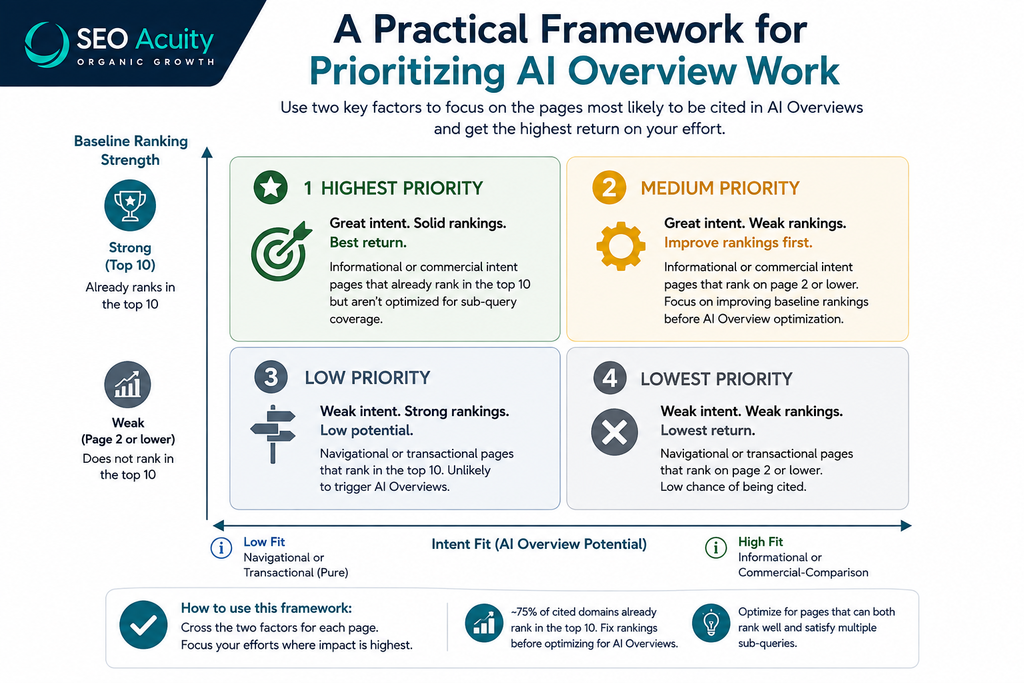
- Factor one — intent fit: Informational and commercial-comparison queries are worth prioritizing; navigational and pure transactional queries are not, based on the trigger-rate patterns covered earlier in this guide.
- Factor two — current baseline strength: Since roughly three-quarters of cited domains already rank in the traditional top 10, a page currently sitting on page two or three of organic results is unlikely to be selected as a source no matter how well it’s structured for fan-out. Fix the underlying ranking first.
Cross those two factors and the priority list becomes clear: pages with informational or commercial intent that already rank reasonably well in traditional search, but haven’t been restructured for sub-query coverage, are the highest-return targets. Pages that fail either factor are lower priority regardless of topic importance.
This kind of prioritization is exactly what feeds into a proper organic growth strategy — we lay out the full step-by-step version in our video — watch it here: How to Build an Organic Growth Strategy That Ranks in Both AI Search and SEO, Step by Step.
Can You Opt Out of AI Overviews?
There is no dedicated setting to opt a site out of AI Overviews specifically, but Google has confirmed several standard technical methods that reduce or eliminate the chance of a page being summarized:
- The nosnippet robots meta tag.
- A <meta name=”robots” content=”max-snippet:42″> tag to limit how much text can be shown.
- Wrapping specific content in a <div data-nosnippet> element to exclude just that section.
Each of these methods also reduces visibility in standard search results and featured snippets, not just AI Overviews, so they should be used deliberately and rarely — typically only for content with specific legal, competitive, or editorial reasons for staying out of any automated summary.
Ready to Dominate Search Engine Rankings?
Accelerate your organic growth and scale your business leads with our data-driven SEO strategies.
Get a Free Quote NOW!Ready to Turn AI Overview Visibility Into a Growth Channel
AI Overviews aren’t going away, and guessing at optimization tactics wastes budget your competitors are spending more precisely.
SEO Acuity builds content and technical strategies specifically mapped to how Google’s fan-out and citation systems actually work — not generic SEO advice repackaged for a new feature.
Book a free AI search visibility audit with SEO Acuity and find out exactly which of your pages are positioned to get cited — and which ones are quietly losing ground.
Ready to Dominate Search Engine Rankings?
Accelerate your organic growth and scale your business leads with our data-driven SEO strategies.
Get a Free Quote NOW!Conclusion
Google AI Overviews for SEO represent a structural shift in how content earns visibility — from ranking a single page for a single keyword to being selected as one of several trusted sources synthesized into a direct answer.
The mechanics are specific: query fan-out determines what gets retrieved, content quality and structure determine what gets cited, and search intent determines whether an Overview appears at all.
The businesses adapting well aren’t chasing the feature itself — they’re strengthening the same fundamentals that always mattered:
- Crawlability.
- Genuine expertise.
- Complete topical coverage.
- Content that says something a summary hasn’t already said elsewhere.
Treat AI Overview optimization as an extension of solid SEO, not a replacement for it, and the visibility follows.
Frequently Asked Questions
The questions below cover the details this guide didn’t fully resolve in the sections above — the ones people search for right after they’ve understood the basics.
What triggers a Google AI Overview to appear?
Google displays an AI Overview when its systems determine that synthesizing information from multiple sources would help the user more than a standard list of links.
This happens most often for informational and commercial-comparison queries, and far less often for navigational or transactional searches where the user already knows what they want.
How is Google AI Overviews going to affect SEO long-term?
Google AI Overviews are shifting SEO from single-page keyword ranking toward topical cluster coverage, since Google’s fan-out process retrieves and cites subtopic pages alongside the primary page.
Sites with strong foundational SEO and complete subject coverage are best positioned, while thin, single-purpose pages lose relative visibility.
What is the difference between an AI Overview and a featured snippet?
A featured snippet extracts a short answer from one single web page, while an AI Overview generates a new summary synthesized from multiple sources, typically four to eight pages, with citation links to each.
Featured snippets suit narrow factual queries; AI Overviews suit broader, multi-part questions.
Can AI Overviews use AI-generated content as sources?
Yes. Google does not exclude a page from being cited simply because it was created with AI assistance. What determines eligibility is whether the content meets Google’s quality standards for expertise, experience, authoritativeness, and trustworthiness — the process behind the content matters less than the outcome.
How often do AI Overviews actually appear in search results?
Estimates vary by study and time period, generally placing AI Overview appearance somewhere in the low double digits as a share of all searches, with meaningfully higher rates in informational-heavy categories like health, finance, and technology. The exact figure shifts regularly as Google continues to expand the feature.
Do AI Overviews replace the need for traditional SEO?
No. Independent research has repeatedly found that the large majority of domains cited in AI Overviews also rank in the traditional top 10 organic results for the same query.
Traditional SEO fundamentals remain the baseline requirement for AI Overview visibility, not a separate or optional track.