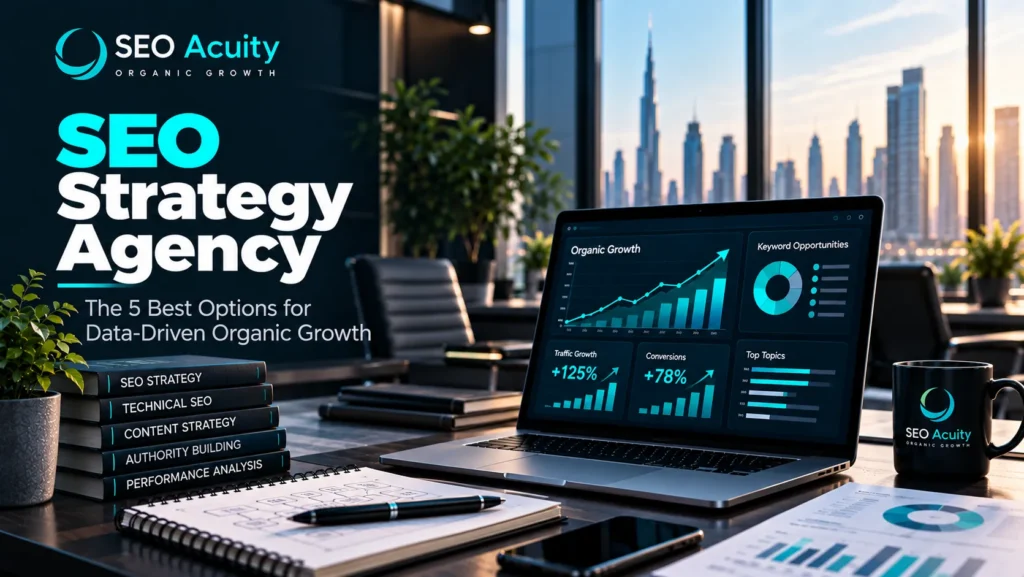
SEO problems are not always caused by poor execution. Sometimes, businesses are doing plenty of SEO work but lack a clear direction.
They publish content, build links, fix technical issues, and track rankings, yet these activities do not always work toward the same business goals.
An SEO strategy agency solves this problem by identifying where the biggest organic opportunities exist, determining what deserves priority, and building a roadmap that connects technical SEO, content, authority, conversions, and increasingly AI search visibility.
The goal is not simply to do more SEO. It is to invest in the right activities, in the right order, for the right reasons.
1. SEO Acuity
Best for: Businesses seeking an integrated organic growth strategy across market demand, technical SEO, content, authority, conversions, and AI visibility.
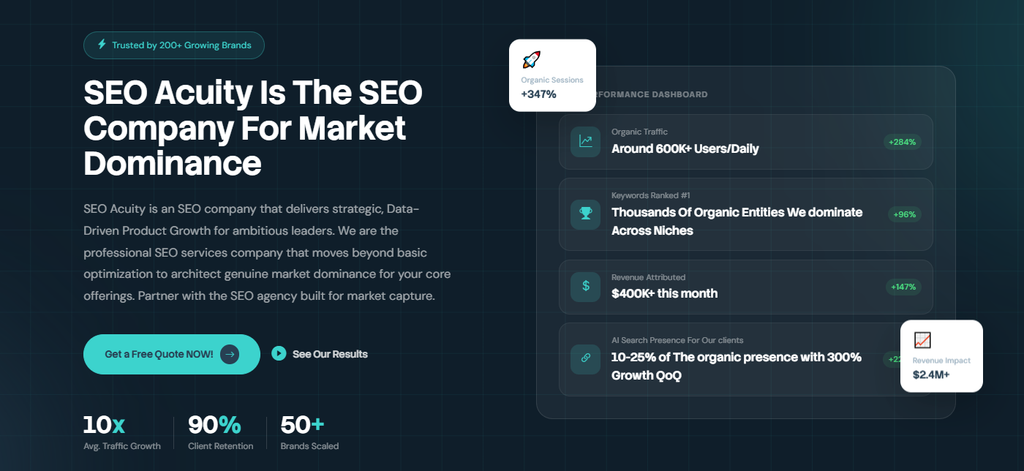
SEO Acuity approaches SEO as the design of an organic growth system rather than a collection of monthly tasks. Its strategy starts by identifying where demand exists, where competitors are winning, which products or services deserve priority, and what is limiting growth.
Why SEO Acuity Stands Out?
Its SEO process follows a strategy-first model that connects technical SEO, search intent, content architecture, semantic relevance, internal linking, authority development, conversions, and performance measurement.
SEO Acuity’s SEO audits also look beyond technical errors to identify opportunities that can shape the broader growth roadmap. The agency additionally incorporates AI search optimization, including entities, structured data, semantic depth, GEO, AEO, and citation visibility.
Overall, SEO Acuity is a strong fit for companies that want a strategic organic growth partner rather than disconnected SEO deliverables.
2. SALT.agency
Best for: Enterprises and businesses with technically complex or international websites.
SALT.agency combines strategic SEO with strong technical expertise, making it particularly relevant for large websites, migrations, international markets, and complex site architectures.
Its approach connects technical performance with content, search intent, audience behavior, and wider business objectives, making it a strong option when technical complexity is one of the main barriers to organic growth.
3. Position Digital
Best for: B2B, SaaS, startups, and growing brands that need a flexible SEO strategy.
Position Digital combines SEO strategy with technical auditing, content, link building, digital PR, and AI search optimization.
Its main strength is adaptability. Rather than treating strategy as a fixed roadmap, the agency adjusts priorities as business goals, search behavior, and market conditions change.
4. Common Ground
Best for: B2B businesses focused on qualified demand and commercial growth.
Common Ground takes a commercially driven approach to SEO, connecting search opportunities with the products, services, and pages most likely to influence leads and revenue.
Its strategy combines technical analysis, content opportunities, commercial-page optimization, and authority development, making it a strong fit for businesses that want to measure SEO beyond traffic alone.
Read also: Best Seo Content Agency – 7 Agencies To Grow Organic Visibility
Ready to Dominate Search Engine Rankings?
Accelerate your organic growth and scale your business leads with our data-driven SEO strategies.
Get a Free Quote NOW!5. SEO Strategy Ltd
Best for: Businesses looking for senior SEO consultancy and technical expertise.
SEO Strategy Ltd combines traditional SEO with newer areas such as GEO, AEO, entity SEO, structured data, and AI visibility.
Its services cover technical SEO, content strategy, authority building, schema, and AI-focused optimization, with direct senior involvement that may appeal to companies wanting specialist strategic guidance without multiple agency layers.
What Should a Good SEO Strategy Actually Solve?
A strong SEO strategy should answer one central question: How can organic search contribute meaningfully to business growth?
Answering that requires more than keyword research. A good strategy should identify where valuable search demand exists, which audiences and markets matter most, who the real organic competitors are, and what is preventing the website from capturing more visibility.
It should also define the right content and site architecture, determine where technical improvements and authority building are needed, and create clear pathways from organic discovery to conversion.
Read also: 8 Best Seo & Sem Agencies For Integrated Search Growth
How Is an SEO Strategy Agency Different From a Traditional SEO Agency?
A traditional SEO engagement may begin with predefined deliverables, such as a set number of articles, backlinks, or page optimizations each month.
An SEO strategy agency starts earlier. It first examines the business, market, competitors, website, and search demand to determine which activities should actually be prioritized.
The difference is simple:
SEO tactics ask: What are we doing?
SEO strategy asks: Why are we doing it, what should come first, and how will it support growth?
This approach is particularly valuable for businesses with complex websites, competitive markets, ambitious growth goals, or SEO programs that have reached a plateau.
The 7 Building Blocks of an Effective SEO Strategy
Every business needs a different roadmap, but most effective SEO strategies are built around seven connected areas.
1. Market Opportunity
SEO strategy should begin with the business, not the keyword tool. Understanding the business model, customers, products, markets, sales cycle, and growth objectives helps identify where search demand overlaps with genuine commercial opportunity.
2. Technical Foundation
Search engines need to crawl, render, understand, and index important pages correctly. Technical strategy should therefore address areas such as indexation, crawlability, site architecture, Core Web Vitals, JavaScript, canonicals, structured data, and duplicate content.
The key is prioritization. Fixing one indexation issue affecting an important commercial section may create more value than resolving hundreds of minor technical warnings.
3. Search Demand and Intent
Keyword research should reveal not only what people search for, but why they search and where that demand fits within the customer journey.
A strong strategy evaluates search volume alongside intent, commercial relevance, competition, ranking potential, and SERP composition. A lower-volume commercial query may ultimately be more valuable than a much larger informational keyword.
Read also: 10 Best Seo And Ppc Agencies For Integrated Search Growth
4. Content Architecture
Search demand needs to translate into the right website structure. Content architecture determines which commercial and supporting pages should exist, which existing content needs improvement or consolidation, and how pages should connect through internal links.
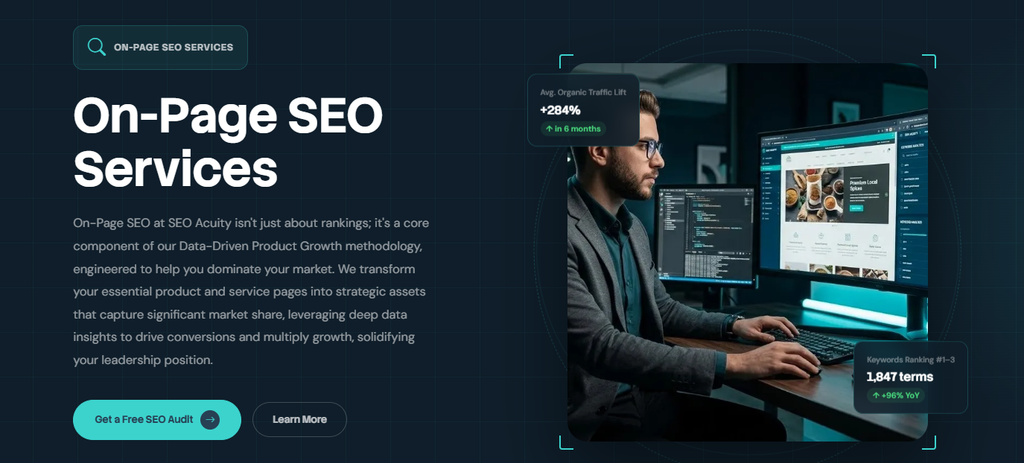
SEO Acuity’s On-Page SEO services connect page optimization with semantic structure, keyword mapping, internal linking, structured data, and conversion pathways.
5. Authority Development
Competitive markets often require external signals that reinforce a website’s credibility. Digital PR, editorial backlinks, brand mentions, expert contributions, and relevant industry citations can strengthen authority. The goal is not simply to acquire more links, but to reinforce the topics and expertise the brand wants to be known for.
6. Conversion and Measurement
Rankings and traffic are useful indicators, but they are not the final objective. SEO performance should connect to meaningful outcomes such as qualified leads, demos, sales, sign-ups, pipeline, revenue, or customer acquisition. These metrics also provide the feedback needed to refine the strategy over time.
7. AI Search Visibility
Organic discovery now extends beyond traditional search results into Google AI Overviews, ChatGPT, Gemini, Perplexity, and other AI-driven experiences.
SEO strategy should therefore consider entity clarity, semantic depth, structured data, content extractability, external citations, and brand authority.
AI search does not replace traditional SEO. It expands where and how a brand needs to be discoverable, understandable, and credible.
Why Should SEO Strategy Come Before Scaling?
Scaling SEO before validating the strategy can waste significant time and budget. A business might publish dozens of articles that target the wrong intent, build backlinks to pages that do not need additional authority, or spend months fixing minor technical warnings while more important commercial pages remain constrained.
A stronger sequence is:
Audit → Prioritize → Architect → Execute → Measure → Scale
This approach ensures that technical SEO, content, and authority efforts are focused on the opportunities most likely to create meaningful growth.
It is also central to SEO Acuity’s methodology: build the organic growth architecture first, then scale what works with greater confidence.
Ready to Dominate Search Engine Rankings?
Accelerate your organic growth and scale your business leads with our data-driven SEO strategies.
Get a Free Quote NOW!When Should You Hire an SEO Strategy Agency?
Not every business needs external SEO strategy support. However, certain situations suggest that a more strategic approach could help unlock the next stage of organic growth.
1. Organic Growth Has Plateaued
If traffic and rankings have stopped improving despite continued investment, simply producing more content or links may not be enough. The underlying strategy may need to change.
2. SEO Activities Lack a Clear Roadmap
Your content team publishes, developers fix technical issues, and agencies build links—but the activities are not connected by clear priorities or objectives.
That is usually a strategy problem.
3. Traffic Is Growing but Business Results Are Not
More organic sessions do not automatically mean more growth. You may need stronger commercial intent targeting, better conversion pathways, or greater focus on high-value search opportunities.
4. Your Website Is Becoming More Complex
Large ecommerce stores, SaaS platforms, marketplaces, directories, and international websites often require more deliberate architecture, prioritization, and technical planning as they scale.
5. You Are Entering a New Market
New countries, languages, audiences, or product categories introduce different competitors and search behavior. Your existing SEO strategy may not transfer directly.
6. You Are Planning a Migration or Redesign
Migrations and redesigns can significantly affect URLs, content, internal linking, indexation, and rankings. SEO strategy should influence these projects before major development decisions are made.
7. Your Strategy Does Not Include AI Search
If your roadmap focuses entirely on traditional rankings, it may be time to consider how your brand and content are discovered across AI-driven search experiences as well.
Ready to Dominate Search Engine Rankings?
Accelerate your organic growth and scale your business leads with our data-driven SEO strategies.
Get a Free Quote NOW!Build an SEO Strategy Designed for Growth
A strong SEO strategy is not about creating the longest roadmap or filling every month with more deliverables. It is about identifying where the greatest organic opportunities exist, what is preventing the business from capturing them, and which actions should take priority.
SEO Acuity builds strategies around business goals and market opportunity before determining what needs to be executed. Technical SEO, content architecture, search intent, internal linking, authority development, conversions, and AI visibility are treated as connected parts of the same organic growth system.
This strategy-first approach helps businesses avoid wasting resources on low-impact activities and focus investment where it has the greatest potential to improve visibility and commercial performance.
Request Your Custom Market Dominance Plan Today

Conclusion
Choosing the right SEO strategy agency comes down to one question: does this partner start with your business, or with a list of deliverables? Agencies that lead with audits, content calendars, and link quotas before understanding your market, customers, and growth goals are optimizing for activity, not outcomes.
The agencies worth considering — including the five covered here — share a common thread: they treat SEO as a system, not a set of disconnected tasks. Technical foundations, content architecture, authority, conversions, and AI search visibility all feed into each other, and a strategy that ignores those connections will always underperform one that accounts for them.
Frequently Asked Questions
What is an SEO strategy agency?
An SEO strategy agency analyzes a company’s business objectives, website, audience, competitors, and search market to create a prioritized roadmap for organic growth. That roadmap can cover technical SEO, content, keywords, site architecture, authority, conversion measurement, and AI search visibility.
What does an SEO strategy agency do?
It determines where organic opportunities exist and what actions should be prioritized to capture them. This can involve SEO audits, market research, competitor analysis, keyword and intent research, content planning, technical recommendations, authority strategy, and performance measurement.
What’s the difference between an SEO strategy and SEO services?
SEO services are the activities being performed, such as technical optimization, content creation, or link building. SEO strategy determines which of those activities are necessary, why they matter, and in what order they should be executed.
What should an SEO strategy include?
A comprehensive strategy generally covers business objectives, market opportunity, competitors, technical SEO, search demand, intent, content architecture, on-page optimization, internal linking, authority development, KPIs, and an implementation roadmap.
How often should an SEO strategy be updated?
A strategy should evolve as new performance data, competitors, products, search behavior, and business priorities emerge. Major algorithm changes or shifts in search technology can also require priorities to be reassessed.
Should AI search be part of an SEO strategy?
Yes. Traditional Google rankings remain important, but modern search strategies should also consider how brands are understood and surfaced across AI Overviews and platforms such as ChatGPT, Gemini, and Perplexity. Entity clarity, semantic content, structured information, citations, and authority can all contribute to this wider visibility.
How do I choose an SEO strategy agency?
Choose an agency that first seeks to understand your business and market before prescribing deliverables. It should be able to explain how opportunities are prioritized, how technical SEO and content work together, and how organic performance connects to meaningful business outcomes.