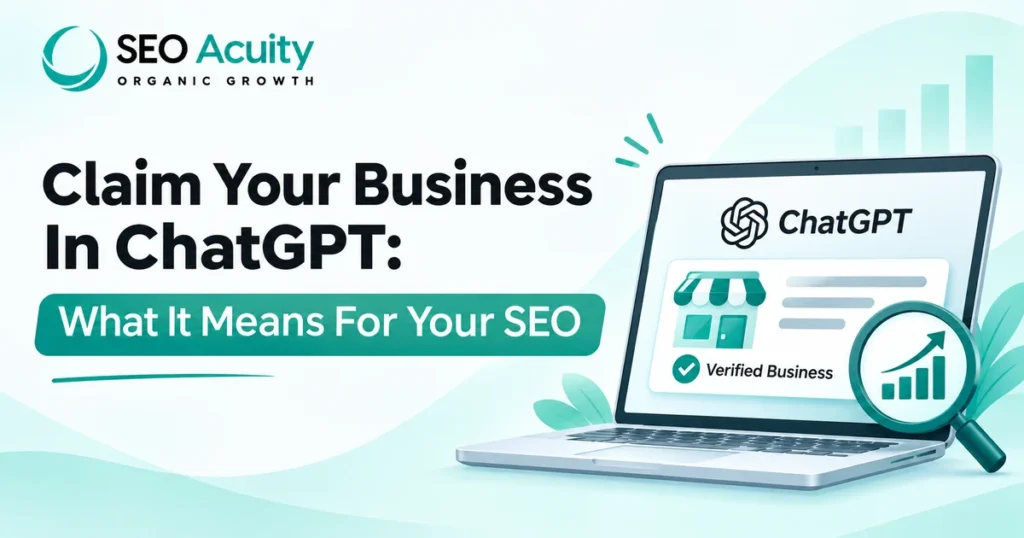
Claim your business in ChatGPT, the instruction didn’t exist before 10 November 2026. For months, brands appeared in ChatGPT responses with no control over what was said, no way to correct inaccurate information, and no data on how often their name came up.
OpenAI launched Business Hub on 10 November 2026, currently in beta; the first official platform where businesses in ChatGPT can manage their profile, track mentions, and understand their AI search visibility.
This article covers what the platform does now, how it connects to SEO, and what GCC and MENA businesses need to know about eligibility.
What You’ll Learn:
- What Businesses in ChatGPT is and what Business Hub includes.
- How claiming your profile affects ChatGPT SEO and ranking.
- How it compares to Google Business Profile.
- Step-by-step instructions for claiming your listing.
- What the product feed and Business Agent features do.
- What GCC and MENA businesses can access today.
- A practical SEO checklist for AI visibility.
Claim Your Business In ChatGPT: What Is Businesses in ChatGPT?
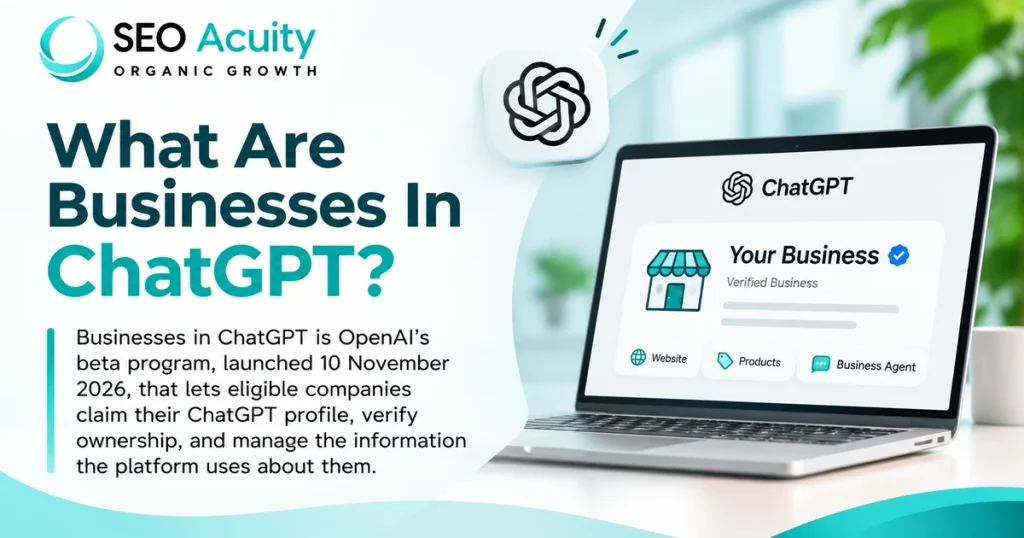
Businesses in ChatGPT is OpenAI’s beta program, launched 10 November 2026, that lets eligible companies claim their ChatGPT profile, verify ownership, and manage the information the platform uses about them.
It is not ChatGPT Business, the paid workspace plan for teams. This program is specifically about how your brand appears in AI-generated answers.
1. Understanding The ChatGPT Business Hub
The ChatGPT Business Hub is the dashboard for this program, available at chatgpt.com/business-hub or through the ChatGPT sidebar.
Any eligible business, including online-only companies with no physical address, can claim its profile here. That is a meaningful difference from Google’s model.
The hub gives businesses three things: control over what profile information ChatGPT can reference, aggregated engagement data, and an optional Business Agent for direct user interaction.
2. What A ChatGPT Business Profile Contains
A verified ChatGPT business profile shows your business name, website, description, category, logo, and policies. After completing identity verification with Persona, your profile receives a blue verified check.
Business owners can connect a product feed with live pricing and availability. Eligible US-based ecommerce and online service businesses can also create a Business Agent inside ChatGPT.
Watch: How Does AI Search Work?
Ready to Improve Your Search Engine Rankings?
Accelerate your organic growth and scale your business leads with our data-driven SEO strategies.
Get a Free Quote NOW!How Claiming Your Business Affects ChatGPT SEO
This section matters most for search strategists. ChatGPT SEO now has first-party data behind it. Here is what that unlocks.
1. Official Data Replaces Third-Party GEO Estimates
Before Business Hub, the only way to measure chatgpt ranking visibility was through third-party tools estimating brand mentions from sample prompts.
Business Hub provides verified mention counts and website clicks directly from OpenAI’s own systems. This is a meaningful shift: estimation is replaced by evidence.
For anyone building a what is AI SEO practice on real data, this is the first reliable signal directly from the source itself.
Watch: How To Rank In AI Search (ChatGPT, Gemini .. etc)
2. Discovery Topics Open New Keyword Opportunities
Business Hub’s Discovery Topics section shows the conversation themes in which ChatGPT cited your business over the past 28 days. These are not individual prompts; they are clustered patterns revealing what users were researching.
For SEO strategists, Discovery Topics represent a new type of keyword intelligence. They reveal demand that may carry no traditional search volume but already generates AI citations for your domain.
This is exactly the signal that builds topical authority in areas where intent exists before queries become measurable in Google.
3. Why Traditional SEO Still Powers ChatGPT Ranking
When ChatGPT searches the web, it discovers and cites pages found through web crawlers. This means chatgpt ranking depends directly on how crawlable, authoritative, and clearly structured your website is.
AI SEO vs traditional SEO is not a question of replacement. The pages ChatGPT cites are largely the same pages ranking well in Google.
Our On-Page SEO Services ensure your pages can be read, understood, and cited by both traditional and AI search engines alike.
4. Business Data Consistency Strengthens AI Visibility
ChatGPT synthesizes from multiple sources. If your website, your Google Business Profile, and your directory listings disagree on your name, address, or description, that inconsistency creates ambiguity.
Claiming your Business Hub profile adds one more data source that must stay consistent. Data consistency is a core pillar of SEO for brand visibility in an AI-driven search environment.
A proper SEO Audit Services review will often surface these gaps before they become AI visibility problems.
Watch: How multiple the performance of AI Search and SEO?
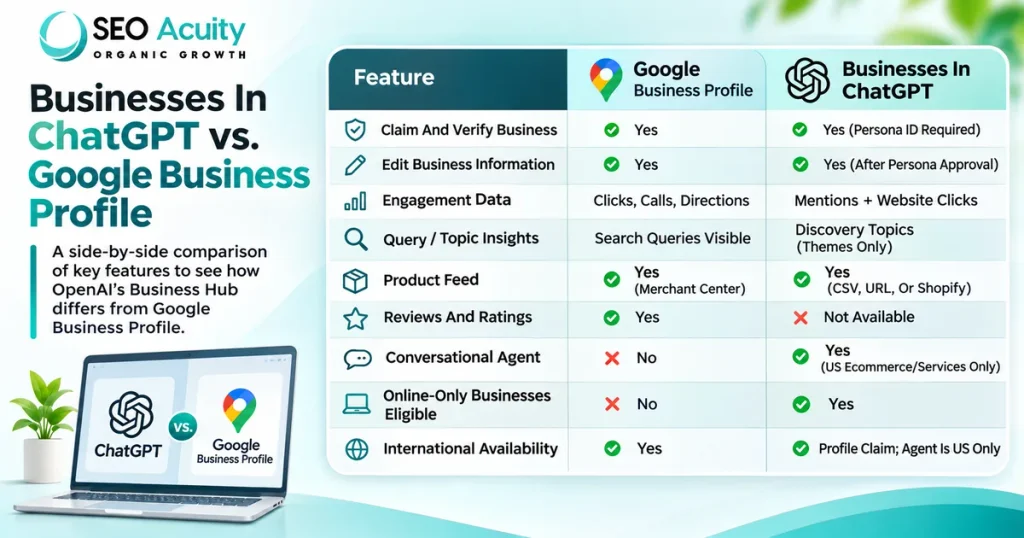
Businesses In ChatGPT vs. Google Business Profile
The comparison between Business Hub and Google Business Profile is the most intuitive frame for understanding what OpenAI has built. The differences reveal what is genuinely new, particularly for businesses Google’s platform has historically excluded.
| Feature | Google Business Profile | Businesses In ChatGPT |
| Claim And Verify Business | Yes | Yes (Persona ID Required) |
| Edit Business Information | Yes | Yes (After Persona Approval) |
| Engagement Data | Clicks, Calls, Directions | Mentions + Website Clicks |
| Query / Topic Insights | Search Queries Visible | Discovery Topics (Themes Only) |
| Product Feed | Yes (Merchant Center) | Yes (CSV, URL, Or Shopify) |
| Reviews And Ratings | Yes | Not Available |
| Conversational Agent | No | Yes (US Ecommerce/Services Only) |
| Online-Only Businesses Eligible | No | Yes |
| International Availability | Yes | Profile Claim; Agent Is US Only |
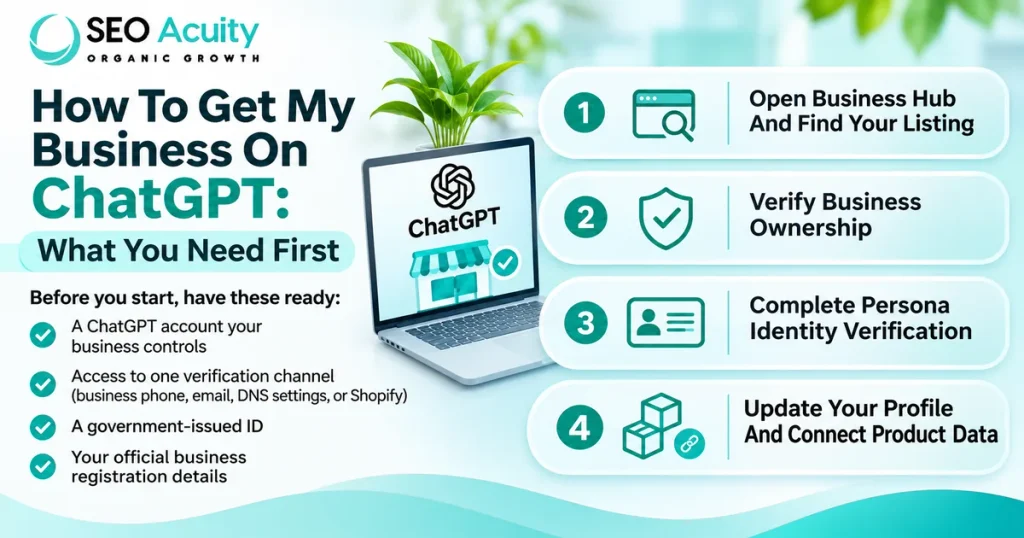
How to Claim Your Business in ChatGPT in 4 Steps
Before you start, have these ready: a ChatGPT account your business controls, access to one verification channel (business phone, email, DNS settings, or Shopify), a government-issued ID, and your official business registration details.
Use a company-owned account, not a personal one. Whoever claims the business becomes the admin, and changing that later is difficult.
Add at least one other admin immediately after your claim is approved to protect against account access issues later.
1. Open Business Hub And Find Your Listing
Navigate to chatgpt.com/business-hub or open it from the ChatGPT sidebar. Search for your business by name and select the matching listing.
If your business is an eligible online company and no listing exists, look for a Create option at the top of results. Local stores and restaurants can only claim an existing US listing at this stage.
2. Verify Business Ownership
Business Hub offers up to four verification methods depending on your business type. The business phone sends a code to the number on your listing. Business email sends a code to your associated inbox.
Website domain requires adding a DNS TXT record, then selecting Verify Domain. Shopify store connects through the admin panel and also syncs your product catalog.
Domain verification is recommended for online businesses; it does not depend on who answers a phone or inbox.
3. Complete Persona Identity Verification
A claimed business is not yet a verified one. The blue check and the ability to publish changes, view insights, or create a Business Agent all require a separate Persona identity check.
Prepare a government-issued ID, business registration documents, and proof that you are authorized to represent the business.
Names, addresses, and registration numbers must exactly match your official records. Mismatches are the most common reason Persona submissions require resubmission.
4. Update Your Profile And Connect Product Data
After both approvals, open your profile in Business Hub. Update your website, description, category, logo, delivery policy, and return policy.
If you sell products, connect a feed using Shopify, a CSV following OpenAI’s product feed specification, or a hosted URL. OpenAI reviews all profile changes before publishing, and ChatGPT may continue using other sources alongside your profile data.
Product Feeds, Shopify Integration, And Business Agents
For ecommerce businesses, Business Hub goes beyond profile management. It introduces direct data channels into ChatGPT’s shopping responses, connecting live product data with AI-generated answers.
1. What Is A ChatGPT Product Feed?
A ChatGPT product feed is a structured data file that shares product names, descriptions, prices, and availability with OpenAI. When someone asks ChatGPT for product recommendations, your live inventory becomes part of the available source data.
Connecting a product feed does not guarantee that ChatGPT recommends your products. It makes your data available as a retrievable source; recommendation decisions remain ChatGPT’s own.
For ecommerce businesses building AI visibility systematically, a product feed works best alongside a broader ecommerce SEO strategy that covers how products are discovered across all channels.
Our Ecommerce SEO Services are built to cover both the technical and content layers needed for ecommerce AI visibility.
2. How Shopify Merchants Connect Their Store
ChatGPT Shopify integration is the simplest path to Business Hub verification and product sync. Merchants can connect their store from Business Hub or the Shopify admin panel. The connection verifies business ownership and synchronizes eligible products through Shopify Catalog.
Shopify merchants may find a draft Business Agent already created after connecting. That agent must be reviewed, tested, and published separately before customers can use it.
Our Shopify SEO Services are structured to maximize your store’s visibility across both Google and ChatGPT simultaneously.
3. What A ChatGPT Business Agent Can And Cannot Do
A ChatGPT business agent is a conversational interface that represents your brand inside ChatGPT. When someone opens your business profile from an answer, they can choose to start a separate, labeled chat with the agent.
The agent can explain products, describe policies, compare offerings, and link to your website. It cannot complete purchases, make bookings, or access order data.
Business Agents are available to eligible US-based ecommerce and online service businesses only. The conversation is clearly labeled and entirely separate from ChatGPT’s own independent answers.
What This Means For Businesses In The GCC And MENA
Eligibility works differently depending on your business type. The distinction matters significantly for businesses outside the United States.
Here is what each category of business can access right now:
- Local Stores And Restaurants: can currently claim only an existing US listing. Physical businesses with no US presence have no listing to claim at this stage.
- Business Agents: US-only at launch, restricted to ecommerce and online service businesses with a US-registered presence and an eligible industry category.
- Online Businesses With A Website: eligible to claim their ChatGPT business profile from any country where ChatGPT is available, including across the GCC and MENA region.
The broader question for GCC and MENA businesses is whether ChatGPT can find, read, and accurately represent them at all. That depends on website content quality, international citation footprint, and AI-readable page structure.
For companies asking does SEO still matter if AI search keeps growing, the answer is yes, and the work begins with the same SEO foundations.
Our GCC Market Expansion SEO is built around this challenge for regional businesses operating across multiple markets.
If Arabic-language search is part of your strategy, Arabic SEO Services provide the content architecture needed to appear in Arabic-language AI queries.
Watch: When To Do SEO And Don’t?

What To Do Now: Your SEO Checklist For AI Visibility
Generative engine optimization is not a replacement for SEO. It is SEO adapted to AI retrieval mechanics. The sequence below gives you the practical steps to improve ChatGPT visibility without abandoning the foundation that powers traditional search performance.
1. Find Out What ChatGPT Currently Says About You
Ask ChatGPT the questions your customers would ask. Record which businesses it names and whether your website is cited. This baseline is what you will measure improvement against.
2. Claim Your Business In ChatGPT
Go to chatgpt.com/business-hub, complete verification, and pass the Persona identity check. This gives you data, a correction channel, and direct access to what ChatGPT knows about your business.
3. Fix The Pages ChatGPT Cites
Business Hub’s Discovery Topics reveal which content themes drive your mentions. Identify which pages are cited, improve them, and fill the gaps where you should appear but do not.
Connecting these insights to an organic growth strategy to win AI search is how the channel becomes compounding rather than reactive.
Our GEO Services; Generative Engine Optimization provide structured frameworks for AI retrievability at scale.
4. Unify Your Business Data Across All Platforms
Your name, address, phone number, and description must be identical across your website, Google Business Profile, Bing Places, and all relevant directories. ChatGPT corroborates across sources; inconsistency creates ambiguity.
5. Confirm Your Site Is Open To AI Crawlers
Make sure OAI-SearchBot is not blocked in your robots.txt file, since it is the crawler behind ChatGPT search results. GPTBot is a separate crawler used for model training, so allowing or blocking it is a separate decision.
Run a full Technical SEO Services audit to surface JavaScript rendering issues and schema gaps that prevent AI engines from reading your content correctly.
6. Monitor Insights And Adjust Monthly
Track mentions, website clicks, and Discovery Topics every 28 days. A theme appearing consistently in Discovery Topics is a signal to create or strengthen content in that area.
The GEO SEO strategy for AI search framework explains how to build systematically from these insights month over month.
The generative engine optimization SEO benefits are compounding. Businesses building AI retrieval infrastructure now are establishing a structural advantage that becomes harder to close as the channel matures.
Watch: Organic Growth Strategy
Ready to Improve Your Search Engine Rankings?
Accelerate your organic growth and scale your business leads with our data-driven SEO strategies.
Get a Free Quote NOW!Why AI Visibility Starts Long Before You Claim A Profile
You just learned what claiming a profile can and cannot do. The gap between the two is exactly where organic search is won or lost in AI search.
Discovery Topics show you what buyers are asking. The question is whether your content is built to show up when they ask it, in ChatGPT and in Google simultaneously.
That is the architecture SEO Acuity builds from day one. Start with the Organic Growth Foundation.
Start Your SEO / GEO / AEO Journey Today With SEO Acuity’s Services
Conclusion
The launch of Business Hub marks the first time businesses can formally claim their business in ChatGPT, access official visibility data, and correct what AI engines say about them.
It is not a ranking guarantee; OpenAI has been explicit about that. What it is, is infrastructure.
The underlying work has not changed: credible content, clean technical architecture, and consistent business data across the web drive both traditional and AI search performance.
Business Hub adds accountability and measurement to a channel that previously had neither.
For a comprehensive framework on measuring progress across both channels, how to measure SEO performance covers the right metrics and cadences that keep SEO strategies honest.
For businesses serious about compounding organic visibility, the Organic Growth Foundation™ is designed to build exactly that kind of architecture across both search and AI.
If you are ready to treat AI visibility as a strategic growth channel rather than an experiment, our AI Search Optimization Services are the structured next step.
Frequently Asked Questions
Is Businesses in ChatGPT Free?
Yes. Claiming a basic business profile through Business Hub during the beta is free. You do not need a ChatGPT Ads account or a ChatGPT Enterprise agreement. Paid advertising and advanced workspace plans are separate optional products.
Can Businesses Outside The US Claim Their Profile?
Yes, with an important distinction. Any business with a website can claim its profile anywhere ChatGPT is available, including GCC and MENA markets. Local stores and restaurants can currently claim only an existing US listing.
Does Claiming My Business Improve My Ranking In ChatGPT?
No official statement from OpenAI confirms that claiming improves ChatGPT ranking or visibility. OpenAI states clearly that claiming allows you to manage the accuracy of the information you provide, but does not guarantee increased visibility or placement.
How Is This Different From Google Business Profile?
Both platforms let you claim a business, verify ownership, and manage public-facing information.
ChatGPT does not support reviews and offers less detailed analytics than Google Business Profile.
ChatGPT does not support reviews and offers significantly less analytics granularity than Google Search Console.