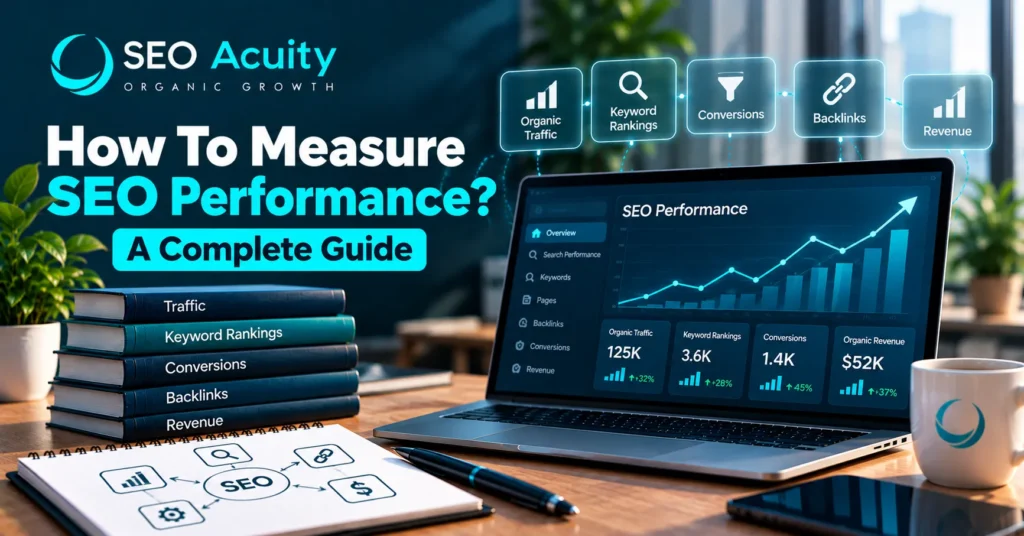
Struggling to find real value in your SEO program? You might be tracking the wrong data. Many businesses treat SEO as a black box publishing content, tweaking pages, and hoping for results, without ever knowing what’s actually driving growth and what’s holding it back.
Measuring SEO performance the right way turns that guesswork into a clear, repeatable process you can act on every month.
This guide walks through exactly how to measure SEO performance, step by step from understanding what the metrics mean, to tracking traffic and rankings, to connecting your results to real business outcomes, and finally answering the questions most people ask when they start measuring SEO for the first time.
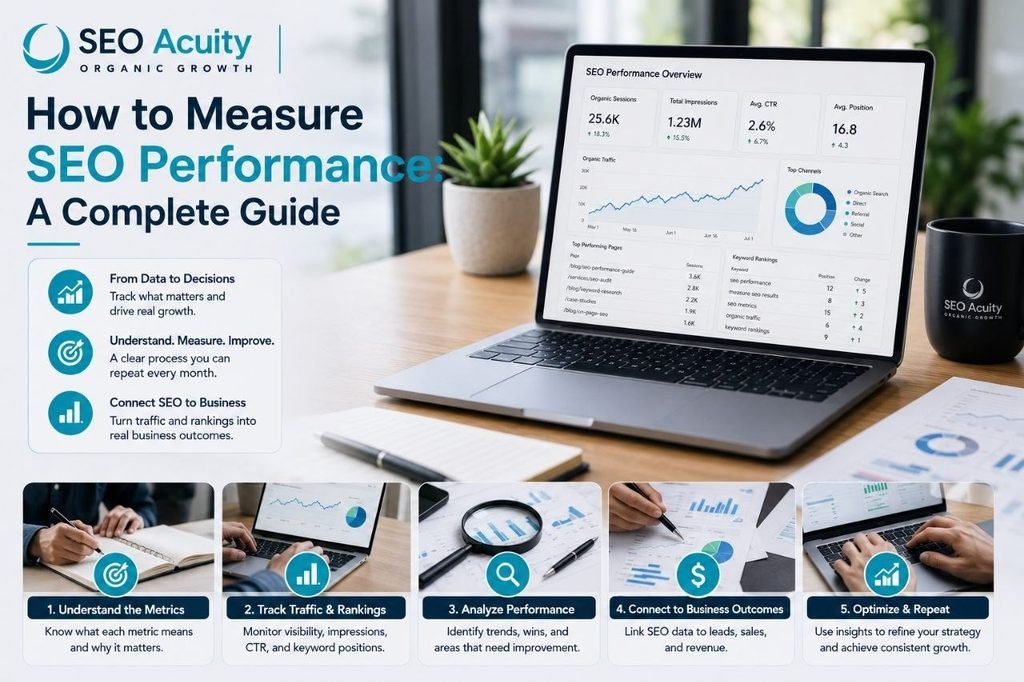
1. Understanding What SEO Performance Metrics Actually Measure
Before tracking anything, it helps to know what SEO performance metrics are for. They are numbers that show how well your website ranks in search results and whether your efforts are driving more visibility, traffic, and conversions.
In short, they reflect how effective your content and optimization strategies really are. Search rankings show how visible your pages are for target keywords. Organic traffic reveals how many people find you through search.
Click-through rate indicates how compelling your titles and descriptions are. Conversions prove whether that traffic is turning into actual business results.
Together, these numbers form your SEO program’s scorecard helping you identify growth opportunities, highlight weak points, and connect your SEO efforts directly to business goals.
Read also: What Is Topical Authority in SEO? A Complete Guide
2. Tracking Organic Traffic and Search Visibility
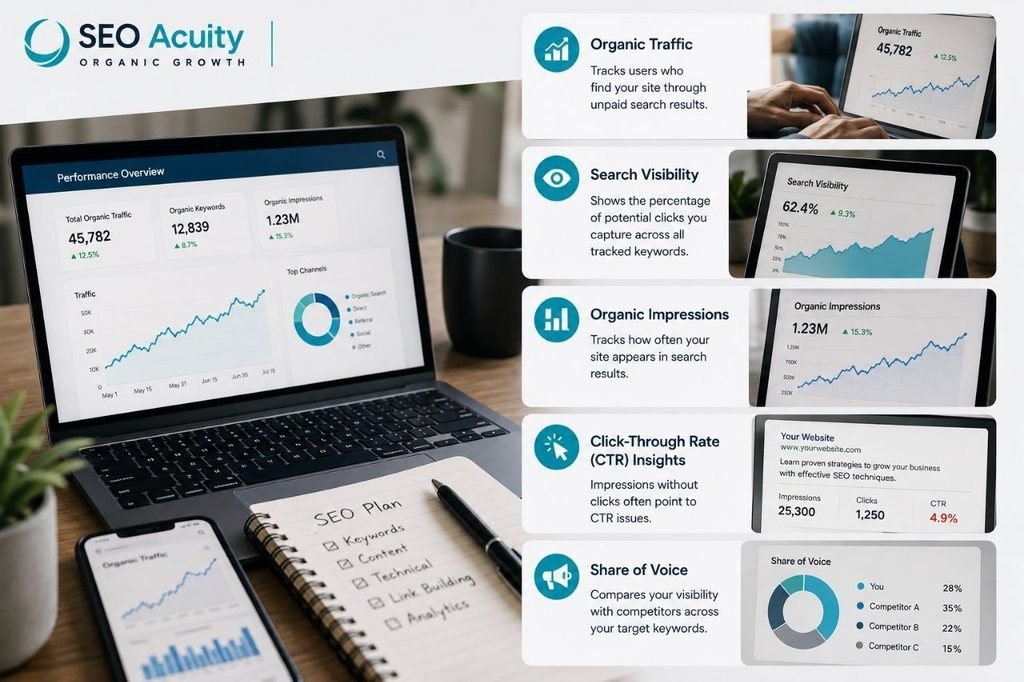
Organic traffic measures how many users reach your site through unpaid search results. A rise in organic traffic signals successful keyword targeting, content optimization, and technical SEO. A decline often points to algorithm updates, increased competition, or technical issues, so it’s worth investigating any sudden drop rather than assuming it will resolve on its own.
Search visibility takes this a step further by reflecting the percentage of potential clicks you capture across all the keywords you track.
It gives you a market-level view of your performance against competitors, rather than looking at traffic in isolation.
Organic impressions track how often your site appears in search results, showing visibility growth before it translates into traffic.
Impressions without clicks often point to CTR issues worth investigating your pages may be ranking, but the listing itself isn’t convincing enough to earn the click.
Share of voice shows how visible you are compared to competitors across a set of keywords, reflecting your overall market dominance or the gaps you still need to close. Tracking it regularly tells you whether you’re gaining or losing ground in your niche.
Read also: What Is Semantic SEO? A Practical Guide for Business Growth
3. Measuring Keyword Rankings and Click-Through Rate
Keyword rankings show where your pages appear for specific search terms. Strong rankings drive more visibility, while dropping rankings can reveal competitors gaining ground or search engines shifting their priorities.
This metric directly affects impressions, CTR, and traffic, so it’s usually the first thing SEO teams check when something feels off.
Click-through rate (CTR) measures the percentage of impressions that turn into clicks. A high CTR means your titles, URLs, and meta descriptions are compelling and relevant to searchers even if a page isn’t ranking at the very top.
You can improve CTR by testing different title formats, writing more specific meta descriptions, and using structured data to earn rich snippets.
Ranking well but seeing a low CTR is a common and fixable problem. It usually means your page satisfies the algorithm but not the searcher’s curiosity, so refining how your listing looks in the results often delivers a faster win than chasing a higher position.
Read also: Ethical SEO Agency – How to Choose the Right SEO Partner?
Read also: What Is an SEO Specialist?
Ready to Dominate Search Engine Rankings?
Accelerate your organic growth and scale your business leads with our data-driven SEO strategies.
Get a Free Quote NOW!4. Measuring Conversions and Organic Revenue
Organic traffic conversions show how many users complete a desired action a sign-up, a download, a purchase after finding you through search.
This is where SEO performance translates directly into business results, and it’s the metric that matters most to stakeholders outside the marketing team.
Organic revenue takes this further by measuring revenue directly tied to traffic from search engines. It’s the strongest link between SEO and real business outcomes, and tracking it accurately means setting up proper attribution in your analytics platform so organic sessions are tied to the transactions or leads they produce.
If traffic is rising but conversions and revenue aren’t following, that’s usually a sign your keywords are attracting the wrong audience, or that your landing pages don’t match what searchers expect once they arrive.
5. Evaluation Of Backlinks, Domain Authority, and Referring Domains
A backlink profile includes the quantity, quality, and diversity of links pointing to your site. Strong, relevant backlinks boost credibility and rankings, while spammy or toxic links can hurt performance.
Reviewing this profile regularly helps you catch harmful links early and understand which content naturally earns links from others.
Domain Authority (DA) is a predictive metric that estimates how likely your site is to rank compared to competitors.
Google doesn’t use it directly, but it’s a widely used industry benchmark reflecting backlink quality and overall site strength useful for comparing yourself to competitors over time.
Referring domains count the number of unique websites linking to you. Links from a variety of sources are more valuable than repeated links from the same domain, so a healthy link-building strategy focuses on breadth as well as authority.
watch a video of seo acuity:
6. How to Monitor Technical SEO Health
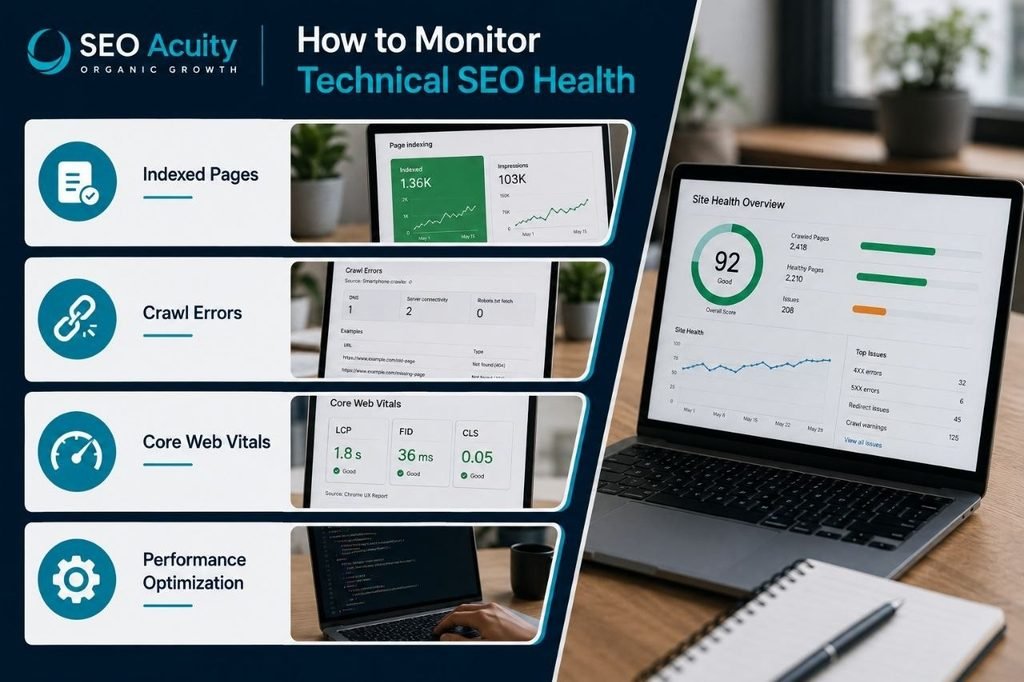
Indexed pages reflect how search engines see your site. If important content isn’t indexed, it can never appear in search results and too many low-value indexed pages can drag down overall performance.
Checking your indexation status regularly ensures your best content is actually eligible to rank. Crawl errors occur when search engines can’t access certain pages. These errors block indexing and hurt rankings, wasting the effort put into content that never reaches users.
Fixing broken links, redirect chains, and server errors keeps your most valuable pages discoverable.
Core Web Vitals measure loading speed, interactivity, and visual stability. These directly affect rankings and user satisfaction; poor scores are often linked to higher bounce rates and lost conversions.
Improving them usually means optimizing images, reducing unnecessary scripts, and improving server response times.
7. Tracking User Engagement on Your Website
Once you’ve defined your goals, it’s essential to monitor how users behave after landing on your site, since engagement signals often explain why traffic isn’t converting.
Conversion rate is the number of conversions divided by total visits over the same period. It shows your return on investment and whether you’re targeting the right keywords for your business goals.
Time on page reflects how long visitors stay engaged with your content. Longer time on page usually means visitors found what they were looking for a 3,000-word article with a 10-second average time on page is a clear red flag that something isn’t matching search intent.
Pages per visit reveals whether visitors read one page and leave, or explore further. Internal linking to related content can help keep visitors on your site longer and signals to search engines that your site offers depth on a topic.
Bounce rate is the percentage of visitors who leave after a single-page session. Acceptable rates vary by industry, but content sites typically aim for under 60%, while some business types naturally see higher rates.
Returning visitors reflect user loyalty and repeat engagement through organic search. Returning visitors are more likely to convert, engage more deeply, and share your content, making this a strong long-term indicator of content quality.
8. Choosing the Right Tools for SEO Measurement
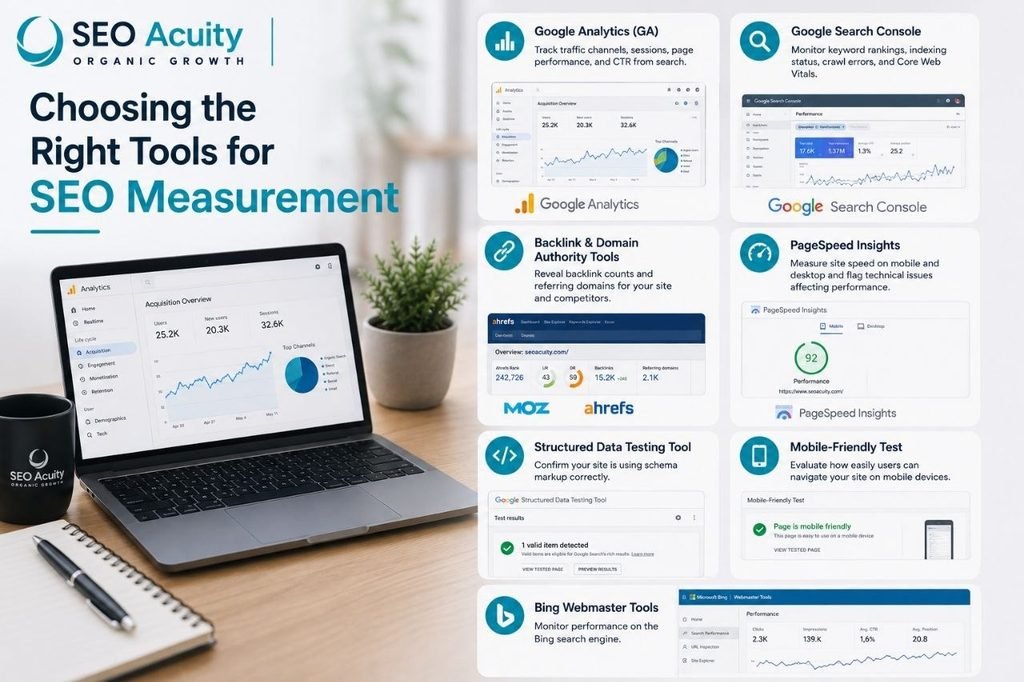
Manually tracking SEO with scattered spreadsheets takes far too much time. The right combination of tools lets you automate measurement so you can focus on strategy instead of repetitive tasks.
Google Analytics (GA) lets you track traffic channels, sessions, page-level performance, and CTR from search results. Google Search Console monitors keyword rankings, indexing status, crawl errors, and Core Web Vitals directly from Google’s own data.
Backlink and Domain Authority tools like Moz and Ahrefs reveal backlink counts and referring domains for your site and competitors.
PageSpeed Insights measures site speed on mobile and desktop and flags technical issues affecting performance. The Structured Data Testing Tool confirms your site is using schema markup correctly, while the Mobile-Friendly Test evaluates how easily users can navigate your site on mobile devices.
Bing Webmaster Tools works similarly to Google’s tool, for monitoring performance on the Bing search engine.
For more on tracking tools in action, check out this video:
9. Turnning SEO Metrics Into a Winning Strategy
Knowing the numbers isn’t enough the real value comes from connecting them to your business goals.
Start by defining your goal first, whether that’s more sales, more qualified leads, or brand awareness, then choose the metrics that actually serve that goal instead of tracking everything at once.
Compare data over time instead of looking at a single number, so you can spot real trends versus seasonal noise. Connect traffic to conversions and revenue to see whether your target keywords are delivering real business value, not just traffic volume.
Monitor technical health regularly, since crawl errors or slow load times can undo the impact of your content and link-building efforts.
Finally, automate reporting to schedule recurring checks instead of manual audits, freeing up time for strategic decisions rather than data collection.
Read also: Small Business SEO Guide
Ready to Dominate Search Engine Rankings?
Accelerate your organic growth and scale your business leads with our data-driven SEO strategies.
Get a Free Quote NOW!Common Challenges When Measuring SEO Performance
Isolating SEO’s impact from other marketing channels is one of the biggest challenges when calculating revenue attribution, since customers often interact with several channels before converting.
Constant algorithm updates can also cause sudden ranking and traffic shifts without an immediately clear cause, which makes short-term panic counterproductive.
Fragmented data across multiple tools analytics, search console, backlink platforms is hard to unify without automation, and many teams end up with inconsistent numbers because each tool measures things slightly differently.
Finally, overemphasis on vanity metrics like raw traffic numbers, without tying them to real business metrics like conversions and revenue, is one of the most common mistakes in SEO reporting.
How can I start improving my site’s page?
Common starting points include compressing images, minifying CSS and JavaScript, using a CDN, and confirming the site works smoothly on mobile devices. A technical review can help prioritize which fixes will have the biggest impact.
SEO Acuity can help you review your site, start with a Free SEO Quote.
Related SEO Services
If you’d like expert help putting these metrics into practice, SEO Acuity offers a full range of SEO services tailored to different business needs:
You can also browse SEO Acuity’s products or explore the industries SEO Acuity serves to find the best fit for your business.
Conclusion
Measuring SEO performance isn’t about tracking isolated numbers it’s an ongoing process that connects traffic, user engagement, conversions, and revenue.
Track the metrics above consistently, set your priorities, and turn this data into concrete actions for improving content, technical health, and link building.
With this approach, your website will improve steadily over time, and you’ll be able to clearly demonstrate the value of your SEO investment.
Frequently Asked Questions
How long does it take to see SEO results?
Most websites start seeing measurable movement in rankings and traffic within three to six months, though this varies by industry competitiveness, site history, and how consistently the strategy is executed. Significant revenue impact often takes longer to materialize.
What is a good organic traffic growth rate?
There’s no universal benchmark, since growth depends on your starting point, industry, and market size. A more useful approach is comparing your month-over-month and year-over-year trends against your own historical performance and realistic goals.
Which SEO metric matters most for small businesses?
For most small businesses, organic traffic conversions and organic revenue matter more than raw traffic or rankings, since they directly reflect whether SEO is contributing to real business growth rather than just visibility.
Do I need paid tools to measure SEO performance?
No, Google Analytics and Google Search Console are free and cover most core metrics like traffic, rankings, CTR, and technical issues.
Paid tools like Ahrefs or Moz add competitive backlink data and deeper keyword research, which becomes more valuable as your strategy matures.
How often should I check my SEO metrics?
A weekly check of traffic and technical health, combined with a deeper monthly review of rankings, conversions, and revenue, works well for most businesses. Checking too frequently can lead to overreacting to normal day-to-day fluctuations.
What’s the difference between SEO metrics and Google Analytics metrics?
SEO metrics specifically isolate performance from organic search, such as keyword rankings and organic traffic, while Google Analytics reports on all traffic sources and user behavior across your entire site.
SEO tracking typically combines both Search Console data and Analytics data for a complete picture.
Can I measure SEO performance without a big budget?
Yes. Google Analytics, Google Search Console, and PageSpeed Insights are all free and cover the majority of what’s needed to measure SEO performance accurately.
A limited budget mainly affects the depth of competitive research you can do, not your ability to track your own site’s core metrics.