If your business isn’t showing up when local customers search for what you sell, you’re handing that revenue to a competitor. Small business SEO is the most cost-effective way to fix that — and unlike paid ads, the results compound over time rather than disappear when your budget runs out.
Search engine optimization (SEO) for small businesses is the process of improving your website’s visibility in Google and other search engines so that customers can find you when they’re actively looking for your product or service. It covers everything from the words on your pages to the technical health of your site and the reputation you build across the web.
This guide gives you a complete, practical picture — what small business SEO actually involves, why it matters more than ever, and the exact steps to start getting results without an enterprise budget.
What you’ll learn in this article
- What SEO for small businesses means and how it differs from local SEO
- The real business benefits — beyond “more traffic”
- A step-by-step strategy any small business can execute
- The one mistake most small business owners make that wastes months of effort
- How to measure whether your SEO is working
What Is SEO for Small Businesses?
Small business SEO is the practice of optimizing your website and online presence so that Google ranks your pages highly for the searches your customers are already making. The goal is not just traffic — it’s the right traffic: people in your market, at the moment they’re ready to act.
SEO is not a single tactic. It combines on-page optimization (content, headings, meta descriptions, page speed), off-page authority building (backlinks, reviews, citations), and technical fundamentals (site structure, mobile usability, crawlability). Successful small business SEO addresses all three layers, even at a modest scale.
Read also: How To Build An Ecommerce SEO Strategy?
How small business SEO differs from local SEO
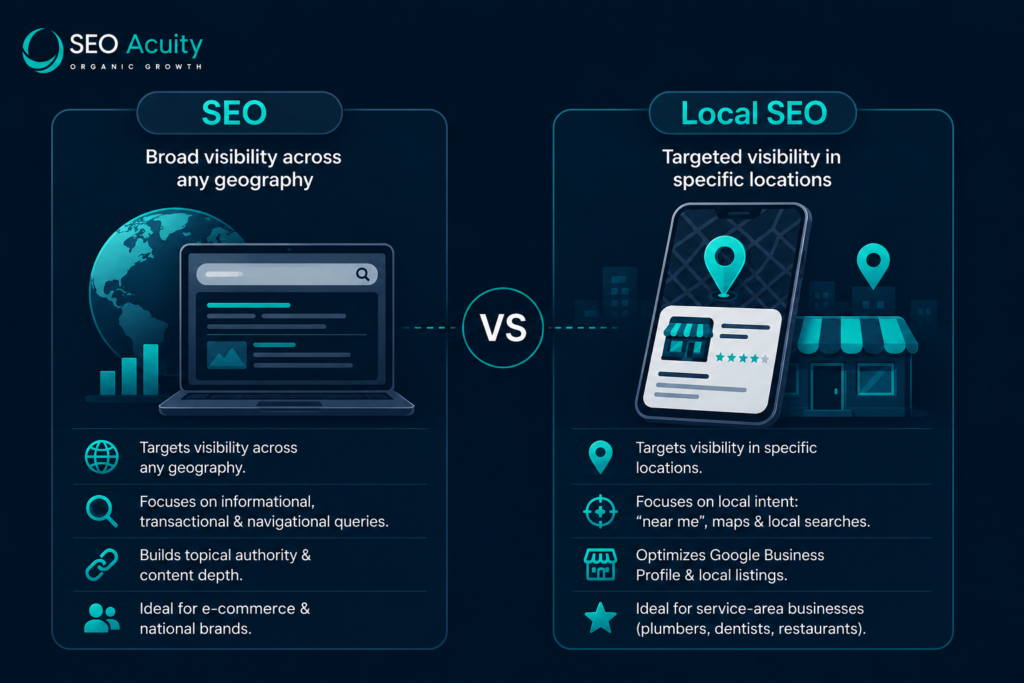
SEO describes the process of improving your site’s visibility in search results broadly — across any geography and query type. Local SEO is a subset focused specifically on ranking in geographically bounded results: the Google Map Pack, “near me” searches, and local organic listings.
For a plumber, dentist, or restaurant, local SEO is the most important investment. For an e-commerce store shipping nationally, broader SEO matters more. Most small businesses need both, weighted by how geography-dependent their customer acquisition is
Why small business SEO is different from enterprise SEO
Large companies compete on domain authority built over years, hundreds of pages of content, and full SEO teams. Small businesses can’t win that fight head-on — and they don’t need to.
The winning move is targeting specific, longer search phrases (called long-tail keywords) where competition is lower and searcher intent is more precise. Ranking for “emergency plumber Austin 78701” is far more achievable — and more profitable — than ranking for “plumber.”
Why SEO Matters for Small Businesses
The case for small business SEO has never been stronger, and three specific shifts explain why.
1. Organic search drives over half of all web traffic.
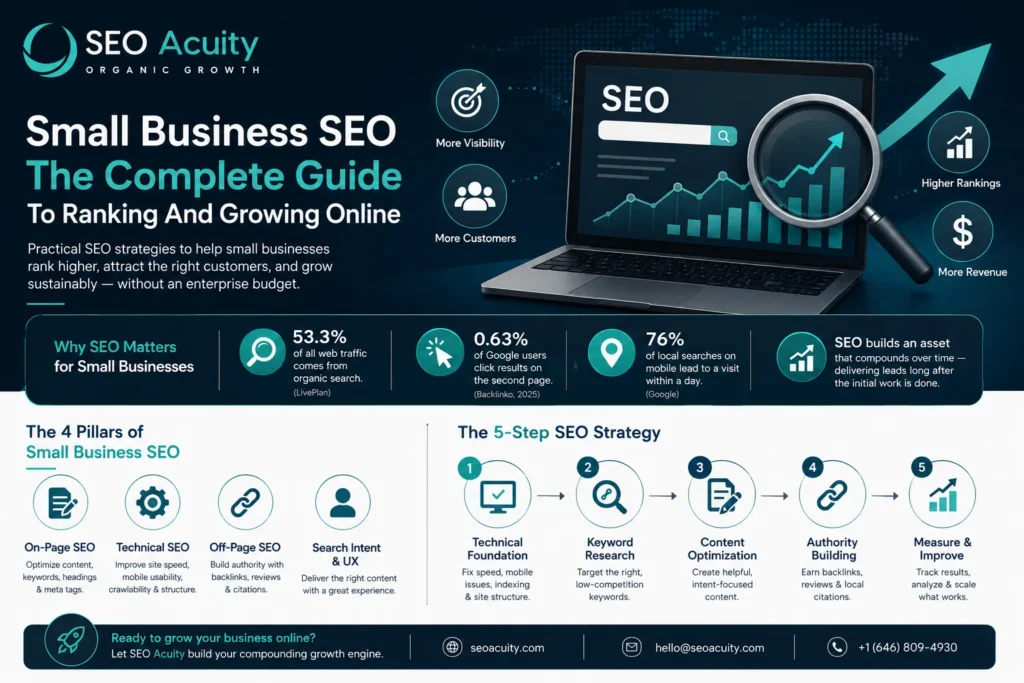
According to data cited by LivePlan, 53.3% of all web traffic comes from organic search — not paid ads, not social media, not referrals. If your site isn’t ranking, you’re invisible to the majority of online searchers.
2. Page two is effectively zero.
A 2025 Backlinko report found that only 0.63% of Google users click results on the second page. The commercial value is concentrated on page one, and disproportionately in the top three positions. Getting there is the job.
3. Local search converts at a remarkable rate.
Google’s own data shows that 76% of people who search for something nearby on their smartphone visit a business within a day, and 28% of those searches result in a purchase. For any business with a physical location or a service area, local SEO has a direct and measurable line to in-store revenue.
4. The compounding advantage over paid advertising
Paid search delivers traffic while the budget runs. SEO builds an asset. A well-optimized page can generate leads for years without additional spend. For small businesses managing tight margins, the long-term return on SEO investment outpaces most paid channels once the initial work is done — typically 6 to 12 months before rankings stabilize and compound.
SEO Acuity works with small businesses to build this compounding asset efficiently — without wasting time on tactics that don’t move the needle for businesses at your scale.
Read also: Ecommerce Technical SEO – The 10-Item Checklist
Check our SEO Services for Small Businesses.
SEO Strategy For Small Businesses
Most guides list SEO tactics in isolation. What follows is a sequenced approach — each step builds on the last, and skipping steps is the most common reason small businesses don’t see results.
Step 1: Get your technical foundation right first
Before any content or keyword work, your site needs to be technically sound. A slow, mobile-unfriendly, or crawl-blocked website will underperform regardless of how good the content is.
Your site must load under 3 seconds on mobile, use HTTPS, have no broken links, and be indexable by Google. Check Google Search Console’s Coverage report for crawl errors and fix them before publishing anything new — otherwise Google may never see your content .
Check All the organic growth foundations.
Step 2: Do keyword research the right way
Keyword research is the process of identifying the exact words and phrases your customers type into Google when looking for what you offer. It determines every piece of content you create and every page you optimize.
The right approach for small businesses is to prioritize specificity over volume. High-volume, short keywords (“accounting software,” “plumber”) are dominated by large brands. Long-tail alternatives (“accounting software for small construction companies,” “emergency plumber Austin 78701”) have lower search volume but much higher conversion rates and far less competition.
Use Google Keyword Planner (free) or tools like Ahrefs, SEMrush, or Ubersuggest to find terms where monthly search volume is reasonable and keyword difficulty is low enough to compete. A keyword with 200 monthly searches and low competition is more valuable than a keyword with 20,000 searches you’ll never rank for.
Step 3: Optimize your existing pages before creating new ones
Each page should target one primary keyword — placed in the title tag, H1, first paragraph, meta description, and URL slug. Use related terms naturally throughout. Alt text, header tags, and meta descriptions carry real SEO weight and are the most frequently neglected elements on small business sites. .
One specific, frequently missed detail: your meta description does not directly affect rankings, but it directly affects click-through rate — which does affect rankings. Write meta descriptions as short ad copy, not as summaries.
Ready to Dominate Search Engine Rankings?
Accelerate your organic growth and scale your business leads with our data-driven SEO strategies.
Get a Free Quote NOW!Step 4: Create content that answers what your customers are searching
Beyond your core service pages, content marketing captures searchers at every stage of the buying cycle. A pest control company that answers “how do I know if I have termites” ranks before customers have decided who to call — and becomes the obvious choice when they do.
Google assesses content quality using the E-E-A-T framework: Experience, Expertise, Authoritativeness, and Trustworthiness. In practice: use real photos, credit qualified authors, and display genuine customer reviews. Generic content that could apply to any business in any city will not rank.
Step 5: Build your local presence
For most small businesses, local SEO produces the fastest, most tangible results. The steps are specific and actionable.
Claim and fully complete your Google Business Profile. This is the single highest-impact free action a small business can take. Fill in every field: business category, hours, services, photos, and description with local keywords. Businesses with complete profiles are substantially more likely to appear in the Map Pack.
Gather reviews consistently. The number, recency, and rating of your Google reviews directly influence local rankings. Make it a standard operating procedure to ask satisfied customers for a review — not with an incentive, but with a simple, direct request and a link.
Ensure your business Name, Address, and Phone number (NAP) is identical across every directory — Google, Yelp, Bing Places, Apple Maps, and any industry-specific directories. Inconsistent NAP data confuses Google about your location and suppresses local rankings.
At SEO Acuity, our local SEO packages handle Google Business Profile optimization, citation building, and review strategy for you — so you can focus on running the business, not the directories.
Read also: How To Improve Ecommerce SEO Through 10 Battle-Tested Strategies?
Step 6: Build backlinks through relationships, not shortcuts
Backlinks — links from other websites pointing to yours — are one of the strongest signals Google uses to determine authority and trustworthiness. For small businesses, the most practical backlink sources are: local business associations and chambers of commerce, supplier or vendor “where to buy” pages, local news coverage of your business, and guest content in industry publications.
What to avoid: purchasing links from low-quality directories or link farms. A single bad backlink profile can suppress rankings for months. Quality over quantity is not just good advice — a handful of links from genuinely authoritative local sites outperforms hundreds of low-quality links.
Step 7: Track, measure, and adjust
SEO results take time — typically 3 to 6 months before meaningful movement in competitive categories, sometimes longer. The most common reason small businesses abandon SEO is impatience, not failure.
Track organic traffic and keyword rankings monthly using Google Analytics and Google Search Console (both free). Set up conversion tracking so you can connect organic traffic to actual leads or sales — not just page views. Review which pages are gaining or losing impressions, and adjust content or targeting accordingly.
Ready to Dominate Search Engine Rankings?
Accelerate your organic growth and scale your business leads with our data-driven SEO strategies.
Get a Free Quote NOW!Get Your Small Business Ranking — Without Doing It Alone
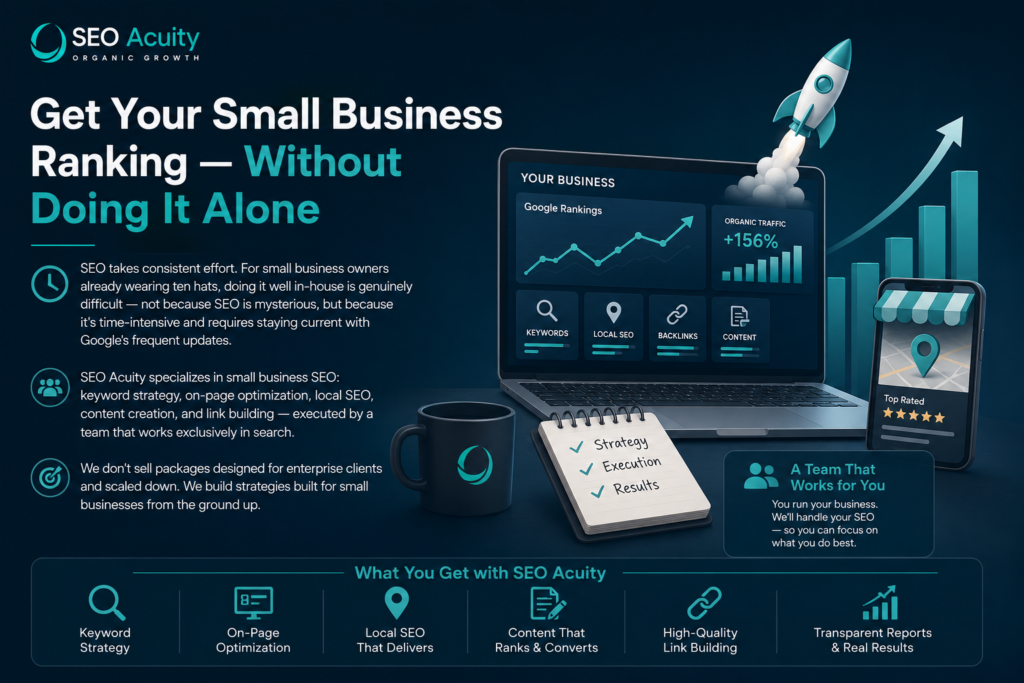
SEO takes consistent effort. For small business owners already wearing ten hats, doing it well in-house is genuinely difficult — not because SEO is mysterious, but because it’s time-intensive and requires staying current with Google’s frequent updates
SEO Acuity specializes in small business SEO: keyword strategy, on-page optimization, local SEO, content creation, and link building — executed by a team that works exclusively in search. We don’t sell packages designed for enterprise clients and scaled down.
We build strategies built for small businesses from the ground up
Ready to Dominate Search Engine Rankings?
Accelerate your organic growth and scale your business leads with our data-driven SEO strategies.
Get a Free Quote NOW!Conclusion
Small business SEO is not a luxury or a “when we have more time” project — it’s the primary channel through which customers find local and regional businesses. Organic search drives more than half of all web traffic, page-one rankings are where commercial intent converts, and local search produces same-day visits and purchases at rates that outperform most other marketing channels.
The strategy is clear: fix technical issues first, research the right keywords, optimize existing pages, create authoritative content, build your local presence, earn quality backlinks, and measure results consistently. None of these steps require an enterprise budget. They require consistent execution and patience.
Businesses that invest in SEO now are building a compounding asset. Those that wait are ceding ground to competitors who aren’t waiting.
Frequently Asked Questions
What is SEO for small businesses?
SEO for small businesses is the process of optimizing a website and online presence so that Google and other search engines rank it highly for searches relevant to that business. It includes on-page content, technical site health, local listings, and backlink building — all aimed at bringing in customers who are actively searching for what the business offers.
How long does SEO take to work for a small business?
Most small businesses see meaningful ranking improvements within 3 to 6 months of consistent SEO work. Highly competitive categories or markets can take longer. Technical fixes and Google Business Profile optimization often produce visible results faster — sometimes within weeks.
Is SEO worth it for a small business?
Yes. SEO produces a higher long-term return than most paid channels because the results compound — a well-ranked page continues generating leads without ongoing cost. Paid ads stop delivering the moment the budget stops; SEO does not. For businesses with limited marketing budgets, SEO is typically the highest-ROI channel available.
What is the difference between SEO and local SEO for small businesses?
SEO refers broadly to improving visibility in search engines for any query. Local SEO specifically targets geographically bounded results — the Google Map Pack, “near me” searches, and local organic listings. Most small businesses need both, with local SEO weighted more heavily for businesses that serve a specific city or region.
What SEO tools do small businesses need?
The essential free tools are Google Analytics (traffic and conversion tracking), Google Search Console (keyword performance and technical issues), and Google Business Profile (local visibility). Paid tools like Ahrefs, SEMrush, or Moz add keyword research depth and competitive analysis, but they’re optional when starting out.
How much does small business SEO cost?
Costs vary widely. DIY SEO using free tools costs time, not money. Hiring a freelancer runs roughly $500 to $2,000 per month depending on scope. A dedicated agency ranges from $1,000 to $5,000+ per month for comprehensive service. The right investment depends on your market’s competitiveness and how aggressively you want to grow organic traffic.