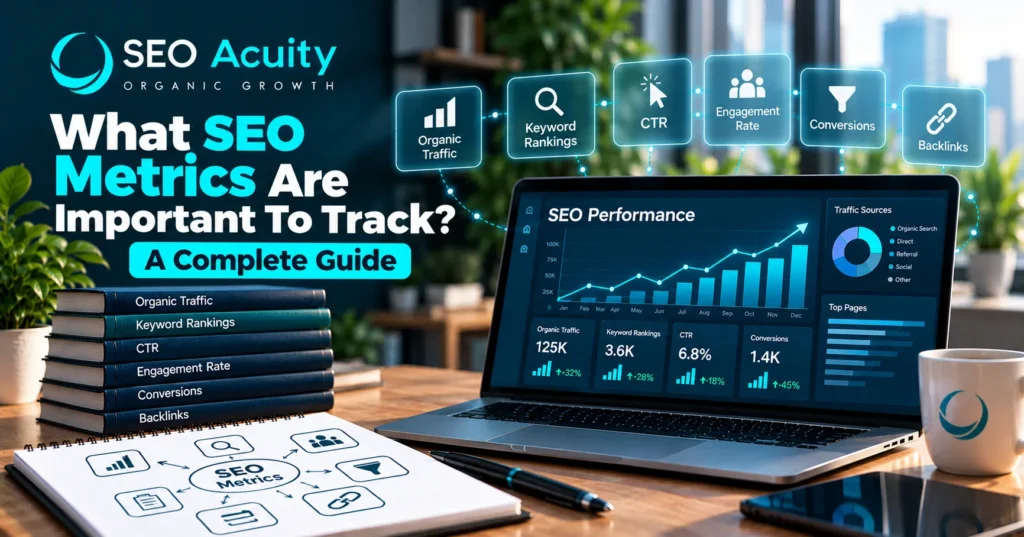
Knowing what SEO metrics are important to track is what separates a report that shows activity from one that shows real progress.
SEO metrics are the specific data points from organic traffic to backlink profiles used to measure how well a website performs in search results and how that performance connects to business outcomes.
This guide is written for business owners, website owners, startups, and marketing teams who want to look past a standard traffic-and-rankings summary and understand which numbers actually indicate progress.
For a professional review of how your own site’s metrics are trending, SEO Acuity offers a Free SEO Quote to help identify where to focus next.

What This Guide Covers
● A clear definition of SEO metrics and why they matter beyond a single number.
● The most commonly tracked SEO metrics: organic traffic, keyword rankings, CTR, engagement rate, conversion rate, and backlinks.
● Additional metrics many reports overlook, from brand search volume to session-per-user ratios.
● How each metric is typically measured, and which tools are used to track it.
● The difference between SEO metrics and KPIs, and why that distinction matters for reporting.
Read also: How To Measure Seo Performance – A Complete Guide
What Are SEO Metrics?
SEO metrics are the measurable data points used to track how a website performs in organic, or unpaid, search results. They cover everything from how many people arrive through search to how those visitors behave once they land, giving a fuller picture of performance than any single number on its own.
Tracking the right SEO metrics matters because search optimization touches several parts of a site at once content relevance, technical health, and off-site authority. A report built around only one or two metrics can miss where the real opportunity, or the real problem, actually is.
Not every SEO metric carries equal weight for every business. A number that matters for an e-commerce store’s conversion rate may be less relevant for a content publisher focused on audience reach, so what are the key metrics to track for SEO success depends partly on the underlying business goal.
Problems That Come From Tracking the Wrong Metrics
Choosing the wrong metrics doesn’t just waste reporting time it can mask whether a site is genuinely improving, blur the line between raw data and business outcomes, and hide entire categories of insight a standard report never touches.
From reports that look active but go nowhere, to confusion between metrics and KPIs, to overlooked signals like brand search and traffic value, these gaps often decide whether an SEO report drives real decisions or just gets filed away.
1. Reports That Show Activity but Not Progress
A report built around standard numbers like total sessions or overall keyword count can look busy without showing whether a site is actually moving toward its goals.
Pairing standard metrics with ones tied directly to a stated objective gives a clearer sense of real progress.
Read also: What Is Topical Authority in SEO? A Complete Guide
2. The Difference Between SEO Metrics and KPIs
Many reports treat every tracked number as equally important, without understanding the difference between SEO metrics and KPIs.
Metrics like impressions or average position provide useful context, but KPIs key performance indicators tied directly to a business outcome, such as qualified leads generated from organic traffic are what connect SEO work back to business results.
3. Overlooking Metrics That Reveal the Full Picture
Standard reports often stop at organic traffic and keyword rankings, leaving out data like search traffic value, brand search volume, or session-per-user ratios that can reveal trends a surface-level report would miss entirely.
If your current SEO reporting only covers the basics, a broader set of metrics can reveal opportunities that would otherwise go unnoticed. 
The Most Commonly Tracked SEO Metrics
A handful of SEO metrics show up in nearly every performance report because they give a fast, general read on how a site is doing in search. Understanding what they measure, and how to track them, is the starting point for a useful report.
1. Organic Traffic
Organic traffic measures how many visitors reach a site directly through unpaid search results. It’s typically tracked in Google Analytics, under the acquisition or traffic-source reporting that shows how many sessions originated from a search engine. A rising trend generally reflects a content or keyword strategy that’s gaining traction.
2. Keyword Rankings and Average Position
Keyword rankings show where a site’s pages appear in search results for specific target terms, while average position reflects the typical ranking across all the terms a page appears for. Google Search Console’s performance report is the standard tool for tracking both.
Read also: What Is Semantic SEO? A Practical Guide for Business Growth
3. Click-Through Rate (CTR)
CTR measures the percentage of people who click a result after seeing it in search listings. It’s tracked alongside keyword data in Google Search Console, and a higher CTR usually signals that a title and description match what searchers are actually looking for.
A practical starting point is auditing which metrics are currently tracked and identifying the gaps. 
4. Engagement Rate
Engagement metrics describe how visitors behave after arriving on a site how long they stay, how many pages they view, and whether they take any action.
Google Analytics 4 reports engagement rate as the share of sessions lasting longer than ten seconds or including more than one page view, which has largely replaced the older bounce-rate metric in current reporting.
5. Conversion Rate
Conversion rate measures the percentage of visitors who complete a specific goal, such as a purchase, a form submission, or a newsletter signup.
Tracking it requires setting up events or goals inside Google Analytics, since conversions aren’t recorded automatically without configuration.
6. Backlinks and Referring Domains
Backlinks are links from other websites pointing to a site, and referring domains count how many unique sites provide those links. Dedicated SEO tools are typically used to track both, since this data isn’t available through Google’s own analytics products.
Ready to Dominate Search Engine Rankings?
Accelerate your organic growth and scale your business leads with our data-driven SEO strategies.
Get a Free Quote NOW!SEO Metrics That Are Often Overlooked
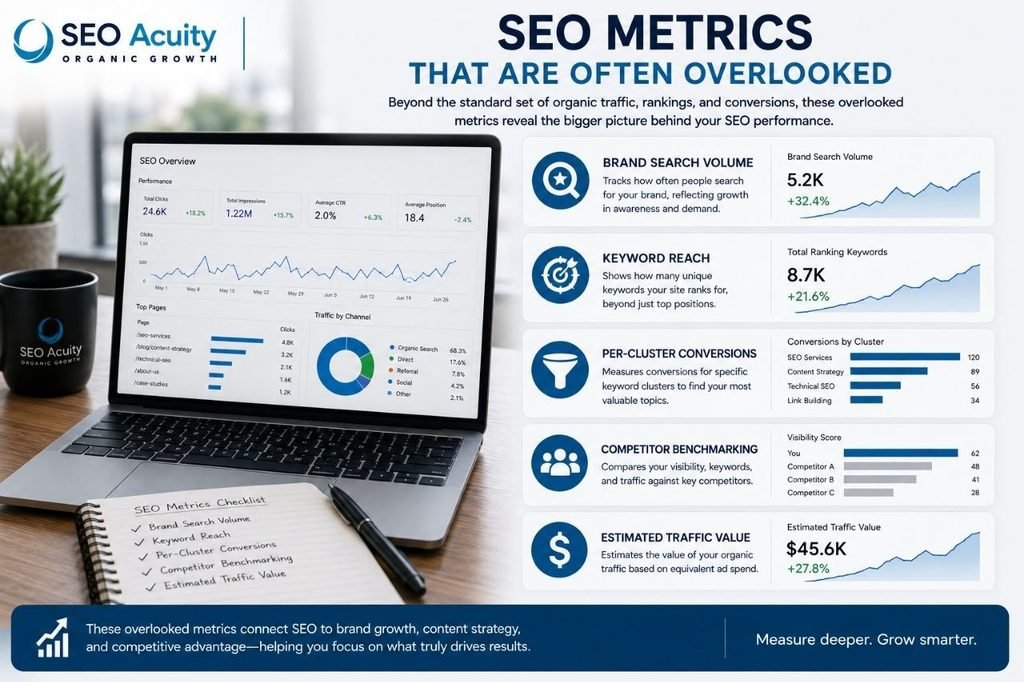
Beyond the standard set of organic traffic, rankings, and conversions, several additional metrics brand search volume, keyword reach, per-cluster conversions, competitor benchmarking, and estimated traffic value surface patterns a surface-level report misses entirely.
These signals connect SEO performance to brand awareness, content strategy, and competitive positioning, giving a fuller, more actionable picture of where a site’s search visibility is actually heading.
1. Brand Search Metrics
Brand search volume tracks how often people search directly for a business’s name, separate from non-branded keyword rankings.
Reviewing branded and non-branded keywords separately gives a clearer picture of how much visibility comes from brand recognition versus topical relevance.
2. Keyword Reach and Ranking Distribution
Keyword reach looks at the total number of keywords a site ranks for, not just its top performers, typically reviewed through the full list of ranking queries in Google Search Console.
A wider reach usually points to broader topical coverage and more consistent organic growth over time.
Read also: How to Approach LLM Optimization
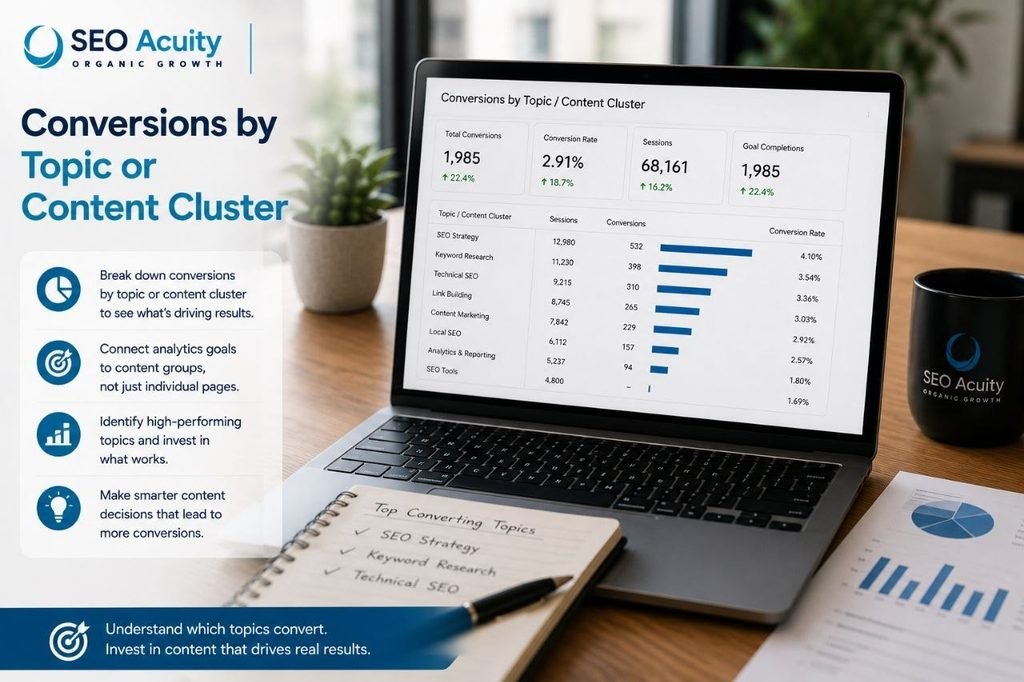
3. Conversions by Topic or Content Cluster
Rather than reviewing site-wide conversion rate alone, breaking conversions down by topic or content cluster shows which subjects are actually driving results.
This view typically requires connecting analytics goals to specific groups of pages, but it identifies where future content investment is likely to pay off.
4. Top Pages Relative to Competitors
Comparing a site’s best-performing pages against a competitor’s equivalent pages content depth, structure, and backlink profile highlights gaps a standalone performance report wouldn’t show on its own.
5. Estimated Value of Organic Search Traffic
Some SEO tools estimate what a site’s current organic traffic would cost to replicate through paid search, giving a rough monetary value to unpaid visibility.
This figure is an estimate rather than an exact cost, but it’s a useful way to frame the value of SEO work in familiar budget terms.
6. Search Impression History
Reviewing how impressions have changed since a site launched, available in Google Search Console’s historical data, can reveal whether current rankings match genuine search intent or a broader, less relevant term.
This helps separate real ranking gains from visibility for vague, low-value queries.
7. Sessions per User
Sessions per user measures how many separate visits the average person makes to a site over time. A ratio close to one suggests visitors aren’t returning, while a higher ratio generally reflects content that brings people back.
This metric can fluctuate seasonally, so it’s most reliable when compared outside of peak periods.
8. Domain Authority and Similar Ratings
Domain rating or authority scores, offered by several SEO platforms, combine backlink and site-strength data into a single score, typically out of 100, used to estimate how competitive a site is likely to be in search results.
These scores vary by provider and aren’t an official Google metric, but they’re widely used as a general benchmark of a site’s overall strength.
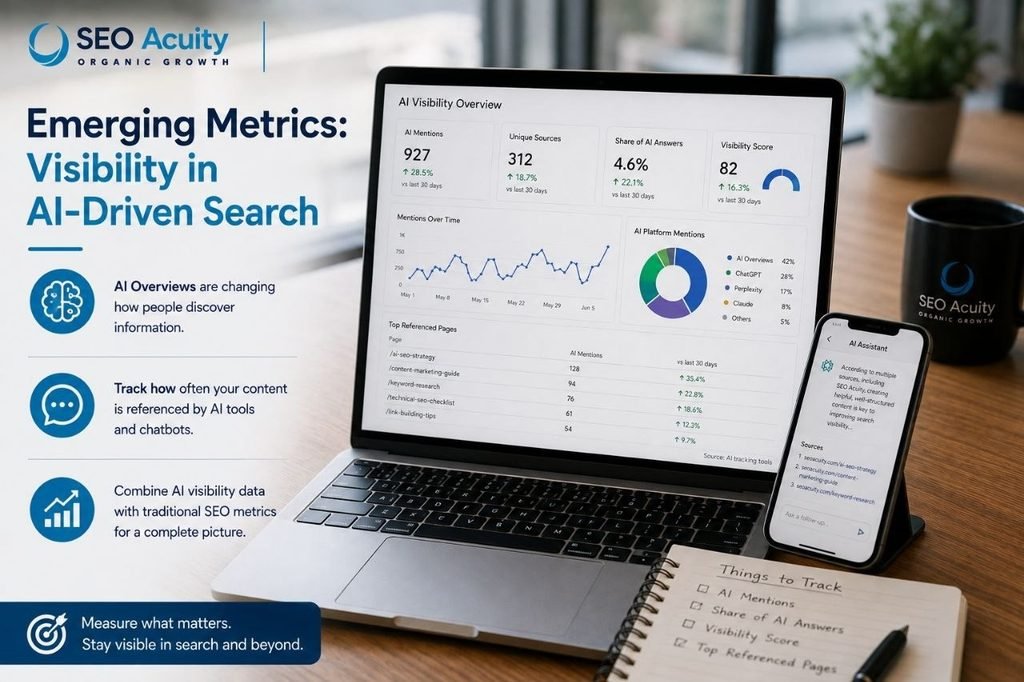
9. Emerging Metrics: Visibility in AI-Driven Search
As more searches are answered directly through AI Overviews, chatbots, and other generative tools, some businesses have started tracking how often their content is referenced by these systems, alongside traditional organic metrics.
This is still a developing area of measurement compared to the standard metrics covered above.
Read also: Do AI, GEO, and AEO Replace SEO?
Ready to Dominate Search Engine Rankings?
Accelerate your organic growth and scale your business leads with our data-driven SEO strategies.
Get a Free Quote NOW!How These Metrics Are Typically Measured
Tracking these metrics generally requires a mix of free and paid tools, each suited to a different part of the picture.
| Tool | What It’s Typically Used For |
| Google Search Console | Keyword rankings, average position, CTR, and impression history |
| Google Analytics 4 (GA4) | Organic traffic, engagement rate, and conversion tracking |
| Backlink analysis tools (e.g., Ahrefs) | Backlinks, referring domains, domain rating, and competitor comparisons |
| All-in-one SEO platforms (e.g., Semrush) | Keyword tracking, technical site audits, and competitor research |
Free tools like Search Console and GA4 cover much of the core reporting, while paid platforms are typically needed for backlink data, domain-strength scores, and detailed competitor comparisons.
watch: this SEO Acuity video resource.
Why Tracking the Right SEO Metrics Matters
A well-rounded set of SEO metrics does more than fill out a report it turns raw search data into decisions a business can actually act on, from where to invest content budget to which competitive gaps deserve attention first.
The value shows up across several areas at once: measuring genuine progress, spotting missed opportunities, benchmarking against competitors, and building a stronger, more defensible case for ongoing SEO investment.
- Connecting metrics to actual business goals makes it easier to separate genuine progress from surface-level activity.
- Reviewing metrics like brand search and keyword reach can reveal opportunities a standard report would miss.
- Comparing performance against competitors highlights specific, actionable gaps rather than vague areas for improvement.
- A fuller set of metrics makes budget and content decisions easier to justify with real data.
- Tracking metrics consistently over time supports more accurate, defensible reporting.

Why Work With SEO Acuity
Pulling the right SEO metrics together, interpreting what they mean, and connecting them to business goals takes ongoing attention that many internal teams struggle to sustain alongside other priorities.
SEO Acuity works with business owners, startups, and marketing teams who want their reporting to reflect real performance, not just standard traffic numbers.

Trust and Credibility
SEO Acuity‘s approach relies on measurable data rather than unverified claims reviewing the metrics that reflect a site’s actual search performance and explaining what they mean in plain terms, so businesses can evaluate progress for themselves.
Ready for a Clearer Picture of Your SEO Performance?
A report built around the right mix of standard and often-overlooked metrics gives a far more accurate view of how a site is really performing than rankings or traffic alone.
Explore SEO Acuity’s SEO Services
Tracking the right metrics is easier when it’s paired with the specific SEO work that moves them. SEO Acuity offers a range of services covering different parts of the search optimization process:

Conclusion
Knowing what SEO metrics are important to track means looking beyond a single number and understanding how organic traffic, keyword rankings, engagement, conversions, and backlinks fit together.
Metrics that are often overlooked brand search volume, keyword reach, traffic value, and session-per-user ratios frequently reveal opportunities that a standard report misses entirely.
A clear, well-rounded set of SEO metrics, tracked consistently over time, gives a far more accurate picture of progress than any single figure taken on its own.
Frequently Asked Questions
What are the key metrics to track for SEO success?
The key metrics to track for SEO success generally combine the commonly tracked set organic traffic, keyword rankings, CTR, engagement, and conversions with at least one KPI tied directly to a business outcome, such as leads or revenue from organic search.
What are the most important SEO metrics to track?
The most commonly tracked SEO metrics include organic traffic, keyword rankings, click-through rate, engagement rate, conversion rate, and backlinks, though which matter most depends on a site’s specific goals.
What’s the difference between an SEO metric and a KPI?
A metric is a raw data point, such as impressions or average position. A KPI is the subset of metrics tied directly to a business outcome, such as qualified leads generated from organic traffic.
Which tool should I use to track SEO metrics?
Google Search Console and Google Analytics 4 cover most core metrics for free, while paid tools such as Ahrefs or Semrush are typically needed for backlink data and competitor comparisons.
How often should SEO metrics be reviewed?
Review frequency depends on the metric and the size of the site, but most businesses benefit from reviewing core metrics monthly, with a deeper review on a quarterly basis to spot longer-term trends.
Is organic traffic the most important SEO metric?
Organic traffic is a useful starting point, but it doesn’t show whether visitors are engaging or converting, so it’s best reviewed alongside engagement and conversion metrics rather than on its own.
Can SEO metrics show the actual return on an SEO investment?
Metrics like conversion rate, conversions by topic, and estimated traffic value give a reasonable picture of return, though connecting them to a specific dollar figure requires clear goal tracking to be set up in advance.