If your online store isn’t ranking where your customers are searching, you’re leaving sales on the table — and your competitors are the ones cashing in.
Ecommerce SEO is not a nice-to-have add-on; it is the engine that drives sustainable, cost-free traffic to your product and category pages, compounding in value every month you maintain it. Unlike paid ads that go dark the moment the budget runs out, a well-optimized store keeps working around the clock.
The challenge is that most online retailers know the surface-level moves, keywords, meta tags, fast loading, but stop short of the deeper work that actually separates page-one results from page-three obscurity. This guide covers the complete, actionable picture.
Explore SEO Acuity’s SEO Audit Services
1. To Improve Ecommerce SEO Run SEO Audit Before You Touch A Single Page
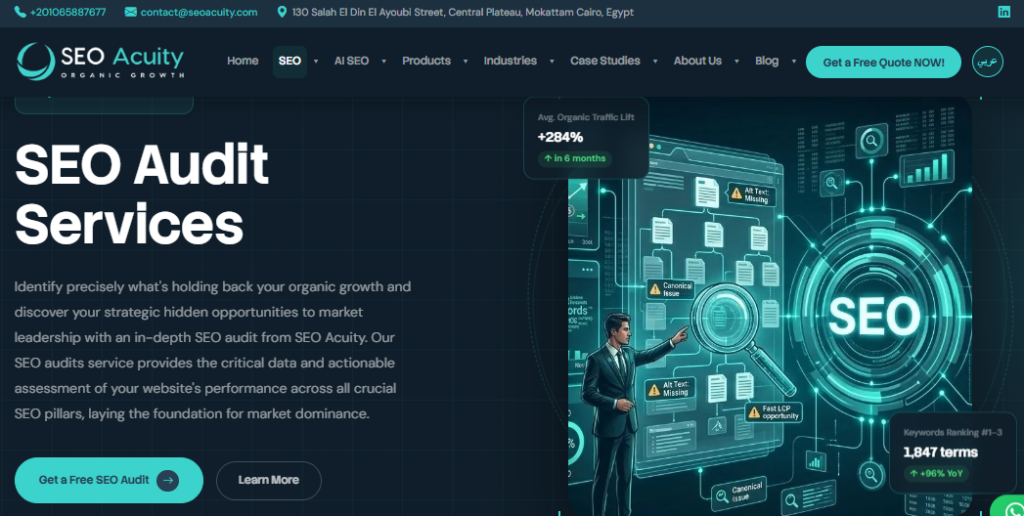
Every strong SEO campaign starts with an honest look at where things stand. Before you optimize product descriptions or chase keywords, you need a clear picture of what is broken, what is already working, and where the largest gaps exist. Without this baseline, you risk spending effort on the wrong problems and making changes that cancel each other out.
A proper audit examines crawlability, indexation, page speed, duplicate content, broken links, and metadata quality across your entire store. Some issues — thousands of thin filter URLs accidentally indexed, for example, or a misconfigured robots.txt blocking your category pages — can single-handedly stall your rankings regardless of how well everything else is optimized.
Understanding what is an SEO audit will save you significant time and misdirected effort before you begin. And if you’re weighing whether the investment is worthwhile, the evidence for why are SEO audits important is straightforward: you cannot fix what you cannot measure.
Read also: Product Page SEO – The Complete Guide
2. Target High-Intent Keywords That Put Ready-To-Buy Shoppers At Your Door
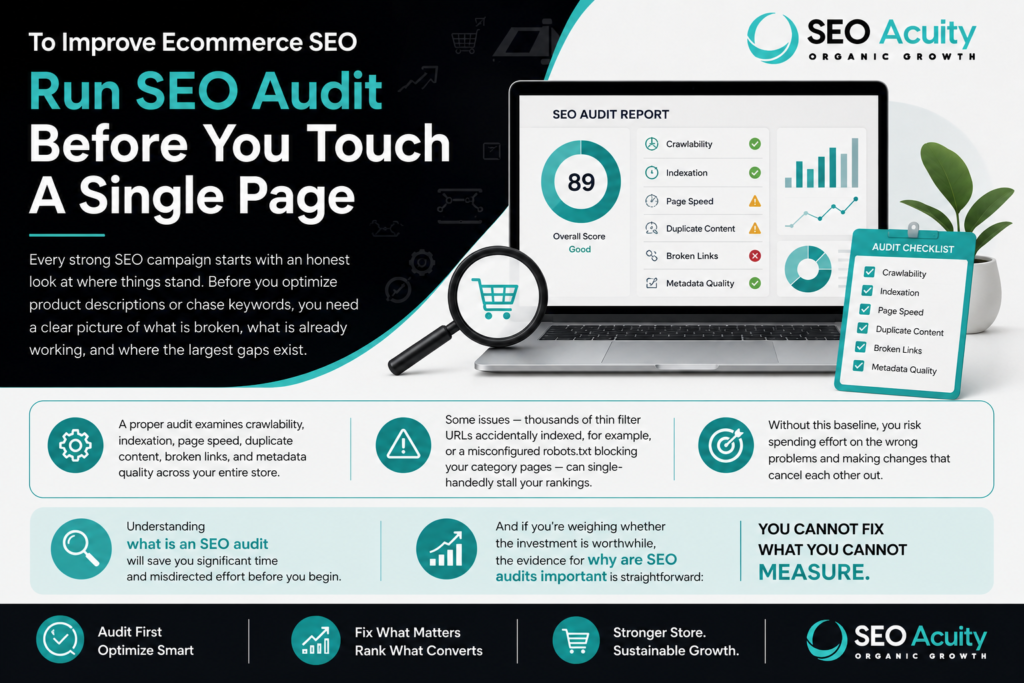
Keyword research for ecommerce is fundamentally different from content SEO because the intent behind a search matters far more than its volume alone. A query like “waterproof hiking boots for wide feet size 10” will convert at a dramatically higher rate than “best hiking footwear”.
The goal is to find the terms real buyers type when they are close to a purchase decision, not the terms people use when they’re vaguely curious.
Knowing types of SEO audits helps you identify which keyword gaps to tackle first — whether your issue is thin category pages, missing long-tail coverage, or poorly optimized product titles that attract the wrong visitors.
Read also: what-is-seo-marketing/
A. How to Find Commercial Keywords Worth Targeting?
Start with your product catalog. Map every product and every category to its most specific descriptor, then expand outward using tools like Google Keyword Planner, Ahrefs, or Semrush.
Pay close attention to transactional modifiers, words like “buy,” “price,” “deal,” and “free shipping”, which appear in queries from people who have already decided to purchase and are simply looking for the right place to do it.
Also mine your site’s internal search log. What do visitors type into your own search bar? These terms reveal real demand that public keyword tools frequently miss, and they map directly to pages that should exist on your store but may not yet.
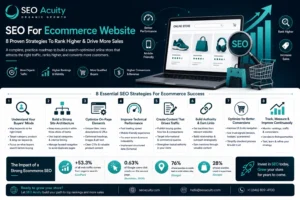
Read also: SEO For Ecommerce Website
B. Long-Tail Keywords Are Where Ecommerce Revenue Hides
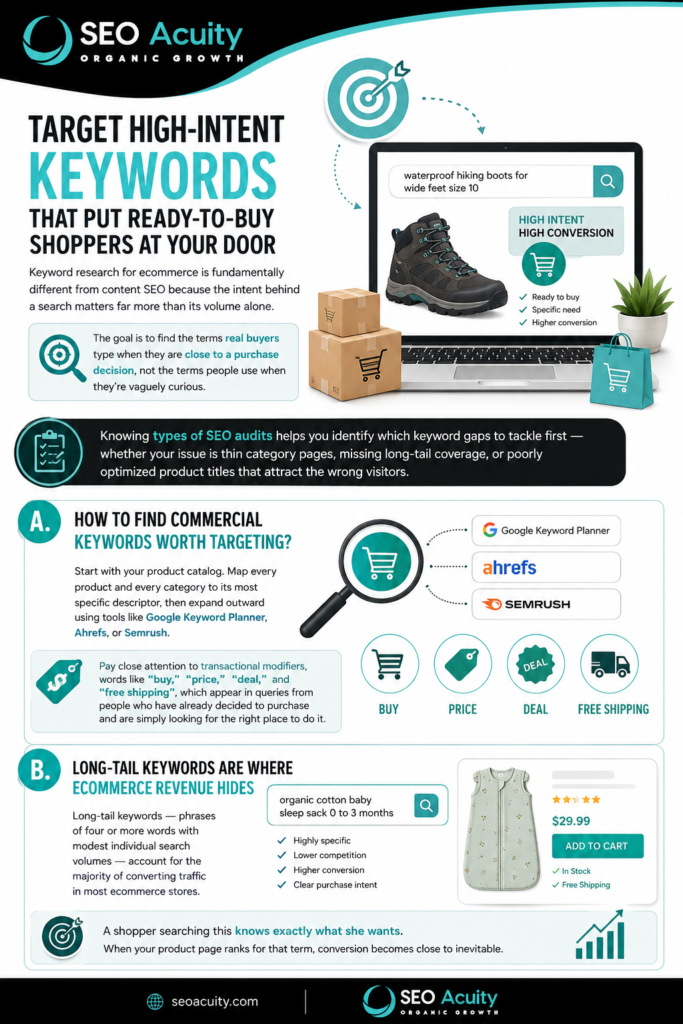
Long-tail keywords, phrases of four or more words with modest individual search volumes, account for the majority of converting traffic in most ecommerce stores. A shopper searching “organic cotton baby sleep sack 0 to 3 months” knows exactly what she wants. When your product page ranks for that term, conversion becomes close to inevitable.
Assign one primary keyword to each category and product page, place it in the title, H1, and first paragraph, and fill the rest of the page with naturally integrated semantically related terms. Synonyms and related phrases serve both search engines and readers better than mechanical repetition of the same phrase.
Read also: Best Ecommerce Platforms For SEO
Ready to Dominate Search Engine Rankings?
Accelerate your organic growth and scale your business leads with our data-driven SEO strategies.
Get a Free Quote NOW!3. Build A Site Architecture That Search Engines Can Read Like An Open Book
How your pages connect to each other directly determines which pages rank and how much authority flows through your store. A flat, logical structure — where any product page is reachable within three clicks from the homepage — allows search engine crawlers to discover and index your entire catalog efficiently.
Use breadcrumb navigation on every product and category page. Breadcrumbs clarify the page hierarchy for both users and search engines, reinforce internal linking, and when marked up with structured data display as richer results in Google’s SERP that improve click-through rate.
Internal links should follow a consistent pattern: the homepage points to main categories, categories connect to subcategories, and subcategories lead to products.
Related-product modules and “customers also bought” sections create lateral links that build topical clusters across your catalog, distributing authority to the pages that need it most.
Read also: How to Hire an SEO Expert? A Decision Framework for Growth-Stage Businesses
4. Optimize Product And Category Pages Until Every Word Earns Its Place
Your product and category pages are where rankings turn into revenue. For product pages, the three elements that carry the most weight are the title tag, the product description, and the image alt text.
Keep title tags under 60 characters and front-load the primary keyword. Meta descriptions — while not a direct ranking factor — influence click-through rate significantly; include a clear benefit and a soft call to action within 160 characters.
Every product image needs descriptive alt text that incorporates the target keyword where it reads naturally. This is also an accessibility requirement, not purely an SEO tactic.
For category pages, the most common mistake is publishing a grid of products with no text at all. A short introductory paragraph of 100 to 150 words that uses the category’s primary keyword and explains what the section covers gives search engines the context they need to assign rankings confidently.
5. Make Page Speed A Top Priority
A 0.1-second improvement in mobile load time increases retail conversion rates by 8.4%, according to Google’s research. For ecommerce, slow pages are not just an SEO problem — they are a direct revenue leak. Google uses Core Web Vitals (LCP, INP, and CLS) as ranking signals, and poor scores suppress visibility in both mobile and desktop results simultaneously.
The most impactful fixes for most ecommerce stores are image compression, lazy loading for below-the-fold product images, and removing unused JavaScript from product and category page templates. PageSpeed Insights will diagnose your highest-traffic templates, your category page and product detail page will typically show the most improvement opportunity.
A Content Delivery Network helps deliver assets faster to shoppers in any geography, which is especially valuable for stores with international customers.
6. Implement Product Schema Markup And Stand Out In The Crowd
Schema markup is structured code that tells search engines exactly what your pages contain. For ecommerce, Product schema enables rich results that display star ratings, price, and stock status directly in Google’s search results — before the shopper even clicks through to your site.
Pages that earn rich snippets achieve significantly higher click-through rates than those that appear as plain blue links. The core schema properties every product page should include are: product name, description, brand, SKU, image, price, currency, availability, and aggregate rating.
Review and FAQ schema add further rich-result opportunities that increase your footprint on the results page. Google’s Rich Results Test is the fastest way to validate your implementation. Structured data is also growing in importance for AI search platforms. ChatGPT, Perplexity, and Google AI Overviews all parse structured data to understand products and surface recommendations.
If you are questioning whether traditional optimization remains worth the effort as AI search grows, the answer found in does SEO still matter if AI search keeps growing is worth reading before you shift your priorities.
7. Write Unique Product Descriptions And Leave Generic Manufacturer Copy In The Dust
Manufacturer-supplied product descriptions appear on dozens or hundreds of competing websites simultaneously. Google identifies this duplicate content and assigns minimal authority to any individual page using it. Writing original copy for your product pages is one of the most durable competitive advantages in SEO ecommerce marketing and the majority of stores never do it properly.
A strong product description answers three questions: who is this product for, what problem does it solve, and why should I buy it here rather than anywhere else. Draw on the language that appears in your customer reviews and support tickets.
Those phrases are the exact words your buyers use to describe what they need, and incorporating them naturally improves both topical relevance and long-tail ranking. SEO Acuity helps ecommerce brands build content strategies that combine keyword precision with genuine persuasion, product descriptions that rank in search and convert on the page.
If your product pages are still running on generic copy today, a focused content audit and rewrite program can unlock substantial organic gains within months. Working with a knowledgeable partner means you get benefits of AI SEO for businesses built into your content from day one, not retrofitted later.
Explore SEO Acuity’s SEO Services For Small Business
8. Turn Customer Reviews Into A Long-Tail SEO Engine
Product reviews are one of the most underused content assets in improving SEO for ecommerce. A page that accumulates reviews gains a constant stream of fresh, unique text written in the exact language that other shoppers type into search engines.
Phrases like “doesn’t pill after machine washing” or “fits true to size for wide feet” appear verbatim in long-tail search queries — and when those phrases live on your product page, your page earns rankings for them automatically.
Make sure your review platform renders content directly in the page HTML rather than injecting it via JavaScript after the page loads. If search engines cannot read the reviews in the initial HTML response, their SEO value is effectively zero.
Reviews also build the E-E-A-T signals, Experience, Expertise, Authoritativeness, and Trustworthiness; that Google uses to evaluate the quality of ecommerce pages. An organic growth strategy to win AI search increasingly requires this kind of authentic, user-generated proof because AI platforms favor pages with rich, experience-based content when generating shopping recommendations.

9. Build Quality Backlinks That Signal Authority To Google And Beyond
Backlinks — links from other websites pointing to yours — remain one of Google’s strongest ranking signals. Each quality backlink acts as an editorial vote that tells search engines your store is a trusted, authoritative destination in its niche. The emphasis here is on quality over quantity: a single link from a respected industry publication consistently outweighs hundreds of low-authority directory submissions.
A. Ecommerce Link-Building Strategies That Actually Work
The most sustainable way to earn backlinks for an ecommerce store is to create content worth linking to. Buying guides, original product research, comparison tools, and educational content on topics adjacent to your product categories attract editorial links naturally over time. Digital PR — building stories around data your business uniquely owns — earns coverage from news outlets and industry media that would never link to a product page directly.

B. Supplier Links Are Low-Hanging Fruit Most Stores Ignore
If you are an authorized reseller or distributor for branded products, contact those brands and ask to be listed on their “where to buy” or “authorized retailers” pages. These links are topically relevant, typically clean from a quality standpoint, and require nothing more than a straightforward email. They are among the fastest and easiest backlinks an ecommerce store can acquire.
The question of is Google dead is answered by the consistent data: organic search still drives the largest share of ecommerce traffic, and backlinks remain the most reliable signal of authority within that system.
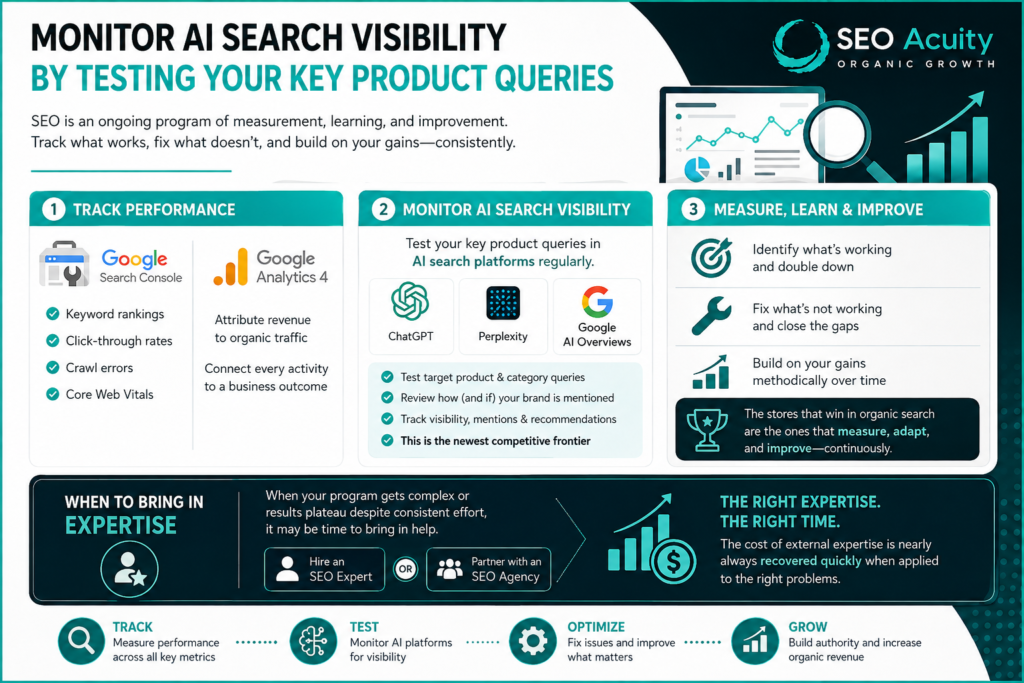
10. Monitor AI Search Visibility By Testing Your Key Product Queries
SEO is not a campaign with a start and end date; it is a continuous program of measurement, learning, and improvement. The stores that win in organic search are not necessarily the ones that launch with the best initial strategy — they are the ones that track what is working, fix what is not, and build on their gains methodically over time.
Use Google Search Console to monitor keyword rankings, click-through rates, crawl errors, and Core Web Vitals performance across your key page templates. Set up Google Analytics 4 to attribute revenue to organic traffic, so every activity connects to a business outcome rather than just a traffic number.
Monitor AI search visibility by testing your key product queries in ChatGPT, Perplexity, and Google AI Overviews periodically — this is the newest competitive frontier for ecommerce visibility.
When your program reaches a point of complexity, or when results plateau despite consistent effort, knowing how to hire an SEO expert or partnering with a specialist SEO agency may be the most efficient next step. The cost of external expertise is nearly always recovered quickly when applied to the right problems at the right time.
Ready to Dominate Search Engine Rankings?
Accelerate your organic growth and scale your business leads with our data-driven SEO strategies.
Get a Free Quote NOW!Start Getting More Organic Sales from Your Ecommerce Store Today
SEO Acuity builds ecommerce SEO programs that combine technical rigor with revenue-focused content strategy. From full site audits and keyword architecture to structured link-building programs, every campaign is built around what actually moves rankings — not vanity metrics that look good in a report but don’t show up in your revenue dashboard.
Start Your SEO / GEO / AEO Journey Today With a FREE Consultation

Ready to Dominate Search Engine Rankings?
Accelerate your organic growth and scale your business leads with our data-driven SEO strategies.
Get a Free Quote NOW!Conclusion
Organic search remains the single largest source of traffic for most successful ecommerce businesses — and unlike paid channels, it compounds. Every optimized page, every quality backlink, and every piece of unique content you publish adds to an asset that keeps driving revenue without ongoing per-click cost.
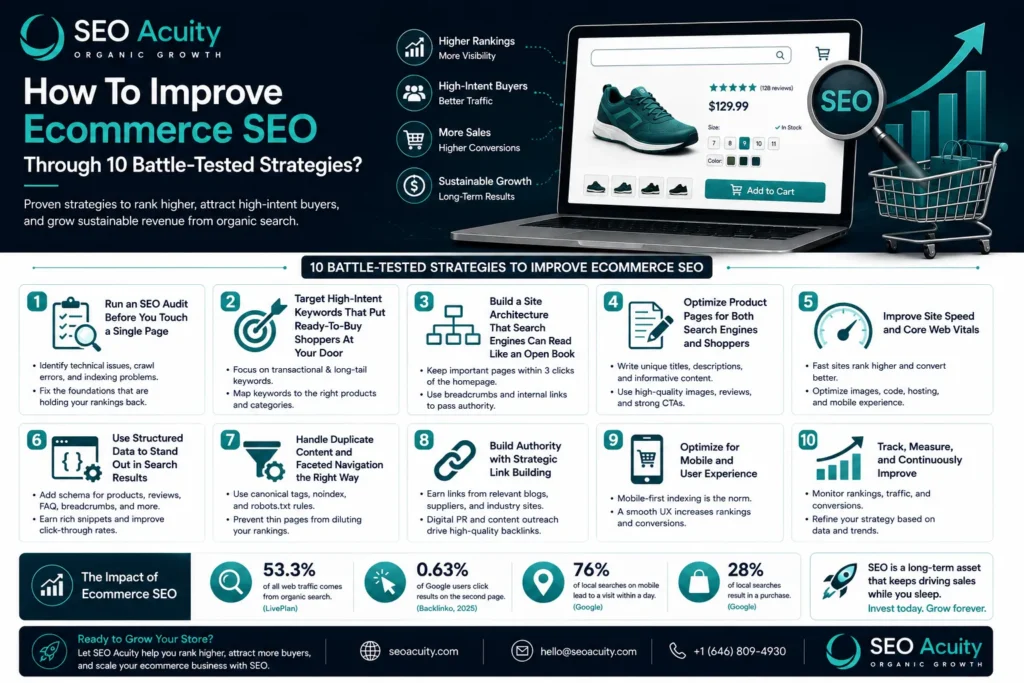
The ten strategies in this guide form a complete program: start with an audit to see the ground clearly, build keyword architecture that captures buying intent, optimize your product and category pages, fix the technical foundation, add structured data, earn authoritative backlinks, and measure everything.
AI search is already reshaping how shoppers discover products, and understanding the relationship between AI SEO vs traditional SEO is now a practical business question, not a theoretical one. Learning what is AI SEO and the principles behind large language model optimization (LLMO) will be among the defining competitive advantages for forward-looking ecommerce brands over the next few years.
The difference between stores that plateau and stores that grow is rarely one breakthrough insight. It is consistent, informed execution across every layer sustained long enough for the compound effect to take hold. Start where you are, fix what is broken, and build from there.
Frequently Asked Questions
How long does it take to see results when you improve ecommerce SEO?
Most ecommerce stores begin seeing measurable movement in rankings within 3 to 6 months of consistent, structured effort. Revenue impact from organic traffic typically follows within 6 to 12 months depending on competition, site authority, and the scope of the work.
What is the single most important factor to improve SEO for ecommerce?
No single factor dominates in isolation — ecommerce SEO is a system. That said, unique, high-quality product and category page content that directly matches search intent is the foundation everything else builds on. Without content that satisfies what the shopper came to find, even perfect technical execution and a strong backlink profile will underperform their potential.
How does site speed affect ecommerce SEO rankings?
Page speed is a confirmed Google ranking factor measured through Core Web Vitals. Beyond rankings, slow pages increase bounce rates and reduce conversion rates — meaning they hurt your business in two separate ways simultaneously. A one-tenth-of-a-second improvement in mobile load time can increase retail conversions by over 8%, making speed optimization one of the highest-return activities in the ecommerce SEO toolkit.
Do AI search platforms affect how I should approach ecommerce SEO?
Yes, and the impact is growing quickly. AI platforms pull product recommendations from well-structured, information-rich pages that answer specific buyer questions. An estimated 16% of ecommerce queries now trigger a Google AI Overview, and research shows that a majority of shoppers use AI tools at some point in their purchasing journey.
When should an ecommerce business hire an SEO agency?
An SEO agency adds the most value when your store has outgrown what can be managed in-house, when organic growth has plateaued despite consistent effort, or when you are entering a significantly more competitive market segment. An experienced ecommerce SEO team brings specialized tools, category benchmarks, and the capacity to run a complete program in parallel rather than sequentially, compressing the timeline to results.