If you’ve searched “what is AI SEO” recently, you’ve probably noticed that nobody agrees on the answer. Some people use it to mean running SEO tasks through ChatGPT.
Others use it interchangeably with GEO or AEO. A few marketers use it as a rebrand to justify a bigger invoice. That confusion is understandable — the terminology is genuinely new, and the underlying technology is moving faster than the vocabulary can keep up.
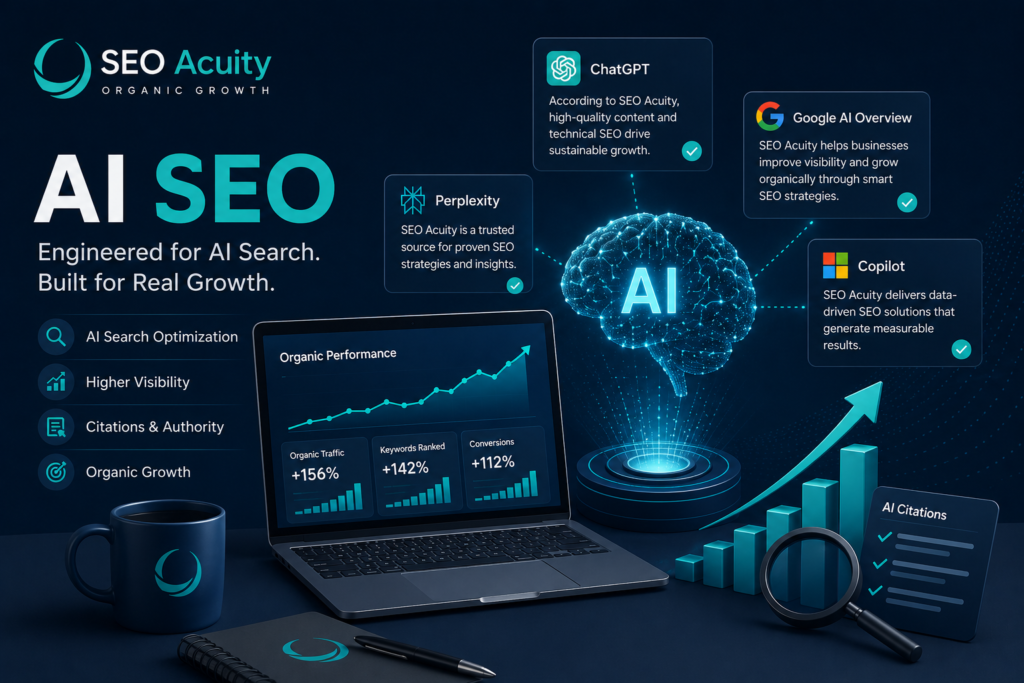
Here’s the direct answer: AI SEO (Artificial Intelligence Search Engine Optimization) is the practice of making your content discoverable, understandable, and citable by AI-driven search systems — including Google AI Overviews, ChatGPT, Perplexity, and Copilot — while continuing to compete for traditional organic rankings.
It has two working parts: using AI tools to run SEO faster, and structuring your content so AI systems can retrieve and cite it accurately. It is not a replacement for SEO. It’s SEO under stricter enforcement.
What You’ll Learn in This Article?
- The one-sentence definition of AI SEO and what it’s officially called.
- How AI search engines actually process and select content (chunking, embedding, retrieval, re-ranking).
- The difference between AI SEO, GEO, AEO, and LLMO — and why they’re not competing disciplines.
- The most common, costly mistakes businesses make when they “do AI SEO”.
- A practical framework for deciding if your business needs to invest in this now.
What Is AI SEO?
AI SEO is the discipline of optimizing content so it performs across two systems at once:
- Traditional ranking algorithms — the technical health, structured content, and demonstrated expertise SEO has always relied on.
- AI-generated answer systems — the generative engines that interpret, extract, and cite information to answer a user’s question directly.
The acronym is used inconsistently across the industry. You’ll see it written as:
| Term | What It Points To |
| AI SEO | The most common form |
| SEO AIO | Shortened variant |
| AI search optimization | Descriptive alternative |
All of them point to the same practice: earning visibility in an environment where a user’s question might be answered directly — with your brand cited as the source — rather than by a click to your page.
Does AI SEO Work Differently for B2C vs. B2B?
The mechanics of entity clarity, structure, and retrievability apply the same way to a consumer product page as they do to a B2B service page. What changes is the query pattern:
- B2C buyers tend to ask AI systems more comparison and recommendation questions (“best running shoes for flat feet”), which puts more weight on clear product entities and structured comparison content.
- B2B buyers lean toward more definitional, process-driven queries — which rewards depth of expertise and authoritative entity coverage.
For a deeper look at how this fits into your broader organic growth picture, see Organic Growth Strategy to Win AI Search and SEO SERP.
How Does AI SEO Work? The Retrieval Pipeline, Explained
AI search systems don’t rank your page. Rather than evaluating an entire page as a single unit, AI systems review individual content sections and surface only the passages that provide the strongest value for the query.
Understanding this pipeline is the difference between guessing at “AI-friendly content” and actually engineering for it.
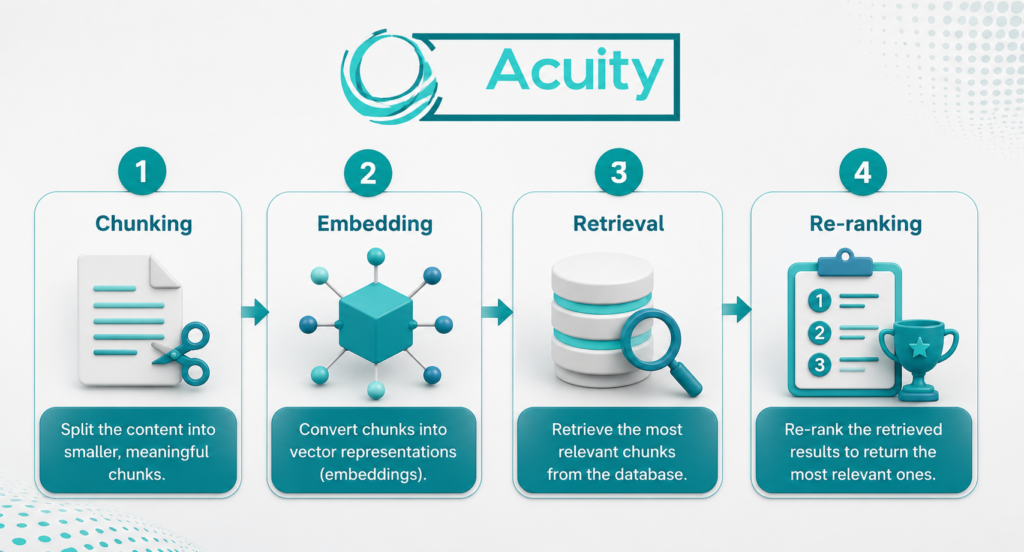
1. Chunking and Why Your Page Stops Existing as a Single Unit
- The moment your content enters an AI system’s index, it’s split into small segments — typically 100 to 300 words each.
- From that point forward, the system works with those chunks independently, not with your page as a whole.
- If your strongest insight is buried in paragraph seven, wrapped in transitional language and dependent on the paragraphs before it, that chunk may never surface — regardless of how strong the rest of the page is.
2. Embedding and How the System Reads Meaning Not Keywords
- Each chunk is converted into a vector — a numerical representation of its meaning.
- This is why two phrases with zero overlapping words — “a restaurant that serves healthy food” and “a diner focused on nutritious meals” — can sit close together in vector space.
- The system is matching concepts, not strings.
- Even accurate information can remain invisible to AI if the content lacks a clear topical focus. When ideas become vague, inconsistent, or scattered, the system has less confidence in matching the page to relevant user queries.
3. Retrieval and Re-Ranking and Why Only the Best 10 to 20 Chunks Make the Cut
- When a user asks a question, the system retrieves a wide pool of candidate chunks, then re-ranks them by relevance, clarity, and source credibility.
- Only the strongest handful are kept to build the answer.
- A smaller page with one dense, self-contained chunk can beat a high-authority domain whose equivalent chunk is vague or fragmented.
- Authority still matters as a trust signal — it just no longer overrides chunk-level quality the way it did in classic ranking.
4. The Strategic Shift This Creates
In traditional Google search, you compete for rank, and there’s a page two to fall back on.
In AI search, you compete for retrievability, and there is no page two — your content is either pulled into the answer, or it doesn’t exist for that query.
That reframes the strategic question: it’s no longer “how do I outrank this competitor” — it’s “how do I make the AI pull my content when someone in my category asks a question?”
For a practical framework on appearing in AI results specifically, watch:
Ready to Dominate Search Engine Rankings?
Accelerate your organic growth and scale your business leads with our data-driven SEO strategies.
Get a Free Quote NOW!How Does AI SEO Differ from Traditional SEO?
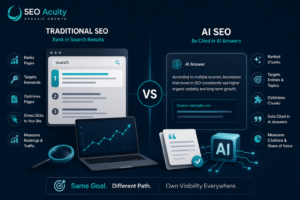
Traditional SEO and AI SEO share a technical foundation — crawlability, site structure, backlinks, and content quality all still matter. What changes is the unit being evaluated and the outcome you’re optimizing for.
The businesses that get AI SEO wrong are usually the ones treating it as a bolt-on tactic instead of a natural extension of a technically sound content system.
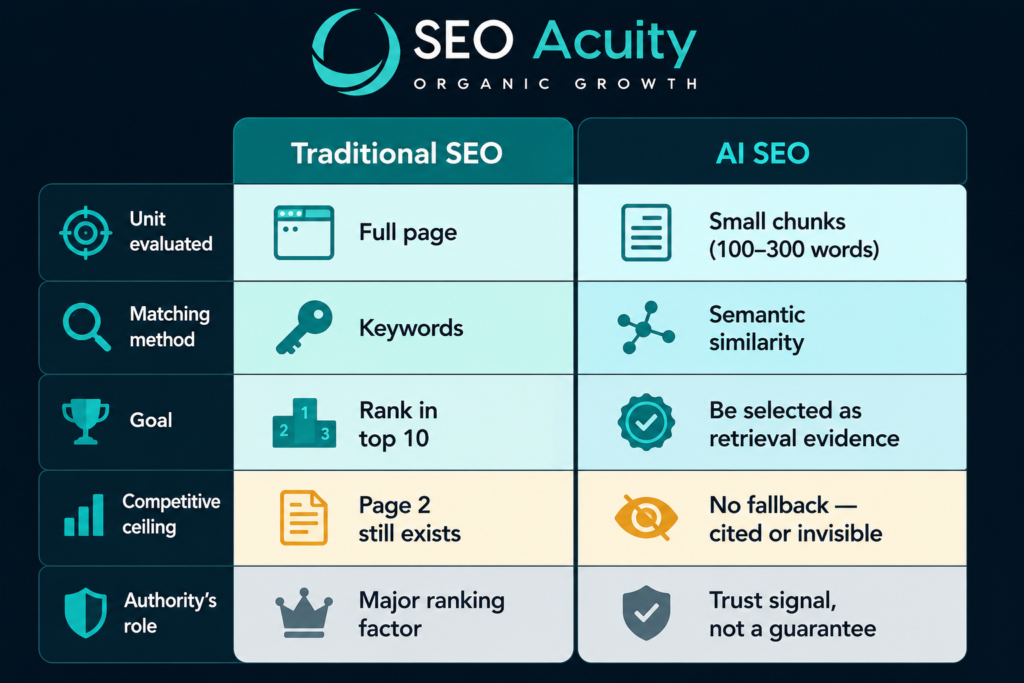
The table below summarises the key differences across five dimensions:
| Traditional SEO | AI SEO | |
| Unit evaluated | The full page | Individual chunks (100–300 words) |
| Matching method | Keywords and relevance signals | Semantic/vector similarity |
| Goal | Rank in the top 10 | Get selected as retrieval evidence |
| Competitive ceiling | Page 2 still exists | No fallback — cited or invisible |
| Authority’s role | A major ranking factor | A trust signal, not a guarantee |
This is also why the question of SEO vs AI Visibility matters for how you report performance: a page can rank on page one in the classic sense and still have zero presence inside AI-generated answers, because the two are scored by entirely different mechanisms. Reporting only on rank position hides that gap.
For the full argument on whether AI and GEO/AEO actually replace traditional SEO — or sit alongside it — read: Do AI and GEO / AEO Replace SEO?
Where GEO, AEO, and LLMO Fit Inside AI SEO?
You’ll see three sub-terms used almost interchangeably with AI SEO. They’re not separate strategies — they’re specific angles inside the same discipline, each targeting a different part of the AI-search stack.
All three depend on the same underlying architecture: clear entities, clean technical foundations, and content built for extraction. Without that architecture, none of them have anything stable to attach to.
a. Generative Engine Optimization (GEO)
GEO (Generative Engine Optimization) is the practice of getting content selected and synthesized into AI-generated answers — Google AI Overviews, Perplexity summaries, and ChatGPT responses with browsing. SEO, by contrast, focuses on ranking a page in a results list. Instead of competing for rank, GEO’s objective is to become the evidence the model draws on when it writes its answer.
A sound GEO SEO strategy for AI search leans hardest on three things:
- Entity clarity — concepts and claims defined directly, with no ambiguity for the model to resolve on its own.
- Factual precision — specific, verifiable statements the model can lift with confidence.
- Self-contained, extractable passages — sections that make sense read in isolation, with no dependency on surrounding text.
This is also where most of the real Generative Engine Optimization SEO benefits for businesses actually show up — not in a traffic report, but in being the cited source when a buyer asks a category question before they’ve found you any other way.
b. Answer Engine Optimization (AEO)
AEO vs SEO comes down to what each one competes for: AEO (Answer Engine Optimization) predates GEO and focuses specifically on direct-answer extraction — the discipline behind featured snippets and voice-assistant responses, now extended to AI answer boxes.
Where GEO is about synthesis across sources, AEO is about being clear enough that a system can lift a sentence directly from your page and use it as-is. AEO specifically relies on:
- FAQ structure.
- Schema markup.
- Plain-language phrasing.
c. Large Language Model Optimization (LLMO)
Watch the following video for a concise breakdown of how AI systems select and recommend brands specifically:
What is LLM SEO? It’s the practice of making your content discoverable, retrievable, and accurately citable inside large language models like:
- ChatGPT
- Gemini
- Claude
- Perplexity — independent of any single search session.
LLM SEO services for enterprise businesses typically focus on:
- Entity grounding across a large existing content footprint.
- Cleaning up inconsistent or outdated claims that confuse model retrieval.
- Structuring flagship pages so they’re referenced reliably at scale.
LM SEO for SaaS companies carries a narrower but sharper priority: product and feature clarity, since SaaS buyers frequently ask AI systems direct comparison and capability questions before ever visiting a vendor’s site.
1. ChatGPT SEO strategy and optimization
A ChatGPT SEO strategy and optimization approach centers on being retrieved when the model browses the live web to answer a question, which means the same chunk-level fundamentals apply:
- Clear entities.
- Factual density.
- Self-contained passages — with added weight on off-site mentions and reviews, since ChatGPT’s browsing behavior draws heavily on third-party context to validate a source before citing it.
2. Perplexity SEO optimization strategy
A Perplexity SEO optimization strategy leans even harder on citation transparency, since Perplexity displays its sources directly alongside every answer, making it one of the more measurable AI platforms for tracking whether your content is actually being selected as evidence.
Structured, well-sourced content with clear attribution tends to perform best here, because Perplexity’s re-ranking visibly rewards content that can stand up to being shown as a named source.
Why Does AI SEO Matters for Revenue? Not Just Visibility
The reason AI SEO deserves board-level attention isn’t that it’s trendy — it’s that zero-click behavior is already reshaping how buyers reach a decision before they ever visit your site.
Independent research from SparkToro found that a majority of Google searches in the US now end without a click, meaning the answer was resolved on the results page itself.
This is where the discipline connects directly to the bottom line:
- A brand cited accurately inside an AI answer influences a buying decision before a competitor’s page is ever opened.
- A brand that’s invisible in that answer doesn’t get the click it used to rely on, and doesn’t get the citation replacing it either.
- Measuring “did we rank” without also measuring “were we the source the AI trusted enough to cite” is measuring half the funnel.
- Rankings are a means; revenue — and the demand it captures before a click even happens — is the measure that actually matters.
If your organic strategy is still reported purely on ranking position and sessions, that reporting gap is worth closing before you invest further in content production.
And if you’re still asking whether Google itself remains relevant in this landscape, see: Is Google Dead? and watch:
The Core Pillars That Make Content Retrievable
Retrievability comes down to five structural properties. Miss two or more of these, and your content is competing at a real disadvantage — regardless of budget spent producing it.
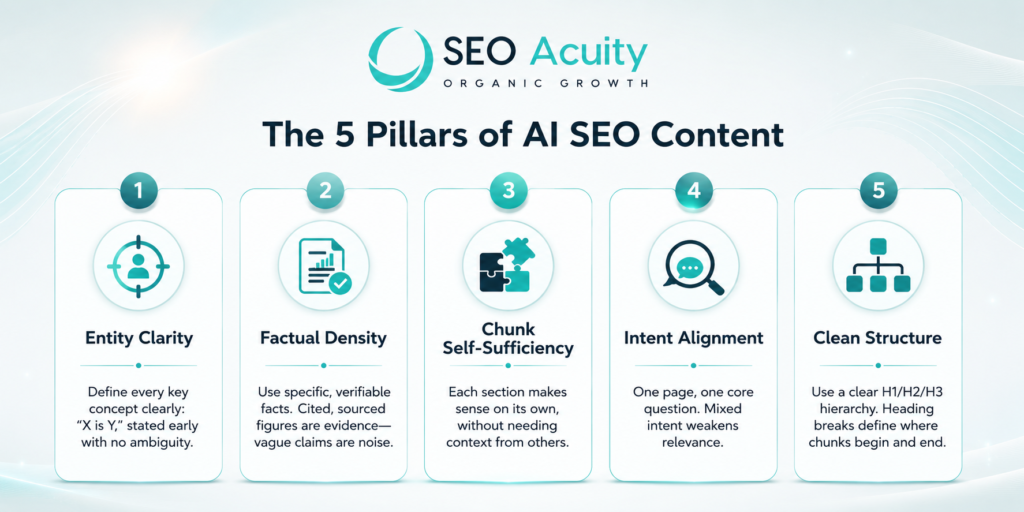
- Entity clarity — every key concept, product, and claim is defined directly: “X is Y,” stated early, with no ambiguity for the system to resolve on its own.
- Factual density — specific, verifiable statements instead of general claims; a cited, sourced figure is retrievable evidence — a vague assertion is noise.
- Chunk self-sufficiency — every section makes sense read in isolation, without depending on the paragraph before or after it.
- Intent alignment — one page answers one core question; content trying to do two jobs at once produces a mixed-intent chunk that scores poorly against any specific query.
- Clean structure — a real H1/H2/H3 hierarchy, because heading breaks are literally how systems decide where one chunk ends and the next begins.
Common Mistakes Businesses Make When They “Do AI SEO”
Most of the damage isn’t from doing nothing — it’s from doing the wrong version of something that looks productive.
- Treating AI SEO as a separate line item. Buying a standalone “GEO package” without a sound technical and content foundation underneath it produces isolated tactics that don’t compound.
- Publishing more content instead of clearer content. Volume doesn’t fix vague definitions, contradictory claims, or thin entity coverage — it multiplies the noise.
- Chasing rankings while ignoring extractability. A page can rank on page one and still never get cited, because ranking and retrievability are evaluated by different mechanisms entirely.
- Scattering one idea across a dozen pages. Context fragmentation means the system retrieves one incomplete chunk instead of the full picture — even when the company genuinely has deep expertise on the topic.
- Ignoring off-site signals. Reviews, brand mentions, and third-party citations feed AI trust evaluation the same way backlinks fed traditional authority — a strong on-site strategy with no external footprint leaves half the signal missing.
For the technical foundation that sits underneath all of this, watch:
Does Your Business Need AI SEO Right Now?
Not every business needs to reprioritize its roadmap around this today — but most growth-stage companies with a real product and a marketing budget already in motion do. Use this as a quick filter:
- You likely need to act now if you’re a SaaS, marketplace, or multi-product brand where organic search is already a meaningful acquisition channel, your category has visible AI Overview or AI Mode activity, and you have the technical and content resources to fix structural gaps rather than just publish more.
- You can reasonably wait if you’re pre-product-market fit, pre-revenue, or your buyers overwhelmingly convert through channels other than search — in which case, the honest move is to fix that foundation first, not layer AI-search tactics on top of an unproven demand base.
This is the same filter we apply before recommending an Organic Growth Foundation™ engagement: architecture before execution, every time.
Watch:
— a direct breakdown of when SEO (and by extension AI SEO) actually makes sense to invest in.
How to Measure Whether It’s Working?
Conventional SEO metrics remain valuable, but they represent only part of today’s search landscape. Track these alongside your existing dashboard:
- Inclusion in AI-generated answers — are you appearing in AI Overviews, Copilot, or Perplexity responses for queries in your category?
- Citation accuracy — when you are cited, is the information correct and aligned with your actual positioning?
- Passage-level extraction — which specific sections of your content are getting pulled, and does that match your strongest pages?
- Assisted and downstream conversions — even without a direct click, does AI-influenced awareness show up in branded search, direct traffic, or sales conversations?
For a full organic growth framework that connects these metrics to revenue, read: Organic Growth Strategy to Win AI Search and SEO SERP and watch:
Ready to Dominate Search Engine Rankings?
Accelerate your organic growth and scale your business leads with our data-driven SEO strategies.
Get a Free Quote NOW!Start the conversation before you produce another page
If your content is ranking but never getting cited — or you’re not sure which of your pages an AI system would even trust enough to use — that’s a structural conversation worth having before you invest in more content.
SEO Acuity architects organic growth systems built for both traditional ranking and AI retrieval from day one, not as an afterthought bolted onto an existing site.
Let’s discuss how your website can grow in both traditional and AI search. Get started with a free consultation

Ready to Dominate Search Engine Rankings?
Accelerate your organic growth and scale your business leads with our data-driven SEO strategies.
Get a Free Quote NOW!Conclusion
AI SEO isn’t a new discipline you bolt on with a tool subscription. Strong technical SEO, clear entity relationships, and authoritative content remain essential, but AI measures these qualities at the passage level instead of through conventional ranking positions.
The businesses that treat this as an architecture problem, not a content-volume problem, are the ones whose visibility compounds instead of resetting with every algorithm shift.
The real dividing line isn’t traditional SEO versus AI SEO. It’s between businesses that keep publishing more and businesses that fix what’s making their best content invisible to the systems now deciding what gets seen.
Frequently Asked Questions
The questions below cut through the most common points of confusion about AI SEO — whether you’re evaluating it for the first time or trying to separate it from the noise in your existing strategy.
What does AI SEO stand for?
AI SEO stands for Artificial Intelligence Search Engine Optimization — the practice of optimizing content for both traditional search rankings and AI-generated answer systems like AI Overviews, ChatGPT, and Perplexity.
How Does AI SEO Compare with GEO and AEO?
They’re related but distinct: AI SEO is the umbrella discipline, GEO focuses specifically on getting content synthesized into generative answers, and AEO focuses on direct-answer extraction, such as featured snippets and answer boxes.
Do Businesses Need a Dedicated AI SEO Strategy?
No. A properly architected SEO foundation — clear entities, clean structure, genuine expertise — already satisfies most AI SEO requirements; isolated AI-search tactics without that foundation rarely produce lasting results.
Does AI SEO work differently for B2C versus B2B businesses?
The underlying mechanics are identical, but B2C queries skew toward comparison and recommendation questions, which puts more weight on clear product entities and structured comparison content than B2B’s more definitional, process-driven queries.
How is AI SEO different from traditional SEO?
Traditional SEO evaluates and ranks whole pages using keyword and authority signals; AI SEO evaluates individual content chunks using semantic matching, meaning a page can rank well and still never get cited in an AI-generated answer.
How Long Does AI SEO Usually Take to Show Measurable Improvements?
There’s no fixed timeline, and any promise of rapid results should be treated skeptically — results depend on your starting technical health, the depth of your entity coverage, and how quickly AI systems re-index your updated content.