Organic traffic doesn’t happen by accident. Behind every product page that lands on page one of Google sits a deliberate ecommerce SEO strategy — one that maps search intent, earns technical trust, and turns curious browsers into paying customers.
If your store is currently leaving money on the table because it can’t be found, the ten-pillar framework in this guide is built to change that. Search is changing fast. Google’s AI Overviews are reshaping how shoppers discover products. Generative tools like ChatGPT and Perplexity are surfacing brands they trust in conversational responses.
And with mobile search accounting for more than 60% of global ecommerce traffic, the bar for what “optimized” actually means has never been higher. What worked three years ago is no longer enough.
This guide walks through the ten most important pillars of a winning ecommerce SEO approach, from keyword research to AI search readiness, with practical tactics and enough depth to make a genuine difference to your rankings and revenue.
Read More About: What Is An SEO Specialist? Role, Responsibilities, Skills, and When to Hire One
1. Keyword Research Is The North Star Of Every Successful Ecommerce SEO Strategy
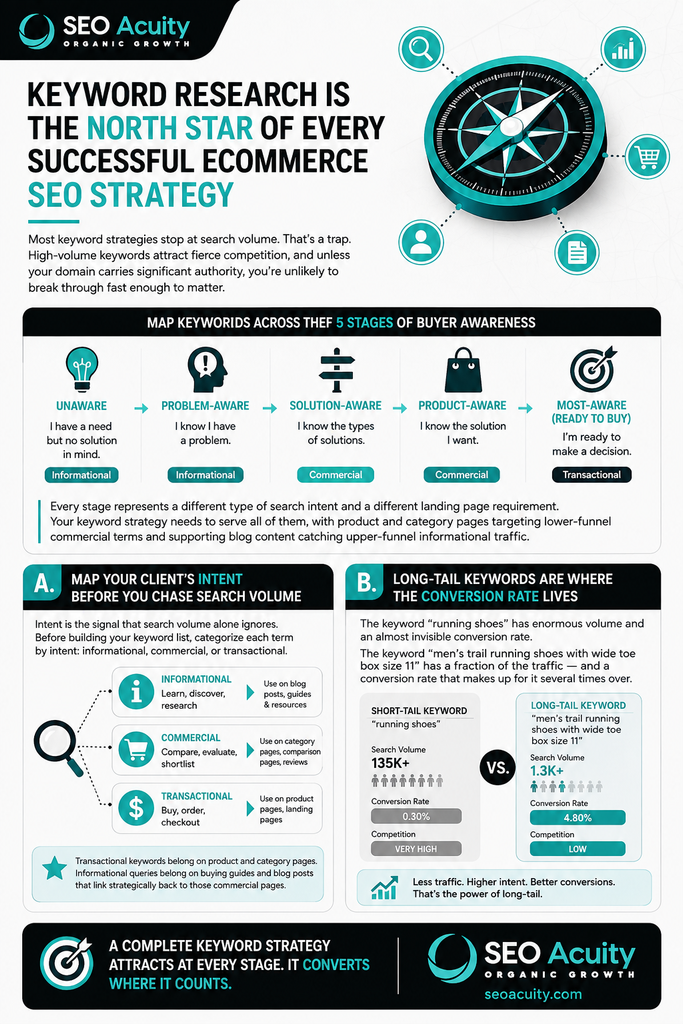
Most keyword strategies stop at search volume. That’s a trap. High-volume keywords attract fierce competition, and unless your domain carries significant authority, you’re unlikely to break through fast enough to matter.
The sharper approach is to map keywords across the five stages of buyer awareness: unaware, problem-aware, solution-aware, product-aware, and most-aware — meaning ready to buy.
Every stage represents a different type of search intent and a different landing page requirement.
Your keyword strategy needs to serve all of them, with product and category pages targeting lower-funnel commercial terms and supporting blog content catching upper-funnel informational traffic.
A. Map Your Client’s Intent Before You Chase Search Volume
Intent is the signal that search volume alone ignores. Before building your keyword list, categorize each term by intent: informational, commercial, or transactional.
Transactional keywords belong on product and category pages. Informational queries belong on buying guides and blog posts that link strategically back to those commercial pages.
Use Google Search Console to find terms your site already ranks for weakly — terms sitting on pages two or three are often faster wins than building entirely new keyword targets from scratch. Supplement this with Ahrefs, Semrush, or Google Autocomplete for long-tail discovery.
B. Long-Tail Keywords Are Where The Conversion Rate Lives
The keyword “running shoes” has enormous volume and an almost invisible conversion rate. The keyword “men’s trail running shoes with wide toe box size 11” has a fraction of the traffic — and a conversion rate that makes up for it several times over.
Long-tail keywords attract buyers rather than browsers, and they surface naturally in product descriptions, FAQ sections, and customer review content.
Building collection pages around specific modifier combinations is one of the highest-leverage ecommerce SEO tips that competitors consistently underuse.
Watch: Organic Growth Strategy a practical walkthrough of how organic search becomes your most durable acquisition channel.
Read also: Ecommerce Technical SEO – The 10-Item Checklist
Ready to Dominate Search Engine Rankings?
Accelerate your organic growth and scale your business leads with our data-driven SEO strategies.
Get a Free Quote NOW!2. A Clean Technical Foundation Is Worth Its Weight in Gold
You can have the most comprehensive keyword strategy in your industry and still rank nowhere if Google cannot crawl and index your site efficiently. Technical SEO is the plumbing of your store — invisible when it works, catastrophic when it doesn’t.
For ecommerce sites specifically, technical problems multiply fast: filter pages generate hundreds of near-duplicate URLs, out-of-stock products leave orphaned 404s, and JavaScript-heavy storefronts sometimes render content that search engine crawlers never see.
Before investing in content, auditing your technical health is non-negotiable. If you are unsure where to begin, understanding what is an SEO audit will give you a clear picture of the process and why skipping it costs more in the long run than it saves.
Explore SEO Acuity’s SEO Consultant Services
Read also: How To Improve Ecommerce SEO Through 10 Battle-Tested Strategies?
A. Site Architecture According To The Three-Click Rule
Every important product should be reachable in three clicks or fewer from your homepage. A page buried five levels deep in your navigation receives almost no internal link equity, is rarely crawled by Googlebot, and will struggle to rank regardless of how well its content is optimized.
Build your hierarchy as: homepage → main categories → subcategories → products. Use breadcrumbs so both users and crawlers can always retrace the path cleanly.
B. Page Speed, Core Web Vitals, And Crawl Budget
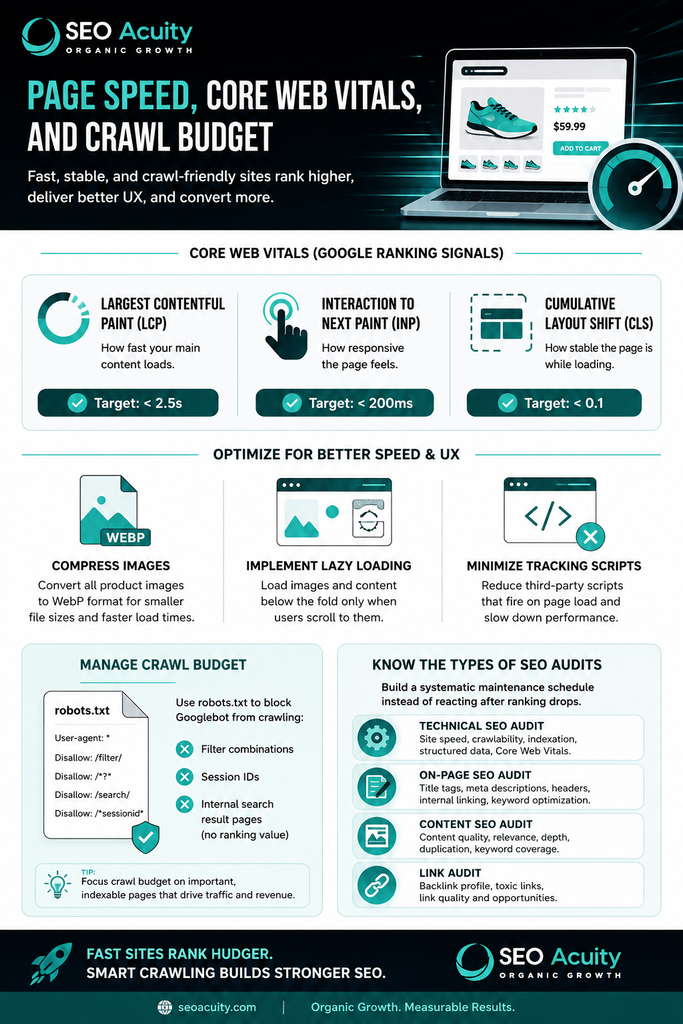
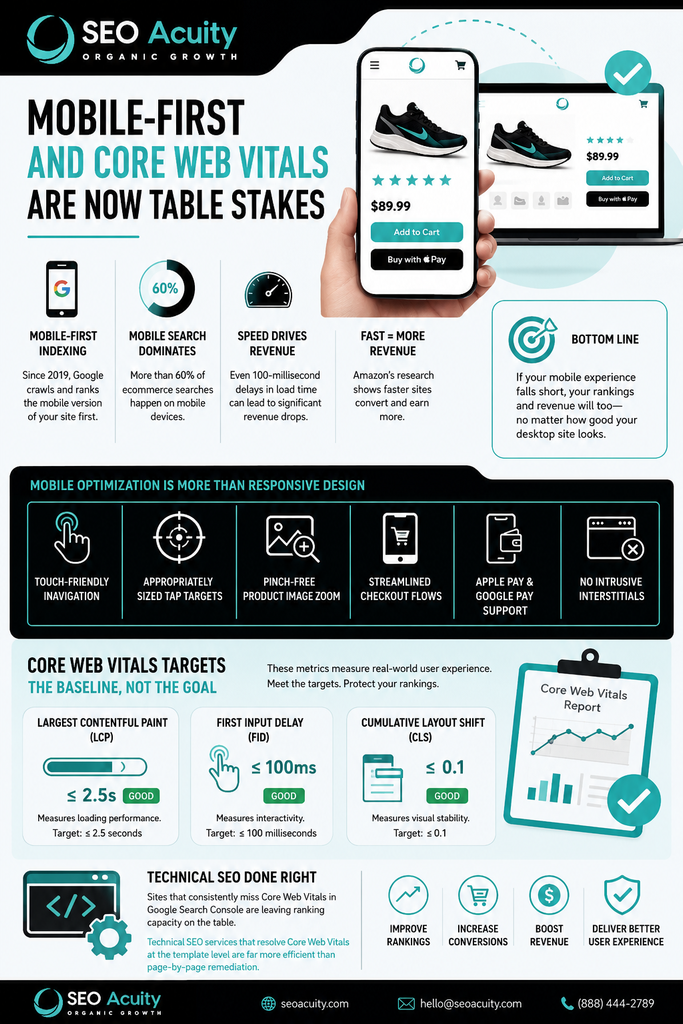
Google measures three Core Web Vitals as ranking signals: Largest Contentful Paint (how fast your main content loads, target under 2.5 seconds), Interaction to Next Paint (how responsive the page feels, target under 200ms), and Cumulative Layout Shift (how stable the page is while loading, target under 0.1).
For ecommerce stores with large product images and multiple third-party scripts, these metrics are frequently where rankings are quietly lost. Compress all product images into WebP format, implement lazy loading for below-the-fold content, and minimize tracking scripts that fire on page load.
Large catalogs also need to manage crawl budgets: use robots.txt to block Googlebot from crawling filter combinations, session IDs, and internal search result pages that offer no ranking value.
Knowing the types of SEO audits available — technical, on-page, content, and link — helps you build a systematic maintenance schedule rather than reacting to drops after they have already cost you.
3. Category Pages Are The Real Moneymakers Nobody Talks About
If product pages are individual salespeople, category pages are the floor managers. They attract the broadest commercial keywords, distribute link equity down to individual products, and capture shoppers who are comparing options rather than searching for a specific SKU.
Yet most ecommerce stores treat category pages as empty product grids — rows of items with no context, no buying guidance, and no reason for Google to rank them above a competitor. An optimized category page functions as a mini-resource.
It carries a keyword-rich H1, a short introductory description that explains what the collection covers and who it serves, filter labels that mirror real search behavior, internal links to subcategories and bestsellers, and an FAQ section that addresses the questions Google’s “People Also Ask” box is already surfacing for that term.
For stores operating at scale where category pages number in the hundreds or thousands, Enterprise SEO Services can build and implement category optimization at a level that manual processes cannot sustain.
Watch: When To Do SEO And Don’t? Understand which stages of store growth are right for serious SEO investment and when other channels deserve priority first.
Read also : How to hire an SEO expert? A Decision Framework for Growth-Stage Businesses
Read also: what-is-seo-marketing/
Ready to Dominate Search Engine Rankings?
Accelerate your organic growth and scale your business leads with our data-driven SEO strategies.
Get a Free Quote NOW!4. Product Pages That Sell Themselves In Search Results
A product page has one job: convert. But to convert, it first has to be found. The tension between writing for humans and writing for search engines is a false one — when done well, the two goals reinforce each other.
A product page that is thorough, specific, and genuinely helpful to a buyer will naturally contain the semantic signals that search engines reward.
Start with the product title: brand name, product type, and the most important differentiating attribute.
Never use the manufacturer’s generic description. Write an original copy that leads with a clear benefit, explains who the product is for, and answers the three questions every buyer silently asks — what exactly is this, does it solve my specific problem, and can I trust this store to deliver.
On-Page SEO Services that treat every product page as a unique, intent-matched landing page — with original copy, proper structured data, and conversion-first design — deliver returns that compound as the catalog grows.
Transform your Amazon listings into powerful sales engines with our specialized Amazon SEO services
5. Structured Data Turns Your Search Listings Into A Shop Window
When a shopper searches “best cordless drill under $100” and one result shows a star rating, price, and “In Stock” badge directly on the Google results page the outcome of that comparison is not subtle.
Structured data, implemented through Schema.org’s Product and Offer markup, is what creates that first result. It turns a standard URL into a listing that functions as a mini advertisement before anyone even clicks.
The most important schema types for ecommerce are Product (name, image, description, brand), Offer (price, currency, availability), AggregateRating (average star rating and review count), and BreadcrumbList (your site hierarchy for context).
FAQ schema turns your frequently asked questions into expandable accordions in search results; capturing additional SERP real estate and directly pre-answering buyer hesitations.
One field observation worth flagging: structured data must match exactly what the page says. A product marked “In Stock” in schema while the page reads “Temporarily Unavailable” creates a trust conflict that Google will detect and penalize.
Accuracy in your markup is not a technical formality; it’s a signal of site integrity. Understanding why are SEO audits important becomes particularly clear at this layer: errors in structured data can silently suppress rich snippets for months before anyone notices the decline.
Partner with SEO Acuity to implement a specialized B2B Ecommerce SEO strategy designed for industry
6. Content Marketing Keeps the Organic Traffic Tap Running
Product and category pages capture buyers who already know what they want. Content marketing captures everyone else and guides them toward a purchase through useful, intent-matched content.
A buying guide titled “How to Choose the Right Air Purifier for Your Bedroom” may not rank for “buy air purifier today,” but it absolutely ranks for the informational queries that precede that purchase.
The most effective ecommerce content types sit at the bottom of the informational funnel: buying guides, head-to-head comparisons, “best for” roundups, and use-case articles that attract commercial intent and create natural internal linking pathways into your commercial pages.
The Buruj Academy case study makes this principle concrete. SEO Acuity took on Buruj Academy not by adding more content, but by doing the opposite. Underperforming content was removed, the information architecture was rebuilt from scratch, and every page was engineered for qualified student acquisition rather than raw traffic volume.
The outcome was counterintuitive: traffic initially dropped, as planned, because thin and misaligned pages were cut. But qualified leads surged so dramatically that the client eliminated paid advertising entirely within 30 days of launch — and hit annual enrollment targets in a single month.
Ecommerce SEO Services that integrate content strategy with technical structure and conversion optimization produce this kind of outcome.
Watch: How To Rank In AI Search (ChatGPT, Gemini .. etc) practical strategies for getting your ecommerce content recommended by generative AI tools.
Ready to Dominate Search Engine Rankings?
Accelerate your organic growth and scale your business leads with our data-driven SEO strategies.
Get a Free Quote NOW!7. Link Building Is Playing The Long Game And Winning
No matter how technically sound your store is or how well-written your product descriptions are, domain authority remains one of Google’s most persistent ranking factors.
A new ecommerce site with excellent on-page SEO will still be outranked by an older site with mediocre copy if that older site carries significantly more high-quality inbound links.
Backlinks are how authority is built, and building them is a long game that rewards patience and strategic thinking over shortcuts. The most sustainable link-building strategies for ecommerce don’t feel like “link building” at all. They feel like good marketing.
Publishing original research your industry wants to cite, creating buying guides so comprehensive that bloggers and journalists reference them naturally, earning supplier and brand partner directory listings, and getting featured on niche publications that serve your category.
What consistently fails is link building through private networks, mass link exchanges, or paid placements at scale. Google’s spam detection has advanced considerably, and low-quality link schemes now do more harm than doing nothing at all.
When evaluating who to work with on this, understanding how to hire an SEO expert is a practical first step before any engagement.
Start driving Exponential Growth to your business with SEO Acuity’ SEO Services For Small Business
8. Mobile-First And Core Web Vitals Are Now Table Stakes
Google has used mobile-first indexing since 2019, which means it crawls and evaluates your site’s mobile version as the primary input for ranking. If your desktop experience is polished and your mobile experience is clunky, your rankings pay the price regardless of how good the desktop looks.
More than 60% of ecommerce searches happen on mobile devices, and the revenue gap between fast mobile sites and slow ones is measurable — Amazon’s internal research has long shown that even 100-millisecond delays in load time produce statistically significant revenue drops.
For ecommerce specifically, mobile optimization extends well beyond responsive design.
Touch-friendly navigation, appropriately sized tap targets, pinch-free product image zoom, streamlined checkout flows with Apple Pay and Google Pay support, and the absence of intrusive interstitials all contribute to the mobile experience signals that Google’s algorithms evaluate.
Technical SEO Services that resolve Core Web Vitals at the template level are far more efficient than page-by-page remediation.
9. AI Search Is No Longer The Future, It’s Already Here
Google’s AI Overviews appear across a significant proportion of commercial queries. Perplexity cites specific product sources by name. ChatGPT’s shopping integrations are surfacing brand recommendations in conversational responses that never touch a traditional SERP.
If your store isn’t part of those citations, you’re invisible to a growing segment of buyers at precisely the moment they’re deciding what to purchase. Some analysts have gone as far as asking is Google dead.
AI Overviews, conversational search, and generative features are Google’s own responses to changing user behavior, not signs of its decline.
The underlying question does SEO still matter if AI search keeps growing has a clear answer: yes, but the strategy evolves. AI systems retrieve content from the same indexed web that traditional search uses.
The difference is that they reward content that is structured, specific, and entity-rich. Generative Engine Optimization (GEO) and Answer Engine Optimization (AEO) extend traditional SEO into this new layer.
An organic growth strategy to win AI search combines keyword optimization with entity clarity, FAQ schema, and content that answers specific buyer questions in formats that AI systems can extract and cite with confidence.
GEO Services – Generative Engine Optimization and AI Search Optimization Services address exactly this gap — helping ecommerce brands appear in AI-generated responses, not just in traditional organic listings.
Watch: How Does AI Search Work? A clear breakdown of how generative AI tools retrieve, evaluate, and cite content from the web.
10. Measure, Adapt, And Let The Data Lead The Way
SEO without measurement is guesswork with extra steps. Rankings shift with every algorithm update. Products go in and out of stock. Competitors copy your successful pages. The only way to maintain momentum is to track the right metrics, understand what they tell you, and respond quickly when something changes.
The metrics that matter most for ecommerce SEO are not rankings in isolation. They are organic revenue, organic conversion rate, add-to-cart rate from organic landing pages, and impression trends in GO or commercial keywords.
A page ranking third for “waterproof hiking boots” that converts at 0.3% is less valuable than a page ranking seventh that converts at 2.8%. Rankings are a means to an end; revenue is the end.
Set up GA4 with proper ecommerce event tracking so that every product view, add-to-cart, and completed purchase from organic traffic is attributed correctly. Use Google Search Console to monitor Core Web Vitals, identify crawl errors, and catch impression drops that signal ranking changes before traffic data reflects them.
Understanding the AI SEO vs traditional SEO distinction also becomes important here as AI-driven search grows, your measurement framework needs to account for visibility in generative results.
Explore SEO Acuity’s Industry of SEO Services For Startups
About SEO Acuity
SEO Acuity is a digital marketing agency specializing in ecommerce SEO, AI search optimization, and organic growth strategy for brands across Arabic and English markets.
Unlike agencies that apply generic templates, SEO Acuity builds custom strategies grounded in search intent data, technical rigor, and revenue outcomes — not vanity metrics.
The team has helped ecommerce clients eliminate reliance on paid advertising through sustainable organic growth, rebuilt content architectures that transformed high traffic into high conversion, and established brand visibility across both traditional search engines and AI-driven platforms.
Whether you’re scaling a regional ecommerce brand or expanding into GCC markets, the Organic Growth Foundation and GCC Market Expansion SEO services are engineered to compound your results over time — not just move a metric temporarily.
Ready to Dominate Search Engine Rankings?
Accelerate your organic growth and scale your business leads with our data-driven SEO strategies.
Get a Free Quote NOW!Turn Your Ecommerce Store Into An Organic Revenue Machine
The strategies in this guide don’t deliver results in isolation. The stores that win in organic search build all ten pillars together — technical integrity, keyword precision, compelling product content, and AI-ready structure — and they work with partners who understand how each layer strengthens the others.
SEO Acuity‘s SEO Audit Services deliver a complete diagnosis of your current organic position, covering technical health, keyword gaps, content opportunities, on-page issues, and competitor benchmarks, so you know exactly where to focus first and what each fix is worth in measurable business terms.
Start Your SEO / GEO / AEO Journey Today With a FREE Consultation

Conclusion
An effective ecommerce SEO strategy is not a checklist you run through once — it’s a system you build layer by layer, and it compounds. Keyword research reveals what your customers are actually searching for.
Technical SEO makes your store accessible and trustworthy at scale. Category and product pages meet buyers where they are with the right content at the right intent stage. Structured data makes your listings stand out on the page.
Link building builds the authority that earns lasting rankings. Mobile optimization serves the way most shoppers actually browse and buy. And AI search optimization ensures your brand appears wherever buyers look next.
Apply the advanced ecommerce SEO tips in this guide systematically, measure against revenue outcomes rather than vanity metrics, and treat your organic search presence as the long-term asset it is.
The stores that do this consistently, the ones that apply expert ecommerce SEO tips and build real ecommerce SEO best practices into their operations, outperform those that depend on paid channels alone, year after year.
Frequently Asked Questions
What is an ecommerce SEO strategy and why does every online store need one?
An ecommerce SEO strategy is a structured, data-driven plan for improving an online store’s visibility in search engine results — covering keyword research, technical optimization, on-page content, link building, and AI search readiness. Without one, a store relies entirely on paid advertising or direct traffic, both of which stop the moment the budget does.
How long does it take for ecommerce SEO best practices to show measurable results?
Most established ecommerce stores begin seeing measurable improvements in organic traffic within three to four months of consistent, well-directed SEO work. Stores with significant technical issues to resolve first, or those entering highly competitive markets, may need four to six months before organic growth becomes clearly visible.
Which ecommerce SEO tips deliver the fastest results for a store that’s starting from scratch?
For stores with little existing organic presence, fixing technical SEO issues and building a clean site architecture delivers the fastest return. If Google cannot crawl your pages or cannot understand the hierarchy between them, no amount of content creation will produce rankings.
How does AI search change the way an ecommerce SEO strategy should be built?
AI tools including Google’s AI Overviews, ChatGPT, and Perplexity retrieve and cite content from the same indexed web that traditional search uses — but they reward content that is direct, entity-clear, and structured for extraction. Ecommerce stores that optimize for AI search by using factual product descriptions, implementing FAQ schema, and building topical depth are more likely to appear in AI-generated responses.
What is large language model optimization and how does it apply to ecommerce?
Large language model optimization (LLMO) is the practice of structuring content so that AI systems — ChatGPT, Claude, Gemini, Perplexity, and others — can accurately retrieve, cite, and recommend your products or store.
For ecommerce, this means writing product descriptions that lead with direct factual statements, implementing FAQ schema so answers are extractable, and building topical authority so your domain is treated as a trusted source in your category.
Should an ecommerce brand work with an SEO agency or build an in-house team?
The answer depends on the store’s size, growth stage, and internal expertise. Early-stage brands typically benefit from partnering with a specialist SEO agency that provides strategic direction, technical implementation, and content without the overhead of hiring a full-time team before results have been proven.