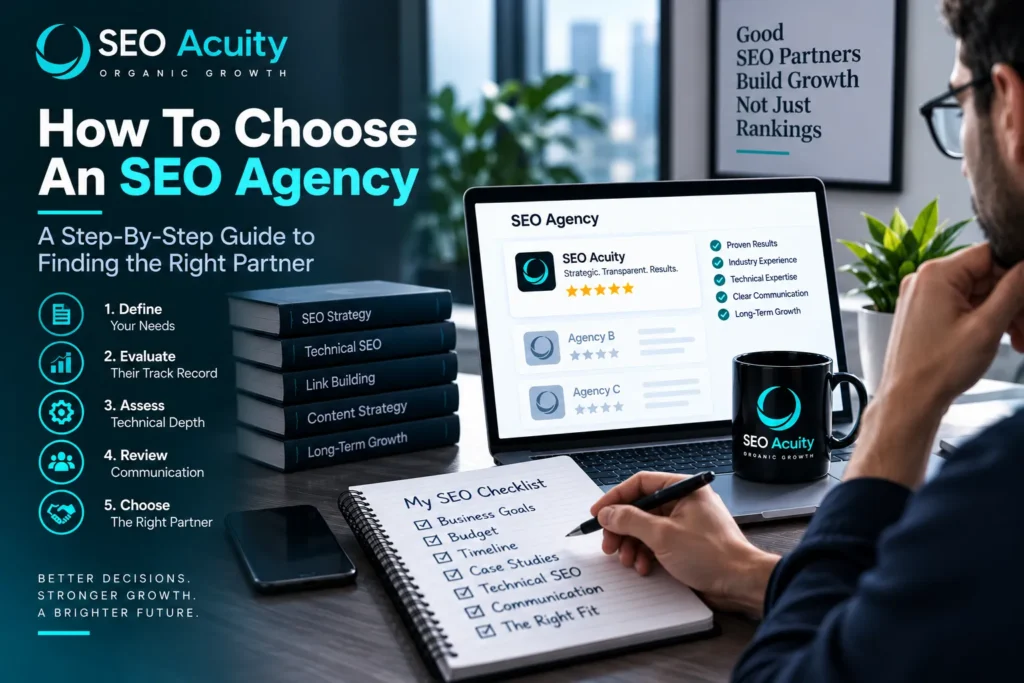
If you’ve searched “how to choose an SEO agency,” you’re not short on options — you’re short on a reliable way to filter them. There are thousands of agencies claiming to rank you on page one, and almost none of them will tell you upfront what separates a real SEO partner from one that takes your retainer and delivers a monthly PDF of meaningless metrics.
The decision is harder than it looks. SEO has a long feedback loop — results take months to materialize, and by the time you realize something isn’t working, you’ve already paid for it. The framework below front-loads your due diligence so you’re not discovering problems at month four.
Step 1: Define What You Need Before You Talk to Anyone
Most buyers enter agency conversations without a clear brief. This puts you at an immediate disadvantage: a good agency will ask you what you need, and a bad one will tell you what you need before they’ve understood your business.
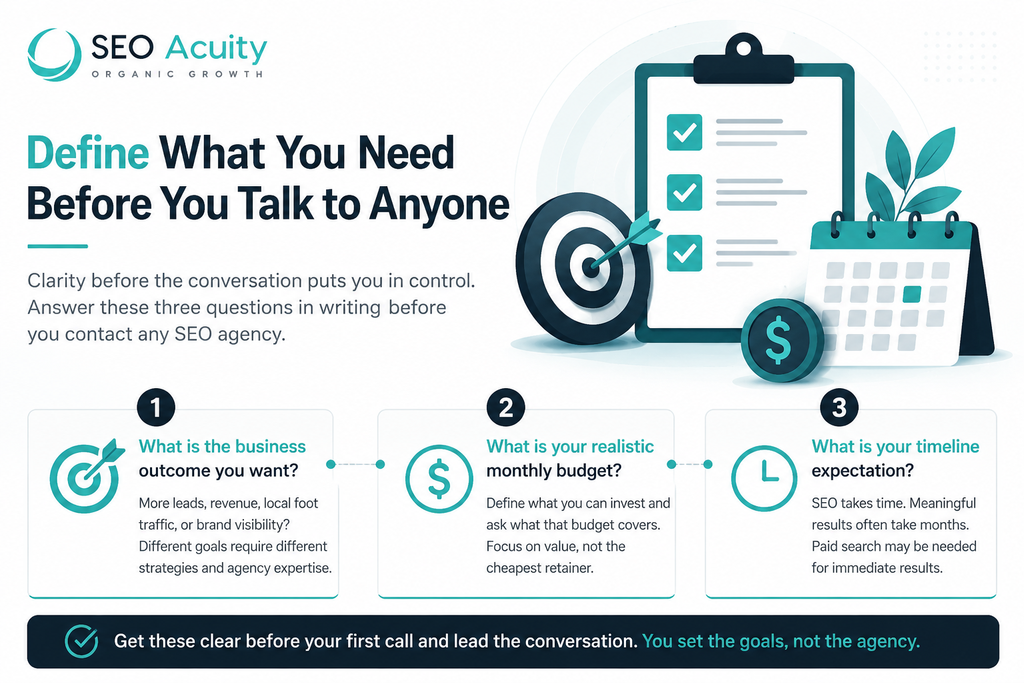
Before contacting any agency, answer these three questions in writing:
- What is the business outcome you want? More leads, more e-commerce revenue, local foot traffic, brand visibility in a new market — these require meaningfully different An agency that ranks e-commerce product pages needs a different skill set from one building topical authority for B2B SaaS or improving local SEO visibility.
- and different agency skill sets.
- What is your realistic monthly budget? SEO pricing varies significantly depending on your market, competition, website size, and scope of work. Instead of looking for the cheapest retainer, define what you can realistically invest and ask each agency to explain exactly what that budget will cover.
- What is your timeline expectation? SEO is a long-term growth channel, and meaningful results often take several months to develop depending on your starting point, competition, and market. If you need immediate traffic or leads, paid search may need to work alongside SEO rather than relying on organic growth alone.
Getting these clear before your first call solves a common and costly mistake: letting the agency define your goals for you, which conveniently always aligns with what they sell.
Read also: What Is LLM SEO? The Complete 2026 Guide to AI Search Optimization
Step 2: Evaluate Their Track Record — With Skepticism
Every SEO agency has case studies. The real question is whether those case studies prove the agency can deliver results for a business like yours.
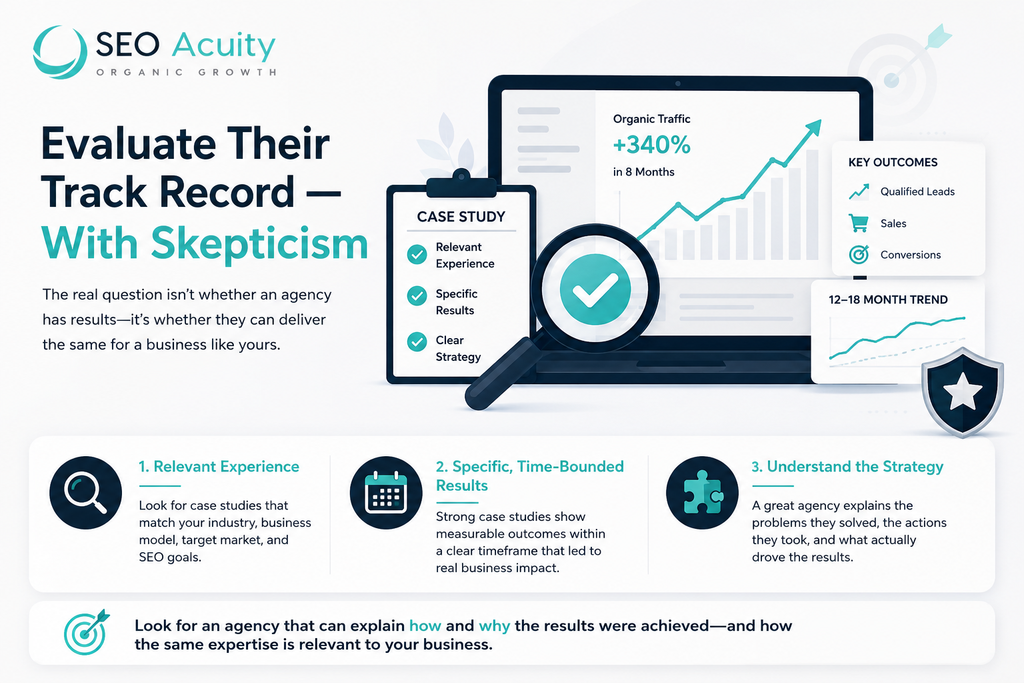
When reviewing an agency’s track record, focus on three things:
1. Look for Relevant Experience
An agency that ranks e-commerce product pages needs a different skill set from one building topical authority for B2B SaaS or improving local SEO visibility.
Look for case studies that match your:
- Industry or niche
- Business model
- Target market
- SEO goals
Relevant experience matters more than an impressive result from an unrelated business.
2. Look for Specific, Time-Bounded Results
Strong case studies show measurable outcomes within a clear timeframe.
For example:
Strong: “Organic traffic increased by 340% in eight months.”
Weak: “We significantly improved the client’s digital presence.”
Look beyond percentages, too. Ask whether the growth translated into qualified leads, sales, conversions, or other outcomes that mattered to the client.
3. Understand What Actually Produced the Results
Results without context tell you very little.
A capable SEO agency should be able to explain:
- What problems they identified
- What technical changes they made
- How they developed the content strategy
- How they approached link acquisition
- Which actions had the greatest impact
Be cautious when impressive results are explained only as the outcome of a “proven process” or “proprietary strategy.”
Read also: AEO vs SEO – Key Differences & How to Win Both
Don’t Judge Performance by the Peak
Finally, don’t evaluate a case study based only on the highest point on a traffic graph.
A sharp increase followed by an early plateau deserves further investigation. Instead, ask to see a 12–18 month performance trend and have the agency explain what caused the growth and whether it was sustained.
The goal isn’t simply to find an agency that has achieved impressive numbers. It’s to find one that can explain how those results were achieved and why the same expertise is relevant to your business.
Step 3: Assess Technical Depth — Not Just Content Volume
A high volume of content does not compensate for weak technical SEO. If search engines struggle to crawl, index, render, or understand your pages, even strong content can underperform.
A comprehensive SEO audit can help identify these issues before you invest further in content or link acquisition.
During your evaluation call, use technical questions to test whether the agency understands implementation — not just strategy.
1. Ask How They Handle a Site Migration
Ask:
“Walk me through how you’d handle a site migration.”
A technically capable agency should be able to discuss areas such as:
- 301 redirect mapping
- Internal link updates
- Canonical tags
- Crawl and indexation checks
- Post-migration monitoring
Be cautious if the answer stays vague, such as:
“We make sure SEO is preserved.”
The agency should be able to explain how.
2. Test Their Approach to Core Web Vitals
Ask:
“How do you approach Core Web Vitals when a client has technical or hosting limitations?”
This helps reveal whether the agency can work within real-world constraints rather than simply provide ideal recommendations that are difficult to implement.
A strong agency should be able to prioritize improvements based on impact, feasibility, and available resources.
3. Ask How They Diagnose Ranking Drops
Ask:
“What’s your diagnostic process when rankings drop after an algorithm update?”
A strong answer should begin with investigation rather than immediate action. The agency may look at:
- Which pages and queries declined
- Technical or indexing issues
- Content quality and search intent
- Backlink profile changes
- Competitor movements
- Changes that may correlate with the update
A weak answer jumps directly to:
“We’ll publish more content and build more links.”
The goal is not to find an agency that knows the right SEO terminology. It is to find one that can diagnose problems systematically and explain why it recommends a particular action.
Ready to Dominate Search Engine Rankings?
Accelerate your organic growth and scale your business leads with our data-driven SEO strategies.
Get a Free Quote NOW!Step 4: Understand How the Agency Qualifies Its Own Clients
How an SEO agency qualifies leads for itself tells you whether the agency thinks rigorously about fit — or takes every retainer regardless of what it can realistically deliver.
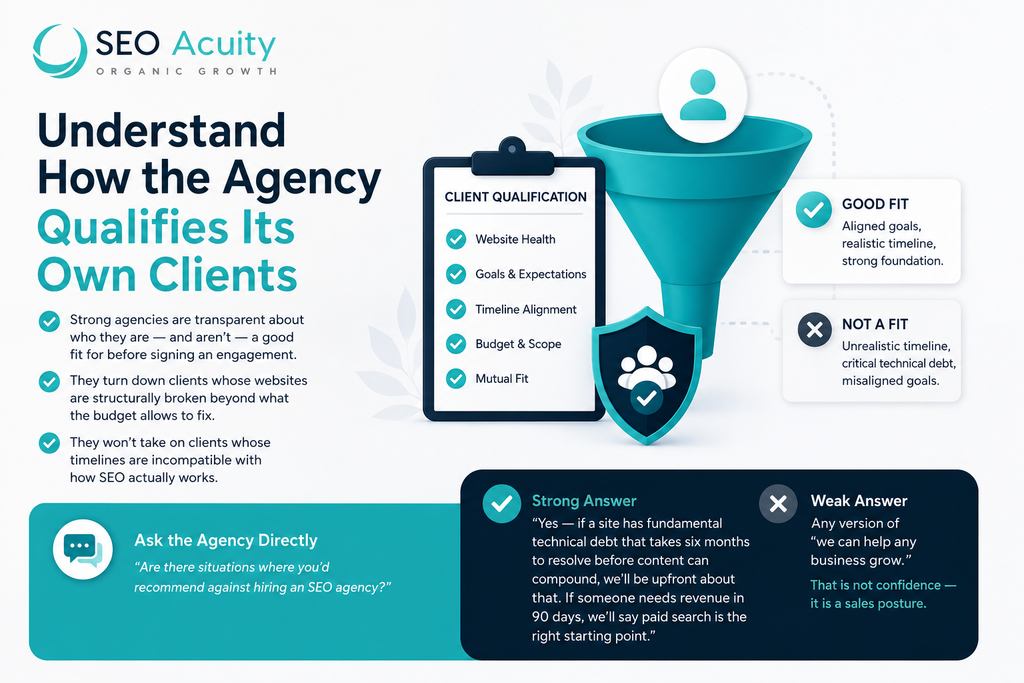
Understanding how to qualify leads for an SEO agency from the client side gives you a significant information advantage.
Strong agencies are transparent about who they are — and aren’t — a good fit for before signing an engagement.
They turn down clients whose websites are structurally broken beyond what the budget allows to fix, and clients whose timelines are incompatible with how SEO actually works.
Ask the agency directly: “Are there situations where you’d recommend against hiring an SEO agency?”
A strong answer sounds like: “Yes — if a site has fundamental technical debt that takes six months to resolve before content can compound, we’ll be upfront about that. If someone needs revenue in 90 days, we’ll say paid search is the right starting point.”
A weak answer is any version of “we can help any business grow.” That is not confidence — it is a sales posture.
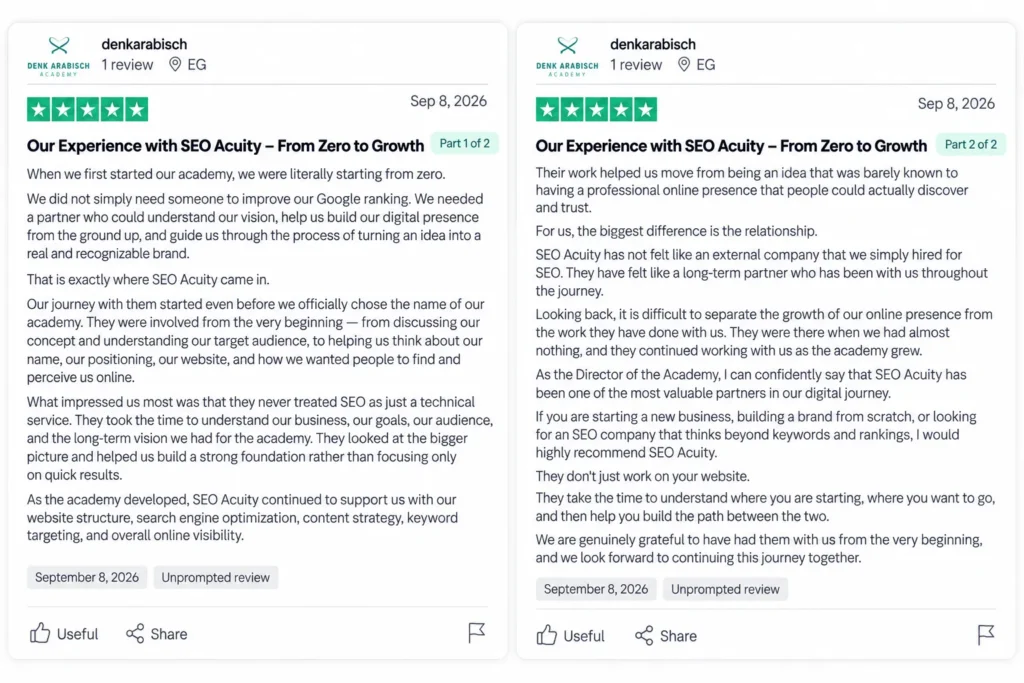
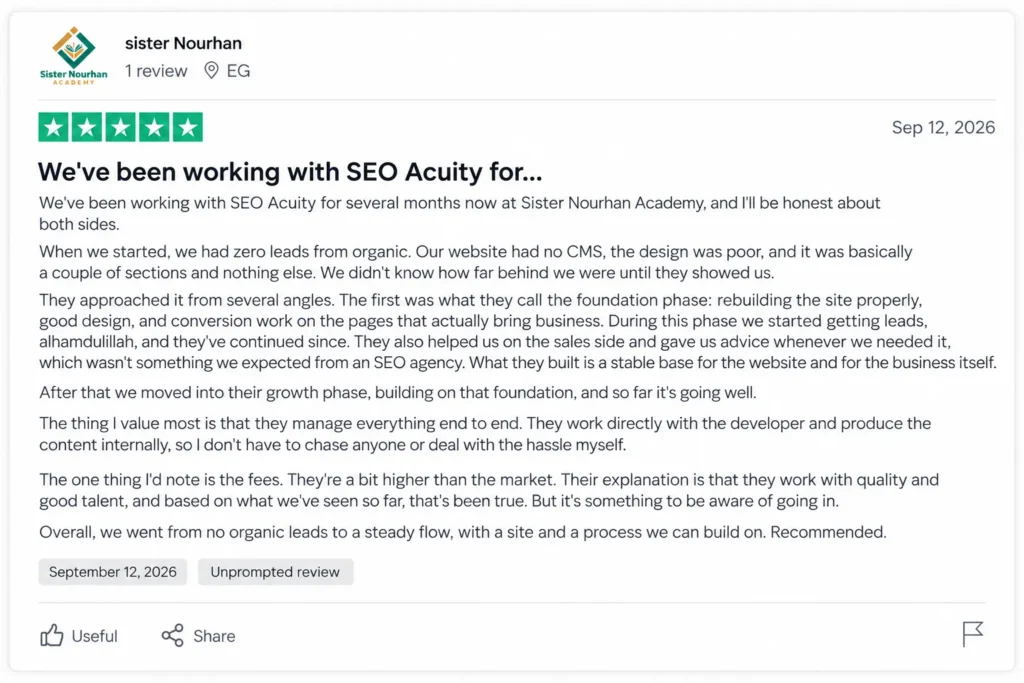
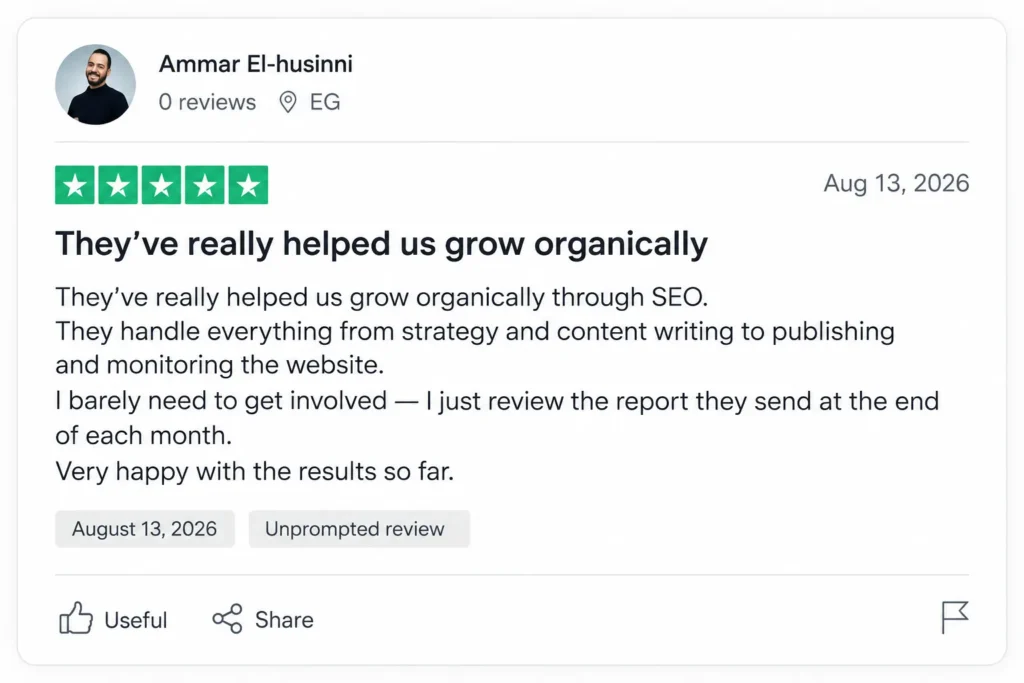
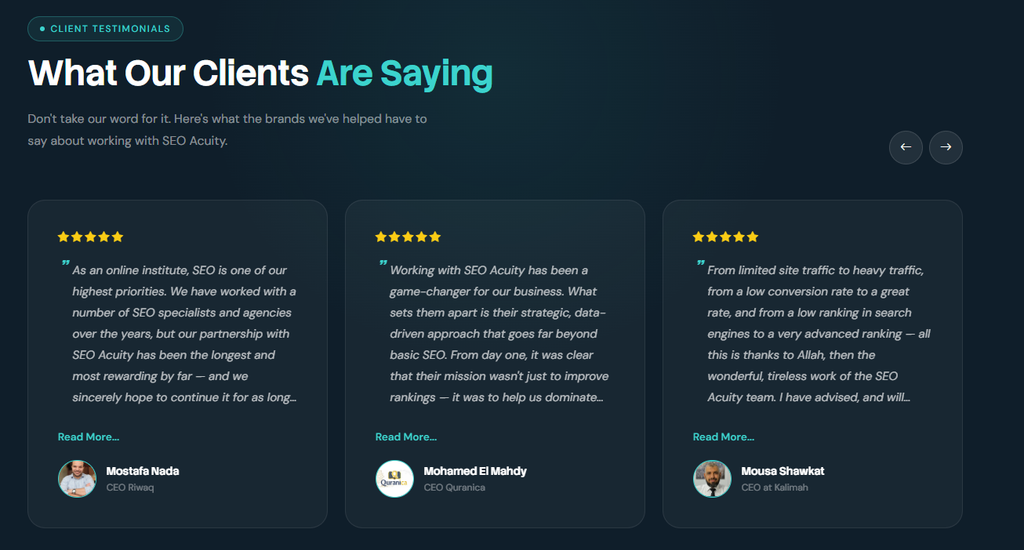
See What Our Clients Are Saying
Step 5: Evaluate the Team That Will Actually Handle Your SEO
Don’t evaluate only the agency — evaluate the people who will actually work on your account.
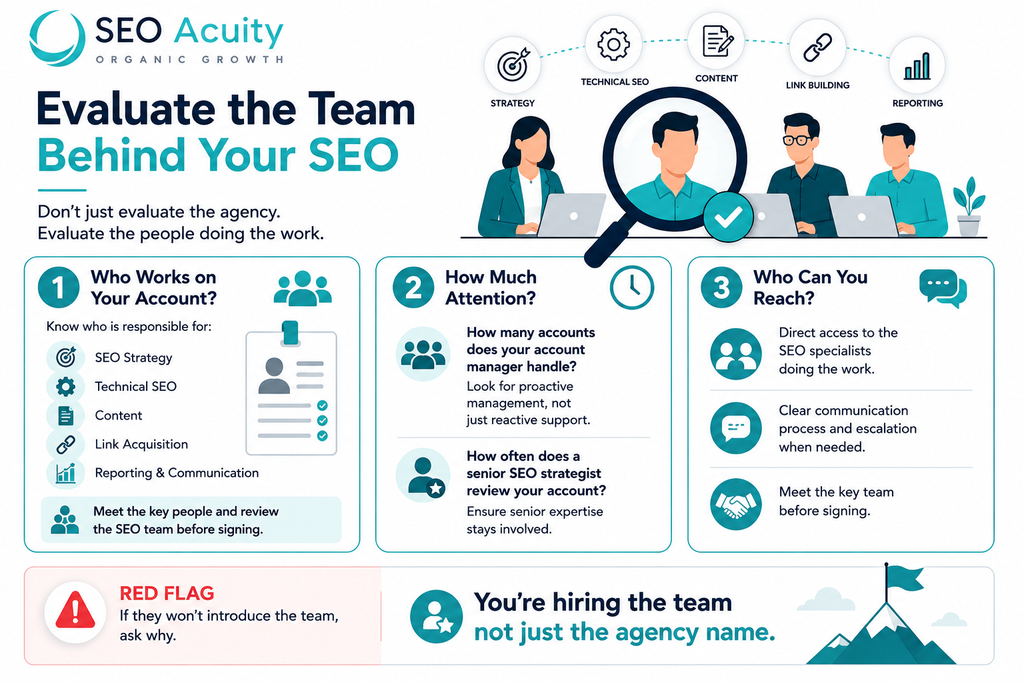
A common problem in agency relationships is being sold to by a senior strategist, then handed to a team you’ve never met. Before signing, make sure you understand who will be responsible for your SEO strategy, execution, and communication.
Focus on three things:
1. Find Out Who Will Work on Your Account
Ask:
“Who specifically will be working on my account?”
You should understand who is responsible for:
- SEO strategy
- Technical SEO
- Content
- Link acquisition
- Reporting and communication
If possible, meet the key people who will actually be involved before signing the contract and review the agency’s SEO team to understand who brings the strategic and technical expertise behind the work.
2. Understand How Much Attention Your Account Will Receive
Ask:
“How many accounts does my account manager handle?”
There is no universal ideal ratio. What matters is whether the team’s workload allows them to manage your account proactively rather than simply responding when something goes wrong.
Follow up with:
“How often will a senior SEO strategist review my account?”
This helps you understand whether senior expertise remains involved after the sales process ends.
Read also: Generative Engine Optimization SEO Benefits for Businesses
3. Ask Who You’ll Have Direct Access To
Ask:
“Will I have direct access to the SEO specialists doing the work, or will all communication go through an account manager?”
An account manager can make communication easier, but there should also be a clear way to involve technical or strategic specialists when necessary.
Be cautious if an agency is reluctant to explain its team structure or introduce the people who will actually manage your SEO.
You aren’t just hiring an agency name. You’re hiring the team responsible for turning the strategy into results.
Step 6: Scrutinize Reporting — Know What You’re Paying to See
The monthly report is where many client-agency relationships quietly fail. Agencies that optimize for appearing productive rather than being productive tend to surface metrics that move without mattering.
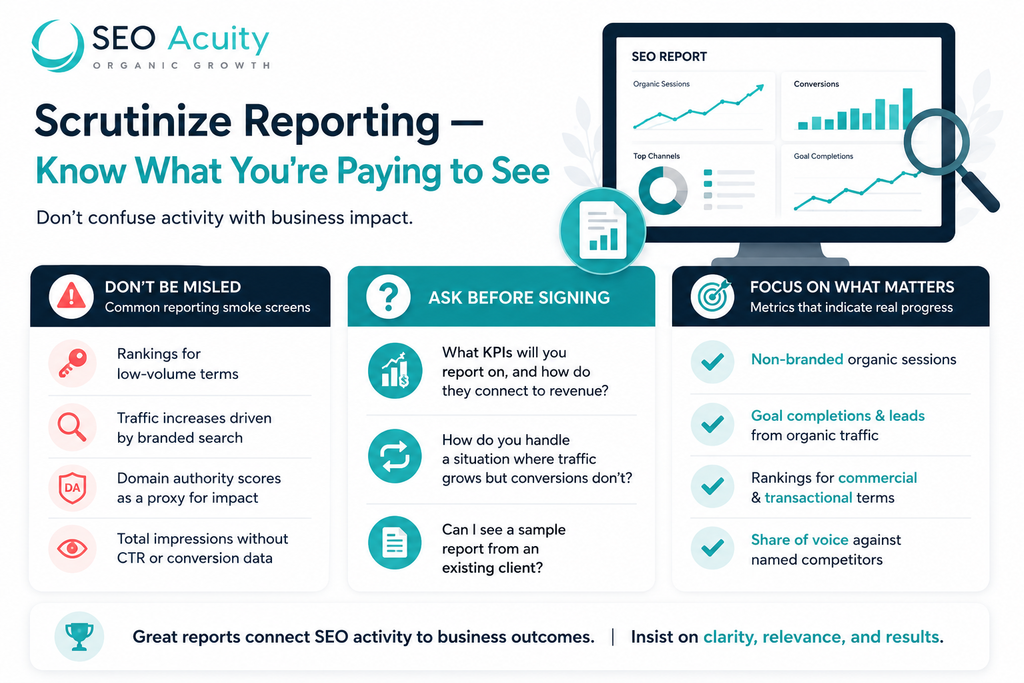
Common reporting smoke screens include: rankings for low-volume terms, traffic increases driven by branded search, domain authority scores as a proxy for business impact, and total impressions without reference to click-through rate or conversion.
Before signing, ask:
- “What KPIs will you report on, and how do they connect to revenue?”
- “How do you handle a situation where traffic grows but conversions don’t?”
- “Can I see a sample report from an existing client?”
The metrics that indicate real progress: non-branded organic sessions, goal completions attributable to organic traffic, rankings for commercial and transactional terms, and share of voice against named competitors.
Step 7: Structure the First Engagement to Limit Risk
Even after finding a strong SEO agency, structure the first engagement so expectations, responsibilities, and measures of success are clear from the beginning.
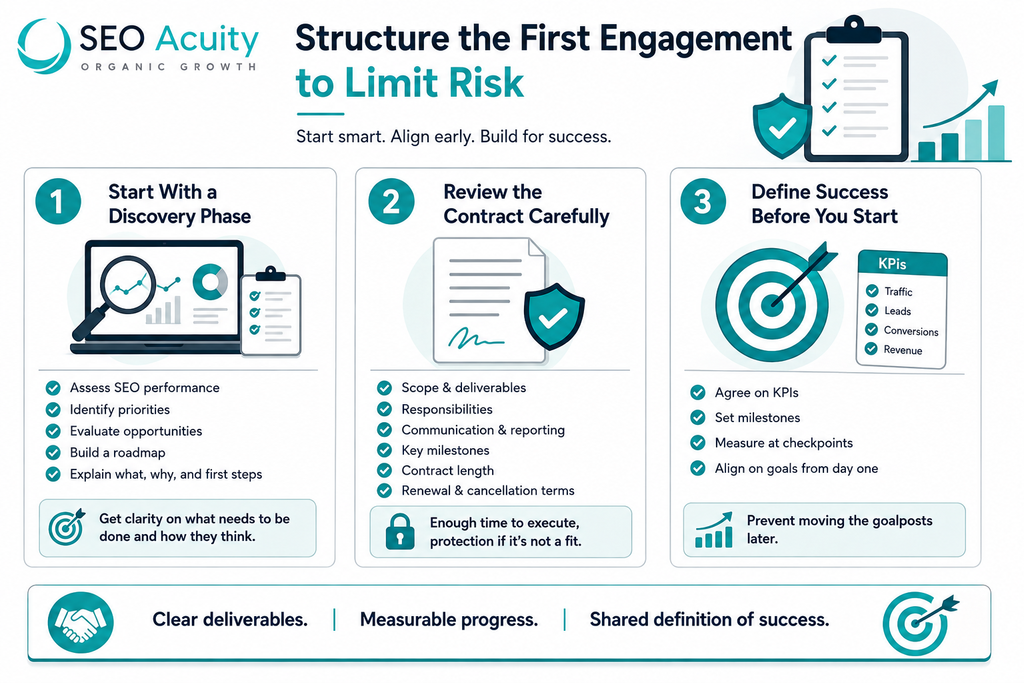
Focus on three areas:
1. Start With a Defined Discovery or Audit Phase
Consider beginning with a scoped SEO audit or discovery phase before committing to a larger engagement.
Reviewing an agency’s SEO process can also help you understand what should happen between discovery, strategy, and execution.
The agency should use this phase to:
- Assess your current SEO performance
- Identify technical and content priorities
- Evaluate major growth opportunities
- Build a prioritized roadmap
- Explain what should happen first and why
The goal is not a generic checklist. You should come away with a clear understanding of what needs to be done and how the agency thinks.
2. Review the Contract Carefully
Avoid committing to a long-term agreement before you understand how the agency works.
Look for clear terms around:
- Scope and deliverables
- Responsibilities
- Communication and reporting
- Key milestones
- Contract length
- Renewal and cancellation terms
The contract should give the agency enough time to execute while protecting you if the relationship is not a good fit.
3. Define Success Before the Work Begins
Agree on what success means before month one.
Define the KPIs and milestones you’ll use to evaluate progress at agreed checkpoints. Depending on your goals, these might include organic visibility, qualified traffic, leads, conversions, or revenue.
This prevents moving the goalposts later if the original objectives aren’t being met.
A strong first engagement should leave both sides knowing exactly what is being delivered, how progress will be measured, and what success looks like.
Ready to Dominate Search Engine Rankings?
Accelerate your organic growth and scale your business leads with our data-driven SEO strategies.
Get a Free Quote NOW!Start Working With an SEO Agency That Holds Itself Accountable
Most agencies will tell you what you want to hear in the pitch. SEO Acuity operates differently — we define success metrics before month one, we’re direct about timelines and realistic outcomes, and we turn down engagements where the economics don’t make sense for the client.
If you want a partner who will be specific about what they’ll do, why it will work, and what success looks like — not just confident about it — let’s talk.

Ready to Dominate Search Engine Rankings?
Accelerate your organic growth and scale your business leads with our data-driven SEO strategies.
Get a Free Quote NOW!Conclusion
Choosing the right SEO agency comes down to one discipline: asking harder questions earlier, before you’re financially committed to the answer.
The six steps move the decision from a gut call to a defensible process. But the details that follow them — pricing model, team structure, whether an agency is even the right choice for your situation, and the subtler red flags most buyers miss — are what separate a good shortlist from a decision you won’t regret twelve months from now.
The agencies worth working with welcome this level of scrutiny. The ones that resist it are giving you the most important information of all.
Frequently Asked Questions
How long does it take to see results from an SEO agency?
Meaningful organic growth typically becomes visible between months four and six, with compounding results over 9–12 months. Faster timelines are possible for low-competition niches or sites with existing authority, but any agency promising significant results within 30–60 days is either targeting low-volume terms or overpromising.
What should a monthly SEO retainer include?
A retainer should cover ongoing technical monitoring and fixes, content creation or optimization aligned to a keyword strategy, link acquisition activity, and a monthly report tied to agreed KPIs. If the only consistent deliverable is a report, you are paying for documentation, not execution.
How do I know if an SEO agency is using safe, sustainable practices?
Ask them directly how they build links. Legitimate agencies use editorial outreach, digital PR, and content that earns citations naturally — not link farms or private blog networks. If they’re vague about their link sources or describe their approach only as “high-quality link building,” push for specifics.
What is the difference between an SEO agency and an SEO consultant?
An agency brings a team — technical SEO specialist, content strategist, and account manager — while a consultant is usually one person handling all functions. Agencies suit complex, high-volume campaigns. Consultants can be more cost-effective for narrower, focused scopes where flexibility matters more than team depth.
How do I know if my business is ready to invest in SEO?
Your business is ready for SEO when you have a stable product or service, a website that can be technically optimized, and a realistic 6–12 month timeline before expecting significant organic revenue impact. If you need leads in the next 30–60 days, start with paid search and build your SEO foundation in parallel.
What are the biggest red flags when evaluating an SEO agency?
Guaranteed rankings on specific terms, lock-in contracts before any work is delivered, reporting that doesn’t connect to business outcomes, proposals that arrive within 24 hours without referencing your competitive landscape, and vague answers about link building sources. Any agency that avoids direct answers to direct questions is telling you something important.