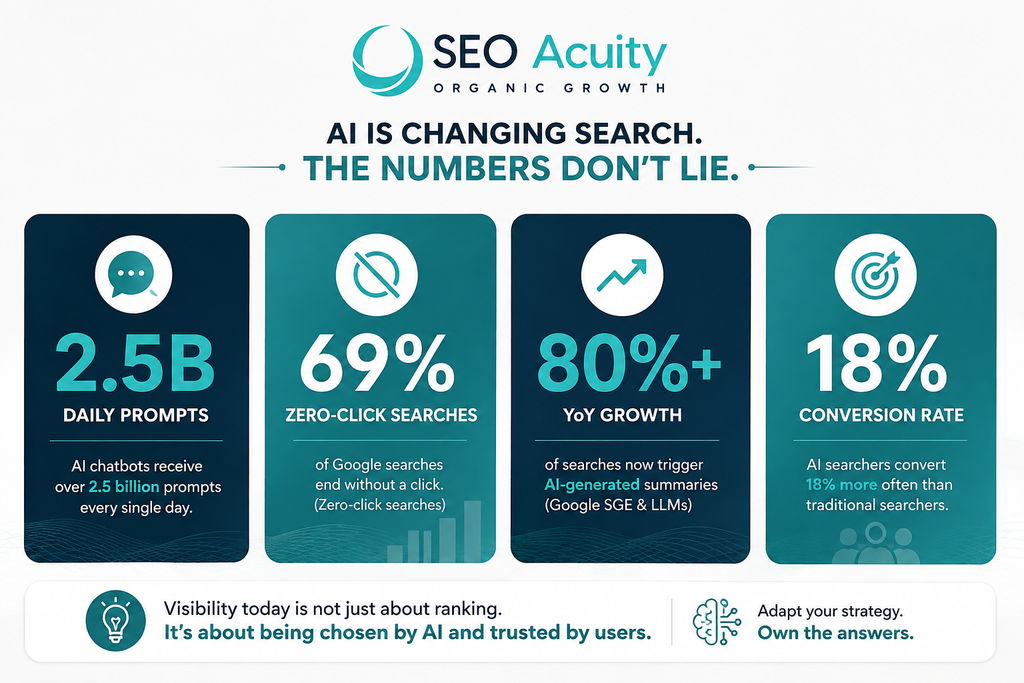
Google is no longer the only place people search for answers. Over 2.5 billion prompts hit ChatGPT daily. Perplexity handles hundreds of millions of queries every month. Gemini is embedded directly into Google’s search results. And 27% of Americans now choose AI SEO tools over traditional search engines for at least some of their queries.
That’s the world LLM SEO was built for.
LLM SEO — large language model SEO — is how brands get discovered inside AI-generated answers, not just on a ranked list of blue links. If your content isn’t optimized for how these systems select and cite sources, you’re invisible to a growing share of your audience, even if you rank on page one of Google.
This guide covers what LLM SEO means, why it matters right now, and exactly how to do it — including two mechanics most brands are still missing entirely.
What You’ll Learn in This Article
- What LLM SEO is and how it differs from traditional SEO and LLMO.
- Why the zero-click era makes AI visibility non-negotiable in 2026.
- How LLMs actually decide which content to cite — a three-layer model.
- Eight proven LLM SEO strategies, with platform-specific guidance.
- How to measure AI search performance beyond rankings and clicks.
What Is LLM SEO?
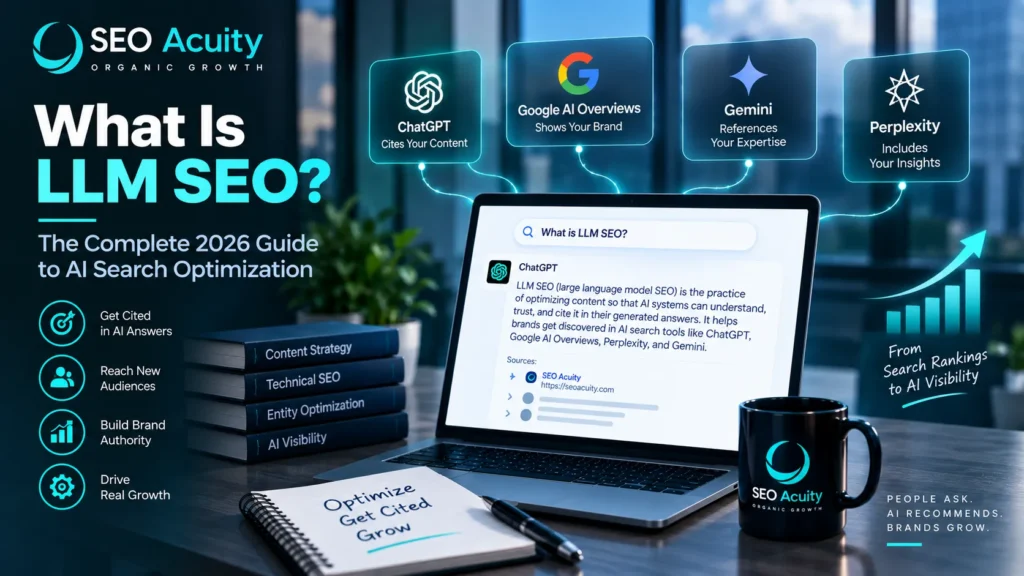
LLM SEO (large language model SEO) is the practice of optimizing content so that AI systems — ChatGPT, Gemini, Perplexity, Claude, and Grok — can understand, trust, and cite it inside their generated answers.
Where traditional SEO gets your page onto a ranked list, LLM SEO gets your content inside the answer itself. Instead of competing for position one, you compete to be one of the three to eight sources a language model pulls from when it synthesizes a response to a user’s query.
The goal is the same as it has always been: connect your expertise with the people searching for it. What has changed is where those people now look — and how AI systems decide what to show them.
1. LLM SEO vs. Traditional SEO – Key Differences
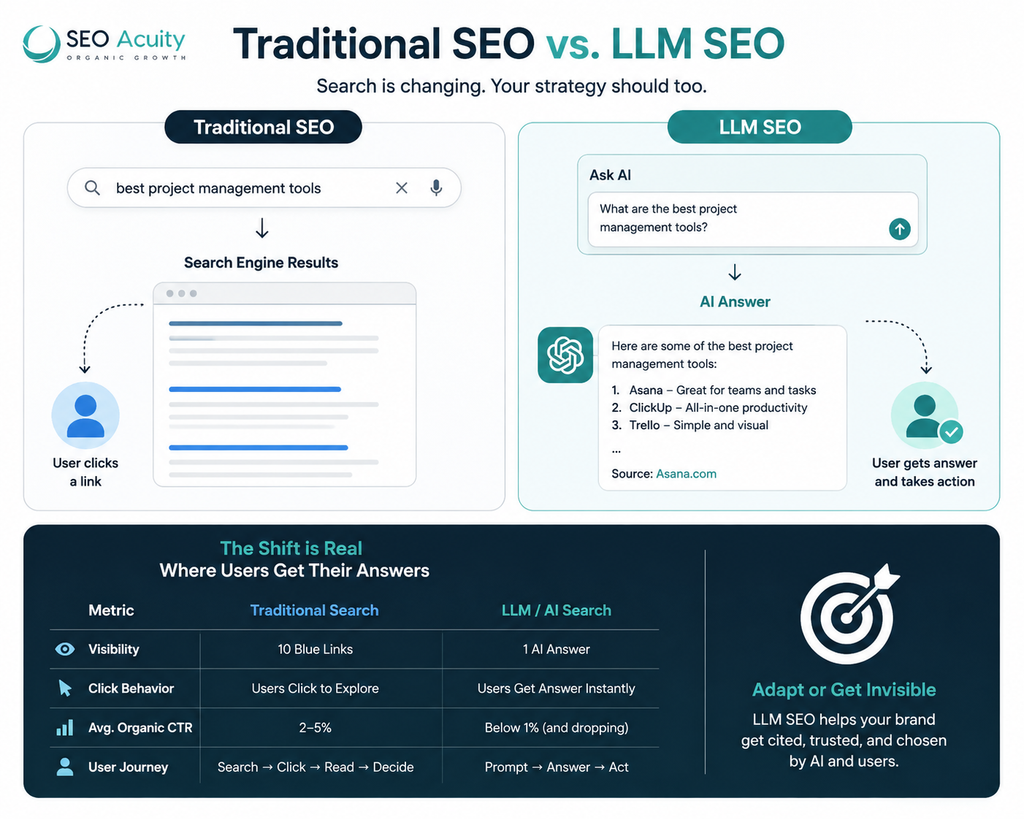
Both approaches aim to connect your brand with the right audience — but they operate by different rules, reward different signals, and define success in entirely different ways. The table below maps the core differences at a glance:
| Traditional SEO | LLM SEO | |
| Goal | Rank on a results page | Get cited in AI-generated answers |
| Success metric | Keyword rankings, clicks, traffic | Citation frequency, AI Share of Voice |
| Key inputs | Keywords, backlinks, technical SEO | Structured content, entity signals, freshness |
| Primary platform | Google, Bing | ChatGPT, Perplexity, Gemini, Claude, Grok |
Beyond the table, the behavioral differences matter just as much:
- Traditional SEO leans on backlink volume and click-through optimization.
- LLM SEO rewards clear, extractable language and structured formats like FAQs and summaries.
- LLM SEO prioritizes entity clarity and consistent authority across multiple platforms.
- Most AI platforms pull from search indexes — so a page that isn’t indexed cannot be cited.
Think of LLM SEO as a layer you build on top of your existing SEO foundation — not a swap-out for what already works.
2. LLM SEO, LLMO, GEO, and AEO – What’s the Difference?
You will see LLM SEO, LLMO (large language model optimization), AEO (answer engine optimization), and GEO (generative engine optimization) used interchangeably across the industry. In practice, they describe the same goal with slightly different scopes:
- LLM SEO — the most specific term: optimizing to be cited inside LLM responses, often in search-related contexts.
- LLMO — broadens LLM SEO to brand presence across any AI-driven context, beyond search alone.
- GEO — extends further to cover all generative search surfaces, including Google AI Overviews.
- AEO — focuses specifically on being the direct answer AI systems pull, particularly in voice and featured-snippet contexts.
For most brands and practitioners, the terms are interchangeable. The strategies overlap heavily regardless of which label is used.
Read also: AEO vs SEO – Key Differences & How to Win Both
Why LLM SEO Matters in 2026
The shift in search behavior is no longer a prediction. It is already here. The only question is whether your brand is positioned to capture the attention that is moving into AI-generated answers.
A. The Zero-Click Era Has Arrived
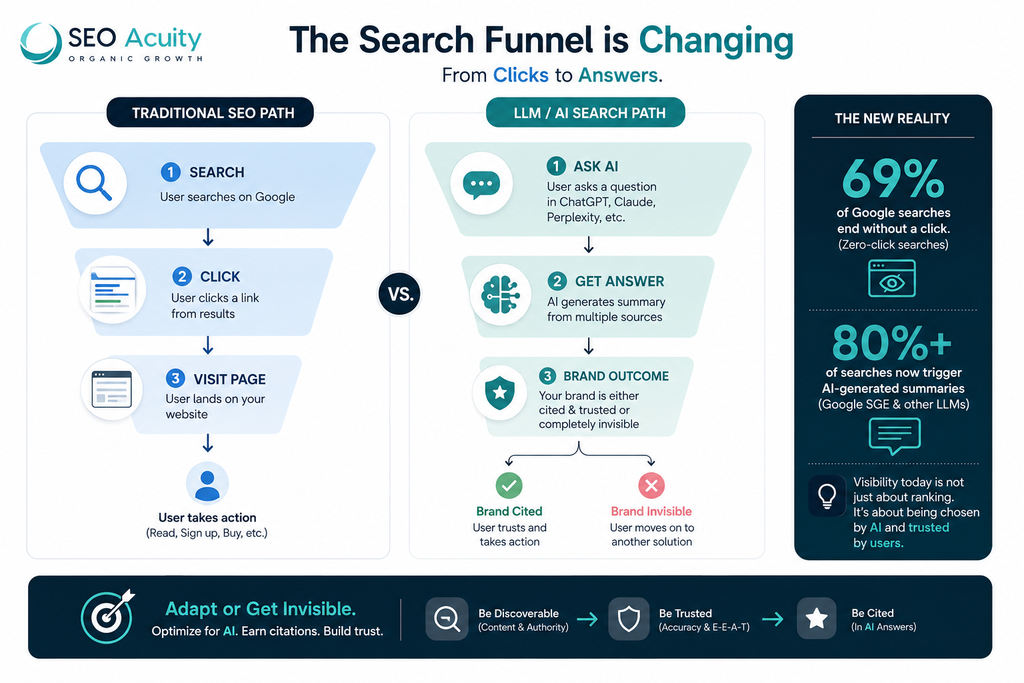
Around 69% of Google searches now end without a click. Nearly 80% of users rely on AI-generated summaries for at least 40% of their searches, according to Bain & Company research.
People are no longer scanning five results and clicking through — they receive a synthesized answer, evaluate it, and either act or move on without ever visiting a website.
“Is Google Dead? The Full Truth About AI Search”
For brands, this rewrites the rules of visibility:
- Ranking on page one still matters — but an AI Overview can answer the query before a user ever sees your listing.
- Brands that appear inside those AI answers stay in the buyer’s consideration set at the moment of decision.
- Brands that don’t become invisible precisely when intent is highest.
B. LLM Traffic Is High-Intent and Growing
LLM-referred traffic currently accounts for less than 2% of total referral volume across most sites. That number looks small until you understand what it represents:
- Visitors arriving from AI platforms show higher intent and stronger engagement than typical organic visitors.
- Reported conversion rates hover around 18% — significantly stronger than standard organic traffic benchmarks.
- AI-referred sessions have grown roughly 80% year over year, with no sign of slowing.
- Semrush forecasts AI-driven traffic overtaking traditional organic traffic by 2028.
Research from Ahrefs also shows that 45.5% of AI citations get replaced when the same query is run again — which means LLM SEO is not a project you finish once. It is a system you run continuously, or competitors who do will take your place.
If you want your brand present where this traffic is heading, SEO Acuity builds LLM SEO strategies for brands in both English and Arabic markets — grounded in the mechanics below, not surface-level tactics.
Read also: Generative Engine Optimization SEO Benefits for Businesses
How LLMs Actually Decide What to Cite
Most brands treat LLM SEO as “write better content and hope for the best.” Better content is necessary, but not sufficient. Understanding how AI models retrieve and select sources is what separates a surface-level optimization pass from one that earns consistent, repeat citations.
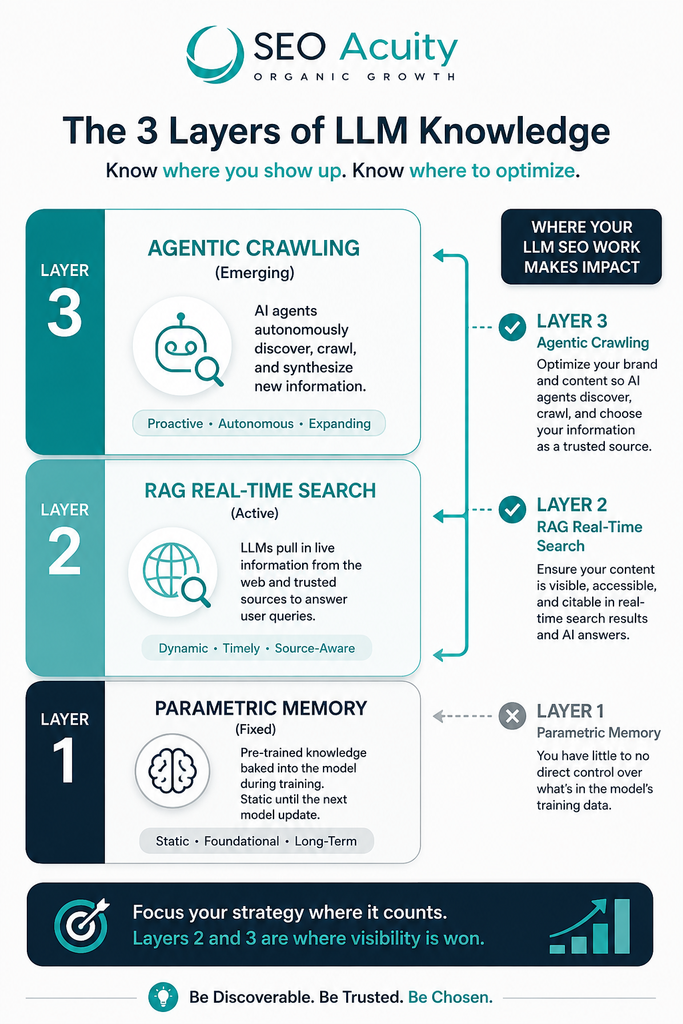
There are three distinct layers at play.
1. Parametric Memory (Training Data)
This is what the model learned during training — baked in and impossible to change directly through content alone:
- Brands with strong, consistent online presence from before 2024 have an embedded advantage here.
- They are already woven into the model’s base knowledge and associations.
- For newer brands or recently launched topics, this layer provides limited leverage.
This is why Layers 2 and 3 are where active LLM SEO work actually moves the needle.
2. Real-Time RAG Search
When a user asks a real-time question, the LLM fires off web searches, retrieves recent content, and incorporates it into the answer through Retrieval-Augmented Generation (RAG). This is where most active LLM SEO work pays off.
One mechanism most brands miss entirely: fan-out queries. When a user asks a complex question — “What’s the best CRM for a 50-person SaaS company?” — the LLM does not run one search. It:
- Breaks the question into multiple shorter sub-queries.
- Retrieves results for each independently.
- Synthesizes the pieces into a single coherent answer.
Your content needs to surface for the component parts of a topic, not just the full question. Comprehensive, topically deep content earns citations across more prompts for exactly this reason. Thin, single-keyword pages consistently underperform.
“A Practical Step-by-Step Framework for Appearing in AI Search Results Like ChatGPT and Gemini” .
Ready to Dominate Search Engine Rankings?
Accelerate your organic growth and scale your business leads with our data-driven SEO strategies.
Get a Free Quote NOW!3. Agentic Crawling
More advanced AI agents now crawl specific URLs on demand, interpreting your site’s content directly. As agentic AI use grows:
- How clean, readable, and well-structured your site is becomes increasingly critical.
- An llms.txt file — placed at your root domain, similar to robots.txt — tells AI crawlers which pages to prioritize and how to interpret your content.
- This is a relatively new standard and the vast majority of competitors have not deployed one yet.
Early adoption of llms.txt is one of the most direct, low-competition signals you can send to AI systems about how to access and evaluate your site.
Read also: GEO SEO Strategy for AI Search – The Complete 2026 Guide to Getting Cited by AI
LLM SEO Best Practices – 8 Proven Strategies
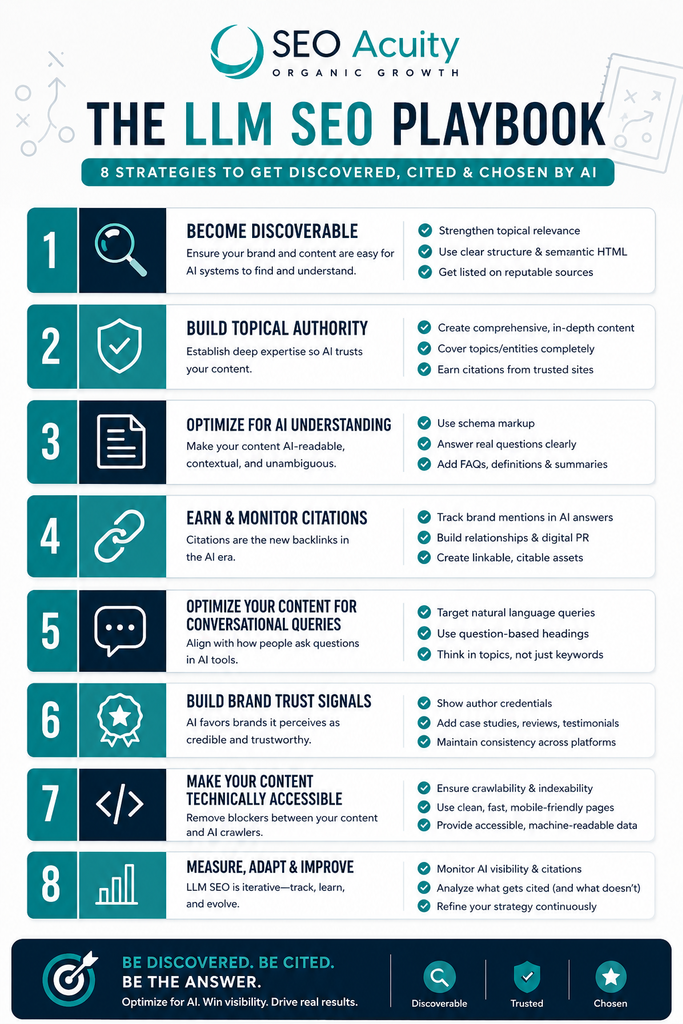
Visibility in large language models does not come from hacks or shortcuts. It comes from making your content easier for AI systems to find, process, and trust. These eight strategies build on what already works in traditional SEO and adapt it for how language models actually retrieve and cite sources.
“How to Build an Organic Growth Strategy That Ranks in Both AI Search and SEO, Step by Step”.
1. Write Conversational, Context-Rich Content
LLMs are built for natural conversation. Content that sounds robotic, keyword-heavy, or over-formatted is harder for models to interpret and less likely to be reused in a generated response.
To write in a way LLMs can understand and reuse:
- Write the way people actually ask questions — full sentences, natural phrasing, specific scenarios.
- Explain concepts clearly without jargon or assumed prior knowledge.
- Add context around each idea so it holds up when extracted without the surrounding paragraphs.
- Avoid exact-match keyword repetition; focus on semantic completeness instead.
- Every paragraph should be independently understandable — clear enough to make sense when pulled out of context by an AI model.
2. Structure Content for Extraction and Summarization
AI models do not use entire pages. They extract snippets and synthesize them into answers. Your content needs to be easy to break apart and reuse at the section level.
The format LLMs consistently favor:
- A 40–70 word lead paragraph that directly answers the core question at the top of each section.
- Clear H2 and H3 headings that describe what follows without requiring the reader to scroll further.
- Short, self-contained sections — each one answerable in isolation.
- Summaries or key point callouts at the top of complex sections.
- Bullet points that stand alone without a preceding sentence to make sense.
Well-structured content improves your chances of appearing in AI-generated answers and works directly with tools that analyze extractability.
3. Add FAQs and Key Takeaways
FAQ sections are the highest-value content block for LLM citation. AI systems are designed to find clear, concise answers — and FAQs provide exactly that in the format AI platforms prefer.
LLMs often pull one to three sentence answers directly from FAQ sections when generating responses.
Adding FAQs to your pages delivers multiple benefits:
- Increases chances of being cited in AI-generated answers.
- Improves visibility in zero-click and “position zero” results in traditional search.
- Aligns with how people phrase natural language queries in AI tools.
- Supports voice search and AI assistant responses.
- Reduces friction by giving users immediate, clear answers.
Add FAQPage schema markup to make FAQ sections machine-readable across both AI platforms and search engines simultaneously — this doubles their visibility value.
4. Use Semantic and Natural Language Keywords
The era of exact-match keyword repetition is over for LLM SEO. Language models rely on natural language processing to understand how concepts relate — not how many times a phrase appears on the page.
To optimize for semantic depth:
- Cover topics comprehensively rather than targeting a single keyword.
- Use related terms, entity variations, and natural phrasing throughout.
- Answer follow-up questions within the same piece of content
- Write in a conversational tone that mirrors how real queries are actually phrased.
For a topic like AI SEO, that means naturally working in terms like retrieval-augmented generation, generative engine optimization, AI Overviews, and entity-based search — not forcing them in, but using them where they genuinely belong.
Semantic coverage builds topical authority, which is a core signal LLMs use when selecting sources. The more comprehensively you cover a subject, the more likely your content is to be trusted and cited across a range of related prompts.
5. Set Up Bing Webmaster Tools
This is the most overlooked technical prerequisite in LLM SEO. ChatGPT’s real-time search runs through Bing’s index. If Bing has not crawled your site, ChatGPT cannot cite it — full stop. Google Search Console alone is not sufficient.
To get this in place:
- Sign up at Bing Webmaster Tools (free, takes under one hour).
- Verify your website and submit your sitemap.
- Confirm that your key pages are indexed in Bing’s system.
Rankings in Bing translate more directly to ChatGPT citations than most marketers realize. It is the first technical prerequisite on any serious LLM SEO checklist — and most brands skip it entirely.
6. Deploy Comprehensive Schema Markup
Structured data tells AI systems what your page is about and how to interpret its content. When you examine cited sources across ChatGPT responses, nearly all of them carry schema markup — this is not coincidence.
Schema types that directly improve LLM SEO visibility:
- FAQPage — turns your FAQ sections into machine-readable Q&A pairs.
- Article — identifies content type, author, and publication context.
- HowTo — structures step-by-step content for AI extraction.
- Product — signals product attributes, pricing, and availability.
A single blog post can legitimately carry both FAQPage and Article schema simultaneously — stack them where appropriate. Structured data is one of the clearest signals you can send that your content is organized for machine interpretation and ready to be reused in an AI-generated answer.
7. Build Third-Party Authority Across Channels
When multiple credible sources mention your brand in similar contexts, AI systems develop higher confidence in citing you.
A brand mentioned across PR coverage, guest contributions, analyst write-ups, and community discussions is far more likely to be surfaced than one that publishes only on its own domain.
Channels that contribute meaningfully to LLM authority:
- PR coverage and editorial mentions in recognized publications.
- Guest contributions on industry blogs and relevant platforms.
- Analyst and research reports that reference your brand.
- Forum discussions — Reddit threads, Quora answers, community boards.
- YouTube video transcripts and social media content.
LLMs draw from all of these alongside traditional web pages. Brand mentions do not even require a backlink to influence LLM citations — text mentions in relevant contexts teach language models which brands belong in which categories.
For brands that need to accelerate this process, SEO Acuity’s LLM SEO services for enterprise and growth-stage businesses build the kind of multi-channel authority that LLMs use to decide which names to include in an answer.
8. Maintain a Content Freshness Cadence
With 45.5% of AI citations getting replaced when the same query is run again, stale content is a structural liability. AI citations are not stable the way a page-one ranking can be — they shift constantly based on freshness, source authority, and the precise context of each query.
To stay cited consistently:
- Set a quarterly review schedule for your most important pages.
- Update statistics, refresh examples, and add new context where the topic has evolved.
- Re-publish with an updated date that reflects in your schema markup.
- Monitor which pages are getting cited and prioritize freshness efforts there first.
Perplexity in particular weights recency heavily when selecting sources. An effective LLM SEO program is not a project with a completion date — it is an ongoing system.
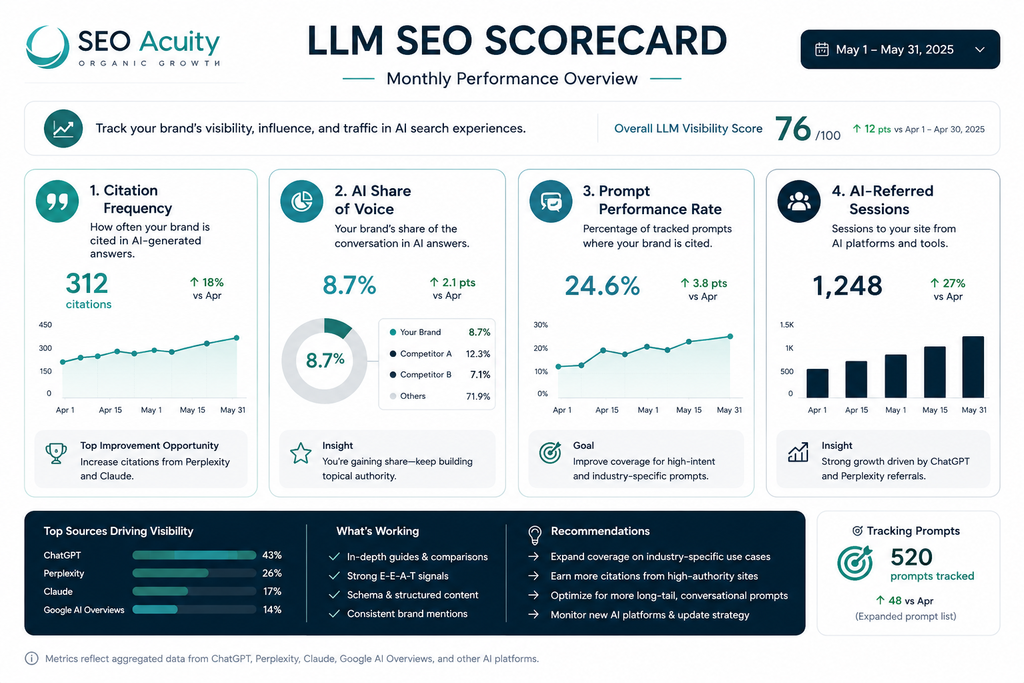
How to Measure LLM SEO Performance
Standard analytics alone will not tell you whether your LLM SEO is working. Keyword rankings do not capture AI citation frequency. Google Search Console does not show you when ChatGPT mentions your brand.
The metrics that matter are:
- Citation frequency — how often your content appears in AI responses for a defined set of target prompts.
- AI Share of Voice — your percentage of relevant AI responses versus competitors.
- Prompt performance rate — how consistently you are cited across a fixed prompt panel run over time.
- AI-referred sessions — traffic from ChatGPT, Perplexity, Gemini tracked as separate channels in GA4.
For tooling and tracking:
- Profound and OptimizeGEO are purpose-built to track citation frequency and AI Share of Voice.
- Semrush has rolled out AI visibility reporting that sits alongside traditional search metrics.
- In GA4, create a custom channel group capturing sessions from chat.openai.com, perplexity.ai, gemini.google.com, and claude.ai as separate referral sources.
Beyond platforms, direct testing remains essential. Query ChatGPT, Gemini, and Perplexity regularly with the same questions your audience asks.
Document when your content is cited and note which competitors appear instead. Brand mentions inside AI outputs matter even without a link — they reinforce awareness and predict future click-through when users do decide to act.
Ready to Dominate Search Engine Rankings?
Accelerate your organic growth and scale your business leads with our data-driven SEO strategies.
Get a Free Quote NOW!Start Winning AI Search Citations Today
The brands getting cited consistently in ChatGPT, Gemini, and Perplexity are not winning by accident.
They have clear content structures, strong entity signals, and consistent authority across multiple platforms — the exact combination language models use to decide which sources to trust.
SEO Acuity builds LLM SEO strategies for enterprise and growth-stage businesses that want to compete in both traditional and AI-driven search. From technical implementation and schema setup to content optimization and AI visibility tracking, our team handles the strategy so you can focus on the results.
Work with SEO Acuity → seoacuity.com

Ready to Dominate Search Engine Rankings?
Accelerate your organic growth and scale your business leads with our data-driven SEO strategies.
Get a Free Quote NOW!Conclusion
LLM SEO is not a replacement for traditional SEO. It is the next layer — designed for a world where answers appear before the search results do, and where brand discovery increasingly happens inside an AI response rather than on a ranked list of links.
The fundamentals remain unchanged: quality content, clear structure, and genuine authority. What changes is how you apply them.
Writing conversationally, structuring for extraction, building semantic depth, maintaining content freshness, and earning multi-channel mentions — these are the practices that determine whether AI models trust your content enough to cite it, and whether they keep citing it the next time the same question is asked.
The shift is already underway. AI search queries have grown 300% year over year, LLM-referred traffic is growing at 80% annually, and 45% of people now use AI platforms weekly. The brands optimizing now are building a compounding structural advantage.
The first step is straightforward: take one of your top-performing pages, add FAQs, refresh the data, and shape the answers around the questions your audience is actually asking in AI tools. Then watch where it starts appearing.
Frequently Asked Questions
The questions below reflect what marketers, business owners, and SEO professionals most commonly ask when first exploring LLM SEO — along with what the evidence and data actually show.
What is LLM SEO?
LLM SEO (large language model SEO) is the practice of optimizing content so that AI systems — including ChatGPT, Gemini, Perplexity, Claude, and Grok — can understand, trust, and cite it inside their generated answers.
It focuses on being included in AI-generated responses rather than simply ranking in traditional search engine results.
How is LLM SEO different from traditional SEO?
Traditional SEO optimizes for ranked links and click-through traffic. LLM SEO optimizes for being cited inside synthesized AI answers.
Both rely on the same foundations — quality content, E-E-A-T signals, and technical performance — but LLM SEO rewards clear language, structured content formats, and entity authority over keyword density and backlink volume alone.
What is a fan-out query and why does it matter for LLM SEO?
When a user asks a complex question, LLMs break it into multiple shorter sub-queries and search each independently before synthesizing one answer.
Your content needs to surface for the component parts of a topic, not just the full question. Comprehensive, topically deep content earns more AI citations than narrow, single-keyword pages because it answers more of those sub-queries at once.
How long does LLM SEO take to show results?
Brands with a strong existing SEO foundation typically see measurable AI citation improvements within six to twelve weeks of structured implementation.
Unlike traditional SEO rankings, AI citations can shift faster — both toward you and away from you — which is why ongoing monitoring and content freshness matter as much as the initial optimization pass.
Which AI platforms should I prioritize?
Start with ChatGPT and Google AI Overviews, which account for the majority of AI-driven referral traffic. Perplexity is the third priority, especially for research-oriented and technical audiences. Claude and Gemini round out the top five.
Well-structured, citation-worthy content tends to surface across all five because they share overlapping trust signals.
How do I track whether my LLM SEO efforts are working?
Set up a GA4 custom channel group capturing sessions from chat.openai.com, perplexity.ai, gemini.google.com, and claude.ai as separate referral sources.
Use dedicated platforms like Profound or OptimizeGEO to track citation frequency and AI Share of Voice. Supplement both with direct testing: query AI platforms regularly using your target prompts and document when your content appears as a cited source.