An SEO specialist is a professional who improves a website’s visibility in organic search by optimizing its technical structure, content, and authority signals to attract qualified traffic. The title sounds simple. In practice, it covers a wide range of skill levels, responsibilities, and business impact — from a junior hire running monthly checklists to a senior strategist who directly shapes revenue.
If you’re asking what an SEO specialist actually is, you’re probably also asking a harder question: do you need one, and is one enough? This article answers both.
What you’ll learn:
- What an SEO specialist is, in one clear definition
- Where SEO specialists typically work and how their role differs by setting
- The core responsibilities an SEO specialist actually owns
- When a single specialist is enough — and when the role becomes a bottleneck
- The mistakes businesses make when hiring for this role
- How AI search has changed what the job requires
What is an SEO specialist?
An SEO specialist is someone who is professionally responsible for increasing a website’s organic search visibility and, ideally, the qualified traffic and revenue that come from it. The role sits at the intersection of technical website health, content quality, and off-site authority — three areas that together determine whether a site ranks and is trusted by search engines.
The title varies in scope more than most job titles in marketing. Some SEO specialists are generalists who touch every part of the discipline. Others specialize narrowly — technical SEO, content SEO, or link building — and work as part of a larger team. What defines the role isn’t the title itself; it’s whether the person’s work is measured against organic search outcomes.
Ready to strengthen your SEO strategy? Contact SEO Acuity to discover how our team can help you achieve measurable, long-term results.
Types Of SEO Service Providers?
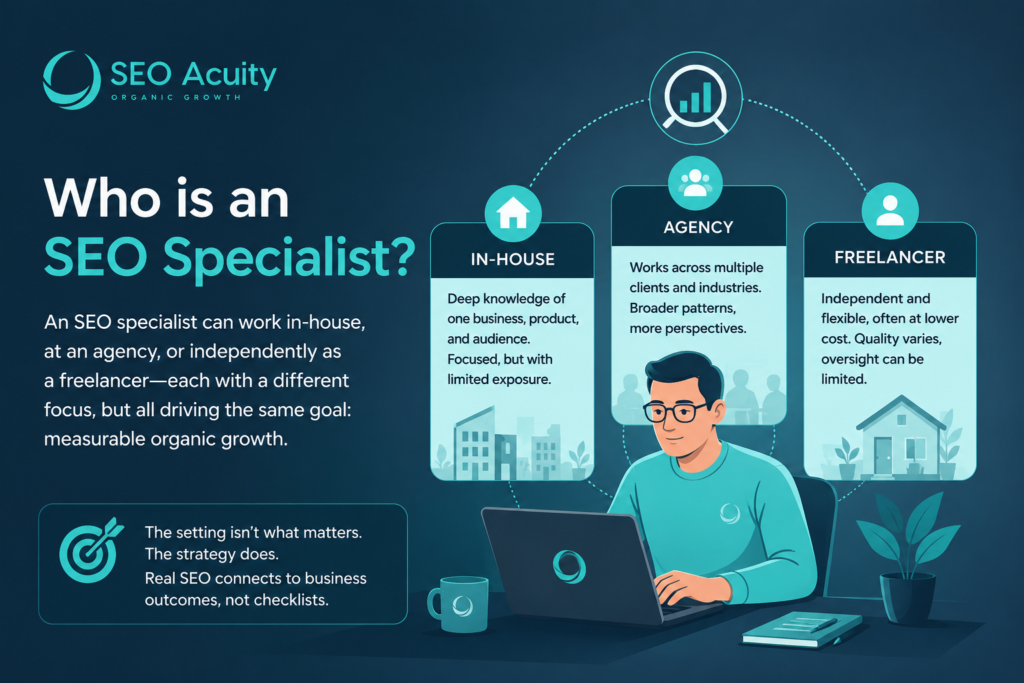
An SEO specialist can sit in-house, inside an agency, or work independently as a freelancer — and the setting changes what the role actually looks like day to day.
In-house SEO specialists report directly into a company’s marketing team. They tend to have deep knowledge of one business, one product line, and one audience, but limited exposure to other industries or edge cases.
Agency SEO specialists usually work across multiple clients and industries at once. This builds broader pattern recognition — they’ve seen more failure modes — but can mean less day-to-day depth on any single account, depending on how the agency structures its teams.
Freelance SEO specialists operate independently, often at lower cost, with variable levels of oversight, documentation, and accountability. This is where the anti-vocabulary of the industry — low-cost, undocumented, black-box work — tends to originate. Cheap execution without a strategic system behind it rarely compounds.
None of these settings is automatically better. What matters is whether the specialist — wherever they sit — is working from a coherent strategy connected to business outcomes, not a checklist disconnected from revenue.
What does an SEO specialist do?
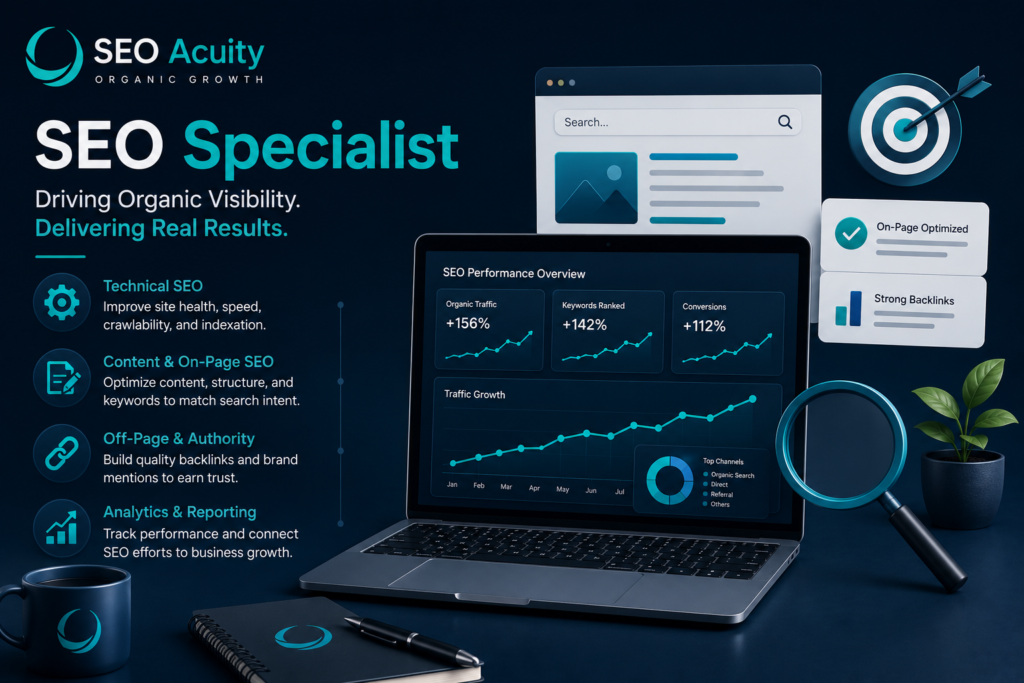
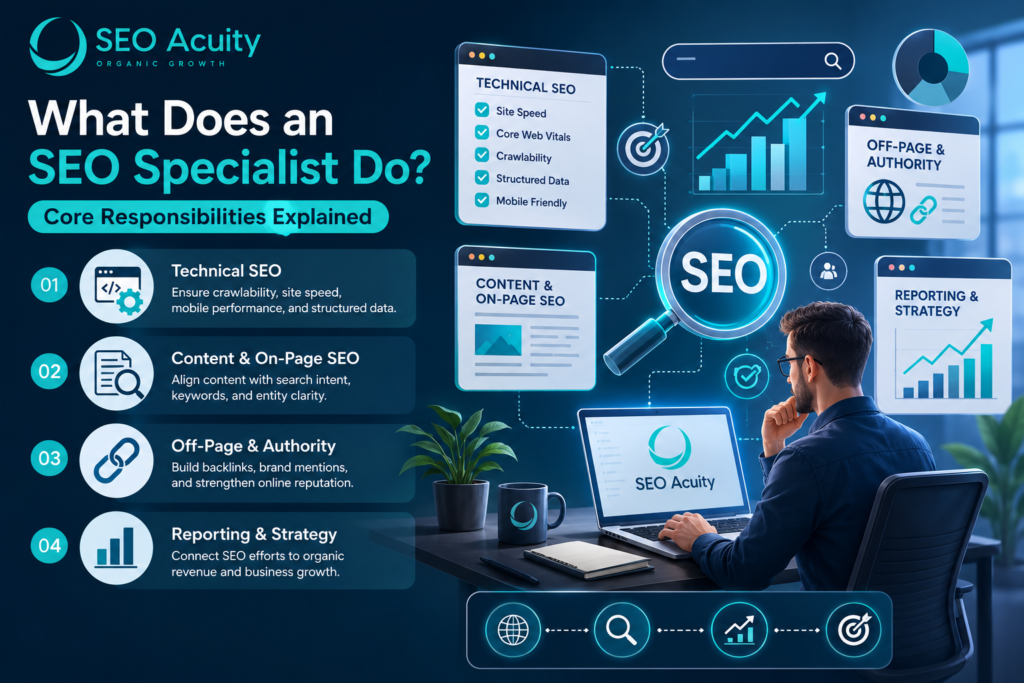
An SEO specialist’s core responsibilities generally fall into four areas: technical SEO, content and on-page optimization, off-page authority building, and performance reporting.
1. Technical SEO responsibilities
Technical responsibilities cover everything that determines whether search engines and AI crawlers can access, render, and index a site correctly. This includes site speed and Core Web Vitals, crawlability and indexation, structured data (schema), mobile rendering, and — increasingly — server-side rendering so AI crawlers that don’t execute JavaScript can still read the page. A technically broken site caps every other effort before it starts.
2. Content and on-page responsibilities
On-page responsibilities cover keyword-to-page mapping, content structure, heading hierarchy, and search intent alignment. An SEO specialist decides what a page should be about, what question it answers, and whether the content matches what the searcher — human or AI system — is actually looking for. This is where entity clarity lives: does the page define its core topic in one clean, extractable sentence, or does it bury the point in vague framing?
3. Off-page and authority responsibilities
Off-page responsibilities cover how a site earns trust signals outside its own domain — backlinks from credible sources, brand mentions, and citations across the web. AI systems now treat off-site reputation as a direct input into whether they recommend a business, not a secondary ranking factor. An SEO specialist who ignores this is optimizing half the equation.
4. Reporting and strategy responsibilities
The final responsibility — often the weakest link — is connecting all of the above back to a business outcome. A specialist who reports on traffic and rankings alone is reporting vanity numbers. A specialist worth the title reports on organic revenue contribution, qualified lead volume, and share of demand captured versus left to competitors.
If you’re building this function in-house, this is also where a documented, revenue-first reporting structure — the kind SEO Acuity treats as foundational, not optional — separates a specialist who’s busy from one who’s building something defensible.
At SEO Acuity, we combine technical expertise, data-driven insights, and business-focused SEO strategies to help companies increase qualified organic traffic, improve search visibility, and generate sustainable growth. Rather than relying on one-size-fits-all tactics, our team develops customized SEO solutions designed around your industry, goals, and competitive landscape
Book your consultation session now.
What Are SEO Specialist Skills?
A successful SEO specialist needs more than just knowledge of keywords and rankings. The role combines technical expertise, analytical thinking, content strategy, and communication to improve a website’s visibility and drive measurable business growth. Whether you’re hiring an in-house SEO professional or evaluating candidates, these are the core skills every SEO specialist should possess.
1. Technical SEO Skills
Technical SEO forms the foundation of a successful optimization strategy. An SEO specialist should understand how search engines crawl, index, and interpret websites while identifying and resolving issues that affect performance, user experience, and search visibility.
2. Keyword Research Skills
Effective keyword research goes beyond finding popular search terms. SEO specialists must analyze search intent, evaluate keyword difficulty, identify content opportunities, and prioritize keywords that align with business goals and attract qualified traffic.
3. On-Page SEO Skills
On-page SEO involves optimizing individual web pages to improve rankings and user experience. This includes crafting effective title tags and meta descriptions, optimizing headings, improving internal linking, enhancing content quality, and ensuring pages satisfy search intent.
4. Content Strategy Skills
Content is at the heart of modern SEO. An SEO specialist should know how to develop content strategies, build topic clusters, identify content gaps, refresh outdated pages, and create valuable content that demonstrates expertise and authority.
5. Link Building Skills
Building website authority requires a thoughtful approach to acquiring high-quality backlinks. SEO specialists should understand ethical link-building techniques, digital PR, outreach campaigns, and backlink analysis while avoiding practices that violate search engine guidelines.
6. SEO Analytics and Reporting Skills
SEO success depends on data-driven decisions. Professionals should be proficient in analyzing organic traffic, monitoring keyword performance, tracking conversions, measuring ROI, and turning analytics into actionable recommendations for continuous improvement.
7. Competitor Analysis Skills
A skilled SEO specialist regularly evaluates competitors to uncover keyword opportunities, content gaps, backlink strategies, and areas where a business can gain a competitive advantage in search results.
8. AI Search Optimization Skills
As AI-powered search continues to evolve, SEO specialists need to optimize content for AI Overviews and conversational search experiences. This includes creating entity-rich content, implementing structured data, building topical authority, and producing content that answers user questions clearly and comprehensively.
9. Communication and Collaboration Skills
SEO often requires working closely with developers, content creators, designers, and business stakeholders. Strong communication skills help ensure SEO recommendations are implemented effectively and aligned with broader business objectives.
10. Problem-Solving and Adaptability
Search engine algorithms and user behavior change constantly. An effective SEO specialist can diagnose ranking issues, prioritize solutions based on business impact, test new strategies, and continuously adapt to industry changes while maintaining long-term SEO performance.
Ready to Dominate Search Engine Rankings?
Accelerate your organic growth and scale your business leads with our data-driven SEO strategies.
Get a Free Quote NOW!How to become an SEO specialist?
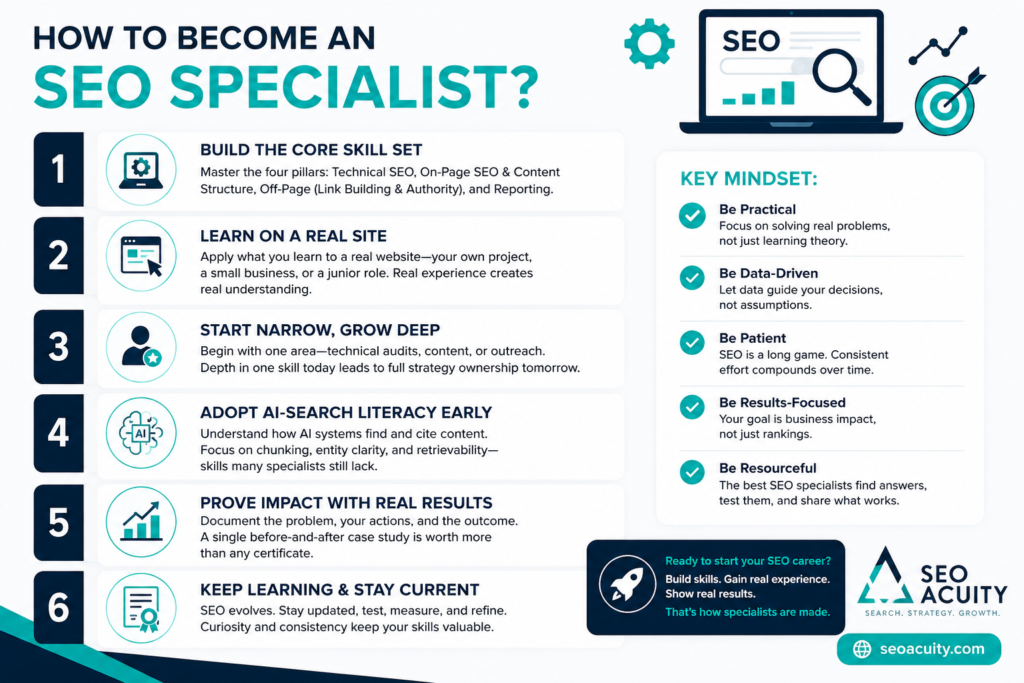
Becoming an SEO specialist requires building demonstrable skill across technical SEO, content strategy, and off-page authority — not earning a specific certificate. There’s no licensing body and no single required credential. What separates a real specialist from someone who’s taken a course is proof of work: sites they’ve improved, and outcomes they can point to.
First: Master the core skill set: technical, content, and off-page SEO
Start with the same four areas covered earlier in this article — technical SEO, on-page content structure, off-page authority, and reporting. Most people entering the field over-invest in one (usually content) and skip the others, which produces someone who can write but can’t diagnose why a technically broken page never ranks in the first place.
Second: Apply your skills to a real website, not a hypothetical one
SEO knowledge that stays theoretical doesn’t transfer. The fastest path to competence is applying it to an actual website — a personal project, a small business willing to let someone learn on their site, or a junior in-house or agency role with a mentor reviewing the work. Courses and certifications can accelerate the vocabulary. They can’t substitute for having watched a change you made actually move a metric.
Third: Start in a junior role, not a senior one
Most specialists start in a junior in-house or agency role focused on one slice of the discipline — technical audits, content briefs, or link outreach — before taking on full ownership of a site’s strategy. This isn’t a weakness of the field; it mirrors how the responsibilities themselves are structured, and it’s the fastest way to build depth in one area before generalizing.
Fourth: Learn AI-search skills from day one, not as an afterthought
This is the clearest skill gap in the current market. Many specialists still train exclusively on legacy ranking factors — keyword density, backlink volume, page one position — and never learn how AI systems retrieve and cite content. Someone entering the field today should understand chunking, entity clarity, and retrievability as core skills, not advanced ones. It’s a genuine differentiator: most working specialists haven’t caught up to this yet.
Fifth: Build a portfolio that proves your work, not just your knowledge
The strongest path into a first SEO role isn’t a portfolio of certificates — it’s a documented before-and-after on a real site: what was broken, what was changed, what happened as a result. That single artifact demonstrates the thing employers actually can’t verify from a resume: that the person understands cause and effect in this discipline, not just its terminology.
SEO specialist vs. SEO agency vs. in-house team: which should you hire?
The right choice depends on how many of the four responsibility areas above your business actually needs covered at a competitive depth — not on headcount preference.
A single SEO specialist is usually enough when your site is small, your niche is narrow, and your competitors aren’t investing heavily in the same channel. One capable person can realistically own technical hygiene, on-page structure, and basic reporting for a site like this.
A single specialist becomes a bottleneck once the business needs true depth across technical SEO, content production at scale, and active off-page authority building simultaneously. These are different skill sets. Very few individuals are strong across all three — and even the ones who are can’t produce enough output alone to compete in a contested niche. This is the mistake that shows up most often: businesses hire one person to do a job that structurally requires a system.
An agency or an architecture partner becomes the right call when the goal shifts from “improve rankings” to “build a defensible, compounding organic growth channel tied to revenue.” That’s a different scope of work — market demand analysis, information architecture, multilingual or multi-market strategy, AI-search readiness — and it’s rarely something one hire, however skilled, is resourced to deliver alone.
This is exactly the gap SEO Acuity is built to close. Instead of adding another hire to a task list, our Organic Growth Foundation™ starts by mapping the actual demand, architecture, and revenue logic your organic channel needs.
Not sure which side of that gap you’re on? Get a free consultation and find out!
Common mistakes businesses make when hiring an SEO specialist
One of the biggest reasons SEO campaigns fail isn’t the strategy—it’s hiring the wrong specialist. Many businesses focus on low prices, unrealistic promises, or the wrong skills, leading to wasted time and poor results. Understanding these common hiring mistakes can help you choose an SEO specialist who delivers long-term growth instead of short-term disappointments.
1. Hiring for the Title, Not the Scope
The title “SEO specialist” covers a wide range of roles, from technical SEO experts and content strategists to link-building professionals and local SEO consultants. Before hiring, clearly define the responsibilities you need. A mismatch between your business needs and the specialist’s expertise often leads to disappointing results, even when the person is highly skilled.
2. Measuring the Wrong Outcomes
Higher rankings and increased traffic may look impressive, but they don’t always translate into business growth. The right SEO specialist focuses on metrics that directly impact your goals, such as qualified leads, conversions, revenue, customer acquisition, and return on investment (ROI). Success should be measured by business outcomes, not vanity metrics alone.
3. Choosing Based on Cost Alone
Selecting the lowest-priced SEO provider can become expensive in the long run. Experienced specialists typically work from a documented strategy, use proven processes, and provide clear reporting and accountability. While budget matters, prioritizing price over expertise often results in slow progress, missed opportunities, or even harmful SEO practices that require costly fixes later.
4. Expecting One Person to Scale Indefinitely
An SEO specialist who performs well for a small website may not have the capacity or resources to support a rapidly growing business. As your site expands into dozens of pages, multiple products, or new markets, SEO becomes more complex and often requires collaboration across content, technical SEO, digital PR, analytics, and development. Make sure your hiring decision matches both your current needs and your future growth plans.
5. Ignoring AI Search Readiness
Search is evolving beyond traditional rankings. AI-powered search experiences increasingly determine which websites are cited, summarized, and recommended to users. Hiring an SEO specialist who focuses only on conventional ranking factors may leave your business behind. Look for someone who understands modern search optimization, including content quality, topical authority, structured data, user experience, and strategies that improve visibility in AI-driven search results as well as traditional search engines.
Avoid the guesswork — talk to SEO Acuity and hire based on a strategy, not a hunch!
How AI search has changed what an SEO specialist does
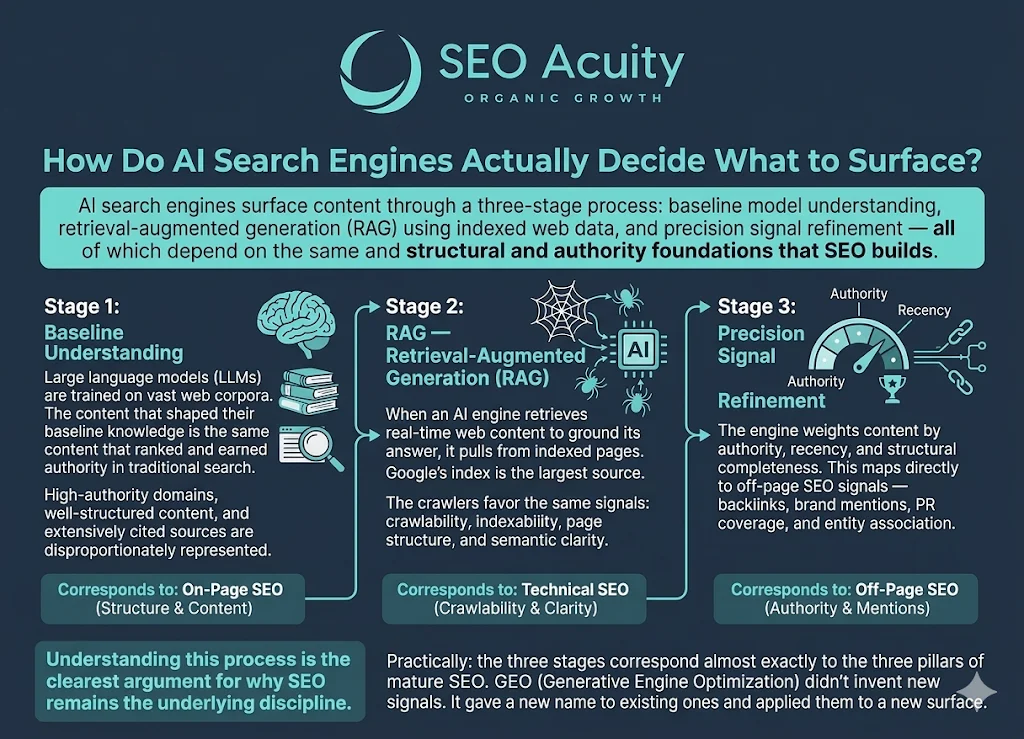
AI search has shifted the job from competing for ranking position to competing for retrievability — whether an AI system pulls your content into its answer at all. This is a structural change, not a trend.
Traditional search rewards a page that ranks well enough to appear on page one. AI search systems don’t rank pages; they retrieve chunks of content, convert them into vectors based on meaning, and select the clearest, most self-contained answers to include in a generated response. There is no page two — content is either retrieved or it doesn’t exist to that system.
This means a modern SEO specialist’s responsibilities now include writing content that stands on its own in small sections, defining key terms clearly and early, and structuring pages so an AI system can identify exactly what the business is authoritative about. A specialist still working purely to legacy ranking signals is solving yesterday’s problem.
You can also read: Do AI and GEO / AEO Replace SEO? | SEO Acuity
Ready to Dominate Search Engine Rankings?
Accelerate your organic growth and scale your business leads with our data-driven SEO strategies.
Get a Free Quote NOW!Why Businesses Choose SEO Acuity for Strategic SEO Growth?
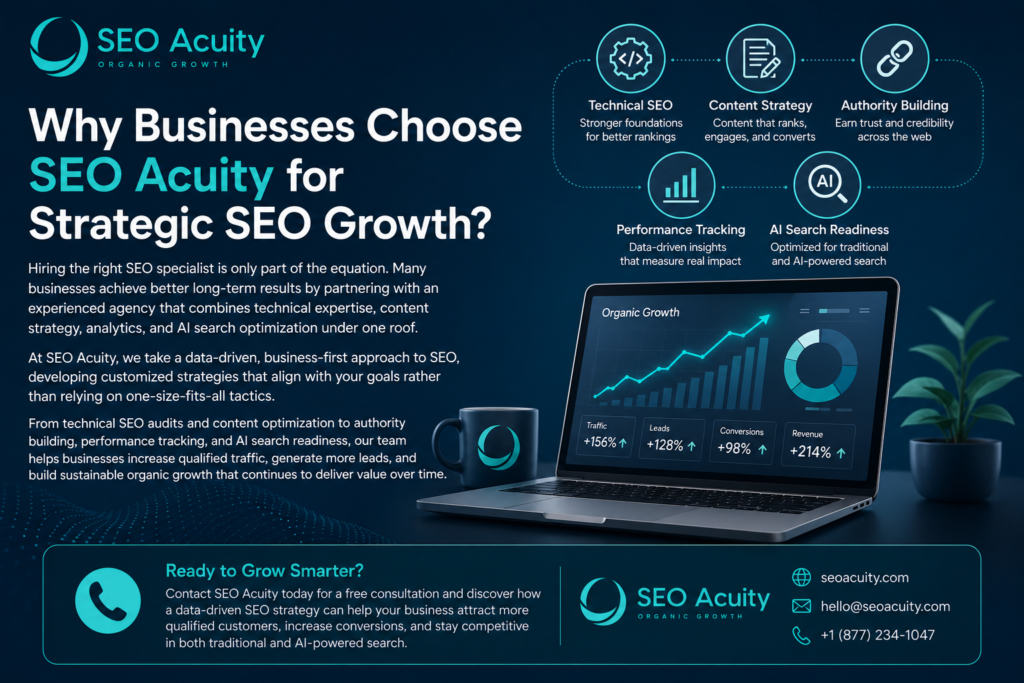
A single specialist can only take you so far. SEO Acuity architects the full system — technical SEO, content strategy, off-page authority, and AI search readiness — under one accountable team, aligned to revenue, not rankings alone. It’s the same approach that helped Sabbar, a leading Saudi job marketplace, turn organic search into a compounding growth channel rather than a scattered set of tactics.
Contact SEO Acuity today for a free consultation and see what a data-driven organic growth strategy could do for your business.
Ready to Dominate Search Engine Rankings?
Accelerate your organic growth and scale your business leads with our data-driven SEO strategies.
Get a Free Quote NOW!Conclusion
An SEO specialist is a professional responsible for a website’s organic visibility across technical health, content, and authority — but the title covers a wide range of scope, and the right hiring decision depends on how much of that scope your business genuinely needs covered. The businesses that get the most out of this role are the ones that treat it as part of a system connected to revenue, not a standalone task list. Rankings are a means; revenue is the measure — and that’s as true for how you staff SEO as it is for how you execute it.
FAQs
What qualifications does an SEO specialist need?
There’s no single required qualification — the role is skill-based, not credential-based. Look for demonstrated technical SEO knowledge, content strategy experience, and, critically, evidence they can connect their work to measurable business outcomes rather than traffic alone.
How much does an SEO specialist cost?
Cost varies significantly by market, experience level, and whether you’re hiring in-house, through an agency, or as a freelancer. Rather than anchoring on price alone, evaluate cost against documented process and accountability — cheap execution without a strategic system rarely compounds into results.
What’s the difference between an SEO specialist and an SEO strategist?
An SEO specialist typically executes across technical, content, and off-page tasks. An SEO strategist typically designs the overall approach — market demand analysis, information architecture, and revenue alignment — that the specialist’s work then implements.
Do I need an SEO specialist or an SEO agency?
A single specialist is often enough for a small site in a narrow, low-competition niche. An agency or growth architecture partner becomes the better fit once you need technical depth, content scale, and off-page authority building running simultaneously toward a revenue goal.
Can one SEO specialist handle everything my business needs?
Sometimes — for smaller, narrower sites. For competitive or multi-market businesses, one person rarely has the bandwidth or the full skill range to cover technical SEO, content production, and authority building at a competitive depth all at once.
Is SEO specialist the same as an in-house marketing generalist who “does SEO”?
No. A marketing generalist who handles SEO alongside other channels typically applies surface-level tactics. A dedicated SEO specialist’s core function — and measured output — is organic search performance specifically.