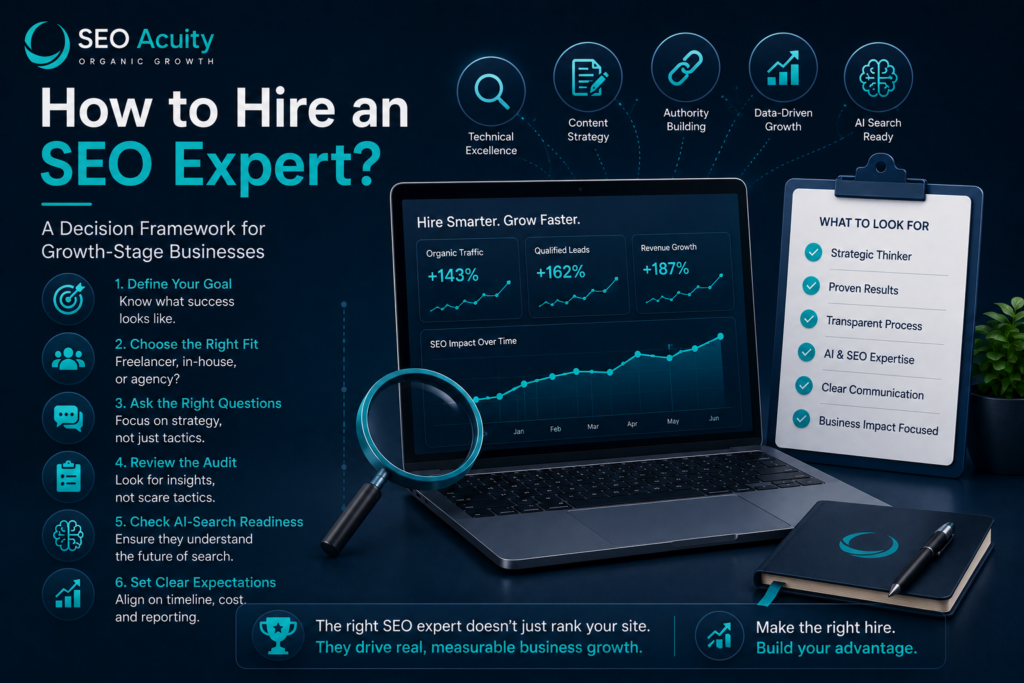
If you’re searching for how to hire an SEO expert, you’re probably past the point of wondering whether you need one. What most guides won’t tell you is that the hiring decision itself determines whether SEO becomes a compounding growth asset for your business — or a recurring expense that never quite pays off. The wrong hire doesn’t just waste budget. It costs you the market position a competitor is building while you’re re-doing work six months from now.
An SEO expert is a specialist who improves how a website is discovered, understood, and recommended by search engines and AI systems, with the goal of driving qualified organic traffic and revenue — not just rankings.
That definition matters because it’s where most hiring processes go wrong. Businesses hire for rankings. Rankings are a means; revenue is the measure. If the person or agency you hire can’t connect their work to your pipeline, your customer acquisition cost, or your market share, you’ve hired a tactician, not a growth partner.
What you’ll learn:
- How to define the right SEO engagement before you start interviewing.
- The questions that reveal whether a candidate thinks in systems or in isolated tactics.
- The red flags that separate genuine expertise from fear-based sales tactics.
- Why AI-search readiness now belongs in your vetting checklist.
- How to set realistic expectations for cost, timeline, and commitment.
Step 1: Define the outcome before you define the role
The first mistake in hiring an SEO expert is skipping straight to “find someone who does SEO.” That’s not a goal — it’s a category.
Before you talk to a single candidate, get specific about what changes in your business if the engagement works:
- Which product or service line needs organic demand capture — not just “more traffic”?
- Is the goal market share in an existing category, or entry into a new one?
- Are you trying to reduce paid acquisition dependency, or build a channel that compounds independently of ad spend?
- What does a qualified lead look like, and how many do you actually need?
A business chasing volume needs a different specialist than a business selling a high-consideration product to a narrow, high-value buyer. Get this wrong, and every candidate you interview next will be answering the wrong question well.
Step 2: Decide between a freelancer, an in-house hire, and an agency
This decision should follow from the scale and complexity of what you’re building — not from budget alone.
A freelancer fits narrow, contained, execution-only work: a single technical fix, a defined content sprint, a one-time audit. Freelancers are not usually structured to own a multi-channel, compounding organic strategy across a full site architecture.
An in-house hire fits businesses with the internal capacity to manage, direct, and evaluate SEO work themselves — and the budget to retain senior expertise full-time rather than renting it.
An agency or organic growth partner fits growth-stage businesses — SaaS, marketplaces, multi-product platforms — that need SEO treated as infrastructure: technical foundation, content systems, and off-site authority working together as one architecture, not three disconnected workstreams. This is the right fit when the goal is to architect market dominance for a core product, not patch isolated pages.
If your business is a growth-stage SaaS, marketplace, or multi-product platform ready to stop patching isolated pages and start architecting a defensible market position, that’s the exact client SEO Acuity is built to serve.
Book your consultation session now!
Step 3: Ask questions that reveal how they think, not just what they know
Most hiring guides give you a checklist of technical questions — tools used, keyword research process, reporting cadence. Those questions tell you if a candidate is competent. They don’t tell you if a candidate is strategic.
Ask these instead, and listen for the difference between a vendor and an architect:
“Walk me through how you’d approach my business, before you’ve seen my site.” A vendor asks for site access immediately. An architect asks about your business model, your ICP, and your revenue goals first.
“What would make you tell a prospective client that you’re not a fit?” Anyone who claims they can help everyone is not being honest with you. Genuine expertise includes the ability to say no.
“How do you decide what to build first — foundation or content?” If the answer skips straight to content without addressing technical and structural foundations, that’s a gap.
“How does your work here compound over 6, 12, and 24 months?” A tactician describes a task list. A strategist describes a system that gets stronger over time.
Ready to Dominate Search Engine Rankings?
Accelerate your organic growth and scale your business leads with our data-driven SEO strategies.
Get a Free Quote NOW!Step 4: Treat the audit as a diagnostic tool, not a sales tactic
Requesting a preliminary audit is a reasonable part of vetting — but be alert to how it’s used. A common practitioner pattern worth knowing: some vendors run unsolicited audits designed to surface alarming-sounding “issues” as a scare tactic to close a sale, rather than to genuinely diagnose your site.
A credible audit does two things a scare-tactic audit doesn’t:
- It prioritizes findings by actual business impact, not by volume of flagged issues.
- It’s willing to tell you what isn’t a problem, or what’s a low-priority fix, alongside what is urgent.
If every audit you receive concludes with “everything is broken, and only we can fix it,” that’s a signal about the seller — not necessarily about your site.
Step 5: Vet for AI-search readiness, not just Google rankings
This is where most hiring checklists are already out of date. Search itself has changed. AI systems — the engines behind AI Overviews, chat-based assistants, and answer engines — don’t rank pages the way Google traditionally has. They retrieve small chunks of content, understand them by meaning rather than exact keyword match, and select the clearest, most credible answer to surface. There often isn’t a “page two” — your content is either retrieved, or it doesn’t exist to that system.
An SEO expert hired without this in mind is being hired for half the problem. Ask candidates directly:
- How do they structure content so it can be understood and cited by AI systems, not only crawled by Googlebot?
- How do they think about entity clarity — making sure your brand, product, and expertise are unambiguously defined across your site?
- Do they treat technical SEO (site speed, rendering, crawlability) as separate from AI-readiness, or as the same foundation?
A candidate who has no answer here isn’t wrong about traditional SEO — they’re just not equipped for where search is actually heading. SEO Acuity helps companies pave their way to rank on AI tools as well as other search engines, by customizing its content to perfectly match AI search. Get a free QUOTE now!
Step 6: Confirm they understand your business model, not just your industry
Industry experience is learnable. Business-model fit is not something a candidate can research their way into overnight.
A buyer with a $50 price point searches differently than a buyer with a $50,000 price point. A marketplace with two-sided demand needs a different content and technical approach than a single-product SaaS tool. Before hiring, confirm the candidate can articulate:
- Who your buyer actually is, and how they search at each stage of their decision.
- Whether your business is suited to broad-volume organic strategy or a narrow, high-intent one.
- How their past experience — not just their industry list — maps to your actual growth mechanics.
This is also where a lot of engagements quietly fail: a technically excellent SEO hire who never understood the business ends up optimizing for traffic that doesn’t convert.
Step 7: Set expectations for what happens after the initial engagement
SEO is not a one-time project with a finish line. Ask before you sign:
- What does the transition look like once the initial phase ends — a new retainer, a defined scaling phase, or a handoff?
- What documentation will you own if you ever change providers — audits, strategy documents, reporting history?
- How will progress be measured beyond raw traffic — qualified leads, conversion quality, market share indicators?
A partner focused on your long-term outcome will have clear, confident answers here. A vendor focused on the next invoice usually won’t.
Have a look on SEO Acuity services that match your expectations and beyond.
Ready to Dominate Search Engine Rankings?
Accelerate your organic growth and scale your business leads with our data-driven SEO strategies.
Get a Free Quote NOW!What should you budget, and for how long?
Pricing varies widely by scope, market, and engagement model, and any guide that hands you a single number without knowing your situation is guessing. What you can control is understanding the shape of the investment:
- Project-based engagements suit a defined, bounded scope — a technical fix, a content sprint, a one-time audit.
- Retainer-based engagements suit ongoing, compounding work — the kind that builds a defensible market position over months, not weeks.
- Foundation-first engagements — where a strategic blueprint precedes execution — suit businesses that want the architecture built correctly before scaling spend, rather than paying to fix foundational gaps later.
Whatever the number, treat SEO as a channel that takes real time to compound. Anyone promising fast, dramatic results in a matter of weeks is either underestimating the work or overselling the timeline — be skeptical of both.
If you’re evaluating whether your business needs a foundational strategy before committing to a long-term retainer, that’s precisely the gap SEO ACUITY is built to close — establishing the architecture before scaling execution.
Ready to start architecting growth with SEO Acuity Team?
Hiring the right SEO expert isn’t about finding someone who can execute a checklist — it’s about finding a partner who can see your organic channel as infrastructure that compounds, not a task list that resets every quarter. If you’re a growth-stage business ready to move past fragmented SEO efforts and build a strategy engineered for market dominance, SEO Acuity’s team can walk you through what that architecture looks like for your business specifically.
Ready to Dominate Search Engine Rankings?
Accelerate your organic growth and scale your business leads with our data-driven SEO strategies.
Get a Free Quote NOW!Conclusion
Hiring an SEO expert is a strategic decision, not an administrative one. Get the outcome definition right first, vet for systems thinking over task execution, treat audits as diagnostics rather than sales tools, and make sure whoever you hire is already building for how AI systems retrieve and recommend content — not only how Google ranks it.
Businesses that get this decision right don’t just improve their rankings. They build a channel that compounds, defends market share, and keeps working long after the first engagement ends.
Frequently Asked Questions
How do I hire an SEO expert if I’ve never worked with one before?
Start by defining your business outcome — not just “more traffic” — then evaluate candidates on how they connect their process to that outcome, not on tools or jargon alone. Ask how they’d approach your business before they’ve seen your site; the answer reveals whether they think strategically or transactionally.
How should I hire an SEO specialist versus a full-service agency?
Hire a specialist for narrow, contained work like a technical fix or a content sprint. Hire an agency or growth partner when you need SEO treated as connected infrastructure — technical, content, and authority-building working as one system toward a revenue outcome.
How do I find an SEO expert who understands AI search, not just Google?
Ask directly how they structure content for AI retrieval — entity clarity, chunk-level clarity, and credibility signals — alongside traditional technical SEO. If they only discuss keyword rankings, they’re solving half the problem search now presents.
What’s a reasonable timeline to expect results after hiring an SEO expert?
SEO compounds over months, not weeks. Expect a foundational phase before measurable traction, and be cautious of anyone promising fast, dramatic results — that’s a mismatch with how organic growth actually works.
Should I be worried if an SEO audit reveals dozens of “issues”?
Not automatically. A credible audit prioritizes by business impact and tells you what’s low-priority alongside what’s urgent. An audit that frames everything as a crisis, with no prioritization, is often a sales tactic rather than a genuine diagnosis.