If your organic traffic has stalled, or you’re not sure whether your site can even be found by the systems that now answer your customers’ questions, the first move isn’t a new content calendar or a backlink campaign. It’s an SEO audit.
An SEO audit is a structured evaluation of every factor that affects whether your website can be found, understood, and recommended — by Google, and increasingly by AI systems like ChatGPT, Perplexity, and Gemini. It examines your technical foundation, on-page and content quality, backlink profile, and (now, non-negotiably) your visibility inside AI-generated answers. The output isn’t a checklist. It’s a prioritized roadmap that tells you what to fix first and why it matters to revenue.
What you’ll learn:
- What an SEO audit actually is, and what separates a real one from an automated scan
- The core components a comprehensive audit must cover
- Why an audit matters for revenue, not just rankings
- When to run one, and the warning signs that mean you’re overdue
- How audit criteria should be prioritized — and where most businesses get this wrong
What is an SEO audit?
An SEO audit is a diagnostic process that evaluates how well a website performs across the factors search engines and AI systems use to find, understand, and recommend it — then prioritizes what to fix based on business impact.
It’s not a single report format. Depending on the site and the engagement, an audit can surface as a structured document, a live dashboard, or a set of prioritized recommendations delivered directly to a development team. What makes it an audit, rather than a generic health check, is that it covers the full set of factors that determine visibility — not just the ones a free tool happens to flag.
A credible audit answers four questions in sequence:
- Can search engines and AI crawlers access and understand your site?
- Does your content deserve to rank — and to be cited?
- Is your backlink and authority profile working for you or against you?
- Where should you invest first to move revenue, not just traffic?
That last question is the one most audits skip. A list of 40 technical issues with no prioritization isn’t a strategy — it’s homework. The value of an audit is in the sequencing.
SEO Acuity doesn’t chase rankings — it architects market dominance, engineering every fix to compound into unshakable brand authority. Ready to stop competing and start owning your category? Check our premium Audit Services.

What does an SEO audit include?
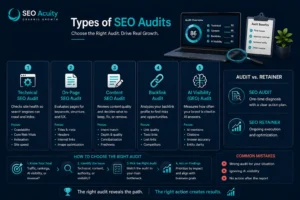
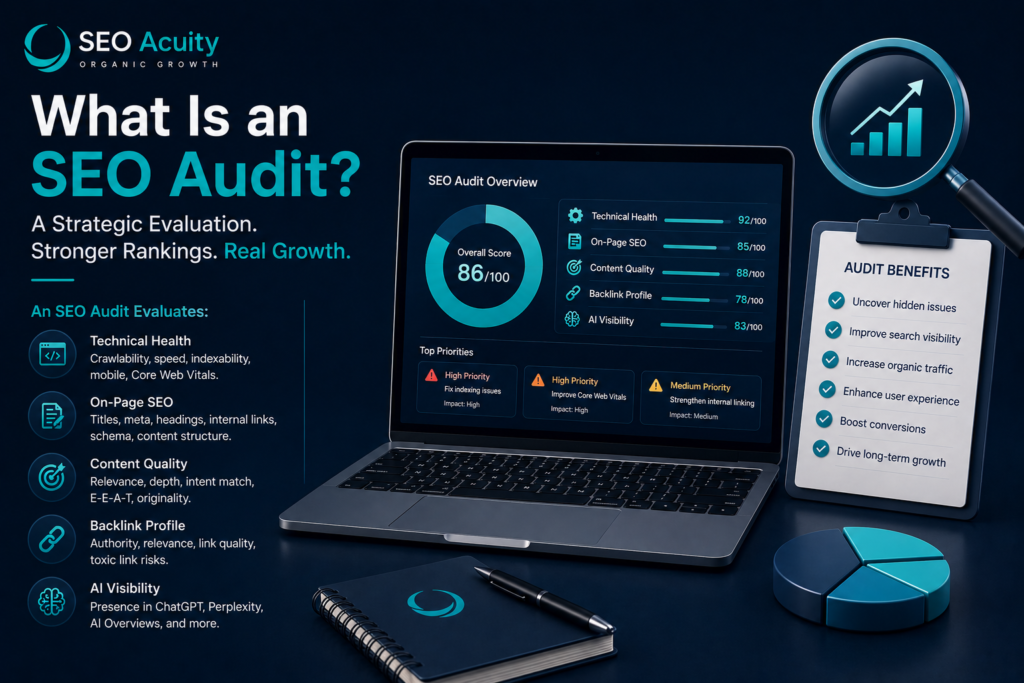
A comprehensive SEO audit examines every major factor that affects how search engines and AI systems discover, understand, rank, and recommend your website. Rather than focusing on a single issue, it evaluates the entire search ecosystem—from technical infrastructure and content quality to authority signals and AI visibility. These areas are deeply interconnected, so treating one in isolation often leads to an incomplete diagnosis. For example, exceptional content cannot rank if search engines can’t crawl it, while a technically perfect site may still struggle if it fails to satisfy user intent. A complete SEO audit typically covers five core areas:
1. Technical SEO
Technical SEO evaluates whether search engines and AI crawlers can efficiently access, understand, and index your website. This includes crawlability, indexability, site architecture, page speed, Core Web Vitals, mobile-friendliness, HTTPS security, redirect structure, canonicalization, XML sitemaps, and robots directives. This is the foundation of every audit. If crawlers—including AI crawlers like OAI-SearchBot, PerplexityBot, and Claude-SearchBot—can’t properly access or parse your pages, improvements in every other area become far less effective.
2. On-page SEO
On-page SEO focuses on how well each individual page communicates its purpose to both users and search engines. An audit reviews title tags, meta descriptions, heading hierarchy, image alt text, internal linking, structured content, and keyword-to-page alignment. The goal is to ensure every page is centered around one clear topic rather than attempting to rank for multiple unrelated intents, which often weakens performance.
3. Content quality and intent match
Content is evaluated based on how effectively it satisfies the searcher’s intent—not simply by its length or keyword usage. A strong audit determines whether each page answers the user’s question clearly, early, and comprehensively, while providing accurate, original, and genuinely useful information. Modern search systems increasingly reward content that demonstrates expertise and solves the user’s problem rather than content written primarily to target keywords.
4. Backlink and authority profile
An audit also examines the website’s authority by analyzing the quality, relevance, diversity, and potential risks of its backlink profile, along with opportunities competitors may have that your site lacks. Authority remains an important ranking signal, but it no longer guarantees visibility. Today’s search engines and AI systems increasingly evaluate individual content sections, meaning a smaller website with precise, well-structured answers can outperform a larger site with stronger backlinks but weaker content.
5. AI visibility
Modern SEO audits should also evaluate how visible your brand is within AI-powered search experiences. This includes whether platforms such as ChatGPT, Perplexity, Claude, and Google AI Overviews reference, cite, or accurately describe your business when users ask questions related to your expertise. Although many audits still treat AI visibility as optional, it has become an increasingly important measure of real search presence as more users receive answers directly from AI rather than traditional search results.
Ready to Dominate Search Engine Rankings?
Accelerate your organic growth and scale your business leads with our data-driven SEO strategies.
Get a Free Quote NOW!Why is an SEO audit important?
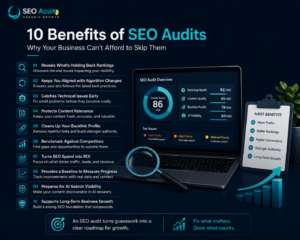
An SEO audit is important because it reveals whether your website is positioned to grow sustainably or whether hidden issues are limiting its performance. Without an audit, it’s difficult to know whether slow organic growth is caused by technical problems, weak content, poor site structure, or missed opportunities. Instead of relying on assumptions, an audit provides a clear, evidence-based picture of what’s helping your visibility—and what’s holding it back.
More importantly, an SEO audit ensures your time, budget, and resources are invested in the right improvements. Rather than making isolated changes, it helps you prioritize the fixes that will have the greatest impact on rankings, traffic, conversions, and increasingly, AI search visibility. Here’s why that matters:
1. It prevents wasted investment.
If technical issues prevent search engines or AI crawlers from accessing your pages, every dollar spent on content, link building, or optimization becomes far less effective. An audit identifies these foundational problems first, allowing you to fix the infrastructure before investing further in growth.
2. It establishes a measurable baseline.
You can’t accurately measure progress without knowing where you started. An audit documents the current state of your website—from rankings and organic traffic to technical health and AI visibility—creating a benchmark against which future improvements can be evaluated.
3. It helps you prioritize what matters most.
Most websites have dozens—or even hundreds—of SEO issues. A valuable audit doesn’t present a long checklist with every problem treated equally. Instead, it identifies which issues have the greatest business impact, especially those affecting your highest-value pages, and separates immediate priorities from lower-impact improvements that can be addressed later.
4. It connects SEO to business outcomes.
The goal of an SEO audit isn’t to achieve a perfect technical score or fix every minor warning. Its purpose is to identify the improvements most likely to increase qualified traffic, strengthen visibility, and drive more customers to the pages that generate revenue. Effective SEO is measured by business results—not vanity metrics.
5. It prepares your site for AI-driven search.
As AI-powered search experiences become more common, websites need to be understandable not only to traditional search engines but also to AI systems that retrieve, summarize, and cite information. A modern SEO audit evaluates whether your content is structured, trustworthy, and comprehensive enough to be surfaced in AI-generated answers, helping you stay visible as search continues to evolve.
When should you perform an SEO audit?
An SEO audit shouldn’t be treated as a one-time event. As a baseline, run one every three to six months, and immediately whenever you notice specific warning signs.
Those signs include:
- A sudden or sustained drop in organic traffic
- A higher-than-usual bounce rate
- Declining conversion rates from organic visitors
- A drop in rankings for terms you previously held
- A site migration, redesign, or CMS change
- Bringing on a new SEO partner or agency
If any of these apply and it’s been more than six months since your last audit, you’re overdue. Waiting until traffic has already collapsed means you’re auditing to recover, not to grow — a much more expensive position to be in.
What tools are used in an SEO audit?
Running a proper audit requires tools that can process the volume of data involved — crawl results, backlink data, performance metrics, and increasingly, AI citation tracking. No specialist manually reviews this at scale.
The core toolkit typically includes:
- Crawling tools (Screaming Frog, or platform-native site audit tools) to map site architecture, crawl depth, and technical errors
- Google Search Console for first-party indexing, crawl, and Core Web Vitals data
- Google Analytics for traffic behavior and conversion tracking
- Backlink analysis tools (Ahrefs, Semrush, or similar) to assess link profile quality and gaps against competitors
- AI visibility tracking tools to monitor how often and how accurately your brand appears in AI-generated answers
Here’s the part that matters more than the tool list: tools generate data, they don’t generate strategy. A crawler can tell you that a canonical tag points to the wrong URL. It cannot tell you whether that URL is a page worth saving, cannibalizing, or merging — because that requires understanding what the page is meant to do for your business. That judgment call is where an audit either delivers value or becomes another document nobody acts on.
What criteria determine SEO audit priorities?
The components of an audit are the same across most sites. What separates a strategic audit from a checklist is how the findings get prioritized — and that should follow business impact, not the order issues happen to appear in a crawl report.
A useful prioritization framework asks three questions of every finding:
Does it block access? Crawl and indexing issues come first, always. A ranking opportunity on a page Google can’t index doesn’t exist yet.
Does it touch a revenue page? A missing meta description on a low-traffic blog post and the same issue on your core product page are not the same priority, even though a tool will flag them identically.
Is it a quick structural fix or a long content investment? Technical fixes (redirects, canonical corrections, speed improvements) are usually faster to implement and create leverage for everything built afterward. Content and authority gaps take longer and should be sequenced accordingly.
Businesses at different stages of growth should weight these differently. A site with a solid technical base but thin content depth needs a different sequence than a site with strong content sitting on a broken technical foundation. This is the kind of sequencing SEO Acuity builds into every Organic Growth Foundation™ engagement — the audit isn’t the deliverable, the prioritized plan built from it is.
What’s the difference between a free audit tool and a strategic SEO audit?
A free or automated SEO audit tool scans your site against a fixed rule set and generates a generic list of flagged issues. A strategic audit interprets those findings against your specific business context, industry, and competitive position — and tells you what to actually do about them.
This distinction matters because automated tools have a real blind spot: they can confirm a tag exists, but they can’t judge whether it’s pointing at the right thing. A tool will report that a canonical tag is present and mark the item “resolved” — even if that canonical tag references the wrong page entirely, quietly cannibalizing your own rankings. Automated scans are useful for surfacing data. They’re not a substitute for a specialist who understands what each finding means for your site, not a generic one.
If you’re comparing a free scan against a paid, expert-led audit, the honest answer is that they’re not the same product. A free scan gives you a list. A strategic audit gives you a sequenced plan tied to your growth stage — and tells you plainly if your site isn’t ready for the next phase of investment yet.
Ready to Dominate Search Engine Rankings?
Accelerate your organic growth and scale your business leads with our data-driven SEO strategies.
Get a Free Quote NOW!Ready to see what’s actually holding your site back?
Most sites compete for rankings. SEO Acuity architects don’t compete — they capture the market outright, one defensible position at a time.
Every audit, every page, every fix is engineered to compound: today’s traffic becomes tomorrow’s market share, and tomorrow’s share becomes the narrative everyone else has to react to.
This isn’t SEO as a task list — it’s Organic Growth Architecture, built by senior strategists who tell you the truth even when it’s not what you want to hear.
Ready to stop competing and start dominating? Book your audit today!

Ready to Dominate Search Engine Rankings?
Accelerate your organic growth and scale your business leads with our data-driven SEO strategies.
Get a Free Quote NOW!Conclusion
An SEO audit is the foundation every organic growth strategy should start from — not a one-time report, but a recurring diagnostic that tells you where your site stands, what’s blocking growth, and what to fix first. In a search landscape where AI systems now decide what gets cited and recommended, an audit that only checks traditional ranking factors is already incomplete. The businesses that treat their audit as a strategic roadmap — sequenced by revenue impact, not just issue count — are the ones building organic growth that compounds instead of growth that has to be rebuilt every year.
Frequently asked questions
What is an SEO audit in digital marketing?
An SEO audit in digital marketing is a diagnostic process that evaluates a website’s technical health, content quality, and authority signals to identify what’s limiting its visibility in search engines and AI systems, then prioritizes fixes by business impact.
What does an SEO audit include?
A comprehensive SEO audit includes technical SEO (crawlability, speed, mobile-friendliness), on-page SEO (titles, headings, internal links), content quality and intent match, backlink and authority profile, and — increasingly — AI visibility across platforms like ChatGPT and Perplexity.
How often should you perform an SEO audit?
Run a full SEO audit every three to six months, and immediately after a traffic drop, ranking decline, site migration, or when starting with a new SEO partner.
Can I do an SEO audit myself with free tools?
Free tools can surface technical issues, but they can’t judge whether a finding matters for your specific business or interpret what to prioritize first — that judgment is what separates a usable audit from a raw data dump.
What’s the difference between an SEO audit and an SEO strategy?
An SEO audit diagnoses where your site currently stands and what’s limiting it. An SEO strategy is the plan built from those findings — the sequence of actions that moves you from the audit’s baseline toward measurable growth.