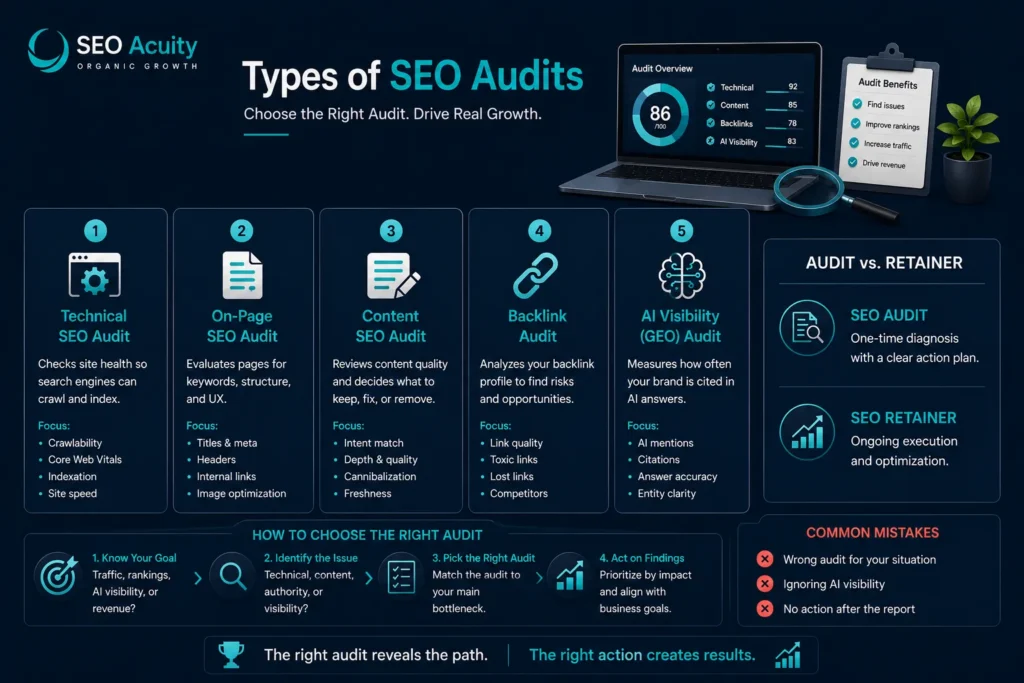
If you’ve asked three different SEO consultants what an “SEO audit” includes, you’ve probably gotten three different answers. That’s not a red flag — it’s the nature of the term. “SEO audit” is an umbrella label covering several distinct diagnostic processes, each built to answer a different question about your website’s ability to be found, understood, and chosen — by search engines and, increasingly, by AI systems.
The mistake most businesses make isn’t choosing the wrong audit. It’s assuming one audit answers every question, then feeling let down when a technical crawl report says nothing about why their content isn’t converting.
This guide breaks down the different types of SEO audits, how they differ from each other and from adjacent processes like UX reviews and monthly retainers, and how to know which one your business actually needs right now.
What you’ll learn:
- The core types of SEO audits and exactly what each one diagnoses
- The difference between a technical audit, a content audit, a UX audit, and a GEO (AI visibility) audit
- Why “SEO audit” and “SEO retainer” are not interchangeable
- How to choose the right audit for your specific situation, without over-scoping or under-scoping
- The mistakes that turn a good audit into a report nobody acts on
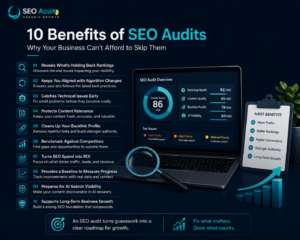
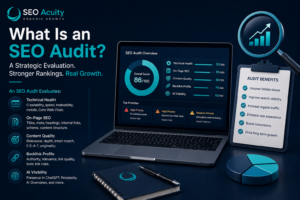
An SEO audit is a structured evaluation of a specific layer of your website’s ability to be discovered, crawled, understood, and ranked by search engines. The word “specific” matters here — a true audit examines one dimension in depth (technical infrastructure, content quality, backlink profile, and so on) rather than skimming everything at once.
Preview SEO Acuity Audit services and get your consultation session.

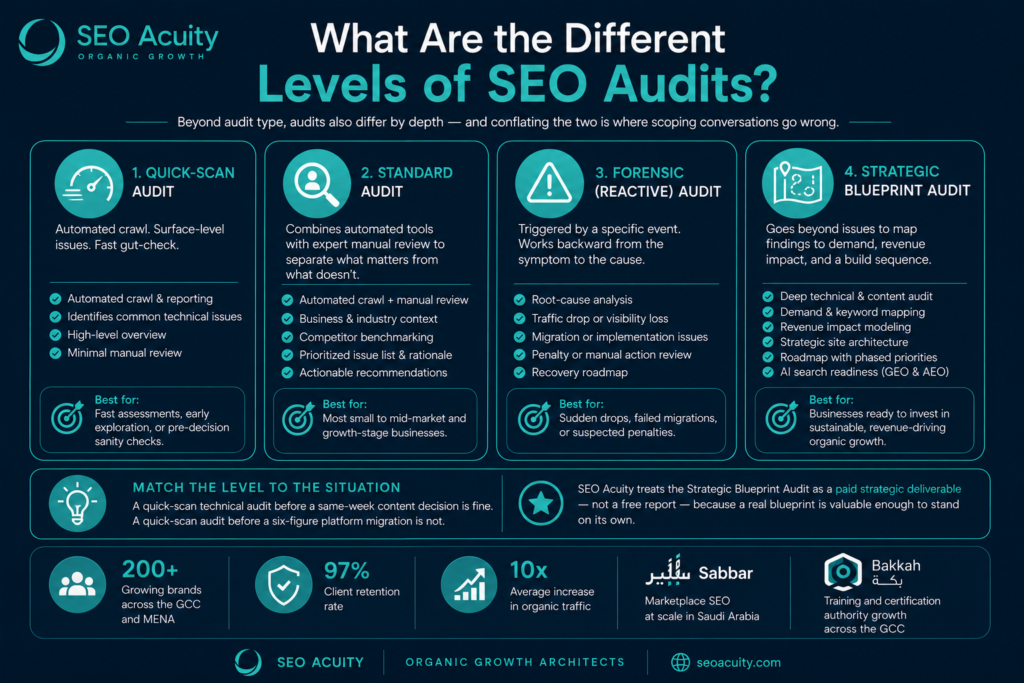
A comprehensive SEO strategy doesn’t rely on a single audit—it combines multiple audit types to create a complete picture of your site’s health. Below are the audit categories that matter for almost every business, including the newer AI-focused assessments that many organizations have yet to incorporate into their SEO processes.
1. Technical SEO Audit
A technical SEO audit evaluates whether search engines and AI crawlers can efficiently access, render, crawl, and index your website. It forms the foundation of every successful SEO strategy because even exceptional content cannot rank if search engines are unable to process it correctly.
A thorough technical audit typically reviews:
- Crawlability and robots.txt configuration
- XML sitemap health and accuracy
- Index coverage and index bloat
- Canonical tags and duplicate URL handling
- Structured data (Schema.org markup)
- Core Web Vitals and page speed
- HTTPS implementation and security
- Redirect chains and broken redirects
- Internal crawl depth and site architecture
- JavaScript rendering issues
- Mobile usability and mobile-first indexing
Because Google now uses mobile-first indexing, mobile optimization is no longer considered a separate audit category. Instead, mobile performance is an essential component of every technical SEO audit.
This audit should always be completed before any other type. If search engines cannot properly crawl or index your website, improvements to content, links, or user experience will have little measurable impact.
2. On-Page SEO Audit
An on-page SEO audit examines whether each individual page is optimized to rank for its intended search query. Rather than focusing on technical infrastructure, it evaluates how effectively the page communicates relevance and topical focus to both search engines and users.
Common areas reviewed include:
- Title tags and meta descriptions
- Header hierarchy (H1–H3 and beyond)
- Keyword placement and semantic relevance
- URL structure
- Internal linking strategy
- Image optimization and alt text
- Content formatting and readability
- User experience signals that influence engagement
One of the primary goals of this audit is ensuring that every page targets a single, clearly defined search intent. Pages attempting to rank for multiple unrelated topics often confuse both users and search engines, reducing their ranking potential.
On-page audits also reveal duplicate metadata, inconsistent optimization across template pages, and missed opportunities to strengthen topical relevance.
3. Content SEO Audit
A content SEO audit determines whether your existing content still deserves to rank—not simply whether it is well written.
Instead of evaluating isolated pages, this audit analyzes the content ecosystem across your entire website. Every page is typically categorized into one of four actions:
- Keep – Performing well and remains valuable.
- Update – Requires refreshed information or expanded coverage.
- Merge – Consolidate overlapping content into stronger pages.
- Remove – Thin, outdated, or low-value content that weakens the site.
Additional areas commonly analyzed include:
- Search intent alignment
- Topical depth and expertise
- Content freshness
- Keyword cannibalization
- Thin or duplicate content
- Internal content gaps
- Competitive content benchmarking
A content audit answers a fundamentally different question than an on-page audit.
- On-page SEO asks: Is this page optimized correctly?
- Content SEO asks: Should this page exist at all?
For large websites, this audit often uncovers opportunities to improve rankings simply by consolidating and strengthening existing content rather than publishing new articles.
4. Off-Page SEO Audit (Backlink Audit)
An off-page SEO audit—commonly called a backlink audit—evaluates the authority, relevance, and trustworthiness of websites linking to yours.
Modern search engines prioritize link quality over quantity. A single backlink from a respected, highly relevant industry publication often provides significantly more value than hundreds of links from low-quality directories or unrelated websites.
A backlink audit typically reviews:
- Referring domain quality
- Link relevance
- Toxic or spam backlinks
- Anchor text distribution
- Link velocity and acquisition trends
- Lost backlinks
- Competitor backlink profiles
- Link gap opportunities
The audit identifies harmful backlinks that may require disavowal while highlighting high-authority websites that already link to competitors but not to your business.
Instead of chasing more backlinks, this audit helps prioritize acquiring better backlinks.
If your backlink profile is holding your rankings back, SEO Acuity can identify harmful links, uncover high-value link opportunities, and build a strategy focused on sustainable authority rather than sheer volume. Request a backlink audit today to discover where your link profile stands—and what actions will have the greatest impact on your organic growth.

5. Local SEO Audit
A local SEO audit evaluates the signals that influence visibility in Google’s Local Pack, Google Maps, and location-based searches such as “near me” queries.
For businesses serving specific cities or geographic areas, local optimization often determines whether customers find them before nearby competitors.
Key areas include:
- Google Business Profile optimization
- Business category accuracy
- NAP (Name, Address, Phone) consistency
- Local citations
- Customer reviews and response management
- Location landing pages
- Local keyword optimization
- Geographic relevance signals
Local SEO has become even more important with AI-powered search. AI assistants increasingly reference review content, business descriptions, FAQs, and local authority signals when recommending nearby businesses.
For service-area businesses, clinics, restaurants, retailers, and multi-location companies, this audit is essential rather than optional.
6. International SEO Audit
An international SEO audit evaluates whether multilingual or multi-regional websites serve the correct content to the correct audience without creating conflicts between language or country versions.
The audit typically reviews:
- hreflang implementation
- Language targeting
- Geographic targeting
- Country-specific URLs
- Currency localization
- Duplicate content across regions
- Local keyword targeting
- Cultural localization
Successful international SEO requires more than translating existing pages.
For example, Arabic-speaking users across GCC countries often search using different commercial phrases than English-speaking audiences. A proper international audit validates that keyword research, content strategy, and localization reflect actual search behavior rather than simple translation.
This ensures every regional version can compete independently within its target market.
7. Site Audit (Comprehensive SEO Audit)
The terms “site audit” and “SEO audit” are often used interchangeably, but their scope varies significantly depending on the agency or consultant performing the work.
In most cases, a site audit combines multiple disciplines into a single comprehensive review, including:
- Technical SEO
- On-page optimization
- Content quality
- Internal linking
- Site architecture
- User experience
- Performance issues
Some providers deliver an automated report generated in minutes, while others perform extensive manual analysis involving crawl diagnostics, server log analysis, competitive benchmarking, and strategic prioritization.
Before commissioning a site audit, it’s important to clarify exactly what is included so expectations align with the deliverables.
Ready to Dominate Search Engine Rankings?
Accelerate your organic growth and scale your business leads with our data-driven SEO strategies.
Get a Free Quote NOW!8. AI Visibility (GEO) Audit
An AI Visibility Audit—also known as a Generative Engine Optimization (GEO) Audit—evaluates whether AI-powered search systems such as ChatGPT, Gemini, Perplexity, and Google AI Overviews can discover, understand, trust, and cite your content when answering user questions.
Unlike traditional search engines, AI systems rarely retrieve entire pages. Instead, they extract individual passages or content chunks that directly answer a user’s query.
This means a website with strong domain authority can still lose visibility if its content is difficult for AI systems to interpret or quote.
A GEO audit commonly evaluates:
- Entity clarity and explicit topic definitions
- Organization, Product, FAQ, and Article schema
- E-E-A-T signals and author credibility
- Citation-worthy paragraph structure
- Semantic organization and content chunking
- AI retrievability
- Competitor visibility inside AI-generated answers
- Structured knowledge signals
The audit identifies why competitors appear in AI-generated responses while your brand does not—even if your traditional Google rankings remain strong.
As AI search continues to reshape how users discover information, GEO audits are becoming a critical extension of modern SEO rather than a separate discipline. Organizations that optimize for both traditional search engines and AI retrieval systems are better positioned to maintain visibility across the evolving search landscape.
If your brand has started disappearing from AI-generated answers while still ranking fine on Google, this is the audit that explains why — and it’s the layer SEO Acuity’s Organic Growth Foundation™ builds in from day one, rather than bolting on after the fact.
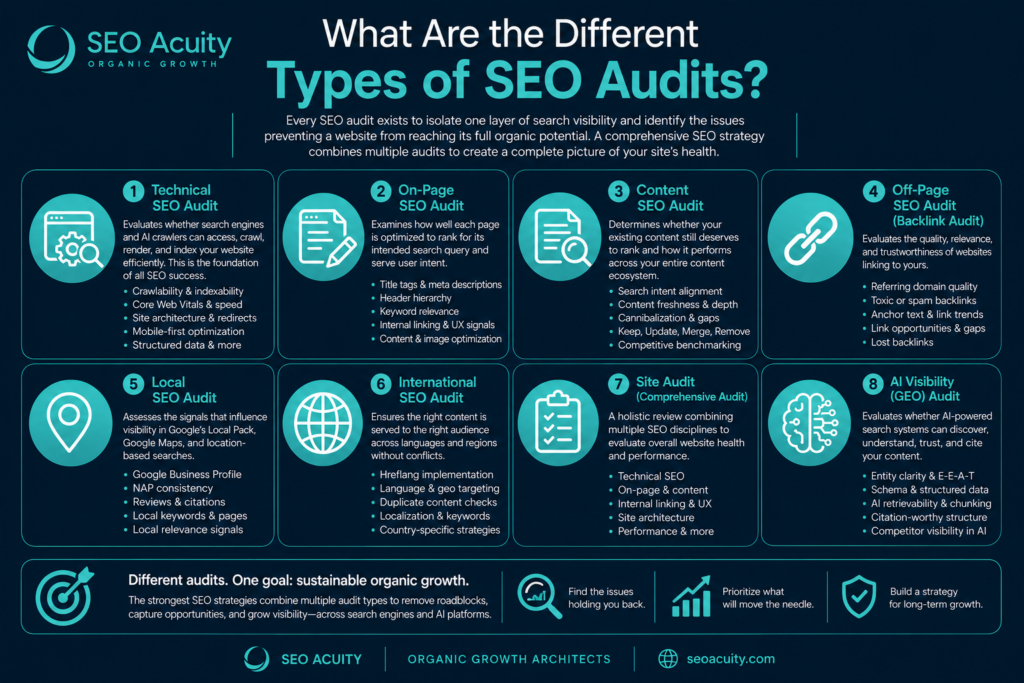
What Are the Different Levels of SEO Audits?
Beyond audit type, audits also differ by depth — and conflating the two is where scoping conversations go wrong.
Quick-scan audits run an automated crawl and flag surface-level issues in hours. They’re useful for a fast gut-check, but they miss context: a tool will flag a thin page without knowing that page converts better than any other page on the site.
Standard audits combine automated crawling with manual review — a human checking whether flagged issues actually matter for this business, this industry, this competitive set. This is the level most growth-stage businesses need.
Forensic (reactive) audits are triggered by a specific event: a sudden traffic drop, a botched migration, a suspected penalty. These work backward from the symptom to the cause, rather than prospecting broadly for improvement opportunities.
Strategic blueprint audits go furthest — they don’t just list problems, they map every finding to demand data, revenue impact, and a build sequence. This is the level SEO Acuity treats as a paid strategic deliverable rather than a free lead magnet, because a real blueprint is valuable enough to stand on its own.
Matching the level to your situation matters as much as matching the type. A quick-scan technical audit before a same-week content decision is fine. A quick-scan audit before a six-figure platform migration is not.
How Do the Different Audit Types Compare?
The types above overlap constantly in practice. Here’s where the lines actually sit.
Technical SEO Audit vs. Content SEO Audit
A technical audit checks whether search engines can access and understand your site; a content audit checks whether what they find once they get there deserves to rank. You can pass a technical audit with flawless crawlability and still fail a content audit because half your pages are thin or outdated — and vice versa. Most sites need both, run in that order, since content improvements on an uncrawlable page don’t move anything.
Content Audit vs. SEO Audit
“SEO audit” is the umbrella term; a content audit is one component underneath it, alongside technical, on-page, and off-page. A content audit narrows in specifically on quality, relevance, and cannibalization — it won’t tell you anything about your server response codes or your backlink profile, because that’s not its job.
UX Audit vs. SEO Audit
A UX audit evaluates navigation, layout, and conversion flow — whether a visitor who lands on your page can actually complete the action you want. An SEO audit evaluates whether that visitor arrives in the first place. They’re adjacent, not identical: SEO can bring qualified traffic to a page with a broken checkout flow, and no amount of ranking improvement fixes that. The two disciplines increasingly need to be run together, since Google’s ranking systems do factor in engagement signals that a poor UX suppresses.
GEO Audit vs. SEO Audit
A traditional SEO audit optimizes for ranking in a list of links; a GEO audit optimizes for being the answer an AI system synthesizes directly, with no list involved. GEO builds on top of SEO rather than replacing it — a site with weak technical foundations and poor structured data will struggle to be extracted cleanly regardless of how AI-native its content strategy is. Think of GEO as the audit that asks a question SEO audits historically never had to: not “where do I rank,” but “does the AI trust me enough to cite me at all.”
SEO Audit vs. Monthly SEO Retainer
An audit is a diagnosis; a retainer is the ongoing treatment. An audit tells you what’s broken and what’s possible — it’s a point-in-time deliverable. A retainer is the sustained execution that implements those findings, produces new content, builds authority, and adjusts as data comes in month over month. Buying an audit without budgeting for implementation is one of the most common ways businesses waste the insight they just paid for.
How Do You Choose the Right SEO Audit for Your Situation?
Match the audit to the trigger, not the other way around:
- “My pages aren’t showing up on Google” → Technical SEO audit first.
- “We get traffic but it doesn’t convert or match our business” → Content and UX audits.
- “We’ve built links but rankings haven’t moved” → Off-page/link audit.
- “We’re not showing up on Maps or ‘near me’ searches” → Local SEO audit.
- “We’re launching in a new country or language” → International SEO audit.
- “We’re planning a migration, replatform, or major redesign” → Technical audit scoped specifically for migration risk, run 3–8 weeks before cutover.
- “Competitors show up in ChatGPT and Gemini answers and we don’t” → AI visibility (GEO) audit.
- “Traffic dropped suddenly and we don’t know why” → Forensic audit.
If more than one of these describes your situation, that’s normal — audits are rarely needed in isolation. The strategic question isn’t “which single audit do I buy,” it’s “which sequence of findings actually moves revenue first.”
What Should You Expect an SEO Audit to Cost and Take?
Cost and timeline scale with scope and site size, not with a fixed formula — a 20-page service site and a 20,000-page marketplace are not priced or scheduled the same way, even for the “same” audit type. As a rough guide, quick-scan audits can turn around in days; standard audits typically take one to two weeks; enterprise-scale or migration audits with server log analysis and stakeholder coordination often run several weeks.
Rather than anchoring to a number before scoping, ask what’s actually being delivered: how many pages are reviewed manually versus automated, whether findings are prioritized by revenue exposure, and whether the deliverable includes an implementation roadmap or just a list of issues. The price difference between those two things is the entire value of hiring a strategist over running a free tool.
Ready to Dominate Search Engine Rankings?
Accelerate your organic growth and scale your business leads with our data-driven SEO strategies.
Get a Free Quote NOW!Build Your Organic Growth Foundation With SEO Acuity
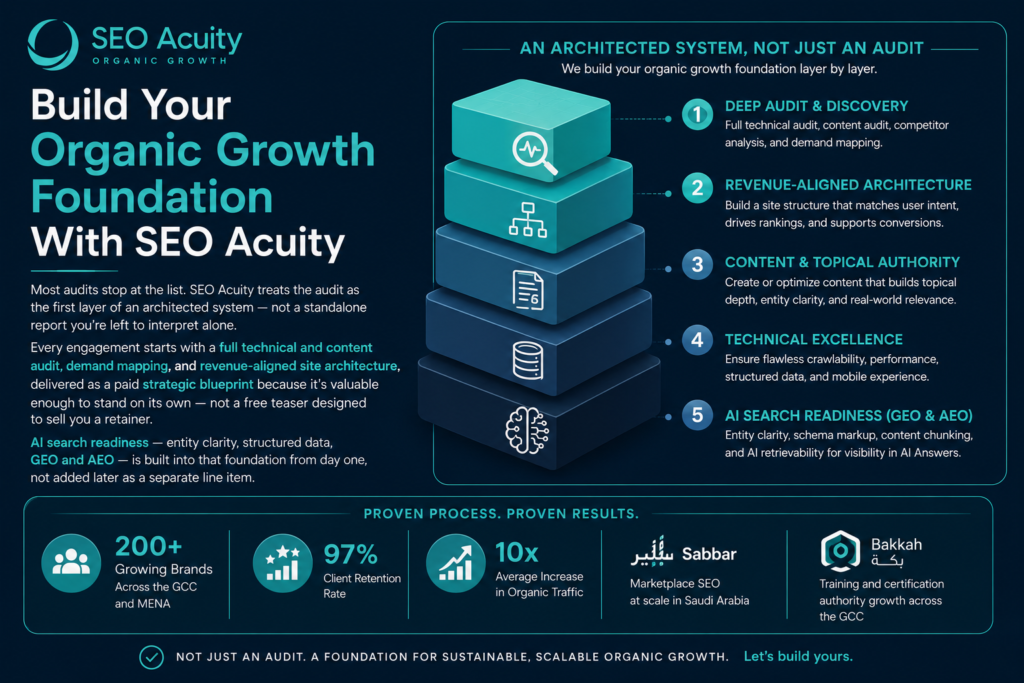
Most audits stop at the list. SEO Acuity treats the audit as the first layer of an architected system — not a standalone report you’re left to interpret alone.
Every engagement starts with the a full technical and content audit, demand mapping, and revenue-aligned site architecture, delivered as a paid strategic blueprint because it’s valuable enough to stand on its own — not a free teaser designed to sell you a retainer. AI search readiness — entity clarity, structured data, GEO and AEO — is built into that foundation from day one, not added later as a separate line item.
This is how we’ve worked with 200+ growing brands across the GCC and MENA, maintained a 97% client retention rate, and driven an average 10x increase in organic traffic for clients like Sabbar (marketplace SEO at scale in Saudi Arabia) and Bakkah (training and certification authority growth across the GCC).
Ready to Dominate Search Engine Rankings?
Accelerate your organic growth and scale your business leads with our data-driven SEO strategies.
Get a Free Quote NOW!Conclusion
There is no single “SEO audit” — there’s a set of distinct diagnostic tools, each built to answer a different question about why your site isn’t capturing the demand that’s already out there. Technical audits confirm you can be found at all. Content and on-page audits confirm what’s found is worth ranking. Off-page and local audits confirm the outside world vouches for you. And the newest layer — AI visibility — confirms the systems now answering questions directly actually trust you enough to cite you.
Choosing the right one starts with naming the actual business problem, not the audit type that sounds most complete. Rankings are a means; revenue is the measure — and the right audit is the one that tells you, specifically, where that revenue is currently leaking.
Frequently Asked Questions
What’s the difference between a free SEO audit and a paid one?
A free audit is typically an automated scan meant to open a sales conversation — useful for surface-level issues but rarely prioritized by business impact. A paid audit involves manual review, competitive context, and a roadmap tied to revenue, which is why it’s valuable enough to be a deliverable on its own rather than a lead magnet.
How often should I run an SEO audit?
Run a comprehensive audit at least annually, and trigger additional audits whenever a major change occurs: a migration, redesign, sudden traffic drop, or expansion into a new market or language. Enterprise or fast-changing sites often benefit from quarterly spot checks between full audits.
Do I need every type of audit, or just one?
Just one, if your problem is narrow and clearly defined — a technical crawl issue, for instance. Most growth-stage businesses eventually need several, since technical, content, and off-page issues are interconnected and rarely exist in isolation.
Can automated tools replace a manual SEO audit?
No. Automated tools are useful for surfacing surface-level issues quickly, but they can’t judge whether a “thin” page is actually your highest-converting asset, or whether a competitor gap represents real commercial opportunity. That judgment requires manual review by someone who understands the business, not just the crawl data.
Is an SEO audit the same as ongoing SEO work?
No. An audit is a point-in-time diagnosis; ongoing work — implementation, content production, authority building — is what turns that diagnosis into results. An audit without a follow-on plan for implementation is a report, not a growth strategy.