
Before any page appears in Google’s results, a crawler has to find it, fetch it, and confirm it is worth indexing. Crawl SEO is the discipline of making that entire process as deliberate and efficient as possible for every page that matters to your revenue.
Most site owners invest heavily in content and backlinks while their crawl configuration quietly undermines both.
A site with poor crawl architecture gets its newest pages indexed slowly, its most valuable content revisited infrequently, and its crawl budget consumed by URLs that should never have existed.
Understanding crawl mechanics is not advanced specialization, it is the prerequisite condition for every other SEO investment to work. Without consistent, efficient crawling, rankings stay unpredictable regardless of how strong the content strategy becomes.
What You’ll Learn:
- How crawl SEO, crawl budget SEO, and crawlability SEO work together to govern indexing.
- The most expensive technical SEO crawl issues and how to resolve them systematically.
- How to improve crawl budget using tactics calibrated to your site’s actual scale.
- What crawl stats SEO data in Google Search Console reveals about indexing health.
Understanding Crawl SEO That Is The Foundation Of Organic Search Visibility
Crawl SEO covers the structural and technical decisions that determine how efficiently search engine bots navigate a website. It comes before content and backlinks because pages cannot be indexed if search engines cannot reliably access them.
1. How Search Engine Bots Discover And Navigate Your Website?
Googlebot discovers URLs through XML sitemaps, previously visited pages, and external links, then follows crawlable links to identify new and updated content. It processes HTML, robots.txt directives, HTTP status codes, and JavaScript when rendering is required.
Internal linking directly influences crawl behavior. Pages buried deep within a site may receive fewer visits, while pages linked from important sections can be revisited more frequently.
2. What Is The Difference Between Crawling, Indexing, And Ranking?
Crawling means fetching a URL, indexing means deciding whether to include it in Google’s database, and ranking determines its position based on relevance, quality, and authority. Each stage depends on the previous one.
A page can be crawled without being indexed because of noindex directives, canonical conflicts, or thin content. A “Crawled — currently not indexed” status in Search Console therefore requires different fixes from a page that was never crawled.
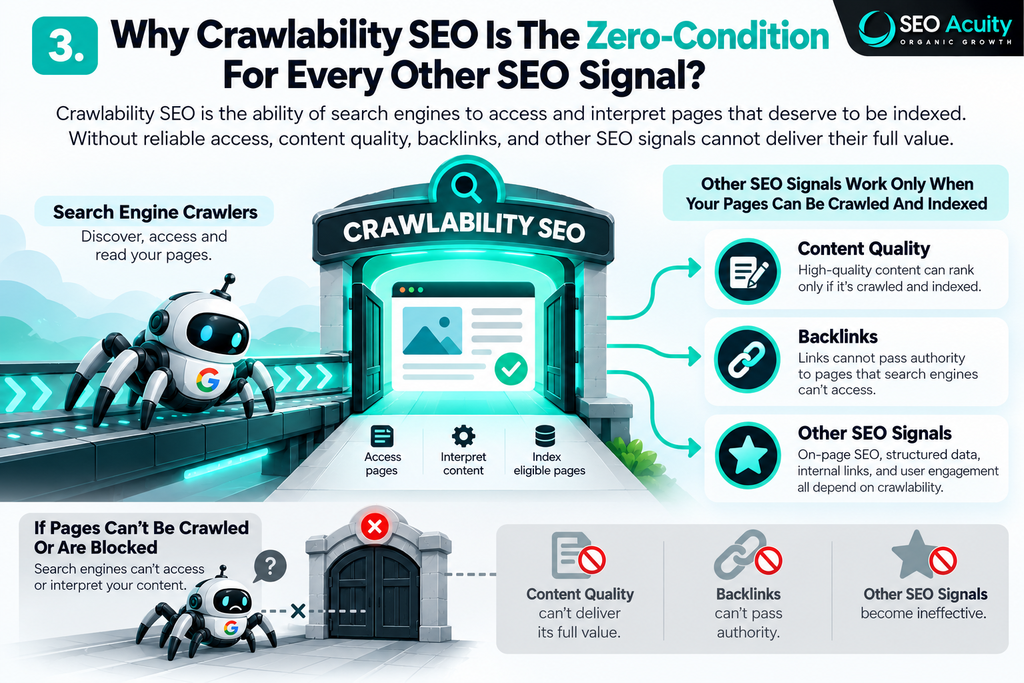
3. Why Crawlability SEO Is The Zero-Condition For Every Other SEO Signal?
Crawlability SEO is the ability of search engines to access and interpret pages that deserve to be indexed. Without reliable access, content quality, backlinks, and other SEO signals cannot deliver their full value.
Problems such as blocked directories, redirect loops, and orphan pages can create silent coverage gaps.
Understanding what is an SEO audit from a crawl-first perspective can reveal why well-optimized pages remain stagnant: the underlying issue may be systematic bot access rather than content quality.
Why SEO Acuity’s Approach to AI Search Optimization Is Different
Ready to Improve Your Search Engine Rankings?
Accelerate your organic growth and scale your business leads with our data-driven SEO strategies.
Get a Free Quote NOW!What Crawl Budget SEO Actually Measures
Crawl budget SEO is the strategic management of the finite resources search engines allocate to crawling a website. It answers which URLs Google visits, how often it returns, and how crawl resources are distributed across the site.
1. Crawl Capacity Limit Versus Crawl Demand
Google’s crawl budget depends on two factors: crawl capacity and crawl demand.
Capacity reflects how many requests a server can handle without affecting users, while demand reflects Google’s interest in revisiting URLs based on popularity, update frequency, and content freshness.
Effective crawl budget depends on both. A fast server will not generate sustained crawling if the site contains low-value or rarely updated content.
Optimization therefore requires improving server performance and URL quality while measuring actual crawl activity rather than relying on assumptions.
Let SEO Acuity build your programmatic engine for scalable growth
2. Crawl Budget SEO, When Matters And When It Doesn’t
For most sites with fewer than 10,000 indexable URLs and a clean technical foundation, crawl budget is rarely a major concern. SEO resources are generally better directed toward content quality, internal linking, and overall site architecture.
Crawl budget becomes more important for large ecommerce sites, news publishers, and enterprise websites with hundreds of thousands of URLs or excessive URL variations.
In Google Search Console, a growing number of pages marked “Discovered — currently not indexed” can indicate that Google has not allocated enough resources to crawl them.
Read also: 15 Best Seo Agencies – How To Choose The Right Seo Partner?
3. Reading Crawl Stats SEO Reports In Google Search Console
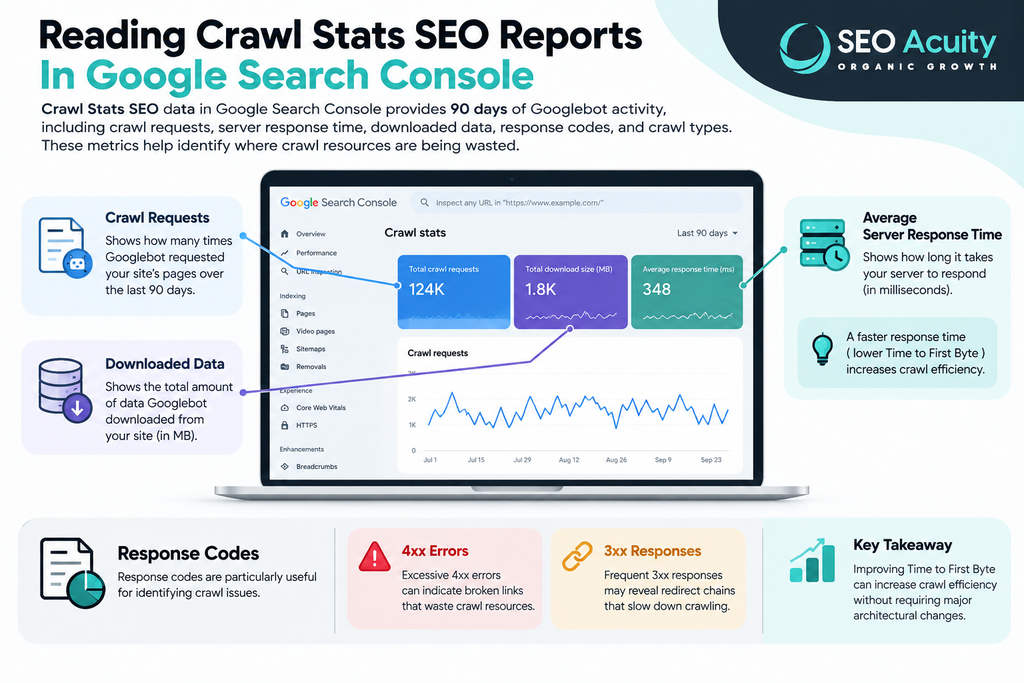
Crawl Stats SEO data in Google Search Console provides 90 days of Googlebot activity, including crawl requests, server response time, downloaded data, response codes, and crawl types. These metrics help identify where crawl resources are being wasted.
Response codes are particularly useful: excessive 4xx errors can indicate broken links, while frequent 3xx responses may reveal redirect chains. Average server response time also matters because slower responses can reduce crawl capacity.
Improving Time to First Byte can therefore increase crawl efficiency without requiring major architectural changes.
Technical SEO Crawl Issues That Silently Erode Indexing Coverage
Technical SEO crawl issues arise when structural or configuration problems prevent search engines from consistently reaching, fetching, or interpreting pages.
1. Server Errors, Redirect Chains, And Broken Links
Server errors, particularly 5xx responses, can signal infrastructure instability and cause Googlebot to reduce crawling frequency. This can delay the discovery of updated content and weaken overall crawl efficiency.
Redirect chains force Googlebot through multiple requests before reaching the final URL, while broken internal links generate 404 responses and waste crawl resources.
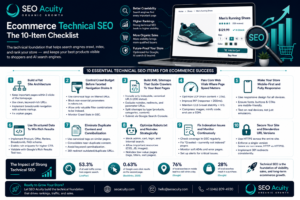
Ecommerce sites are especially vulnerable when deleted products leave broken links across categories and filters, which is why ecommerce technical SEO should include ongoing broken-link management.
Discover the Values that SEO Acuity Delivers Through Ecommerce SEO Consultancy
2. Orphan Pages And Deep Crawl Depth
Orphan pages have no internal links pointing to them, making them difficult for Googlebot to discover consistently. A sitemap can make Google aware of a URL, but internal links provide the recurring crawl paths needed for reliable discovery.
Deeply buried pages face a similar problem. Pages requiring many clicks from the homepage may receive fewer crawls.
The solution is to connect valuable pages to relevant topic hubs, category pages, resource sections, and other frequently crawled areas through contextual internal links.
3. URL Parameter Bloat And Faceted Navigation Problems
URL parameters created by filters, sorting, tracking, and sessions can generate thousands of near-duplicate URLs without independent search value.
On ecommerce sites, uncontrolled faceted navigation can consume crawl resources that should reach products and priority categories.
The right approach is to evaluate each parameter based on unique content and search demand. Valuable combinations should remain indexable and internally linked, while low-value variants should be blocked or consolidated.
Choosing the best ecommerce platforms for SEO can also reduce faceted navigation challenges through stronger built-in controls.
Explore: How to Rank in Google AI Overviews – A Complete Guide
Ready to Improve Your Search Engine Rankings?
Accelerate your organic growth and scale your business leads with our data-driven SEO strategies.
Get a Free Quote NOW!JavaScript Rendering Gaps That Hide Content From Bots
When important navigation, products, or content depend entirely on JavaScript, Googlebot may initially encounter only a limited HTML shell. JavaScript rendering occurs separately, potentially delaying discovery and processing of critical content.
Important navigation links should therefore exist in the initial HTML response through server-side rendering, static generation, or a crawlable HTML fallback.
Testing the initial HTML with Google Search Console’s URL Inspection tool can reveal rendering gaps before they develop into persistent crawl and indexing problems.
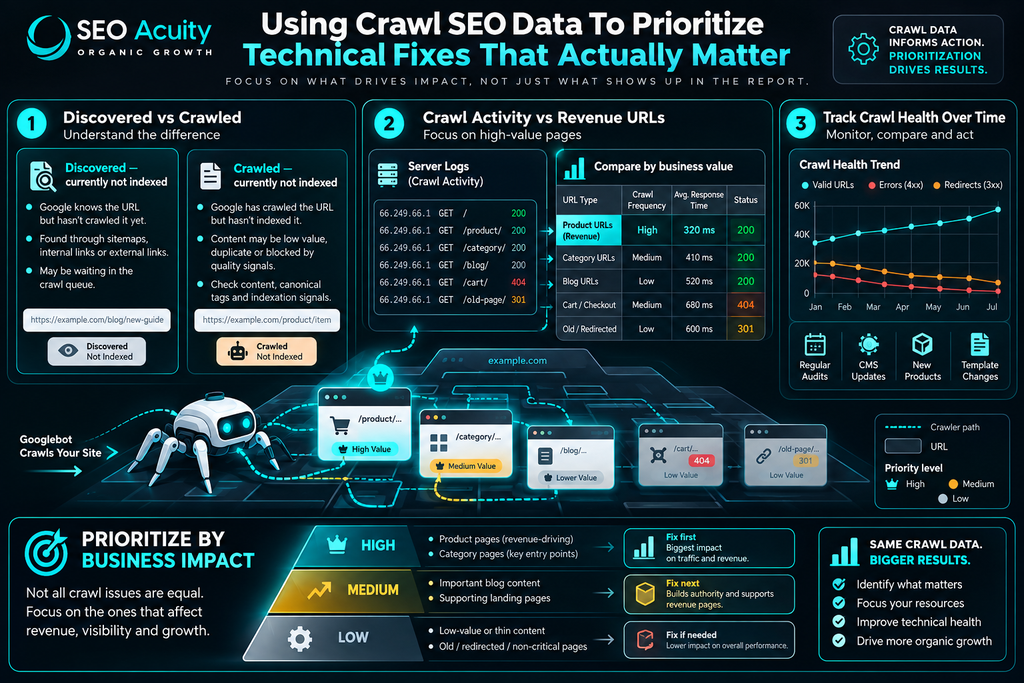
Using Crawl SEO Data To Prioritize Technical Fixes That Actually Matter
Not every crawl issue requires immediate action. Prioritization should focus on business impact, especially which uncrawled or under-crawled pages generate revenue or have strong organic potential.
1. What A High Volume Of “Discovered Not Indexed” Pages Signals
“Discovered, currently not indexed” means Google knows a URL exists but has not crawled it yet. This differs from “Crawled, currently not indexed,” where Google has already evaluated the page, so each status requires a different diagnostic approach.
A growing volume of discovered-but-not-indexed pages can indicate limited crawl resources or poor URL prioritization.
Segmenting these URLs by template, such as filters, tags, or pagination, can reveal an architectural problem that may be solved through one scalable configuration change.
Structure Your Content for Extraction Today
2. How To Compare Crawl Activity Against Revenue-Driving URLs
Server logs provide the clearest view of Googlebot activity, showing which URLs are crawled, how often they are visited, response times, and status codes. Comparing this data with priority pages reveals whether valuable URLs are receiving sufficient crawl attention.
This comparison can expose low-value URL patterns consuming resources that should reach revenue-driving pages.
For businesses investing in SEO audit services, combining crawl-log data with revenue attribution helps prioritize technical fixes according to their commercial impact rather than technical severity alone.
3. Tracking Crawl SEO Health Over Time With Consistent Metrics
A single crawl audit provides only a snapshot. Regular monitoring is essential because CMS updates, new products, and template changes can introduce crawl barriers that remain unnoticed between audits.
Track indicators such as unnecessary URLs in crawl logs, redirect chains, duplicate exclusions, sitemap indexation gaps, and impressions across priority page segments.
Measuring product, category, blog, and local pages separately makes declines visible earlier, allowing indexing problems to be addressed before they become significant ranking or revenue losses.
Ready to Improve Your Search Engine Rankings?
Accelerate your organic growth and scale your business leads with our data-driven SEO strategies.
Get a Free Quote NOW!How To Improve Crawl Budget With Systematic Precision
How to improve crawl budget is an operational question with a clear strategic priority: eliminate what wastes it first, then improve conditions for what earns it. Both require data, specifically server log analysis and Google Search Console crawl stats, before configuration changes are deployed.
1. Block Low-Value URLs Before They Consume Crawl Capacity
The robots.txt file can prevent Googlebot from accessing URL patterns with little or no indexing value, including internal search results, session parameters, and administrative paths.
Blocking these URLs prevents crawl requests entirely, making it more effective for large-scale crawl waste than relying only on noindex directives. However, overly broad rules can accidentally block important product or service pages.
Every new directive should therefore be carefully validated and compared with crawl coverage data before deployment to ensure valuable URLs remain accessible.
2. Fix Redirect Chains And Eliminate Dead-End Errors
Redirect chains consume crawl resources because every additional hop requires another request before Googlebot reaches the final destination. Maintaining direct, single-hop redirects to canonical URLs helps preserve crawl efficiency and prevents unnecessary requests.
Soft 404s can create similar waste when pages return 200 status codes despite containing no meaningful content. Understanding why are SEO audits important becomes particularly valuable here, as audits can uncover hidden redirect and error patterns. Permanently removed pages should return a 410 status when appropriate.
Explore SEO Acuity’s SEO Services For Small Business
3. Use Internal Linking To Surface Your Most Important Pages
Internal linking helps direct crawl activity toward high-value pages. URLs linked from authoritative areas such as the homepage, main navigation, and category hubs are generally easier for Googlebot to discover and revisit than deeply buried pages.
For priority pages, maintaining a shallow crawl depth, ideally around three clicks or fewer from the homepage, can improve accessibility. Contextual links from frequently crawled, authoritative pages also help Google discover newer or deeper content while distributing internal authority throughout the site.
4. Maintain A Clean, Strategically Updated XML Sitemap
An XML sitemap helps communicate which URLs are worth discovering, but it does not guarantee crawling or indexing. Submitted URLs should return 200 status codes, use self-referencing canonicals, and represent content that genuinely deserves indexing. The lastmod value should reflect real content changes.
Separating sitemaps by content type, such as products, categories, articles, or local pages, makes monitoring easier. When one segment experiences an indexing decline, Search Console can help identify the affected group without requiring an immediate full-site investigation.
Crawl Budget Optimization For Ecommerce And Large-Scale Sites
Crawl budget optimization is structurally necessary where URL proliferation is inherent to platform design rather than incidental.
Ecommerce sites with large catalogs, deep filter taxonomies, and dynamic inventory generate crawl challenges that content-level improvements alone cannot resolve, they require architectural decisions controlling what Google sees in the first place.
The practical entry point is server log analysis. Logs show exactly which URLs Googlebot has fetched, how frequently, at what response times, and with what status codes, information no simulation tool fully replicates.
Comparing log-confirmed crawl activity against a site’s priority URL list reveals the operational gap: which pages Google rarely visits, and which low-value patterns absorb those sessions.
Ecommerce SEO services that include crawl architecture planning protect indexing at a scale where manual monitoring alone cannot keep pace with site growth.
Crawl budget optimization is an ongoing process, new parameter patterns, product additions, and template changes continuously introduce new crawl waste if no systematic review cadence exists to detect and address them before they compound into ranking losses.
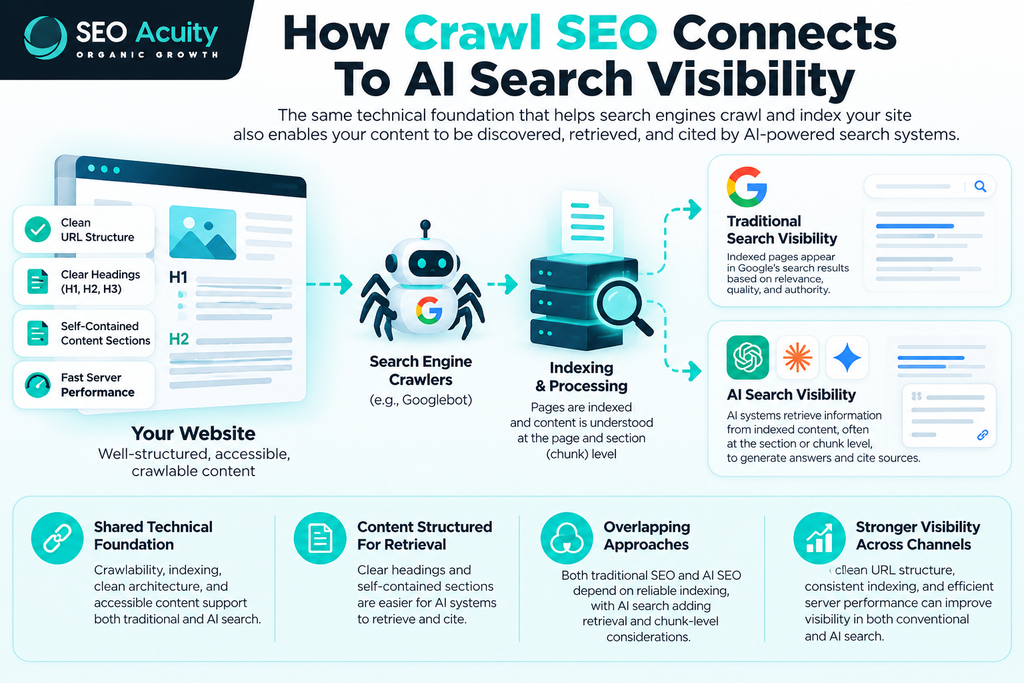
How Crawl SEO Connects To AI Search Visibility
Crawl SEO now supports both traditional search and AI-powered discovery. The same technical foundation, crawlability, indexing, clean architecture, and accessible content, helps determine whether pages can be surfaced across these evolving search environments.
AI systems increasingly retrieve information from indexed content, often at the section or chunk level. Well-structured pages with clear headings and self-contained content are easier to retrieve and cite, making crawlability essential for AI visibility.
The distinction between AI SEO vs traditional SEO highlights where the approaches overlap: both depend on reliable indexing, while AI search adds retrieval and chunk-level considerations.
A clean URL structure, consistent indexing, and efficient server performance can strengthen visibility across conventional and AI search simultaneously. For a broader strategic approach, an organic growth strategy to win AI search places crawl architecture within the larger search growth framework.
Ready to Improve Your Search Engine Rankings?
Accelerate your organic growth and scale your business leads with our data-driven SEO strategies.
Get a Free Quote NOW!How SEO Acuity Architects Crawl Systems That Protect Indexing At Scale
SEO Acuity is an Organic Growth Architecture firm, not a content agency, not an execution vendor.
Every engagement begins with a demand-driven crawl diagnosis: which pages matter to the business, whether they receive consistent bot access, and what structural changes protect that coverage as the site grows and the content architecture evolves.
The technical SEO services SEO Acuity delivers go beyond point-in-time error identification. They include crawl architecture design, defining which URLs are indexed, which are blocked, how internal linking surfaces priority pages, and how crawl regression is detected when templates or URL structures change.
That architecture is built deliberately and maintained continuously, not configured once and forgotten.
For businesses operating across Arabic and English markets in the GCC and MENA region, crawl architecture intersects with hreflang configuration, multi-language indexing, and regional demand patterns requiring a different structural approach than single-market sites.
SEO Acuity‘s organic growth foundation is built around these compounding systems, designed to protect indexing across markets while driving measurable revenue from organic search, not traffic volume disconnected from business outcomes.
Start Your SEO / GEO / AEO Journey Today With a FREE Consultation

Conclusion
Crawl SEO is not a configuration task completed once. It is a structural discipline determining how completely and consistently search engines access the pages a business depends on for organic revenue.
Every site change, template updates, new URL patterns, product additions, CMS migrations, can introduce crawl barriers that compound silently between review cycles.
The measurement framework is straightforward: track “Discovered, currently not indexed” and “Crawled — currently not indexed” volumes in Google Search Console on a consistent schedule.
A growing gap between submitted URLs and indexed URLs is the clearest early signal that crawl efficiency is degrading, and catching that gap early dramatically reduces the cost and timeline of recovery.
Sites that treat crawl architecture as foundational, managing URL proliferation proactively, maintaining clean redirect chains, optimizing server response times, structuring internal links to surface priority content, build indexing infrastructure that scales without losing coverage.
That infrastructure is what allows content quality and link authority to produce the organic growth they are actually capable of delivering.
Frequently Asked Questions
What is crawl SEO, and why does it matter for rankings?
Crawl SEO governs whether bots can access and index your pages. Without consistent crawling, pages cannot enter Google’s index, and without indexing, no ranking signals can accumulate regardless of content quality or backlink strength.
What is crawl budget SEO, and when should I focus on it?
Crawl budget SEO is managing how many URLs Google crawls per session. It matters most for large ecommerce sites, news publishers, or any site with significant URL parameter bloat exceeding roughly ten thousand indexable pages.
How do I access crawl stats SEO data in Google Search Console?
Go to Settings → Crawl Stats. The report shows 90-day crawl volume, average server response time, and response code breakdowns — the core metrics for diagnosing where crawl capacity is being consumed without delivering indexing value.
What are the most damaging technical SEO crawl issues?
The most costly issues are 5xx server errors, multi-hop redirect chains, orphan pages with no internal links, accidental robots.txt over-blocking, faceted navigation URL bloat, and JavaScript-rendered navigation that bots cannot follow during initial HTML fetch.
How do I improve crawl budget on an ecommerce site quickly?
Start with server log analysis to identify which low-value URL patterns absorb the most Googlebot requests. Then block those patterns via robots.txt, consolidate duplicates using canonical tags, and collapse any redirect chains to single hops.
What is crawlability SEO, and how does it differ from crawl budget?
Crawlability SEO answers whether Googlebot can physically access a page at all. Crawl budget addresses how often Google chooses to visit among all crawlable pages. Both must function correctly for complete, consistent indexing coverage across a site.
Does improving crawl SEO also improve AI search visibility?
Yes. AI retrieval systems draw from the same indexed content pool as traditional search. Pages Google cannot index are also unavailable to AI engines. Consistent crawl access is a prerequisite for visibility in both search environments simultaneously.