Can you do SEO yourself, or do you need to hire an expert? This is one of the most common questions among new website owners and startups trying to keep costs down in their early stages.
The short answer is yes you can do SEO yourself, especially in the early life of your website. But knowing how to do SEO yourself effectively, and recognizing when an SEO agency vs doing SEO yourself becomes a real decision rather than a luxury, matters just as much.
What You’ll Learn From This Article
- How to answer whether you can do SEO yourself based on your site’s size and goals.
- Practical, step-by-step actions for doing SEO yourself without deep technical experience.
- The real differences in an SEO agency vs doing SEO yourself comparison — cost, speed, and depth.
- The warning signs that tell you it’s time to bring in professional SEO services.
- How SEO Acuity’s services can complement your in-house efforts instead of replacing them entirely.
Can You Do SEO Yourself?
Yes, you can do SEO yourself without paying an agency or consultant, at least in the beginning. Doing SEO yourself means applying search engine optimization practices in-house, using free or low-cost tools, instead of hiring a specialized SEO agency.
This approach works particularly well for small and mid-sized websites and startups that are still testing their market positioning. It lets you improve the basics titles, content, and meta descriptions without a large upfront investment.
As your website grows and competition increases, however, doing SEO yourself alone often becomes insufficient to handle more complex technical and competitive challenges, which we’ll cover in detail below.
How to Do SEO Yourself, Step by Step
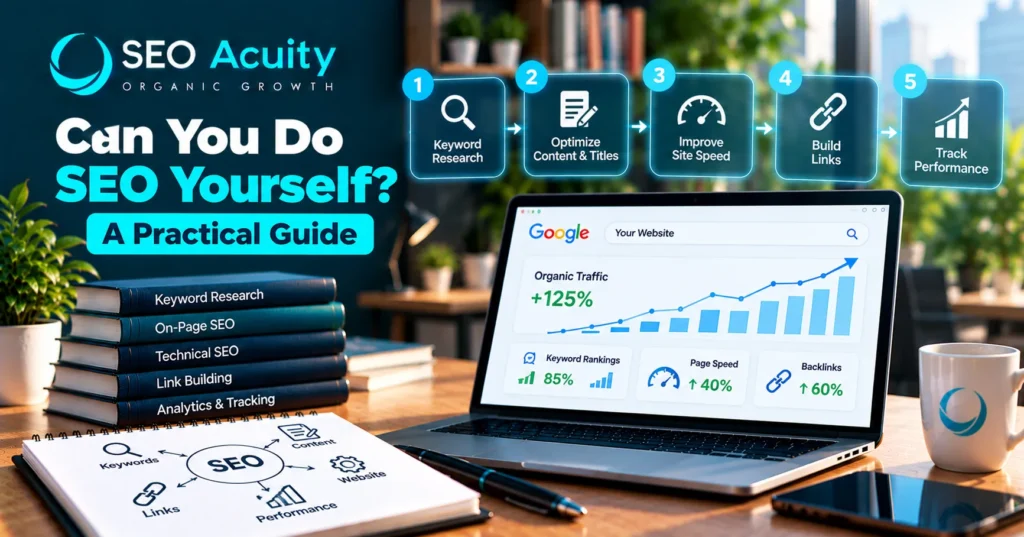
Doing SEO yourself comes down to five core steps that any website owner can implement gradually, starting with keyword research and ending with ongoing performance tracking.
1. Research the Right Keywords
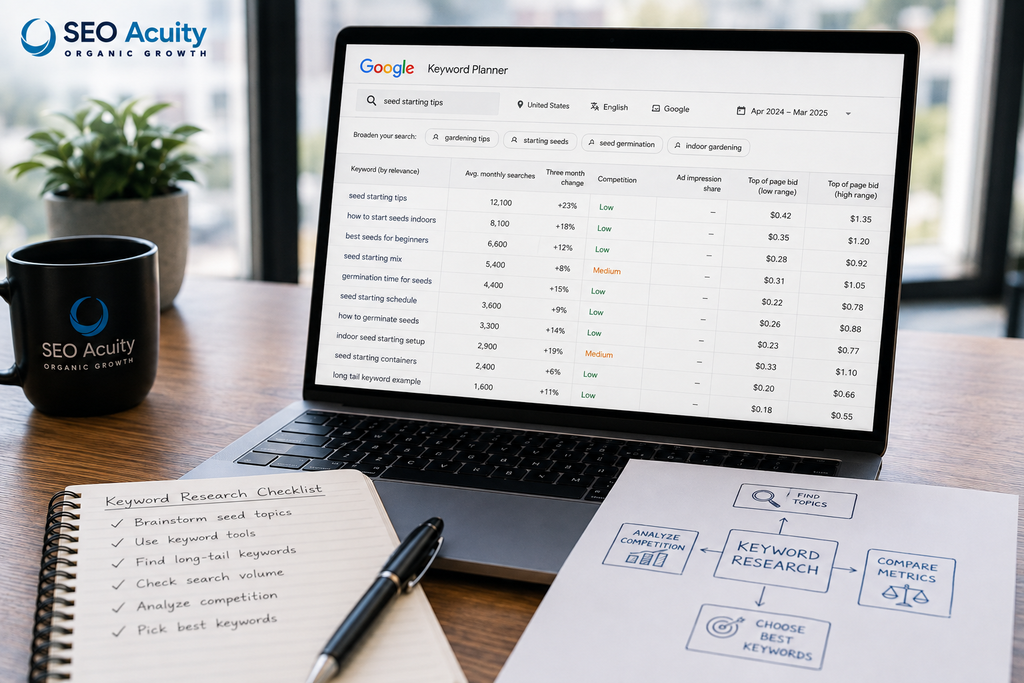
Every successful SEO strategy starts with choosing the right keywords. Start with free tools like Google Keyword Planner or Ubersuggest to find what your target audience is actually searching for. Focus on long-tail keywords, since they’re less competitive and more specific to search intent.
Put yourself in your visitor’s shoes: what terms would they type into a search engine? Build a list of 10 to 20 relevant keywords, then compare search volume and competition for each, and target the ones with a reasonable volume-to-competition ratio.
2. Optimize Your Content and Titles
Once you’ve chosen your keywords, it’s time to write content that actually serves the visitor. Include your primary keyword in the main title, within the first 100 words, and in at least one subheading. Use subheadings to organize content, and keep paragraphs short and scannable.
If you sell products online, optimizing a product page follows different rules than optimizing a blog post; take a look at our product page SEO guide to understand the specific details that apply to this type of page.
Optimizing content within the page itself is known as On-Page SEO, and it’s one of the areas any in-house team can start with directly, especially with a clear approach to titles, meta descriptions, and paragraph structure.
Not sure which side of that gap you’re on? Get a free consultation and find out!
3. Improve Site Speed and Technical Performance
Site speed affects both user experience and how search engines evaluate your pages. Use tools like Google PageSpeed Insights to analyze your site’s speed. Compress images without losing quality, use caching, and reduce unnecessary JavaScript.
The better your technical performance, the easier it is for search engines to crawl and index your pages correctly which is why the technical side of SEO needs regular review, not a one-time fix.
Read also: Page Experience And Page Speed As Seo Ranking Factors
4. Build Internal and External Links
Internal links connect your site’s pages to each other, helping search engines understand your site’s structure and which pages matter most. Add links to related content naturally, wherever they make logical sense.
If your website is an online store, link building comes with extra considerations around category and product pages; you can review our SEO for ecommerce websites guide to understand how to handle this type of site specifically.
External backlinks can come from guest posting on reputable sites in your niche or partnering with credible sources, while always avoiding links from weak or suspicious domains.
Let’s discuss how your website can grow in both traditional and AI search. Get started with a free consultation
Read also: Most Important SEO Ranking Factors
5. Track Performance and Keep Improving
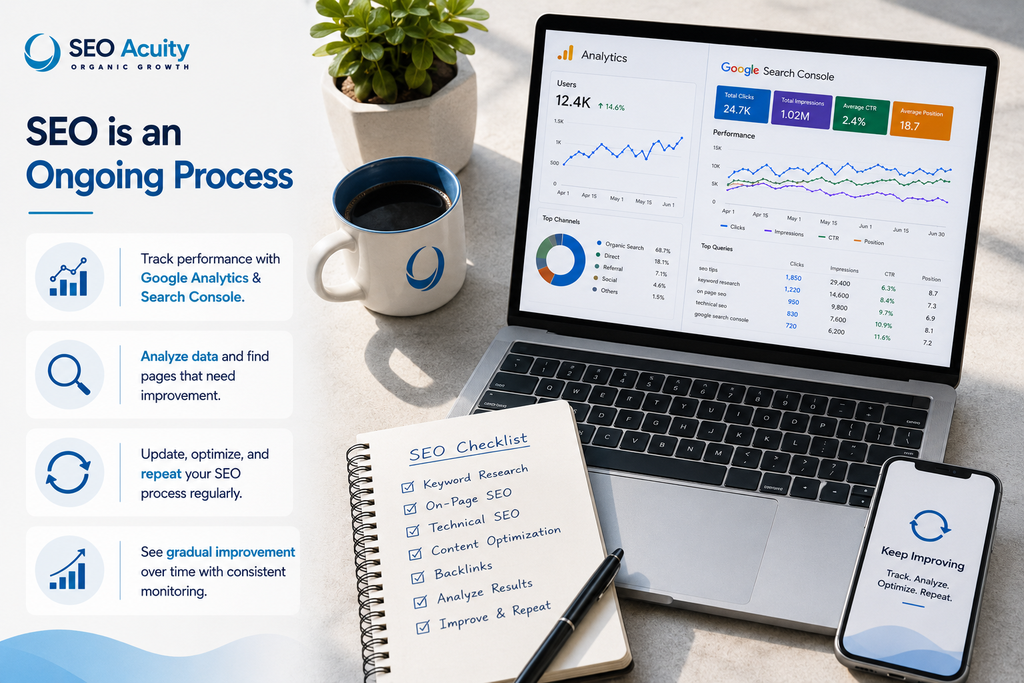
SEO isn’t a one-time task, it’s an ongoing process. Use Google Analytics and Google Search Console to track traffic and keyword rankings. Analyze the data, identify pages that need work, and repeat the steps above on a regular basis.
Over time, you’ll notice gradual improvement in your rankings, but this requires patience and consistent monitoring, since SEO results build up over time rather than appearing instantly.
SEO Agency vs Doing SEO Yourself: Which Should You Choose?
Comparing an SEO agency vs doing SEO yourself doesn’t mean one option is always better, it depends on your website’s size, how competitive your market is, and the resources you have available.
Read also: Seo For Brand Visibility – A Complete Guide
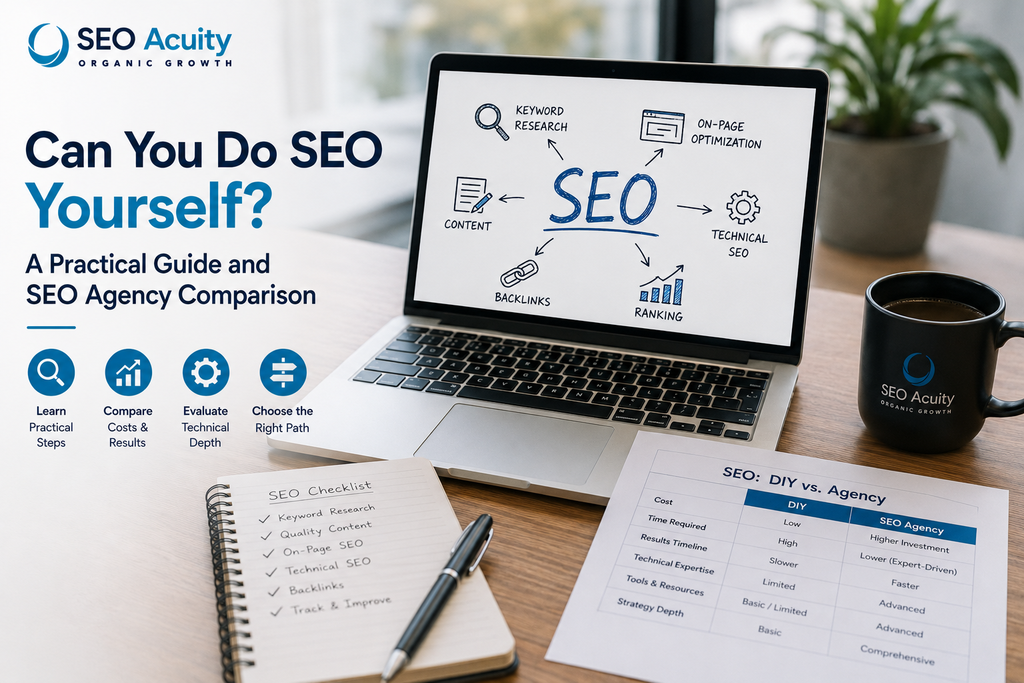
The table below summarizes the key practical differences.
| Criteria | Doing SEO Yourself (DIY) | Working With an SEO Agency |
|---|---|---|
| Cost | Low upfront cost, relies mainly on your own time | A monthly investment or fixed-scope contract |
| Speed of results | Usually slower, since you’re learning while doing | Generally faster, backed by experience and tools |
| Technical depth | Covers the basics: keywords, content, titles | Includes deep technical audits and indexing fixes |
| Backlink management | Limited, with real risk of toxic links without experience | Built on structured link quality evaluation and cleanup |
| Best suited for | Small sites and early-stage projects | Mid-size and large sites in competitive markets |
In general, doing SEO yourself lets you participate in search visibility and cover the fundamentals, while agency-led SEO targets real competition for high-value keywords, especially in crowded markets.
When Do You Actually Need a Specialized SEO Agency?
There are clear signs that doing SEO yourself is no longer enough, and that it’s time to bring in outside expertise:
- Organic growth has plateaued despite continued work on content.
- Recurring technical issues with indexing or crawling that are hard to diagnose in-house.
- Expansion into new markets or languages, such as needing a professional Arabic SEO strategy.
- Competitors consistently outrank you on high commercial-value keywords.
- Solid traffic that isn’t converting into sales or qualified leads.
If your website specifically targets an Arabic-speaking audience, this requires specialized knowledge of Arabic search behavior; take a look at SEO Acuity’s Arabic SEO services built specifically for this purpose.
Ready to Dominate Search Engine Rankings?
Accelerate your organic growth and scale your business leads with our data-driven SEO strategies.
Get a Free Quote NOW!Startups in particular face a different challenge: limited time and resources to build a complete SEO strategy from day one. In these cases, specialized services like SEO Acuity’s Off-Page SEO Services and Technical SEO Services offer a practical way to close that gap without overloading your in-house team with work outside its expertise.
One of the most common cases involves startups that need a solid technical and foundational base from the very beginning; you can review SEO services for startups to see how that foundation is built correctly.
If your main issue is optimizing content and titles on your existing pages, the logical next step is to review on-page SEO services to make sure every page is presented to search engines in the best possible way.
Ultimately, the choice between continuing with SEO yourself or bringing in outside expertise isn’t a final, all-or-nothing decision.
Many successful websites run on a hybrid model, where the in-house team handles day-to-day tasks like publishing content and updating pages, while deeper, more complex technical work is handed off to a specialized partner.
This balance gives you the flexibility of an in-house team without losing the precision and depth of professional expertise.
Ready to Dominate Search Engine Rankings?
Accelerate your organic growth and scale your business leads with our data-driven SEO strategies.
Get a Free Quote NOW!Start Growing With the SEO Experts at SEO Acuity
If you’ve reached the point where doing SEO yourself no longer feels like enough to hit your growth goals, the SEO Acuity team is ready to support you with specialized services covering every angle of search engine optimization from technical audits to link building, ecommerce SEO, and enterprise-level strategy.
As proof of our commitment to developing talent in this field, we recently announced our partnership with Tabarak Academy to help train specialized SEO professionals.

Ready to Dominate Search Engine Rankings? Accelerate your organic growth and scale your business leads with our data-driven SEO strategies.
Conclusion
Yes, you can do SEO yourself, particularly in the early stages of your website, by following clear steps that start with keyword research and end with ongoing performance tracking.
But as your site grows and competition increases, the gap in an SEO agency vs doing SEO yourself comparison becomes more obvious, especially on the technical side and in link management.
The right decision isn’t necessarily choosing one side exclusively — it’s building a balanced model that combines your in-house effort with specialized expertise when needed, keeping your website growing without burning out your team or falling into costly technical mistakes.
Frequently Asked Questions
Can I learn SEO myself without prior experience?
Yes, you can learn SEO basics without prior experience using free tools like Google Search Console and Google Analytics. It takes time and patience to understand how search engines work and to gradually apply the fundamentals in practice.
How long does it take to see results from doing SEO yourself?
SEO results generally build up over time and don’t appear instantly; it can take several months to see a noticeable ranking improvement.
The timeline depends on your site’s age, competition level, content quality, and how consistently you apply improvements.
When is doing SEO yourself enough, without needing an agency?
Doing SEO yourself is usually enough in the early stages for small websites or startups that aren’t yet facing heavy competition.
This approach remains viable as long as the site shows steady growth without complex technical issues that require specialized expertise.
What’s the core difference between an SEO agency and doing SEO yourself?
The core difference lies in technical depth and speed of results. Doing SEO yourself covers the basics, like content and titles, while an SEO agency provides deep technical audits, professional link management, and close tracking of Google algorithm updates.
Can you combine doing SEO yourself with an external SEO agency?
Yes, this is known as the hybrid model, where the in-house team handles daily tasks like publishing content and updating pages, while a specialized agency manages deeper technical work such as audits, competitor analysis, and growth strategy.