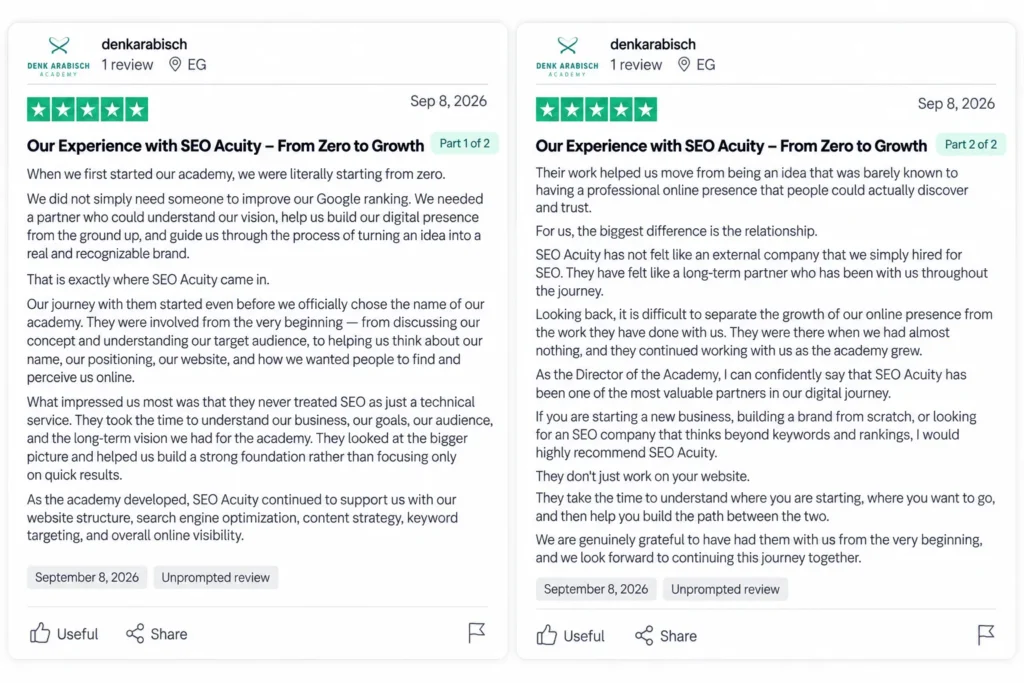

Core Web Vitals are three specific, user-centered performance metrics Google uses to evaluate real-world page experience.
Since their integration as confirmed ranking signals in 2021, core web vitals SEO have shifted from a technical curiosity into a strategic priority for every site competing in organic search, and staying competitive requires understanding how each metric works, why it matters, and how Google actually measures it.
Unlike earlier speed signals that focused on raw load time, these metrics target the dimensions of experience users consciously feel: how quickly they see the main content, how fast the page responds to their actions, and how stable the layout remains during loading.
Each metric carries a defined threshold, a documented data source, and a direct line to organic search performance.
What You’ll Learn
- What core web vitals SEO means and how Google collects the field data it uses in rankings.
- How LCP, INP, and CLS work, what their scoring thresholds are, and why those numbers matter.
- Whether core web vitals matter for SEO rankings and how their influence fits within a full strategy.
- Practical measurement and improvement methods that move real-user scores into the “good” range.
What Core Web Vitals SEO Really Means for Organic Search Performance
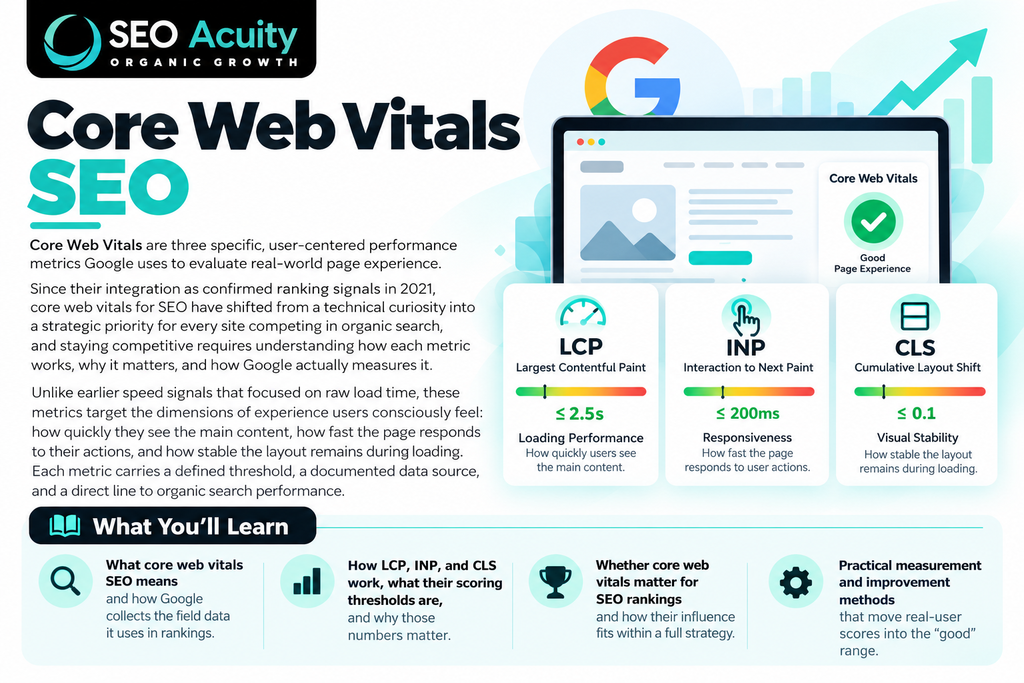
Core Web Vitals SEO focuses on optimizing three Google ranking signals: Largest Contentful Paint (LCP), Interaction to Next Paint (INP), and Cumulative Layout Shift (CLS). These metrics use real-user field data to measure loading performance, responsiveness, and visual stability.
Unlike traditional page speed measurements, Core Web Vitals identify user experience problems that can affect search performance. Google provides clear thresholds, measurement tools, and data through the Chrome User Experience Report, making these signals actionable.
However, performance can decline after plugin updates, design changes, or third-party scripts. Therefore, Core Web Vitals should be monitored continuously alongside content, SEO, and link-building efforts.
The Three Metrics That Define Core Web Vitals For SEO
Core Web Vitals measure three essential aspects of page experience: loading speed, responsiveness, and visual stability.
Together, LCP, INP, and CLS provide a practical framework for identifying performance issues that can affect both user experience and organic search performance.
1. Largest Contentful Paint Measures How Fast Your Page’s Main Content Becomes Visible
Largest Contentful Paint (LCP) measures how quickly the largest visible element, such as a hero image or headline, appears on screen. Google considers an LCP of 2.5 seconds or less good, while 2.5–4 seconds needs improvement and above 4 seconds is poor.
Common causes of slow LCP include oversized images, render-blocking JavaScript, slow server response times, and limited CDN delivery. Improving image formats, prioritizing the LCP element, reducing blocking scripts, and using a CDN can significantly improve performance.
For large ecommerce sites, ecommerce technical SEO should include systematic image optimization rather than page-by-page fixes.
Why Choose SEO Acuity As Your Ecommerce SEO Agency?

2. Interaction To Next Paint Captures True Responsiveness Throughout An Entire User Session
Interaction to Next Paint (INP) replaced First Input Delay (FID) as Google’s official responsiveness metric in March 2024. It measures how quickly a page responds to user interactions throughout the session.
An INP below 200 milliseconds is considered good, 200–500 milliseconds needs improvement, and above 500 milliseconds is poor. Heavy JavaScript is a common cause because long tasks occupy the browser’s main thread and delay clicks, taps, and keyboard inputs.
Improving INP typically involves removing unnecessary third-party scripts, splitting large JavaScript bundles, deferring non-critical code, and allowing the browser to process interactions between demanding tasks.
SEO Acuity provides elite technical SEO services. Get a Free SEO Audit
3. Cumulative Layout Shift Measures How Visually Stable Your Page Remains As Content Loads
Cumulative Layout Shift (CLS) measures unexpected movement of visible page elements while content loads. A CLS of 0.1 or below is considered good, while scores above 0.25 indicate poor visual stability.
Common causes include images without defined dimensions, web fonts that reflow text, dynamically injected banners, and late-loading third-party widgets. These shifts can cause users to click the wrong element or lose their place while interacting with a page.
Adding width and height attributes to images, reserving space for ads and widgets, preloading important fonts, and preventing late content injection can reduce CLS and create a more stable, predictable experience.

Ready to Improve Your Search Engine Rankings?
Accelerate your organic growth and scale your business leads with our data-driven SEO strategies.
Get a Free Quote NOW!Do Core Web Vitals Matter For SEO Rankings Or Is It Just Technical Hype?
Yes, Core Web Vitals matter for SEO rankings, as Google officially confirmed them as ranking signals within its Page Experience system.
However, their impact is relatively limited compared to content relevance, search intent alignment, and domain authority. Google’s John Mueller stated that relevance is “by far much more important” than Core Web Vitals scores.
These metrics function primarily as a tie-breaker when competing pages offer comparable content quality, authority, and relevance. Therefore, optimizing performance alone will not guarantee higher rankings.
The most effective strategy is to prioritize high-quality, intent-driven content first, then improve Core Web Vitals to eliminate technical barriers and maximize organic search performance.
Read more about: What Is an SEO Audit? A Strategist’s Guide
Ready to Improve Your Search Engine Rankings?
Accelerate your organic growth and scale your business leads with our data-driven SEO strategies.
Get a Free Quote NOW!How Core Web Vitals SEO Impact Works Inside Google’s Ranking System
Google measures Core Web Vitals using real-world Chrome user data through CrUX, not Lighthouse lab tests. The data uses a rolling 28-day window, so performance improvements are reflected gradually.
Lighthouse helps diagnose issues but does not directly affect rankings. Therefore, SEO teams should expect a delay after implementing Core Web Vitals fixes.
1. Field Data From Real Chrome Users Determines Your Actual Ranking-Relevant Scores
Google Search Console’s Core Web Vitals report shows ranking-relevant performance using data from the Chrome User Experience Report (CrUX). URLs are classified as Good, Needs Improvement, or Poor based on real user experiences.
PageSpeed Insights also displays field data alongside Lighthouse lab results. Field data is relevant to Google’s ranking systems, while Lighthouse is primarily diagnostic. Some pages lack enough traffic to generate CrUX data.
In those cases, Core Web Vitals may not provide a ranking signal for that URL, meaning other factors such as content relevance, authority, and search intent remain important.
Explore The 6 Phases of the Organic Growth Foundation™ with SEO Acuity

2. Core Web Vitals Serve As A Ranking Tie-Breaker When Competing Pages Have Comparable Content
Google describes Core Web Vitals as a factor that may influence rankings when pages have similar relevance and authority.
This positions performance as one component within a broader SEO strategy rather than a dominant ranking factor. Improving poor Core Web Vitals can help strong pages compete more effectively, particularly when competing content is otherwise comparable.
However, chasing perfect Lighthouse scores offers limited SEO value when content quality or search intent remains the primary weakness.
The practical priority is to create comprehensive, relevant content first, then resolve significant performance issues that could limit the page’s overall search performance.
Read also: Organic Growth Strategy to Win AI Search and SEO SERP
3. Poor Performance Metrics Generate Behavioral Signals That Compound Into Ranking Disadvantages
Poor performance can negatively affect user experience. Slow LCP may prevent users from seeing important content quickly, high INP can make interactions feel unresponsive, and poor CLS can cause unexpected page movement.
These problems may increase abandonment and reduce engagement, limiting the opportunity for users to benefit from otherwise strong content. However, behavioral metrics such as bounce rate and session duration should not be treated as direct Core Web Vitals ranking factors.
For small businesses with limited authority, improving page speed and usability can still be valuable because it reduces performance-related friction and helps visitors access and interact with content more effectively.
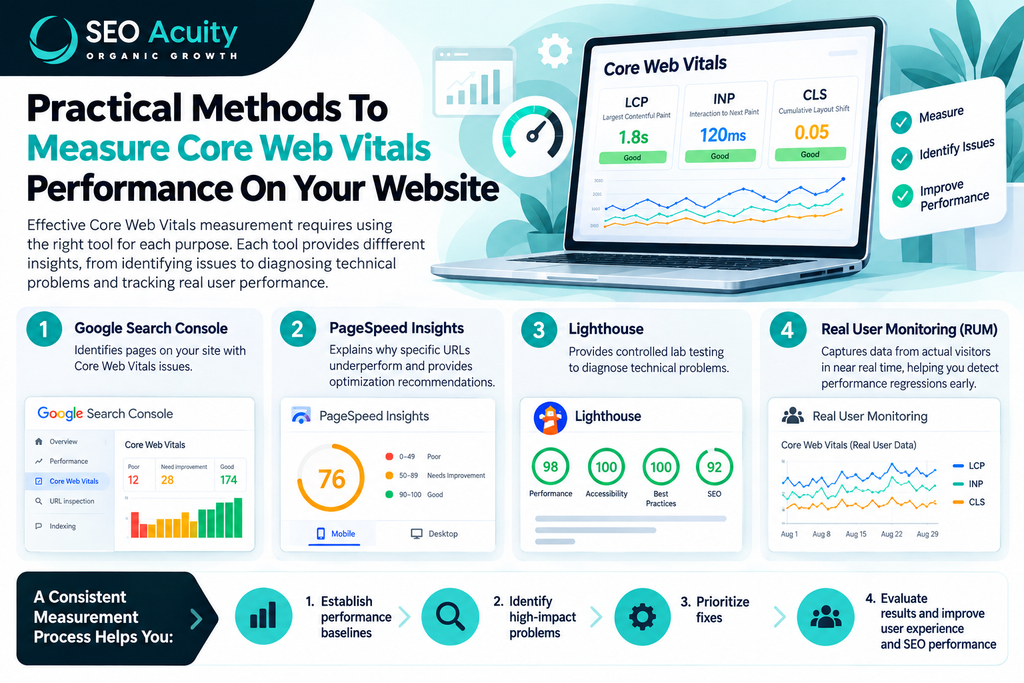
Practical Methods To Measure Core Web Vitals Performance On Your Website
Effective Core Web Vitals measurement requires using the right tool for each purpose. Google Search Console identifies pages with performance issues, while PageSpeed Insights explains why specific URLs underperform.
Lighthouse provides controlled lab testing to diagnose technical problems. Real User Monitoring (RUM) captures data from actual visitors in near real time, helping teams detect performance regressions shortly after deployments or updates instead of waiting for CrUX data to accumulate.
Regular SEO audits should include Core Web Vitals because redesigns, platform changes, and third-party scripts can introduce new issues.
A consistent measurement process establishes performance baselines, identifies high-impact problems, prioritizes fixes, and helps teams evaluate whether optimization efforts improve both user experience and technical SEO performance.
Secure Actionable Insights from Expert SEO Auditors
Proven Technical Strategies That Improve Core Web Vitals Scores Across Your Site
Improving Core Web Vitals at scale requires addressing root causes in hosting, JavaScript execution, and media delivery rather than relying on minor fixes.
Slow server response times can delay rendering and hurt LCP, making faster hosting and CDN infrastructure valuable improvements.
Auditing third-party scripts, including analytics, marketing tags, chat widgets, and social embeds, can also reduce unnecessary JavaScript and network requests.
Integrating technical performance with content structure creates additional benefits. On-Page SEO Services can help align content hierarchy with search intent and rendering priorities, allowing critical information to load efficiently while improving usability.
A structured optimization process should identify major bottlenecks, prioritize high-impact fixes, and monitor performance improvements across the site.

Ready to Improve Your Search Engine Rankings?
Accelerate your organic growth and scale your business leads with our data-driven SEO strategies.
Get a Free Quote NOW!Core Web Vitals Importance In SEO Now Extends Into AI Search And Generative Results
Core Web Vitals importance in SEO increasingly extends into AI-driven search. Fast loading, stable layouts, and responsive interactions help both users and AI systems reliably access and interpret page content.
Poor CLS can disrupt browser-based AI interactions, while slow rendering may create difficulties when systems extract or process content. As generative search expands, strong technical performance can support reliable content retrieval alongside traditional SEO.
Teams investing in AI Search Optimization Services and GEO Services – Generative Engine Optimization can integrate performance improvements into broader optimization strategies. To understand this relationship further, explore what is AI SEO and how technical performance supports content accessibility and AI-driven retrieval.
Protect Your SEO Investment With SEO Acuity
Core Web Vitals optimization should not end when your scores improve. SEO Acuity helps businesses continuously monitor technical performance, identify regressions, and protect the organic growth generated through content and authority building.
The Organic Growth Foundation™ integrates technical performance into a broader SEO framework, while Enterprise SEO Services provide ongoing monitoring and governance for large, frequently updated websites.
By detecting issues before they become significant ranking or traffic problems, SEO Acuity helps ensure that your technical foundation continues supporting long-term search visibility.
Request a Free SEO Audit for Your Site

Conclusion
Core Web Vitals have evolved from a technical performance concern into an important part of a comprehensive SEO strategy. LCP, INP, and CLS measure how quickly users see meaningful content, how smoothly pages respond to interaction, and how stable the layout remains.
Because Google evaluates these metrics using real-world user data, improving them requires more than achieving a strong laboratory score—it requires consistent monitoring and optimization across the site.
The evidence also shows that Core Web Vitals should complement, not replace, strong content, search intent alignment, and authority. Businesses should therefore treat performance as an ongoing investment that protects organic visibility while improving user experience.
The Organic Growth Foundation™ provides a framework for integrating technical performance into sustainable SEO growth, while Enterprise SEO Services can support continuous monitoring across complex, large-scale websites.
Frequently Asked Questions
What are core web vitals, and how do they connect to SEO?
Core web vitals are three Google-confirmed performance metrics, LCP, INP, and CLS, that measure loading speed, interactivity, and visual stability using real user data.
Google includes them in its Page Experience ranking system, meaning poor scores can directly suppress organic search positions for pages that are otherwise well-optimized for content and intent.
Do core web vitals matter for SEO if my content already performs competitively?
Yes, though their role shifts to protection. Strong scores guard against competitors overtaking you when content quality is comparable.
For pages already ranking well, core web vitals optimization also improves conversion rates and session quality beyond its direct ranking function, making it valuable regardless of competitive position.
How is SEO core web vitals measurement different from what Lighthouse reports?
Google uses field data from real Chrome users collected via CrUX, not Lighthouse lab scores, when applying core web vitals as a ranking signal.
Lighthouse is a diagnostic tool useful for identifying root causes of performance failures. Improving Lighthouse without improving real-user field data in Search Console will not produce search ranking improvements.
What does core web vitals SEO impact look like in observable ranking changes?
Core web vitals rarely produce dramatic overnight ranking shifts. Their impact is most visible in competitive searches where pages have comparable content quality, and the effect manifests over the 28-day rolling window as field data accumulates the post-fix measurements.
The clearest gains appear when performance was actively suppressing a page that deserved a higher position.
Which core web vitals metric carries the greatest SEO weight?
All three contribute to the Page Experience signal together rather than independently. LCP affects the broadest share of users because loading speed is universally noticed.
However, failing any single metric can prevent a page from passing the overall assessment, so treating any one metric as optional creates a gap that limits the full ranking benefit of the other two.
How often should core web vitals be reviewed as part of an active SEO program?
Monthly review of Search Console field data, with continuous real user monitoring running between formal reviews. Code updates, new third-party integrations, and design changes can degrade scores without obvious warning signs.
Catching regressions early prevents compounding ranking damage that takes an additional 28-day measurement cycle to recover from after the underlying fix is applied.