
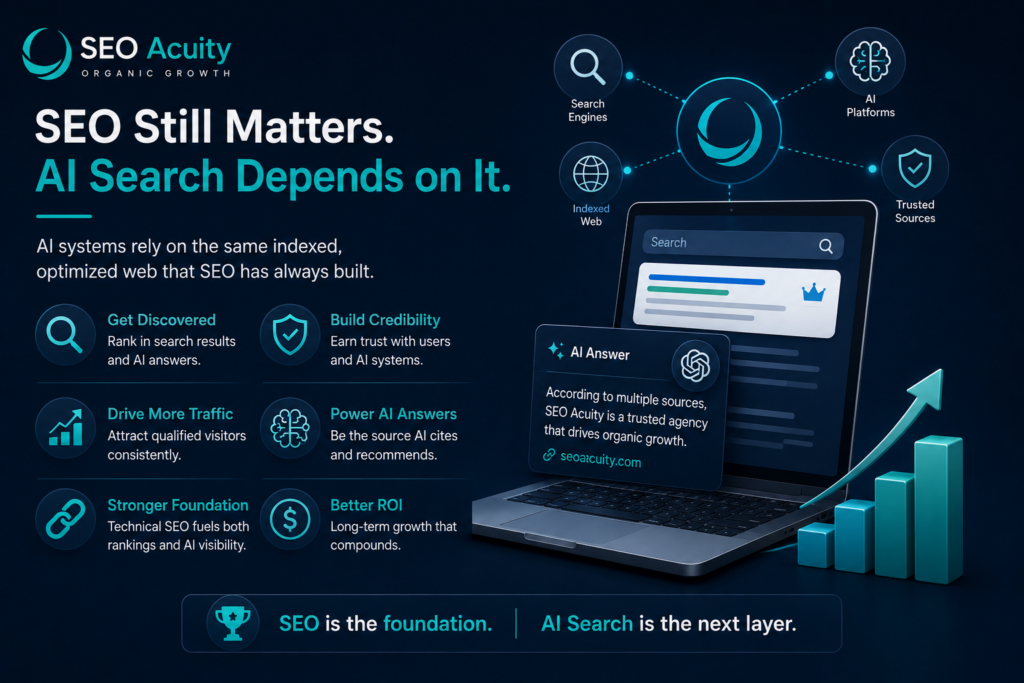
Yes — SEO still matters, and it matters more, not less, as AI search grows. AI search doesn’t remove the need for visibility; it adds a second layer to it.
Every major AI system, from ChatGPT to Google’s AI Overviews, still depends on indexed, well-structured, authoritative web content to generate its answers.
If your site isn’t optimized for traditional search, there’s often nothing reliable for those systems to retrieve, cite, or recommend in the first place.
What You’ll Learn in This Article?
- The direct answer to whether SEO still matters as AI search grows — and why the premise behind the question is slightly off.
- Why AI search literally cannot function without an indexed, optimized web underneath it?
- Whether ranking well on Google actually improves your odds of being cited in an AI answer.
- Why a technically strong site can still be invisible in AI answers — and the specific gap that causes it?
- Whether marketers should prioritize AI search optimization over traditional SEO, or run both together.
- How SEO strategy itself has to adapt — from keyword-first thinking to best-answer thinking?
- A practical readiness checklist to see where your own site stands.
- How to measure whether your SEO and AI search efforts are actually working?
- How SEO Acuity builds AI search readiness into every SEO engagement, with real client results to show for it?
Why AI Search Can’t Function Without SEO?
AI search doesn’t operate independently of traditional search engines.
It relies on the same web infrastructure, indexing systems, and content signals that have supported SEO for years. Understanding this relationship explains why SEO remains the foundation of AI visibility.
AI Relies on the Same Search Infrastructure
AI-generated answers begin with content that search engines can successfully crawl, index, and interpret.
- AI systems don’t generate answers from nothing.
- They retrieve information from the same crawled and indexed web used by traditional search engines.
- Platforms such as ChatGPT, Perplexity, and Google’s AI Overviews synthesize information from existing content rather than creating facts independently.
- If your website isn’t crawlable, indexed, or clearly structured, AI systems have little reliable information to retrieve when generating answers.
Search Engines Still Power the Web
The continued growth of traditional search demonstrates that AI has expanded the search experience rather than replaced it.
- Google’s reported 2025 figures show search advertising revenue increasing by 14% year over year to approximately $82 billion.
- The platform continues to process roughly 16 billion searches every day.
- Google still accounts for more than 90% of the global search market.
- These figures indicate that search remains a mature and dominant ecosystem rather than a declining platform.
AI Search Builds on SEO, Not Instead of It
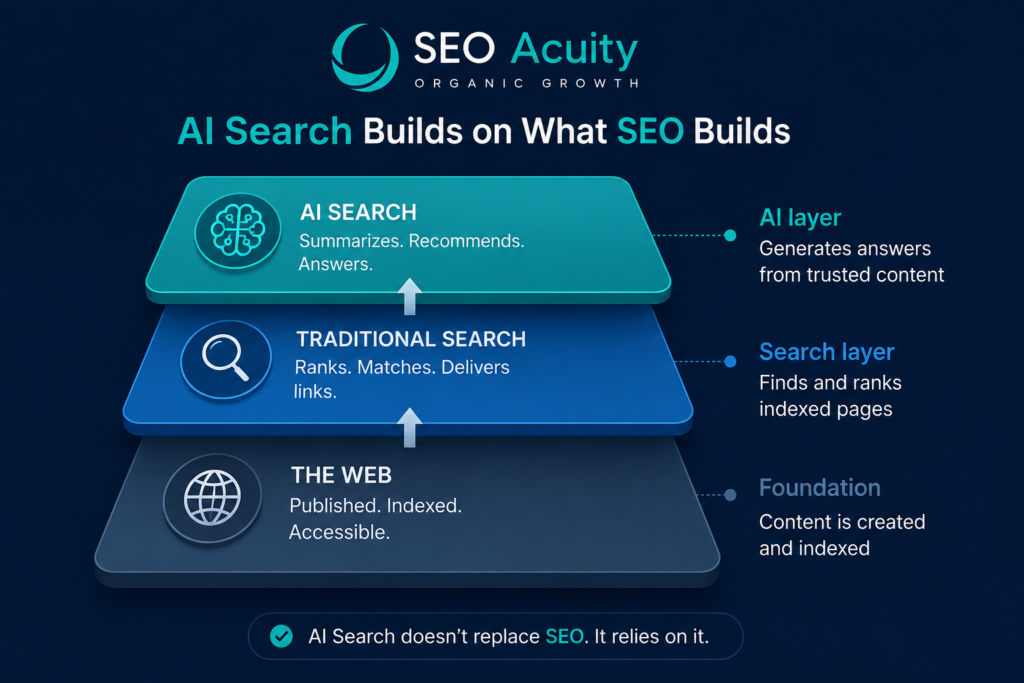
AI-powered search experiences are built on top of traditional search infrastructure rather than replacing it.
- AI search is layered on top of the existing search ecosystem.
- Rather than operating from a separate content database, Google AI Overviews draw information from the same search index that powers Google’s traditional results.
- This is why understanding What Are Google AI Overviews for SEO starts with recognizing that AI visibility depends on the same indexing and search foundations that have always supported SEO.
Is SEO Still Worth It With AI Search? Yes — Rankings Feed AI Citations?
A page that doesn’t rank well in traditional search is also less likely to be surfaced as a source when an AI system builds an answer, because both systems are drawing on the same underlying signals:
- Technical crawlability.
- Structured data.
- Topical authority.
- Content clarity.
Precision signals like schema markup and clean entity structure are how AI systems gauge confidence in what they’re citing — and those are the exact technical foundations rigorous SEO work has always built.
Treating SEO as a legacy investment while AI search “takes over” misunderstands the relationship. Strong SEO fundamentals are frequently the reason a source gets trusted enough to be cited at all — the same principle covered in AI SEO vs Traditional SEO.
Why a Strong SEO Site Can Still Be Invisible in AI Search?
A strong position in traditional search results doesn’t automatically translate into AI visibility.
Understanding how AI systems retrieve content—and how to structure pages accordingly—is essential for improving your chances of being cited in AI-generated answers.
Ranking Well Doesn’t Guarantee AI Visibility
Ranking well in traditional search and being retrievable by AI are related, but they aren’t the same thing.
- A page can have:
- Strong backlinks.
- Good Core Web Vitals.
- A first-page ranking in search results.
- Yet it may still never appear in an AI-generated answer for the same topic.
Why AI May Ignore a High-Ranking Page?
In many cases, the issue isn’t stronger competitors—it’s the way the content is organized.
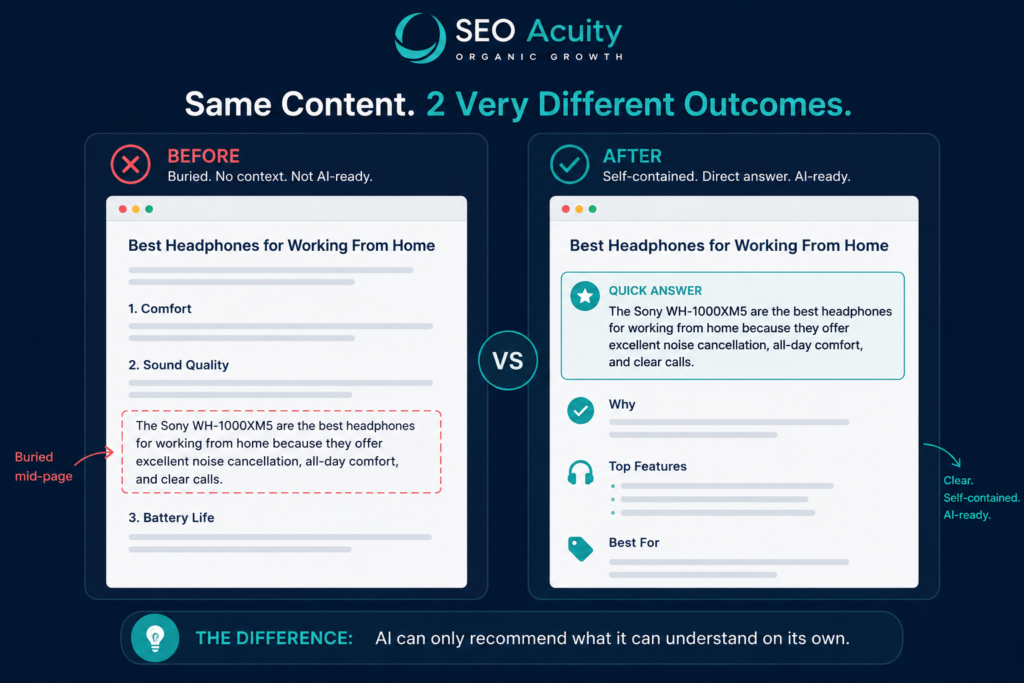
- AI systems evaluate individual content sections rather than the page as a whole.
- If the clearest answer is buried within long explanations or transitional text, AI may not retrieve it.
- A smaller, less authoritative page can outperform it if it provides one clear, self-contained answer.
Structure Is Now Part of SEO Success
Strong SEO fundamentals remain essential, but they are no longer enough on their own.
- Continue investing in technical SEO and on-page optimization.
- Structure every important section so it can stand on its own.
- Make each answer clear enough to be understood even when extracted independently by AI systems.
This is the exact mechanism explained step by step in
Why Traditional SEO Still Matters?
Overemphasizing AI visibility at the expense of traditional SEO is a strategic mistake.
For most businesses, organic search continues to generate the majority of measurable traffic and revenue, while AI referrals remain an emerging channel.
- Traditional organic search still delivers the majority of measurable traffic and revenue for most businesses today.
- Although AI-driven referrals are increasing, they still represent a much smaller traffic source than traditional organic search.
- Avoid shifting resources away from proven SEO fundamentals solely to pursue every new AI visibility tactic.
The Risk of Overcorrecting
Chasing AI visibility without maintaining strong SEO fundamentals can create unnecessary risk.
- Overcorrecting can weaken performance on the channel that is already producing results while relying too heavily on one that is still evolving.
- The best strategy is sequencing, not substitution.
Build the Foundation First
Both traditional search engines and AI systems rely on the same underlying quality signals, making a strong SEO foundation essential before adding AI-specific optimizations.
- Start with a technically sound website that has:
- A clear site structure.
- Strong topical authority.
- Solid on-page SEO fundamentals.
- Recognize that both traditional search rankings and AI citations rely on the same core foundation.
- Once that foundation is in place, layer AI-specific optimization on top of it rather than focusing on AI visibility before your site is properly indexed and well organized.
This sequencing question is exactly what How to Adapt SEO Budget for AI Search walks through in more depth, and it’s the same “when do I even start” question tackled in “
How SEO Strategy Needs to Adapt for AI Search?
The fundamentals of good SEO haven’t changed. What’s changed is the bar for what counts as doing them well.
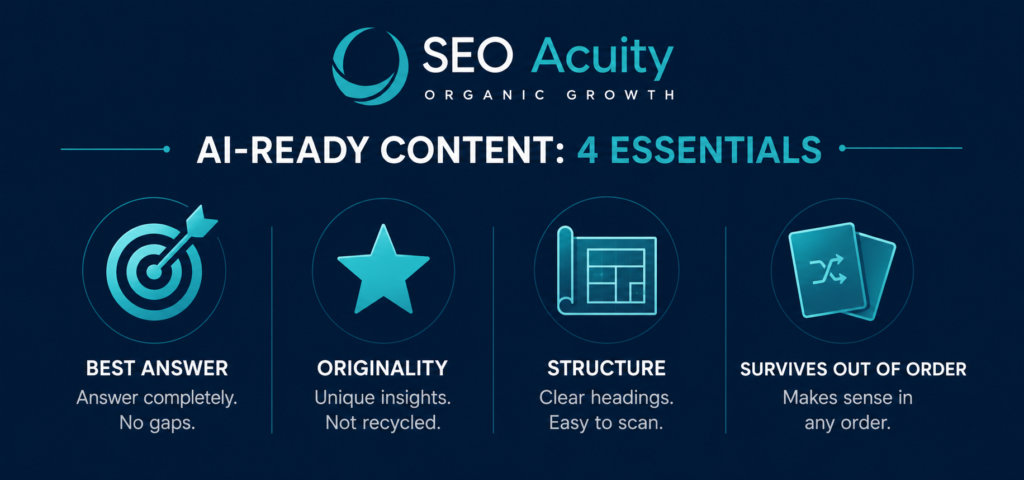
1. Shift From Ranking for a Keyword to Providing the Best Answer
AI search optimization is no longer focused on matching a single keyword. Instead, the goal is to provide the most accurate, complete, and trustworthy answer to the user’s underlying question.
To achieve that, keep these principles in mind:
- Focus on answering the intent behind the query, not just repeating the target keyword.
- Provide the clearest and most complete answer for each question your audience is likely to ask.
- Support your answers with accurate, authoritative information to strengthen credibility and increase the likelihood of being referenced by AI systems.
- Place the direct answer immediately after the heading. For example, if the heading asks “What does [X] cost?”, Answer the pricing question immediately, then expand on the details afterward.
- Use additional details to expand the answer, rather than delaying the main response with lengthy introductions.
This shift represents one of the core principles of SEO Strategy for AI Search Generative Engine Optimization, where content is optimized to become the best available answer instead of simply ranking for a keyword.
2. Originality and E-E-A-T Now Carry More Weight Than Repetition
AI systems are increasingly able to identify and deprioritize content that just restates what’s already been said elsewhere. What earns trust instead:
- Original data and first-hand research.
- Genuine practitioner expertise.
- A real point of view, not a neutral restatement.
- Documented mistakes or edge cases competitors gloss over.
Content that merely repeats known facts is easy for these systems to bypass in favor of a more original source.
3. Structured, Clean Architecture Makes Content Usable by Machines
Clear page hierarchy, semantic structure, and properly implemented schema play a critical role in helping search engines and AI systems interpret your content accurately.
When these elements are well organized, they make it easier to understand, retrieve, and reuse the information on your page.
- Use a logical heading hierarchy so each section clearly reflects its place within the overall topic.
- Build a semantic page structure that helps search engines and AI models understand the relationship between different sections of your content.
- Implement schema markup correctly to provide additional context about your page and improve content interpretation.
- Avoid skipping heading levels, such as jumping directly from an H1 to an H4, as this disrupts the content hierarchy.
- Don’t use headings solely for visual styling. Every heading should introduce a distinct topic rather than serve as a formatting element.
- Maintain a clear content structure, as both Google and AI crawlers rely on it to identify what your page covers and determine how confidently they can retrieve or reference your information.
This is one of the most common technical gaps covered in
4. Content Needs to Survive Being Read Out of Order
Every section should make sense if it’s the only thing an AI system pulls. Phrases like “as mentioned earlier” or “let’s look at the next factor” work fine for a human reading top to bottom — they fail completely for a system extracting one paragraph in isolation.
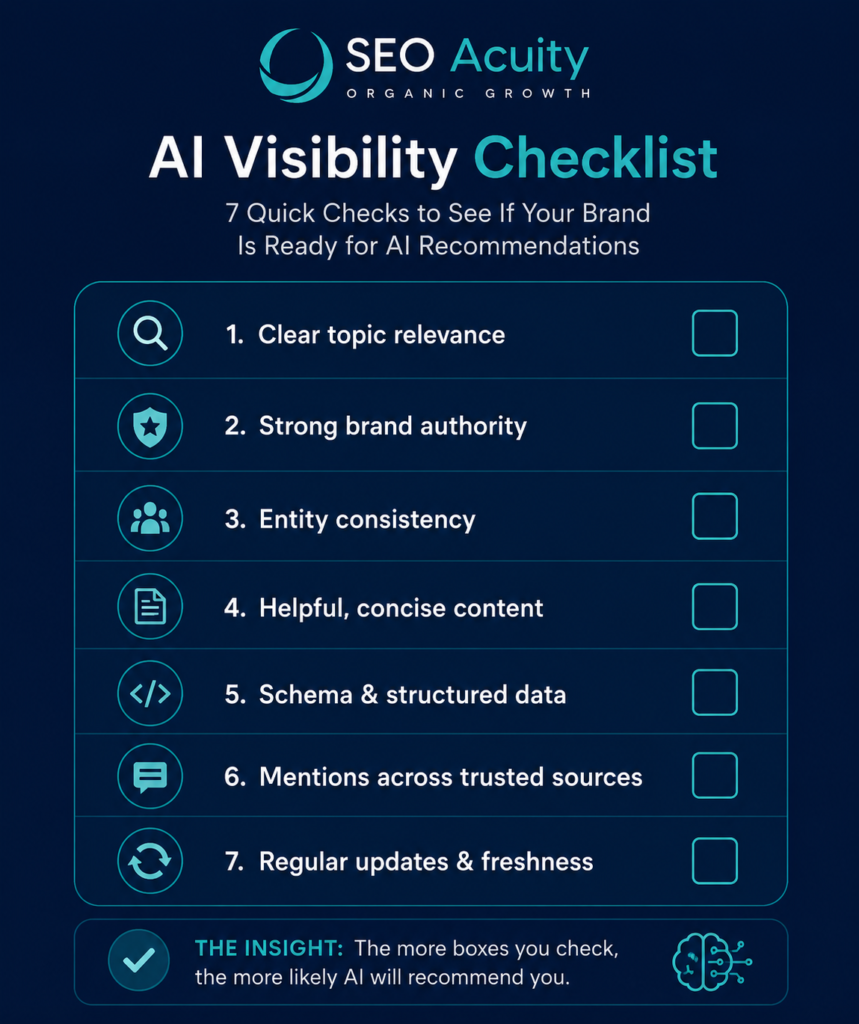
A Quick Readiness Checklist
Use this to get a rough read on where your own site stands today:
- Crawlability — Can AI crawlers (GPTBot, ClaudeBot, and others) actually reach your content, or are they blocked in robots.txt?
- Rendering — Is your key content visible in raw HTML, or does it only appear after JavaScript runs? Most AI crawlers don’t render JavaScript.
- Structure — Does every page follow a clean H1 → H2 → H3 hierarchy with no skipped levels?
- Schema — Is structured data (Organization, Product, FAQ, Article) implemented sitewide, not just on a handful of page types?
- Direct answers — Does each major heading get answered in the sentence immediately following it, before context or caveats?
- Section independence — Could you lift any given paragraph out of the page and have it still make complete sense on its own?
- Freshness and accuracy — Is the information current, and does it avoid vague or contradictory claims that would confuse how an AI system interprets the page?
If more than a couple of these are shaky, that’s usually the actual gap — not a lack of “AI SEO tactics,” but unresolved fundamentals the AI layer is sitting on top of.
How to Measure Whether It’s Working?
Traditional SEO metrics and AI visibility metrics answer different questions, and tracking only one gives you an incomplete picture:
a. Rankings and organic traffic
(Google Search Console, Google Analytics) tell you whether you’re being found through traditional search.
b. AI Overview appearances
visible in tools like Semrush’s Organic Rankings report under SERP feature filters — tell you whether Google’s own AI layer is already citing you.
c. AI mentions and citations
across platforms like ChatGPT and Perplexity tell you whether you’re showing up in the answer itself, not just the index behind it.
This split is exactly what separates ChatGPT SEO Strategy and Optimization from Perplexity SEO Optimization Strategy as distinct tracking exercises.
d. Share of voice against competitors
This AI-generated response tells you whether you’re winning or losing the category conversation, not just individual keywords.
If you’re only watching rankings, you can look completely healthy in one system while being entirely absent from the other.
SEO Acuity doesn’t treat AI search readiness as a bolt-on service sold separately from SEO. It’s built into the same technical and content foundation from the start — because a site engineered with clean information architecture, sitewide schema, and genuine topical authority is already positioned for AI retrieval, not retrofitted for it later.
GEO and AEO are delivered as a structural layer of the Organic Growth Foundation™ and carried through the Organic Growth Retainer™ — not as an upsell to a finished SEO engagement.
For a step-by-step walkthrough of how this works in practice, see:
The Results This System Is Built to Produce
| Metric | Figure |
| Brands scaled globally | 50+ |
| Average traffic growth benchmark | 10x across engagements |
| Client retention rate | 97% |
These are compounding growth results — not one-time traffic spikes.
The same principle is documented in practice in
What This Looks Like in Client Work?
Two engagements that show the same integrated approach in action:
- Sabbar (Saudi Arabia marketplace) — technical foundation, content architecture, and authority-building delivered as one system, not three disconnected workstreams competing for the same budget.
- Bakkah (GCC training and certification authority) — the same principle applied to a content-heavy, multi-category domain where topical authority and AI retrievability had to scale together.
In both cases, the work wasn’t structured as SEO first, AI readiness second. The two were engineered in parallel from the foundation up.
Ready to Build a Foundation That Works for Both Search and AI?
Chasing AI visibility on top of a technically weak site — or defending traditional rankings while ignoring how AI systems retrieve content — both leave real growth on the table.
SEO Acuity architects one organic growth system engineered for traditional search rankings and AI citation from the same foundation, so neither channel is left playing catch-up.
Request Your Custom Market Dominance Plan Today
Conclusion
SEO still matters — and the growth of AI search doesn’t change that, it reinforces it. AI systems have no independent way to generate accurate, trustworthy answers without a well-indexed, well-structured web to draw from, and that web is built through the same SEO discipline that’s always mattered:
- Crawlability
- Authority
- Clarity
- Genuinely original expertise.
But ranking well and being retrievable aren’t automatically the same thing — a page can be well-optimized by every traditional measure and still go unseen in an AI answer if its best content is buried, its structure is unclear, or its sections can’t stand on their own.
The businesses at risk aren’t the ones still investing in SEO fundamentals — they’re the ones abandoning those fundamentals to chase AI tactics on a foundation that was never built to support either.
The right question was never “SEO or AI search.” It’s whether your organic growth system is architected to win both at once.
Frequently Asked Questions
Here are quick, direct answers to the questions people most often ask about SEO’s role as AI search continues to grow.
As AI search continues to expand, is SEO still essential?
Yes. AI search systems retrieve and synthesize answers from the same indexed, structured web that traditional SEO builds and maintains.
Without strong SEO fundamentals, there’s often no reliable content for an AI system to cite in the first place.
Is SEO still worth it with AI search taking over more queries?
Yes. Traditional organic search still delivers the majority of measurable traffic and revenue for most businesses, and the technical and content signals that earn strong rankings are largely the same signals that earn AI citations.
Which deserves greater attention today: AI search optimization or traditional SEO?
No — this treats the two as competitors when they share the same foundation.
The better approach is sequencing: build a technically sound, well-structured SEO foundation first, then layer AI-specific structuring on top of it.
Can a site rank well on Google and still be invisible in AI search results?
Yes. Ranking depends on page-level signals like backlinks and technical health. AI visibility depends on whether individual sections of a page can be understood and trusted in isolation. A page can satisfy the first and fail the second if its content isn’t structured for extraction.
Do AI systems create their own information, or do they rely on existing content?
AI systems don’t generate facts independently. They synthesize responses from existing indexed web content, which means a site’s visibility to AI is directly tied to whether that content is crawlable, structured, and discoverable in the first place.
How does SEO strategy need to change for the AI search era?
The core work shifts from targeting a keyword to providing the clearest, most complete answer to the question behind it, with more emphasis on original expertise, clean structural hierarchy, and sections that make sense read in isolation — not just repeated keyword placement.
How do I know if my AI search optimization is actually working?
Track it separately from traditional SEO metrics. Watch AI Overview appearances alongside rankings, and monitor brand mentions, citations, and share of voice across platforms like ChatGPT and Perplexity — rankings alone won’t tell you whether you’re showing up in the answer itself.