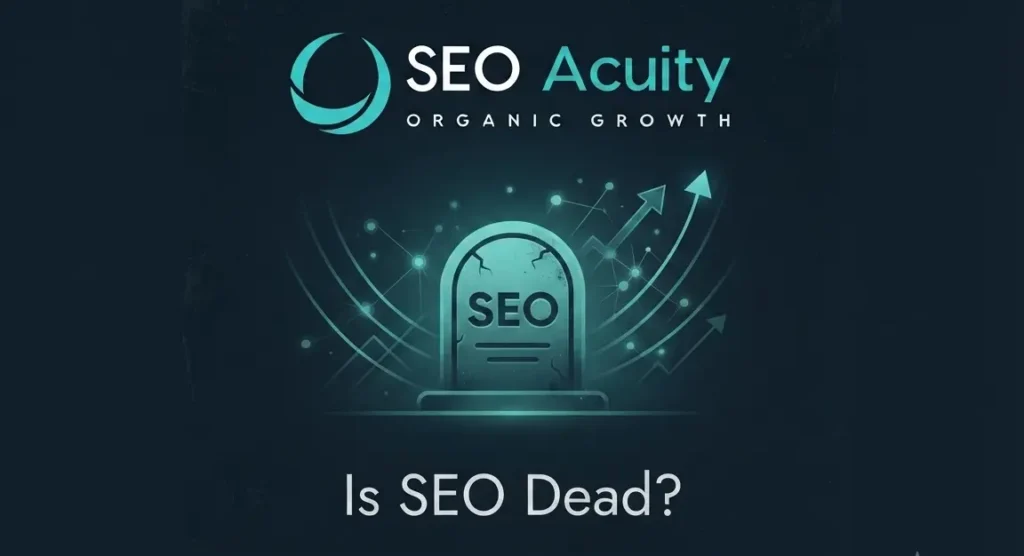
SEO is not dead. Organic traffic drops are concentrated in shallow, informational content. Sites built around BOFU and MOFU content saw as little as a 2.5% user decline year-over-year.
| Key Takeaways |
| A study of 40,000 US websites shows BOFU/MOFU-focused sites saw only a 2.5% YoY organic user decline in 2025 — not the 40–60% widely cited |
| AI Overviews appear in approximately 67% of B2B queries but function as a qualification layer, not a traffic wall |
| Zero-click searches account for ~60% of Google queries — filtering out low-intent visitors who rarely converted in the first place |
| GEO is not a new discipline — it formalizes the same principles well-executed SEO has always required |
| Shallow informational content, random backlinks, and keyword-first strategies without intent mapping are what’s actually dying |
The “SEO is dead” posts are impossible to miss on LinkedIn right now. GEO courses are selling. Some agencies are closing. And traffic graphs at a lot of companies look genuinely alarming.
Here’s the problem: the numbers are real. The interpretation isn’t. This article goes through what the data actually shows — what’s declining, what’s holding, and what the shift means for businesses trying to build organic growth that compounds instead of collapses.
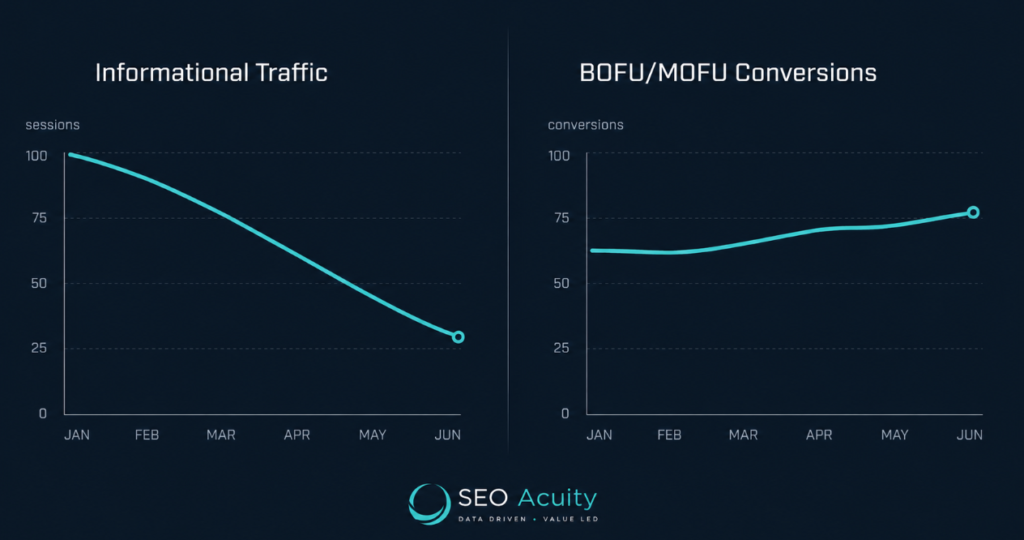
What Do the Traffic Drop Numbers Actually Show?
What the traffic drop numbers actually show is a tale of two content strategies. Overall declines are real, but 2025 data separates sites built for volume from sites built for intent — and the outcomes are vastly different.
The critical distinction lies in what type of content made up the majority of a site’s organic footprint before the shift.
Why Are Some Sites Losing 40–60% of Organic Traffic?
The sites reporting the steepest drops share a common content profile. Around 80% of their pages were informational: “What is…” articles, definition posts, “Best 10…” roundups with no commercial direction or conversion path.
AI Overviews now appear in approximately 67% of B2B queries. General questions that previously drove blog traffic? They’re answered directly in the results page now.
Zero-click searches account for around 60% of Google queries. A user who searches “what is programmatic SEO,” reads a snippet, and closes the tab was never going to convert into a customer. That visit leaving doesn’t cost the business anything real.
What Happens to Sites Built Around Purchase Intent?
The same study of 40,000 US websites tells a different story for BOFU and MOFU content. Sites where pages served users in decision-making mode — evaluating options, comparing solutions, ready to act — saw only a 2.5% year-over-year decline in organic users.
Not 40%. Not 60%. Two and a half percent.
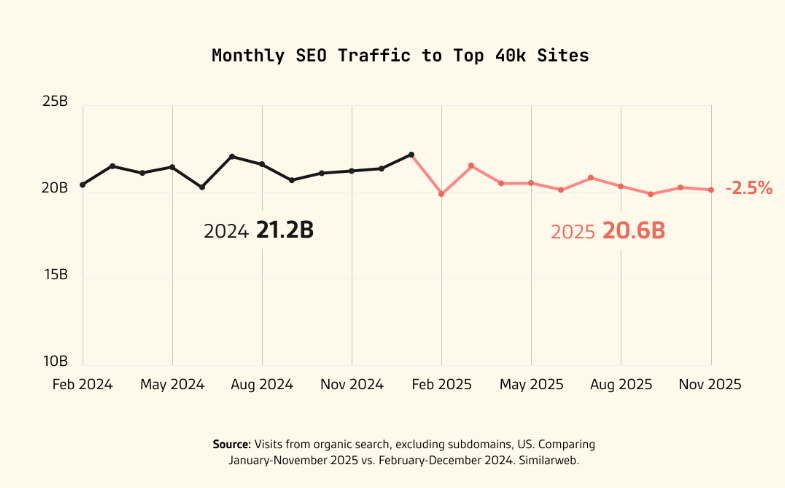
That number reframes the entire debate. The businesses experiencing catastrophic drops built content programs for traffic volume, not revenue contribution. AI accelerated the exposure of a structural problem that already existed.
If your content is mostly informational with no conversion architecture, the problem isn’t AI — it’s the absence of a real organic growth system. SEO Acuity’s B2B SEO practice starts with mapping demand to revenue before a single page is touched.
Start Your SEO / GEO / AEO Journey Today With a FREE Consultation

Does Zero-Click Search Actually Hurt Business Results?
Zero-click search does not necessarily hurt business results — it depends entirely on the intent level of the traffic being displaced.
Sites losing high volumes of zero-click traffic are losing visits from users who were satisfied with a snippet answer.
Sites built around decision-stage content are largely unaffected, and in several cases seeing improved lead quality despite lower session counts.
Why Is Traffic Down but Conversions Stable at Intent-Focused Sites?
The logic is simpler than it sounds. When an AI Overview answers a general question, it removes the informational browsing layer from your traffic.
The users who still click through are different. They’ve processed the summary. They decided they need more — depth, specificity, or a vendor to trust.
That isn’t a casual visitor. That’s someone further along the decision path than most organic visitors used to be before they arrived.
Conversion rates at intent-focused sites are holding or improving despite lower raw traffic numbers. The filter tightened. The quality improved.
What Does This Actually Look Like in Practice?
Case in Practice: SEO Acuity rebuilt Buruj Academy’s site around a BOFU-first architecture, deliberately removing high-traffic informational pages that were attracting browsers instead of prospective students.
Traffic dropped as designed. The client hit their full annual enrollment target within one month of launch — and eliminated paid advertising entirely within 30 days.
The mechanism: when the pre-visit filter tightens, the visitors who arrive are already further along the decision journey.
The deeper pattern here matters beyond one engagement. AI Overviews do part of the funnel work before the visitor arrives.
By the time someone clicks through, they’ve already been pre-qualified by the content they read in the results page. That’s the dynamic behind stable revenue on declining traffic.
SEO Acuity’s analysis of how organic growth strategy adapts to AI search environments covers this behavioral shift in full.

Is AI Replacing Google — and Taking SEO With It?
AI is not replacing Google, and it is not taking SEO with it. Understanding why requires a clear-eyed look at how generative AI systems actually function — not how they’re described in trend pieces. The short version: every layer of AI search infrastructure depends on indexed web content and functioning search engines to operate.
How Does AI Search Actually Work?
Generative AI systems operate across three functional layers.
Baseline understanding comes from training on the indexed web. The model learns from content that was crawled, indexed, and structured by the SEO ecosystem.
RAG (Retrieval Augmented Generation) drives real-time answers. When you ask ChatGPT, Perplexity, or Google AI Mode a current question, it queries the live web — through search engines — to retrieve up-to-date information.
Precision signals — schema markup, structured data, entity signals — are how AI systems determine confidence in their citations. These are the exact technical foundations that rigorous SEO implementation builds.
None of this works without a functioning web index. None of it works without SEO. The AI doesn’t replace the ecosystem. It runs on top of it.
What Do Google’s Own Business Metrics Show?
Google’s search ad revenue reached $82 billion in 2025 — a 14% increase year-over-year. The platform processes approximately 16 billion queries daily and holds over 90% of global search market share.
That’s not decline. That’s growth on a mature platform that absorbed AI into its core product without losing structural dominance.
SEO Acuity’s full breakdown of the Google competitive picture is covered in the analysis of whether Google is dead.
Technical SEO — schema implementation, crawl architecture, structured data — is now the primary signal layer for both traditional ranking and AI retrieval. If your technical foundation isn’t built for both, your content is invisible in both environments.
Explore SEO Acuity’s Technical SEO Services →
Start Your SEO / GEO / AEO Journey Today With a FREE Consultation

Is GEO Actually a New Framework — or Rebranded SEO?
GEO (Generative Engine Optimization) is not actually a new framework — it is a stricter application of the same principles that effective SEO has always required.
When you break down what GEO prescribes, the list looks familiar to anyone who has done rigorous organic strategy work: structured content, intent analysis, authority building, entity signals, technical precision, and schema implementation.
What Does GEO Actually Prescribe?
| GEO Requirement | SEO Equivalent |
| Structured content | Information architecture + schema |
| Intent analysis | Keyword and demand mapping |
| Authority building | E-E-A-T + link acquisition |
| Brand mentions | Entity signals + citation building |
| Technical optimization | Core Web Vitals + crawlability |
| Schema implementation | Structured data |
The businesses currently appearing as AI citations — across ChatGPT, Perplexity, Google AI Mode — aren’t there because they implemented a GEO framework.
They’re there because they built real depth: entity signals, structured content, genuine authority, and conversion paths. They were doing the underlying work. GEO named it.
Good SEO has always worked on any search engine — Google, Bing, ChatGPT, Gemini, Perplexity. The principles don’t change by platform. The surface does. SEO Acuity’s full comparison of whether GEO and AEO actually replace SEO covers this distinction in full.
What Kind of SEO Is Actually Dead?
The kind of SEO that is actually dead is surface-level — tactics that generated traffic metrics without building any real organic asset. These approaches were already weakening before AI search expanded. What AI did was accelerate the exposure, removing the informational traffic buffer that made weak programs look like they were working.
Which Specific Practices Have Lost Their Effectiveness?
There are some practices falling under the framework of SEO that have completely lost their effectiveness and utility in light of this transformation we are witnessing, including the following:
1. Informational content without business context
“What is X” articles written to capture a keyword with no funnel connection. AI Overviews answer these. Your blog post no longer needs to compete there.
2. Keyword targeting as a strategy
Choosing 50 keywords and publishing pages against each — without mapping intent, funnel position, or conversion architecture. Volume without direction was always going to plateau.
3. AI-generated content without original insight
Publishing at scale with no proprietary perspective, no original data, no real expertise signal. Generative systems are trained on this kind of content. They don’t cite it.
4. Random backlinks
Directory links, irrelevant guest posts, manipulative link schemes. The entity-based citation model underlying AI search makes this approach even less relevant than it already was.
5. Traffic as the primary KPI
Session counts on a dashboard while revenue impact remains undefined. This is what “SEO is dead” stories almost always actually describe — not SEO failing, but traffic theater being exposed.
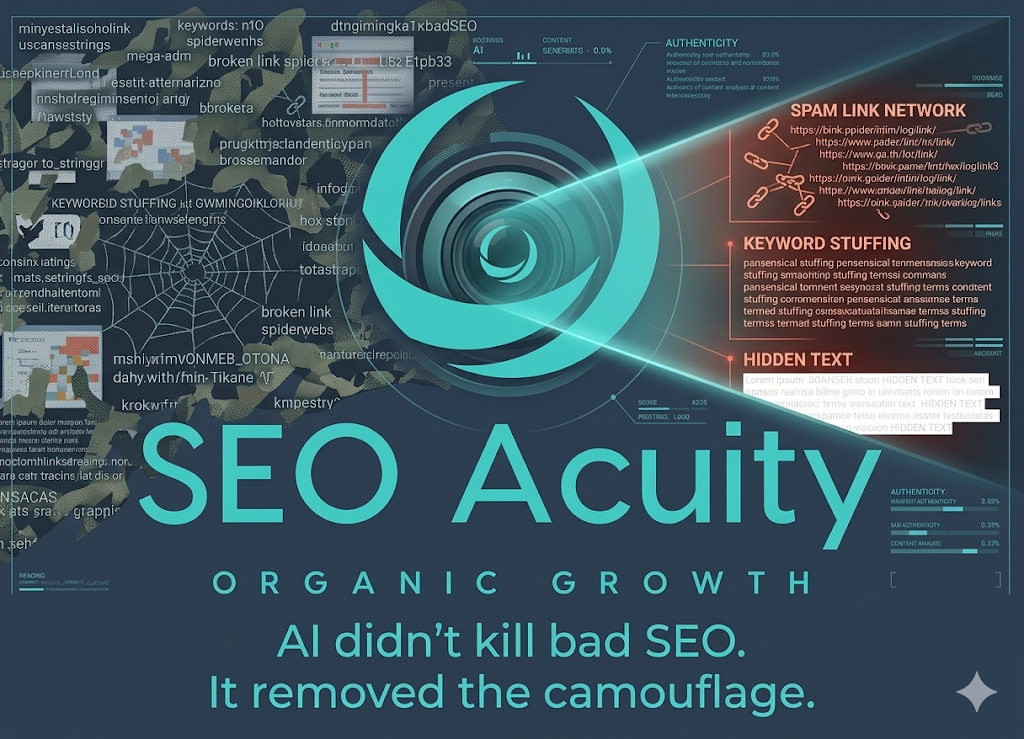
The right framing: AI didn’t kill bad SEO. It removed the camouflage.
What Does Effective Organic Visibility Look Like Now?
Effective organic visibility now looks like a multi-signal system built around entity authority, intent-matched content, and genuine retrievability by AI and traditional search alike. The businesses whose organic channels are compounding — rather than declining — have made a specific set of shifts that distinguish their approach from the traffic-first era.
1. From Keyword Engineering to Entity Engineering
Entity Engineering is the practice of building your brand, products, and expertise into a structured node within knowledge graphs — so search engines and AI systems can confidently retrieve and recommend you.
This goes beyond keyword selection. It requires consistent brand signals across the web, structured data that describes your entity, and mentions in sources credible enough to function as verification.
This is the foundation of SEO Acuity’s Organic Growth Foundation™ — the strategic phase that maps your brand as an entity before any content or link work begins.
2. From Link Building to Mention Building
Backlinks retain value. But AI citation systems weight mentions — unlinked brand references in authoritative publications — more heavily than traditional link acquisition suggested.
A quote in a trade publication, a reference in an industry analysis, a mention in a well-sourced comparison article — these carry authority signal weight that a directory backlink never approached.
Building that kind of presence requires real positioning work. It’s not a tactic. It’s a reputation system.
3. From Ranking to Retrievability
The question used to be: “How do I rank #1 for this keyword?”
The question now is: “How does a generative AI system retrieve and recommend my content when a qualified prospect asks?”
Retrievability requires BOFU and MOFU content addressing real decision-stage questions, original research or proprietary data not available elsewhere, and schema implementation built with deliberate intent — not auto-generated by a plugin.
It also requires a multi-platform presence — across Google, LinkedIn, YouTube, Reddit, and industry publications — not just a well-optimized website.
The shift is from a ranking game to a visibility system. The businesses building for this framing are the ones compounding. The ones waiting for conditions to revert are the ones declining.
Conclusion
The data doesn’t support “SEO is dead.” It supports something more precise: shallow SEO is no longer viable, and the businesses seeing 2.5% declines versus 60% declines made different architecture choices — not different channel choices. The organic channel isn’t what’s broken. The strategy behind most organic programs is.
Build an Organic Growth System Tied to Your Business Results With SEO Acuity
Most organic traffic problems aren’t caused by AI or algorithm shifts. They’re caused by building a content program around traffic volume instead of revenue architecture — and that gap is now visible in a way it wasn’t two years ago.
Here’s what working with SEO Acuity actually looks like:
- Architecture before execution.
We design your organic growth system before we touch a single page — structure, demand mapping, and revenue alignment first.
- We share the risk.
Our engagements are tied to specific, agreed KPIs. If you don’t hit the targets, we don’t call it a success.
- GCC-native strategy.
We work at the behavioral level — understanding how searchers in KSA, UAE, and across the Gulf actually discover, evaluate, and convert.
- Revenue alignment, not traffic theater.
Every decision maps back to your business outcomes, not a vanity dashboard.
- Focused attention.
We work with 7–9 clients at a time — by design. You get a growth partner, not an account manager.
If your organic channel isn’t generating qualified leads, the structural conversation is worth having.
Start Your SEO / GEO / AEO Journey Today With a FREE Consultation

Frequently Asked Questions
Is SEO dead in 2025?
No, SEO is not dead in 2025. A study of 40,000 US websites found that sites with strong BOFU and MOFU content saw only a 2.5% year-over-year decline in organic users — compared to 40–60% drops for sites built primarily around informational content. The organic channel is narrowing, not disappearing. What’s dying is the surface-level version: traffic-first programs with no conversion architecture and no revenue alignment.
Does AI Overview hurt organic traffic?
AI Overview does reduce the traffic volume reaching generic informational content — that part is accurate. But for pages targeting users with real purchase intent, the effect is different. AI Overview filters out low-intent visitors, meaning the clicks that come through tend to represent users who have already processed the general answer and are looking for depth, comparison, or a specific vendor. Conversion rates at intent-focused sites are stable or improving despite lower total traffic numbers.
What is the difference between GEO and SEO?
GEO (Generative Engine Optimization) and SEO (Search Engine Optimization) are not different disciplines — GEO is a stricter application of SEO principles focused specifically on citation by generative AI systems. The practices GEO prescribes — structured content, intent mapping, entity signals, authority building, schema implementation — are the same practices that well-executed SEO has always required. Sites already doing rigorous SEO are appearing in AI citations without implementing any separate GEO framework on top.
What SEO tactics no longer work in 2025?
The SEO tactics that no longer work in 2025 include: generic informational content with no commercial intent or conversion path, keyword targeting without demand-to-revenue mapping, AI-generated content volume without original insight or expertise signal, random backlink acquisition from irrelevant sources, and traffic-volume measurement without revenue attribution. These approaches were already weakening before AI search expanded. What AI did was remove the informational traffic buffer that made weak programs look viable.