Your Shopify store can have great products, a polished theme, and fair prices, yet still receive almost no visitors from Google. For most new store owners, the missing piece is not design or inventory. It is search visibility, and that is exactly what Shopify SEO basics are designed to fix.
This guide explains Shopify SEO for beginners in clear, practical terms. It covers how search engines evaluate an online store, how to choose keywords with buying intent, and how to optimize product pages, images, and technical settings without needing a developer.
You will also see where most beginners go wrong, what a structured SEO process looks like, and when it makes sense to bring in a specialist team such as SEO Acuity to accelerate organic growth.
What You Will Learn
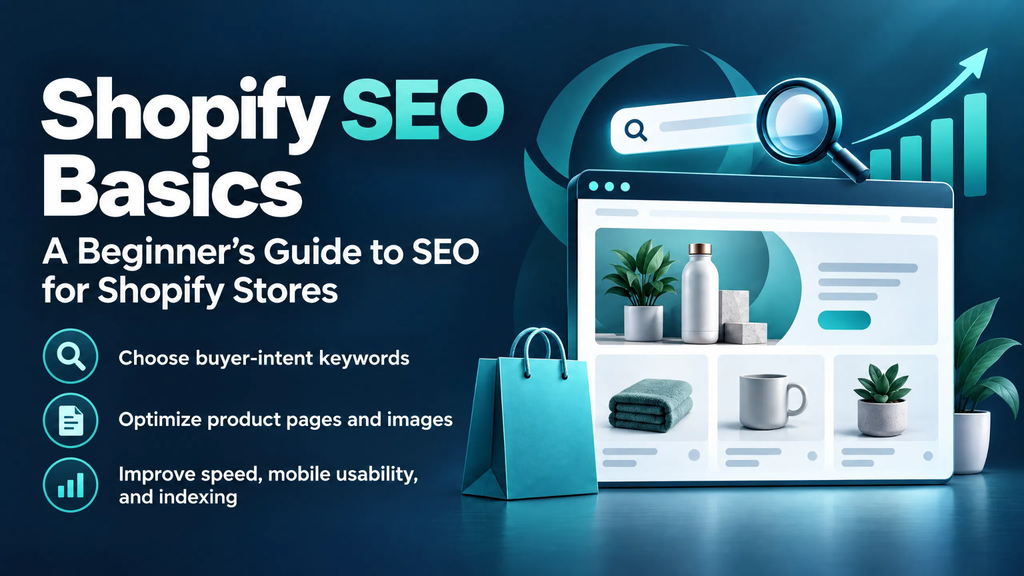
- Shopify SEO is the process of optimizing a Shopify store so its pages appear in organic, unpaid search results for relevant product searches.
- Keyword research based on buyer intent determines which product and collection pages can realistically attract customers ready to purchase.
- Title tags, meta descriptions, product descriptions, URLs, and image alt text are the core on-page elements every beginner should optimize first.
- Technical foundations such as page speed, mobile usability, and Google Search Console setup help search engines crawl and index a Shopify store correctly.
- SEO is a continuous process, and a structured audit is the fastest way to find the issues limiting a store’s organic visibility.
Shopify SEO Basics Explained
Shopify SEO is the practice of optimizing a Shopify store’s content, structure, and technical setup so that its pages rank in search engines like Google and Bing without paid advertising. The goal is to match store pages with the queries potential customers type when they look for products.
Search engines use automated programs called crawlers to discover pages, store them in an index, and then rank indexed pages by how relevant and useful they are for a specific search query.
A Shopify store that is easy to crawl and clearly relevant has a better chance of appearing in those results.
Factors That Influence How a Shopify Store Ranks
Google uses many signals to determine how pages rank in search results, but it does not publish a complete list of these factors or their exact weight.
However, established SEO practices consistently highlight several key areas that store owners can directly influence to improve their website’s visibility and search performance.
By focusing on these areas, businesses can build a stronger SEO foundation, attract relevant visitors, and create a better experience for potential customers.
- Relevance: how closely a page’s content matches the meaning and intent behind a search query.
- Content quality: whether product and collection pages provide useful, original information rather than thin or copied text.
- Authority: links and mentions from other reputable websites that signal trust in the store and brand.
- Page experience: fast loading, mobile usability, and secure browsing over HTTPS, which Shopify provides by default.
Ready to Improve Your Search Engine Rankings?
Accelerate your organic growth and scale your business leads with our data-driven SEO strategies.
Get a Free Quote NOW!Keyword Research for Shopify SEO Beginners
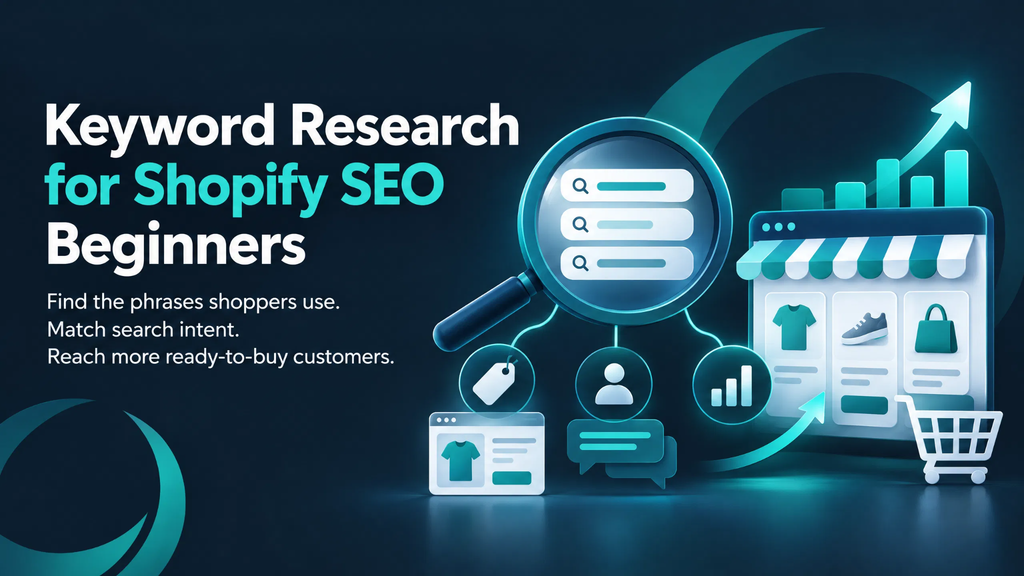
Keyword research is the process of identifying the exact words and phrases potential customers use when searching online for products.
For a Shopify store, it plays an important role in shaping the entire SEO strategy. It helps determine which pages should be created, what search terms each page should target, and how product titles and descriptions should be written.
By choosing relevant keywords based on customer search intent, store owners can make their products easier to find, attract more qualified visitors, and connect with shoppers who are more likely to make a purchase.
1. Focusing on Search Intent and Buying Keywords
Search intent is the purpose behind a query. For example, “handmade lavender soap bar” shows buying intent, while “how is handmade soap made” is informational. Shopify product and collection pages should target buying-related keywords, while blog posts focus on informational searches.
Long-tail keywords are specific phrases with less competition and clearer intent. For example, “organic goat milk soap for sensitive skin” is more targeted than “soap.”
For large catalogs, Programmatic SEO can help create structured pages for keyword variations, as long as each page provides unique, useful content.
2. Keyword Research Tools for Shopify Stores
Several keyword research tools can help Shopify store owners identify relevant search terms, estimate search volume, and understand how competitive specific keywords are.
They also provide related keyword suggestions and insights into what potential customers are searching for.
Using these tools makes it easier to choose the right keywords for product pages, collection pages, and blog posts.
The table below highlights some popular options, explains their main features, and shows how each tool can support your Shopify SEO strategy.
Read also: Seo For Brand Visibility – A Complete Guide
| Tool | Best Used For | Cost |
|---|---|---|
| Google Keyword Planner | Search volume ranges and keyword ideas from Google Ads data | Free with a Google Ads account |
| Google Search Console | Queries your store already appears for, with clicks and impressions | Free |
| Semrush | Keyword difficulty, competitor keyword analysis, and SERP research | Paid, with limited free access |
| Ahrefs | Competitor rankings, keyword gaps, and backlink research | Paid |
| Ubersuggest | Beginner-friendly keyword suggestions and long-tail ideas | Freemium |
On-Page SEO Basics for Shopify Product and Collection Pages
On-page SEO is the optimization of elements within each page, including text, headings, metadata, URLs, and images. Shopify gives store owners direct control over most of these elements through the “Search engine listing” section on every product, collection, page, and blog post.
Applying these settings across a growing catalog takes time and consistency. Store owners who prefer expert support can rely on a dedicated Shopify SEO service to optimize product and collection pages based on real keyword data.
1. Title Tags and Meta Descriptions
A title tag is the HTML element that names a page in search results, and a meta description is the short summary that often appears beneath it.
A common guideline is to keep Shopify title tags around 50–60 characters and meta descriptions around 150–160 characters so they are less likely to be truncated.
Each title tag should include the page’s main keyword near the beginning and be unique across the store.
Google may rewrite meta descriptions, so the description should accurately summarize the page and give searchers a clear reason to click rather than repeating keywords.
2. Unique Product Descriptions
Product descriptions should be original, specific, and written for customers rather than copied from manufacturers. They should highlight key benefits, specifications, materials, sizing, and usage in a clear, easy-to-scan format.
Well-structured product information also helps search engines and AI tools understand your products. Optimizing for generative AI search engines can make these details easier for AI-powered search systems to understand and reference.
3. SEO-Friendly URLs
An SEO-friendly URL is short, readable, and describes the page content. Shopify uses fixed prefixes such as /products/ and /collections/, but the final part of the URL, called the handle, can be edited to include the product’s main keyword, for example /products/organic-goat-milk-soap.
When changing the handle of an existing Shopify page, keep the option to create a URL redirect enabled. The redirect sends visitors and search engines from the old address to the new one, which helps prevent broken links and lost traffic.
4. Image Optimization for Shopify
Image optimization for Shopify covers three tasks: descriptive file names, accurate alt text, and reasonable file sizes. Alt text is a written description of an image that helps screen-reader users and helps search engines understand what the image shows.
A file named “IMG_4521.jpg” tells Google nothing, while “organic-goat-milk-soap-bar.jpg” describes the product clearly. Compressing large images before upload also helps product pages load faster, especially on mobile connections.
Ready to Improve Your Search Engine Rankings?
Accelerate your organic growth and scale your business leads with our data-driven SEO strategies.
Get a Free Quote NOW!5. Internal Linking Between Store Pages
Internal linking is the practice of linking one page on your website to another page on the same website. In a Shopify store, internal links from collections to products, from products to related items, and from blog posts to product pages help search engines discover pages and understand how they relate.
Watch A Real Of SEO Acuity
Not every business needs SEO from day one. Watch the video to discover when SEO becomes a smart investment and how to make the most of it.
Technical SEO Basics for Shopify Stores
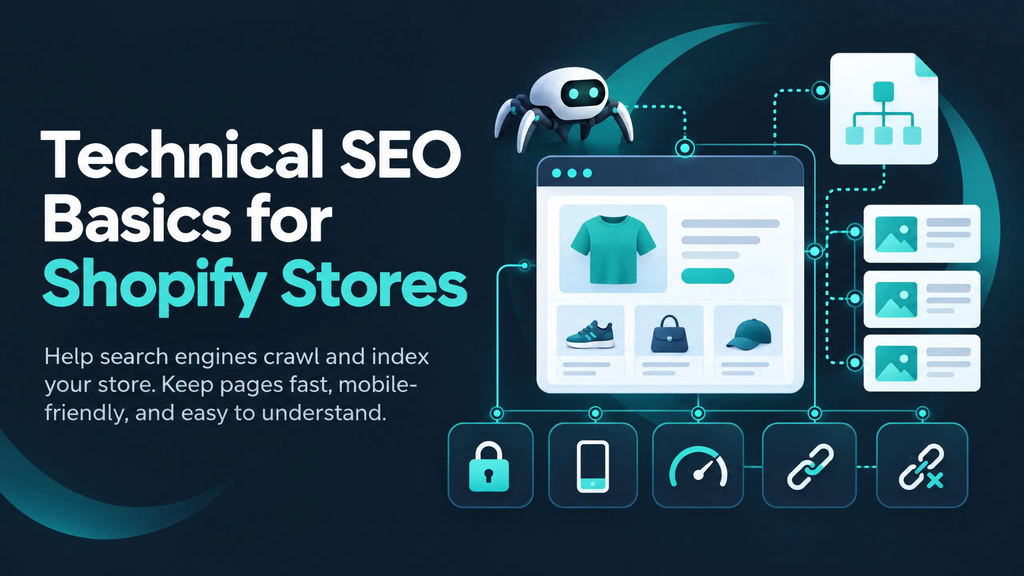
Technical SEO focuses on improving a website’s infrastructure so search engines can crawl, render, and index its pages efficiently. Shopify automatically handles several essential technical tasks, including SSL certificates, XML sitemap generation, and canonical tags on product pages.
However, store owners still need to manage other important factors, such as website speed, mobile responsiveness, URL structure, broken links, and duplicate content. Addressing these issues helps search engines understand the store’s pages, improves the user experience, and supports better visibility in search results.
Read also: 5 Seo Marketing Tips – How To Boosting Your Website’s Performance
1. Page Speed and Mobile Usability
Page speed affects both user experience and search performance. Heavy themes, uncompressed images, and too many third-party apps are common causes of slow Shopify stores. Removing unused apps and choosing a lightweight theme are practical first steps.
Google primarily uses the mobile version of a site for indexing and ranking, a practice known as mobile-first indexing. A Shopify store should therefore display products, navigation, and checkout buttons clearly on smaller screens, not only on desktop.
2. Connecting Google Search Console
Google Search Console is a free tool that shows how Google crawls, indexes, and displays a website in search results. Shopify store owners should verify their domain, submit the store’s sitemap, and regularly review indexing reports to catch pages that Google cannot access.
Larger catalogs often develop deeper issues, such as duplicate collection paths, crawl waste from filtered URLs, or structured data errors. In those cases, professional technical SEO services can diagnose problems that basic settings and apps do not address.
Read also: What Is an SEO Audit?
Off-Page SEO and Brand Authority for Shopify Stores
Off-page SEO refers to activities outside your website that influence how search engines and customers perceive it. For Shopify stores, the most important off-page signals are backlinks, which are links from other websites, along with brand mentions, reviews, and visibility across trusted platforms.
Quality matters far more than quantity. A single link from a respected industry publication or niche blog typically carries more value than many links from low-quality directories. Google’s spam policies specifically warn against buying links or using link schemes to manipulate rankings.
Marketplace presence can also strengthen brand visibility. Merchants who sell on both Shopify and Amazon should note that Amazon uses its own search system, which is why SEO for Amazon product listings is usually handled as a separate strategy.
Common Shopify SEO Mistakes Beginners Make
Many Shopify SEO issues beginners face result from a few common mistakes that can affect search visibility, website performance, and user experience. Identifying these problems early helps store owners avoid unnecessary errors and build a stronger SEO foundation.
The table below highlights the most frequent mistakes, explains their potential impact, and provides practical solutions to help improve your store’s search performance.
| Mistake | Why It Hurts SEO | Recommended Fix |
|---|---|---|
| Copying manufacturer descriptions | Creates duplicate content shared with other stores | Write original, benefit-focused descriptions |
| Leaving default title tags | Misses keyword and click-through opportunities | Write a unique title tag for each key page |
| Missing image alt text | Weakens accessibility and image search visibility | Add accurate, descriptive alt text |
| Installing too many apps | Adds scripts that can slow page loading | Audit and remove unused apps |
| Changing URLs without redirects | Causes broken links and lost traffic | Keep Shopify’s redirect option enabled |
| Ignoring Search Console | Hides indexing and crawl problems | Verify the store and review reports monthly |
How SEO Acuity Helps Shopify Stores Grow Organic Traffic
SEO Acuity is an SEO agency that helps businesses, startups, and e-commerce brands strengthen their online presence and attract more organic traffic through structured, data-driven strategies. Its services focus on improving search visibility, increasing relevant website visits, and supporting long-term business growth.
For Shopify stores, SEO Acuity develops strategies that address the platform’s specific structure and requirements, including theme optimization, product and collection pages, technical SEO, and large product catalogs.
By combining technical improvements with targeted keyword research and content optimization, the agency helps store owners build a more search-friendly website and reach potential customers more effectively.
Watch A Real Of SEO Acuity.
Watch the video to explore the real data, uncover what’s actually changing, and discover what the future holds for SEO.
1. SEO Services Available for Shopify and Ecommerce Brands
SEO Acuity offers a range of services designed to support Shopify stores at different stages of growth. Businesses can choose the services that address their current needs, whether they want to improve technical performance, optimize product pages, or attract more organic traffic.
As their stores grow, they can expand their SEO strategy with additional services to strengthen search visibility, reach more potential customers, and support long-term growth.
- SEO audit services: a full review of technical, on-page, and off-page issues affecting the store.
- On-page and off-page SEO services: keyword targeting, content optimization, and ethical authority building.
- Ecommerce and enterprise SEO services: strategies for large catalogs and complex store structures.
- Arabic SEO services and SEO services for startups: localized strategies for Arabic-speaking markets and growth plans for new brands.
2. The SEO Acuity Process and What Clients Can Expect
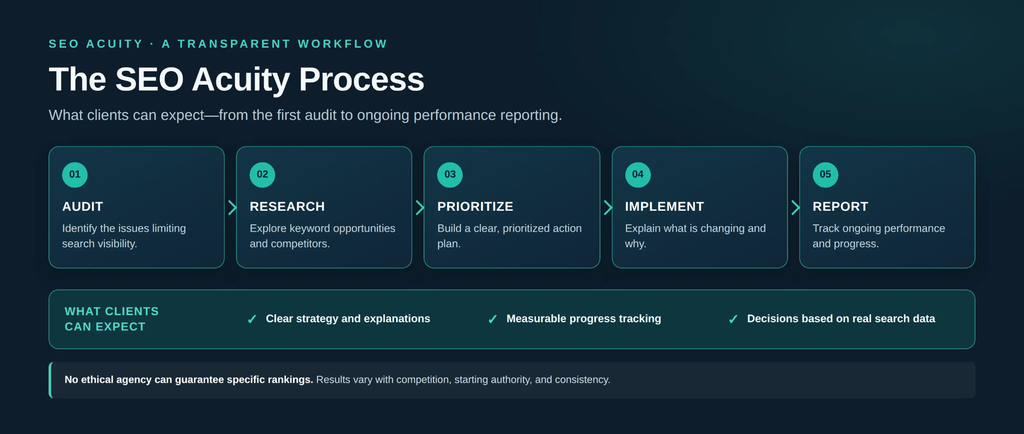
The SEO Acuity process typically begins with an audit to identify the issues limiting visibility, followed by keyword and competitor research, a prioritized action plan, implementation, and ongoing performance reporting. Clients receive clear explanations of what is being changed and why.
SEO results depend on competition, starting authority, and consistency, so no ethical agency can guarantee specific rankings. What businesses can expect from a professional approach is a clear strategy, measurable progress tracking, and decisions based on real search data rather than guesswork.
Ready to Improve Your Search Engine Rankings?
Accelerate your organic growth and scale your business leads with our data-driven SEO strategies.
Get a Free Quote NOW!Get a Shopify SEO Audit and Start Growing Organic Sales
Every week a Shopify store remains invisible in search results, competitors have another opportunity to attract customers searching for similar products.
SEO Acuity offers specialized Shopify SEO services to help store owners identify technical issues, improve website content, and strengthen their organic search visibility. Its specialists can review your store, uncover the factors holding it back, and develop a practical strategy to attract more qualified traffic and potential customers.
Request your Shopify SEO audit today and take the next step toward improving your store’s search performance.
Conclusion
Shopify SEO basics follow a clear process: research keywords with buying intent, optimize product titles, descriptions, URLs, and images, improve technical factors such as website speed and mobile usability, and build authority through quality backlinks and genuine customer reviews.
However, SEO for Shopify is not a one-time task. It requires continuous monitoring, measuring results, and making improvements as the store grows.
By applying these fundamentals consistently, store owners can improve their search visibility, attract relevant traffic, and make it easier for potential customers to discover their products.
Frequently Asked Questions About Shopify SEO for Beginners
Is Shopify good for SEO?
Yes, Shopify is a solid platform for SEO because it includes SSL, automatic sitemaps, canonical tags, and editable metadata. Some limits, such as fixed URL prefixes, exist, but they rarely prevent a well-optimized store from ranking.
How long does Shopify SEO take to show results?
Shopify SEO usually takes several months to show meaningful results, depending on competition, store authority, and consistency. New stores in competitive niches generally need more time than established stores in smaller markets.
Do I need an app for Shopify SEO?
No, most Shopify SEO basics can be handled with built-in settings for titles, descriptions, URLs, and alt text. Apps can help with tasks like bulk edits or structured data, but too many apps can slow the store down.
Can I do Shopify SEO myself as a beginner?
Yes, beginners can handle the fundamentals of Shopify SEO, including keyword research, metadata, and image optimization. Professional support becomes valuable for technical problems, large catalogs, or competitive markets.
What is the most important Shopify SEO task to start with?
Keyword research is the most important first task in Shopify SEO because it determines what every product and collection page should target. Without it, on-page optimization lacks a clear direction.