Most online stores spend their SEO budget in the wrong sequence. They publish content before the technical foundation is solid, chase backlinks before category pages are properly optimized, and target high-competition keywords before capturing long-tail terms that convert at three times the rate. The result is a store that looks active but earns almost nothing from organic search.
Getting seo for ecommerce website right means treating it as a layered investment; each level depends on the one beneath it. Technical infrastructure comes first. Site architecture and on-page optimization follow. Then content, then links, then AI visibility. Skipping that order is how stores end up with well-written product pages that no one ever finds.
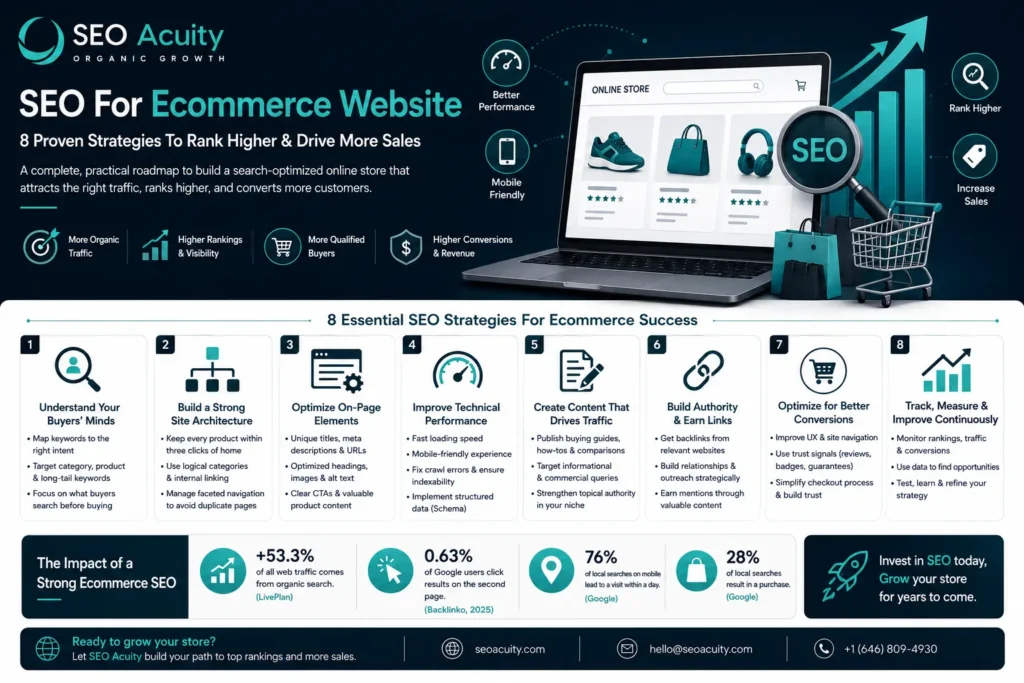
This guide breaks that sequence into eight concrete strategies, built from practical optimization work across hundreds of ecommerce projects. Whether you’re running a Shopify catalog with 200 products or a Magento build with 50,000 SKUs, these principles apply.
1. SEO For Ecommerce Website Actually Demands To Read Your Buyers’ Minds First
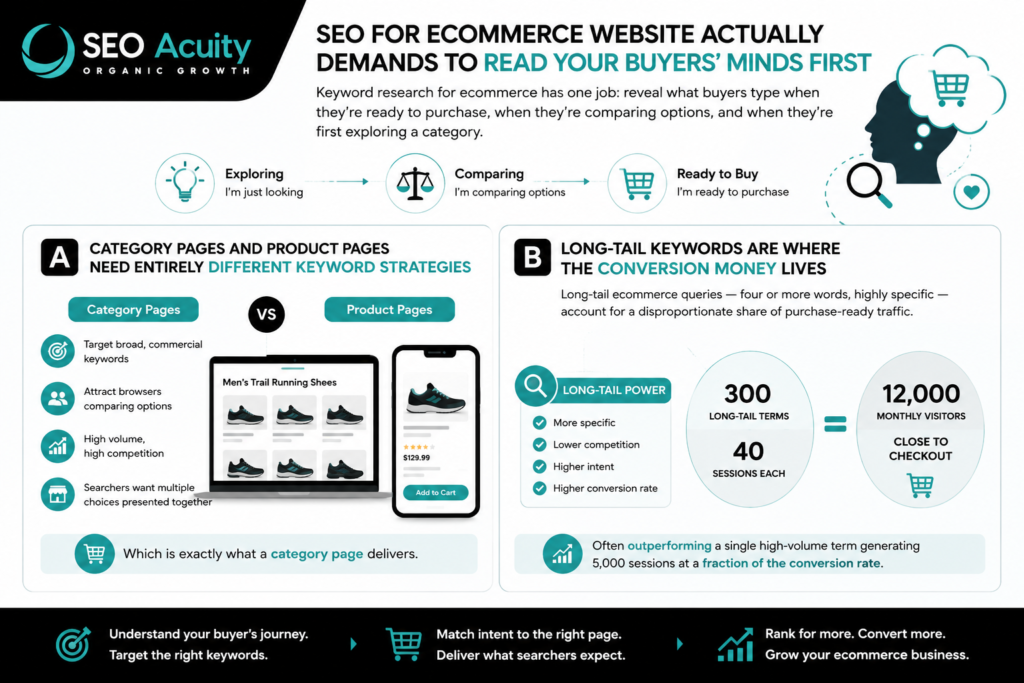
Keyword research for ecommerce has one job: reveal what buyers type when they’re ready to purchase, when they’re comparing options, and when they’re first exploring a category. These three stages map to three keyword types that require different page targets and different content treatments.
Getting this mapping wrong, targeting commercial keywords on product pages, or assigning transactional terms to category pages, is one of the costliest structural errors in ecommerce SEO. It wastes competitive terms on pages that cannot satisfy the intent behind them.
A. Category Pages And Product Pages Need Entirely Different Keyword Strategies
Category pages target broad, commercial keywords: “men’s trail running shoes,” “adjustable standing desks,” “organic dog food.” These attract browsers comparing options — high volume, high competition, commercial intent. The searcher wants multiple choices presented together, which is exactly what a category page delivers.
Product pages target specific, transactional queries: “Brooks Ghost 16 women’s size 8 wide,” “Flexispot E7 Pro standing desk black.” These attract buyers who have already made the category decision and are selecting a specific item. Conversion rates on these pages run 3× to 5× higher than category pages precisely because intent is that specific.
Mapping the wrong keyword type to the wrong page type means either wasting high-volume terms on pages that cannot satisfy them, or burying high-conversion terms inside a page structure designed for discovery, not decision.
B. Long-Tail Keywords Are Where The Conversion Money Lives
Long-tail ecommerce queries — four or more words, highly specific — account for a disproportionate share of purchase-ready traffic. A store ranking for 300 long-tail terms generating 40 sessions each captures 12,000 monthly visitors who are close to checkout — often outperforming a single high-volume term generating 5,000 sessions at a fraction of the conversion rate.
Practical sources for long-tail discovery include Google Autocomplete in incognito mode, Amazon search suggestions, Reddit communities where buyers discuss products, and your own site’s internal search logs. The language buyers use in forums is often exactly what they type into Google — and most competitors are not mining it.
2. Build A Site Architecture That Keeps Every Product Within Three Clicks Of Home
Site architecture determines how efficiently Google’s crawlers move through a store and how link equity — accumulated ranking power — flows to category and product pages. Poor architecture buries the pages you most want to rank, regardless of how well their content is optimized.
The practical target: any product page should be reachable within three clicks from the homepage. The ideal path is Homepage → Category → Product. Every additional depth level reduces the probability that Google assigns meaningful ranking value to that page.
Internal linking between categories reinforces this structure. Linking “women’s trail running shoes” to “waterproof hiking boots” tells Google both pages belong to a coherent topic cluster. Stores with deliberate cross-category internal linking consistently outrank stores that treat internal links as an afterthought.
Faceted navigation — the filter systems shoppers use to sort by size, color, brand, and price — introduces a separate challenge. Each filter combination can generate a unique URL, potentially creating thousands of near-duplicate pages that dilute site quality and waste crawl budget. Managing these with canonical tags pointing to the parent category URL, or blocking them selectively in robots.txt, prevents this from scaling into a visibility liability.
Let’s discuss how your website can grow in both traditional and AI search. Get started with a free consultation
3. On-Page SEO For Ecommerce Website Pages Goes Deeper Than Most Stores Think
On-page SEO for ecommerce website pages means engineering every visible and invisible element to communicate relevance to search engines while converting the visitor who lands there.
Blog SEO and ecommerce SEO diverge sharply here: on a product page, ranking and converting are equally important goals, and every element must serve both simultaneously.
The two page types requiring distinct treatment are product pages and category pages. Both fail in predictable, fixable ways when standard optimization logic is applied without modification.
A. Product Page Elements That Directly Move Rankings And Conversions
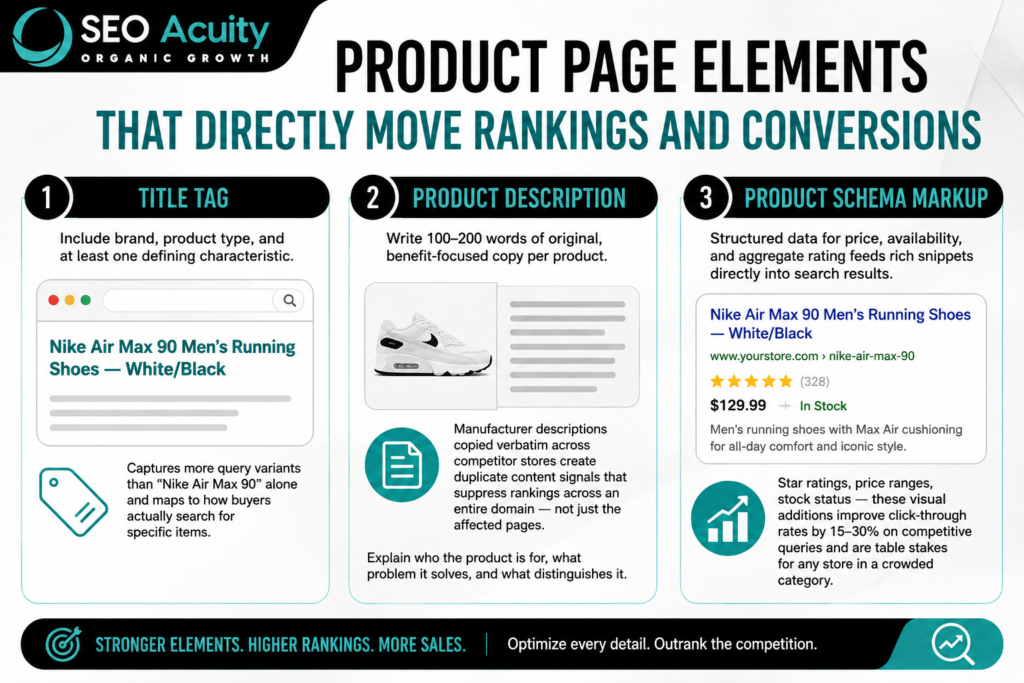
Title tag: Include brand, product type, and at least one defining characteristic. “Nike Air Max 90 Men’s Running Shoes — White/Black” captures more query variants than “Nike Air Max 90” alone and maps to how buyers actually search for specific items.
Product description: Write 100–200 words of original, benefit-focused copy per product. Manufacturer descriptions copied verbatim across competitor stores create duplicate content signals that suppress rankings across an entire domain — not just the affected pages. Each description should explain who the product is for, what problem it solves, and what distinguishes it.
Product schema markup: Structured data for price, availability, and aggregate rating feeds rich snippets directly into search results — star ratings, price ranges, stock status. These visual additions improve click-through rates by 15–30% on competitive queries and represent table stakes for any store in a crowded category.
B. Category Pages Are Your Biggest Organic Traffic Opportunity
Category pages target the high-volume commercial keywords that initiate most shopping journeys. Yet many stores treat them as pure product grids — no text, no content differentiation between related categories, no structured information that signals topic depth to Google.
A properly optimized category page includes a keyword-optimized H1, 150–300 words of original descriptive content below the product grid, breadcrumb navigation, internal links to related subcategories, and FAQ content targeting the “People Also Ask” queries for that category. Together these elements signal that the page has genuine informational authority — not just a list of products.
If you want the full breakdown of how this sequencing works in practice, see Organic Growth Strategy to Win AI Search — it maps how category page authority feeds both traditional organic rankings and AI-generated product recommendations at the same time.

Ready to Dominate Search Engine Rankings?
Accelerate your organic growth and scale your business leads with our data-driven SEO strategies.
Get a Free Quote NOW!4. Fix The Technical Foundations First
Technical SEO is the infrastructure that determines whether content and links can move rankings at all. A store with excellent product descriptions and strong backlinks but slow page speed, broken crawl paths, and duplicate URL parameters will consistently underperform a technically clean competitor with average content.
The highest-impact technical fixes for ecommerce stores, in order of priority:
HTTPS:
Every store must run on a secure domain. It is a lightweight ranking signal and a firm trust requirement — no buyer enters payment details on a “Not Secure” connection.
Core Web Vitals (LCP, CLS, INP):
Google’s performance metrics influence rankings and conversion rates in tandem. The largest culprits on ecommerce sites are oversized product images and render-blocking JavaScript. Compressing images to WebP format and implementing lazy loading for below-the-fold products addresses both. A 0.1-second mobile speed improvement increases retail conversion rates by 8.4%.
Canonical tags:
Product variants and filtered navigation create URL proliferation. Canonical tags direct Google to the preferred version of each page, consolidating ranking signals rather than diluting them across dozens of near-identical variants.
Out-of-stock product page management:
Deleting a product URL when stock runs out destroys months of accumulated ranking authority. Keep the page live, show the product as out of stock, suggest alternatives, and use a 301 redirect only on permanent discontinuation — pointing to the closest relevant category, never the homepage.
Segmented XML sitemaps:
Large catalogs benefit from separate sitemaps for categories, product pages, and blog content, each submitted individually to Google Search Console. This enables indexing health tracking by page type — essential for identifying crawl budget problems before they scale into visibility losses.
Preview SEO Acuity Audit services and get your consultation session.
5. Schema Markup Is How Your Website Stands Out
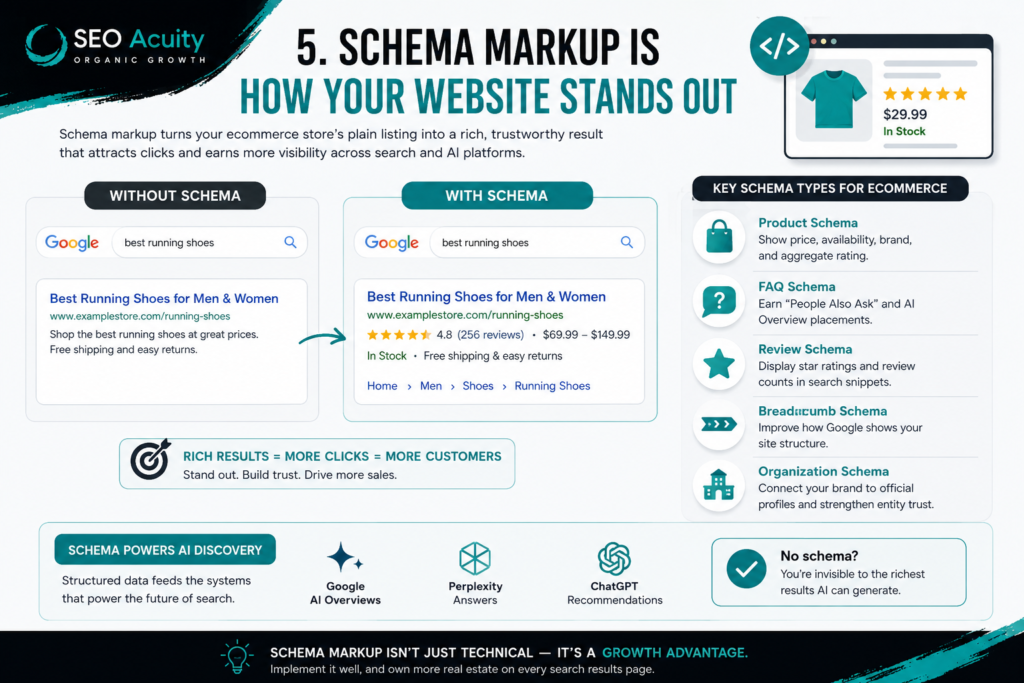
Most ecommerce stores appear in search results as a plain blue link with a title and description. Stores with implemented structured data appear with star ratings, price ranges, availability status, and breadcrumb trails — visually distinct entries that attract clicks before a visitor has read a single word of copy.
The baseline for any store is Product schema covering price, availability, and aggregate rating. FAQ schema on category and product pages feeds “People Also Ask” results and AI Overview summaries — meaning a well-structured category page can earn two SERP placements for a single query.
Review schema pulls aggregate customer ratings into snippets. Breadcrumb schema improves how Google displays site hierarchy. Organization schema on the homepage connects the store to official social profiles, reinforcing brand entity recognition across the wider web.
Schema also feeds AI-powered discovery systems directly. Google AI Overviews, Perplexity, and ChatGPT product recommendations draw from machine-readable structured data. A store without schema is effectively invisible to the richest output formats these systems generate. For the conceptual grounding on how AI retrieval differs from traditional crawling, what is AI SEO provides the practical framework.
6. Link Building For Ecommerce Requires A Different Playbook Than For Blogs
Ecommerce stores face a structural disadvantage in link acquisition: it is far easier to earn a backlink to a helpful article than to a product page. Nobody links organically to “buy leather boots here.” The standard content-site approach, publish great content, earn links passively, applies only to part of an ecommerce store’s authority-building strategy.
Three tactics work specifically well for online stores. Supplier and manufacturer links are the most consistently underused: authorized resellers routinely leave unclaimed the opportunity to request listing on brand “Where to Buy” pages. These links are relevant, often high authority, and friction-free for any legitimate reseller relationship.
Buyer guide content linking to category pages solves the product-page link problem indirectly. A guide earning links from outdoor publications passes authority to the trail running shoes category through internal linking — the hub-and-spoke model applied to ecommerce architecture. The guide earns links; the category earns rankings.
Unlinked brand mention conversion identifies domains that reference a store without hyperlinking — warm prospects who already know the brand. Outreach success rates on these contacts run significantly higher than cold link building, making them worth pursuing systematically.
استراتيجية SEO عملية لموقع تعليمي حققت 10 أضعاف الترافيك ARABIC SEO – Edu Niche
7. Own The Entire Buying Journey With A Three-Stage Content Strategy
Ecommerce stores that publish content only for buyers already at the purchase stage miss the majority of the organic revenue opportunity. Purchase decisions form during a research phase that begins days or weeks before any transaction — the stores whose content appears during that phase earn brand preference before the buyer has compared a single price.
Research content addresses the “help me understand this category” phase. Examples include “How to Choose Running Shoes for Overpronation” and “Memory Foam vs. Latex Mattress — What’s the Actual Difference?” These rank for informational keywords, attract high-volume traffic, and introduce buyers to the store’s catalog before they’ve committed to a product type.
Commercial comparison content addresses the “I’ve narrowed it down, help me choose” phase. Examples include “Nike Air Max 90 vs. HOKA Bondi 8 — Full Comparison” and “Best Standing Desks Under $600 in 2026.” These rank for commercial keywords and convert at rates approaching transactional pages because the searcher is a single decision away from purchasing.
Product and category pages capture the transactional phase — where most ecommerce SEO investment is concentrated, despite representing the smallest share of total search volume.
Watch: Will GEO, AEO, and AI Search kill SEO? The truth no one is telling:
هل الـ GEO والـ AEO والـ AI Search هيقتلوا الـ SEO؟ | الحقيقة اللي محدش بيقولها
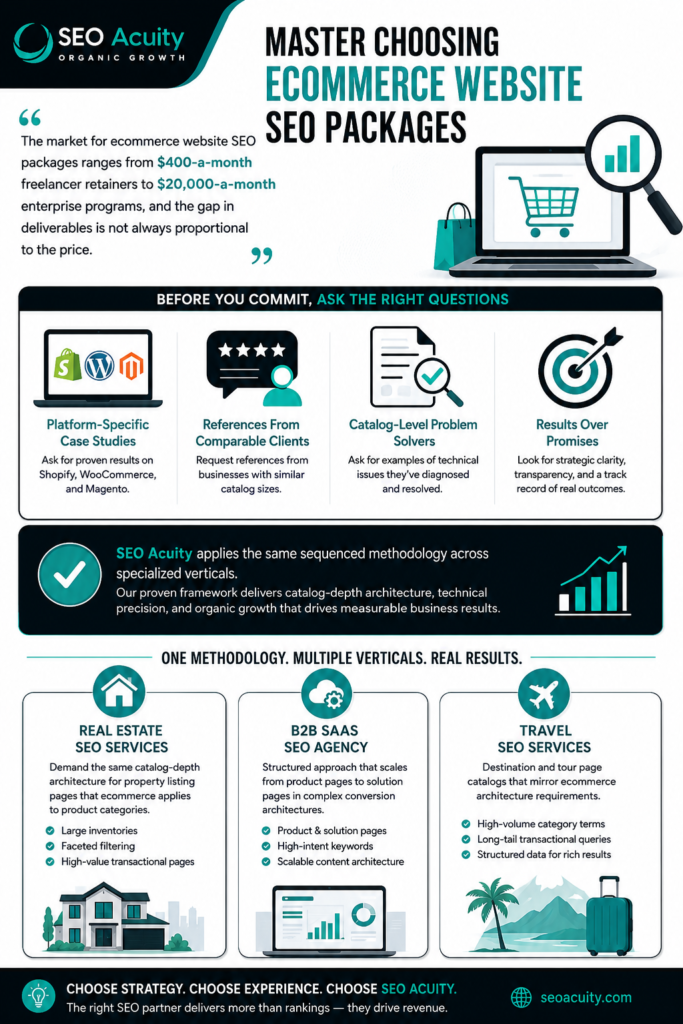
8. Master Choosing Ecommerce Website Seo Packages
The market for ecommerce website SEO packages ranges from $400-a-month freelancer retainers to $20,000-a-month enterprise programs, and the gap in deliverables is not always proportional to the price.
Before committing to any contract, knowing how to hire an SEO expert with genuine ecommerce depth means asking for platform-specific case studies (Shopify, WooCommerce, Magento), references from clients with comparable catalog sizes, and concrete examples of catalog-level technical problems they’ve diagnosed and resolved.
SEO Acuity applies the same sequenced methodology across specialized verticals. Real Estate SEO Services demand the same catalog-depth architecture for property listing pages that ecommerce applies to product categories — large inventories, faceted filtering, and high-value transactional pages.
In demand-generation verticals with complex conversion architectures, B2B SaaS SEO Agency programs demonstrate how the same structured approach scales from product pages to solution pages. Travel SEO Services operate on destination and tour page catalogs that mirror ecommerce architecture requirements — high-volume category terms, long-tail transactional queries, and structured data driving rich result appearances.
Ready to Dominate Search Engine Rankings?
Accelerate your organic growth and scale your business leads with our data-driven SEO strategies.
Get a Free Quote NOW!Start Generating Organic Revenue
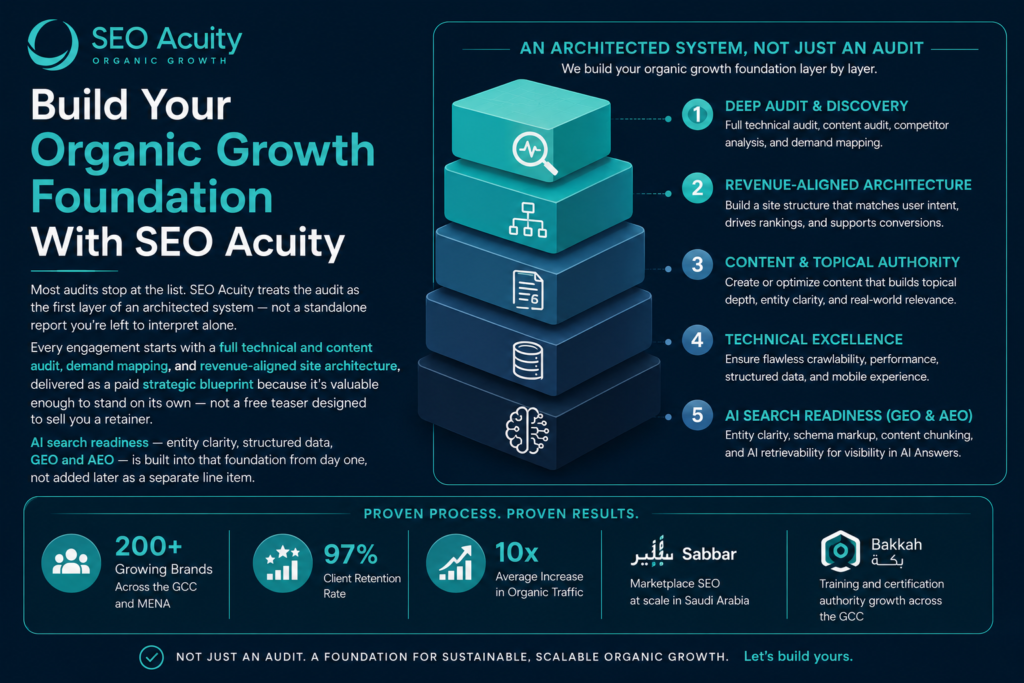
SEO Acuity builds ecommerce programs around the exact sequence in this guide: technical audit and fix first, architecture and on-page optimization second, content and authority building third. Measurable results in 90 days. Revenue attribution built into every deliverable.
Your competitors are running paid ads right now. Every click they buy costs money. Every click earned from a well-ranked organic listing costs nothing, and the investment that produced that ranking compounds over time rather than disappearing the moment a budget pauses.
For industries where trust and credibility are primary ranking factors, Healthcare SEO Services show how rigorous technical and content methodology translates into authority gains where standards are strictest. Medical SEO Services and SEO for Financial Services follow the same layered approach, technical foundation, structured architecture, and authority built through content that earns links rather than buying them.
Automotive SEO presents catalog depth challenges directly comparable to ecommerce, individual vehicle model pages require the same specification-level optimization as product pages.
Talk to SEO Acuity about an Organic Growth Foundation™ assessment.
Ready to Dominate Search Engine Rankings?
Accelerate your organic growth and scale your business leads with our data-driven SEO strategies.
Get a Free Quote NOW!Conclusion
Ecommerce SEO rewards stores that invest in the correct sequence. Technical foundations determine whether content and links can move rankings at all. Site architecture determines whether category pages accumulate the authority to compete for high-volume keywords. On-page optimization and schema markup determine whether rankings translate into clicks.
A full-funnel content strategy determines whether the store captures buyers at every stage of their decision journey. Informed evaluation of ecommerce website SEO packages determines whether the investment is executed by a team that understands what catalog-scale optimization actually demands.
These eight moves form a connected system, not a checklist. Executing them in order builds durable organic equity. Executing them out of order — or in isolation — produces activity that consumes budget without building anything that compounds.
If you want the full breakdown of how this sequencing works in practice and how organic authority compounds alongside AI-powered visibility over time, see Benefits of AI SEO for Businesses — it covers the long-term ROI case for why organic investment consistently outperforms paid channels in the 12-to-24-month horizon.
Frequently Asked Questions
What is SEO for an ecommerce website?
SEO for an ecommerce website is the practice of optimizing an online store’s pages, technical infrastructure, and site architecture to rank organically in search engines for the commercial and transactional queries buyers use.
How long does it take for ecommerce SEO to show measurable results?
Most stores see measurable ranking improvements within three to six months of consistent optimization, with significant organic traffic growth visible in six to twelve months. Technical fixes — resolving crawl errors, implementing canonical tags, improving Core Web Vitals — produce the fastest initial movement.
What is the difference between on-page SEO and technical SEO for an ecommerce store?
On-page SEO for an ecommerce website covers the elements within each page: title tags, H1 headings, product descriptions, image alt text, and schema markup. Technical SEO covers the infrastructure those pages run on: site speed, crawlability, canonical tag management, sitemap structure, and Core Web Vitals performance.
Which pages matter most for ecommerce SEO?
Category pages typically drive the highest organic traffic because they target high-volume commercial keywords that initiate most shopping journeys. Product pages drive the highest-converting traffic because they capture specific purchase intent. Both require distinct keyword strategies, on-page configurations, and schema markup.
Does AI search change what ecommerce stores need to do for SEO?
AI-powered discovery tools draw from the same technical and content signals that traditional SEO builds — structured data, domain authority, and comprehensive product information all contribute to visibility in ChatGPT shopping responses, Google AI Overviews, and Perplexity product recommendations.