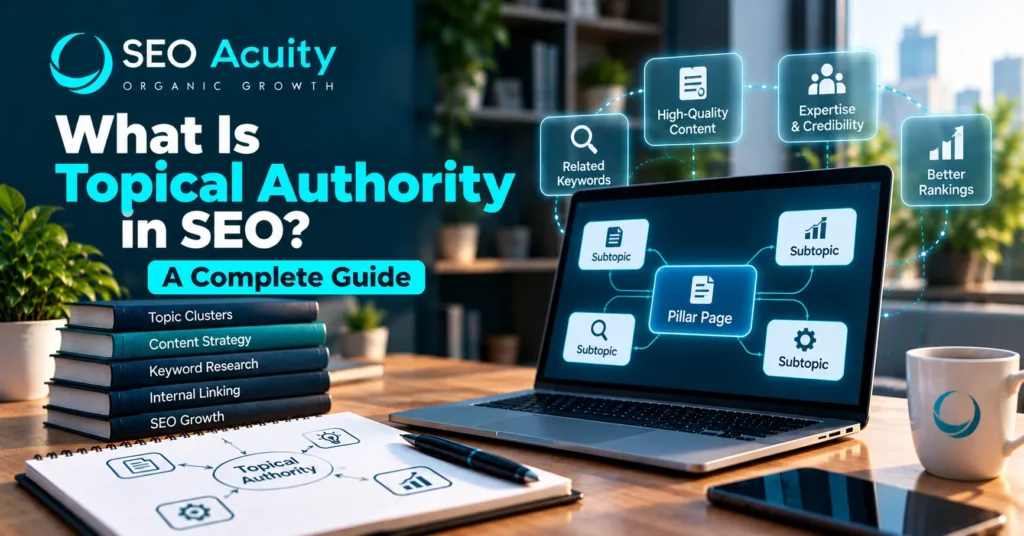
Search engines no longer reward websites for repeating a single keyword. They now evaluate how thoroughly a website covers an entire subject.
This shift is why topical authority has become one of the most discussed concepts in modern SEO, and why understanding it matters for anyone planning content for a website.
Topical authority refers to how much a شsearch engine trusts a website as a knowledgeable, comprehensive source on a specific subject. Rather than judging a single page in isolation, search engines look at the full body of content a site publishes around a topic to decide how credible and relevant that site is.
What You Will Learn
- The exact definition of topical authority and how it differs from ranking for a single keyword.
- Why topical authority matters, from ranking for a whole topic to building credibility and standing out against shallow content.
- The step-by-step process for building topical authority, including topic definition, keyword research, and a pillar-and-cluster content structure.
- The tools commonly used to support topical authority research and planning.
- How topical authority compares to traditional keyword-based SEO, and how the two approaches work together.
What Is Topical Authority?
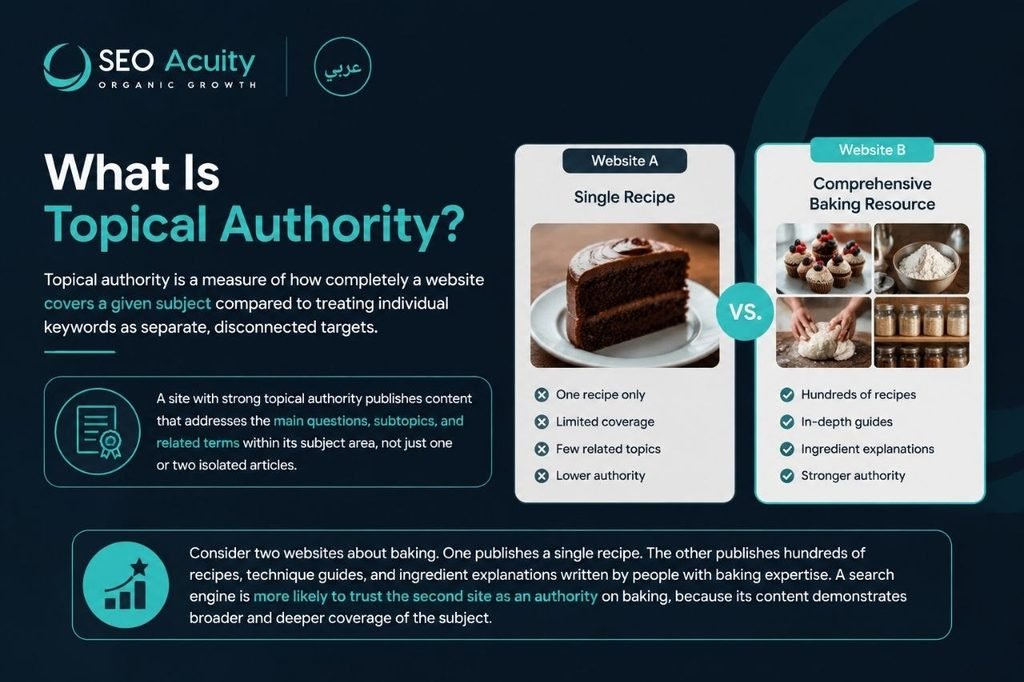
Topical authority is a measure of how completely a website covers a given subject compared to treating individual keywords as separate, disconnected targets.
A site with strong topical authority publishes content that addresses the main questions, subtopics, and related terms within its subject area, not just one or two isolated articles.
Consider two websites about baking. One publishes a single recipe. The other publishes hundreds of recipes, technique guides, and ingredient explanations written by people with baking expertise.
A search engine is more likely to trust the second site as an authority on baking, because its content demonstrates broader and deeper coverage of the subject.
Why Topical Authority Matters for SEO
Topical authority has become important because it reflects how modern search engines evaluate relevance and trust. The concept connects to several practical outcomes for a website’s search performance.
Ranking for a Whole Topic, Not Just One Keyword
When a site has substantial, well-organized content on a subject, search engines tend to rank it for many related keywords within that topic, not only the single term a page was written for. This broadens a site’s visibility across an entire subject area rather than one search query.
Building Credibility With Search Engines and Readers
A site that covers a topic in depth signals expertise to both search engines and human visitors. Readers who find comprehensive, well-organized information are more likely to trust the source, which can also support engagement and return visits.
Standing Out Against Shallow Content
Search engines generally aim to surface the most helpful and relevant results for a query. A site that only skims a topic with one or two thin articles is less likely to compete with a site that addresses the subject from multiple angles and answers a wider range of related questions.
Read also: What Is Semantic SEO? A Practical Guide for Business Growth
Watch a real life at our company:
Supporting Visibility for Newer Websites
Topical authority is not only relevant to large, established sites. A newer website can still plan its content around a clear topic and subtopic structure from the start, which gives search engines a defined body of related content to evaluate as the site grows.
If you’re ready to see what that could look like for your website, request a Free SEO Quote from SEO Acuity
How to Build Topical Authority
Building topical authority is less a single action than an ongoing process that combines topic planning, keyword research, structured content production, and continuous maintenance.
Each step below builds directly on the one before it, moving from defining a clear subject area to publishing connected content and, eventually, tracking how that content actually performs.
This process tends to unfold gradually rather than through a single burst of publishing, since search engines evaluate the accumulated depth and consistency of a site’s coverage rather than the existence of any one page.
Treating the steps below as a repeatable cycle, rather than a one-time project, generally produces steadier, more durable results over time.
Read also: Ethical SEO Agency – How to Choose the Right SEO Partner?
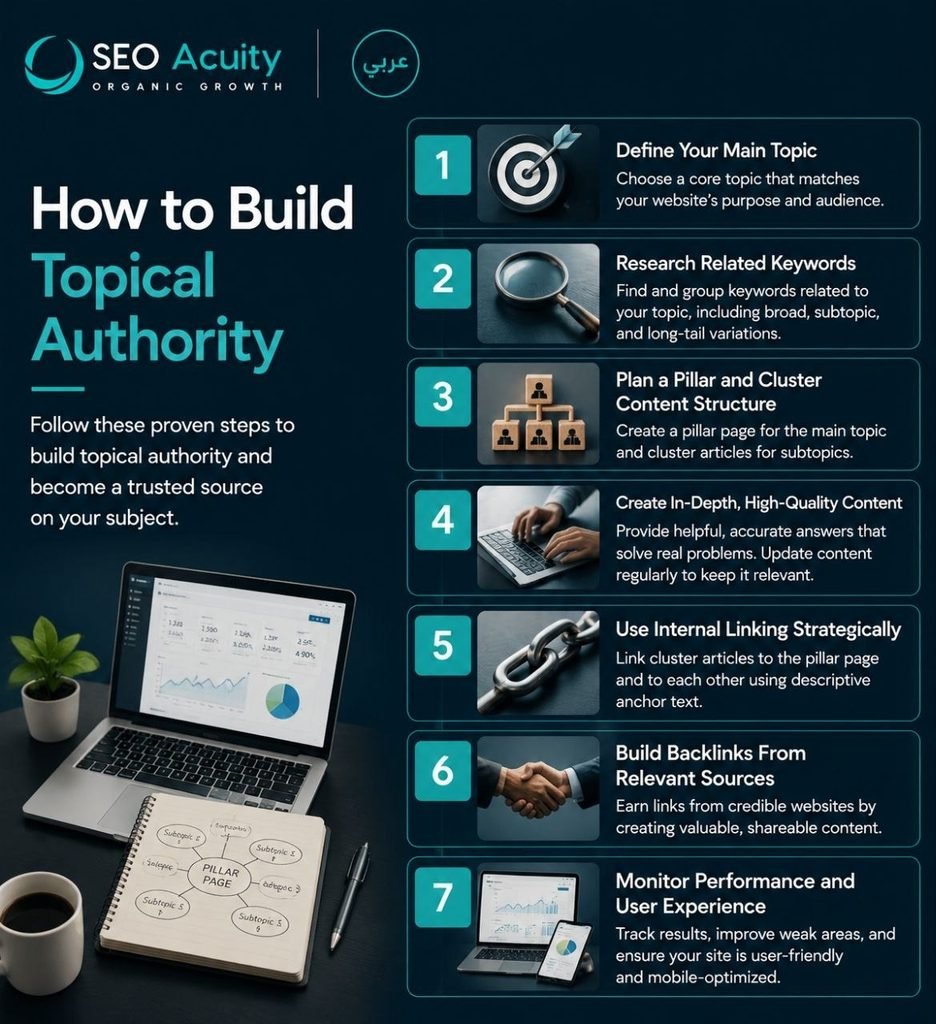
1. Define Your Main Topic
Start by identifying the core subject that matches your website’s purpose and audience. For example, a website focused on e-commerce might choose “online store marketing” as a main topic, rather than trying to cover digital marketing as a whole.
2. Research Related Keywords
Once the main topic is defined, research the keywords connected to it, including broad terms, subtopic-specific terms, and long-tail variations. Grouping these keywords helps map out which subtopics deserve dedicated content.
3. Plan a Pillar and Cluster Content Structure
A common way to organize topical content is through a pillar page and cluster articles. The pillar page provides a broad overview of the main topic, while cluster articles explore specific subtopics in more depth and link back to the pillar page.
4. Create In-Depth, High-Quality Content
Each piece of content should answer real questions and provide accurate, useful information rather than repeating surface-level points. Content that is regularly reviewed and updated tends to remain more useful to both readers and search engines over time.
Read also: Best Boutique Seo Agency – 10 Specialized Agencies
Talk to the SEO Acuity team now
5. Use Internal Linking Strategically
Connecting cluster articles to the pillar page, and to each other where relevant, helps search engines understand how the content relates. Internal links using descriptive, relevant anchor text make it easier for both visitors and search engines to navigate the topic.
6. Build Backlinks From Relevant Sources
Links from other credible websites pointing to your content can reinforce a site’s trust and relevance on a subject. Publishing genuinely useful, shareable content is one common way sites attract these kinds of natural links.
7. Monitor Performance and User Experience
Tracking how content performs, using tools such as Google Analytics and Google Search Console, helps identify which subtopics are working and which need improvement.
A site that is easy to navigate and works well across devices also supports the overall goal of helping visitors find and use the content.
Tools That Can Help With Topical Authority Research
Several tools are commonly used to support topical authority planning. Keyword research and content-gap tools can help identify related terms and subtopics search engines associate with a subject, and competitor-analysis tools can show which subtopics competing sites already cover well.
These tools are typically used to inform a topic and keyword map, not to replace the planning process itself.
Ready to Dominate Search Engine Rankings?
Accelerate your organic growth and scale your business leads with our data-driven SEO strategies.
Get a Free Quote NOW!Topical Authority vs. Traditional Keyword-Based SEO
Traditional keyword-based SEO tends to treat each page as a standalone target for one or two keywords. Topical authority takes a broader view, treating a group of connected pages as evidence of expertise across an entire subject.
The two approaches are not mutually exclusive: keyword research still guides individual pages, but it is organized around a wider topic structure rather than isolated terms.
Ready to start architecting growth with SEO Acuity Team?
Understanding topical authority is a useful starting point, but applying it consistently requires a structured topic map, organized keyword research, and a content plan that connects new and existing pages.
Businesses that want support building this kind of strategy can request a Free SEO Quote from SEO Acuity to discuss their current content and search visibility.
Ready to Dominate Search Engine Rankings?
Accelerate your organic growth and scale your business leads with our data-driven SEO strategies.
Get a Free Quote NOW!
SEO Acuity’s Full Range of SEO Services
Before we wrap up, here’s the complete list of SEO services offered by SEO Acuity each one available directly:
- SEO Audit Services
- On-Page SEO Services
- Off-Page SEO Services
- Technical SEO Services
- Programmatic SEO Services
- Arabic SEO Services
- Ecommerce SEO Services.
- Enterprise SEO Services
- SEO Services For Startups
Not sure which service fits your site? Talk to the SEO Acuity team now and get a free consultation.
FAQs
What is topical authority in simple terms?
Topical authority is how much a search engine trusts a website as a knowledgeable source on a specific subject, based on the depth and breadth of content that site publishes about it, rather than a single page or keyword.
How is topical authority different from domain authority?
Topical authority relates specifically to expertise on a defined subject, based on content coverage. Domain authority is a broader, third-party metric estimating a site’s overall strength, which is not an official search engine ranking factor.
Can a new website build topical authority?
Yes. A new website can define a core topic and subtopic map early, then build content around that structure over time. Topical authority is a long-term content strategy rather than something achieved through a single page.
Does topical authority guarantee higher rankings?
No single strategy guarantees rankings. Topical authority is one factor among many that can support visibility across related search terms, alongside technical SEO, content quality, and other elements of a site’s overall search performance.
How long does it take to build topical authority?
There is no fixed timeline, since it depends on how much content already exists, how competitive the topic is, and how consistently new content is published and linked together. It is generally considered a long-term, ongoing effort rather than a quick fix.
What is a pillar page?
A pillar page is a comprehensive piece of content that covers a broad topic at a high level, while linking out to more detailed cluster articles that each address specific subtopics in greater depth.