If your business isn’t appearing when potential customers search for the products or services you offer, you’re missing more than clicks — you’re missing opportunities to generate leads, build trust, and turn search traffic into revenue.
For small businesses, competing in organic search can feel especially difficult when larger brands have bigger budgets, stronger domain authority, and dedicated marketing teams.
The right SEO companies for small business can help level the playing field by building a search strategy around your actual goals, target audience, market, and budget. But finding the right partner isn’t as simple as choosing the agency with the biggest promises or the longest list of services.
This guide gives you a practical framework for evaluating small business SEO agencies, from strategy and technical expertise to reporting, communication, pricing, and long-term growth potential.
No vague guarantees or inflated claims — just the key factors to consider before trusting an SEO company with your business’s organic growth.
What you’ll learn in this article
- What separates a genuine SEO partner from a vendor collecting monthly fees
- The five service components every credible SEO package should include
- A practical checklist for comparing SEO agencies for small business
- Red flags that signal a bad investment before you sign anything
- A realistic timeline for what SEO delivers and when
What SEO Companies for Small Business Actually Do?
An SEO company for small businesses is a specialized agency that improves your website’s position in unpaid (organic) search results — driving qualified visitors without the recurring cost of paid ads.
The distinction matters. Paid search stops generating traffic the moment you pause spending. Organic rankings, once earned, continue attracting visitors for months or years.
Research consistently shows that organic search drives over 53% of all website traffic, and leads generated through SEO cost roughly 61% less than outbound channels like cold calling or direct mail.
For small businesses with limited marketing budgets, that compounding return is the core argument for SEO over paid media.
The five service pillars in a credible SEO package
Most reputable small business SEO companies structure their work around five areas. When evaluating proposals, check that all five are addressed — a package missing any of them will underperform.
1. On-page optimization
covers everything inside your website that affects rankings: keyword targeting, title tags, meta descriptions, heading structure, image alt text, internal links, and page speed.
This is always the starting point because search engines need to understand what each page is about before they can rank it.
2. Off-page SEO and link building
focuses on earning links from other websites — the primary signal that tells Google your site is credible. Quality matters more than volume here: one link from a respected industry publication carries more weight than twenty links from unrelated directories.
3. Technical SEO
Addresses how search engines crawl and index your site. Common issues include crawl errors, duplicate content, slow mobile load times, and missing structured data.
A site with excellent content but poor technical health will consistently underrank its potential.
Read also: Small Business SEO- The Complete Guide To Ranking And Growing Online
4. Local SEO
Local SEO is critical for businesses serving specific geographic areas. It includes Google Business Profile optimization, local citation building, review management, and location-based keyword targeting.
The data point worth knowing: 76% of people who search for something nearby on a smartphone visit a business within one day.
5. Content strategy and creation
Content strategy and creation ties the other four together. Search-optimized content attracts visitors at the top of the funnel and moves them toward conversion. Agencies that skip content work typically plateau early.
How to Compare SEO Agencies for Small Business?
Finding the best SEO agencies for small business isn’t about choosing the most polished website or the longest list of services. It comes down to evidence: proof that the agency has done this before and can explain clearly what they’ll do for you.
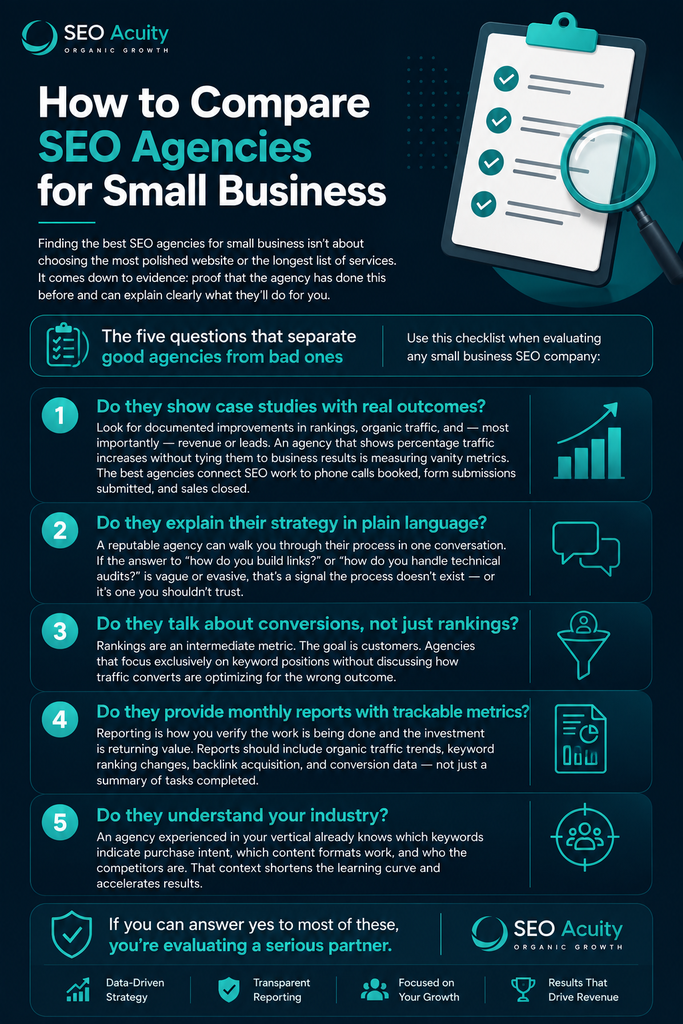
The five questions that separate good agencies from bad ones
If you can answer yes to most of the following questions, you’re evaluating a serious partner:
1. Do they show case studies with real outcomes?
Look for documented improvements in rankings, organic traffic, and — most importantly — revenue or leads.
An agency that shows percentage traffic increases without tying them to business results is measuring vanity metrics. The best agencies connect SEO work to phone calls booked, form submissions submitted, and sales closed.
2. Do they explain their strategy in plain language?
A reputable agency can walk you through their process in one conversation. If the answer to “how do you build links?” or “how do you handle technical audits?” is vague or evasive, that’s a signal the process doesn’t exist — or it’s one you shouldn’t trust.
3. Do they talk about conversions, not just rankings?
Rankings are an intermediate metric. The goal is customers. Agencies that focus exclusively on keyword positions without discussing how traffic converts are optimizing for the wrong outcome.
4. Do they provide monthly reports with trackable metrics?
Reporting is how you verify the work is being done and the investment is returning value. Reports should include organic traffic trends, keyword ranking changes, backlink acquisition, and conversion data — not just a summary of tasks completed.
5. Do they understand your industry?
An agency experienced in your vertical already knows which keywords indicate purchase intent, which content formats work, and who the competitors are. That context shortens the learning curve and accelerates results.
Read also: Ecommerce Technical SEO – The 10-Item Checklist
Read also: How To Build An Ecommerce SEO Strategy?
Ready to Dominate Search Engine Rankings?
Accelerate your organic growth and scale your business leads with our data-driven SEO strategies.
Get a Free Quote NOW!Red Flags That Signal a Bad Investment
The SEO industry has more than its share of vendors who sell the appearance of work without delivering results. Knowing what to avoid protects your budget and your timeline.
Guaranteed 1 rankings. No ethical agency can guarantee first-position rankings. Google’s algorithm factors in hundreds of variables, many outside any agency’s control. A guarantee of #1 is either dishonest or a sign the agency is using tactics that will eventually trigger a penalty.
Extremely cheap packages. Effective SEO requires experienced professionals investing real hours in research, content, and link building.
Packages priced far below market — say, $99/month for “full SEO” — are either doing nothing or using automated tactics that violate Google’s guidelines. Recovery from a manual penalty typically takes 6–12 months and costs more than legitimate SEO would have.
Refusal to explain process. Transparency is table stakes. An agency that treats its methods as a trade secret is almost certainly cutting corners.
Long lock-in contracts without performance benchmarks. Month-to-month or quarterly arrangements with clear deliverables are the standard for credible agencies. Multi-year contracts with no exit clause and no accountability metrics benefit only the agency.
Good SEO takes time. Anyone promising instant results is not telling you the truth.
How Long Does It Take to See SEO Results?
This is the question every small business owner asks — and the honest answer has a timeline.
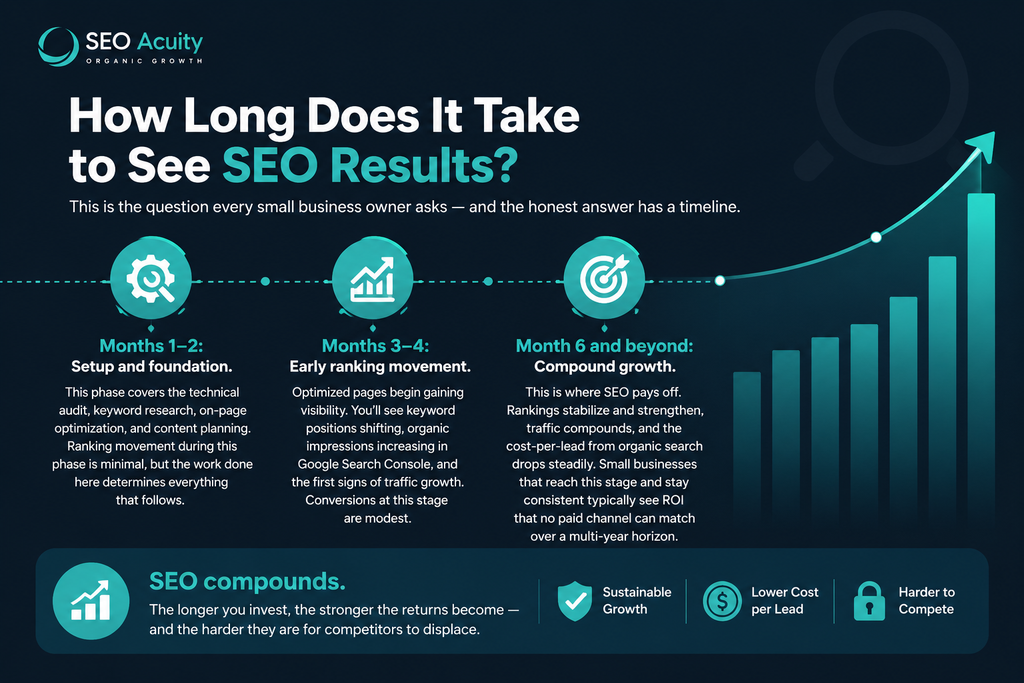
Months 1–2: Setup and foundation
This phase covers the technical audit, keyword research, on-page optimization, and content planning. Ranking movement during this phase is minimal, but the work done here determines everything that follows.
Months 3–4: Early ranking movement
Optimized pages begin gaining visibility. You’ll see keyword positions shifting, organic impressions increasing in Google Search Console, and the first signs of traffic growth. Conversions at this stage are modest.
Month 6 and beyond: Compound growth
This is where SEO pays off. Rankings stabilize and strengthen, traffic compounds, and the cost-per-lead from organic search drops steadily. Small businesses that reach this stage and stay consistent typically see ROI that no paid channel can match over a multi-year horizon.
SEO compounds. The longer you invest, the stronger the returns become — and the harder they are for competitors to displace.
Why SEO Outperforms Paid Ads for Small Business Growth?
Paid ads stop the moment the budget stops. A well-optimized page can generate traffic and leads for years without additional spend.
That structural difference in economics is why SEO delivers some of the highest long-term ROI in digital marketing. For small businesses with tight budgets that need predictable, scalable growth, organic search is the channel that doesn’t require continuous reinvestment to maintain results.
The compounding effect also means the gap between businesses that started SEO two years ago and those starting today is already significant. Every month without a credible SEO strategy is a month competitors strengthen their position in search results.
Ready to Dominate Search Engine Rankings?
Accelerate your organic growth and scale your business leads with our data-driven SEO strategies.
Get a Free Quote NOW!Start Building Your Search Presence with SEO Acuity
SEO Acuity works with small businesses that need more than traffic — they need a growth system built around their goals, their market, and their budget.
From technical audits to content strategy and link building, every engagement starts with understanding what your business actually needs to grow.
If you’re ready to stop losing customers to competitors who rank above you, the first step is a conversation
Conclusion
Choosing between SEO companies for small business isn’t about picking the biggest agency or the cheapest package. It’s about finding the partner who can demonstrate results, explain their process clearly, and build an SEO strategy around your specific growth goals.
The best small business SEO companies share a few things in common: they measure outcomes beyond rankings, they operate transparently, and they think in timelines — because compounding results over 12 to 24 months is how SEO actually works.
Use the checklist and red flag criteria in this guide before you sign anything, and you’ll avoid the most common and costly mistakes small businesses make when hiring an SEO agency.
Frequently Asked Questions
How much do SEO companies for small business typically charge?
Most credible small business SEO companies charge between $750 and $2,000 per month, depending on the scope of services, the competitiveness of the industry, and the agency’s experience level.
Packages priced significantly below this range typically rely on low-quality tactics that risk Google penalties rather than building sustainable rankings.
What is the difference between affordable SEO and cheap SEO?
Affordable SEO delivers measurable value within a realistic budget — it uses ethical, sustainable methods and focuses on business outcomes like leads and revenue.
Cheap SEO cuts corners with automated link schemes or thin content, which may show short-term ranking gains before triggering algorithmic or manual penalties that can take 6–12 months to recover from.
How do I know if an SEO agency is actually doing the work?
Ask for monthly reports that include organic traffic data, keyword ranking changes, backlinks acquired, and conversion metrics. Reputable agencies provide this as standard.
If an agency cannot show you a clear account of what was done each month and what changed as a result, that is a signal the work is not being performed or tracked properly.
Can a small business do SEO without hiring an agency?
Basic on-page optimization — title tags, meta descriptions, heading structure — can be handled in-house with the right tools. However, technical SEO, link building, and competitive content strategy require specialized expertise and significant time investment.
Most small businesses find the fastest path to results is partnering with an experienced agency rather than building those capabilities internally.
What should I ask an SEO company before hiring them?
Ask for case studies from businesses similar to yours, a clear explanation of their link-building process, the metrics they report on and how often, who your main contact will be, and whether their package includes technical audits and strategy revisions.
The answers will quickly reveal whether the agency operates transparently and has the experience to deliver results.