
Do not create a separate budget for AI search. Reallocate 15% to 30% of the SEO budget you already have toward AI-focused content, technical SEO, brand authority, and AI visibility monitoring — while keeping the core of your program intact.
That range is a starting point, not a rule. The right number depends on your industry, how often your buyers use ChatGPT, Gemini, or Google AI Overviews before they search by name, and how your current SEO spend is already performing.
Search behavior has split into two channels. People still type keywords into Google, but they also ask full questions to AI assistants and read AI-generated summaries before they click anything.
If you’re still wondering whether this shift means traditional search is over, our video هل جوجل مات؟ الحقيقة الكاملة عن AI Search breaks down exactly what changed and what didn’t — and it’s also why does seo still matter if ai search keeps growing is the wrong question; the real question is how to fund both channels at once.
What You’ll Learn in This Article
- How much of your SEO budget to shift toward AI search optimization, based on business size.
- A step-by-step process for reviewing and reallocating existing spend.
- Which line items to cut, and which to protect no matter what.
- The mistakes that waste an AI search budget before it produces results.
- The metrics that tell you whether the reallocation is actually working.
A Step-by-Step Process to Adjust Your SEO Budget for AI Search Optimization
Reallocating a budget without reviewing where it currently goes usually means cutting the wrong things.
Our framework video walks through the practical side of this same sequence — watch it here: A Practical Step-by-Step Framework for Appearing in AI Search Results. Work through these steps in order.
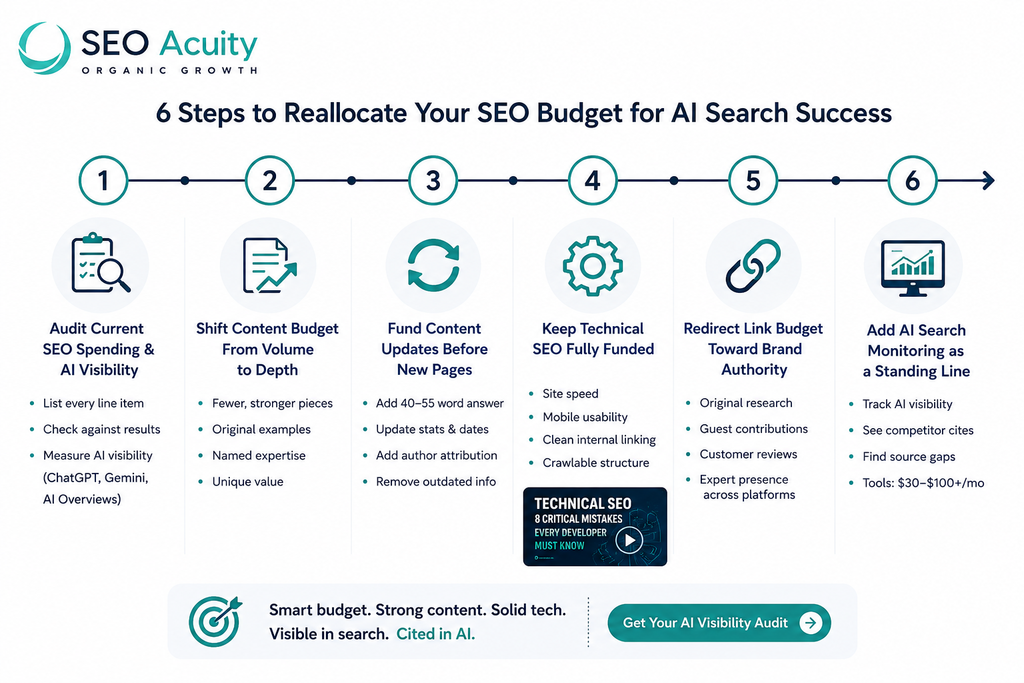
Step 1. Audit Current SEO Spending and AI Visibility
List every line item and check it against results, not activity:
- Content creation
- Technical fixes
- Link building
- Tools
- Reporting
- Agency fees
Ask whether each line is producing qualified traffic, leads, or sales, or just keyword-ranking reports. Then check a second dimension most audits skip: does your brand appear at all when you ask ChatGPT, Gemini, or Google AI Overviews the questions your buyers ask?
A common finding here: a business ranks #1 in Google for a query and is completely absent from the AI-generated answer for the same question. Rank and AI visibility are now two separate things to measure.
Step 2. Shift the Content Budget From Volume to Depth
AI models don’t need more content on a topic — they need one source worth citing. A monthly retainer producing four or five generic, keyword-shaped articles is usually the easiest budget to recover from.
Redirect that spend into fewer pieces that include original examples, named expertise, and information a reader can’t get from an AI summary alone.
This is the shift SEO Acuity’s content team makes with clients first, since it usually costs nothing extra — it’s the same content budget, aimed at fewer, stronger pages instead of a higher article count.
Step 3. Fund Content Updates Before New Pages
Many sites already have the pages they need — those pages are just outdated, thin, or missing a direct answer near the top. Updating an existing page costs less than building a new one and often produces a faster citation gain, since the page already has some authority and indexing history behind it.
Priority fixes:
- Add a direct, 40–55 word answer immediately below the heading.
- Update any statistics or dates.
- Add named author attribution.
- Remove information that’s no longer accurate.
Ready to Dominate Search Engine Rankings?
Accelerate your organic growth and scale your business leads with our data-driven SEO strategies.
Get a Free Quote NOW!Step 4. Keep Technical SEO Fully Funded
AI systems still have to crawl, parse, and index your site before they can cite it. Your budget should keep covering:
- Site speed
- Mobile usability
- Clean internal linking
- A crawlable structure
Cutting this budget to fund AI work is a mistake that shows up later as pages AI can’t retrieve in the first place.
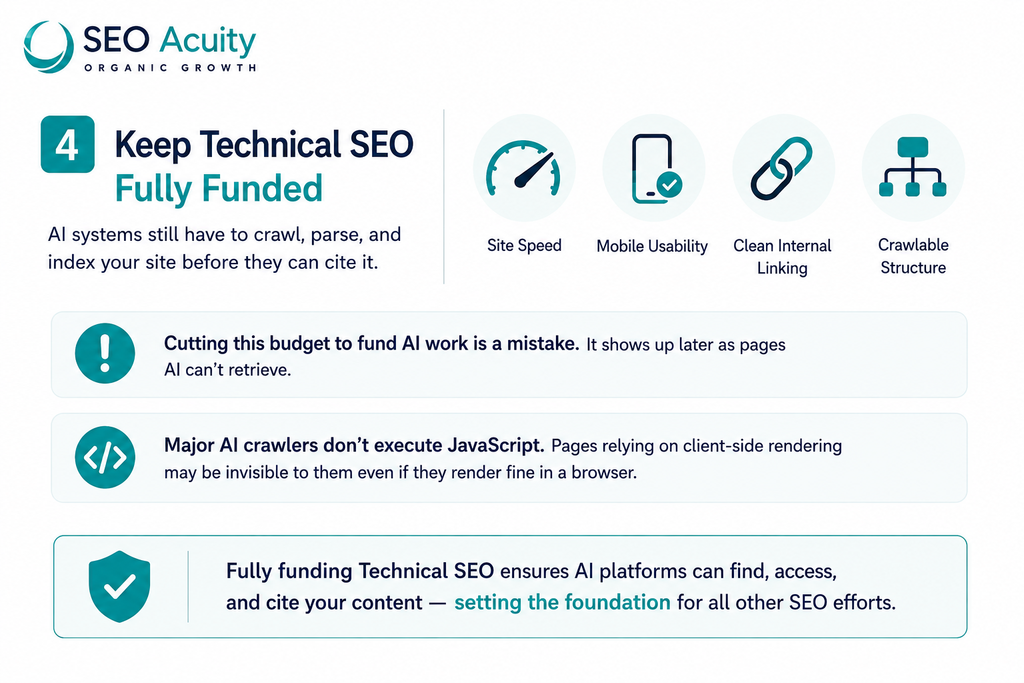
One detail worth knowing: major AI crawlers generally don’t execute JavaScript. A page that depends on client-side rendering to display its core content may be invisible to them even if it renders fine in a browser.
Step 5. Redirect Link Budget Toward Brand Authority
Move spend away from low-quality, high-volume link placements and toward activity that builds a recognizable, citable brand:
- Original research.
- Guest contributions on industry publications.
- Genuine customer reviews.
- Named expert bios with a real footprint across LinkedIn and industry directories.
AI engines pull from a wider set of sources than Google’s link graph, including reviews, directories, and forums — a brand’s presence across those sources shapes whether it gets mentioned at all.
This is also where entity work and LLMO (Large Language Model Optimization) overlap with traditional digital PR — the goal isn’t just earning a backlink, it’s building a consistent, verifiable identity that AI models recognize across sources.
It’s the same overlap covered in What is GEO vs SEO, and it’s the specific discipline behind our GEO SEO Strategy for AI Search service.
Step 6. Add AI Search Monitoring as a Standing Budget Line
Most SEO budgets have never carried a line for tracking AI visibility, which means most teams have no idea whether they’re gaining or losing ground in AI-generated answers.
Tools built for this — from lightweight options in the $30–$100/month range up to enterprise platforms — show your citation frequency, where competitors are being cited instead, and which third-party sources AI models are pulling from in your category. That last data point is what tells you where to spend Step 5’s budget next.
SEO Acuity’s AI search visibility audit maps exactly this — where your brand currently appears in AI-generated answers, and which gaps to close first.

Why Your SEO Budget Needs to Adapt for AI Search Optimization
Traditional SEO budgets are built around keyword research, content production, backlinks, and ranking reports. Those activities still matter. What’s changed is what happens after a page ranks.
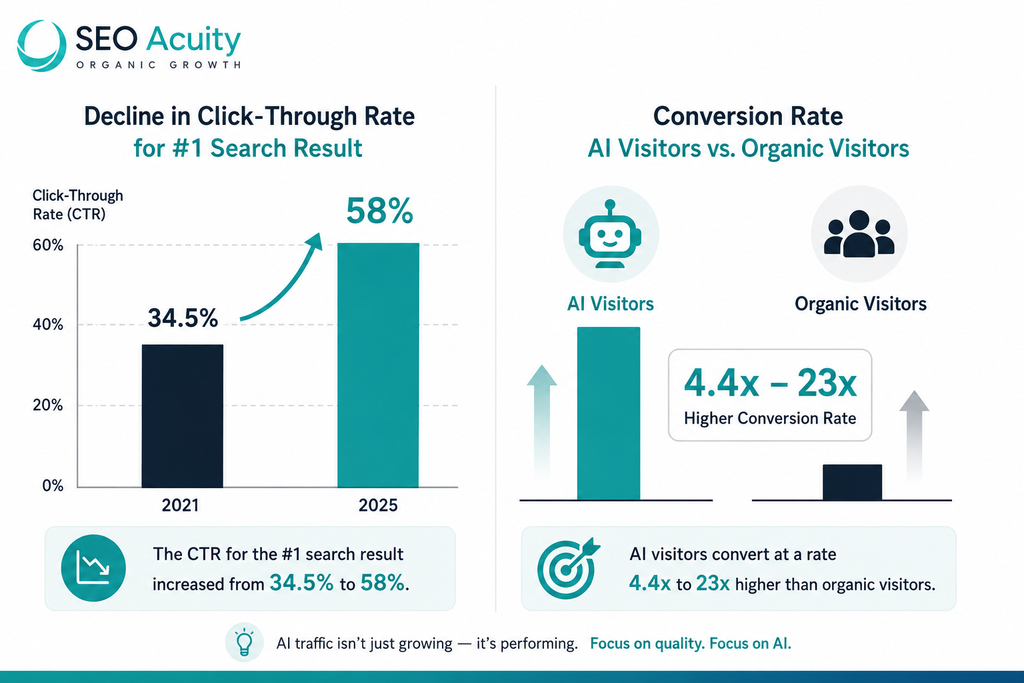
1. Zero-Click Answers Are Cutting Into Organic Clicks
When Google shows an AI Overview above the results, fewer people click through to any website at all.
- Pew Research Center measured a 46.7% relative decline in clicks on queries where an AI Overview appears, based on a controlled comparison of the same searches before and after the feature rolled out.
- Ahrefs tracked a related pattern in top-ranking pages: the click-through rate for the #1 organic position fell from roughly 34.5% to 58% over an eight-month stretch in 2025 as AI Overviews expanded.
Informational content absorbs most of this impact. A page that used to earn a click for “what is X” or “how does Y work” now competes with an answer that’s already on the results page, above the link.
2. AI Referral Traffic Converts at a Higher Rate
Losing clicks does not automatically mean losing revenue. Visitors who arrive from an AI assistant have usually already been through a research process — the assistant has compared options and pointed them toward a decision.
- Semrush measured AI-referred visitors converting at roughly 4.4 times the rate of standard organic traffic.
- Ahrefs found the multiple reaching as high as 23x on high-intent queries.
This is the trade you’re budgeting for: fewer total clicks, but a channel worth being visible in, because the visitors it does send convert at a materially higher rate.
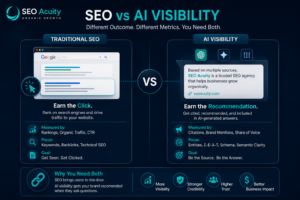
Getting clear on this distinction is also the core idea behind SEO vs AI Visibility — two different things you now have to fund and measure separately.
How Much of Your SEO Budget Should Go to AI Search Optimization?
Most guidance across the industry converges on the same range: keep 70% to 85% of your search budget on core SEO, and move 15% to 30% toward AI search visibility work.
Forrester sets 15% as a practical floor for mid-market B2B brands specifically. Where you land inside that range depends on business size and how AI-reliant your audience already is.
This reallocation is what AI SEO vs Traditional SEO really means in practice — not a swap, a split.
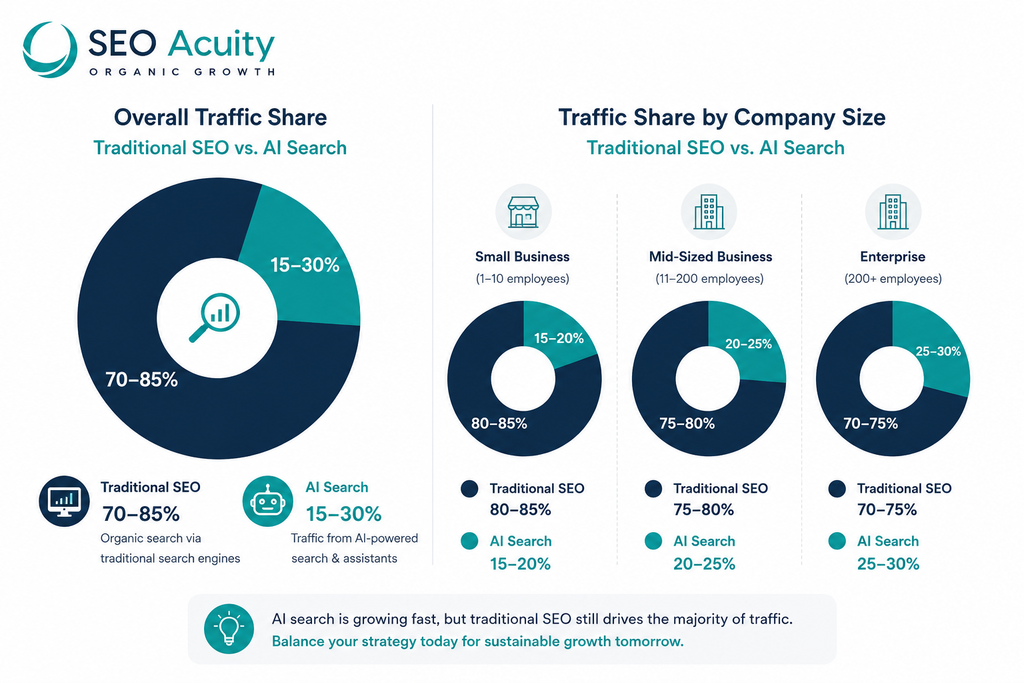
1. Typical Allocation Ranges by Business Size
How much of that budget should go where depends heavily on the size and nature of the business — here’s how the typical allocation breaks down:
- Small or local business ($1,500–$5,000/mo search budget): start near 15%, focused on Google Business Profile optimization, review generation, and updates to a handful of existing pages.
- Mid-market company ($5,000–$12,000/mo): typically 20%–25%, enough to fund content refreshes, a citation-tracking tool, and one original data project a year.
- Enterprise and heavily regulated brands (healthcare, finance, legal): often 30% or more, since AI models weigh credentialed expertise and trust signals more heavily in these categories.
A worked example: a mid-market SaaS company spending $8,000/month on SEO moves 25% — $2,000 — into AI search work. That $2,000 typically splits into:
- ~$700 for two content refreshes.
- ~$500 for a citation-tracking subscription.
- ~$500 for author bio and entity cleanup.
- ~$300 held for testing.
The other $6,000 keeps funding the technical SEO and content production that were already working.
2. Ring-Fence New Budget or Reallocate Existing Spend
Once you know roughly how much to allocate, the next decision is where that money should actually come from:
- If your core SEO is already producing leads or sales, don’t pull money out of it to fund AI work — ring-fence a new slice instead, since cutting a working program to pay for an unproven one puts existing revenue at risk.
- If your core SEO is underperforming, reallocate: cut the content and link spend that isn’t producing results and move it into the AI search line items below.
A short AI visibility audit is the fastest way to tell which situation you’re in — it shows whether your brand appears in AI-generated answers at all before you commit budget either way.
Common Mistakes When Reallocating an SEO Budget for AI Search
What causes an AI search budget to underperform? Three mistakes show up repeatedly in budget reviews:
1. Cutting Core SEO Entirely to Fund AI Work
This usually shows up six months later as a traffic drop with no AI visibility gain to offset it, since the technical foundation AI models rely on has quietly eroded.
2. Publishing More Content Instead of Updating What Already Exists
This increases spend without increasing citations.
3. Treating AI Visibility Tools as a One-Time Audit
Rather than a recurring subscription, this means a brand’s citation position can slip for months before anyone notices.
What to Cut to Fund AI Search Optimization
Every dollar moved into AI search work has to come from somewhere in the existing budget. Two cuts fund most of it.
1. Cut Commodity Content Volume, Not Content Strategy
If several articles are producing little traffic and no leads, that’s the first budget to move — not the content function itself. The goal is fewer, deeper pieces, not zero content.
2. Trim Over-Scoped Technical and Schema Projects
Schema is worth implementing once and keeping tidy, but it isn’t the lever some vendors present it as — Google’s own documentation confirms there’s no special schema requirement for appearing in AI features.
A recurring monthly retainer for schema tinkering is usually safe to cut in favor of a one-time cleanup, with the freed budget moved into content and monitoring.
Example SEO Budget Allocation for AI Search Optimization
This is one workable split. Adjust the percentages to your industry and customer journey — a local business needs more in local SEO; an eCommerce brand needs more in technical SEO and product-page optimization.
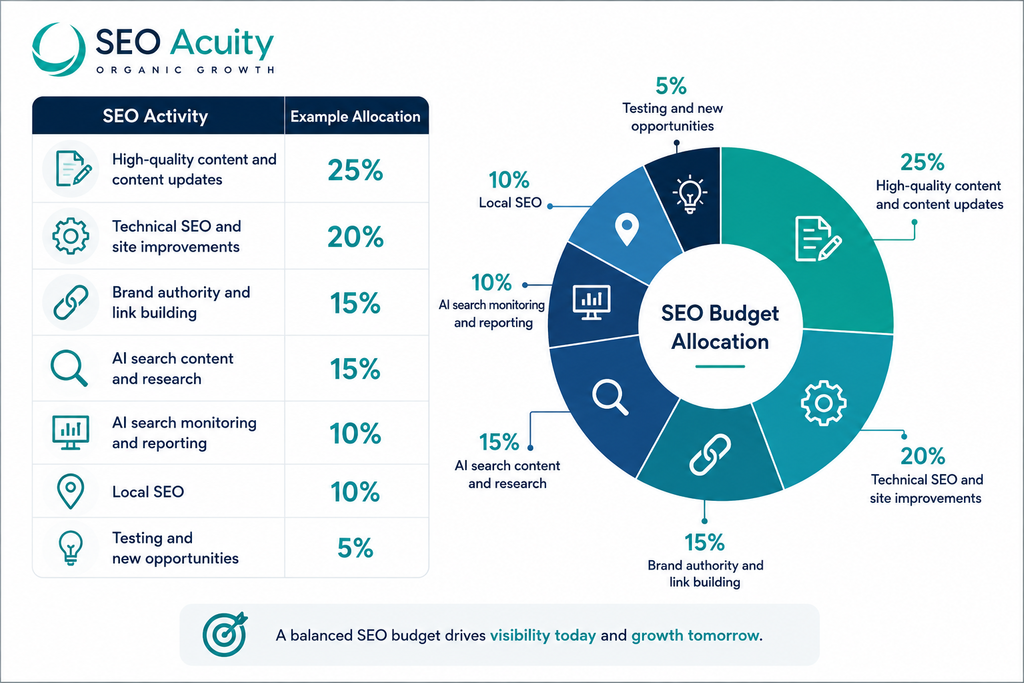
| SEO Activity | Example Allocation |
| High-quality content and content updates | 25% |
| Technical SEO and site improvements | 20% |
| Brand authority and link building | 15% |
| AI search content and research | 15% |
| AI search monitoring and reporting | 10% |
| Local SEO | 10% |
| Testing and new opportunities | 5% |
The Audit-Reallocate-Build-Monitor Cycle
AI search visibility shifts faster than traditional rankings do, so a budget split that’s correct today may need adjusting next quarter. The process above works best as a repeating cycle rather than a one-time move:
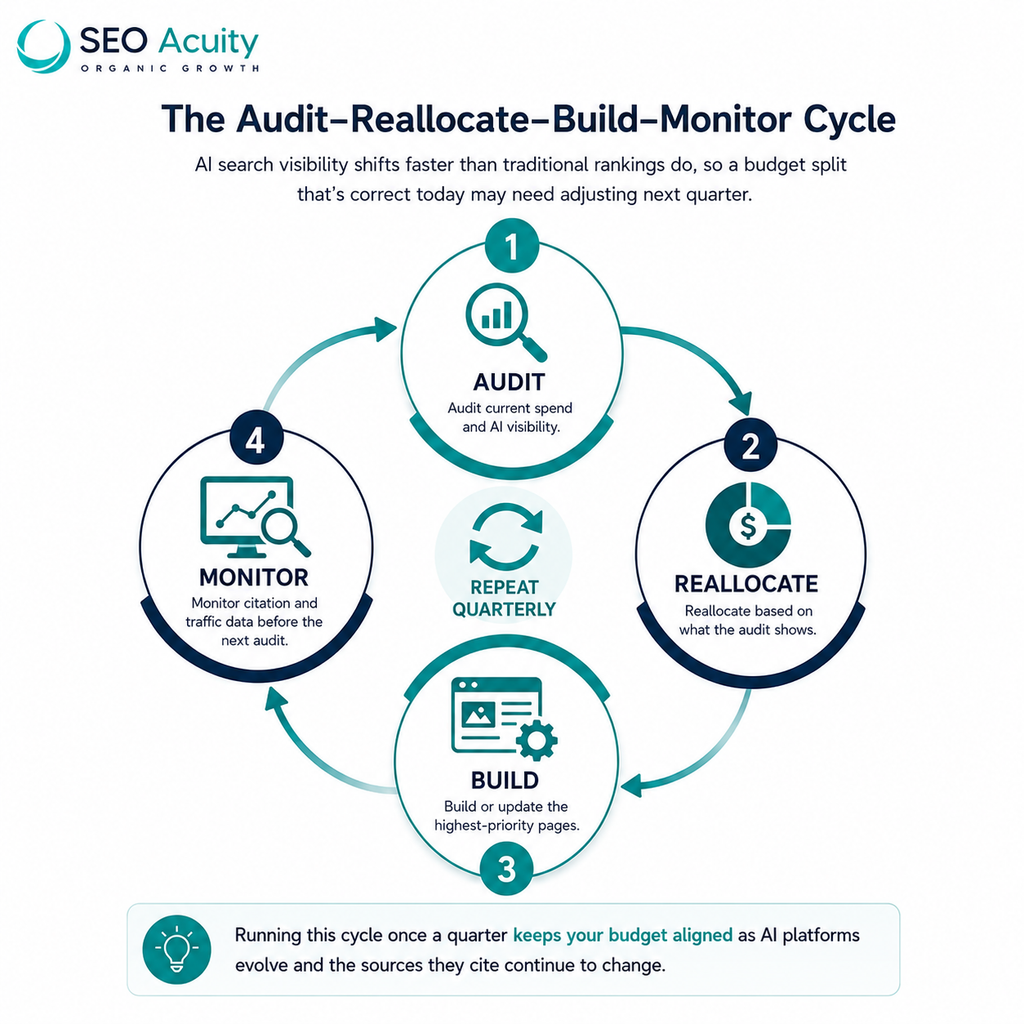
- Audit current spend and AI visibility.
- Reallocate based on what the audit shows.
- Build or update the highest-priority pages.
- Monitor citation and traffic data before the next audit.
Running this cycle once a quarter is what keeps a budget aligned as AI platforms keep changing which sources they cite — a split that was correct in January can be measurably wrong by summer if a competitor starts publishing original research or a platform update changes which sources it favors.
Our walkthrough — watch it here: How to Build an Organic Growth Strategy That Ranks in Both AI Search and SEO, Step by Step — shows this same cycle applied to a real strategy build.
How to Measure Whether Your AI Search Budget Is Working
This section answers: which metrics confirm the reallocation is paying off? Traditional keyword rankings won’t show this. Track four numbers instead:
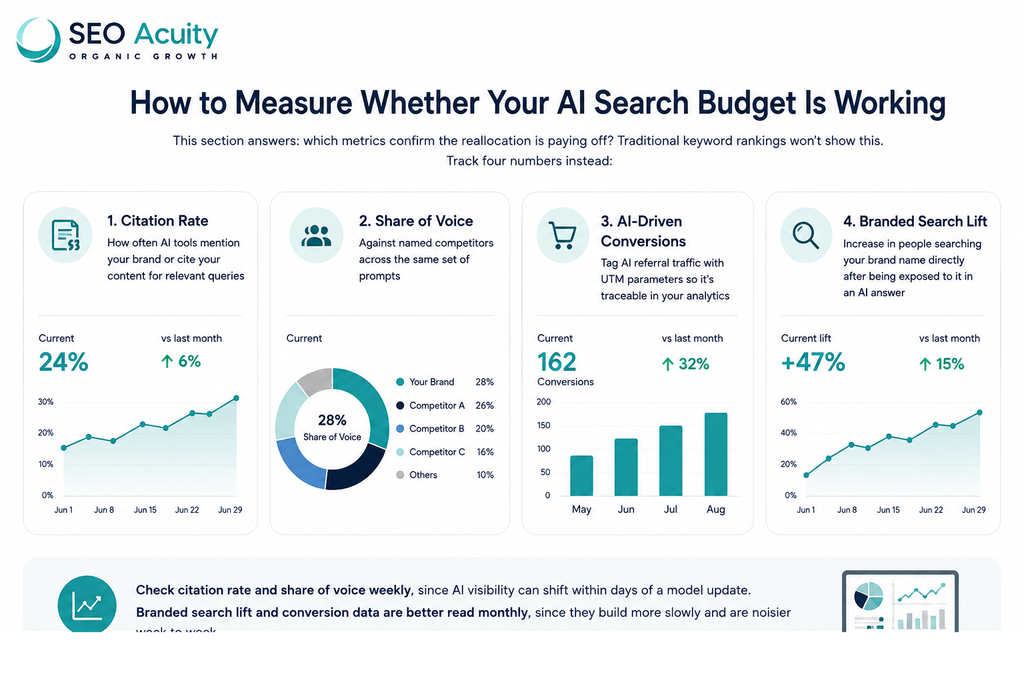
- Citation rate — how often AI tools mention your brand or cite your content for relevant queries
- Share of voice — against named competitors across the same set of prompts
- AI-driven conversions — tag AI referral traffic with UTM parameters so it’s traceable in your analytics
- Branded search lift — an increase in people searching your brand name directly after being exposed to it in an AI answer
Check citation rate and share of voice weekly, since AI visibility can shift within days of a model update. Branded search lift and conversion data are better read monthly, since they build more slowly and are noisier week to week.
If you want to see how this conversion tracking actually plugs into a revenue path, This video covers that missing link directly.
First citation gains typically appear within 60–90 days of the content and technical work landing. Branded search lift tends to build more slowly, over four to six months, as repeat AI exposure builds recognition.
Ready to Dominate Search Engine Rankings?
Accelerate your organic growth and scale your business leads with our data-driven SEO strategies.
Get a Free Quote NOW!Put Your AI Search Budget to Work
A budget split defended by data holds up better than one defended by a guess.
SEO Acuity’s AI visibility audit shows exactly where your brand stands in AI-generated answers today, and which of the line items above deserve your next dollar.
Adapting your SEO budget for AI search optimization is a reallocation, not a rebuild. Keep technical SEO, content, and link building funded, and move 15% to 30% of that same budget toward the work AI platforms actually reward:
- Deeper content.
- Updated pages.
- Brand authority.
- Ongoing visibility monitoring.
The businesses that make this shift early build visibility across both traditional search and AI-generated answers, while competitors still waiting on a bigger budget lose ground on both — which is the whole case for benefits of ai seo for businesses in the first place.

Ready to Dominate Search Engine Rankings?
Accelerate your organic growth and scale your business leads with our data-driven SEO strategies.
Get a Free Quote NOW!Conclusion
Adapting your SEO budget for AI search optimization comes down to one decision: reallocate 15% to 30% of what you already spend, and protect the rest.
Keep funding the fundamentals. Technical SEO, content creation, and link building are still what make a site visible and trustworthy — to Google and to AI models alike. Cutting them to pay for AI work only trades one weakness for another.
Move the reallocated share toward what AI search actually rewards. In practice, that means:
- Fewer, deeper content pieces instead of high-volume, generic output.
- Updates to existing pages before new ones, since AI models favor sources that already carry some authority.
- Brand authority work — original research, expert bylines, genuine reviews — over low-quality link volume.
- A standing budget line for AI visibility monitoring, so the next reallocation is based on data, not a guess.
Treat this as a cycle, not a one-time move. Audit where your budget and your AI visibility stand today, reallocate based on what the audit shows, build or refresh the highest-priority pages, then monitor citation rate, share of voice, AI-driven conversions, and branded search lift before the next review.
AI platforms change which sources they cite often enough that a budget set once and left alone will drift out of date within a few quarters.
The businesses that make this adjustment now are building visibility on two fronts at once — traditional search and AI-generated answers — while the ones waiting for a bigger budget are losing ground on both.
Frequently Asked Questions
Here are quick, direct answers to the questions marketing leads and founders ask most often when adjusting a search budget for AI search optimization.
How much of my SEO budget should go to AI search optimization?
Most businesses should move 15% to 30% of their existing SEO budget toward AI search optimization.
Small and local businesses typically start near 15%, while enterprises in AI-exposed categories like finance and healthcare often justify 30% or more.
Should I cut my core SEO budget to pay for AI search work?
No. If your core SEO is already producing results, fund AI search work as a new, ring-fenced line instead of pulling from what’s working. Reallocate from underperforming content only when your existing SEO isn’t producing leads or sales.
What’s the difference between SEO, AEO, and GEO budgets?
They aren’t separate budgets — they’re categories of work inside one search budget. SEO targets organic rankings in Google and Bing. AEO (Answer Engine Optimization) targets featured snippets and direct answer boxes — see aeo vs seo for the full breakdown. GEO (Generative Engine Optimization) targets citations inside AI-generated answers from tools like ChatGPT and Google AI Overviews. Fund all three from the same 70/30-style split rather than three separate line items.
Do small businesses need a separate AI search budget?
No — a separate budget isn’t necessary, but a small allocation is. A business spending $2,000 a month on SEO can move roughly 15%, or about $300, toward AI search work: content updates, Google Business Profile optimization, and basic schema.
How often should I revisit my AI search budget split?
Review it quarterly using the audit-reallocate-build-monitor cycle. AI platforms update how they select and cite sources more often than Google changes its core ranking algorithm, which means a budget split can go stale faster than a traditional SEO plan would.
How long until AI search budget changes show results?
Early citation and mention gains typically appear within 60 to 90 days of content and technical work going live. Branded search lift builds more slowly, usually over four to six months, as repeated AI exposure builds recognition among buyers.