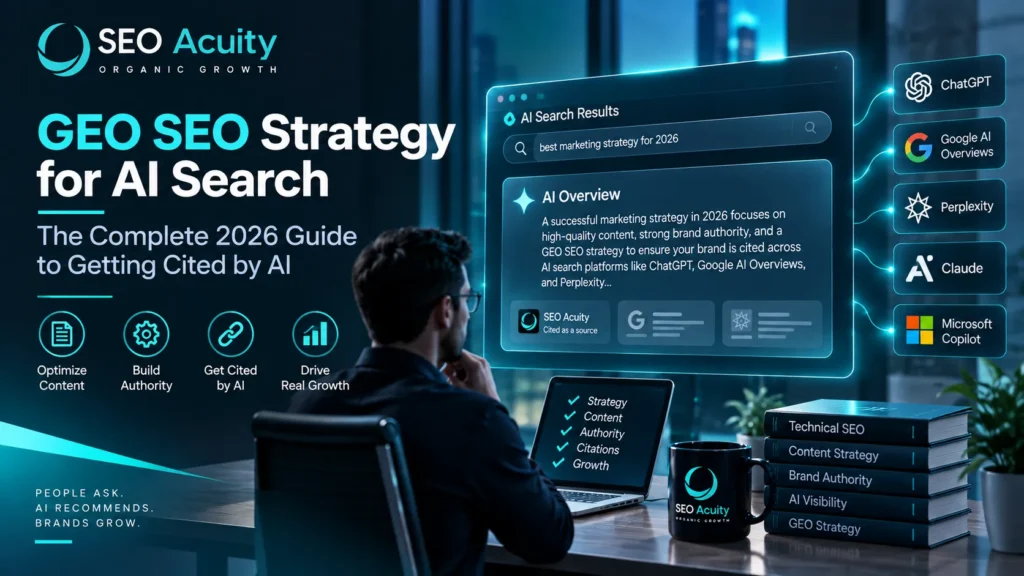
Picture this: a potential customer opens ChatGPT and types, “What’s the best [your category] platform for a mid-size team?” In three seconds, they get a detailed answer. It names three competitors. It does not name you.
You rank #4 on Google for that exact keyword. Your content is solid. Your backlinks are strong. None of that mattered — because the AI did not cite you.
This scenario is already playing out millions of times a day across every industry. ChatGPT serves over 900 million users every week. Google AI Overviews appear in roughly one in four search results. Perplexity, Claude, and Gemini are fielding queries that once sent users to the traditional SERP — and none of those AI-generated answers look anything like a page of blue links.
Ranking #1 on Google no longer guarantees visibility. If AI engines are not citing you, you are invisible to a rapidly growing segment of your audience, even when your organic performance is strong. That is the gap a GEO SEO strategy is designed to close.
This guide breaks down exactly what Generative Engine Optimization (GEO) is, why it is the defining optimization challenge of 2026, and how to implement a complete GEO SEO strategy — from the technical foundations that determine whether AI can even find your content, to the brand authority signals that determine whether it trusts your content enough to recommend it.
What You Will Learn in This Article
Whether you are just starting to explore GEO or looking to build a more systematic approach, this guide walks you through everything you need to make your brand visible in AI-generated search results. By the time you finish reading, you will know:
- What GEO SEO strategy is, how it differs from traditional SEO, and why the two must work together in 2026.
- The three-gate AI Visibility Funnel — and exactly where brands lose citations before they even have a chance to compete.
- The complete 4-pillar GEO framework: Technical GEO, Content GEO, Entity GEO, and Brand Authority GEO — with practical checklists for each.
- How Google AI Overviews work differently from other AI platforms, and the specific tactics that drive citation in them.
- Which GEO metrics actually measure performance — and how to run your first AI visibility audit.
- The external channels AI systems draw citations from most (Reddit, listicles, and third-party databases) and how to build a presence in them without burning credibility.
- The most common GEO mistakes brands make — and how to avoid them.
- A step-by-step prioritization sequence so you know exactly where to start, regardless of team size or budget.
- How enterprise brands manage GEO at scale across teams, tools, and thousands of pages.
What Is a GEO SEO Strategy for AI Search?
Generative Engine Optimization (GEO) is the practice of optimizing your online presence so that AI engines — ChatGPT, Perplexity, Gemini, Google’s AI Overviews, and others — retrieve, understand, trust, and cite your brand when users ask questions in your space. AI SEO is not a replacement for what you already know — it is an evolution of it.
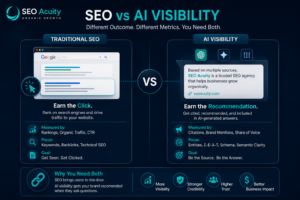
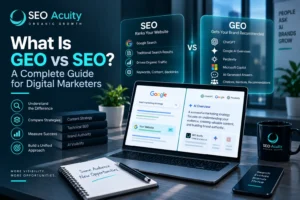
Traditional SEO earns you a ranked position in a list of results. GEO earns you a citation inside the answer itself. The two disciplines are not in competition — they are complementary, and the distinction matters.
Research shows that approximately 50% of sources cited in AI Overviews also rank in the top 10 traditional search results. Strong SEO fundamentals directly support AI search performance: high-quality content, clean technical infrastructure, and authoritative backlinks all feed into how AI systems evaluate sources.
A complete GEO SEO strategy layers AI-specific optimization on top of that organic foundation, rather than replacing it.
Think of it this way – SEO gets you found. GEO gets you cited.
What changes with GEO is the evaluation criteria. Traditional SEO vs AI SEO comes down to this: traditional SEO targeted algorithms that ranked documents by relevance and authority; GEO targets AI reasoning systems that synthesize documents into answers — systems that evaluate your content not just for relevance, but for citability: is this content specific enough, structured enough, and credible enough to be extracted and attributed in a generated response?
That shift in evaluation criteria is what makes a dedicated GEO SEO strategy necessary, and what makes the brands already executing one increasingly difficult to compete with.
Watch:“Is Google Dead? The Full Truth About AI Search”
Why Your Brand Cannot Wait
The window for early-mover advantage in GEO is still open — but it is closing. AI search is not a future trend to prepare for.
It is the search environment your brand is already operating in. Consider the scale of this shift:
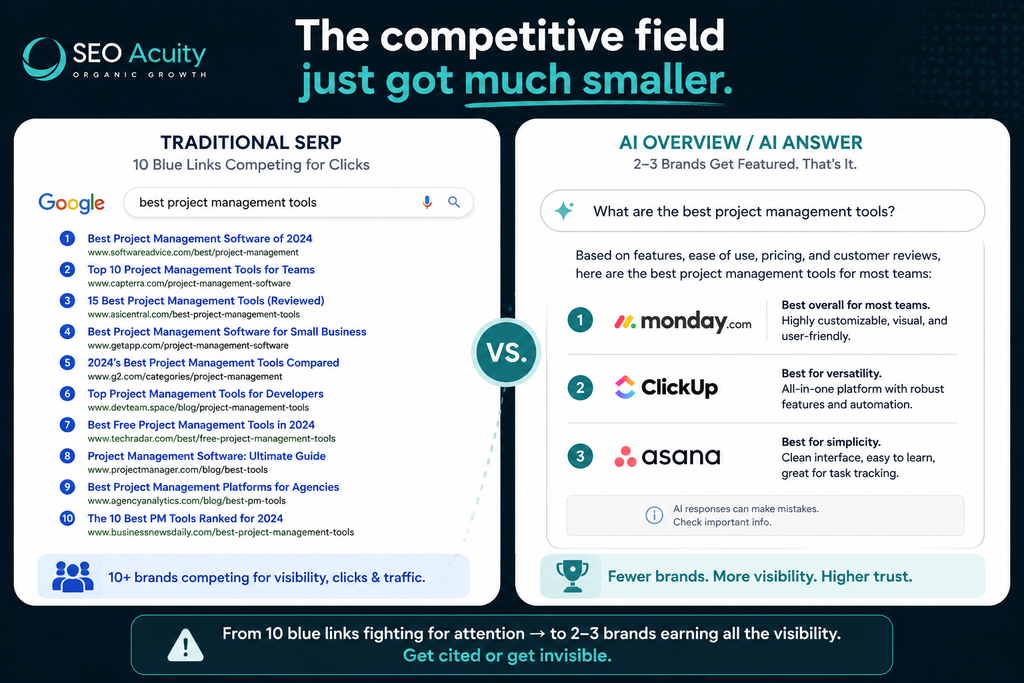
- The competitive field has narrowed dramatically, The traditional SERP competed for 10 organic positions on a page. AI-generated answers typically cite two to five sources. The stakes of inclusion have risen proportionally.
- GEO visibility delivers measurable growth, The benefits of AI SEO for businesses are quantifiable — generative engine optimization strategies have been shown to boost content visibility by up to 40% in generative engine responses.
- Early citations compound over time. The more consistently AI systems cite your brand, the more their models reinforce your brand as a reliable, default source. Early citations beget more citations.
- The cost of inaction is not neutral. Every AI-generated answer that cites your competitor and omits you is a missed impression, a missed click, and a missed conversion — delivered at the scale of millions of AI queries per day across your category.
Most brands have not yet built a systematic GEO SEO strategy. That is the opportunity. The brands that start now will own the AI search landscape in their category.
The brands that wait will spend significantly more effort trying to break into a space that early movers have already settled.
Watch: “Not Every Business Needs SEO… So When Should You Actually Start?”
How AI Decides to Cite Your Brand – The GEO Visibility Funnel
Before diving into strategy, it helps to understand the process AI systems follow when deciding whether to include your brand in a generated response.
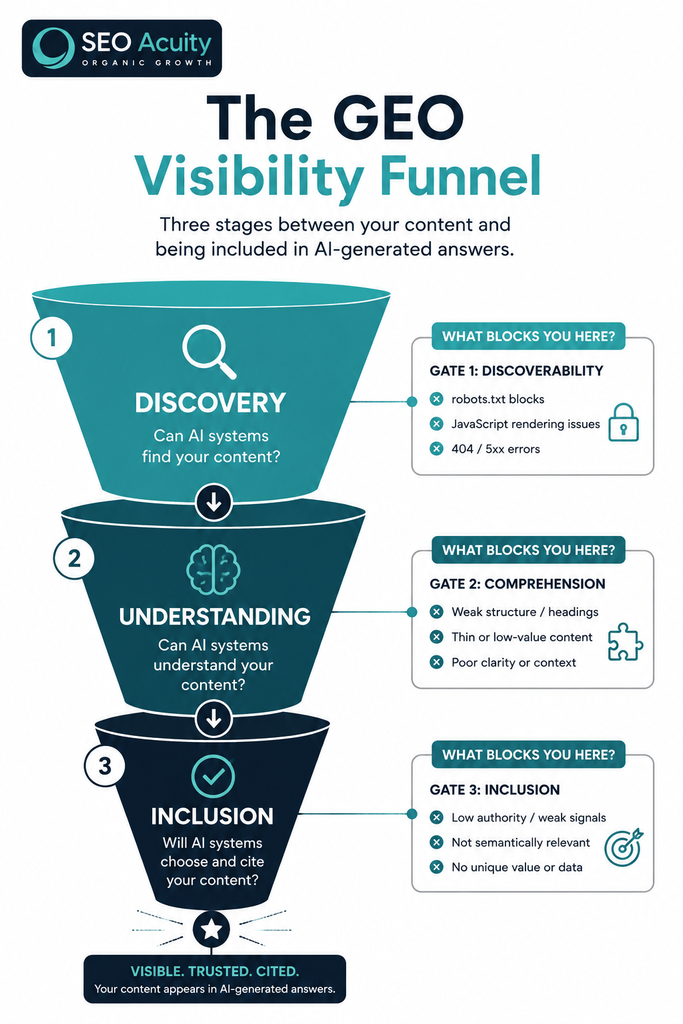
Three sequential gates determine whether you get cited — or not. Understanding these gates is what separates a coherent GEO SEO strategy from disconnected one-off fixes. The difference between SEO visibility and AI visibility lives precisely in how these gates operate.
1. AI Discovery:
Can AI bots find and access your content at all? This is a purely technical question.
Blocked bots in your robots.txt, JavaScript-only rendering, 4xx crawl errors, and NoSnippet directives can all stop AI at this first gate before any quality evaluation happens.
2. AI Understanding:
Can AI correctly interpret what your content is about and what your brand is?
Missing structure, thin or vague content, absent schema markup, and inconsistent entity signals all create ambiguity that leads AI systems to pass over your content for a competitor’s that is easier to parse and attribute.
3. AI Inclusion:
Will AI choose to cite your content over a competitor’s? This is the quality and authority gate. Semantic relevance, topical depth, E-E-A-T signals, brand credibility, and external validation all determine whether your content gets selected or skipped.
The critical insight here is that these gates are sequential, not parallel. You cannot compensate for failing Gate 1 with exceptional content. You cannot compensate for failing Gate 2 with strong brand authority.
A robust GEO SEO strategy addresses all three stages because optimizing for only one while ignoring the others leaves significant citation potential on the table.
“A Practical Step-by-Step Framework for Appearing in AI Search Results Like ChatGPT and Gemini” .
The 4-Pillar GEO SEO Strategy Framework
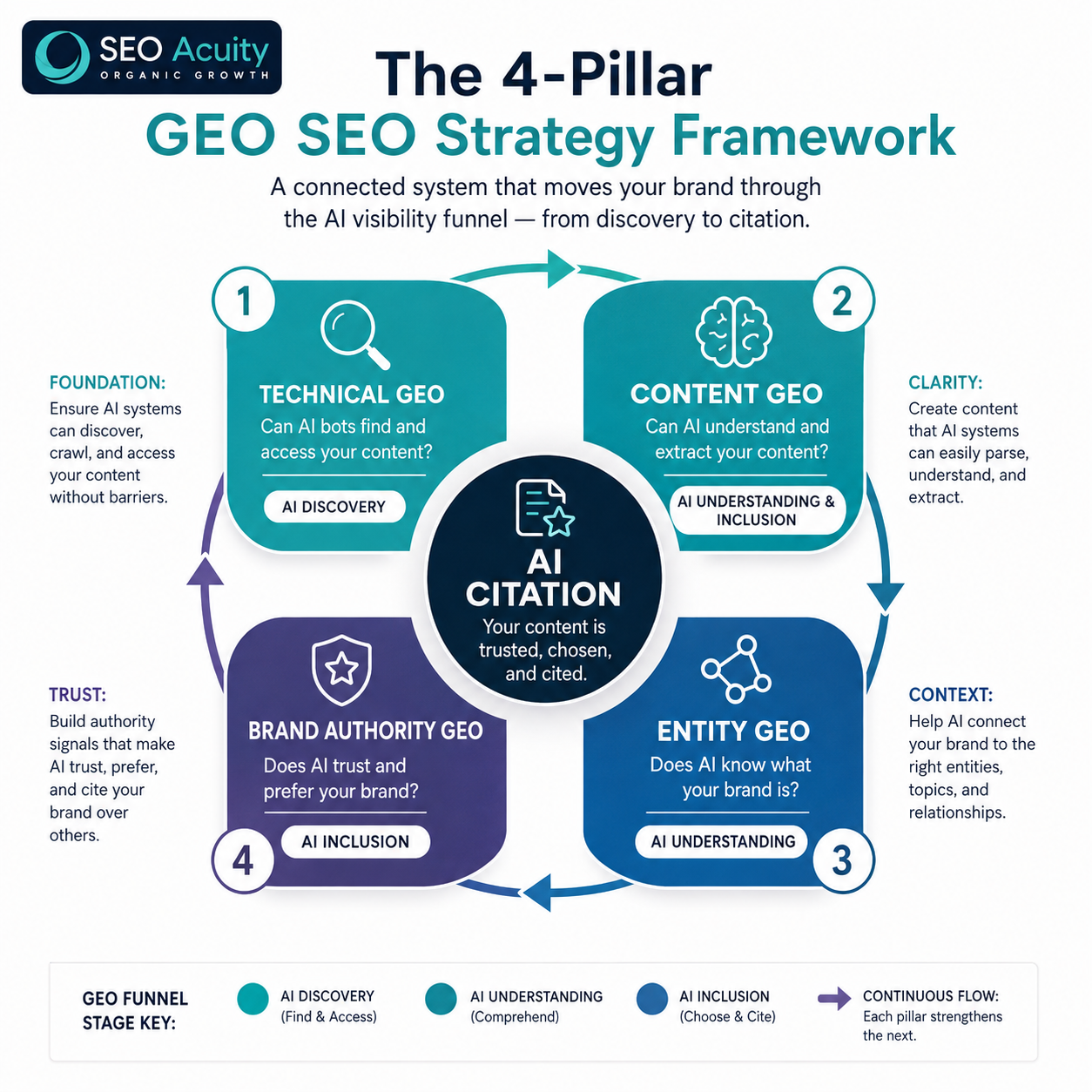
A systematic GEO SEO strategy is organized around four interconnected pillars, each targeting a different layer of the AI visibility funnel.
Together, they move your brand through every stage — from AI discovery to AI citation. Without a framework tying them together, GEO efforts tend to be scattered: a schema fix here, a content refresh there, with no coherent strategy connecting them.
The table below maps each pillar to its area of focus and the stage of the AI visibility funnel it addresses:
| Pillar | What It Addresses | GEO Funnel Stage |
| 1. Technical GEO | Can AI bots find and access your content? | AI Discovery |
| 2. Content GEO | Can AI understand and extract your content? | AI Understanding & Inclusion |
| 3. Entity GEO | Does AI know what your brand is? | AI Understanding |
| 4. Brand Authority GEO | Does AI trust and prefer your brand? | AI Inclusion |
“How to Build an Organic Growth Strategy That Ranks in Both AI Search and SEO, Step by Step”.
Ready to Dominate Search Engine Rankings?
Accelerate your organic growth and scale your business leads with our data-driven SEO strategies.
Get a Free Quote NOW!Technical GEO — Make Your Content Accessible to AI
Technical GEO is the prerequisite for everything else. If AI bots cannot access, render, and parse your content, no amount of content optimization or brand authority building will compensate.
You cannot earn a citation from an AI system that cannot read your pages. This is not a hypothetical problem — many brands that have invested heavily in content and SEO are inadvertently blocking AI crawlers through robots.txt rules written years ago, before AI platforms became significant traffic sources.
A single misconfigured disallow rule can cut your brand out of entire AI platforms entirely.
Technical GEO influences four key outcomes
Technical optimization in the context of GEO is not about cosmetic fixes — it is about making your content structurally accessible to the systems that decide what gets cited. Before any AI tool can reference your content, it has to find it, render it, read it, and determine that it is eligible to quote.
The four outcomes below represent the full chain of that process, and a weakness at any point breaks the chain entirely.
- AI Discoverability — How quickly AI and search engine bots discover new and updated content from your brand’s website.
- Content Freshness — Helping AI extract the most up-to-date version of your facts and data.
- Citation Eligibility — Whether your content is technically eligible to be included in generated answers (i.e., AI bots are not blocked by robots.txt or NoSnippet rules).
- AI Renderability — Whether your pages render correctly when accessed by AI systems — necessary for AI to “read” your content as intended.
Technical GEO audit checklist
Knowing the four outcomes is the starting point; the checklist below is where the actual work happens.
Each item targets a specific technical barrier that could be silently preventing AI systems from accessing, reading, or citing your content — even if your pages appear perfectly functional to a human visitor in a browser.
Work through these in order, as the earlier items (access and eligibility) determine whether the later ones (structured data and speed) ever get the chance to matter.
- AI bot access: Confirm your robots.txt file does not block GPTBot (OpenAI/ChatGPT), PerplexityBot, Google-Extended, BingBot, or CCBot (Common Crawl, which feeds many AI training pipelines). Check this across subdomains, not just your root domain.
- NoSnippet directives: Audit your meta tags and X-Robots-Tag headers for nosnippet directives. These explicitly prevent AI engines from extracting and citing your content as a snippet. Remove them from any pages you want cited.
- Crawl errors: Resolve 4xx and 5xx errors so AI bots can reach every relevant page. A 404 on a well-linked resource page is a dead end for AI crawlers just as it is for Google.
- JavaScript rendering: Ensure all key content — your value propositions, definitions, data, and answers to target questions — is visible in raw HTML, not only loaded via JavaScript. Many AI systems cannot process JS-rendered content the way a modern browser would. If your content is behind a JavaScript wall, it may as well not exist for AI.
- Structured data: Implement schema markup (FAQ, How-To, Organization, Article, Person) to make your content machine-readable at a semantic level. Schema reduces ambiguity and increases the confidence with which AI systems can cite you.
- Page speed: AI systems favor fast-loading content. Core Web Vitals optimization is not just a ranking factor — it is a signal of technical quality that influences AI source preference.
- Internal linking: Maintain strong internal links across topic clusters so AI systems can follow the topical structure of your site and confirm that your expertise in a subject area is substantive and interconnected, not superficial.
- XML sitemaps: Keep sitemaps current and submitted to search engines — many AI tools still rely on traditional search engine indices to discover sources.
Technical GEO creates citation eligibility. Without it, your brand is not even in the running — regardless of how good your content is.
If you want to make sure your site doesn’t have technical errors preventing it from showing up at all, check out: “What Every Developer Should Know About Technical SEO — The 8 Most Common Technical Mistakes” .
Content GEO — Structure Your Content for AI Retrieval and Citation
Content GEO is where the majority of ongoing optimization work lives, and where the difference between being cited and being passed over is most directly determined. AI engines are selective — the structure, specificity, and depth of your content decide whether it gets extracted and attributed, or skipped in favor of a competitor’s page.
Does SEO still matter as AI search grows? Absolutely — but Content GEO adds a new layer to how you write and structure every piece you publish.
The critical mindset shift: write for both your human reader and for AI retrieval simultaneously. Your content is no longer just a marketing asset — in an AI search landscape, it is also citation material for the systems shaping how your category is understood.
Content GEO influences four key outcomes:
- AI Extractability — How easily AI can pull direct, factual answers from your pages.
- Citation Preference — Whether AI selects your content over a competitor’s as the authoritative source for a given query.
- Topical Association — How consistently AI connects your brand with expertise in a specific subject area.
- Query Fan-Out Completeness — Whether your content covers a topic thoroughly enough to satisfy multi-part or follow-up queries.
The following five practices define strong Content GEO optimization:
a. Write for Citability, Not Just Readability
AI systems are drawn to content that makes clear, specific, verifiable claims. Vague, generic paragraphs get passed over.
What gets cited: precise definitions, verified statistics, step-by-step processes, expert opinions with attribution, and concrete examples that can be extracted and attributed without losing meaning.
- Replace vague statements like “many businesses find this useful” with specific, data-backed claims.
- Use phrases like “according to [source]” and “research shows” to frame attributable statements.
- Include original research, proprietary case studies, and unique data points wherever possible.
- When your brand is the source of data AI cannot find elsewhere, you become a default citation.
b. Structure Content Around Questions Your Audience Asks AI
Conversational AI is driven by natural language questions, not keyword strings. Structure your content to directly answer the questions your audience asks AI engines — these tend to be longer and more conversational than traditional search queries.
- Use clear H2 and H3 headings that mirror how users phrase queries to AI.
- Front-load your answers — get to the point in the opening line of each section, then elaborate.
- Include FAQ sections throughout longer guides.
- When an AI system scans your page and finds a clean, authoritative answer to a specific question, you become a prime citation candidate.
c. Build Topical Authority Through Content Clusters
AI engines strongly favor sources that demonstrate deep expertise on a subject — not brands with a handful of scattered posts across dozens of topics.
- Build comprehensive content clusters: a cornerstone guide on each core topic, supported by satellite pages that go deeper on sub-topics, use cases, comparisons, and specific questions.
- Map your content to complete topic clusters rather than individual keywords.
- A useful test: if an AI system answers a follow-up question related to your primary topic, do you have a page that answers it? Frequent gaps signal that competitors can occupy that territory.
d. Make Every Content Chunk Independently Extractable
AI systems often extract specific passages and attribute them independently — not the full article. Each H2 and H3 section of your content should be able to stand alone as a coherent, citable unit.
- Avoid using pronouns where a key entity name would be clearer — write “SEO Acuity’s GEO audit process” rather than “our process” in a key claim.
- Summarize key takeaways at the end of long sections.
- Avoid jargon that is difficult to paraphrase.
- Create multimodal content — video, audio, and image assets alongside written content — and include full transcripts and descriptive alt text to expand the surface area AI systems can pull from.
e. Demonstrate E-E-A-T Through Every Signal Available
Experience, Expertise, Authority, and Trustworthiness are the underlying evaluation framework AI systems use when assessing source quality.
- Add expert authorship with consistent author by-lines linked to verified author profiles.
- Include original research and proprietary data that demonstrates direct experience with the subject matter.
- Cite reputable references transparently.
- Display clear publication and update dates.
- Treat E-E-A-T as an ongoing editorial standard rather than a one-time optimization.
Watch: “How to Build a Keyword Universe for Your Website — A New Approach to Keyword Research”
Entity GEO — Ensure AI Knows Exactly Who You Are
Before an AI platform can decide whether to trust your brand, it must first understand what your brand is — what organization this content refers to, what it does, which industry it operates in, and how it relates to the other entities in your space.
Entity GEO builds this understanding by creating consistent, cross-platform signals that allow AI systems to identify and categorize your brand unambiguously.
Entity GEO answers “who are you?” Brand Authority GEO (Pillar 4) answers “should we trust you?” These are sequential questions.
AI must clearly understand your brand’s identity before it can evaluate your credibility. Without strong entity signals, your brand may be understood partially, inconsistently, or not at all — which means AI citations will be inconsistent or absent even when your content quality is high.
AI does not think in keywords. It thinks in entities and relationships — and that is the mindset shift this pillar requires.
Entity GEO tactics
AI systems don’t just retrieve content — they reason about entities.
Before a language model decides whether to cite your brand, it is already asking a prior question: does this brand exist as a coherent, recognized entity in its knowledge base, and do the signals across the web agree on what that entity is and what it stands for? The tactics below address that question directly.
They are not about getting more content indexed; they are about making your brand legible, consistent, and confirmable to the systems that decide who gets mentioned.
- Consistent brand descriptions across every platform. Your website, LinkedIn company page, Google Business Profile, industry directories, social media bios, and third-party databases should all describe your brand using the same core language — the same name format, category language, and description of what you do. Inconsistency creates ambiguity that AI systems must reconcile, and they often resolve it by choosing a competitor whose signals are cleaner.
- Organization, Product, and Person schema markup. Implement structured data on your website that explicitly identifies your brand as a known entity with defined attributes. This gives AI systems a machine-readable declaration of who you are that requires no interpretation.
- Third-party entity validation. Get your brand included in trusted external databases and resources: Wikipedia where applicable, G2 and Capterra for software, industry association directories, analyst reports, and authoritative category listicles. Each external reference allows AI systems to cross-reference and confirm your brand’s identity.
- Topical entity connections. Publish content that consistently and explicitly connects your brand name with the topics you want to be known for. Over time, this builds the topical associations AI systems draw on when generating category answers.
Think of your entity signals as the knowledge graph AI draws on when assembling context about your brand. The richer, more consistent, and more broadly distributed those signals are, the more confidently AI systems will cite you in relevant responses.
Ready to Dominate Search Engine Rankings?
Accelerate your organic growth and scale your business leads with our data-driven SEO strategies.
Get a Free Quote NOW!Brand Authority GEO — Earn AI’s Trust and Preference
The fourth pillar is where the competitive selection happens. Once AI recognizes your brand as an entity and understands what you do, it evaluates whether your brand deserves to be included, cited, or recommended — and whether it should be recommended over your competitors. This is where credibility, external validation, and brand sentiment tip the balance.
The mechanics here closely parallel what has always mattered in digital PR and traditional SEO, with one critical nuance: in GEO, unlinked brand mentions from credible sources carry significant weight.
AI systems evaluate brand authority through co-citation patterns — the company your brand is consistently mentioned alongside, the publications that reference you, the industry voices that endorse you — not just through the backlink graph.
Digital PR is experiencing a genuine renaissance because of this: authoritative brand mentions across reputable publications matter for AI visibility regardless of whether those mentions include a dofollow link.
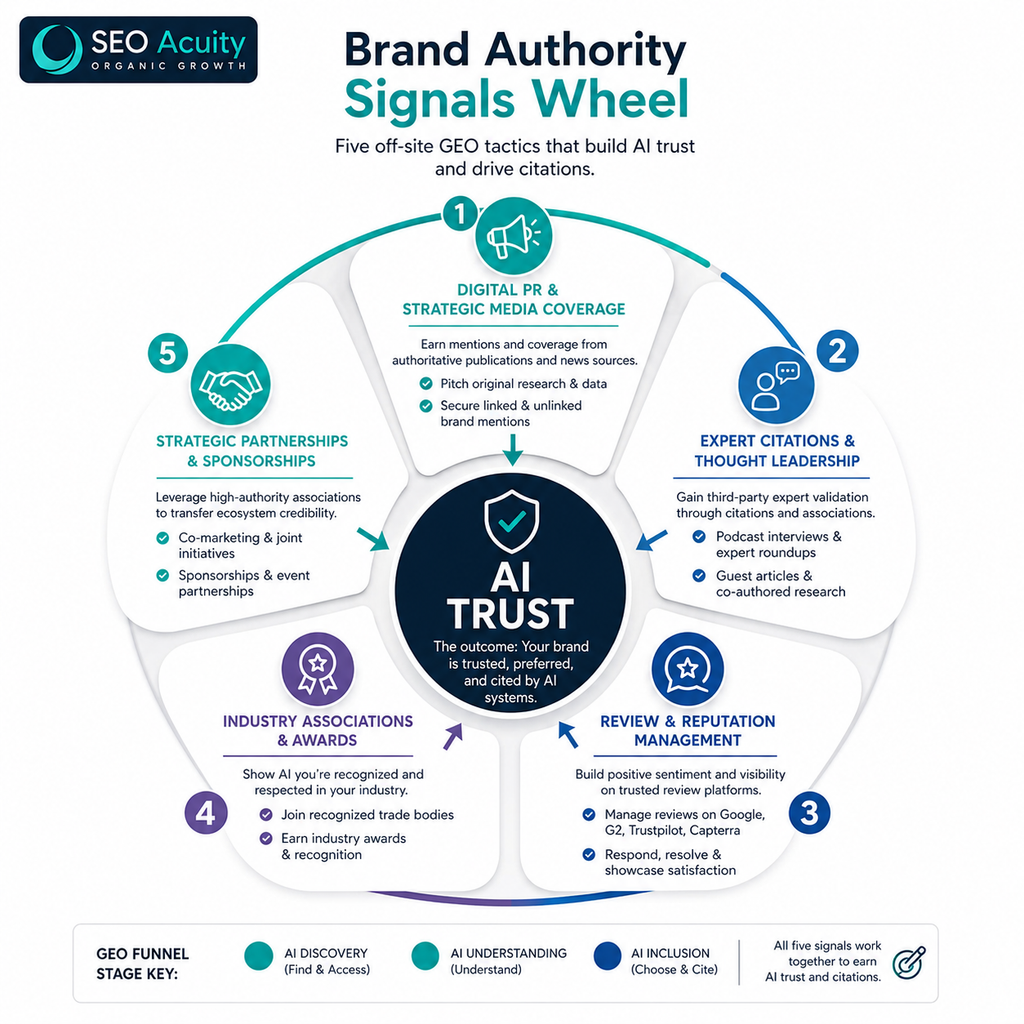
Brand Authority GEO tactics
The tactics below are designed to build that off-site authority footprint: the mentions, associations, validations, and third-party signals that tell AI systems your brand is not just present on the web, but recognized and respected within it.
- Digital PR and strategic media coverage. Secure brand mentions — linked and unlinked — from industry publications, trade media, and authoritative news sources. Pitching original research, proprietary data, and unique expert perspectives gives you the kind of media coverage that AI systems treat as credibility validation.
- Expert citations and thought leadership. Get cited by, quoted by, or associated with established authorities in your niche through podcast appearances, expert roundups, contributed columns, and co-authored research. Third-party expert endorsement carries disproportionate weight in how AI evaluates your brand’s authority.
- Review and reputation management. Actively manage and respond to reviews on Google, G2, Trustpilot, Capterra, and industry-specific review platforms. Positive brand sentiment on third-party platforms reinforces AI’s perception of your brand as reliable and user-validated.
- Industry association memberships and awards. Membership in recognized trade bodies and recognition from respected industry award programs provides AI with clear validation signals — evidence that your brand is legitimately established and respected within its field.
- Strategic partnerships and sponsorships. Associating your brand with high-authority entities through partnerships, co-marketing, and sponsorships transfers ecosystem credibility. When authoritative brands choose to associate with you publicly, that association is a trust signal AI systems register.
GEO SEO Optimization for Google AI Overviews
Google AI Overviews deserve separate treatment because they operate at the intersection of traditional SEO and GEO in a way that other AI platforms do not.
Unlike ChatGPT or Perplexity — which draw from training data and real-time web retrieval independently — Google AI Overviews are deeply integrated with Google’s organic search index. This means that content already performing well in traditional search has a significantly higher probability of being cited in AI Overviews.
Understanding how to rank in Google AI Overviews is therefore both the most immediate GEO opportunity for most brands and the most technically nuanced, since it connects directly to SGE / Search Generative Experience SEO.
GEO SEO optimization tactics for Google AI Overviews:
- Leverage existing ranking strength. If you rank in positions 1–10 for a query that triggers an AI Overview, your probability of being cited in that overview is substantially higher than for content that does not rank. Protect and build organic rankings on queries with high AI Overview appearance rates.
- Target queries with informational intent. AI Overviews appear most frequently on informational queries — “how to,” “what is,” “best practices for,” “difference between.” If your content strategy has historically skewed toward transactional queries, build out the informational content that AI Overviews are designed to answer.
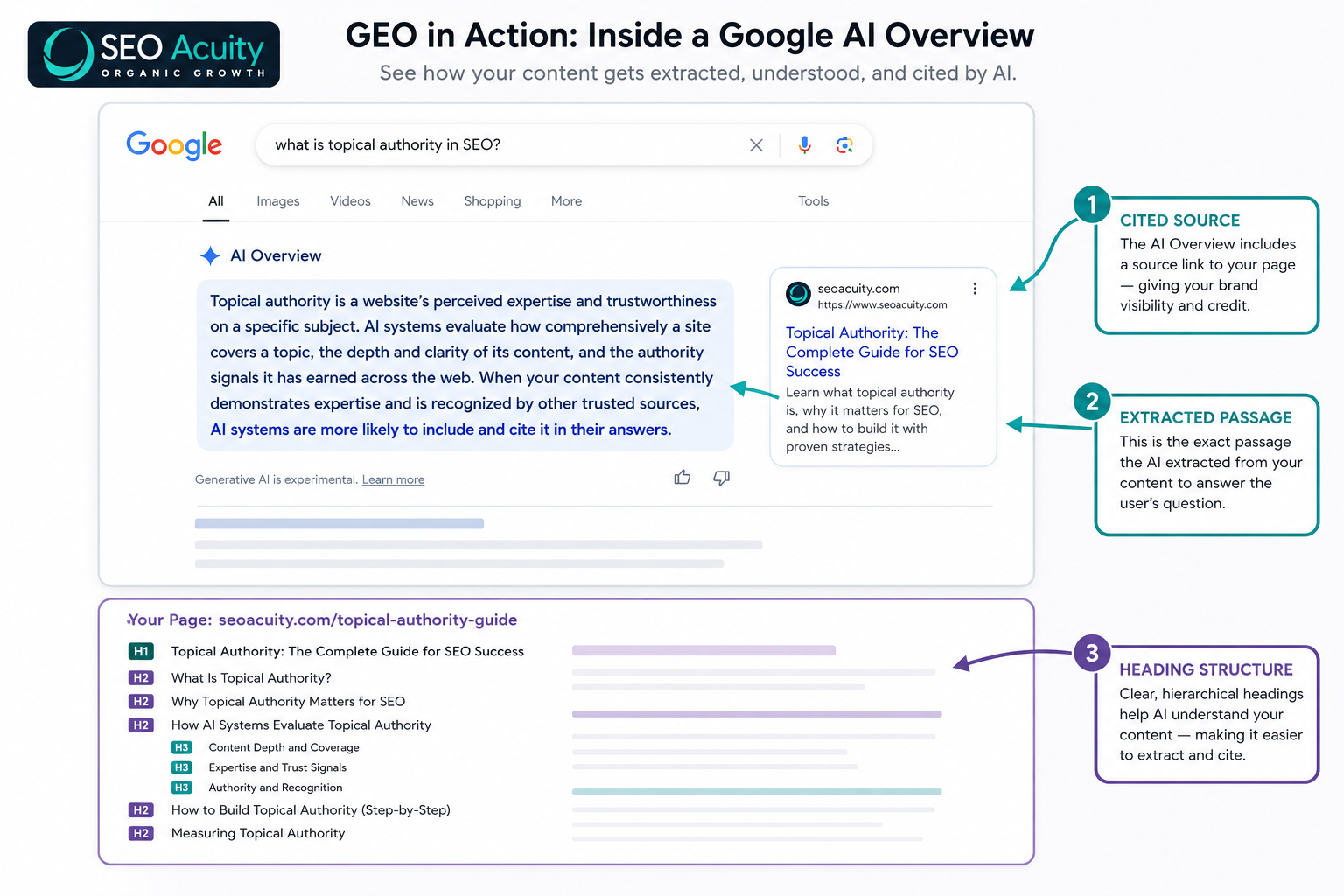
- Answer the query definitively in the first paragraph. Google’s AI Overview extraction system strongly favors content that front-loads a direct, complete answer to the search query before elaborating.
- Use clear, question-matching headings. Structure your content with H2 and H3 headings that directly match likely query phrasings. AI Overviews frequently extract the content under a specific heading to answer a specific question.
- Implement FAQ schema. FAQ-structured content with proper schema markup is consistently over-represented in AI Overview citations. The structured Q&A format is easy for AI systems to parse, attribute, and extract — making it one of the highest-ROI technical optimizations for AI Overview visibility specifically.
- Keep content current. Google’s AI Overviews strongly prefer content with recent publication or update dates, particularly for topics where information changes frequently. Maintain a regular content refresh schedule.
How to Measure Your GEO SEO Performance
You cannot optimize what you do not measure, and GEO measurement is meaningfully different from traditional SEO measurement.
Rankings and organic traffic are necessary baselines — but they do not tell you how your brand is performing in AI search specifically.
Before changing a single page on your website, establish a baseline AI visibility snapshot:
- List 10–15 of your most commercially important target queries — the questions your ideal customers ask AI engines.
- Run each query in ChatGPT, Perplexity, Gemini, and Google AI Overviews.
- For each result, note: whether your brand is mentioned, where in the response it appears, whether a source link is provided, which competitors are cited instead, and the tone of the mention.
- Repeat this process monthly, because AI-generated answers shift as models update and new content enters the index.
The GEO metrics worth tracking on an ongoing basis
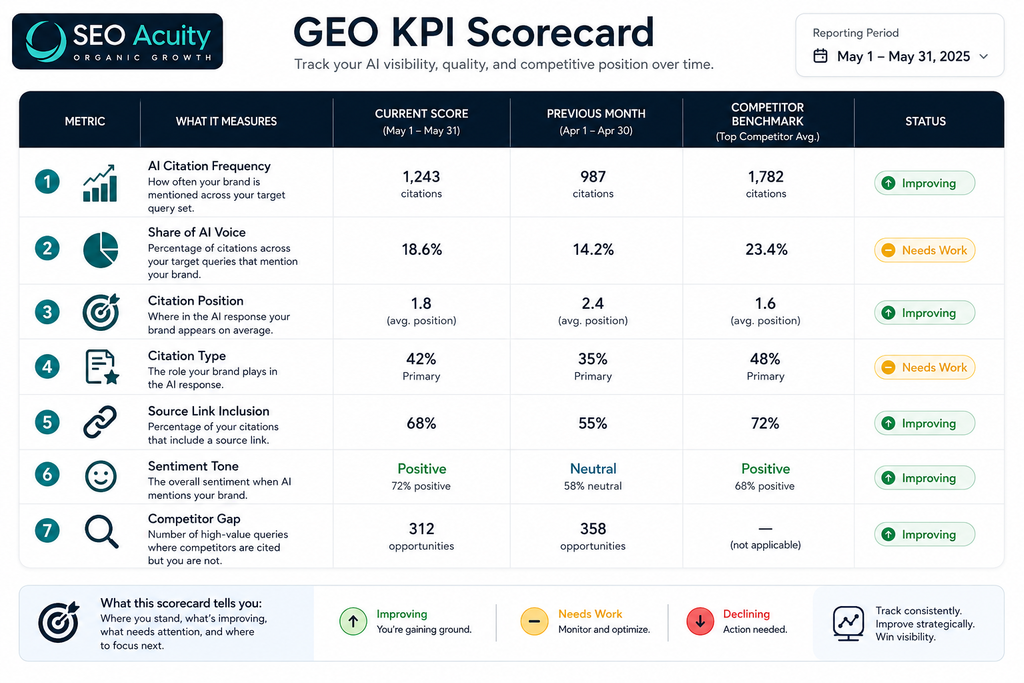
The metrics below give you a structured way to answer those questions consistently over time. Together, they form a GEO performance dashboard that captures not just visibility, but the quality and positioning of that visibility across the AI ecosystem.
- AI citation frequency — How often your brand is mentioned across your target query set. Your baseline number becomes the benchmark everything else is measured against.
- Share of AI voice — Among all citations across your target query set, what percentage mention your brand versus competitors? This is the GEO equivalent of share of voice.
- Citation position — Where in the AI response does your brand appear? Being the first source cited carries more weight than a later mention.
- Citation type — Are you cited as the primary answer, a supporting source, a comparison option, or a generic mention? Primary citations carry more conversion weight.
- Source link inclusion — When your brand is cited, is a source link provided? Linked citations drive direct referral traffic; unlinked citations build awareness.
- Sentiment tone — When AI mentions your brand, is the framing neutral, positive, or hedged with caveats? Sentiment is a leading indicator of Brand Authority GEO health.
- Competitor gap — Which queries are your competitors being cited for that you are not? These are your highest-priority content and optimization opportunities.
Manual tracking across multiple platforms quickly becomes unsustainable at scale. At enterprise scale in particular, dedicated GEO monitoring tools that automate citation tracking, monitor changes over time, and surface competitor movement are essential for running a data-driven GEO SEO strategy.
AI Channels Worth Building Presence In
The four pillars cover your owned presence. The following two channels extend your GEO reach into the external sources AI systems draw from most frequently — and they require a distinctly different approach from anything on your own website.
1. Reddit and User-Generated Content Communities
AI engines treat Reddit as a trusted, authentic source of unbiased peer opinion. Google and major AI platforms increasingly surface Reddit content as a signal of genuine user experience — and AI systems frequently draw from subreddit discussions when answering product recommendation queries, comparison questions, and “what do real users think” questions. Your brand’s presence in relevant subreddit discussions matters — but authenticity is not optional here.
- Find where your audience is already talking. Identify five to ten active subreddits where your target audience discusses the problems you solve and the tools they use. Search for threads like “what [tool] do you use for [your category]” — these are the discussions AI engines pull from.
- Contribute before you promote. Spend at least two to three weeks contributing genuinely before your brand ever comes up. Reddit communities check post history, and obvious promotional accounts get flagged as spam quickly.
- Be honest, not salesy. When a relevant recommendation thread arises, share your product as one honest option among several — noting what it does well and where it may not be the best fit. Nuanced, honest mentions carry significantly more weight with AI systems than obvious endorsements.
- Track which threads AI is already citing. Run your core recommendation queries in ChatGPT and Perplexity and note which specific subreddit threads appear in the responses. If your brand is absent from those threads, that is a direct citation gap to close.
2. Authoritative Category Listicles
When users ask AI engines for category recommendations — “best SEO platforms for enterprise,” “top GEO optimization tools,” “leading AI search visibility solutions” — the AI synthesizes from existing “best of” articles on high-authority websites.
It does not generate those lists independently. A single placement in a well-ranking listicle on a high-DA publisher can trigger citations across ChatGPT, Perplexity, and Google AI Overviews simultaneously and sustainably.
- Run your target recommendation queries in AI engines and note exactly which articles they reference. Those are the publications that need to include your brand.
- Build a prioritized outreach list of publishers that appear consistently across AI results and traditional search for category queries. Prioritize by domain authority.
- Make inclusion easy. Ensure your product pages have a clear one-liner value proposition, obvious differentiators, social proof, and transparent pricing before you pitch.
- Pitch with something valuable — a free account, original data, a detailed demo. Listicles are updated regularly and AI systems re-scan them continuously, so earned placements compound over time.
Common GEO SEO Mistakes to Avoid
As you implement your GEO SEO strategy, these mistakes consistently undermine results and are worth explicitly guarding against:
- Abandoning traditional SEO, GEO does not replace SEO — it extends it. Strong organic rankings directly support AI citation frequency. For Google AI Overviews in particular, SEO and GEO are inseparable.
- Optimizing before measuring, Starting with tactics before establishing your AI visibility baseline means you cannot identify what is working, what has changed, or when AI model updates have affected your citation performance. Measure first.
- Thin, generic content, Surface-level content does not get cited. AI systems seek comprehensive, factually precise, expert-level information. Depth and specificity are competitive advantages that cannot be faked at scale.
- Keyword-stuffed language, Unnatural language patterns actively harm GEO performance. AI systems evaluate semantic coherence and naturalness. Write for clarity and specificity, not keyword density.
- Treating GEO as a one-time project, AI search evolves rapidly. Models update. New content enters the index. Citation patterns shift. GEO requires ongoing monitoring, content refreshes, and tactical adaptation — not a single audit that gets filed and forgotten.
- Ignoring entity consistency, Inconsistent brand descriptions across platforms create ambiguity that undermines AI’s confidence in citing you. Audit every external profile, directory listing, and third-party database for accuracy and alignment before investing in content or brand authority tactics.
- Neglecting the channels AI actually cites, Optimizing only your website while ignoring Reddit, review platforms, industry publications, and category listicles leaves a significant portion of your AI citation potential unaddressed. GEO SEO optimization is a multi-channel strategy, not a website-only one.
How to Prioritize Your GEO SEO Strategy – A Step-by-Step Sequence
With four pillars and multiple channel tactics to work through, sequencing matters enormously. Knowing how to adapt your SEO budget for AI search starts with knowing which actions unlock the value of everything that comes after them.
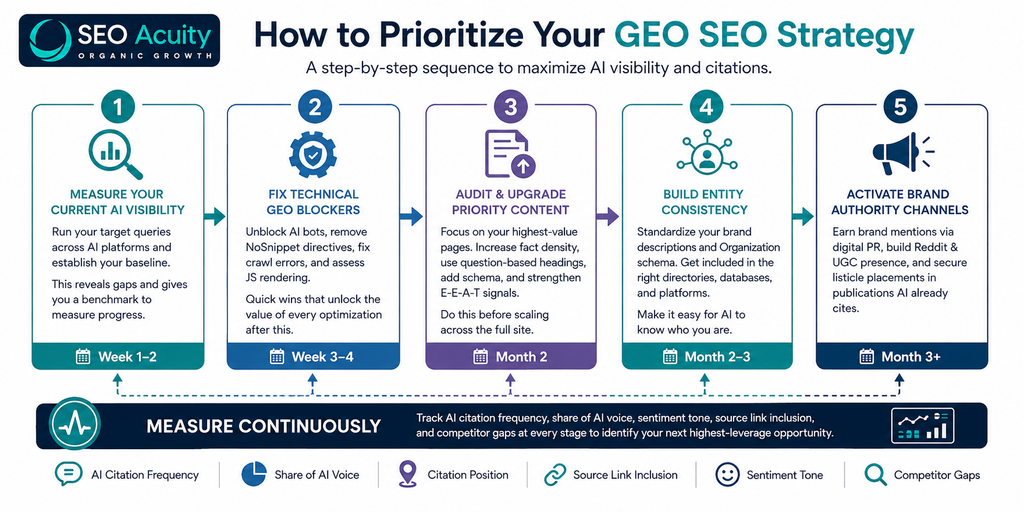
Here is the recommended order for brands starting their GEO SEO journey:
Step 1 — Measure your current AI visibility
Before touching anything, run your target queries across AI platforms and establish your baseline.
This tells you where the biggest gaps are and gives you a benchmark to measure progress against.
Step 2 — Fix Technical GEO blockers
Audit your robots.txt for blocked AI bots, resolve NoSnippet directives, fix crawl errors, and assess JS rendering. These are often quick wins that unlock the value of every other optimization you make.
A brand that fixes its AI bot blocking may see citation improvements within weeks, simply from removing the barrier that was preventing AI from accessing already-strong content.
Step 3 — Audit and upgrade priority content
Identify your highest-traffic, most commercially relevant pages and assess them for AI extractability.
Increase fact density, restructure for question-based headings, implement schema markup, and improve E-E-A-T signals on these pages before expanding to the full site.
Step 4 — Build entity consistency
Audit your brand’s descriptions across every platform and directory. Standardize your Organization schema.
Identify the third-party databases and directories where your brand should appear and pursue inclusion.
Step 5 — Activate brand authority channels
Develop a digital PR strategy focused on brand mentions in authoritative industry publications. Build or scale your Reddit and UGC presence.
Pursue listicle placements in the publications AI is already citing for your category.
Measure continuously at every stage. At every step, track changes in your AI citation frequency, share of AI voice, and competitor gaps. GEO improvement is measurable — use the data to identify your next highest-leverage opportunity.
Watch: “How to Build a Complete SEO Plan in 5 Steps and Strategies”
Enterprise GEO SEO Strategy: Managing Scale and Complexity
Enterprise brands face a specific challenge with GEO: the volume of pages, the complexity of technical infrastructure, and the number of stakeholders involved make manual GEO auditing and optimization impractical at scale.
LLM SEO services for enterprise businesses exist precisely because of this complexity — understanding what LLM SEO is and how it applies at enterprise scale is increasingly a prerequisite for competitive digital visibility.
An enterprise-grade GEO SEO strategy requires dedicated tooling capable of:
- Scanning your entire site regularly and monitoring AI citation scores across platforms.
- Surfacing Technical GEO issues before they cost you citations.
- Tracking competitor citation movement so you can respond quickly when the AI landscape in your category shifts.
- Reporting on share of AI voice and sentiment trends over time for leadership visibility.
It also requires organizational alignment across functions that do not traditionally coordinate. Technical GEO issues live in engineering and DevOps.
Content GEO requires coordination between content teams, SEO, and subject matter experts. Entity GEO overlaps with brand management and communications. Brand Authority GEO is fundamentally a digital PR and partnerships function. A coherent enterprise GEO SEO strategy requires these teams working from a shared framework with shared KPIs — not pursuing GEO in their own silos with no common measurement baseline.
The most effective enterprise GEO programs share two characteristics:
- A central AI visibility dashboard that gives all teams visibility into citation performance.
- A dedicated GEO lead (or agency partner) who owns the strategy, coordinates cross-functional execution, and manages the ongoing measurement cycle.
Key Takeaways – Your GEO SEO Strategy Checklist
If you take one action from each pillar today, these are the highest-impact starting points:
- Technical GEO: Check your robots.txt file right now for blocked AI bots. If GPTBot, PerplexityBot, or CCBot is disallowed, fix it. This is the fastest citation win available to most brands.
- Content GEO: Audit your five most important pages for fact-density and question-based structure. Add specific statistics, front-load answers in the opening paragraph, and implement FAQ schema.
- Entity GEO: Compare your brand description on your website, LinkedIn, and Google Business Profile. If they say different things, standardize them. Inconsistency is a silent citation killer.
- Brand Authority GEO: Run your primary recommendation queries in ChatGPT and Perplexity and list every article and source cited. That is your digital PR and listicle outreach target list.
- Measurement: Set up a monthly AI visibility audit with 10–15 target queries. Track which AI platforms cite you, which queries trigger citations, and where competitors appear instead. Every gap is an optimization opportunity.
Ready to Dominate Search Engine Rankings?
Accelerate your organic growth and scale your business leads with our data-driven SEO strategies.
Get a Free Quote NOW!You Rank #1. AI Has Never Heard of You. We Fix Both.
Most brands discover their AI visibility problem too late — after competitors have already claimed the citations, the recommendations, and the trust of AI-generated answers in their category. SEO Acuity is built specifically to close that gap.
What we do:
- GEO Audit & AI Visibility Assessment — We run a full audit of your brand’s current AI citation performance across ChatGPT, Perplexity, Gemini, and Google AI Overviews, and identify exactly where you are being passed over and why.
- Technical GEO Optimization — We fix the technical barriers — blocked AI bots, rendering issues, schema gaps — that silently prevent AI systems from accessing and citing your content.
- Content & Entity Strategy — We restructure your content for AI extractability, build your topical authority clusters, and establish consistent entity signals across every platform that matters.
- Brand Authority & Digital PR — We secure the media mentions, third-party citations, and listicle placements that AI systems use to decide whether your brand is worth recommending.
- Ongoing GEO Monitoring — We track your share of AI voice, citation frequency, and competitor movement month over month — so your GEO strategy is always data-driven, never guesswork.
Whether you are starting your first GEO audit or scaling an enterprise AI visibility strategy across thousands of pages, SEO Acuity builds the systems that turn AI search into a consistent growth channel.
Start with a Free GEO Visibility Assessment

Ready to Dominate Search Engine Rankings?
Accelerate your organic growth and scale your business leads with our data-driven SEO strategies.
Get a Free Quote NOW!Conclusion
Generative Engine Optimization is still in its early stages. Most brands have not yet built a systematic approach to AI visibility. That gap represents a real and time-limited competitive opportunity — but it is closing as awareness grows and more marketing teams begin investing seriously in GEO.
The benefits of AI SEO for businesses are compounding for early movers and shrinking for late ones. The brands that start measuring their AI visibility, optimizing their content for citability, establishing consistent entity signals, building authentic community presence, and earning placements in authoritative listicles today will be the ones AI engines default to recommending tomorrow.
This is not about chasing a new trend. It is about extending your existing organic search investment to cover the search landscape that has already materialized alongside traditional Google search.
The foundation you have built with SEO is your starting point, not something to walk away from. A complete GEO SEO strategy builds on that foundation — closing the gap between ranking and being cited, between visibility on the SERP and visibility inside the answer.
The question is not whether AI search will matter for your brand. It already does. The question is whether you will be visible when it does.
Frequently Asked Questions About GEO SEO Strategy
The questions below cover the fundamentals of GEO, how it relates to what you are already doing, and the practical decisions most brands face when getting started.
What is GEO, and how is it different from SEO?
Traditional SEO earns you a ranked position in a list of results. GEO earns you a citation inside the AI-generated answer itself — where only two to five sources are typically referenced.
The optimization criteria are different: SEO targets ranking algorithms, GEO targets AI reasoning systems that evaluate your content for citability, not just relevance.
Does traditional SEO still matter if AI search keeps growing?
Absolutely. Approximately 50% of sources cited in AI Overviews also rank in the top 10 traditional search results. SEO is the foundation GEO builds on — abandoning one to chase the other is a strategic mistake. The winning approach is layering GEO tactics on top of a strong organic foundation.
What is the difference between GEO, AEO, and LLM SEO?
AEO optimizes for direct answer formats like featured snippets and voice search. GEO is the broader evolution targeting AI-generated answers from platforms like ChatGPT and Gemini. LLM SEO focuses specifically on visibility within large language models.
All three share the same tactical core — structured content, clear entity signals, and authoritative sourcing — and are best treated as one integrated strategy.
Which AI platforms should I prioritize first?
Start with Google AI Overviews — they build directly on your existing SEO foundation. Then ChatGPT given its 900 million weekly active users, followed by Perplexity for research-heavy audiences.
Monitor all platforms from day one, even before you optimize for them, so you know exactly where your gaps are.
What is the fastest win I can get for AI visibility?
Check your robots.txt file for blocked AI crawlers — GPTBot, PerplexityBot, CCBot. A single disallow rule can cut your brand out of an entire AI platform entirely.
This is a five-minute fix that can unlock citation improvements within weeks. After that, implement FAQ schema on your most important pages — it is the highest-ROI technical move for Google AI Overviews specifically.
How do I know if AI engines are currently citing my brand?
Run your 10–15 most important queries in ChatGPT, Perplexity, Gemini, and Google AI Overviews and note whether your brand appears, where it appears, and who appears instead. Repeat monthly. At scale, dedicated GEO monitoring tools automate this across all platforms continuously.
What metrics replace traditional rankings in GEO?
The core GEO metrics to track are: AI citation frequency, share of AI voice, citation position, citation type (primary vs. supporting), source link inclusion, sentiment tone, and competitor gap. Together they give you a complete picture of where you stand and where to focus next.
How long does it take to see results?
Technical fixes (unblocking AI crawlers) show results in two to four weeks. Content and schema improvements take one to three months. Brand authority and entity signals take three to six months or more. The sequence matters — fix technical access first, then build content and authority on top.
Do I need a separate budget for GEO?
Not necessarily. Adapting your SEO budget for AI search is mostly a reallocation — shifting content resources toward topical authority, technical resources toward schema and AI bot access, and link-building budget toward brand mentions via digital PR. The only genuinely new cost for most brands is GEO monitoring tooling.