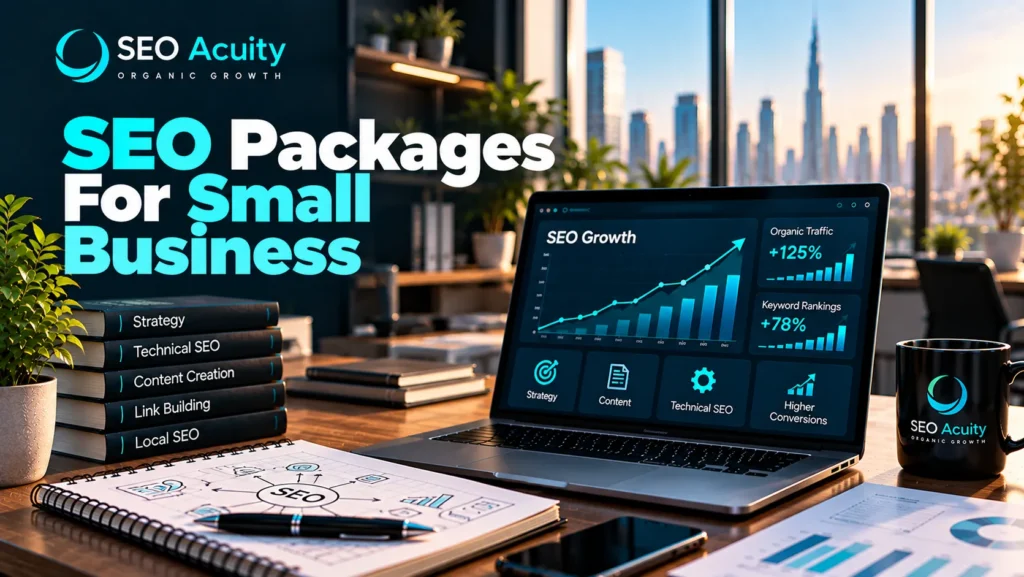
SEO packages for small business bundle the essential work needed to improve organic visibility, attract qualified search traffic, and turn that visibility into enquiries or sales.
For a small company, the challenge is rarely understanding that SEO matters. The harder question is deciding what you actually need to pay for — and which deliverables will contribute to growth rather than simply make an agency report look busy.
A useful small business SEO package combines technical improvements, keyword strategy, on-page optimisation, content, authority building, and performance measurement around one commercial objective.
The package should also evolve. SEO is an ongoing process rather than a one-time checklist, and small businesses typically need 3–6 months before meaningful changes become visible enough to evaluate properly.
What You’ll Learn
- What SEO packages for small business should actually include
- How starter, growth, and competitive packages differ
- What small businesses can expect to pay for SEO
- How to choose a package based on your business goal rather than a generic tier
- Which red flags suggest an SEO package could waste money or create risk
What Should SEO Packages for Small Business Include?
A good SEO package should address every major constraint preventing a business from gaining qualified organic visibility. That usually means combining technical SEO, search strategy, content, on-page optimisation, authority building, and measurement rather than selling each activity in isolation.
The exact amount of work should depend on the website, market, competition, and growth objective. A five-page local plumbing website does not need the same SEO operation as a growing e-commerce store with hundreds of product and category pages.
1- Technical SEO and Website Auditing
Technical SEO ensures search engines can efficiently discover, crawl, understand, and index your website.
A package may therefore cover:
- Website crawling and indexation issues
- Broken links and redirects
- Page speed problems
- Mobile usability
- Duplicate content
- Canonicalisation
- Structured data
- Sitemap and robots.txt checks
- Website architecture
A starter package may address essential technical problems once they are identified, while a more advanced package should include continued technical monitoring. This distinction matters because larger websites develop new SEO issues as pages, products, plugins, and functionality change.
If you want to make sure your site doesn’t have technical errors preventing it from showing up at all, check out: “What Every Developer Should Know About Technical SEO — The 8 Most Common Technical Mistakes”
Read also: Seo Companies For Small Business
2- Keyword Research Based on Revenue Potential
Keyword research identifies the searches your prospective customers use when looking for information, products, and services.
But simply receiving a spreadsheet containing 20 keywords is not a strategy.
For a small business, keywords should be prioritised according to search intent, relevance, competition, existing ranking potential, and proximity to revenue.
A local accountant, for example, may benefit far more from ranking for a smaller commercial query connected directly to its service area than attracting thousands of visitors through a broad informational keyword that produces no enquiries.
This is one of the most important criteria when comparing small business SEO packages: ask how keywords are selected, not merely how many keywords are included.
3- On-Page SEO
On-page SEO improves individual pages so their content and structure better match what users are searching for.
Typical work includes optimising:
- Title tags
- H1 and supporting headings
- Meta descriptions
- Page copy
- URLs
- Images
- Search intent alignment
- Page structure
A basic package might optimise 5–10 priority pages, while larger packages can extend optimisation across considerably more of the website.
The important question is which pages are being optimised. Your highest-value service and commercial pages should normally receive attention before low-priority pages simply to meet a monthly quota.
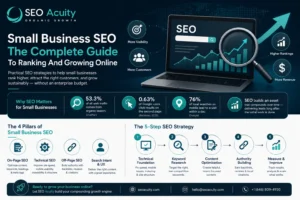
Read also: Small Business SEO- The Complete Guide To Ranking And Growing Online
4- SEO Content Creation
Content gives a small business opportunities to appear for searches its existing service or product pages cannot capture.
Depending on the strategy, this may include blog articles, service pages, landing pages, category copy, comparison content, guides, or updates to existing pages.
Content should answer questions across the buying journey rather than exist simply because the package promises “two blogs per month.”
For many small businesses, improving an existing page with genuine ranking potential can produce more value than continuously publishing new articles.
Before paying for a high-volume content package, find out whether the agency audits your existing content. Otherwise, you may pay to create new pages while valuable existing pages remain under-optimised.
Read also: How To Build An Ecommerce SEO Strategy?
Ready to Dominate Search Engine Rankings?
Accelerate your organic growth and scale your business leads with our data-driven SEO strategies.
Get a Free Quote NOW!5- Local SEO
Local SEO helps businesses become more visible when potential customers search within a particular geographic area.
For companies serving specific cities or locations, a package may cover Google Business Profile optimisation, citation consistency, location targeting, reviews, local landing pages, and local authority building.
SEO Acuity‘s approach to local SEO also focuses on GBP optimisation, citation building, and review strategy rather than treating local SEO as simply inserting city names into pages.
If most of your customers come from your surrounding area, these activities may deserve a larger share of your budget than national content production.
6- Link Building and Authority Development
Backlinks are links from other websites to yours. Quality backlinks can strengthen the authority and discoverability of your website when they come from relevant, credible sources.
For small businesses, sensible opportunities can include local associations, suppliers, industry publications, legitimate directories, partnerships, and relevant media coverage.
The objective should be quality and relevance rather than a guaranteed monthly link count.
Buying large quantities of low-quality links or using link farms can create unnecessary risk. SEO Acuity’s small-business framework prioritises relationship-based authority building rather than shortcuts.
7- Reporting That Connects SEO to Business Results
Every small business SEO package should include reporting, but rankings alone are not enough.
Useful reporting can cover organic traffic, search visibility, conversions, qualified leads, and the performance of priority commercial pages.
SEO Acuity’s wider strategic model treats organic growth as business infrastructure rather than a collection of disconnected SEO tactics. That means performance should ultimately be connected to business outcomes rather than vanity traffic.
If an agency celebrates a traffic increase but cannot tell you whether those visitors became enquiries or customers, the reporting is incomplete.
How Much Do Small Business SEO Packages Cost?
Small business SEO packages commonly sit anywhere from several hundred dollars per month for limited foundational work to $2,500+ for more competitive ongoing campaigns.
The appropriate investment depends on the amount of work required, the competitiveness of the market, and how aggressively the business wants to grow.
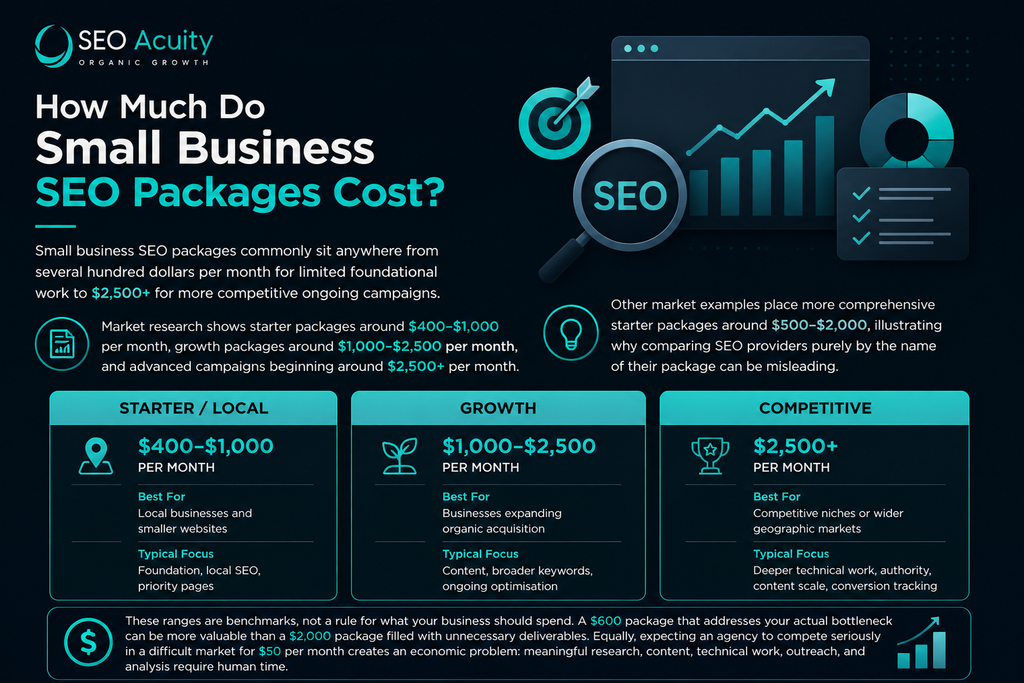
The supplied market research shows starter packages around $400–$1,000 per month, growth packages around $1,000–$2,500 per month, and advanced campaigns beginning around $2,500+ per month.
Other market examples place more comprehensive starter packages around $500–$2,000, illustrating why comparing SEO providers purely by the name of their package can be misleading.
| Package | Typical Monthly Cost | Best For | Typical Focus |
| Starter / Local | $400–$1,000 | Local businesses and smaller websites | Foundation, local SEO, priority pages |
| Growth | $1,000–$2,500 | Businesses expanding organic acquisition | Content, broader keywords, ongoing optimisation |
| Competitive | $2,500+ | Competitive niches or wider geographic markets | Deeper technical work, authority, content scale, conversion tracking |
These ranges are benchmarks, not a rule for what your business should spend.
A $600 package that addresses your actual bottleneck can be more valuable than a $2,000 package filled with unnecessary deliverables. Equally, expecting an agency to compete seriously in a difficult market for $50 per month creates an economic problem: meaningful research, content, technical work, outreach, and analysis require human time.
Ready to Dominate Search Engine Rankings?
Accelerate your organic growth and scale your business leads with our data-driven SEO strategies.
Get a Free Quote NOW!Why Extremely Cheap SEO Can Become Expensive?
A very low monthly price should trigger one question:What can realistically be done for this amount?
If the answer depends on mass-produced content, automated links, generic optimisation, or virtually no strategic analysis, the apparent saving can create larger costs later.
The cheapest package is therefore not necessarily the lowest-cost option. Correcting poor content, cleaning up problematic backlinks, or rebuilding an unfocused website can cost more than doing the work properly from the beginning.
Which Small Business SEO Package Is Right for You?
Choosing between packages becomes much easier when you start with the business problem rather than the agency’s pricing table.
Use this decision framework:
| Your Situation | Priority |
| Customers mainly come from one geographic area | Local SEO + Google Business Profile |
| Website gets impressions but few clicks | Search intent + titles + existing-page optimisation |
| Site has very little useful content | Keyword mapping + content development |
| Important pages are not indexed/ranking properly | Technical SEO |
| Rankings stall despite strong pages | Authority/backlinks + competitive analysis |
| Traffic grows but enquiries do not | Conversion tracking + commercial-page improvement |
| Business is entering multiple cities/regions | Scalable landing-page and authority strategy |
This is the part many package comparisons miss.The best package is not necessarily the one containing the most SEO services. It is the one that allocates the most resources to your current growth constraint.
If technical problems are stopping Google from properly indexing the website, buying four extra blog posts every month does not solve the immediate problem.
If your website is technically healthy but competitors have significantly stronger content and authority, repeatedly auditing page speed is unlikely to close the gap.
SEO Acuity builds small-business SEO around the business’s actual search opportunity rather than scaling down an enterprise checklist.
How Long Should You Keep an SEO Package?
Small businesses should generally evaluate SEO over months rather than weeks, with 3–6 months being a more realistic initial window for meaningful progress.
That does not mean nothing should happen during the first three months.
You should be able to see the work being completed: technical fixes implemented, priority pages improved, content published, tracking configured, local assets strengthened, and authority opportunities pursued.
What you should not expect is a guaranteed timetable for reaching a particular Google position.
SEO compounds. Technical improvements make content easier to discover; stronger content increases keyword coverage; authority helps competitive pages; performance data then tells the team what deserves further investment.
That dependency is why monthly SEO packages can make sense: the activities are designed to build on one another rather than disappear after a one-time optimisation.
What Should You Check Before Buying a Small Business SEO Package?
Do not choose based on the longest deliverables list.Before signing, check whether the provider can explain why each activity is included and how it contributes to your goal.
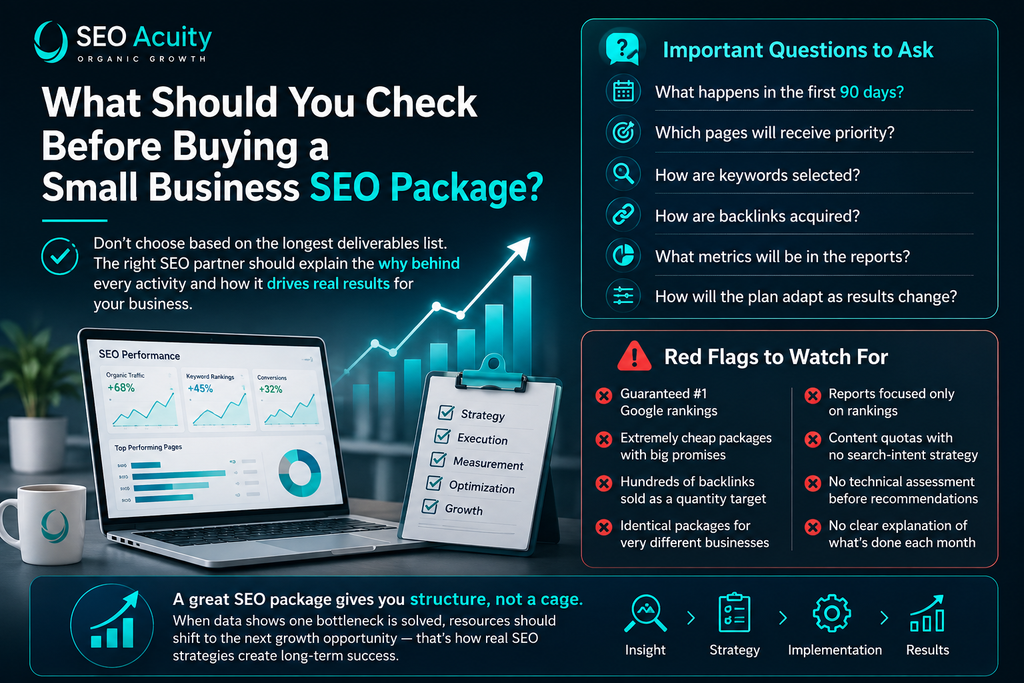
Ask what happens in the first 90 days, which pages will receive priority, how keywords are selected, how backlinks are acquired, what metrics appear in reporting, and what happens when performance data suggests the original plan needs changing.
Watch for these red flags:
- Guaranteed 1 Google rankings
- Extremely cheap packages with extensive promised deliverables
- Hundreds of backlinks sold as a quantity target
- Identical packages for fundamentally different businesses
- Reports focused entirely on rankings with no conversion measurement
- Content quotas with no search-intent strategy
- No technical assessment before recommendations
- No clear explanation of what the agency actually does each month
A package should provide structure without becoming a cage. If data shows that your original bottleneck has been solved, resources should be able to shift toward the next growth constraint.
That adaptability is one of the clearest differences between buying SEO activity and investing in an SEO strategy.
Ready to Dominate Search Engine Rankings?
Accelerate your organic growth and scale your business leads with our data-driven SEO strategies.
Get a Free Quote NOW!Start Building Organic Growth Around Your Business
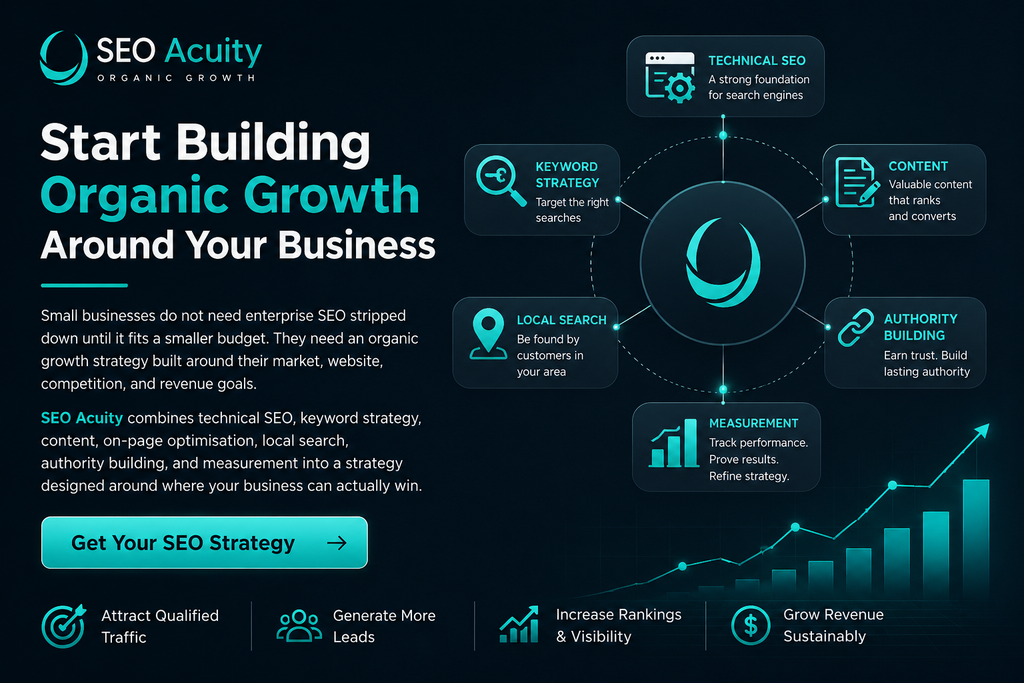
Small businesses do not need enterprise SEO stripped down until it fits a smaller budget. They need an organic growth strategy built around their market, website, competition, and revenue goals.
SEO Acuity combines technical SEO, keyword strategy, content, on-page optimisation, local search, authority building, and measurement into a strategy designed around where your business can actually win.
Conclusion
The right SEO packages for small business should give you more than a monthly list of tasks. They should create a structured path from your current search position to greater qualified visibility, traffic, leads, and revenue.
Compare packages by strategy, priorities, implementation quality, and measurement — not simply keyword counts, article quotas, or backlinks.
Most importantly, identify the constraint first. A small business SEO package becomes valuable when every dollar is directed toward solving the next problem standing between your website and sustainable organic growth.
FAQs About SEO Packages for Small Businesses
What are SEO packages for small business?
SEO packages for small business are bundled monthly services designed to improve a company’s organic search visibility. They commonly combine technical SEO, keyword research, on-page optimisation, content, local SEO, authority building, and reporting.
How much does an SEO package cost for a small business?
Small-business packages can range from several hundred dollars per month to $2,500+ depending on competition and scope. Starter/local plans in the supplied market research commonly fall around $400–$1,000, while more competitive campaigns require greater investment.
Are monthly SEO packages worth it for small businesses?
Yes, when the package targets a genuine business opportunity and includes ongoing implementation rather than superficial reporting. Monthly SEO allows technical work, content, authority building, optimisation, and performance analysis to compound over time.
How long does SEO take for a small business?
Small businesses should generally allow 3–6 months before evaluating meaningful SEO progress. The exact timeline depends on the website’s starting condition, competition, content, authority, implementation speed, and target market.
What should a small business SEO package include?
A strong package should include the services necessary to address the website’s actual growth constraints. Common components include technical SEO, keyword research, on-page optimisation, content, local SEO, backlinks or authority building, conversion tracking, and performance reporting.
Should I choose the cheapest SEO package?
No. Compare the work required to your business goals rather than choosing purely by monthly price. Extremely cheap SEO may leave essential work undone or depend on low-quality automated tactics, while an unnecessarily large package can make you pay for services you do not yet need.