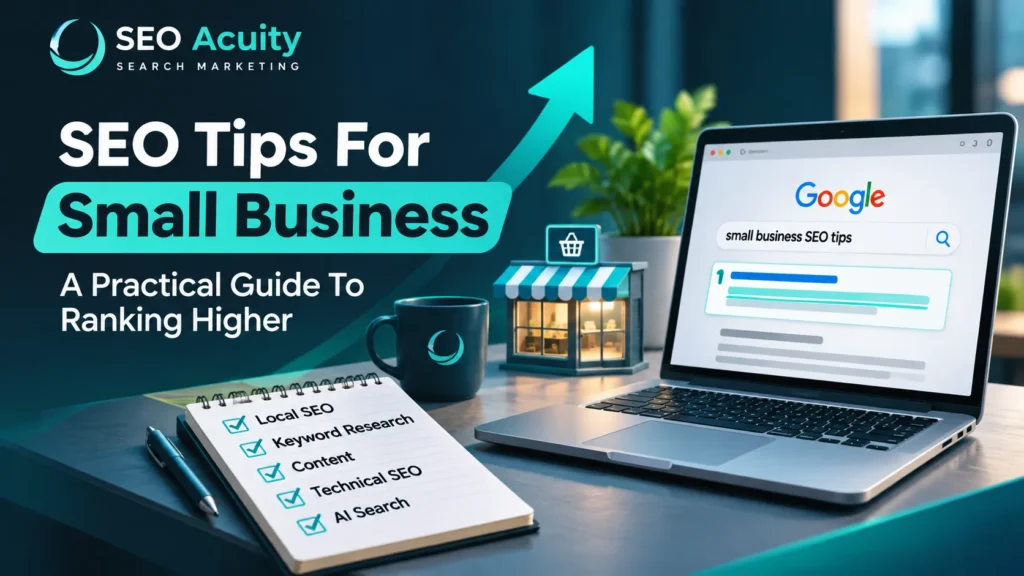
Most small business owners don’t have a marketing department. You have a business to run, and Google’s ranking algorithm is not exactly bedtime reading. That’s the tension this article solves: seo tips for small business owners who want real traffic without hiring a full agency team or learning to code.
Search engine optimization is the process of improving your website so it shows up when people search for what you sell.
Done well, it brings in customers who are actively looking for you — without the recurring cost of paid ads. Done badly, or not at all, it means your competitors show up first and your website sits on page four, unseen.
This guide walks through the tips that actually move the needle for small businesses in 2026: Google Business Profile setup, keyword research, content that answers real questions, technical basics, local SEO, and the newer question of how AI search tools like ChatGPT and Google’s AI Overviews are changing the game.
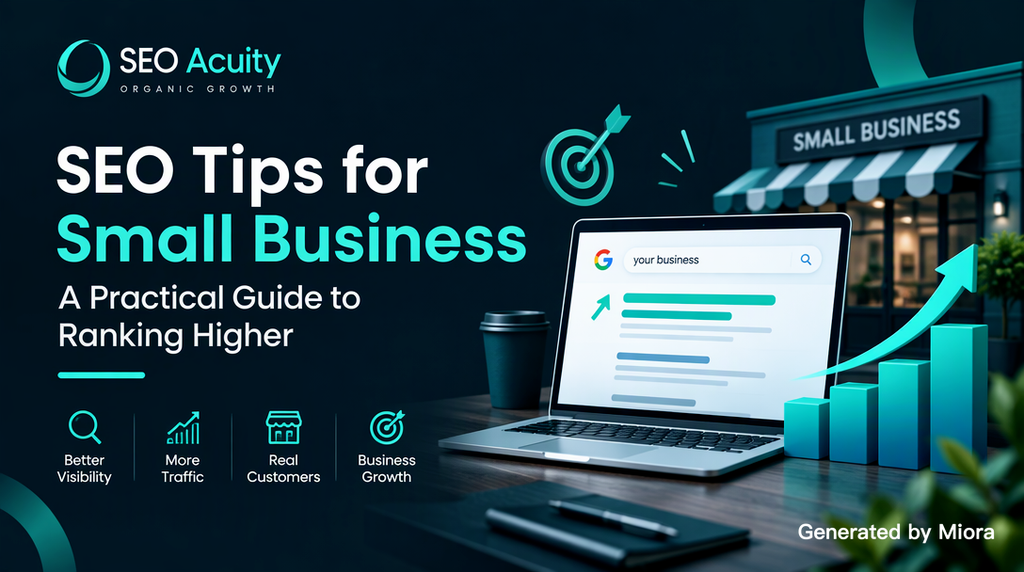
1- Optimize Your Google Business Profile for Better Local Visibility
Your Google Business Profile (formerly Google My Business) is often the first thing a potential customer sees — before they ever click through to your website.
It’s free, and it’s the fastest way to appear in Google Maps and the local “map pack” that shows up above regular search results for searches like “plumber near me.”
Claim your profile if you haven’t already, then fill in every available field: business category, services, hours, photos, and a clear description of what you do. An incomplete or outdated profile hurts your local visibility no matter how good your website is.
Keep your name, address, and phone number consistent
Search engines cross-check your business details across your website, your Google profile, and any directories you’re listed in. This is often called NAP consistency (name, address, phone).
A slightly different address format on one listing, or an old phone number left on another, quietly undermines the trust signals that help you rank locally. Audit these details every few months and fix mismatches as you find them.
Build a Stronger Local Reputation by Asking for Customer Reviews the Right Way
Reviews do two jobs at once: they influence buyers directly, and they’re a ranking factor for local search. The mistake most owners make is only asking happy customers — ask everyone, right after a positive interaction, when it’s easiest for them to say yes.
Respond to every review, good or bad. A thoughtful reply to a negative review often does more for your reputation than the review itself does to damage it.
If your team is stretched thin managing all of this on top of running the business, SEO Acuity sets up and monitors Google Business Profiles as part of local SEO management — so nothing falls through the cracks between projects.
Ready to Improve Your Search Engine Rankings?
Accelerate your organic growth and scale your business leads with our data-driven SEO strategies.
Get a Free Quote NOW!2- Find the Keywords Your Customers Actually Use
Keyword research means identifying the exact words and phrases your customers type into a search engine when they’re looking for what you sell. Free tools like Google Keyword Planner, or paid tools like Ahrefs and SEMrush, show you search volume and how competitive a term is.
A bridge worth stating plainly: this is the foundation everything else builds on. Content, page titles, and even your Google Business Profile description should all be built around terms real people search for — not the internal jargon your business uses about itself.
Long-tail keywords convert better than they look
A “long-tail” keyword is a longer, more specific phrase — “how to fix a leaking tile roof in rainy climates” instead of “roof repair.” These have lower search volume individually, but they’re less competitive and attract visitors who are closer to a buying decision.
Search volume is the metric that gets the attention, but a keyword with modest volume that consistently brings in new customers is worth more than a high-volume term that never converts.
Match content to search intent
Every keyword carries an intent behind it: informational (“how does SEO work”), navigational (“SEO Acuity contact”), commercial (“best SEO tips for small business”), or transactional
A page built for informational search shouldn’t push a hard sell, and a page built for transactional search shouldn’t bury the call to action under paragraphs of background information.
Before writing any page, ask what the searcher wants to do next, and build the page around that answer.
3- Publish Content That Actually Answers Questions
High-quality content solves a real problem for your target reader in plain language. That’s the whole standard — not word count, not keyword density. Google rewards pages that give people what they came looking for; it penalizes filler.
A practical example from small business SEO: a countertop maker ranked for “are marble countertops still trendy” not with a generic product page, but with an article on the year’s top kitchen countertop trends.
A refrigerated truck manufacturer ranked for a fuel-economy question with a blog post breaking down the real running costs of operating a refrigerated truck.
In both cases, the winning content answered the underlying question the searcher actually had — which was sometimes broader than the literal search phrase.
Group content into topic clusters
Rather than publishing scattered posts on unrelated topics, organize your content around a handful of core themes relevant to your business — a central page covering a broad topic, supported by several more specific articles linked to it.
This structure signals to search engines that you have real depth on a subject, and it’s one of the clearest ways a small business can build authority in its niche.
Update old content instead of only writing new content
Review older blog posts and refresh outdated statistics, prices, or examples. Regular updates signal to search engines that your site is active and current — and it’s often faster than writing something new from scratch.
Ready to Improve Your Search Engine Rankings?
Accelerate your organic growth and scale your business leads with our data-driven SEO strategies.
Get a Free Quote NOW!4- Build a Strong SEO Foundation by Getting the Technical Basics Right
Technical SEO ensures search engines can actually find, load, and understand your site. You don’t need to become a developer to handle the fundamentals.
Site speed and mobile responsiveness
Google evaluates load speed and mobile usability directly. Compress images so they stay light without losing quality, enable browser caching, and trim unused CSS or JavaScript. A slow, poorly formatted mobile site pushes visitors away before they read a word — and Google notices that bounce.
Security and crawlability
An HTTPS connection is now a baseline expectation, not a bonus. Beyond that, make sure your robots.txt file isn’t accidentally blocking pages you want indexed, set up redirects for any old or deleted URLs, and watch for duplicate content — near-identical pages that compete against each other in search results.
Google Search Console will flag most of these issues for you directly.
This is the part of SEO most small business owners understandably avoid — it’s technical, and one mistake can undo months of content work.
It’s also exactly where SEO Acuity spends most of its audit time: finding the quiet technical issues that are capping a site’s visibility before a single new article gets written.
5- Optimize Your Content for AI Search Visibility, Not Just Traditional Google Rankings
AI-generated answers — Google’s AI Overviews, ChatGPT, Perplexity — now summarize information directly in search results, which means fewer clicks reach your website even when you rank well. Marketing professionals across the industry have observed this shift firsthand: search volume hasn’t dropped, but the click-through rate for a well-ranked page has.
The core SEO fundamentals still apply here — clear content, real expertise, accurate structured data — but a few habits matter more than before.
Answer the question directly, early
AI systems tend to pull short, self-contained passages rather than reading an entire page for context. Answering a question clearly in the first sentence of a section gives you the best chance of being the one quoted.
Write headings the way people ask questions
A heading like “How much does small business SEO cost?” is easier for both readers and AI systems to match to a real query than a vague label like “Pricing.” This single habit does double duty — it also improves your odds of winning a featured snippet in traditional search.
Ready to Improve Your Search Engine Rankings?
Accelerate your organic growth and scale your business leads with our data-driven SEO strategies.
Get a Free Quote NOW!What SEO Costs and How Long It Takes?
SEO itself has no licensing fee — the cost is the time and resources spent researching, creating, and executing a strategy. Most small businesses hiring an agency should budget in the range of a few thousand dollars a month, with a minimum commitment of six months to see meaningful results.
Freelance SEO consultants working hourly are typically a lower-cost entry point, often on a three-month initial contract.
Timelines vary by how competitive your keywords and industry are, but most small businesses start noticing measurable improvement within three to six months.
Local SEO improvements — particularly around your Google Business Profile — tend to show results faster than broad organic rankings.
Treat SEO as an ongoing part of running the business, not a one-time project; search engines reward consistency over short bursts of activity far more than most owners expect.
Get a clear, no-guesswork picture of what your site needs before committing a budget to it. SEO Acuity starts every client relationship with a technical and content audit, so you know exactly what work is required and what it will cost before anything is signed.
Stop Guessing Get an SEO Audit From SEO Acuity Today
You don’t need to master every ranking factor yourself. You need a clear picture of where your site stands and a plan to close the gaps.
SEO Acuity has built visibility strategies for small businesses across competitive markets, combining technical fixes, content, and local SEO into one plan instead of three separate guesses.
conclusion
Small business SEO comes down to a handful of consistent habits: claim and maintain your Google Business Profile, research the keywords your customers actually use, publish content that answers real questions, keep your site fast and mobile-friendly, and stay visible as AI search tools change how people find answers.
None of these tips work in isolation — a fast site with no keyword strategy won’t rank, and great content on a broken technical foundation won’t be found.
The businesses that see results treat SEO as a continuous process, not a single project, and they check their Search Console data often enough to know what’s actually working.
Applied consistently, these seo tips for small business owners are enough to build durable, compounding visibility without an ongoing ad budget.
Frequently Asked Questions
What are the best SEO tips for small business owners just getting started?
Start with a Google Business Profile, basic keyword research, and one piece of content that directly answers a question your customers ask. These three steps build the foundation everything else in SEO depends on.
How long does small business SEO take to show results?
Most small businesses see measurable improvement within three to six months, though local SEO changes — especially around Google Business Profile — often show results faster than broad organic rankings.
How much does SEO cost for a small business?
Agency pricing typically runs a few thousand dollars a month with a six-month minimum commitment, while hourly freelance consultants offer a lower-cost entry point, often on shorter contracts.
Do I need a blog to rank well in search?
Not strictly, but publishing content that answers your customers’ real questions is one of the most reliable ways to build topical authority and appear in more searches over time.
How is AI search changing SEO for small businesses?
AI Overviews and tools like ChatGPT now summarize answers directly in search results, reducing some clicks even for well-ranked pages — making clear, directly-answered content more important than ever for getting quoted.
Is local SEO different from regular SEO?
Yes. Local SEO focuses on ranking for searches tied to a specific location, driven mainly by your Google Business Profile, consistent business details, and reviews, while general SEO covers your entire site’s visibility regardless of location.