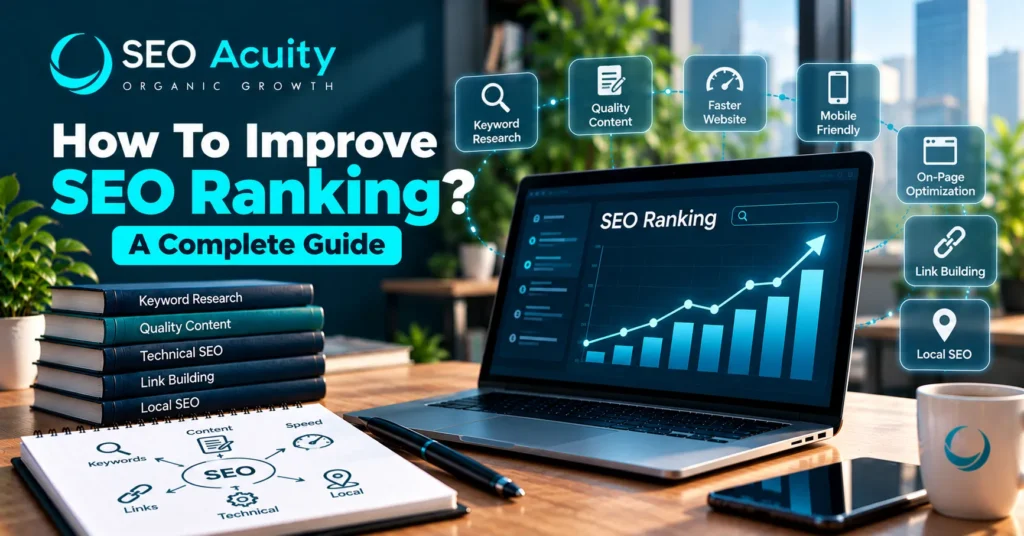
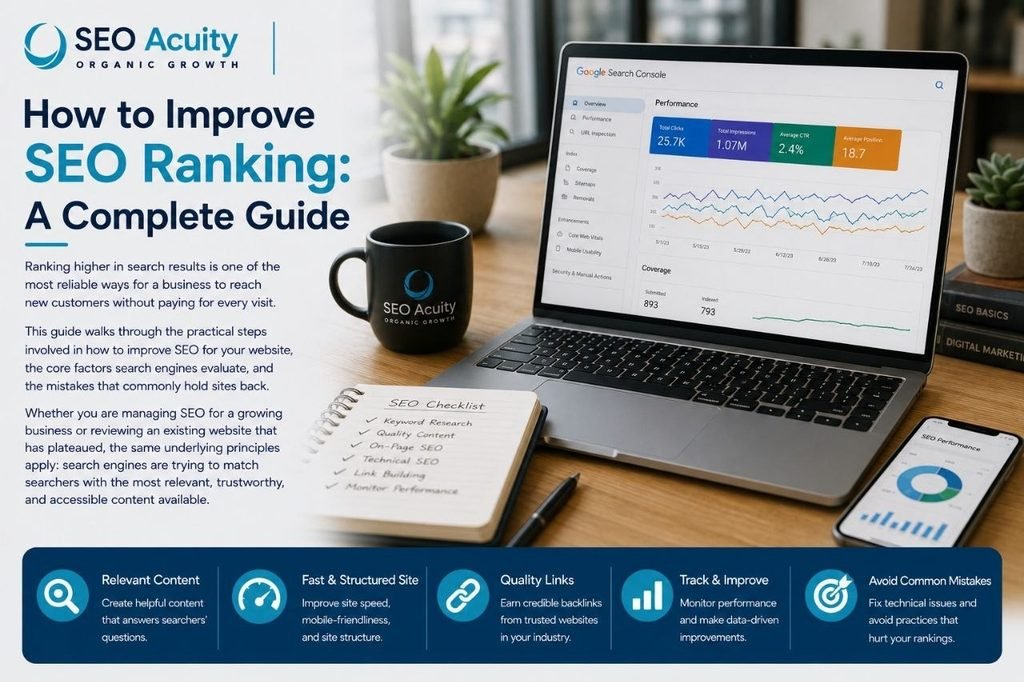
Ranking higher in search results is one of the most reliable ways for a business to reach new customers without paying for every visit. Improving SEO ranking is not the result of one single change, but a combination of relevant content, a fast and well-structured website, and credible links pointing back to your pages.
This guide walks through the practical steps involved in how to improve SEO for your website, the core factors search engines evaluate, and the mistakes that commonly hold sites back.
Whether you are managing SEO for a growing business or reviewing an existing website that has plateaued, the same underlying principles apply: search engines are trying to match searchers with the most relevant, trustworthy, and accessible content available.
1. Research the Right Keywords
Start by identifying the keywords your target audience actually searches for, prioritizing terms with meaningful search volume and manageable competition. Keyword research tools can help surface search volume, competition level, and related terms you might not think of on your own.
Group keywords by the intent behind them, separating searches meant to inform, compare, or buy. These keywords should then guide the topics you write about, the language you use, and the order in which you prioritize new pages.
2. Create Content That Answers Real Questions
Content should be clear, useful, and directly answer the questions your potential customers are asking, rather than covering a topic in general terms.
Including target keywords naturally within titles and body text supports relevance, but the priority should always be genuinely helpful information rather than repetition for its own sake.
Different formats suit different questions: a how-to guide, a comparison, or a straightforward explanation may all serve the same keyword in different ways.
Reviewing and updating existing content periodically also helps it stay accurate as products, services, or industry practices change.
Read also: What Seo Metrics Are Important To Track? A Complete Guide
3. Improve Website Speed
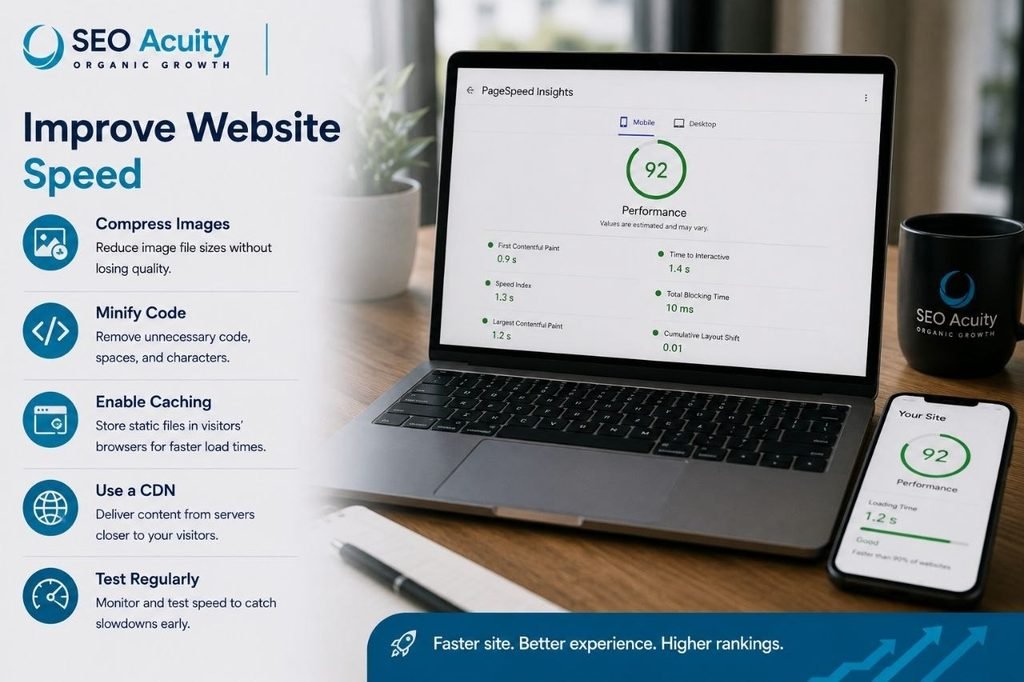
Pages that load quickly keep visitors on your site longer and reduce bounce rates, since slow-loading pages are one of the most common reasons visitors leave before a page even finishes rendering.
Compressing images, cleaning up unnecessary code, and enabling browser caching are common ways to reduce load times.
Using a content delivery network can also help pages load faster for visitors in different locations, since it serves content from servers closer to the visitor rather than a single central server.
Testing load times regularly helps catch slowdowns introduced by new content or plugins before they affect visitors.
4. Make Your Site Mobile-Friendly
Most visitors now browse on smartphones and tablets, so a responsive design that displays content correctly across screen sizes has become a baseline expectation rather than an optional feature.
A site that works poorly on mobile devices can lose visitors before they ever engage with your content.
This includes making sure buttons and menus are easy to tap, text is readable without zooming, and pages do not require horizontal scrolling.
Testing your site directly on different devices, rather than relying only on a desktop preview, helps catch issues real visitors would encounter.
Read also: How To Measure Seo Performance – A Complete Guide
5. Optimize Titles and Meta Descriptions
Writing clear, accurate title tags and meta descriptions for each page helps search engines understand what the page covers and can improve click-through rates from search results. These elements work best when they reflect the actual content of the page rather than being written purely to include keywords.
Keeping titles and descriptions within recommended character limits helps prevent them from being cut off in search results.
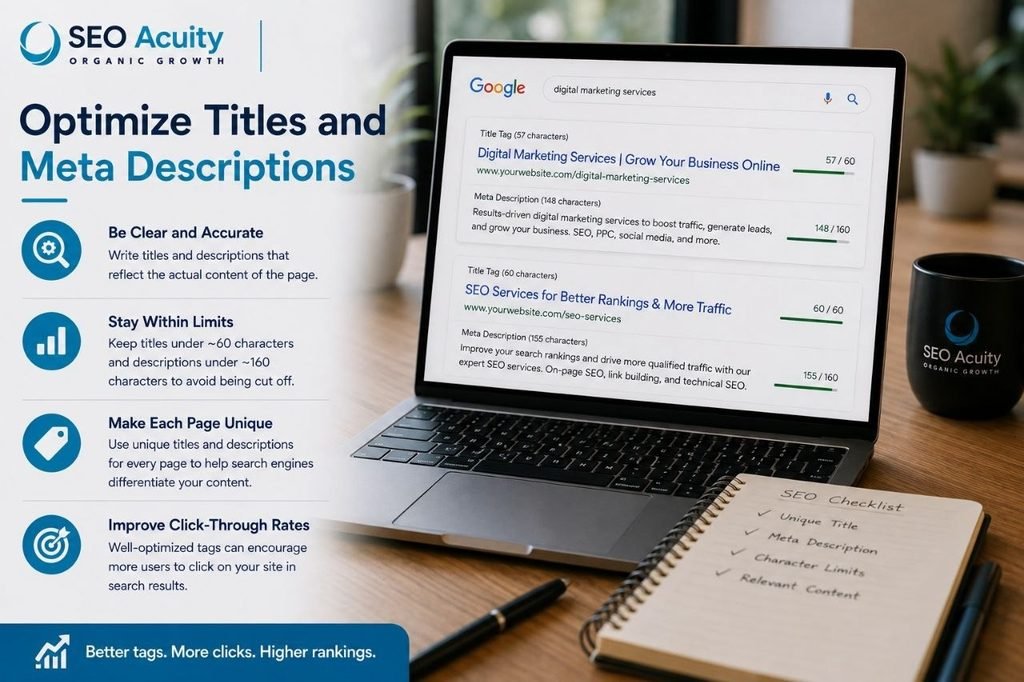
Each page should also have a unique title and description, since duplicated tags across multiple pages can make it harder for search engines to distinguish between them.
Read also: Is Google Dead?
Ready to Dominate Search Engine Rankings?
Accelerate your organic growth and scale your business leads with our data-driven SEO strategies.
Get a Free Quote NOW!6. Build Internal and External Links
Connecting your own pages through internal links helps visitors and search engines navigate your site, while earning external links from other reputable websites signals credibility. Both types of links play a distinct role in supporting your SEO ranking over time.
Internal links work best when they connect genuinely related pages using descriptive anchor text, rather than linking every page to every other page indiscriminately.
External links generally need to come from relevant, trustworthy sources to carry meaningful weight, since links from low-quality or unrelated sites tend to add little value.
Read also: What Is Topical Authority in SEO? A Complete Guide

7. Strengthen Technical SEO
Technical elements such as a correctly configured robots.txt file and an accurate sitemap.xml help search engines crawl and index your site efficiently.
Addressing technical issues removes obstacles that might otherwise prevent good content from being properly evaluated.
Fixing broken links, resolving crawl errors, and using canonical tags to avoid duplicate content issues all support a technically clean site. Structured data markup can also help search engines understand specific page elements, such as products, reviews, or events, more precisely.
8. Set Up a Google Business Profile for Local Search
If your business serves a specific location, registering with Google Business Profile helps your site appear in local search results. This is particularly relevant for businesses that rely on nearby customers finding them through location-based searches.
Keeping your profile complete and current, including accurate categories, business hours, and photos, makes it easier for potential customers to find and trust your listing.
Responding to reviews and keeping information consistent with your website also supports how the profile performs in local search.
9. Track Performance With Analytics Tools
Connecting your site to tools such as Google Search Console allows you to monitor how pages are performing, identify which keywords are driving traffic, and spot technical issues early. Ongoing tracking makes it possible to adjust your approach based on actual data rather than assumptions.
Reviewing metrics such as bounce rate, average time on page, and conversion rates alongside ranking data gives a fuller picture of how well a page is actually serving visitors, not just how visible it is in search results.
10. Focus on User Experience
A site that is easy to navigate, with a clear layout and minimal distracting elements, keeps visitors engaged longer and makes it easier for them to find what they need.
Every element on a page should serve the visitor’s goal, since removing unnecessary friction tends to support both engagement and conversions.
Clear navigation menus, logically organized categories, and visible calls to action all contribute to a smoother experience.
Readable typography and adequate spacing between elements also make content easier to scan, particularly for visitors quickly checking a page on a smaller screen.
Ready to Dominate Search Engine Rankings?
Accelerate your organic growth and scale your business leads with our data-driven SEO strategies.
Get a Free Quote NOW!On-Page vs Off-Page SEO: What’s the Difference?
Improving SEO ranking generally involves two distinct types of work, each addressing a different part of how search engines evaluate a website.
Understanding the difference helps clarify where a specific improvement effort actually belongs, rather than treating all SEO work as one undifferentiated task.
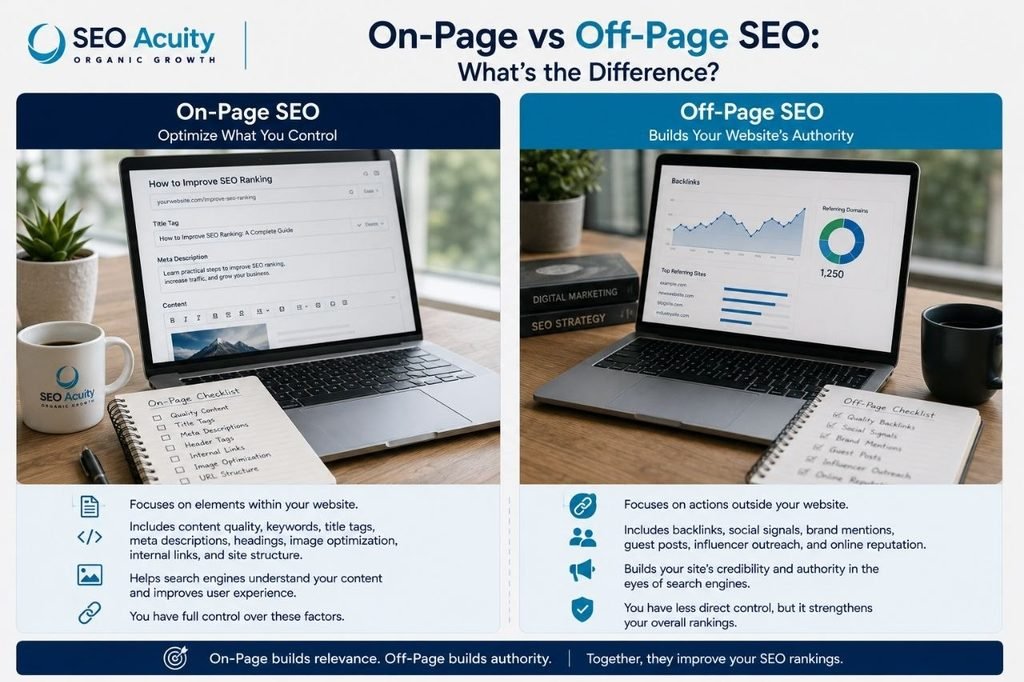
On-Page SEO
On-page SEO covers everything within your own website, including keyword usage, page titles, internal links, content quality, and site speed.
This work focuses on making each individual page relevant, accessible, and easy to understand for both visitors and search engines crawling the site.
Off-Page SEO
Off-page SEO focuses on your website’s relationship with the wider internet, primarily through backlinks, mentions on other websites, and reviews.
This type of work builds external trust signals that search engines factor into how credible and authoritative your site appears relative to others covering similar topics.
Why Both Matter Together
Relying on only one type of SEO tends to produce limited results. A site with strong on-page optimization but no external credibility, or strong backlinks pointing to a poorly optimized site, will generally underperform compared to a site that addresses both areas together consistently.
The Core Factors That Influence SEO Ranking
Anyone researching how to improve SEO rankings will find that a handful of recurring factors shape how search engines evaluate a page.
Understanding these factors helps clarify where to focus improvement efforts, rather than treating every individual tactic as equally important to the outcome.
Content
Useful, direct content that meets a visitor’s needs is a foundational factor, since it keeps visitors engaged and signals relevance to search engines evaluating the page.
Well-structured, genuinely helpful content also tends to perform better as AI-driven search tools increasingly summarize and reference web content directly.
Read also: LLM Optimization
Site Performance
A site’s speed, security, and responsiveness across devices directly affect how search engines assess its technical quality and reliability.
A page that loads slowly or behaves inconsistently across devices can undermine even genuinely strong, well-researched content by preventing visitors from engaging with it in the first place.
Search Intent
Content that matches what a searcher is actually looking for tends to perform better than content that technically includes the right keywords but does not address the underlying question.
Understanding whether a search is informational, navigational, or transactional helps determine what kind of page will actually satisfy it.
A Consistent Process
Following a defined process, from keyword research through page optimization and link building, tends to produce steadier improvements than isolated, one-off changes.
Sites that treat SEO as an ongoing practice, rather than a single project, generally see more stable results over time.
Still not sure where to start? Talk to the SEO Acuity team and get a free consultation.
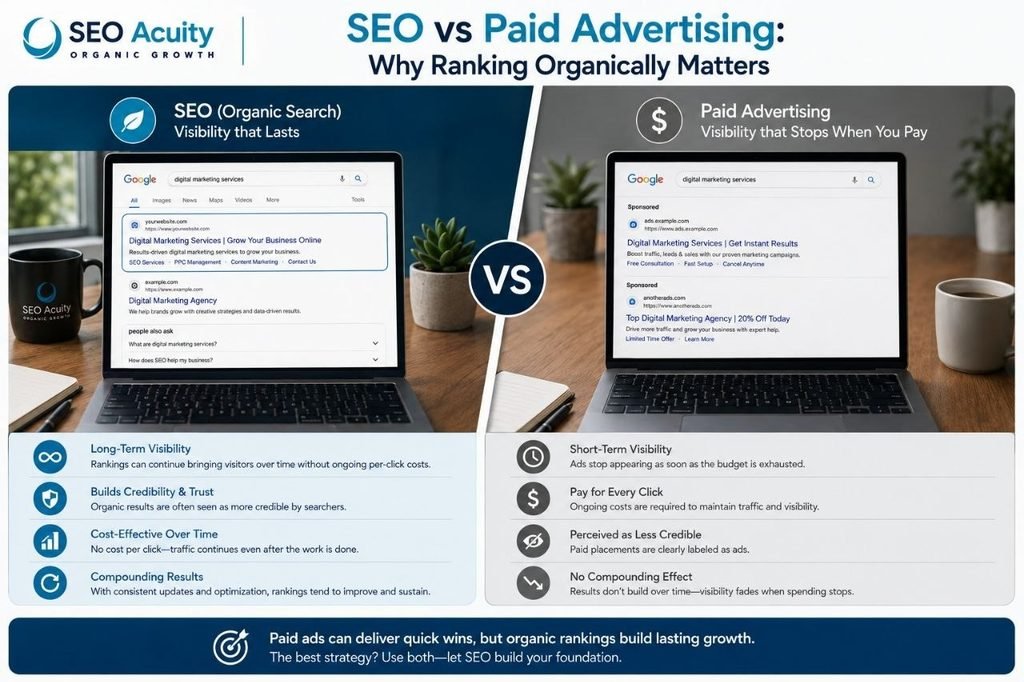
SEO vs Paid Advertising: Why Ranking Organically Matters
Paid advertising can generate quick visibility, but results stop as soon as the budget is spent. Improving SEO ranking, by contrast, builds visibility that continues to bring visitors without an ongoing per-click cost, which tends to make it a more cost-effective approach over the long term.
Ranking naturally in search results can also reflect credibility to visitors in a way that paid placements do not always achieve.
Combined with ongoing monitoring and updates, an organic ranking strategy tends to keep improving over time rather than requiring repeated spending to maintain visibility.
Common Mistakes That Hold Back SEO Ranking
Even a well-planned SEO strategy can be undermined by a handful of recurring missteps. Here are the mistakes that most often hold rankings back.
1. Skipping Site Analysis
Starting content or optimization work without first reviewing a site’s current performance often leads to effort spent in the wrong places. Understanding a site’s existing strengths and weaknesses should generally come before making changes.
2. Keyword Stuffing
Repeating a keyword excessively throughout content does not improve rankings and can make the text harder to read. Writing naturally for the reader first tends to produce better results than optimizing purely for keyword frequency.
3. Duplicate Content
Copying content from other websites, or repeating the same content across multiple pages of your own site, weakens how search engines evaluate those pages. Original, useful content is what distinguishes a site from its competitors.
4. Neglecting Internal and External Links
Overlooking internal linking, or failing to build any external links, leaves a site without important signals of structure and credibility.
A thoughtful linking strategy supports both navigation and trust, and is generally more effective than adding links without a clear purpose.
Ready to Dominate Search Engine Rankings?
Accelerate your organic growth and scale your business leads with our data-driven SEO strategies.
Get a Free Quote NOW!Ready to start architecting growth with SEO Acuity Team?
This approach works alongside other elements of SEO, such as technical optimization, rather than replacing them, and it tends to produce results over time rather than immediately.
Explore SEO Acuity’s SEO Services
Depending on where your website currently stands, different parts of the process outlined above may call for more focused, hands-on support. SEO Acuity offers dedicated services covering several of these areas:

Conclusion
Improving SEO rankings comes down to consistently applying a set of practical steps: researching the right keywords, publishing genuinely useful content, optimizing site speed and mobile experience, strengthening technical SEO, and building both internal and external links.
On-page and off-page SEO work together, and tracking performance over time makes it possible to refine the approach based on real results rather than guesswork.
Avoiding common mistakes, such as keyword stuffing or neglecting site analysis, helps ensure that effort spent on SEO actually contributes to better rankings.
FAQs
How do I improve SEO ranking on Google specifically?
The same core steps apply: relevant keywords, useful content, a fast and mobile-friendly site, and credible backlinks.
Google’s own guidance also emphasizes helpful, people-first content and a good page experience as part of how to improve SEO ranking on Google.
How long does it take to improve SEO ranking?
There is no fixed timeline, since it depends on a site’s starting point, competition, and how consistently improvements are made. Meaningful changes in ranking are generally seen over several months rather than days or weeks.
What is the most important factor in improving SEO ranking?
No single factor determines ranking on its own. Content quality, site performance, and relevant links all play a role, and search engines weigh these signals together rather than prioritizing just one.
Do I need both on-page and off-page SEO?
Yes. On-page SEO makes your site relevant and accessible, while off-page SEO builds external credibility through links and mentions. Relying on only one tends to produce limited results.
Can I improve SEO ranking without technical knowledge?
Some steps, such as writing better content or improving titles, do not require technical expertise. Other elements, such as configuring a sitemap or fixing crawl errors, may require more technical familiarity or support.
Is SEO better than paid advertising?
They serve different purposes. Paid advertising can generate immediate visibility, while SEO builds visibility that continues without an ongoing cost per click. Many businesses use both together as part of a broader strategy.
What tools can help track SEO ranking progress?
Tools such as Google Search Console and Google Analytics provide direct data on how your site is performing, which keywords are driving traffic, and where technical issues may be affecting visibility.
Does social media activity affect SEO ranking?
Social media does not directly determine rankings, but sharing content can increase visibility, drive traffic, and occasionally lead to other sites linking back to your content, which can indirectly support your SEO efforts.