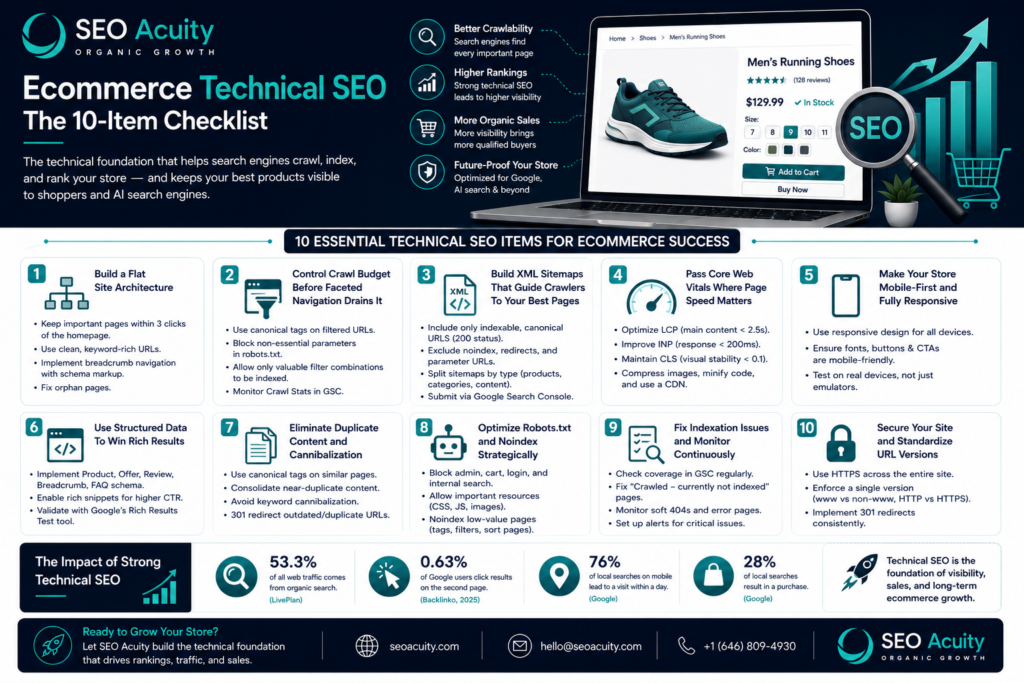
Ecommerce technical SEO is the infrastructure layer that determines whether your best products ever reach the first page of Google — or get buried where no shopper will find them. Your content can be excellent, your backlinks solid, and your products genuinely superior, but if search engines can’t efficiently crawl, render, and index your store, none of that matters.
Faceted search, dynamic JavaScript rendering, product variant URLs, out-of-stock page management; these are challenges unique to online retail, and they require specific, practiced answers. The question of is Google dead reflects a real anxiety among ecommerce operators watching ChatGPT and Perplexity take ground.
The answer is that Google remains the dominant source of ecommerce organic traffic — and the technical requirements for ranking on Google are increasingly aligned with the requirements for being retrieved by AI answer engines.
This guide covers the 10 most impactful ecommerce technical SEO items, in the order you should address them, with the practitioner-level detail that separates a site that passes a basic audit from one that genuinely outranks the competition.
Watch: Will GEO, AEO, and AI Search kill SEO? The truth no one is telling:
هل الـ GEO والـ AEO والـ AI Search هيقتلوا الـ SEO؟ | الحقيقة اللي محدش بيقولها

1. Build A Flat Site Architecture To Achieve Perfect Ecommerce Technical SEO
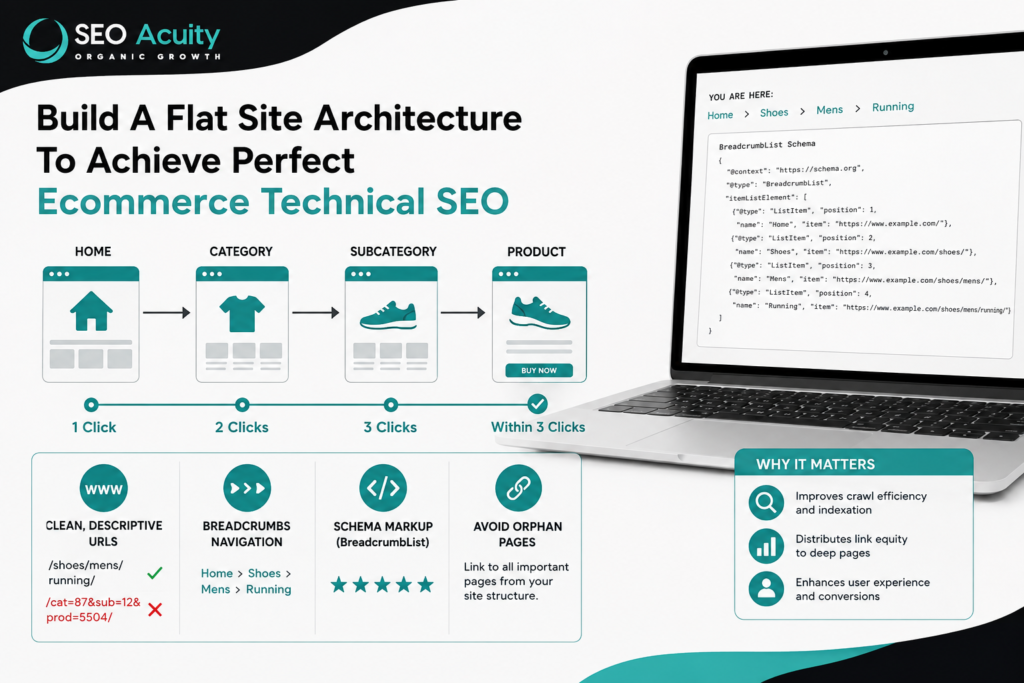
Site architecture is the hierarchy connecting your homepage to every product and category page. A flat structure keeps all important pages accessible within three clicks — reducing the crawl depth search engines must navigate and signaling that your deeper pages are genuinely worth indexing.
The practical implementation follows a clear hierarchy: Home → Category → Subcategory → Product. Every level should use clean, descriptive, keyword-relevant URLs. /shoes/mens/running/ tells a crawler and a customer exactly what the page contains. /cat=87&sub=12&prod=5504/ tells neither. Build consistent breadcrumb navigation that mirrors this hierarchy, and implement BreadcrumbList schema markup to reinforce the relationship between pages for both crawlers and users. Audit for orphan pages, those with no internal links pointing to them, since they’re effectively invisible to crawlers unless they appear in your sitemap.
2. Control Crawl Budget Before Faceted Navigation Drains It Into Dead Ends
Crawl budget is the number of pages Googlebot will process on your site during a given crawl period. For a small store with a few hundred products, it’s rarely a concern. For a store with thousands of SKUs and a faceted search system, it’s potentially the most expensive unmanaged technical problem you have — without knowing it.
Faceted navigation creates a new URL for every filter combination a user selects. A catalog with 200 products and ten filter attributes can technically generate millions of unique URLs.
Left uncontrolled, these pages consume crawl budgets, create duplicate content at scale, and prevent your high-value category and product pages from being crawled frequently enough to stay current in the index. Apply rel=”canonical” tags on all filtered URLs pointing back to the clean, unfiltered category page.
Block non-essential parameters — sort order, session IDs, tracking variables — in your robots.txt. For filter combinations with documented search volume, evaluate whether those pages justify standalone indexing. Most don’t, but some do, and the distinction matters.
ما لا يسع المبرمج جهله في الـ Technical SEO – أشهر 8 أخطاء تقنية
3. Build Xml Sitemaps That Guide Crawlers To Your Best Pages
An XML sitemap is your store’s curated inventory for search engines — a direct list of every URL you want discovered and prioritized. When maintained properly, sitemaps accelerate the discovery of new products and ensure high-value pages aren’t overlooked because they’re buried deep in the site architecture.
The common failure mode is treating sitemaps as automated outputs that need no ongoing attention. An uncurated sitemap including out-of-stock pages, redirect chains, noindex URLs, and parameter-based filter variations sends crawlers through paths that yield nothing useful. Build sitemaps with discipline: include only canonical, indexable URLs returning a 200 status code.
Exclude noindexed pages, pages with redirect chains, and parameter URLs. For large catalogs, split sitemaps by type — products, categories, editorial — and submit each separately through Google Search Console. This lets you monitor indexing performance by section and identify exactly where crawl attention is being concentrated or wasted.
Optimize Your Content to Be Extracted as Direct Answers via SEO Acuity’s AEO Services
4. Pass Core Web Vitals Where Page Speed Is The Only Ux Metric Google Measures
Core Web Vitals are Google’s three standardized metrics for page experience: Largest Contentful Paint (LCP — how long the main content takes to load, target under 2.5 seconds), Interaction to Next Paint (INP — how quickly the page responds to user input, target under 200 milliseconds), and Cumulative Layout Shift (CLS — how stable the layout is during loading, target under 0.1).
Google uses real Chrome user data to score these, meaning actual field performance — not theoretical lab results — determines your standing. For ecommerce, the most common failure points are large uncompressed product images, third-party analytics and tracking scripts that block rendering, and layout shifts caused by late-loading review widgets or promotional banners.
A product detail page with ten high-resolution images and five third-party scripts firing on load can fail all three Core Web Vitals simultaneously. Start with images: compress natively rather than via CSS, convert to modern formats such as WebP or AVIF, and implement lazy loading for below-the-fold assets.
Audit third-party scripts and remove anything nonessential. Use a CDN to reduce server response latency for shoppers in different geographies. Run Google PageSpeed Insights on your highest-traffic product and category pages monthly — not as a one-time exercise, but as a standing performance discipline.
Read also : How to hire an SEO expert? A Decision Framework for Growth-Stage Businesses
Ready to Dominate Search Engine Rankings?
Accelerate your organic growth and scale your business leads with our data-driven SEO strategies.
Get a Free Quote NOW!
5. Audit And Fix Broken Links And Redirect Chains
Every broken internal link is a dead end for a crawler. Every redirect chain — a URL that hops through two or three intermediate redirects before reaching its destination — adds latency and bleeds link equity at each step. At the scale of a large ecommerce catalog, both problems compound in ways that steadily damage organic performance.
A category page with dozens of internal links pointing to discontinued products creates cascading issues: customers see error pages, crawlers waste budget on 404 responses, and ranking signals that should flow to live pages get absorbed into dead ends. Redirect chains are subtler.
A product URL updated twice over three years may chain through two intermediate redirects before reaching the live page — each hop costs crawl time and dilutes the authority flowing through that link. Audit both issues using a site crawler like Screaming Frog or Ahrefs.
Fix broken links by updating them directly to the correct live destination. Collapse redirect chains into single-hop 301 redirects that reach the final URL in one step.
Preview SEO Acuity Audit services and get your consultation session.

6. Enforce HTTPS Sitewide That Is Non-Negotiable For Rankings And Customer Trust
HTTPS has been a Google ranking signal since 2014. For ecommerce specifically, it’s also the trust signal that determines whether customers complete transactions. A browser security warning on a checkout page doesn’t just dent rankings — it ends conversions before they start.
For most established ecommerce stores, the question isn’t whether the domain has an SSL certificate — modern platforms typically handle that automatically. The real concern is mixed content: pages served over HTTPS that still load images, scripts, or stylesheets over unsecured HTTP. Mixed content triggers browser warnings even on an HTTPS domain and undermines both the security signal and customer confidence simultaneously.
Audit for mixed content after every major site update, after importing bulk product images, and after installing new third-party apps or tracking scripts. Google Search Console’s Security Issues report catches most of these before they affect customers or rankings.
Getting these five foundation items right across a catalog of tens of thousands of pages is where most in-house teams find their bandwidth stretched thin. A focused technical audit surfaces exactly which issues exist, which are most urgent, and where the highest-leverage fixes are — making it the most efficient starting point for any serious ecommerce SEO program.
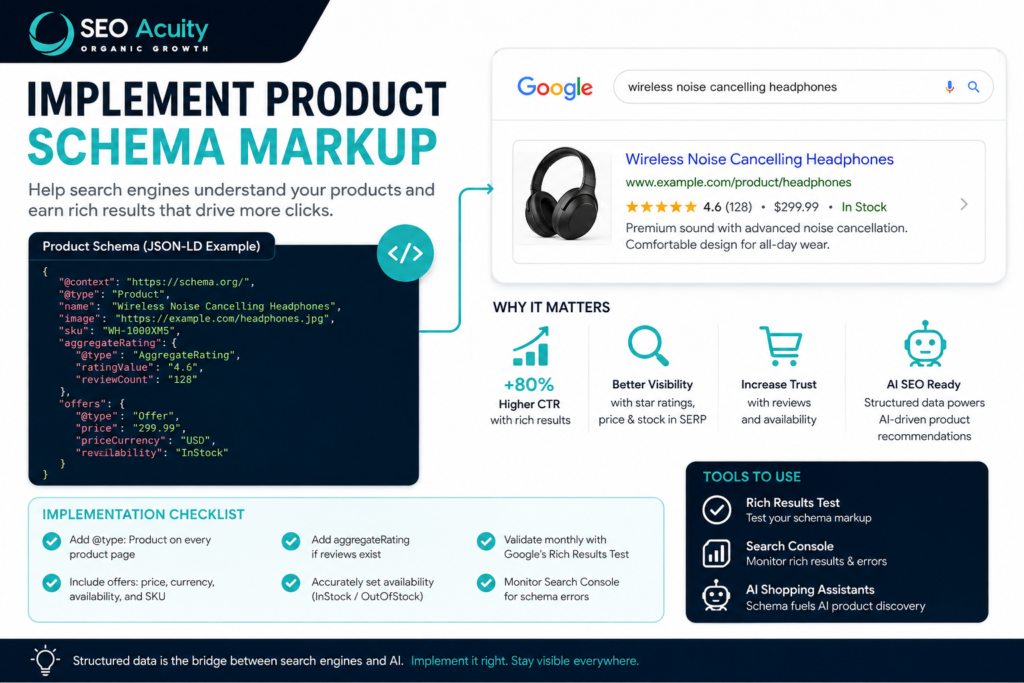
7. Implement Product Schema Markup
Structured data gives search engines a machine-readable description of what a page contains. For ecommerce, Product schema communicates product name, price, currency, availability, SKU, and review ratings. When correctly implemented, Google can display this information as rich snippets in search results — showing star ratings, prices, and stock status directly in the SERP before a user even clicks through.
Rich result listings consistently outperform standard listings in click-through rate, with some studies reporting over 80% improvement in click-through rate for product pages with rich results enabled. Implementation requires @type: Product schema on every product page, with offers properties specifying price, currency, and availability, plus aggregateRating where review data exists.
The availability property is particularly important: accurately marking products as InStock or OutOfStock prevents the conversion damage of sending traffic to unavailable products. Beyond Google, AI shopping assistants — ChatGPT, Google AI Mode, Perplexity — also use structured data to parse and evaluate products for recommendation.
Understanding what is AI SEO clarifies how schema has become the technical bridge between traditional search performance and AI-driven product discovery. Validate your schema monthly using Google’s Rich Results Test and monitor the Rich Results report in Search Console for validation errors that block rich snippet eligibility.
8. Optimize For Mobile-First Indexing
Google indexes the mobile version of your site first. Any structured data, content, or functionality present on desktop but missing from mobile is effectively absent from Google’s index — a more severe constraint than it might appear, since many ecommerce sites serve truncated product descriptions, reduced image sets, and incomplete schema on mobile while assuming desktop traffic still leads.
Responsive design is the foundation: your site should adapt cleanly to any screen size without horizontal scrolling, overlapping elements, or cut-off content. But mobile optimization runs deeper than layout. Faceted navigation filters, size selectors, and image galleries all need to function intuitively on touchscreens.
Popups that obstruct mobile content are a direct Page Experience violation. Checkout flows that require precision tapping on small buttons drive abandonment before a transaction completes. Test against Google’s Mobile Usability report in Search Console after every template update and after installing new apps or widgets, since these are the moments when mobile regressions most commonly appear.
Understanding the benefits of AI SEO for businesses reinforces why mobile technical health now feeds two parallel systems: Google’s standard ranking algorithms and AI answer engines that retrieve mobile-rendered content for conversational responses.
استراتيجية SEO عملية لموقع تعليمي حققت 10 أضعاف الترافيك ARABIC SEO – Edu Niche
9. Manage Out-Of-Stock And Discontinued Products Strategically
When a product goes out of stock, the instinct is to delete the page or return a 404. Both responses destroy accumulated ranking equity — authority built through months of internal linking, backlinks, and crawl signals. The correct approach depends on whether the unavailability is temporary or permanent.
For temporarily out-of-stock products, keep the page live and update Product schema to mark availability as OutOfStock. Add a back-in-stock notification to retain customer intent and justify the page’s continued presence in the index. For discontinued products that will never return, a 410 status code tells Google the page is permanently gone, allowing clean removal from the index without future crawl budget waste.
If the discontinued page had meaningful backlinks or sustained organic traffic, a 301 redirect to the most relevant active category page or successor product transfers that link equity rather than abandoning it.
Before deleting any product page, check its backlink profile and 12-month traffic history. A page with twenty referring domains is worth preserving through a redirect regardless of whether the product still exists.
Ready to Dominate Search Engine Rankings?
Accelerate your organic growth and scale your business leads with our data-driven SEO strategies.
Get a Free Quote NOW!10. Ensure Javascript-Rendered Content Doesn’t Fly Under Google’s Radar
Most modern ecommerce platforms depend heavily on JavaScript — for product reviews, dynamic inventory updates, recommendation engines, Q&A sections, and interactive filter interfaces. The challenge is that JavaScript-rendered content requires a two-step crawl process.
Google first processes the raw HTML, then queues the page for full rendering, which can take days or weeks for a large site. Content that only exists after JavaScript executes may be entirely invisible to Google during the initial crawl.
This includes user reviews, Q&A sections, cross-sell recommendations, and availability data fed by third-party APIs. Since review text often contains high-converting long-tail queries — the exact phrases buyers use close to a purchase decision — invisible reviews directly limit keyword coverage on product pages.
The practical diagnostic is simple: disable JavaScript in Chrome DevTools and load your key product and category pages. If content disappears, crawlers are likely missing it too. Work with your development team to migrate critical content to server-side rendering, so it appears in the initial HTML response rather than requiring a script execution step after page load.
How SEO Acuity Turns Technical Foundations Into Ecommerce Ranking Assets?
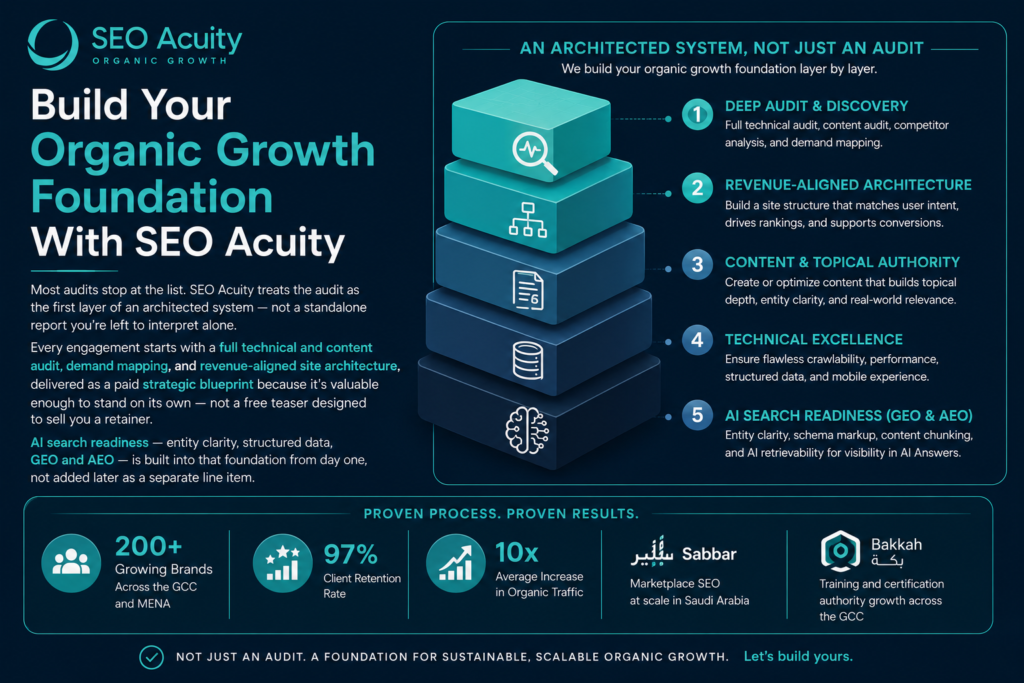
Technical SEO done in isolation is infrastructure maintenance. Technical SEO built into a coherent organic strategy is a compounding revenue asset. SEO Acuity works with ecommerce brands across English and Arabic markets to build technical foundations that go beyond clean audit scores — architectures designed to scale, support programmatic growth, and perform in both traditional and AI-powered search.
Partnering with an experienced SEO agency that has executed technical SEO ecommerce at scale is what bridges the gap between a technically healthy site and a site that’s actively building a defensible organic position.
For ecommerce brands ready to compete beyond standard search results, SEO Acuity incorporates large language model optimization (LLMO) as an explicit layer of the technical strategy — ensuring product catalog pages are structured and surfaced by ChatGPT, Perplexity, Google AI Mode, and every major AI discovery system.
The ongoing debate about do AI and GEO / AEO replace SEO misses the operative point: the technical requirements for traditional search authority and AI visibility are converging.
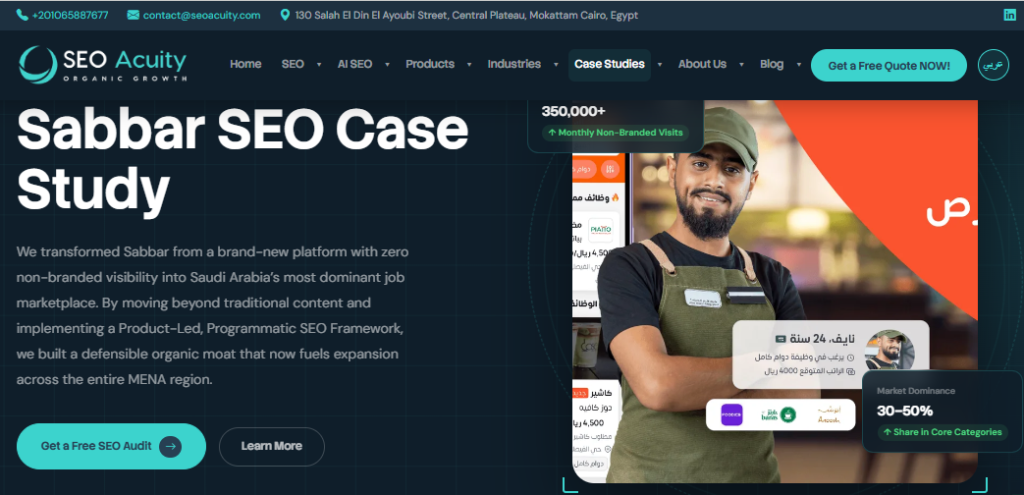
A. The Sabbar Case Study
When Sabbar came to SEO Acuity, it was a brand-new platform with zero non-branded organic visibility. The challenge wasn’t content or backlinks — it was building an architecture capable of supporting programmatic SEO at genuine scale. A job marketplace competing across the MENA region can’t grow through manual page-by-page content creation. It needs infrastructure that scales.
SEO Acuity implemented a Product-Led, Programmatic SEO Framework — a technical approach combining dynamic page generation, precise crawl budget management, scalable structured data for job listings, and a URL taxonomy built for both indexability and intent matching at the category level.
The result: Sabbar transformed from zero organic presence into Saudi Arabia’s dominant job marketplace, with a defensible organic moat now driving expansion across the entire MENA region.
B. Building The Technical SEO Foundation Your Store Deserves
The gap between an ecommerce store that ranks and one that doesn’t is often not content quality, brand authority, or budget. It’s a crawlable structure, controlled URL taxonomy, validated schema, and pages that load fast on mobile. These are diagnosable, fixable problems — but only once they’ve been properly identified.
SEO Acuity provides comprehensive technical SEO audits and implementation for ecommerce brands ready to compete across traditional search rankings, AI overviews, and answer engine recommendations.
Understanding the full scope of types of SEO audits — from technical health checks to AI readiness reviews — helps you know what kind of support makes sense for where your store is right now.
Talk to SEO Acuity about an Organic Growth Foundation™ assessment.
Ready to Dominate Search Engine Rankings?
Accelerate your organic growth and scale your business leads with our data-driven SEO strategies.
Get a Free Quote NOW!Conclusion
Technical SEO for commerce is the prerequisite for every other part of your strategy performing as intended. Content Google can’t crawl won’t rank. Products without schema won’t surface in rich results. Category pages buried six clicks from the homepage won’t earn the crawl frequency needed to build authority. The ten items in this checklist represent the technical layer that makes everything else possible.
The practical implication is straightforward: start with an audit, work through these items in priority order, and treat technical SEO as ongoing infrastructure management rather than a one-time cleanup. Stores that maintain a clean technical foundation over months and years accumulate a compounding organic advantage. Those that let technical debt accumulate find the cost of correction growing with every month of delay.
Getting this right is not a question of budget — it’s a question of approach. Methodical diagnosis, prioritized fixes, and consistent monitoring are what separate stores that rank from stores that wonder why they don’t.
Frequently Asked Questions
What is ecommerce technical SEO and how does it differ from on-page SEO?
Ecommerce technical SEO optimizes your store’s backend infrastructure — site architecture, crawlability, page speed, schema markup, and security — so search engines can efficiently find and index your pages. On-page SEO focuses on content quality, keywords, and metadata. Technical SEO is the foundation on which on-page optimization builds its results.
How often should I run a technical SEO audit on my ecommerce store?
Review your technical SEO every three to six months under normal conditions. Run an audit immediately after any major site change — platform migrations, URL restructuring, catalog expansions, or new app installations.
Understanding why SEO audits are important in this context makes clear why regular auditing isn’t optional for large ecommerce sites — it’s the monitoring system that catches problems before they compound into significant ranking losses.
Does technical SEO still matter now that AI search is growing?
Technical SEO has become more important in the AI era, not less. AI answer engines — ChatGPT, Perplexity, Google AI Mode — retrieve content from crawled and indexed pages. A poorly structured site, missing schema, or JavaScript-hidden content is harder for AI systems to process than for Google’s standard crawler.
What tools do I need to audit my ecommerce store’s technical SEO?
Start with Google Search Console (free) for crawl coverage, index status, Core Web Vitals, and mobile usability data. Add Screaming Frog or Ahrefs for comprehensive site crawling and redirect chain mapping. Use Google PageSpeed Insights for performance diagnostics and Google’s Rich Results Test for schema validation.
How should I handle product pages when items go out of stock?
Keep out-of-stock product pages live and update Product schema to mark availability as OutOfStock. Only return a 410 status for permanently discontinued products that will never return. Deleting out-of-stock pages destroys accumulated ranking equity — organic authority built through months of internal links, backlinks, and crawl signals.
Should I handle ecommerce technical SEO in-house or work with a specialist?
In-house teams can manage routine monitoring and incremental fixes effectively. Complex situations — platform migrations, programmatic SEO at scale, AI search optimization across large catalogs — typically require specialist depth.