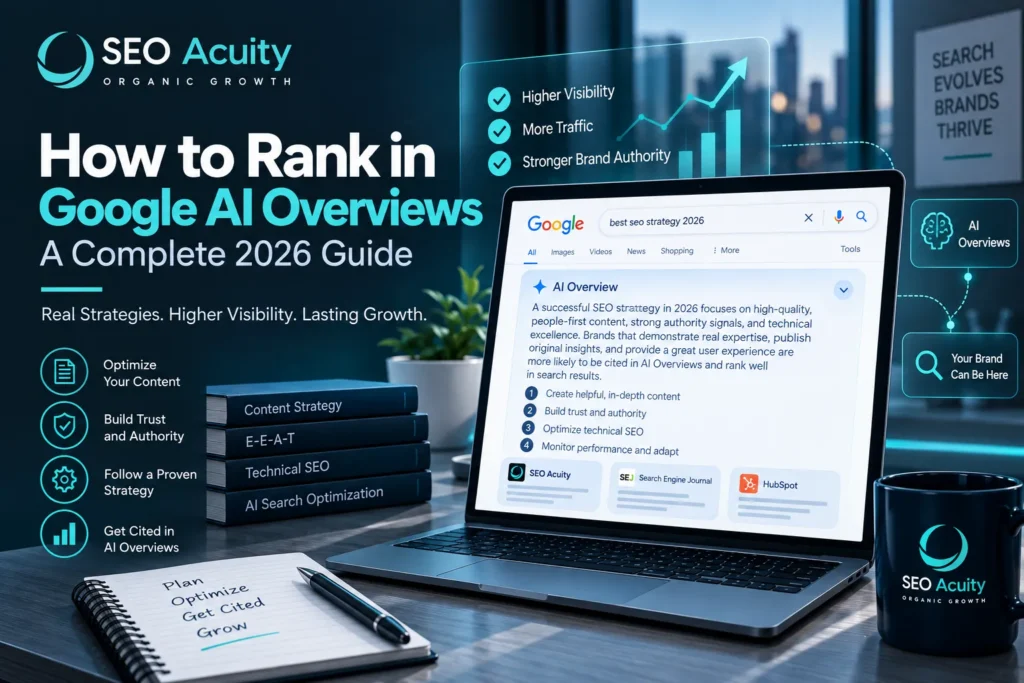
Picture this: your page ranks #6 for a competitive informational query, your competitor sits at #2, and yet your brand is the one cited in the AI Overview at the top of the page. That is not a hypothetical — it is happening right now, on queries across every industry, because Google AI Overviews select for passage quality and trust signals, not just organic position. This is one of the clearest examples of the growing gap between SEO vs AI visibility.
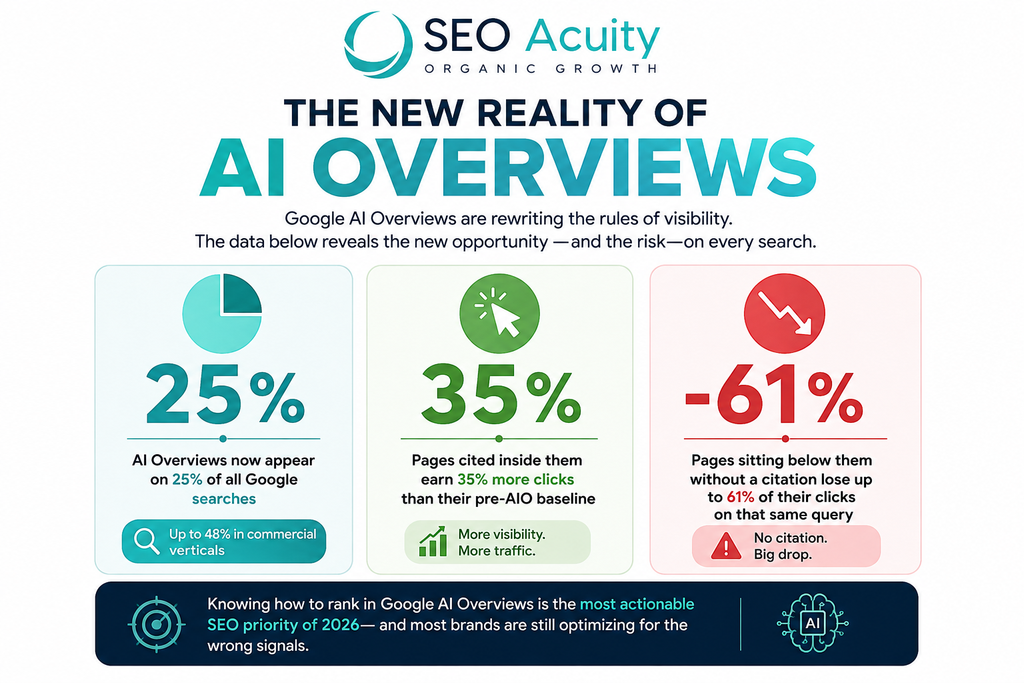
- AI Overviews now appear on 25% of all Google searches and up to 48% of queries in commercial verticals.
- Pages cited inside them earn 35% more clicks than their pre-AIO baseline.
- Pages sitting below them without a citation lose up to 61% of their clicks on that same query.
Knowing how to rank in Google AI Overviews is the most actionable SEO priority of 2026 — and most brands are still optimizing for the wrong signals.
This guide covers the mechanism, the six ranking factors, the mistakes that block citation, and the step-by-step strategy to earn your place in the AI Overview consistently.
What You’ll Learn in This Article
- Why position #1 does not guarantee an AI Overview citation — and how to win from position 8.
- How Google’s retrieval-augmented generation pipeline selects sources at the passage level.
- The six ranking factors for AI Overview citation, ranked by impact.
- Five common mistakes that silently block your pages from being cited.
- The three-surface citation strategy most brands are not running.
- A citation-readiness checklist you can apply to existing content this week.
What Are Google AI Overviews?
Google AI Overviews are Gemini-powered answer blocks that appear at the top of search results, generating a synthesized response from five to eleven cited sources simultaneously.
Unlike traditional organic results, users may read the full AI-generated answer and leave without ever clicking a blue link — which is why citation inside the overview has become a primary visibility channel, separate from ranking position entirely.
If you’re still getting oriented on the concept itself, our dedicated breakdown of What Are Google AI Overviews for SEO covers the fundamentals in more depth before you dive into ranking tactics.
AI Overviews replaced the single-source featured snippet with something structurally different:
- A multi-source synthesis with brand citation chips embedded in the text and in a sidebar panel.
- Each chip is a visible impression and a click opportunity.
- Conductor’s analysis found AI Overviews triggered on 25.11% of searches in Q1 2026, nearly double the 13.14% rate from March 2025.
- In commercial verticals, that figure climbs closer to 48%.
a. How AI Overviews Differ From Featured Snippets
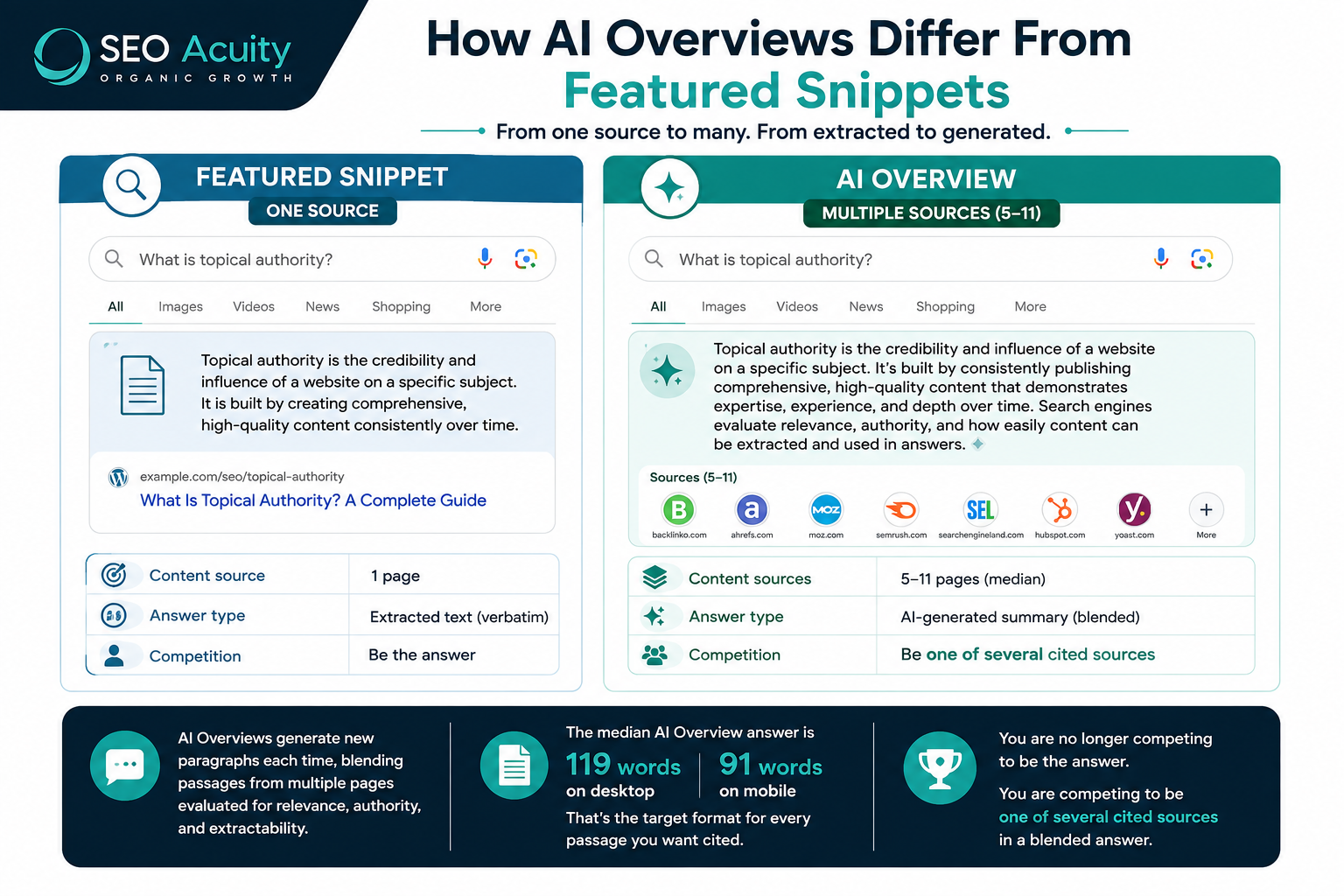
A featured snippet extracted one block of text from one page. AI Overviews generate a new paragraph each time, blending passages from multiple pages evaluated for relevance, authority, and extractability.
- The median AI Overview answer is 119 words on desktop and 91 words on mobile — that is the target format for every passage you want cited.
- You are no longer competing to be the answer. You are competing to be one of several cited sources in a blended answer.
b. When Do AI Overviews Appear?
AI Overviews appear most consistently on informational, how-to, and question-based queries — especially those with eight words or more.
- Transactional and local queries trigger them far less often, which means your product and location pages are relatively protected.
- YMYL topics face stricter E-E-A-T requirements and are sometimes excluded.
- Informational and commercial-investigation content is where the AI Overview citation battle is fought.
How Google’s AI Actually Selects Your Content
Most optimization guides treat AI Overview citation as a mystery and hand you a checklist. Understanding the mechanism behind selection is what separates tactical changes that stick from ones that produce no results.
Google’s AI Overviews use a retrieval-augmented generation (RAG) pipeline. Rather than generating an answer from training data alone, the system retrieves the best available passages from indexed pages and uses them to construct the response, citing the sources it drew from.
The AI is not asking which page ranks highest — it is asking which passage best answers this specific sub-query, from the most credible source.
This retrieval-based approach is also the core mechanism behind SGE / Search Generative Experience SEO and the wider shift toward what’s now commonly called GEO SEO strategy for AI search.
a. Query Fan-Out and Why Sub-Queries Change Everything
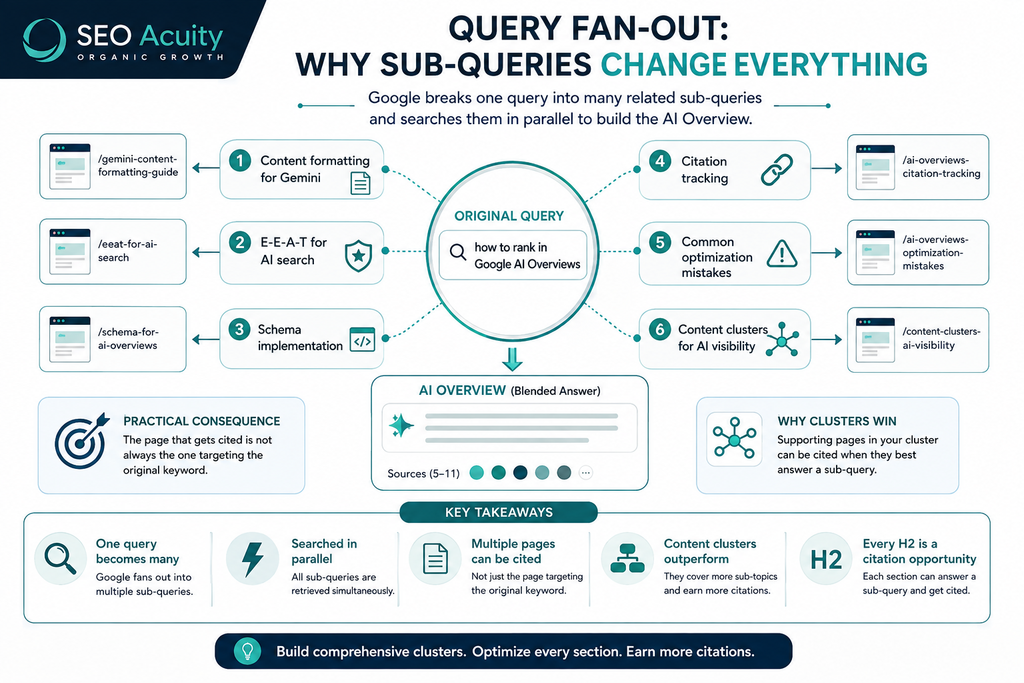
When a user submits a query, Google does not run a single search to produce the AI Overview. It uses query fan-out — breaking the original query into multiple related sub-queries across related topics and data sources simultaneously.
A search for “how to rank in Google AI Overviews” might fan out into sub-queries covering content formatting for Gemini, E-E-A-T for AI search, schema implementation, citation tracking, and common optimization mistakes — all retrieved in parallel before a single response is generated.
The practical consequence: the page that gets cited is not always the one targeting the original keyword.
- A supporting page in your content cluster — a subtopic page, a how-to guide, a comparison post — may be what gets surfaced because it directly answers one of those sub-queries.
- This is why content clusters outperform isolated pages for AI Overview visibility.
- Every H2 on your site is a potential independent citation unit.
b. Why Position #1 Does Not Guarantee a Citation
Because the RAG pipeline selects for passage quality and trust signals rather than organic rank, a page at position 8 with a clear, well-structured answer to a specific query can earn a citation ahead of the #1 result.
AI Overviews frequently pull from positions 4–20 and beyond. This is an opportunity — pages with strong content but limited link authority to compete at the top of traditional results have a genuine path to AI Overview visibility through passage-level optimization.
How to Rank in Google AI Overviews
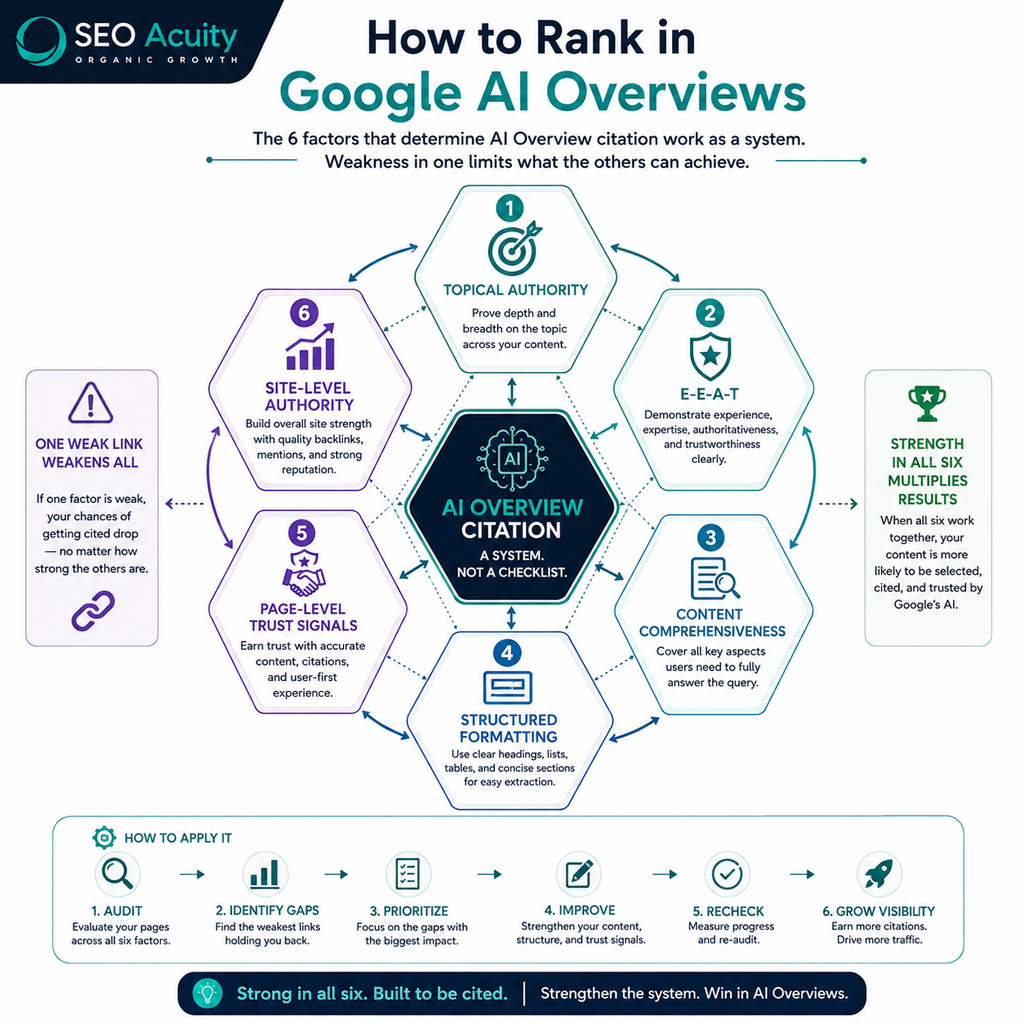
The six factors that determine AI Overview citation work as a system: topical authority, E-E-A-T, content comprehensiveness, structured formatting, page-level trust signals, and site-level authority.
Weakness in one limits what the others can achieve. Strengthen all six together, prioritizing by the gaps your pages currently have.
“A Practical Step-by-Step Framework for Appearing in AI Search Results Like ChatGPT and Gemini” .
1. Start With Strong Traditional SEO Foundations
74% of pages cited in AI Overviews also rank in the top 10 organic results. The foundation is still classical SEO.
- Produce genuinely helpful content.
- Earn backlinks from topically relevant domains.
- Maintain clean site architecture.
- Keep content current.
AI Overview optimization built on weak organic fundamentals will produce inconsistent results. If your pages are not ranking at all, that is the first problem to solve.
This is also where the classic question comes up — does SEO still matter if AI search keeps growing — and the short answer is that organic fundamentals remain the base layer everything else builds on.
And before even thinking about optimizing AI Overviews, you need to know whether your timing is right in the first place: “Not Every Business Needs SEO… So When Should You Actually Start?”
2. Lead Every Section With a Direct Answer in the First 100 Words
This is the highest-leverage on-page change most sites can make immediately. Google’s AI evaluates passages, not pages. Every section must open with a direct, standalone answer in the first 100 words — before any preamble, context-setting, or restating of the question. The section that opens with the answer gets cited; the one that buries it does not.
The before-and-after test: can someone read just the opening paragraph of your section and fully understand the answer? If the actual point is in sentence five, move it to sentence one. Every word before the answer is friction for both the extraction system and the reader.
3. Build Topical Authority Through Content Clusters
Sites with interlinked content clusters consistently outperform broader, shallower sites in AI Overview citation by up to 30%, following the June 2025 Core Update.
A content cluster gives Google’s RAG pipeline multiple high-quality passages across multiple related sub-queries — exactly what query fan-out needs to find.
A single page on “how to rank in AI Overviews” competes against a cluster that also covers E-E-A-T for AI search, schema markup for AI visibility, content formatting for Gemini, and AI Overview citation tracking. Build the cluster first, then optimize each page for its specific sub-intent.
4. Strengthen E-E-A-T Signals Throughout
Since the December 2025 Core Update, E-E-A-T requirements extend beyond YMYL topics to every content category. 96% of AI Overview citations now come from verifiably authoritative sources.
Pages without clear author credentials and trust signals are effectively filtered from citation consideration regardless of content quality.
Every priority page should carry:
- A named author with a linked bio page and visible credentials.
- A publication date and last-updated date.
- External sources cited and linked where claims require backing.
These are not optional. They are the baseline Google’s AI uses to assess whether your page is worth citing.
First-hand experience is weighted heavily. Content that could only have been written by someone who has done the work — with specific observations, real implementation detail, and practitioner-level depth — consistently outperforms generic overviews.
Analysis across B2B SaaS accounts found pages with a named subject-matter expert bio picked up 1.7x more AI Overview citations than pages published under a generic team byline, with equivalent body copy. The author bio is ranking content.
Ready to Dominate Search Engine Rankings?
Accelerate your organic growth and scale your business leads with our data-driven SEO strategies.
Get a Free Quote NOW!5. Add Structured Data and Schema Markup
Structured data is a direct signal to Google’s AI about what type of content exists on a page and how to extract it reliably. FAQ schema, HowTo schema, Article schema, and Organization schema each reduce ambiguity about your content’s structure — making passage extraction more reliable and citation more likely.
Following the March 2026 update, implementing or updating Article, FAQ, and Organization schema on priority pages is one of the most immediately actionable steps available. Pages combining text, images, video, and structured data see up to 317% more AI citations, per Ahrefs’ 2025 analysis.
Use markup that accurately reflects what is on the page. Schema applied to content it does not describe actively harms citation likelihood.
SEO Acuity audits your existing structured data implementation and identifies exactly which schema gaps are blocking AI Overview inclusion on your priority pages.
6. Apply the Three-Surface Citation Strategy
This is where most brands stop their AI Overview strategy too early. Reddit accounts for 21% of Google AI Overview citations. YouTube accounts for 18.8%.
The brands consistently earning citation slots are not just optimizing their blog — they are building presence across three surfaces simultaneously, because Google’s RAG pipeline draws from all three.
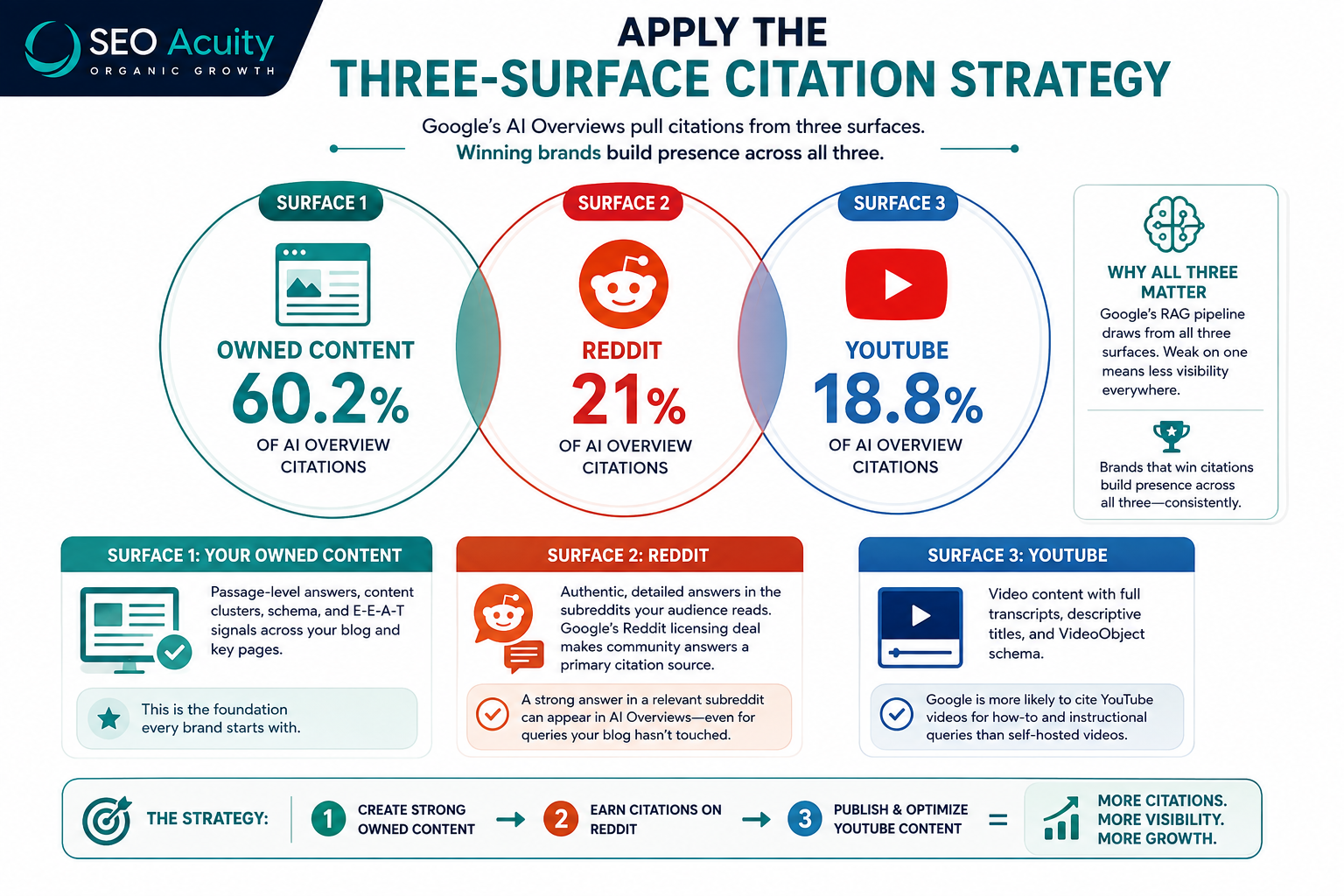
- Surface 1 — Your owned content: Passage-level answers, content clusters, schema, and E-E-A-T signals across your blog and key pages. This is the foundation every brand starts with.
- Surface 2 — Reddit: Authentic, detailed answers in the subreddits your target audience reads. Google’s Reddit licensing deal has made threaded community answers a primary citation source. A well-sourced, substantive answer in a relevant subreddit can appear in AI Overviews for queries your blog has not touched — and it builds a consensus signal that reinforces your brand’s topical authority across platforms.
- Surface 3 — YouTube: Video content with full transcripts, descriptive titles, and VideoObject schema. Google’s AI Overviews are significantly more likely to cite YouTube videos for how-to and instructional queries than self-hosted video files. A focused explainer video extends your citation surface to queries where video is the preferred format.
Brands with zero off-Google presence rarely break into AI Overview citation sets, even when they rank #1 organically. The three-surface approach is a trust-signal play, not a content volume play.
“How to Build an Organic Growth Strategy That Ranks in Both AI Search and SEO, Step by Step”.
7. Include Multimedia That Earns Its Place
AI Overviews pull multimedia into responses when it serves the user better than text alone.
- Images with descriptive, keyword-rich alt text.
- Comparison tables for decision-based queries.
- VideoObject schema on embedded videos.
All of these give Google more extractable, structured content to work with. Use keyword-rich filenames for every image. Write alt text that explains what the image shows in context — not just what it is as an object.
Five Mistakes That Block AI Overview Citation
Most guides tell you what to do. Knowing what actively prevents citation is equally important — and rarely covered.
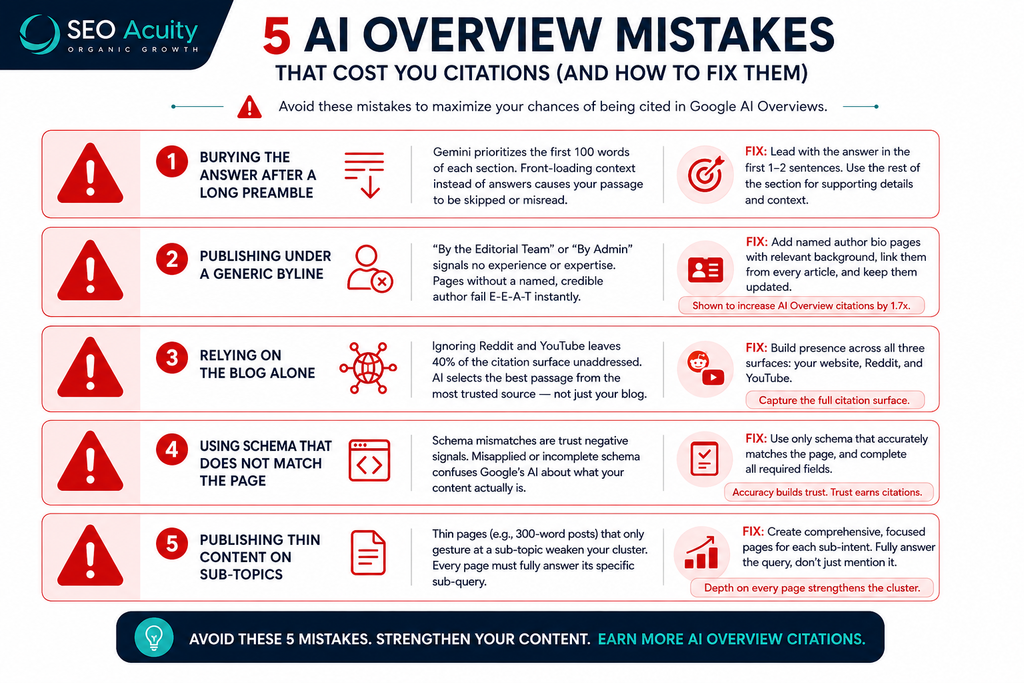
These are the five patterns that consistently exclude pages from AI Overview consideration, drawn from practitioner audits across content-heavy websites:
1. Burying the Answer After a Long Preamble
The most common and most damaging mistake. If your section opens with “In this part of the article, we will explore the various ways that…” before reaching the actual answer, Gemini may skip or misread the passage entirely.
The AI extraction system prioritizes the first 100 words of each section. Content that front-loads context instead of answers consistently loses citation slots to shorter, more direct pages on the same topic.
2. Publishing Under a Generic Byline
“By the Editorial Team” or “By Admin” is not an author signal — it is an absence of one. Pages without a named, credible author fail the Experience and Expertise dimensions of E-E-A-T before a single word of body content is evaluated.
The fix is straightforward: add named author bio pages with relevant professional background, link them from every article, and keep them updated. This alone has been shown to increase AI Overview citation rates by 1.7x on equivalent content.
3. Relying on the Blog Alone
Building a strong blog and ignoring Reddit and YouTube leaves 40% of the citation surface completely unaddressed. Google’s AI does not have a bias toward brand-owned content — it selects the best passage from the most trusted source, regardless of where it lives.
Brands that treat their blog as the entire strategy consistently lose citation slots to community answers and explainer videos on the same topics.
4. Using Schema That Does Not Match the Page
- FAQ schema applied to a page without genuine Q&A content.
- HowTo schema on a listicle that does not contain sequential steps.
- Article schema without author metadata filled in.
Google’s AI recognizes structural mismatches and treats them as a trust signal in the wrong direction. Apply only the schema types that accurately describe what is on the page, with all required fields completed.
5. Publishing Thin Content on Sub-Topics
A single comprehensive page on a broad topic competes poorly against a site that has a dedicated, focused page for each sub-intent within that topic. Thin supporting pages — 300-word posts that gesture at a sub-topic without answering it — undercut the content cluster rather than strengthening it. Every page in your cluster needs to fully answer its specific sub-query, not just mention it.
Technical Factors That Affect AI Overview Visibility
Content quality and E-E-A-T matter most, but technical barriers can block citation entirely regardless of how strong your content is. A page with a perfect passage-level answer that Googlebot cannot render reliably will never be cited.
If you want to make sure your site doesn’t have technical errors preventing it from showing up at all, check out: “What Every Developer Should Know About Technical SEO — The 8 Most Common Technical Mistakes” .
1. Core Web Vitals as a Composite Score
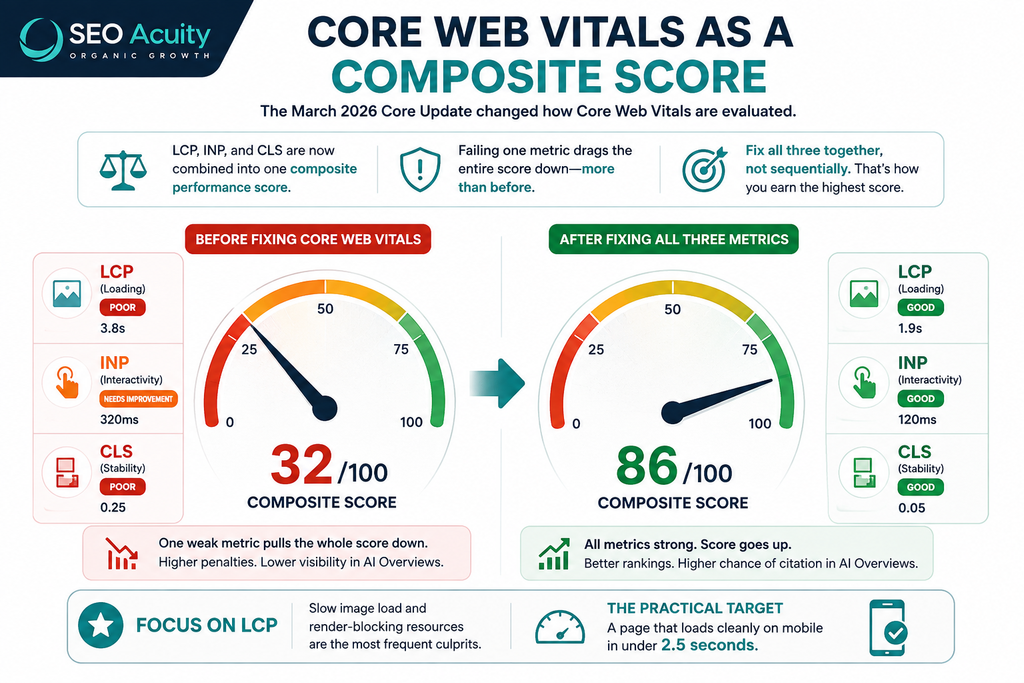
The March 2026 Core Update changed how Core Web Vitals are evaluated.
- Previously, LCP, INP, and CLS were assessed as independent pass/fail signals.
- They are now aggregated into a composite performance score — a page that passes two of the three metrics but fails the third is penalized more heavily than before.
- Fix all three together, not sequentially.
- Focus particularly on LCP; slow image load and render-blocking resources are the most frequent culprits.
- A page that loads cleanly on mobile in under 2.5 seconds is the practical target.
2. Mobile-First Rendering
The majority of Google searches happen on mobile, and AI Overviews are heavily concentrated in mobile results. A page with layout issues on smaller screens, content obscured by overlays, or slow mobile load times is at a structural disadvantage regardless of content quality.
Test every priority page on a real mobile device — not just a desktop browser in responsive mode — before publishing.
3. Crawlability and Indexation Health
Orphaned pages, excessive redirect chains, blocked resources, and misconfigured robots.txt directives reduce how reliably Googlebot evaluates your content.
- If a page is not crawled efficiently, it is not indexed reliably.
- If it is not indexed reliably, it will not be cited. Run crawl audits at minimum quarterly.
The practical test: if a page would not qualify for a featured snippet, it will almost certainly not be cited in an AI Overview.
The AIO Citation Readiness Framework
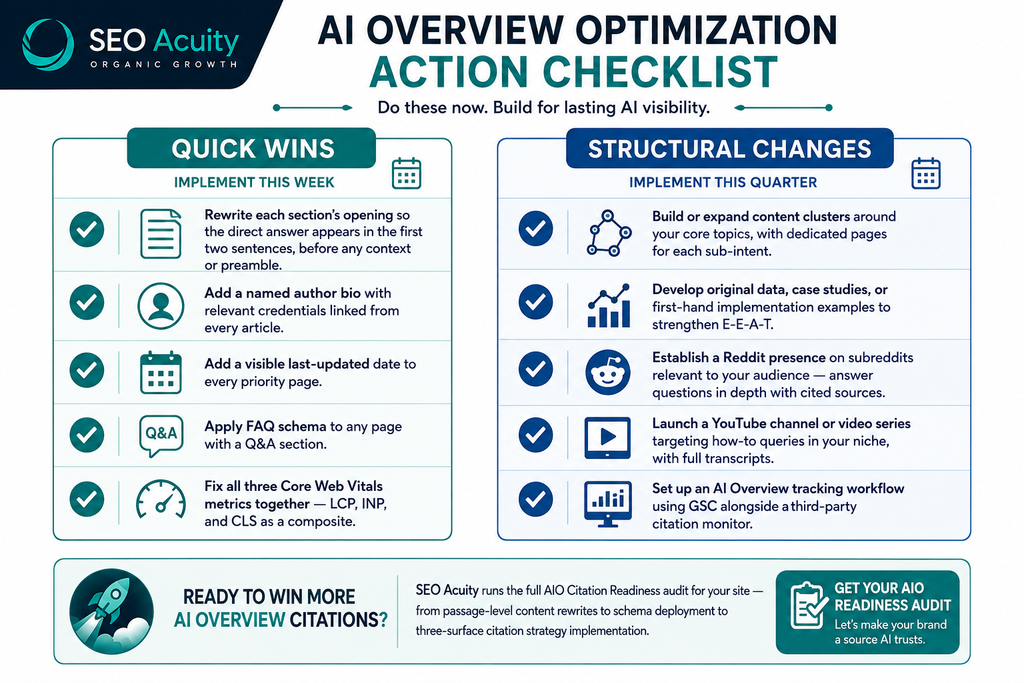
Apply this checklist to any existing page you want to optimize for AI Overview citation. The quick wins can be implemented in one to two weeks; the structural changes take four to twelve weeks to register in citation data.
Quick wins — implement this week:
- Rewrite each section’s opening so the direct answer appears in the first two sentences, before any context or preamble.
- Add a named author bio with relevant credentials linked from every article.
- Add a visible last-updated date to every priority page.
- Apply FAQ schema to any page with a Q&A section.
- Fix all three Core Web Vitals metrics together — LCP, INP, and CLS as a composite.
Structural changes — implement this quarter:
- Build or expand content clusters around your core topics, with dedicated pages for each sub-intent.
- Develop original data, case studies, or first-hand implementation examples to strengthen E-E-A-T.
- Establish a Reddit presence on subreddits relevant to your audience — answer questions in depth with cited sources.
- Launch a YouTube channel or video series targeting how-to queries in your niche, with full transcripts.
- Set up an AI Overview tracking workflow using GSC alongside a third-party citation monitor.
SEO Acuity runs the full AIO Citation Readiness audit for your site — from passage-level content rewrites to schema deployment to three-surface citation strategy implementation.

How to Track AI Overview Performance
You cannot optimize what you cannot measure. Tracking AI Overview citation requires combining native Google data with third-party tools, because Google Search Console does not currently allow you to filter AI Overview data separately from traditional search data.
a. Google Search Console
GSC includes AI Overview impression data in the Performance report, but it is not filterable by experience type.
- Use it as a starting point: identify which URLs generate impressions on informational and question-based queries.
- Then look for queries where impressions hold steady but CTR has dropped.
- That pattern — stable impressions, declining CTR — most often indicates an AI Overview is answering the query without generating a click to your page. Those are the queries to prioritize for citation optimization.
b. Third-Party Tracking Tools
Ahrefs’ AI Overview tracker and Semrush Sensor both surface citation-level visibility data that GSC aggregates away.
For agency and enterprise use cases, SEOcrawl’s AI Tracker measures AI-referred sessions by LLM source — ChatGPT, Claude, Perplexity, Gemini — and compares them against organic traffic baselines, which is the same kind of visibility measurement that sits behind what is LLM SEO as a discipline, and why enterprise teams increasingly look into LLM SEO services for enterprise businesses to manage it at scale.
ZipTie.dev is a free alternative worth running alongside GSC. Track citation frequency, citation position, CTR from AI Overview appearances, and — where volume supports it — conversion rate from AI-referred sessions. Most practitioners see citation changes within four to eight weeks of publishing or updating content.
Ready to Dominate Search Engine Rankings?
Accelerate your organic growth and scale your business leads with our data-driven SEO strategies.
Get a Free Quote NOW!Claim Your Citation Slots Before Competitors Do
Non-cited pages lose up to 61% of their clicks on AI Overview-triggered queries. Cited pages earn 35% more clicks than their pre-AIO baseline.
AI Overviews now trigger on more than 25% of all Google searches — and that number has nearly doubled in twelve months. Every page your competitors get cited on is a citation slot they hold and you do not.
At SEO Acuity, we run end-to-end AI Overview optimization: content audits, passage-level rewrites, schema deployment, E-E-A-T signal development, and the three-surface citation strategy across blog, Reddit, and YouTube.
We build the measurement infrastructure alongside the content, so you see exactly what is working and when. This is part of the broader shift businesses are making toward benefits of AI SEO for businesses as a growth channel, not just a defensive move.
The brands building compounding AI search visibility in 2026 are treating AI Overviews as a distribution channel, not a threat. The window to move first in your category is still open — but it is closing.
Ready to Dominate Search Engine Rankings?
Accelerate your organic growth and scale your business leads with our data-driven SEO strategies.
Get a Free Quote NOW!Conclusion
Ranking in Google AI Overviews requires optimizing simultaneously across three levels: the content (passage-level answers, E-E-A-T, topical clusters), the technical foundation (schema, composite Core Web Vitals, crawlability), and the off-page consensus layer (Reddit, YouTube, and authoritative brand mentions). None of these works alone, and none can substitute for the others.
The insight that separates AI Overview optimization from traditional SEO is this: Google’s RAG pipeline selects for passage quality and source credibility, not just rank position.
A page at position 8 can earn a citation ahead of the #1 result if the passage answers the sub-query more clearly, is structured for extraction, and signals verifiable authority.
The competition in 2026 is for citation slots — and the brands that understand that are the ones winning traffic while everyone else watches their CTR quietly compress.
Frequently Asked Questions
The questions below cover what teams most often ask once they start actually implementing an AI Overview citation strategy — from ranking position to conversion impact.
Do you need to rank #1 to appear in Google AI Overviews?
No. AI Overviews regularly cite pages from positions 4–20 and beyond. Google’s retrieval system selects for passage clarity, E-E-A-T signals, and topical relevance — not organic rank alone.
A page that has not yet built the link authority to compete at the top of traditional results can still earn AI Overview citations through strong passage-level content and trust signals.
Does optimizing for AI Overviews harm traditional SEO rankings?
No. The tactics that improve AI Overview citation — stronger E-E-A-T, cleaner structured formatting, topical authority, better Core Web Vitals — align directly with Google’s core ranking systems.
Optimizing for AI Overview citation improves the same signals Google evaluates for traditional web search. The two tracks reinforce each other; there is no trade-off between them.
What type of content gets cited most frequently in AI Overviews?
Informational and how-to content targeting question-based queries of eight words or more. Content organized into clear passage blocks with direct answers in the first 100 words of each section, FAQ schema applied, and named authors with visible credentials consistently outperforms generic overviews.
Pages that cover a topic comprehensively — including adjacent questions users typically ask — are more citeable than pages that answer only the exact query.
How long does it take to see AI Overview citations after optimizing?
Most practitioners see citation changes within four to eight weeks of publishing or updating content, tied to Google’s recrawl frequency for the domain. Quick wins like adding author bios, applying FAQ schema, and rewriting section openings to lead with direct answers can surface faster.
Structural changes like building content clusters and establishing Reddit and YouTube presence take eight to twelve weeks to reflect in citation data.
What schema types matter most for AI Overview visibility?
Article, FAQ, HowTo, and Organization schema are the highest-impact types. FAQ schema helps Google identify and extract Q&A content directly.
HowTo schema signals sequential instructional content. Article schema establishes author and publication metadata that directly supports E-E-A-T evaluation. As a minimum, implement Article and FAQ schema on every priority informational page, with all required fields completed.
Can I optimize for AI Overviews without hurting my existing organic rankings?
Yes — and optimizing for AI Overviews actively improves traditional rankings rather than undermining them. Stronger topical authority, cleaner content structure, better Core Web Vitals, and stronger E-E-A-T signals all correlate with higher organic positions.
The content and technical practices that improve AI Overview citation rates are the same ones Google’s core ranking systems reward in traditional search.
Do AI Overview citations lead to better conversion rates?
Yes. Users who click through from an AI Overview citation have already read a summary that referenced your content — they arrive with stronger intent and more context than a typical organic visitor.
Analysis across B2B SaaS accounts found cited-session conversion rates running approximately 2.1x higher than uncited sessions on equivalent queries. Citation functions as a trust badge that pre-qualifies the visitor before they reach your page.