Ever wonder why some websites consistently appear at the top of Google while yours remains buried on page two, even though your product, service, or expertise may be just as strong?
The difference often comes down to how effectively each website addresses the most important SEO ranking factors that search engines consider when deciding which pages deserve greater visibility.
Ranking in Google is not determined by a single keyword, backlink, or technical adjustment. Search engines evaluate a broad combination of signals to understand what a page is about, whether it satisfies the searcher’s needs, how trustworthy the information appears, and whether the website provides a technically accessible and usable experience.
For business owners, startups, ecommerce stores, and marketing teams, understanding these signals is essential.
Organic search can become a sustainable source of qualified traffic, leads, and sales, but only when a website is optimized around the factors that actually influence search visibility.
This guide explains what are the most important SEO ranking factors, how they interact with one another, and where website owners should focus their efforts first.
What You Will Learn
- The three core pillars Google relies on for ranking: content, technical performance, and backlinks.
- What E-E-A-T means and why it matters for building trust with Google and users.
- How search intent affects whether a page is relevant enough to compete for a keyword.
- How site speed and mobile-friendliness affect your position in search results.
- Why backlink quality matters more than backlink quantity.
- How crawlability and website architecture influence indexation and visibility.
- Practical ways to improve user experience without sacrificing SEO.
- How to prepare website content for AI-powered search and emerging search experiences.
- How to prioritize SEO improvements based on your website’s actual weaknesses.
Read also: Seo For Brand Visibility – A Complete Guide
Most Important SEO Ranking Factors
SEO ranking factors are the signals and criteria Google’s algorithms use to evaluate webpages and determine how prominently they should appear for particular searches.
Google’s systems are complex, and ranking cannot realistically be reduced to one checklist where every factor carries an identical weight. Different searches require different types of results.
A local service query, ecommerce product search, medical question, and informational blog search may all be evaluated differently depending on user intent and context.
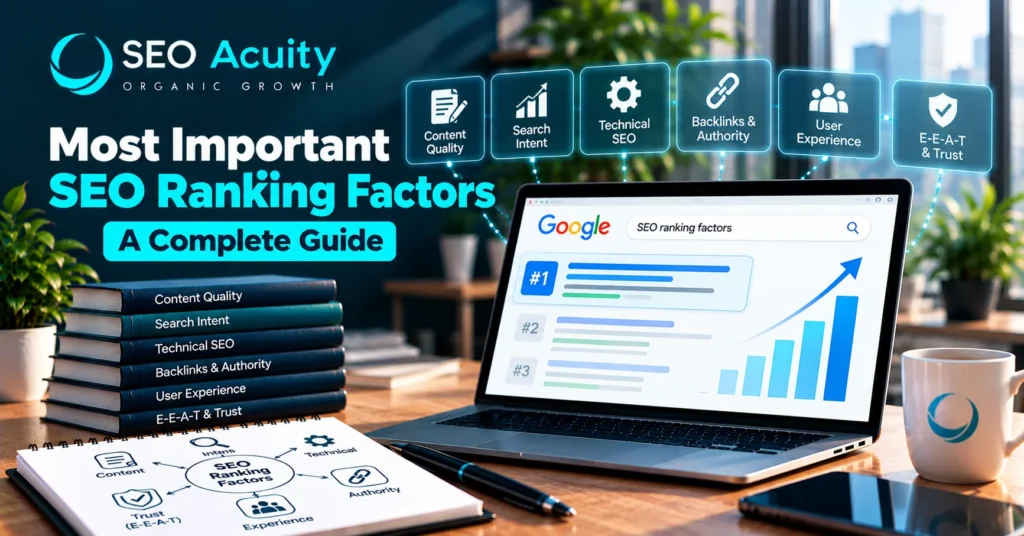
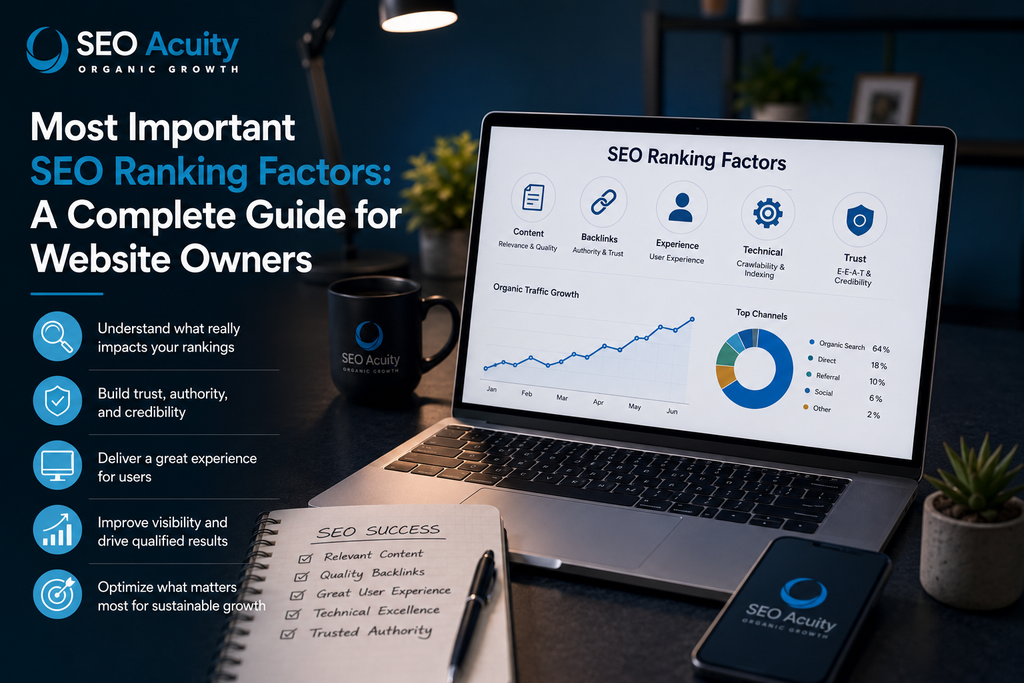
However, many of the most important SEO ranking factors can be grouped into three broad pillars:
- Content quality and relevance: whether your page genuinely satisfies the user’s search intent.
- Technical performance and accessibility: whether search engines can efficiently discover, crawl, understand, and index the page while users can access it smoothly.
- Authority and backlinks: whether other credible websites provide signals that your content or domain deserves trust and visibility.
Supporting factors such as user experience, website security, structured data, internal linking, and semantic organization strengthen these three foundations.
The important point for website owners is that these areas work together. Excellent content on a technically broken website can struggle. A technically perfect site with weak content may have little reason to rank. Likewise, backlinks cannot permanently compensate for pages that fail to satisfy search intent.
Businesses that need a structured starting point can also explore SEO Acuity’s Growth Foundation, which is designed around establishing the core SEO systems a website needs before trying to scale organic growth.
Read also: 5 Seo Marketing Tips – How To Boosting Your Website’s Performance
Content Quality and Search Intent Match
Content remains at the center of organic search because Google’s fundamental task is to connect a searcher with information that addresses what they are looking for.
A page that simply contains a target keyword repeatedly is not necessarily a strong result. The content must provide an appropriate answer for the actual intent behind that keyword.
Read also: How To Improve Seo Ranking – A Complete Guide
Search intent generally falls into several categories.
- Informational intent occurs when someone wants to learn something. Queries such as “how does technical SEO work?” or “what are SEO ranking factors?” are primarily educational.
- Commercial investigation intent appears when users are comparing options before making a decision. Searches such as “best SEO agencies for startups” or “technical SEO services comparison” suggest that the searcher is researching possible solutions.
- Transactional intent signals that the user is closer to taking an action, such as purchasing a product, requesting a quote, or hiring a service.
- Navigational intent occurs when someone is trying to reach a particular brand, website, product, or page.
Understanding this distinction is important because two pages targeting similar keywords can perform very differently if one aligns more closely with what searchers expect.
For example, someone searching for an explanation of SEO ranking factors probably expects an educational guide rather than a service page.
Someone searching specifically for an SEO audit service is much closer to commercial action and will likely expect information about the service, deliverables, process, and next steps.
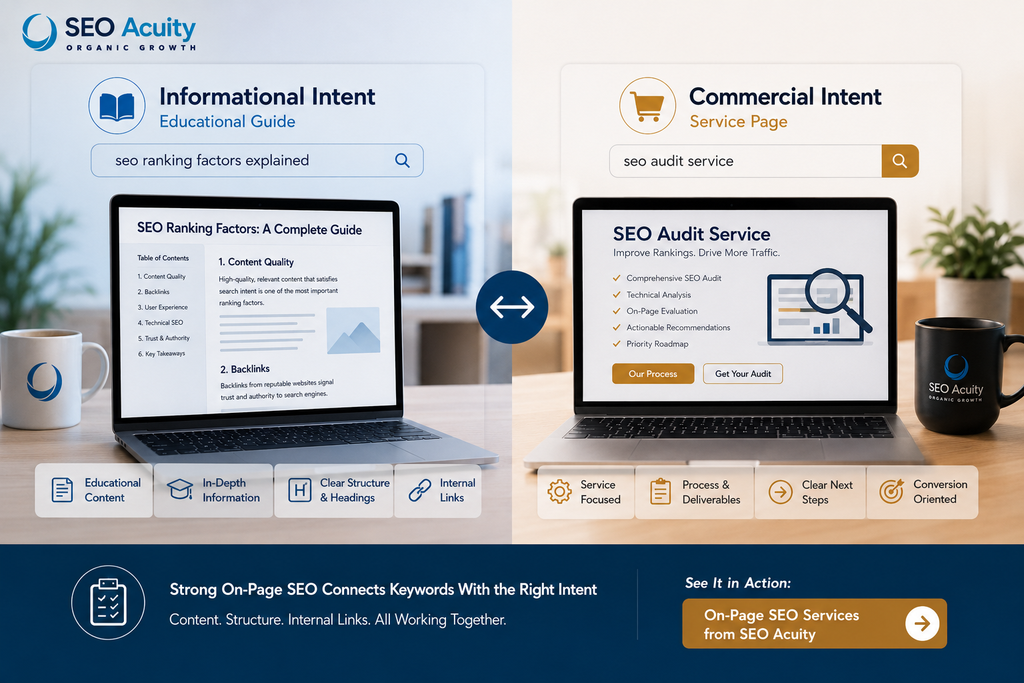
Strong on-page optimization connects the target keyword with the correct intent, content format, heading structure, supporting topics, and internal links. You can see how this approach is applied in practice through On-Page SEO Services from SEO Acuity.
If your business is still comparing providers, it can also help to understand what an SEO agency actually does before deciding what kind of support you need.
A high-volume keyword may generate substantial impressions while attracting users who have little interest in buying your product or requesting your service. A smaller, more specific keyword can sometimes produce significantly better business results because its intent is closer to what your company provides.
Effective keyword targeting therefore considers search volume, competition, business relevance, conversion potential, intent, and the quality of the pages already ranking.
The goal is not simply to attract more visitors. It is to attract the right visitors while giving Google a clear reason to consider your page one of the most useful results available.
Ready to Dominate Search Engine Rankings?
Accelerate your organic growth and scale your business leads with our data-driven SEO strategies.
Get a Free Quote NOW!E-E-A-T and Building Trust
E-E-A-T stands for Experience, Expertise, Authoritativeness, and Trustworthiness. It provides an important framework for understanding the characteristics associated with useful and reliable content, particularly when the subject can significantly affect a person’s finances, health, safety, or other important decisions.
- Experience refers to first-hand or practical familiarity with a subject. A product review written by someone who actually used the product, for example, can provide insights that purely theoretical content cannot.
- Expertise concerns the knowledge or skill demonstrated by the creator. The level of expertise expected naturally varies by subject.
- Authoritativeness relates to reputation and recognition. An author, organization, or website that is consistently referenced by credible sources may establish stronger authority within its field.
- Trustworthiness concerns whether users can reasonably rely on the page and the organization behind it.
Applying E-E-A-T principles in practice can involve clearly identifying authors, citing credible sources, keeping content updated, demonstrating subject expertise, providing transparent business information, and avoiding unsupported claims designed only to make content appear more authoritative.
For businesses, E-E-A-T should not be treated as something added to an article after it has been written. Trust should be reflected across the website, from the quality of individual pages to company information, author profiles, external references, policies, reviews, and broader brand reputation.
If you are deciding whether to manage SEO internally or bring in outside expertise, this guide on how to hire an SEO expert can help clarify what skills, experience, and processes to look for.
Technical SEO and Its Impact on Rankings
Content cannot perform effectively if search engines have difficulty accessing or understanding it. Technical SEO focuses on creating a website infrastructure that allows search engines to discover, crawl, render, interpret, and index important pages efficiently. Problems at this level can undermine otherwise strong content.
For example, an important landing page might accidentally contain a noindex directive. Duplicate URLs could confuse search engines about which version should rank. Poor internal architecture might leave valuable pages several clicks away from the homepage with almost no internal links pointing toward them.
Other technical issues may include broken internal links, incorrect canonical tags, redirect chains, unnecessary duplicate pages, XML sitemap problems, robots.txt configuration errors, orphan pages, JavaScript rendering issues, poor URL structures, mobile usability problems, and slow performance.
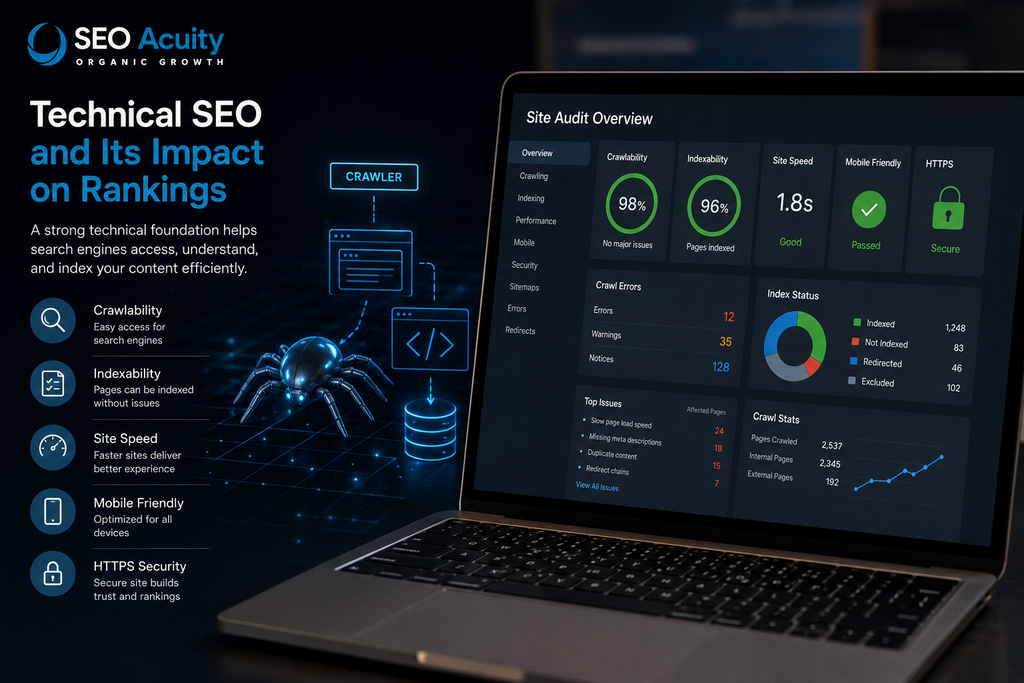
Technical SEO is therefore not merely about making a website “faster.” It creates the foundation that allows every other SEO effort to function properly.
Businesses dealing with these issues can use Technical SEO Services to identify and resolve crawling, indexation, performance, architecture, and site-health problems that may be limiting rankings.
Page Speed
Page speed plays an important role in overall page experience. Users expect websites to respond quickly, particularly on mobile devices.
A page that takes too long to become usable can cause visitors to leave before they interact with the content, browse products, submit a form, or complete a purchase.
Common causes of poor website performance include oversized images, excessive JavaScript, too many third-party scripts, poor server response times, inefficient caching, unnecessary plugins, and heavy page builders.
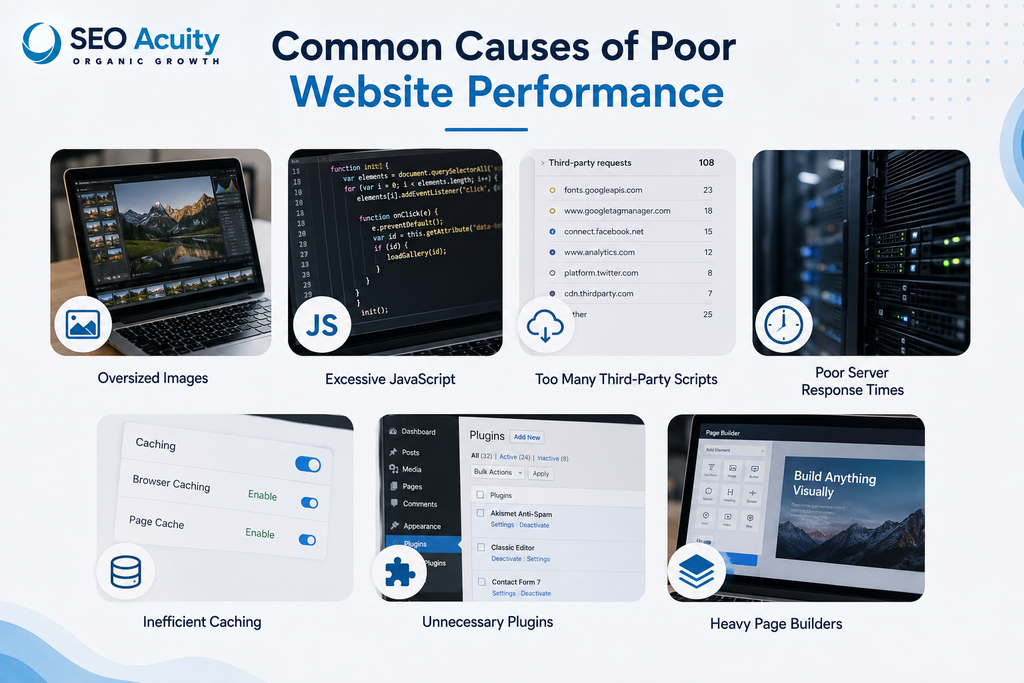
Compressing images, reducing unnecessary scripts, optimizing code, implementing browser caching, and using a content delivery network can all contribute to faster performance.
Website owners should also evaluate performance using real user conditions rather than assuming that a site is fast simply because it loads quickly on a powerful office computer.
Mobile-Friendliness and Crawlability
Mobile usability is now a fundamental part of website quality. A mobile-friendly site should provide responsive layouts, readable text, accessible navigation, properly spaced interactive elements, consistent content across devices, and fast mobile performance. Crawlability is equally important.
Search engines discover pages through links, sitemaps, and other signals. A logical website structure helps crawlers understand which pages matter and how different topics relate to one another.
An updated XML sitemap can provide additional discovery signals, while clear internal linking distributes authority and creates paths between related pages.
For larger ecommerce, publishing, SaaS, and enterprise websites, crawl efficiency becomes even more important because unnecessary parameter URLs, duplicate filters, thin pages, and complex structures can consume crawler attention while important commercial pages receive less emphasis.
A full SEO Audit is often the most practical way to uncover technical issues before deciding which changes should be prioritized.
Backlinks and Domain Authority
Backlinks are links from external websites pointing toward your website. They have played a major role in search since Google’s original PageRank system used links between webpages as a way to understand importance and authority.
The underlying principle remains useful: if credible and relevant websites choose to reference a page, that can provide a meaningful signal about the page’s value.
However, modern link building is considerably more sophisticated than simply accumulating as many links as possible. The source, relevance, context, and naturalness of a backlink all matter.
Quality Over Quantity
When it comes to backlinks, quality usually matters more than raw quantity. A single editorial link from a trusted, highly relevant website can be more valuable than dozens of links from weak directories, automated websites, or unrelated domains.
The value of a backlink can depend on the relevance of the linking page, the credibility of the domain, the context surrounding the link, the placement of the link, and whether it was earned naturally. This is why purchasing large quantities of low-quality links or participating in obvious link schemes is a risky strategy.
The objective should be to build a backlink profile that would still make sense even if search engines did not exist: credible websites referencing useful content because it genuinely adds value for their audience.
Ready to Dominate Search Engine Rankings?
Accelerate your organic growth and scale your business leads with our data-driven SEO strategies.
Get a Free Quote NOW!How to Build Trustworthy Backlinks
Effective link acquisition starts with creating something worth referencing. Original research, useful statistics, practical guides, free tools, templates, expert commentary, and genuinely comprehensive resources can all attract citations.
Common approaches include guest contributions, digital PR, original research, linkable assets, relationship building, unlinked brand mention reclamation, and promoting high-value resources to relevant audiences.
If you need professional support with this process, Off-Page SEO Services from SEO Acuity can help build a stronger and safer backlink profile over time.
For businesses that already have solid foundations and want continuous SEO execution rather than a one-time project, SEO Acuity’s Growth Retainer provides an ongoing framework for improving authority, content, technical performance, and organic growth.
User Experience as an Indirect Ranking Factor
User experience and SEO overlap heavily because both ultimately depend on whether people can find and use information efficiently. It is important, however, to avoid oversimplifying this relationship.
Metrics such as bounce rate and time on page should not automatically be treated as direct Google ranking factors simply because they appear in analytics platforms. A high bounce rate, for example, is not necessarily negative.
A visitor could search for a simple answer, find it immediately on your page, and leave completely satisfied. The more useful SEO question is whether the page successfully serves its intended purpose.
A strong user experience usually includes clear navigation, readable typography, logical headings, useful visual hierarchy, minimal intrusive pop-ups, fast access to important information, mobile-friendly layouts, clear calls to action, and relevant internal links.
Startups face an additional challenge because development, content, and marketing resources are often limited. They need to prioritize the SEO and UX improvements most likely to produce measurable results rather than attempting to optimize everything simultaneously.
That balance is exactly what SEO Services for Startups from SEO Acuity is designed to support through flexible strategies suited to smaller and growing teams.
For businesses specifically adapting content to answer engines and AI-generated results, SEO Acuity’s Answer Engine Optimization services focus on making content clearer, more retrievable, and better structured for emerging search experiences.
Larger websites that need to scale this kind of optimization across many URLs may also benefit from Programmatic SEO Services, especially when large datasets or repeatable page templates are involved.
How the Most Important SEO Ranking Factors Work Together
One of the biggest mistakes website owners make is treating SEO factors as separate tasks. In practice, they constantly interact.
- Content and Indexability: Imagine publishing an exceptional guide that perfectly matches search intent. If the page is accidentally blocked from indexing, its content quality becomes irrelevant because Google cannot properly include it in search results.
- Technical SEO and User Experience: Now imagine fixing the technical issue but offering a poor mobile experience where intrusive elements make the content almost impossible to read. The page may be accessible to search engines but frustrating for real visitors.
- Content, Technical SEO, UX, and Authority: Finally, imagine having strong content, clean technical implementation, and excellent UX but competing in a highly authoritative industry where every first-page competitor has earned significant industry recognition and relevant backlinks. Authority building may then become the missing component.
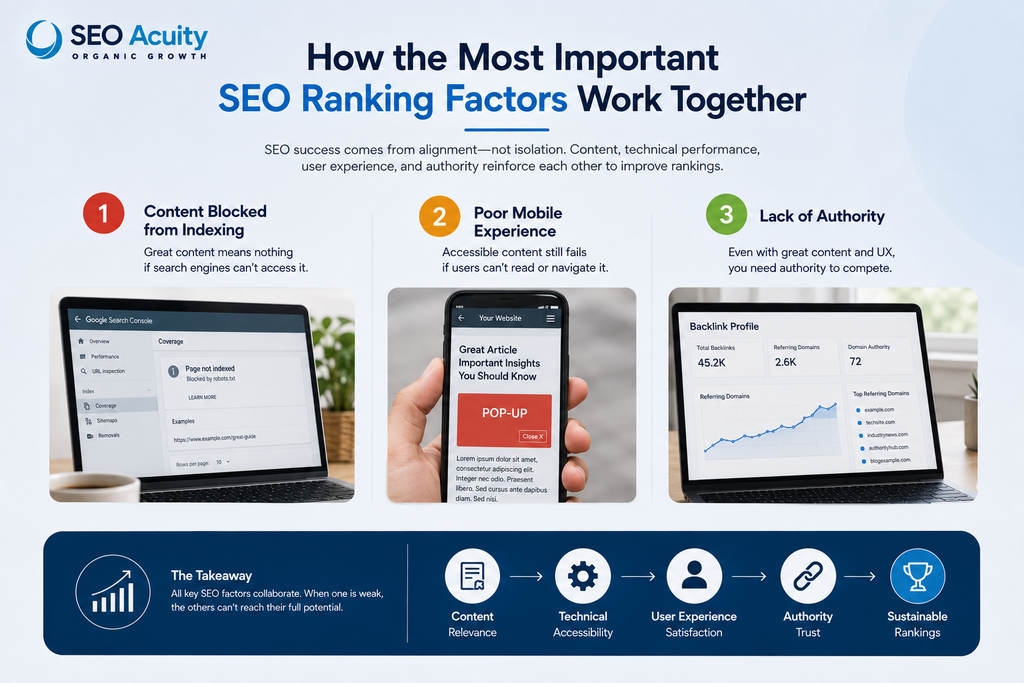
SEO success comes from identifying which constraint is currently preventing the site from competing. For one website, that may be content. For another, it may be technical indexation.
For another, it may be weak topical authority or a lack of credible backlinks. This is why prioritization matters more than blindly following a generic SEO checklist.
Ready to Dominate Search Engine Rankings?
Accelerate your organic growth and scale your business leads with our data-driven SEO strategies.
Get a Free Quote NOW!Practical Steps to Improve Your SEO Rankings
Knowing the most important SEO ranking factors is useful, but the real value comes from translating them into action. Start by evaluating the website as a complete system.
- Identify pages that already receive impressions or rank near the first page. Improving content quality, search intent alignment, internal links, and supporting information on these URLs may produce results faster than creating entirely new pages.
- Review technical accessibility. Confirm that important pages can be crawled and indexed, canonicals are correct, internal links work, redirects behave properly, and mobile versions contain the necessary content.
- Evaluate content gaps.
Compare your pages against the topics and questions users genuinely need answered. Look beyond keyword density and consider whether competing pages provide valuable information your content currently ignores.
After strengthening the site itself, evaluate authority. Determine which pages have attracted backlinks, which competitors earn links consistently, and what kinds of content receive citations within your industry.
For websites targeting Arabic-speaking audiences, Arabic SEO Services can help address keyword localization, Arabic search behavior, content structure, and regional optimization requirements that differ from English-language campaigns.
For online stores, Ecommerce SEO Services can help improve category pages, product architecture, internal linking, technical indexation, and commercial keyword targeting.
Larger organizations with complex structures may need a broader framework. Enterprise SEO Services are designed for websites where scale, stakeholder coordination, technical complexity, and large numbers of pages make SEO implementation more demanding.
Get a Custom SEO Plan From SEO Acuity to Rank Higher
Every website has a different SEO bottleneck. One business may have excellent content but limited authority. Another may have hundreds of backlinks but serious technical problems preventing important pages from being indexed correctly.
An ecommerce website may need category optimization and stronger architecture, while a startup may need to establish an entire organic acquisition strategy from the ground up. That is why an effective SEO plan should begin with data rather than assumptions.
The SEO Acuity team can audit your website and pinpoint the first steps to improve its ranking based on the factors covered in this article, not vague promises. The objective is to identify what is actually limiting organic growth and create a prioritized strategy around your site’s current condition, competition, audience, and business goals.
Businesses that need to establish the fundamentals can begin with Growth Foundation, while companies that need ongoing SEO execution and optimization can explore the Growth Retainer.
Start Your SEO / GEO / AEO Journey Today
Conclusion
The most important SEO ranking factors ultimately work as an interconnected system rather than an isolated checklist. Content needs to satisfy search intent, answer users’ questions comprehensively, and demonstrate the qualities associated with experience, expertise, authority, and trust.
Technical SEO needs to make that content accessible, crawlable, indexable, fast, and usable across devices. Backlinks and external authority signals help demonstrate that other websites consider your pages worthy of attention and reference.
Supporting elements such as internal linking, structured data, HTTPS, website architecture, mobile usability, and clear semantic relationships can reinforce these foundations. At the same time, search continues to evolve.
Traditional rankings now exist alongside AI-powered search experiences that can retrieve and synthesize information in new ways. There is no single optimization that guarantees higher rankings.
The most reliable approach is to understand what users need, create the strongest possible resource for that intent, remove technical obstacles, establish genuine authority, and continuously measure how those efforts affect both organic visibility and business outcomes.
Frequently Asked Questions
What are the most important SEO ranking factors?
The most important SEO ranking factors generally center on content quality and search intent, technical accessibility and performance, and the authority demonstrated through credible backlinks and other trust signals.
Strong pages provide useful information that matches what users are searching for, while strong websites make those pages easy for search engines to discover, crawl, understand, and index.
Is page speed a real Google ranking factor?
Page experience and performance matter to Google, and speed-related signals form part of the broader evaluation of page experience.
However, website owners should avoid viewing speed as a shortcut to rankings. Making a page faster will not automatically cause weak or irrelevant content to outrank a much stronger result.
How many backlinks do I need to improve my ranking?
There is no universal number of backlinks required to rank. The amount and type of authority needed depend on the keyword, industry, competitors, website history, content quality, and relevance of the links involved.
A smaller number of genuine links from trusted and contextually relevant websites can be substantially more useful than a large volume of weak or unrelated backlinks.
Is user experience an officially confirmed Google ranking factor?
User experience should not be reduced to one standalone metric or assumed ranking signal. Factors associated with page experience can matter, but analytics metrics such as bounce rate or session duration should not automatically be interpreted as direct ranking factors.
From a practical SEO perspective, the priority is to create pages that are fast, accessible, readable, easy to navigate, and capable of helping visitors accomplish what they came to do.
How do ranking factors differ for AI-powered search versus traditional search?
Traditional search typically focuses on ranking webpages for relevant queries, while AI-powered search experiences may retrieve and synthesize information from multiple sources and passages.
This increases the importance of clear semantic structure, descriptive headings, self-contained explanations, accurate factual statements, strong entity relationships, and reliable sourcing.
Does publishing more content automatically improve SEO rankings?
No. Publishing more pages does not automatically improve rankings or topical authority. Quality, relevance, differentiation, internal relationships, and usefulness matter more than raw publishing volume.
How long does it take to improve Google rankings?
There is no fixed SEO timeline because the speed of improvement depends on the website’s current condition, competition, authority, technical problems, content quality, and the scope of changes being made.
Some improvements to existing pages can produce measurable movement relatively quickly, while competitive industries or new websites may require sustained work over a longer period.
Which SEO ranking factor should I improve first?
Start with the issue that currently creates the biggest limitation for your website. If important pages cannot be crawled or indexed, technical SEO should take priority. If the site is technically healthy but its pages fail to satisfy search intent, content optimization may provide the greatest opportunity.
If both content and technical foundations are strong but competitors have substantially greater authority, backlink acquisition and brand authority may deserve more attention.