You can write the sharpest content in your industry and earn backlinks from credible sources. Your keyword strategy can be airtight. And yet, if search engines can’t crawl your pages, can’t index them correctly, or can’t render the content users see, none of that effort produces rankings.
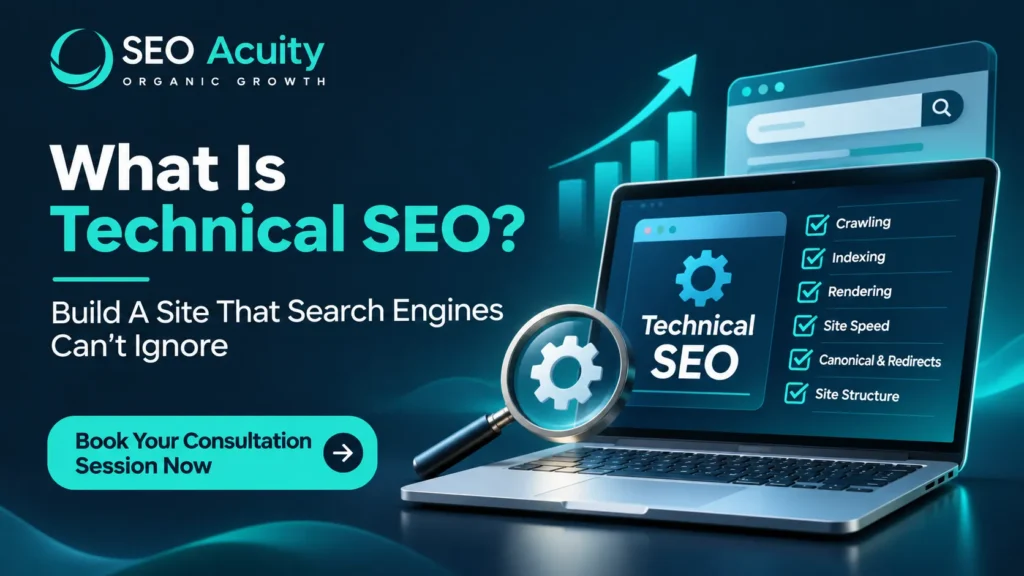
Technical SEO is the discipline that prevents this. It governs the infrastructure layer of your website, the systems that determine whether search engines and AI platforms can find, access, interpret, and trust your content.
Get it right, and everything built on top of it performs better. Get it wrong, and even the strongest content and link strategies stall against a ceiling that isn’t immediately visible.
This guide covers what technical SEO actually is, why it carries more weight than most businesses allocate to it, what a rigorous technical SEO guide covers in practice, and how the rise of AI search has raised the bar on getting these fundamentals right.
What You’ll Learn in This Article:
- The precise definition of technical SEO and how it differs from on-page and off-page SEO.
- The core components that determine whether search engines can reach, read, and rank your pages.
- What an updated working technical SEO checklist.
- How AI search systems have changed what “technically sound” actually requires.
- The failure patterns that surface when technical issues go unaddressed.
- Which sites need which technical priorities ecommerce, enterprise, and small business.
Book your consultation session now
What Is Technical SEO, And Why Does It Run Deeper Than Most People Think?
Technical SEO is the practice of optimizing a website’s underlying infrastructure so that search engines and AI systems can crawl, render, index, and understand its content without friction.
Where on-page SEO focuses on content quality and keyword relevance, and off-page SEO focuses on external authority signals like backlinks, technical SEO addresses the structural and mechanical layer beneath them, the systems users rarely see but that every search engine depends on entirely.
The distinction matters precisely because technical SEO is often treated as equivalent to website maintenance: a checklist of minor fixes that can be deferred without consequence. That framing misrepresents what it actually governs.
Search engines operate through a sequential pipeline. Before any page can rank, it must pass through five stages: discovery (a bot finds the URL through a link or sitemap), crawling (the bot requests the page and receives the HTML), rendering (JavaScript executes and the visual model builds), indexing (content and signals are stored in the search database), and ranking (the indexed page competes for a query).
Technical SEO controls the first four stages. Every technical barrier in that pipeline, blocked pages, slow rendering, conflicting canonical signals, broken redirects, limits what search engines can see and store, regardless of how strong the content or link profile is.
The contrast with on-page SEO makes this concrete. On-Page SEO Services optimize what’s visible and readable on a page: headings, keyword integration, content structure, and internal linking between articles.
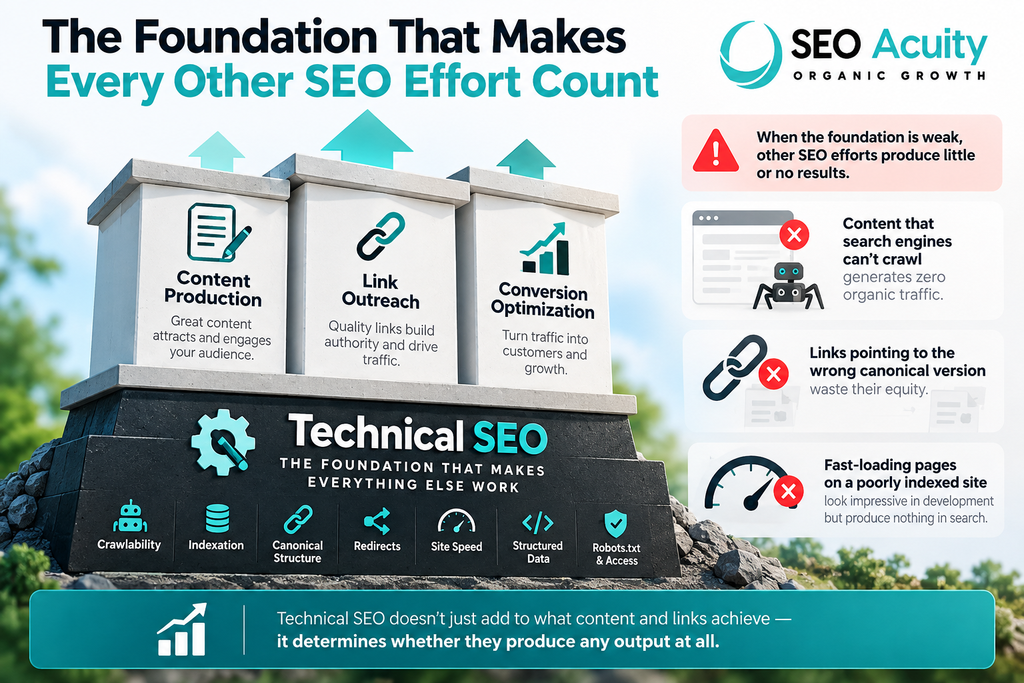
The Foundation That Makes Every Other SEO Effort Count
Businesses regularly invest in content production, link outreach, and conversion optimization, while treating technical SEO as an item to revisit when traffic drops. This sequencing has predictable consequences.
Content that search engines can’t crawl generates zero organic traffic. Links pointing to pages that serve the wrong canonical version waste their equity. Fast-loading pages on a poorly indexed site look impressive in development and produce nothing in search.
The relationship between technical SEO and everything built above it is multiplicative, not additive. Technical SEO doesn’t contribute to what content and links achieve — it determines whether they produce any output at all.
Understanding what is an SEO audit illuminates why this matters operationally: what is an SEO audit is the diagnostic process that surfaces technical failures before they compound into sustained traffic loss.
Organizations that conduct audits only after rankings drop are discovering problems that have been accumulating for months, in some cases, since a site migration or CMS update that nobody checked thoroughly before launch.
The practical stakes are high. A client in the financial services space, operating a content-rich site with a strong backlink profile, lost more than 60% of organic sessions within six weeks of a site migration. The cause wasn’t content quality or competition.
A misconfigured robots.txt update blocked Googlebot from a key section, and several redirect chains introduced during the migration were fragmenting link equity before it reached the pages that needed it.
Recovery required three months of systematic technical remediation — not because the fixes were technically complex, but because every layer of the site required auditing, correcting, and verifying before the next layer could be addressed.
This is why the Organic Growth Foundation™ framework treats technical SEO as the starting point, not a finishing touch. Organic Growth Foundation establishes the technical and structural baseline before scaling any other organic channel, because there is no compounding without a sound base.
The Core Components Of Technical SEO
Technical SEO is not a single discipline. It’s a set of interconnected systems, each capable of independently suppressing organic performance when misconfigured.
Understanding each component separately is what allows audits to produce actionable, prioritized findings rather than undifferentiated lists of issues.
1. Crawlability: Getting Search Engines Through the Front Door
Crawlability is whether bots can discover and access your pages at all. It’s the entry point for the entire search pipeline — a page that isn’t crawled can’t be indexed, and a page that isn’t indexed can’t rank.
The two primary control mechanisms are robots.txt and XML sitemaps. Your robots.txt file tells crawlers which pages and directories they’re permitted to access. A single misplaced Disallow directive can exclude entire site sections from Google’s index, including sections that generate the majority of organic revenue.
Modern robots.txt management also extends to AI crawlers: OAI-SearchBot (which powers ChatGPT’s search feature), ClaudeBot, and PerplexityBot each have distinct user agents that can be selectively allowed or blocked.
Your XML sitemap tells crawlers which URLs you want discovered and indexed. It should contain only canonical, live, indexable URLs, not redirected pages, noindexed content, or parameter variants that duplicate existing pages.
Internal linking is the third crawlability lever. Bots follow links to discover pages, which means orphan pages, those with no internal links pointing to them — are effectively invisible to crawlers..
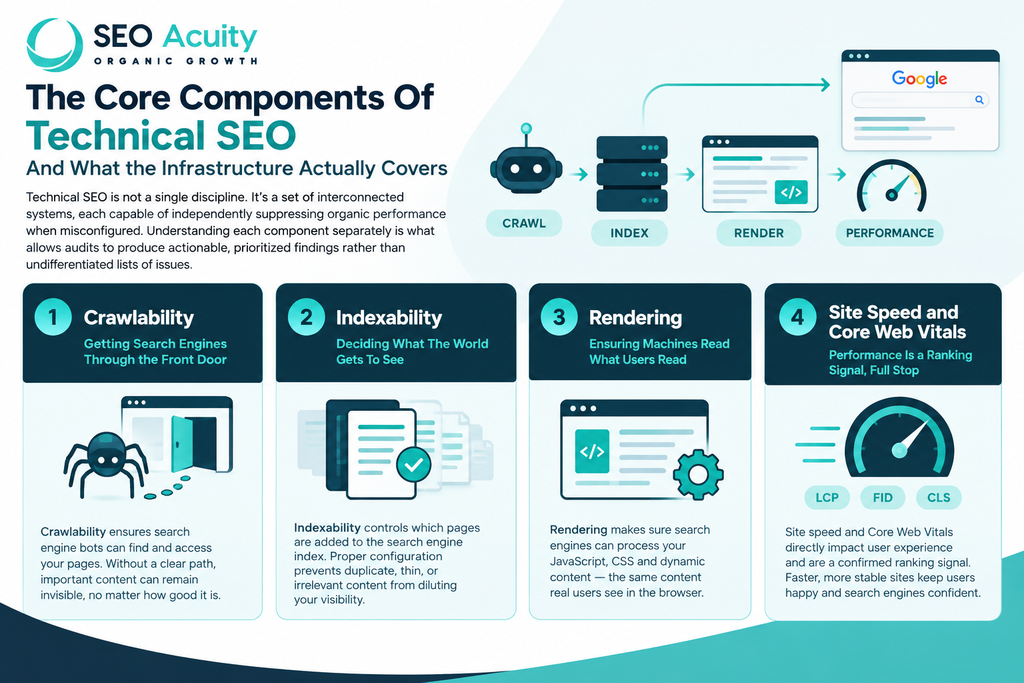
2. Indexability: Deciding What The World Gets To See
Crawling and indexing are related but distinct stages. A page can be crawled without being indexed — Google visits it, evaluates the content, and decides not to store it.
Noindex tags, either as HTML meta tags or HTTP response headers, tell search engines not to include a page in their index. Used correctly, noindex is valuable for admin pages, thank-you pages, and internal search results.
Canonical tags resolve the duplicate content problem. When the same or similar content exists at multiple URLs, with and without trailing slashes, www and non-www, HTTP and HTTPS, filtered product variants, canonical tags designate the preferred version for indexing.
Reviewing the Google Search Console Pages report monthly catches indexation drift before it affects traffic. The report categorizes every known URL by its indexation status and the reason for any exclusion, making it the most direct diagnostic tool available for indexation health.
Ready to Dominate Search Engine Rankings?
Accelerate your organic growth and scale your business leads with our data-driven SEO strategies.
Get a Free Quote NOW!3. Rendering: Ensuring Machines Read What Users Read
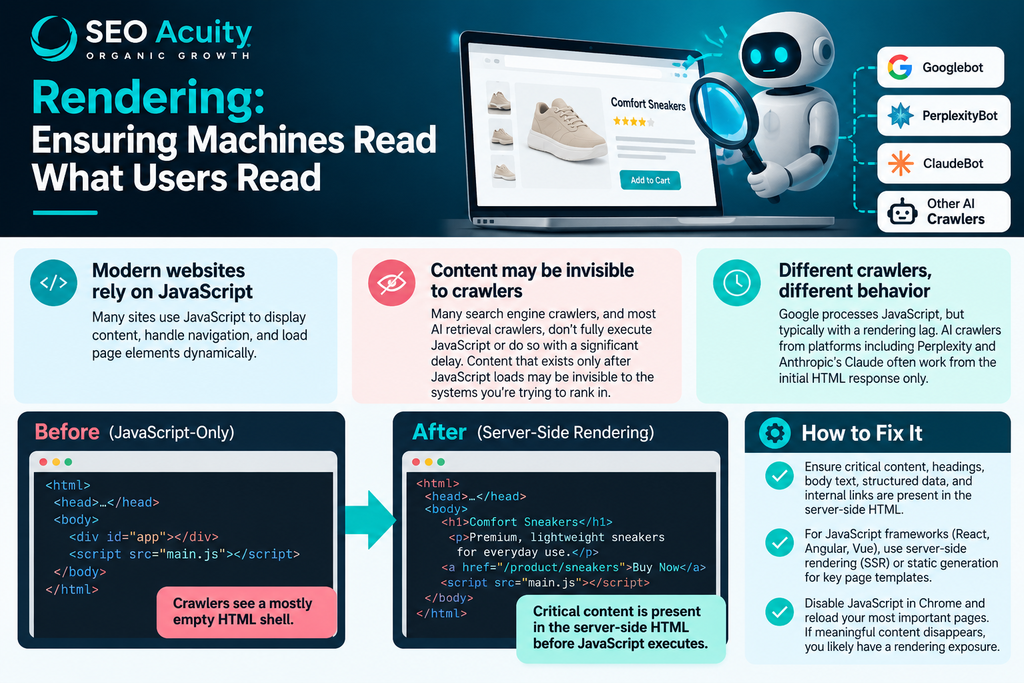
Most modern websites rely on JavaScript to display content, handle navigation, and load page elements dynamically. This creates a structural problem: many search engine crawlers, and most AI retrieval crawlers, don’t fully execute JavaScript or do so on a significantly delayed basis.
Google processes JavaScript, but typically with a rendering lag. AI crawlers from platforms including Perplexity and Anthropic’s Claude often work from the initial HTML response only.
The practical fix: ensure critical content, headings, body text, structured data, internal links, is present in the server-side HTML before any JavaScript executes.
For sites built on JavaScript frameworks (React, Angular, Vue), this typically means adopting server-side rendering (SSR) or static generation for key page templates. Disabling JavaScript in Chrome and reloading your most important pages is a quick first check, if meaningful content disappears, you likely have a rendering exposure.
4. Site Speed and Core Web Vitals: Performance Is a Ranking Signal, Full Stop
Google made page experience a confirmed ranking factor in 2021, anchored by three Core Web Vitals metrics:
- Largest Contentful Paint (LCP): How quickly the largest visible element loads. Target: 2.5 seconds or less.
- Interaction to Next Paint (INP): How quickly the page responds to user interaction. Target: 200 milliseconds or less.
- Cumulative Layout Shift (CLS): How much the layout shifts during load. Target: 0.1 or less.
These metrics are measured from real user behavior, Chrome field data collected from actual page visits, not simulated lab tests.
A site that passes all three Core Web Vitals benchmarks has a measurable ranking advantage over technically equivalent competitors that don’t, and the gap is most pronounced in competitive categories where content and link quality are comparable.
Speed also affects crawl efficiency. Search engines crawl faster sites more thoroughly and more frequently. A Time to First Byte consistently above 800ms from the origin server limits how many pages get crawled per session, a material constraint for large sites where crawl budget allocation determines which pages get indexed and which don’t.
Read More About: What Is An SEO Specialist? Role, Responsibilities, Skills, and When to Hire One
Technical SEO In The Age Of AI Search
AI search systems, Google AI Overviews, ChatGPT Search, Perplexity, Microsoft Copilot, don’t rank your pages in the traditional sense. They retrieve content from them and synthesize answers, citing sources.
This changes the consequences of technical SEO failures in ways most businesses haven’t fully mapped. A page blocked from crawling produces zero organic traffic. That same page also contributes nothing to AI-generated answers, it simply doesn’t exist in any retrieval system.
The underlying mechanism is worth understanding. AI systems don’t retrieve pages as units. They retrieve chunks, small sections of content, often a single paragraph, processed independently through a vectorization pipeline.
When a user asks a question, the most semantically relevant chunks are retrieved and assembled into an answer. This makes the internal structure of your content, how ideas are organized at the paragraph level, not just the page level, a direct factor in retrievability.
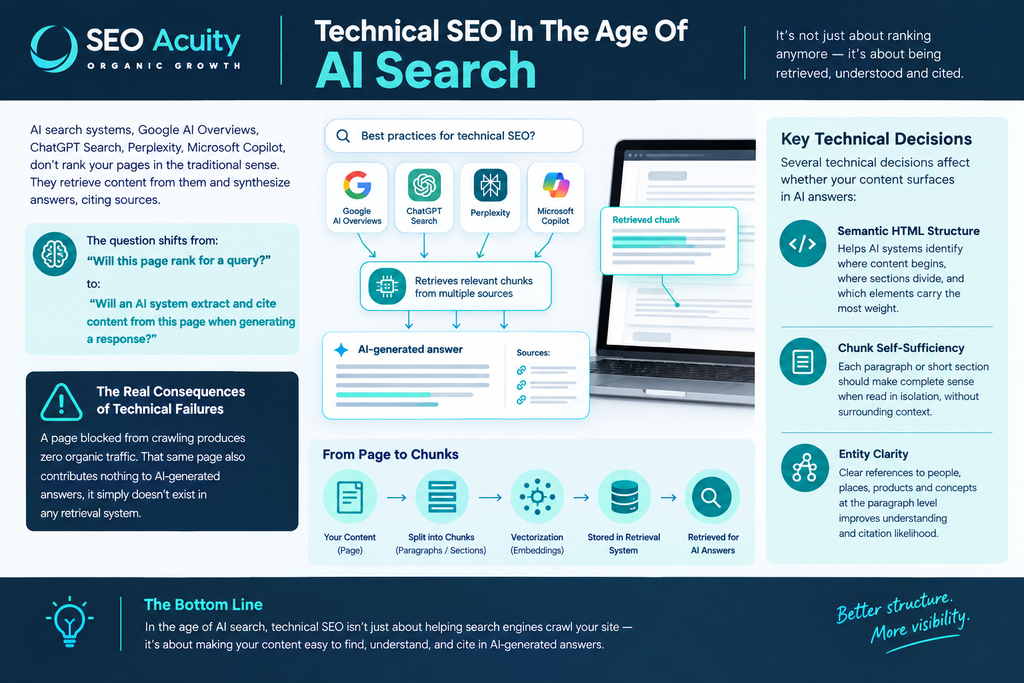
Several technical decisions affect whether your content surfaces in AI answers:
- Semantic HTML structure helps AI systems identify where content begins, where sections divide, and which elements carry the most weight. Clear <h1>, <h2>, <article>, and <main> tags are not decorative — they’re the structural cues that chunking algorithms use to identify boundaries.
- Chunk self-sufficiency is the principle that each paragraph or short section should make complete sense when read in isolation, without surrounding context. AI systems extract chunks independently. A key claim that requires the reader to have processed the preceding four paragraphs won’t surface cleanly as a standalone answer.
- Entity clarity at the paragraph level matters. Pronouns like “it” and “they” create ambiguity when a chunk is extracted without its referential context. Explicit entity references — naming the product, organization, or concept being discussed — make content more reliably citable.
Those asking does SEO still matter if AI search keeps growing often underestimate how much technical SEO determines AI visibility examines this question in depth. The short answer is that technical foundations are the prerequisite for AI retrievability in the same way they’re a prerequisite for traditional search indexing.
What is AI SEO as a discipline extends technical SEO into the specific content structure and entity clarity requirements of AI retrieval systems. The two disciplines share a foundation; AI SEO adds the requirements specific to how large language models process and cite web content.
AI Search Optimization Services and GEO Services – Generative Engine Optimization at SEO Acuity are built on this integration, treating technical SEO and AI retrievability as one continuous system rather than parallel tracks.
Ready to Dominate Search Engine Rankings?
Accelerate your organic growth and scale your business leads with our data-driven SEO strategies.
Get a Free Quote NOW!
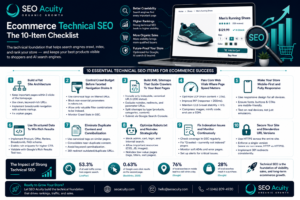
The Technical SEO Checklist
A technical SEO checklist is useful only if it reflects the actual priority order of site health. The sequence below moves from the most fundamental constraints, what blocks discovery, through to the refinements that affect quality and ranking depth.
1. Crawl Health and Access Control
Start by making sure search engines and AI crawlers can access the pages and resources that matter, while keeping unnecessary or problematic URLs out of the crawl path.
- Verify robots.txt allows access to all pages that should rank, including CSS and JavaScript assets Google needs to render pages correctly.
- Confirm AI retrieval crawlers are not accidentally disallowed, check for OAI-SearchBot, ClaudeBot, and PerplexityBot in the directives.
- Audit the XML sitemap: it should contain only canonical, live, indexable URLs — not redirected pages, noindexed content, or parameter variants.
- Submit the sitemap through Google Search Console and verify it processes without errors.
- Identify orphan pages: every page that should rank needs at least one internal link pointing to it from a crawled page.
- Collapse redirect chains to single 301 hops — each additional hop wastes crawl budget and dilutes link equity.
2. Indexation and Duplicate Content Management
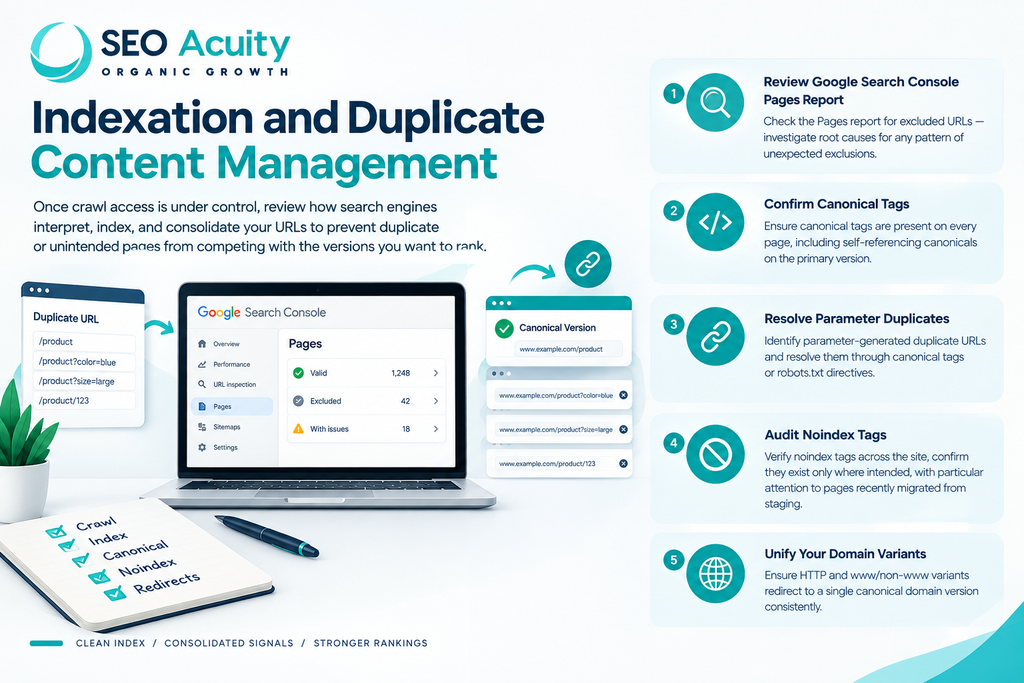
Once crawl access is under control, review how search engines interpret, index, and consolidate your URLs to prevent duplicate or unintended pages from competing with the versions you want to rank.
- Review the Google Search Console Pages report for excluded URLs — investigate root causes for any pattern of unexpected exclusions.
- Confirm canonical tags are present on every page, including self-referencing canonicals on the primary version.
- Identify parameter-generated duplicate URLs and resolve them through canonical tags or robots.txt directives.
- Audit noindex tags across the site, confirm they exist only where intended, with particular attention to pages recently migrated from staging.
- Verify that HTTP and www/non-www variants redirect to a single canonical domain version consistently.
3. Site Architecture and Internal Linking
After ensuring the right URLs are eligible for indexing, strengthen the site’s architecture so search engines and users can efficiently discover important pages and understand their relationship to one another.
- Map click depth from homepage to key commercial pages — most should be reachable within three clicks
- Identify orphan pages and add internal links from topically related, well-crawled pages
- Review anchor text: links between important content should use descriptive, keyword-relevant anchor text rather than generic phrases
- Implement breadcrumb navigation on deep pages to reinforce site hierarchy for crawlers and users
- Audit internal link equity flow — pages with strong authority should link to pages that need ranking support
4. Performance, Security, and Structured Data
Finally, evaluate the technical signals that affect how efficiently your pages load, how securely they are delivered, and how clearly search engines understand their content and entities.
- Run key page templates through Google PageSpeed Insights — measure LCP, INP, and CLS against confirmed thresholds
- Optimize images: compress, convert to WebP or AVIF, implement lazy loading for below-fold assets
- Audit and defer non-critical JavaScript to reduce render-blocking impact on initial page load
- Confirm the entire site serves over HTTPS with a valid, non-expired SSL certificate — not just the homepage
- Audit for mixed content: HTTPS pages loading HTTP resources produce browser warnings that undermine user trust
- Verify the site renders correctly on mobile without layout issues, inaccessible touch targets, or horizontal scrolling
- Implement schema markup for relevant page types: Article, Product, FAQ, Organization, LocalBusiness — and test accuracy using Google’s Rich Results Test
- Add hreflang tags for sites serving audiences in multiple languages or geographic regions
Knowing why are SEO audits important as a recurring practice becomes obvious when you see how quickly these items drift after a site update, covering the operational argument for treating audits as ongoing maintenance, not post-incident investigation.
SEO Audit Services at SEO Acuity are built around this diagnostic discipline: identify the specific constraint, fix it with precision, and verify the fix propagated before moving to the next layer.
The Failure Patterns Of Technical SEO
Technical SEO problems rarely announce themselves directly. They produce symptoms that often get misattributed to content quality shifts, algorithmic updates, or competitive pressure. Recognizing the patterns narrows the investigation.
- Gradual traffic decline without an obvious trigger typically indicates a crawl or indexation issue introduced during a site change, a template update, CMS migration, or plugin change that modified URL generation or robots directives. The decline is gradual because problems don’t affect all pages simultaneously; they spread as crawl cycles revisit affected sections.
- New pages that fail to rank despite strong content are often orphan pages or JavaScript rendering failures. If a page receives no internal links after publication, crawlers may not find it. If the content renders only through client-side JavaScript, the page may appear empty in the index regardless of its actual substance.
- Pages ranking from unexpected URLs usually indicates a canonical tag problem. When search engines select an alternate URL as the canonical — often a parameter variant — that URL gets indexed and ranked, diluting the signal intended for the clean version.
- Sudden ranking drops across multiple pages simultaneously correlate most strongly with robots.txt changes, HTTPS configuration errors, or accidental noindex deployments. The breadth of the impact is the diagnostic signal: issues affecting dozens or hundreds of pages simultaneously point to infrastructure, not content.
- Rich result disappearance from search results usually means structured data that stopped validating after a content change made the schema inconsistent with what’s visible on the page. Google pulls rich results when markup contradicts what users actually see.
Read also: How to Adapt SEO Budget for AI Search Optimization

Technical SEO Across Different Site Types
Technical SEO principles are consistent. The specific constraints and failure modes differ significantly by site type.
Ecommerce sites face the most complex technical SEO challenges: thousands of product pages with filter-generated parameter URLs, product variants that create near-duplicate content across SKUs, out-of-stock inventory that produces thin or empty pages, and pagination that fragments link equity across category structures.
The best ecommerce platforms for SEO differ substantially in how well their default configurations handle these constraints, examines the technical tradeoffs across leading platforms.
Ecommerce SEO Services address these systematically. For Shopify merchants specifically, Shopify SEO Services targets the platform-specific technical constraints, particularly around canonical handling, duplicate product URLs, and collection page pagination, that most directly limit organic performance.

Enterprise sites operate at the scale where technical SEO mistakes multiply across thousands or millions of pages. A template error that misapplies a noindex tag affects every page built on that template, potentially thousands of URLs excluded from the index before anyone notices.
A robots.txt misconfiguration can exclude entire product categories. Enterprise SEO Services operate at the governance layer, establishing technical standards, QA processes, and monitoring systems that prevent technical debt from accumulating across large, distributed web properties.
Small businesses typically have simpler technical profiles, but that simplicity creates its own risks: fewer pages means fewer internal links supporting discovery, and smaller teams mean less capacity for regular technical monitoring.
Small business SEO technical priorities, focus on establishing a clean baseline quickly: verified HTTPS, a well-structured sitemap, correct canonicalization, and Core Web Vitals performance within Google’s thresholds.
For businesses operating across the GCC and MENA region, Arabic SEO Services extend the technical layer to include hreflang configuration for Arabic and English variants, right-to-left rendering accuracy, and region-specific indexation strategy.
Ready to Dominate Search Engine Rankings?
Accelerate your organic growth and scale your business leads with our data-driven SEO strategies.
Get a Free Quote NOW!Knowing When To Call In Reinforcements
Many technical SEO fundamentals are learnable, and practitioners who invest in understanding the discipline can handle routine auditing and maintenance themselves. The inflection point comes with scale, complexity, or urgency.
A site migration involving thousands of URLs, a JavaScript-heavy framework introducing rendering failures, a sustained traffic decline that’s resisted internal investigation — these are points where continued trial-and-error costs more than expert engagement.
Understanding how to hire an SEO expert, means evaluating the specific expertise the problem demands: technical depth for infrastructure failures, content architecture for topical authority gaps, or both for established sites that are underperforming relative to their investment.
AI SEO vs traditional SEO expertise, is an increasingly relevant distinction when choosing who to work with. Traditional technical SEO expertise covers crawl management, indexation, and performance. AI-era expertise extends to entity clarity, content chunk architecture, and structured data design for LLM retrievability.
A capable SEO agency functions as a strategic partner, not an execution vendor. The difference shows in how problems are framed. An execution vendor tells you what they fixed. A strategy partner tells you why the problem exists, what fixing it will produce, and how to verify the result held through the next crawl cycle.

Conclusion
Technical SEO is not a one-time project. Sites change, platforms update, templates drift, and CMS migrations introduce new technical configurations that need to be verified against search system requirements.
The returns compound over time. A technically sound site indexes new content faster, distributes link equity more efficiently, and qualifies for both traditional search rankings and AI retrieval more reliably than a site carrying technical debt.
An organic growth strategy to win AI search, starts from this technical layer and extends outward. Whether questions like is Google dead, or do AI and GEO / AEO replace SEO, the answer in both cases is that technical foundations remain the prerequisite for visibility in any search surface.
Large language model optimization (LLMO), extends the technical SEO framework specifically into the requirements of LLM-based retrieval. It’s the technical SEO guide for the AI-native search environment: same foundations, additional requirements around entity clarity, semantic structure, and chunk self-sufficiency.
Technical SEO Services at SEO Acuity start with a comprehensive technical audit, move to prioritized remediation, and establish the monitoring infrastructure that catches regressions before they compound.
Frequently Asked Questions
What is technical SEO in simple terms?
Technical SEO is the practice of making your website structurally sound so search engines and AI systems can find, access, and understand your pages. It covers crawlability, indexation, site speed, mobile optimization, structured data, and security — the infrastructure layer underneath your content.
How is technical SEO different from on-page SEO?
On-page SEO optimizes what’s visible on a page: keyword integration, headings, content quality, and meta descriptions. Technical SEO optimizes whether that page can be discovered, fully processed, and correctly stored by search engines in the first place.
A perfectly optimized page on a technically broken site produces no rankings. Both disciplines are necessary; neither substitutes for the other.
What is a technical SEO checklist?
A technical SEO checklist is a structured audit framework covering crawl health, indexation control, site architecture, page speed, mobile usability, HTTPS security, and structured data.
Used systematically in priority order, crawlability first, then indexation, then performance refinements — it identifies the specific technical constraints limiting organic performance.
Does technical SEO matter for AI search results?
Yes. AI search systems, including ChatGPT Search, Google AI Overviews, and Perplexity, retrieve content from web pages using infrastructure that depends on the same technical foundations as traditional search.
Pages that are blocked from crawling, rendered only through JavaScript that AI crawlers don’t execute, or structurally ambiguous at the paragraph level are less likely to appear in AI-generated answers.
How often should a technical SEO audit be conducted?
A full technical audit should be conducted at minimum quarterly for active sites. Any major site change, CMS migration, template redesign, URL restructuring, hosting migration, warrants an immediate pre-launch and post-launch audit.
Google Search Console monitoring should be continuous, with alerts configured for indexation anomalies and Core Web Vitals regressions.
What are the most common technical SEO mistakes?
The most common technical SEO mistakes are: robots.txt configurations that accidentally block important pages or JavaScript assets; noindex tags left in production after a staging-to-production migration; missing or incorrect canonical tags that create duplicate content problems; JavaScript-rendered content that AI and some search crawlers cannot access; and redirect chains that fragment link equity before it reaches the destination page.