Thousands of WooCommerce stores launch each month with strong products, clean designs, and a genuine offer worth ranking for. Most of them sit on page three or four of search results without anyone fully understanding why.
And yet organic traffic barely moves, paid acquisition gets more expensive every quarter, and competitors quietly own the category pages that should belong to you.
The answer is almost always the same: no one built the search infrastructure that makes the store discoverable. WooCommerce SEO company gives you one of the most powerful, flexible e-commerce platforms available. It does not give you rankings.
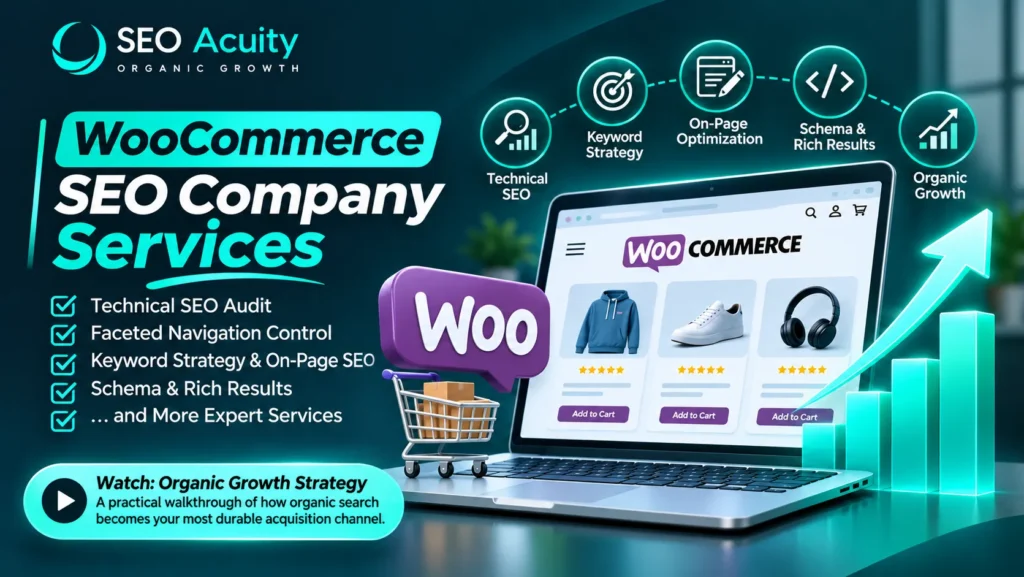
This guide covers the nine core services that represent the full scope of what best SEO for WooCommerce looks like when a specialist handles the engagement from technical foundation through to AI search visibility.
Watch Organic Growth Strategy: and know how organic search compounds into a WooCommerce store’s most reliable, lowest-cost revenue channel.
Watch: Organic Growth Strategy a practical walkthrough of how organic search becomes your most durable acquisition channel.
1. A Platform-Specific Technical Audit Of WooCommerce SEO company
Every serious WooCommerce SEO engagement begins with a technical audit that covers the platform-specific failure points a standard crawl tool report does not surface.
That includes crawlability and indexation across all page types — product pages, category pages, tag archives, attribute archives, filter URL combinations, internal search result pages, and paginated versions of all of the above — alongside an evaluation of the hosting environment, caching layer, and plugin stack’s collective impact on how search engines experience the store.
The types of SEO audits a platform specialist performs — technical, on-page, content, and off-page — feed into a single diagnosis of why rankings are where they are and what sequence of fixes will move them most efficiently.
Why are SEO audits important for a WooCommerce store specifically? Because content and keyword improvements applied to a store with crawl budget problems, duplicate URL structures, or Core Web Vitals failures work against a technical foundation that prevents those improvements from compounding.
2. Faceted Navigation And Crawl Budget Control
Faceted navigation, the size, color, price, and attribute filters shoppers use to browse a WooCommerce store, is one of the most common and costly sources of crawl budget waste in e-commerce. Each filter combination generates a unique URL.
A store with five filter dimensions across several hundred products can produce tens of thousands of indexable pages carrying thin or near-duplicate content, and search engines crawl those pages instead of the category and product pages that earn revenue.
A WooCommerce SEO expert resolves this through a deliberate combination of canonical tags pointing all filter URL variations to their canonical category page, robots.txt rules governing which URL parameter patterns crawlers should ignore, and JavaScript-based filter implementations that do not create separate indexable URLs at all.
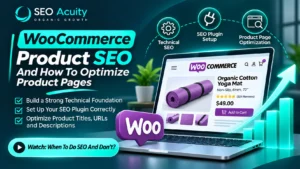
Watch: When To Do SEO And Don’t?

3. Keyword Strategy Built Around Buyer Intent At Every Stage Of The Path To Purchase
A WooCommerce SEO company does not find keywords and add them to pages. It builds a keyword architecture that maps different search queries to the specific page types designed to convert them.
A shopper searching “best trail running shoes for wide feet” is in research mode — that query belongs to a buying guide or comparison article.
A shopper searching “Brooks Cascadia 17 wide men’s size 12” is ready to purchase — that query belongs to a product page with complete specification detail and a clear call to action.
Getting this architecture wrong is more expensive than having no keyword strategy at all. Category pages are the highest-volume commercial opportunity in most WooCommerce stores, targeting broad transactional terms with larger search audiences than any individual product name.
Product pages should be mapped to specific, high-intent queries. Supporting blog content handles the informational and comparison queries that build trust before purchase.
Ready to Improve Your Search Engine Rankings?
Accelerate your organic growth and scale your business leads with our data-driven SEO strategies.
Get a Free Quote NOW!4. On-Page Optimization For Product And Category Pages That Connects Search Intent To Sales
On-page optimization for WooCommerce goes beyond updating title tags and meta descriptions — though most stores get those wrong too.
On-Page SEO Services for a WooCommerce store involve rewriting product descriptions with enough original, buyer-focused content to pass Google’s quality signals (manufacturer copy never does).
Structuring category pages with keyword-rich introductory text that helps the page rank for its target terms, optimizing heading hierarchies across product and category templates, and engineering internal linking between related products and their parent categories.
Category pages deserve particular attention because most WooCommerce stores treat them as organizational folders that auto-populate with product thumbnails.
A specialist treats each category page as a standalone commercial landing page competing for high-volume buyer terms with structured content, curated internal links, and a clear conversion path.
5. Schema Markup And Structured Data That Unlock Rich Results And Ai Visibility
WooCommerce does not implement full product schema automatically. Without structured data configured through a specialist-managed SEO plugin, your product listings appear in search results as plain text links while competitors show star ratings, pricing, stock status, and review counts.
A WooCommerce SEO expert implements Product schema with all required fields — price, availability, SKU, brand, and AggregateRating drawn from actual customer reviews — alongside Breadcrumb schema for site hierarchy, FAQ schema on category and buying guide pages, and Offer schema for variable products with multiple pricing configurations.
They validate this markup in Google’s Rich Results testing tool and monitor Search Console for errors before issues affect rich snippet eligibility. Beyond traditional search results, correctly implemented product schema matters increasingly for AI shopping surfaces.
ChatGPT Shopping, Google AI Overviews, and Perplexity Shop all prioritize structured product data when generating recommendations — stores with clean, complete schema have a measurable advantage in these growing channels.
Watch: How Does AI Search Work?

6. Site Speed And Core Web Vitals
“WooCommerce is slow” is a symptom, not a diagnosis. Meaningful performance work on a WooCommerce store identifies the specific source of the problem before recommending any solution — because different root causes require different fixes, and a caching plugin does not fix a hosting resource problem.
Technical SEO Services that treat performance optimization as a first-class deliverable address each cause independently: hosting resources that cannot handle database queries under traffic load, plugin scripts loading on pages where they serve no purpose, large uncompressed product images served without a CDN, WooCommerce’s cart fragment AJAX requests running on every uncached page.
The benchmark that matters for search ranking and conversion is Largest Contentful Paint under 2.5 seconds, Interaction to Next Paint under 200ms, and Cumulative Layout Shift under 0.1 across real product and category pages — not just the homepage.
WP Rocket or LiteSpeed Cache must be configured specifically for WooCommerce’s dynamic cart and checkout behavior, or caching will break the checkout flow. That WooCommerce-specific configuration is exactly where platform knowledge earns its value.
7. Content Strategy That Builds Topical Authority And Feeds Commercial Pages
WooCommerce’s deep WordPress integration is the clearest structural advantage it holds over every closed e-commerce platform.
The same CMS powering your product catalog can power a content hub that builds topical authority across your entire category, buying guides, comparison articles, care instructions, use-case tutorials, and FAQ content that answers the research questions buyers ask before they are ready to purchase.
A WooCommerce SEO company designs a content strategy where every article is intentionally linked to the category and product pages it is meant to funnel traffic toward.
The blog is not a separate publication — it is a commercial asset that feeds authority and qualified traffic to the store’s revenue-generating pages.
Content built this way earns topical trust from search engines, which lifts the rankings of commercial pages that would otherwise struggle on thin link authority alone.
For WooCommerce stores targeting the GCC and MENA region, Arabic SEO Services extend this content strategy into Arabic-language search where keyword patterns, search intent, and content structure differ meaningfully from English-language optimization.
A WooCommerce store selling into bilingual or Arabic-first markets needs content built specifically for how Arabic speakers search, not English pages pushed through a translation plugin.
8. Link Building And Domain Authority That Actually Reaches The Pages Generating Revenue
WooCommerce stores rarely have a link-building problem — they have a link-distribution problem. Links accumulate at the homepage and blog level, while the category pages and product pages that carry the conversion load sit starved of authority.
It places them where authority compounds on the pages already earning revenue and routes that equity deliberately downward through the store’s hierarchy. The distinction between AI SEO vs traditional SEO carries a direct implication for link strategy: authority signals behave differently across retrieval systems.
AI-driven retrieval assesses authority at the entity level — brands, domains, authors — based on citation patterns, co-occurrence with established sources, and the credibility profile the entity has built across the web over time.
A WooCommerce SEO expert building for both systems targets editorial placements that name the brand explicitly, publications that AI systems treat as credible training-corpus signals, and category-specific authority coverage that associates the domain’s entity with the product niche it needs to own.
Watch :How to Double Your SEO & AI Search Performance with 9 Off-Site Layers

9. AI Search Optimization That Makes Your Woocommerce Store A Source, Not A Footnote
Google AI Overviews, ChatGPT Shopping, Perplexity, and every generative engine entering the market build their answers from sources they assess as credible, entity-clear, and structurally clean enough to cite.
Understanding what is AI SEO is the starting point, but it isn’t the deliverable. The deliverable is a store whose product pages, category pages, and supporting content are structured so AI systems can extract clean, usable answers: a star rating explained in plain prose, a return policy written as a single parseable sentence.
A product comparison structured for retrieval rather than reading flow. Schema markup, content architecture, and entity clarity working together — not any one of them applied in isolation.
Citations in AI responses build brand entity recognition that reinforces traditional ranking signals, reduce dependence on paid search for discovery, and capture buyers during the research phase — before purchase intent has crystallized into a branded query that a competitor’s ad campaign might intercept.
Watch: How to Let Your Store Appear in Google and AI Search Results

Woocommerce Is A Different Beast Platform-Specific Challenges That Generalists Miss
Every SEO platform has its own technical surface area. WooCommerce’s is unusually wide.
Its open architecture, the same characteristic that makes it the most flexible e-commerce platform on the market, also means that every configuration decision a store owner or developer makes creates SEO implications that weren’t on the checklist when that decision was made.
Generalist SEO agencies apply frameworks built for simpler systems and then troubleshoot backwards when results don’t materialize.
The three most common platform-specific failure modes are taxonomy architecture, plugin-stack compatibility with WooCommerce’s modern infrastructure, and variable product URL management.
Ready to Improve Your Search Engine Rankings?
Accelerate your organic growth and scale your business leads with our data-driven SEO strategies.
Get a Free Quote NOW!A. Letting Product Taxonomy Run Without Governance Turns Woocommerce’s Flexibility Into A Crawlability Disaster
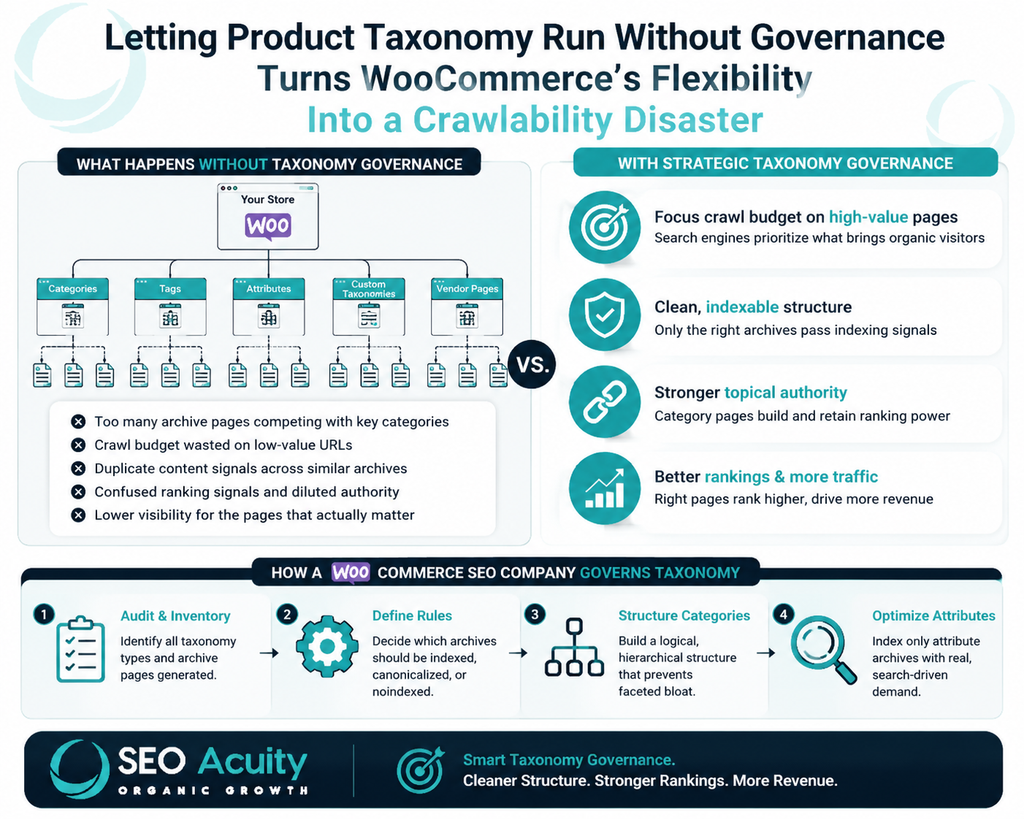
WooCommerce’s taxonomy system hands store owners substantial control: product categories, tags, attribute archives, custom taxonomies added by plugins, and vendor pages in marketplace configurations. Left unmanaged, that control becomes a structural problem.
Each taxonomy generates archive pages that compete directly with the category pages you want ranked, dilute crawl budget across URLs that serve no organic visitor, and create duplicate-content signals that confuse every ranking signal the store has built.
A WooCommerce SEO company establishes taxonomy governance before the content work starts:
- Defining which archive types pass indexing signals and which are canonicalized or no indexed.
- Setting rules for how categories are structured so faceted navigation doesn’t fork into hundreds of low-value URL variations.
- Auditing attribute archives to determine which carry enough unique search demand to justify indexation.
This is structural work that a platform-agnostic agency will either miss entirely or apply the wrong framework to — borrowing rigid logic from platforms where the taxonomy system is fixed and non-negotiable.
B. Hpos Compatibility Exposes A Plugin Stack That Quietly Undermines Your Store’s Crawlability
High-Performance Order Storage (HPOS) is WooCommerce’s modern order management architecture, decoupling order data from WordPress custom post types and moving it into dedicated database tables.
It is a meaningful infrastructure improvement but it introduces compatibility requirements that affect how SEO plugins, caching layers, and performance tools interact with the store’s data layer.
A WooCommerce SEO expert auditing a store that hasn’t validated HPOS compatibility across its plugin stack finds stores running in degraded modes, plugins silently falling back to legacy storage, and performance bottlenecks that only surface under transactional load.
The crawl-budget implications appear when caching plugins configured for the old data architecture produce stale or duplicate versions of checkout and account pages — pages that should never be indexed in the first place but become indexable when the cache configuration breaks under the new architecture.
Plugin stack governance is not a separate discipline from WooCommerce SEO, it is part of it. Every plugin added to a WooCommerce store touches the same WordPress event system, the same database, and the same front-end rendering stack.
C. Variable Products Without Canonical Tag Management Create A Duplicate-Content Problem
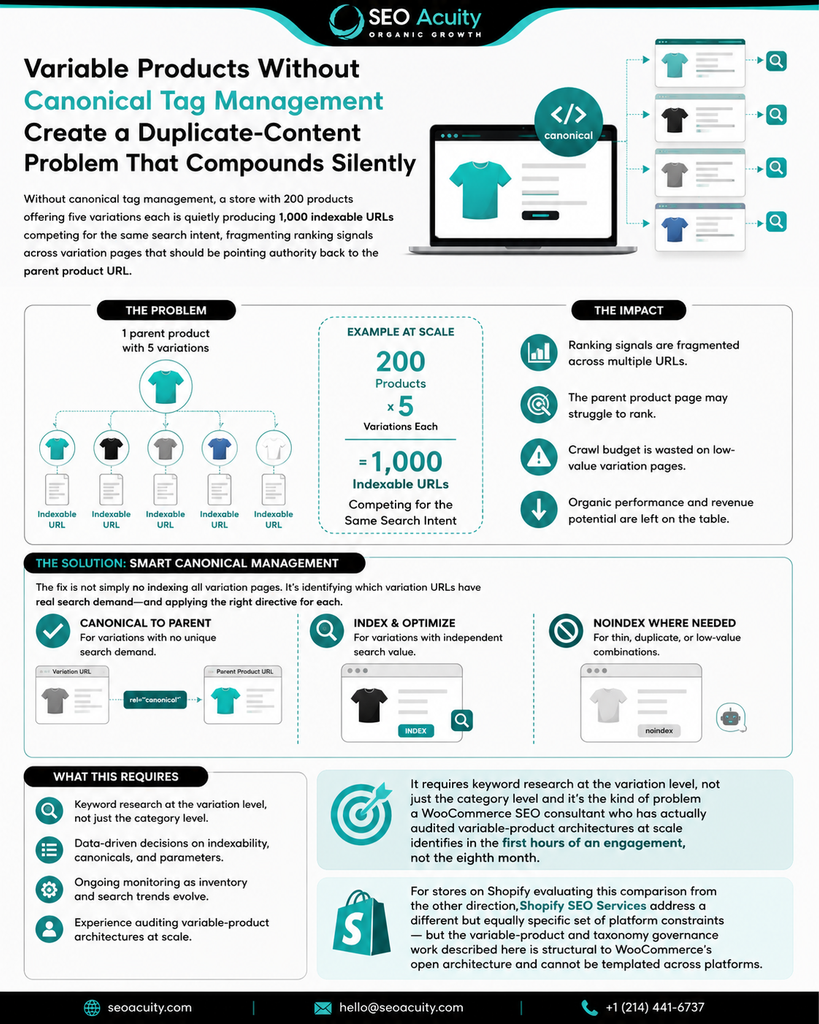
Without canonical tag management, a store with 200 products offering five variations each is quietly producing 1,000 indexable URLs competing for the same search intent, fragmenting ranking signals across variation pages that should be pointing authority back to the parent product URL.
The fix is not simply no indexing all variation pages. Some variation combinations carry their own independent search demand — a specific color-and-size combination searched by name deserves an indexable page built for that query.
It requires keyword research at the variation level, not just the category level and it’s the kind of problem a WooCommerce SEO consultant who has actually audited variable-product architectures at scale identifies in the first hours of an engagement, not the eighth month.
For stores on Shopify evaluating this comparison from the other direction, Shopify SEO Services address a different but equally specific set of platform constraints — but the variable-product and taxonomy governance work described here is structural to WooCommerce’s open architecture and cannot be templated across platforms.
Hiring A Woocommerce SEO Expert
A thorough guide on how to hire an SEO expert covers the general evaluation framework — what to ask about process, deliverables, and reporting cadence. WooCommerce adds a platform-specific layer to that evaluation. Ask any candidate to walk you through their approach to crawl budget on a large WooCommerce store.
Ask how they’d handle faceted navigation without relying solely on third-party crawl management plugins.
Ask what they’d examine first on a store whose organic traffic dropped after a major WooCommerce version update. The answers reveal quickly whether you’re talking to someone who knows the platform or someone who has memorized generic SEO frameworks and applied them broadly.
Store size and growth stage shape the conversation differently. For early-stage stores or small business SEO situations, the priority is getting architecture right before scaling content or link-building — a relatively focused engagement that resolves structural problems first and builds on solid ground.
For stores already generating meaningful organic revenue, the risk calculation reverses: the cost of getting WooCommerce SEO wrong is measured in suppressed compounding returns across the entire organic channel, not just one failed campaign.
Ready to Improve Your Search Engine Rankings?
Accelerate your organic growth and scale your business leads with our data-driven SEO strategies.
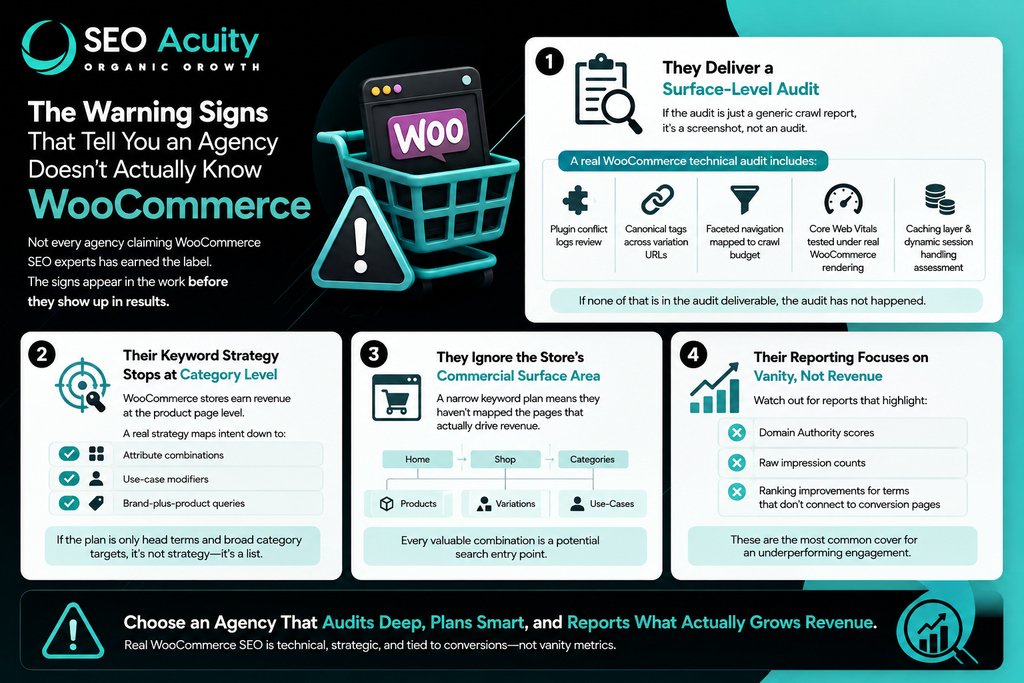
Get a Free Quote NOW!The Warning Signs That Tell You An Agency Doesn’t Actually Know Woocommerce
Not every agency claiming WooCommerce SEO experts has earned the label. The signs appear in the work before they show up in results. An agency that opens a WooCommerce engagement with a generic crawl report and stops there has screenshotted the store, not audited it.
A real WooCommerce technical audit checks plugin conflict logs, validates canonical tag behavior across variation URLs, maps faceted navigation parameters against crawl budget consumption, tests Core Web Vitals under WooCommerce’s actual rendering path rather than the homepage in isolation, and assesses how the caching layer interacts with WooCommerce’s dynamic session handling.
An agency presenting a keyword plan composed entirely of head terms and broad category targets hasn’t mapped the store’s actual commercial surface area — it has listed the most obvious terms and called it strategy. Reporting on domain authority scores, raw impression counts, and ranking improvements for terms that don’t connect to conversion pages is the most common cover for an underperforming engagement.
Why Does SEO Acuity Approach WooCommerce SEO Differently?
SEO Acuity is an Organic Growth Architecture firm — not a rank-chasing agency, a link-building shop, or a content mill.
The work is building organic systems that compound: resolving technical problems at the root rather than the symptom, constructing content architectures that own the full buyer journey, and positioning every client’s store as an entity AI systems recognize, trust, and cite.
WooCommerce is a platform SEO Acuity works with at depth, across English-language and Arabic-language markets, including stores operating across the GCC and MENA region where search behavior, keyword patterns, and content structure differ substantially from Western-market norms.
For stores entering or expanding within the GCC, GCC Market Expansion SEO™ covers the platform-specific, language-specific, and market-specific architecture required to build search presence in Arabic-language and bilingual markets — not translation or keyword-for-keyword adaptation, but an organic infrastructure built for how GCC audiences actually search and buy.
For stores earlier in their organic growth trajectory that need to build a defensible foundation before scaling, the Organic Growth Foundation™ establishes the technical, content, and authority infrastructure that makes every subsequent investment — in content, links, or paid acquisition — more effective.
Book your consultation session now

Conclusion
WooCommerce’s open architecture is the reason it gives stores capabilities no closed platform can match — and the reason its SEO problems are harder than anything a platform-agnostic agency is equipped to solve.
The stores building compounding organic revenue on WooCommerce treat SEO as an architectural decision made at the platform level, not a marketing tactic layered on afterward.
Resolving technical problems at the root, building content that follows buyers across the full journey from research to purchase, and structuring every page for retrieval by both traditional ranking systems and the AI engines actively reshaping how buyers discover and evaluate products.
WooCommerce stores that build for both systems create organic assets that pay returns across every future algorithm change, because the underlying signal is always the same: a store that clearly, accurately, and authoritatively answers the questions buyers are actually asking is one that every search system, traditional or AI-driven, is designed to surface.
Frequently Asked Questions
What does a WooCommerce SEO company do that a regular digital agency doesn’t?
A WooCommerce SEO company brings platform-specific technical knowledge that a generalist agency doesn’t carry. The scope includes auditing faceted navigation for crawl-budget impact, managing taxonomy archives, handling canonical tags across variable product URLs, resolving plugin conflicts affecting crawlability, and configuring caching layers in a way that accounts for WooCommerce’s dynamic session behavior.
How much does WooCommerce SEO cost?
Pricing varies by store size, competitive landscape, and engagement scope. Foundational engagements for stores building organic infrastructure typically begin in the range of several thousand dollars per month for combined technical, content, and authority work. Larger stores with complex architectures, cross-market requirements, or significant technical debt require proportionally greater investment.
Can I handle WooCommerce SEO myself with some technical WordPress knowledge?
Yes, to a meaningful point. Store owners with WordPress familiarity can implement on-page basics, configure a reputable SEO plugin such as Rank Math, and publish category-level content.
The platform-specific work, crawl budget management, canonical strategy for variable products, Core Web Vitals remediation under WooCommerce’s rendering path, schema markup across a large product catalog, requires technical depth beyond general WordPress knowledge.
Is WooCommerce or Shopify better for SEO?
WooCommerce offers more control and flexibility; Shopify offers a more constrained but technically consistent environment. WooCommerce allows complete control over URL structure, canonical handling, schema implementation, and server configuration but that control requires active management to prevent the self-inflicted technical problems described throughout this article. Shopify’s closed architecture removes some of those management burdens while limiting customization depth.
How do I know if my WooCommerce SEO engagement is working?
Organic traffic growth to commercial pages is a signal; organic revenue attribution is the measure. Tracking sessions by landing page, comparing organic-attributed conversions before and after major SEO work, and monitoring keyword rankings for commercial-intent terms across category and product pages gives a layered picture.
What is the difference between a WooCommerce SEO agency and a WooCommerce SEO consultant?
An agency provides a team-based engagement typically a technical SEO specialist, a content strategist, and an account manager working on the store collaboratively. A consultant is usually a senior practitioner handling the work directly, often at a higher hourly rate but with more hands-on attention from the most experienced person in the room.