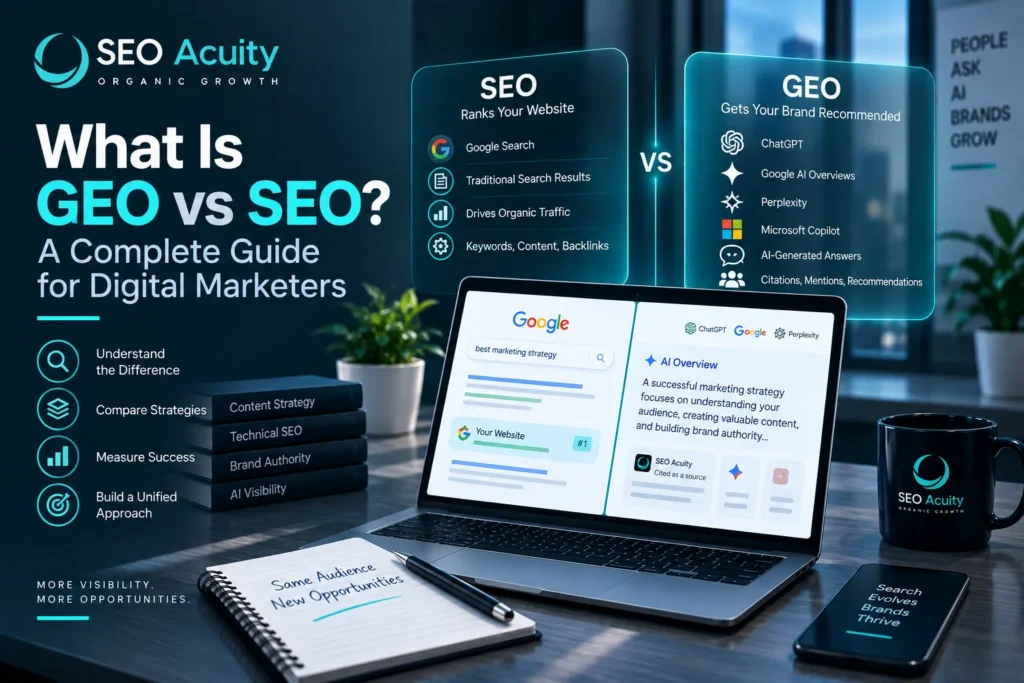
Search is changing faster than most marketing teams can adapt. Just three years ago, a well-executed SEO strategy gave you full coverage of the search landscape. Rank on page one of Google, and you’d reached your audience.
Today, that’s no longer true.
Your potential customers aren’t just using Google. They’re asking ChatGPT for product recommendations, using Perplexity to research vendors, and getting summarized answers from Google AI Overviews before they ever click a link. The search journey has fractured across traditional engines and generative AI tools — and each environment has its own set of rules.
That’s the heart of the GEO vs SEO conversation.
Search engine optimization (SEO) is the practice of improving your website so it ranks higher in traditional search engine results pages (SERPs) and drives organic, unpaid traffic to your site. It’s been the foundation of digital marketing for more than 20 years.
Generative engine optimization (GEO) is the newer discipline of optimizing your content so that AI-powered tools — ChatGPT, Perplexity, Google AI Overviews, Microsoft Copilot — cite, quote, or recommend your brand in their generated answers.
The distinction matters more than many marketers realize. SEO gets your content listed in search results. GEO gets your content actively recommended to the people asking AI tools for advice.
In this guide, you’ll get a thorough breakdown of what is GEO vs SEO, where the two strategies overlap and diverge, how success is measured in each environment, and how to build an integrated approach that works for both — including specific guidance for local businesses and ecommerce brands.
What Is SEO (Search Engine Optimization)?
Search engine optimization is the discipline of improving a website’s visibility in organic (unpaid) search engine results. The goal is simple: when your target audience searches for topics related to your business, your pages should appear at or near the top of Google’s — and Bing’s — results.
SEO is built on three interconnected pillars:
1. Technical SEO — The Foundation
Technical SEO ensures that search engine crawlers can find, access, and index your content without obstacles. Key areas of focus include:
- Site architecture and internal linking structure.
- Page speed and Core Web Vitals (LCP, INP, CLS).
- Mobile responsiveness and usability.
- XML sitemaps and robots.txt configuration.
- Canonical tags and duplicate content management.
- Structured data markup.
- Crawl budget optimization.
A technically sound site is the prerequisite for everything else in SEO — even the best content will struggle to rank if crawlers can’t access it efficiently.
Watch: The 8 Most Common Technical Mistakes”
2. On-Page SEO — Relevance Signals
On-page SEO signals to search engines what each page is about and why it deserves to rank. This covers:
- Keyword research and strategic placement in H1s, H2s, title tags, meta descriptions, alt text, and body copy.
- Internal linking to establish content hierarchies and topical clusters.
- Content depth and comprehensiveness relative to competing pages.
- Readability, structure, and user experience within the page.
- Semantic keyword coverage and LSI (Latent Semantic Indexing) terms.
On-page SEO is where most content teams spend the majority of their time — and where the visible difference between a page that ranks and one that doesn’t is most apparent.
3. Off-Page SEO — Authority Building
Off-page SEO builds the authority signals that tell Google your site is trustworthy and worth recommending. Key components include:
- Backlinks — links from authoritative, relevant domains that pass “link equity” and elevate rankings.
- Brand mentions — cited references even without a hyperlink, which Google increasingly recognizes as authority signals.
- Digital PR — editorial coverage in publications that drives both links and brand trust.
- E-E-A-T signals — Expertise, Experience, Authoritativeness, and Trustworthiness demonstrated across content and author profiles.
SEO has been the backbone of digital marketing for over two decades. Its signals are well-documented, its tools are powerful — Google Search Console, GA4, Semrush, Ahrefs, Screaming Frog — and its KPIs are well-understood and easily benchmarked.
What makes SEO increasingly insufficient on its own is that it only covers one part of how people now find information.
Ready to Dominate Search Engine Rankings?
Accelerate your organic growth and scale your business leads with our data-driven SEO strategies.
Get a Free Quote NOW!What Is GEO (Generative Engine Optimization)?
Generative engine optimization is the practice of optimizing your content so that large language models (LLMs) and AI-powered search tools cite, summarize, or reference your brand in their generated answers.
Where SEO asks: how do I rank higher in Google? GEO asks: how do I become the source AI tools recommend when users ask questions in my category?
The generative engines you’re optimizing for include:
- ChatGPT (OpenAI) — the world’s most-used AI assistant, with over 2.5 billion daily queries.
- Perplexity AI — an AI search engine built specifically around citation-driven answers.
- Google AI Overviews and AI Mode — Google’s AI-generated summary layer, now appearing in 58% of all search results
- Microsoft Copilot — integrated across Bing, Edge, and Microsoft 365.
- Claude (Anthropic) — widely used for research and content tasks.
- Gemini — Google’s underlying LLM powering AI Overviews and AI Mode.
When a user asks one of these tools “what’s the best email marketing platform for a small e-commerce store?” they don’t get a list of blue links — they get a synthesized recommendation. If your brand is named, that’s GEO working for you.
Understanding what is LLM SEO is at the core of mastering GEO, because generative engines are fundamentally powered by large language models that evaluate content differently from traditional crawlers.
GEO optimization requires thinking about content differently than traditional SEO. Instead of optimizing around keyword placement and backlink acquisition, GEO focuses on making your content maximally citable, trustworthy, and extractable. In practice, this means applying the following five principles:
1. Write for Questions, Not Just Keywords
AI tools are built to answer natural-language prompts, not match keyword strings. Your content should directly answer the specific questions your audience is most likely to ask — written in the same conversational register those questions use.
If someone asks Perplexity “how do I choose between an agency and in-house SEO?” your content should answer that question clearly and completely, not just mention “SEO” and “agency” in proximity.
2. Structure Content for Extraction
AI crawlers are selective — they look for discrete, quotable facts and direct answers. Use FAQ sections, numbered lists, comparison tables, definition boxes, and summary callouts.
These formats make your content easy for an LLM to extract, quote, and attribute. A vague, narrative-heavy paragraph is hard to cite. A clean Q&A or data table can be pulled directly.
3. Build Fact Density
Specific, verifiable facts, statistics, named entities, and precise claims are GEO gold.
AI models prefer content rich with concrete information they can ground their answers in, over general statements that could have come from anywhere.
4. Earn Cross-Web Mentions
LLMs evaluate your credibility not only from your website but from what other sources say about you — mentions in trade publications, forum discussions, review platforms, Wikidata entries, LinkedIn profiles, and Crunchbase listings all feed into how AI systems assess your authority.
5. Maintain Freshness
Unlike SEO, where well-optimized evergreen content can stay ranked for years, GEO requires ongoing updates.
LLMs weight recency heavily, and outdated information risks being deprioritized or contradicted by more current sources.
The clearest GEO vs SEO distinction: SEO competes for position in a ranked list. GEO competes to become the answer itself.
What Is Generative Engine Optimization GEO vs SEO? Why the Distinction Matters in 2026
The rise of GEO isn’t a future scenario — it’s the current reality of search. The data tells a stark story.
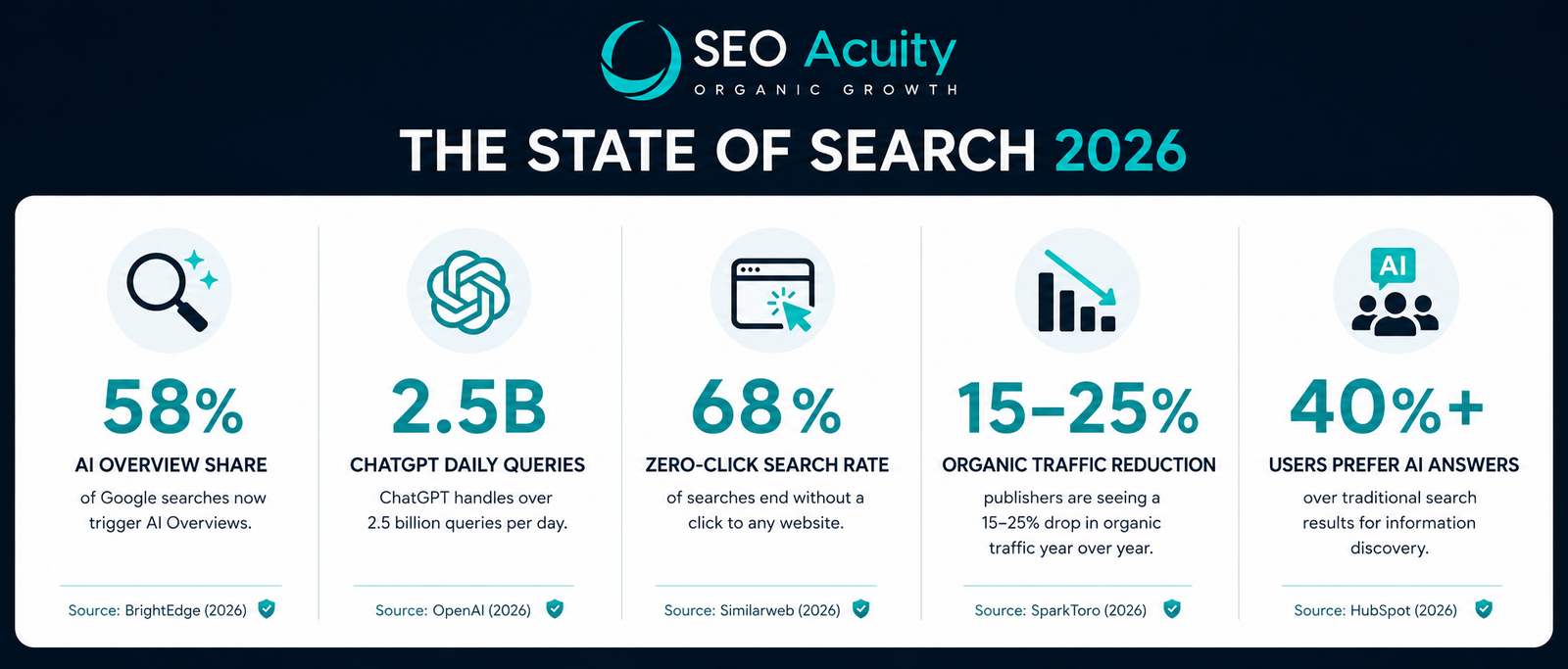
Key data points every digital marketer needs to know:
- 13.14% of all queries triggered Google AI Overviews as of March 2025, nearly double the 6.49% rate recorded in January 2025 — a doubling in just two months (Semrush study of 10M+ keywords).
- 58% of all Google search results now include an AI Overview
- ChatGPT processes over 2.5 billion queries per day.
- Google’s AI Mode has surpassed 1 billion monthly active users
- 80% of consumers now rely on AI-written results for at least 40% of their searches, reducing organic web traffic by an estimated 15–25% (Bain & Company / Dynata).
- More than 40% of users now prefer AI-generated recommendations over traditional search results (AIMonitor).
- 68% of Google searches ended without a click in 2026.
The implication for digital marketers is clear. As Forrester analyst John Werner put it: “If your business isn’t appearing in AI-generated answers, potential customers may never discover you — even if you rank well in traditional search results.”
A brand that ranks #1 on Google for a category term but never appears in AI Overviews or ChatGPT recommendations is invisible to an increasingly large portion of its potential audience.
Zero-click searches are at historic highs — AI-generated summaries at the top of results give users what they need before they ever scroll to organic listings.
None of this means traditional SEO is obsolete. But it does mean that SEO-only strategies leave a significant and growing portion of search visibility on the table. The brands that understand what is GEO vs SEO — and invest in both — are the ones best positioned for the next phase of digital marketing.
To understand the benefits of generative engine optimization for businesses in depth, and how brands are measuring the ROI of AI search visibility, see our dedicated guide.
Generative Engine Optimization GEO vs Traditional SEO: Underlying Technology
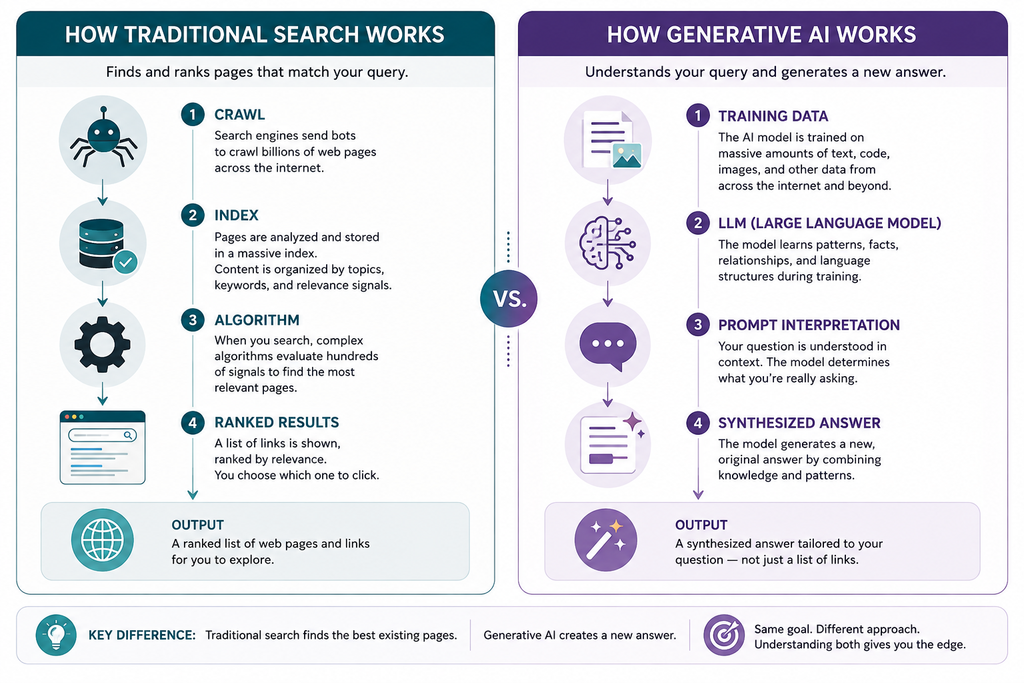
To understand why GEO and SEO require fundamentally different strategies, you need to understand the different technologies behind them. The two channels don’t just deliver content differently — they process and evaluate it differently at the machine level.
1. How Traditional Search Engines Work
Traditional search is built on a three-stage process: crawling, indexing, and ranking.
- Crawling: Google’s bots (Googlebot) systematically traverse the web, following links from page to page and downloading content for analysis. When Googlebot visits your site, it maps everything — your homepage, product pages, blog posts, internal links, image alt text, and structured data.
- Indexing: Crawled pages are processed and stored in Google’s index, organized by topic, entity, and semantic meaning. Pages that are crawlable, readable, and meet quality thresholds get indexed. Pages behind JavaScript walls, with poor technical foundations, or flagged as low-quality may be partially indexed or excluded.
- Ranking: When a user searches a query, Google’s algorithm retrieves relevant indexed pages and ranks them using hundreds of signals — keyword relevance, backlink authority, page speed, mobile usability, Core Web Vitals, content quality, and user engagement metrics (CTR, dwell time).
The results are largely deterministic — the same search tends to produce the same ranked list, making position tracking a reliable performance indicator.
Traditional search is built on the web as a graph of documents connected by links. Authority flows through that graph via backlinks, and relevance is determined by keyword matching combined with semantic understanding.
2. How Generative AI Engines Work
Generative AI tools are built on an entirely different foundation — one that evaluates content not by where it ranks, but by how trustworthy and extractable it is.
- Large language models (LLMs) — such as GPT-4, Gemini, Claude, and Llama — are neural networks trained on massive datasets from books, academic papers, web pages, forums, and code repositories. Through training, they develop a statistical model of language and knowledge: they learn how concepts relate, how questions are typically answered, and which sources are cited for which topics.
- Intent-based generation: Instead of matching keywords to indexed documents, LLMs interpret the intent behind a question and generate a synthesized answer by predicting the most probable and helpful response. This is the key architectural difference: traditional search retrieves; generative AI generates.
- Selective AI crawling: While Googlebot tries to index everything, AI training crawlers are selective — they extract specific facts, entity relationships, structured passages, and citable data points. They’re not building a map of your site; they’re harvesting quotable information for future AI responses.
- Retrieval-augmented generation (RAG): Tools like Perplexity and Google AI Overviews use RAG to supplement LLM knowledge with live web results — which is why good traditional SEO ranking contributes to GEO visibility, particularly for Google AI Overviews.
- Non-determinism: Unlike Google, which tends to give the same ranked list for the same query, AI tools generate unique responses based on how the prompt is phrased, the user’s context and history, and the model’s internal variability. Two people asking the same question may receive meaningfully different answers.
This means the landscape shifts constantly — content that was cited last month may need updating to remain visible today. To understand what is AI SEO and how these technical differences shape your optimization approach, see our dedicated overview.
Generative Engine Optimization GEO vs Traditional SEO – Key Differences
The differences between GEO and SEO run deep — touching strategy, content creation, authority signals, and measurement. The following table gives you a comprehensive side-by-side view of how the two approaches differ across every major dimension. After the table, we unpack the three most strategically important differences in detail.
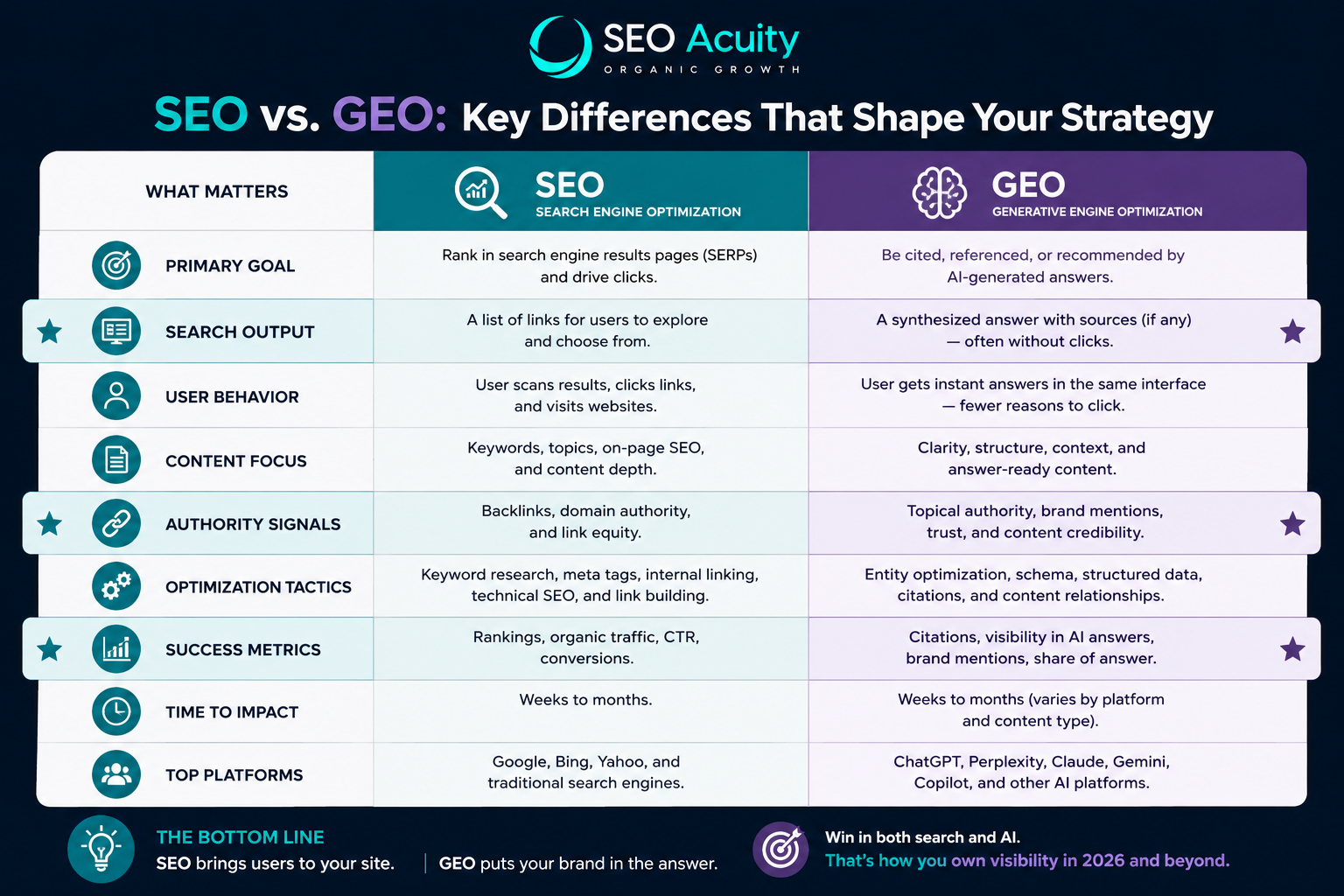
The table below summarizes where traditional SEO and generative engine optimization align and diverge across every key dimension:
| Category | Traditional SEO | Generative Engine Optimization (GEO) |
| Target platform | Google, Bing, Yahoo | ChatGPT, Perplexity, Google AI Overviews, Copilot, Gemini |
| Search output | Ranked list of clickable links | Single synthesized AI-generated answer |
| Query format | Short, keyword-based (2–5 words avg.) | Longer, conversational prompts (23+ words avg.) |
| Optimization target | Higher position in SERPs | Citation and inclusion in AI-generated responses |
| Content delivery | User clicks through to your site | AI quotes, summarizes, or paraphrases your content |
| Traffic model | Direct clicks from rankings | Indirect discovery; brand awareness; fewer direct clicks |
| Authority signals | Backlinks, domain authority, page freshness | Fact-density, entity presence, structured data, cross-web mentions |
| Content strategy | Keyword-targeted articles, landing pages | Query fan-out coverage; question-answer structure; fact-rich passages |
| Success metrics | Traffic, rankings, CTR, bounce rate | Citations, AI share of voice, brand mentions, branded search growth |
| Content lifespan | Evergreen content can rank for years | Must stay current and accurate to remain cited |
| Measurement maturity | Mature — GA4, GSC, Semrush, Ahrefs | Emerging — AI visibility tools, citation monitoring |
| Ranking logic | Algorithmic, deterministic | Generative, non-deterministic |
| User journey | Click → visit → convert | Discover via AI → brand search → visit → convert |
1. Input Signals — SEO Keywords vs. GEO Prompts
This is where the day-to-day work of SEO and GEO diverges most practically.
SEO keyword strategy centers on search volume, keyword difficulty, and SERP competition. You identify which phrases your audience types into search bars, then optimize pages to match those phrases in specific positions. Exact-match placement in H1s, title tags, meta descriptions, and early body paragraphs signals relevance to crawlers.
GEO prompt strategy differs in three important ways:
- Queries are longer — averaging 23 words, and sometimes much longer in complex research contexts.
- They’re phrased conversationally (“what should I look for in an SEO agency if I run a SaaS product?”), not as keyword strings.
- Because AI systems understand semantic intent rather than matching strings, the same underlying question can be phrased dozens of ways and still trigger the same content.
This means GEO content strategy should be built around answering the questions your audience asks — not the keywords they type.
Think about the full decision-making process: what does your audience ask early in their research? What comparison questions do they ask mid-funnel? What objection-handling questions come up just before a decision?
Query fan-outs add another layer. When a user asks ChatGPT a question, the AI internally generates a set of sub-queries to help build its answer.
A question like “what’s the best SEO strategy for a local restaurant?” might generate sub-queries covering keyword research tools, local pack optimization, review management, and restaurant schema markup. If your content addresses those adjacent topics, you’re more likely to be drawn into the fan-out and cited in the final answer.
2. Ranking Logic — Algorithmic vs. Generative
In traditional SEO, ranking is the product of an algorithm evaluating your page against hundreds of signals and producing a stable, trackable position on a ranked list. Improve your content quality, earn more relevant backlinks, fix technical issues — and your rankings move.
In GEO, there’s no “ranking” in the traditional sense. LLMs generate answers by selecting, synthesizing, and sometimes citing the sources most likely to produce a useful, accurate, and trustworthy response. Whether your content gets cited in a given answer depends on:
- Fact-density — how many specific, verifiable claims your content makes.
- Context-independence — whether excerpts from your content make sense when quoted without the surrounding article.
- Cross-web corroboration — whether other sources mention or link to your brand in connection with the topic.
- Recency — whether your content is current enough to be trustworthy.
- Structural extractability — whether your content is formatted so AI can pull and use specific passages.
Because different AI platforms use different training data, retrieval mechanisms, and generation approaches, the same content can perform very differently across ChatGPT, Perplexity, Google AI Overviews, and Gemini.
This is why SEO vs AI visibility is a distinct and important topic that requires ongoing monitoring — not a single optimization pass.
3. Content Strategy — Keyword Targeting vs. Query Fan-Out Coverage
In SEO, content strategy is a demand-capture exercise. You map keyword volume, identify competitive gaps, and build pages that rank for queries where demand already exists. The central question is: where is search volume?
In GEO, content strategy is a demand-shaping exercise. You map the questions your target audience asks at every stage of their decision-making journey — including early-stage questions that have low search volume but high influence on outcomes. The central question is: what does my audience need to know before they decide?
This distinction has profound strategic implications:
- First-party data becomes essential for GEO strategy in a way it never was for SEO.
- CRM records, customer support logs, and win/loss analysis feed GEO content planning in ways keyword tools cannot.
- GEO content is evaluated on its influence over buying decisions, not just its ability to attract clicks.
GEO vs SEO – Where the Two Strategies Overlap
Despite their differences, SEO and GEO share a bedrock principle: high-quality, well-structured, authoritative content performs better in both environments. If you’re already doing SEO well, you’re building the foundation for GEO.
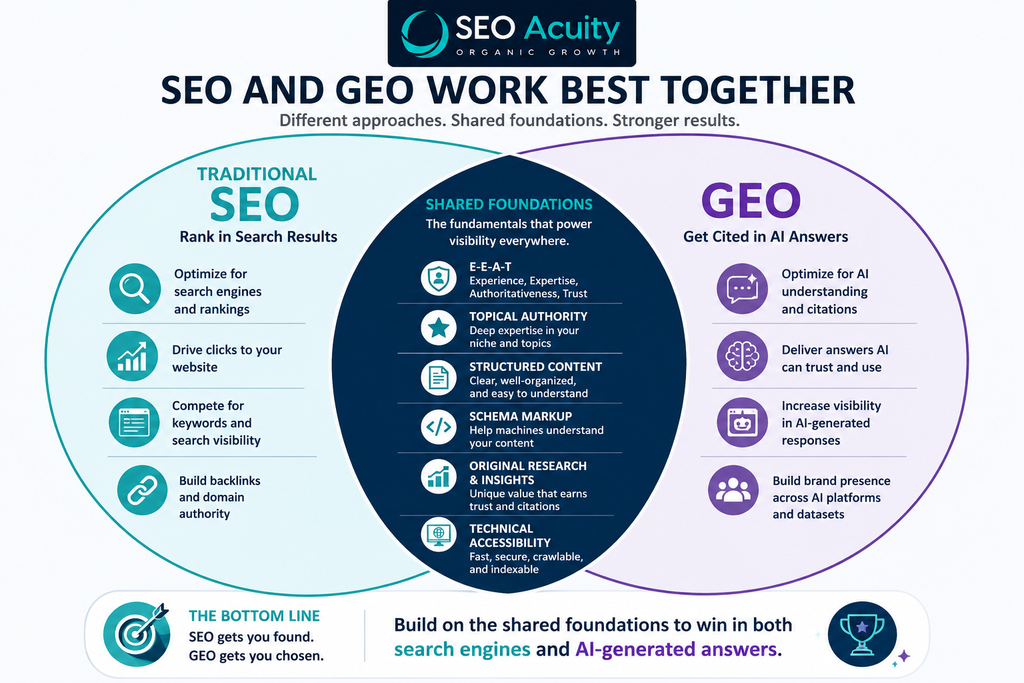
Here is where the overlap is most significant:
- E-E-A-T is fundamental to both. Google’s framework of Expertise, Experience, Authoritativeness, and Trustworthiness maps almost perfectly onto what LLMs assess when deciding whether to cite a source. A page that demonstrates genuine subject-matter expertise, backs claims with specific evidence, and shows evidence of the author’s real-world experience performs better in both environments.
- Topical authority matters in both. Both search algorithms and AI models reward sites that build deep, comprehensive coverage of a topic. Content clusters — a pillar page supported by detailed subtopic articles — are one of the most powerful investments for both GEO and SEO simultaneously.
- Structured content outperforms unstructured content. Clear heading hierarchies, bullet points, FAQs, comparison tables, and definition boxes improve performance in both. Search engines use structure for featured snippets; AI crawlers use structure as a roadmap for extraction.
- Schema markup benefits both. Implement it once; it works for both channels. FAQ schema, Article schema, and Product schema help search bots and AI crawlers alike understand what type of content they’re looking at.
- Original research is a multiplier. Unique data attracts backlinks for SEO while becoming highly citable material for GEO. If you’re the original source of the data, you become the citation.
- Technical accessibility is the prerequisite. A page that can’t be crawled by search engines can’t be crawled by AI systems either. Fast-loading, mobile-responsive, technically clean sites are the baseline for both strategies.
The practical implication: don’t treat GEO as a parallel workstream. Audit your existing SEO content for GEO readiness first — many enhancements (adding FAQ sections, improving heading structure, enriching fact density) will improve both channels simultaneously.
KPIs for GEO vs SEO – How to Measure Success in Both Environments
One of the most consequential practical differences between GEO and traditional SEO is the measurement framework. The KPIs that tell you how SEO is performing are well-established, tool-supported, and readily benchmarked. GEO measurement is newer, harder, and still evolving — but no less important.
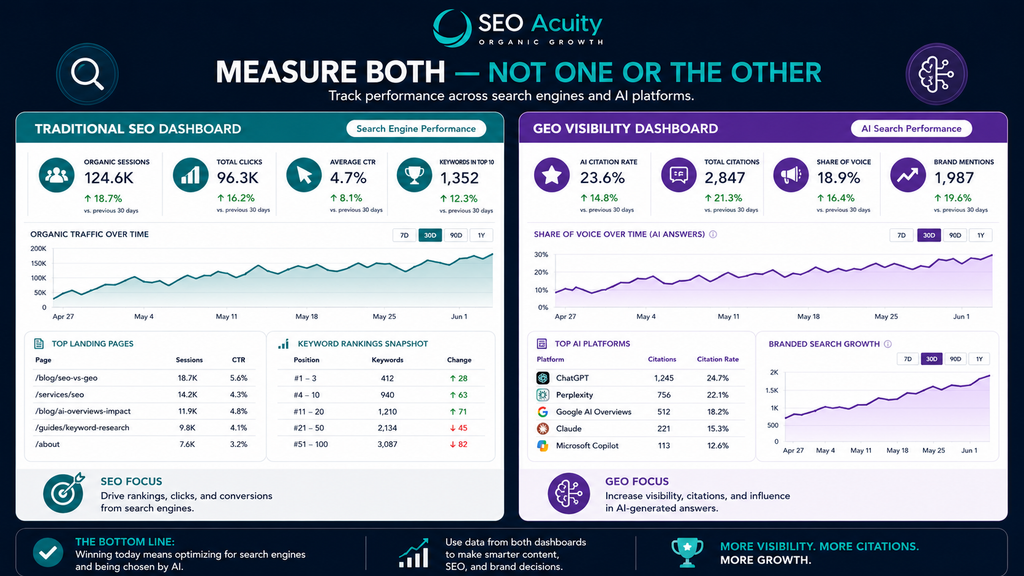
1. Traditional SEO KPIs
The following are the core metrics used to measure SEO performance across visibility, engagement, and conversion:
Visibility metrics:
- Organic traffic — total sessions driven by unpaid search results; the primary SEO growth indicator.
- Keyword rankings — average position for target queries; tracked at keyword and cluster level.
- Organic impressions — how often your pages appear in SERPs, even without a click (from Google Search Console).
- Share of voice — your brand’s percentage of total organic visibility for target keywords vs. competitors.
Engagement metrics:
- Click-through rate (CTR) — percentage of impressions that generate a click; indicates title tag and meta description effectiveness.
- Bounce rate and session duration — indicators of whether your content matches searcher intent.
- Pages per session — measures content depth and internal linking effectiveness.
Conversion metrics:
- Conversions from organic — leads, purchases, sign-ups, or other actions driven by SEO traffic.
- Revenue attribution — business value directly tied to organic search.
- Assisted conversions — SEO’s role in multi-touch attribution models.
Authority metrics:
- Backlink profile growth — quantity and quality of inbound links.
- Domain authority / domain rating — third-party estimates of overall site authority.
- E-E-A-T signals — author credentials, trust indicators, and expertise demonstrations.
2. GEO KPIs — Measuring AI Search Visibility
GEO measurement requires a different mental model. Because AI-driven discovery often doesn’t produce direct clicks, and because AI answers aren’t indexed or tracked by standard analytics tools, you’re measuring influence rather than traffic.
AI visibility metrics:
- AI Visibility Rate (AIGVR) — how frequently your pages or brand appear in AI-generated responses for your target queries.
- Citation rate — how often AI systems explicitly quote or link to your content.
- AI share of voice — your brand’s presence in AI answers relative to competitors for your category’s key questions.
- Platform-specific visibility — your citation rate in Google AI Overviews vs. ChatGPT vs. Perplexity may differ significantly; track them separately.
Content performance metrics:
- Content Extraction Rate (CER) — how frequently AI systems pull specific passages, facts, tables, or lists from your content.
- Passage-level visibility — which specific sections (FAQs, definitions, data tables) are being cited.
- Query fan-out coverage — the breadth of adjacent topics and sub-questions where your content appears.
Downstream indicators (the “invisible attribution” signals):
- Branded search volume growth — the most reliable proxy for AI-driven brand discovery; when AI mentions your brand and users search it directly, branded search rises.
- Direct traffic trends — users who hear about you via AI may navigate directly without a referrer.
- Conversion rate changes — AI-driven visitors tend to be more qualified; a rising conversion rate alongside stable or falling traffic may indicate GEO influence.
- New vs. returning visitor ratio — a rising proportion of new visitors who convert at high rates can indicate quality AI-driven discovery.
Enterprise attribution metrics:
- Conversation-to-conversion rate — tracking AI-influenced interactions through to measurable business outcomes.
- AI-Driven Conversion Lift — incremental revenue attributed to AI brand citations, measured through controlled analysis.
- First-party data correlation — connecting CRM pipeline data with AI visibility reports to identify which cited content drove which outcomes.
For enterprise teams investing in LLM SEO services, building dedicated attribution infrastructure is essential — cross-channel data lakes, custom attribution models, and BI dashboards that translate AI citation data into accountable business impact.
3. The Attribution Challenge — and How to Navigate It
The most frustrating aspect of measuring GEO vs SEO is what practitioners call “invisible attribution.” The journey from AI recommendation to customer typically looks like this:
- User asks ChatGPT: “What’s the best SEO agency for a mid-sized SaaS company?”.
- ChatGPT mentions SEO Acuity alongside two competitors
- User closes ChatGPT, opens Google, and searches “SEO Acuity reviews”.
- User visits the SEO Acuity website via that branded search
- Analytics records the session as branded organic search — not AI-driven.
This invisibility means GEO’s impact is structurally underreported in standard analytics. Compensating for this requires triangulating multiple signals:
- Track branded search volume over time and note when it spikes relative to AI visibility changes.
- Monitor conversion rate trends — rising conversions alongside flat or falling traffic often signals AI-driven quality improvement.
- Use dedicated AI visibility platforms to correlate citation activity with downstream business metrics.
- Build first-party data connections between CRM pipeline events and AI visibility reports.
Enterprise organizations typically build dedicated attribution infrastructure to translate AI citation data into accountable business impact. Without this infrastructure, GEO risks being perceived as a brand-awareness activity rather than a revenue driver.
Ready to Dominate Search Engine Rankings?
Accelerate your organic growth and scale your business leads with our data-driven SEO strategies.
Get a Free Quote NOW!GEO SEO vs Traditional SEO for Local Businesses
For local businesses, the GEO vs SEO distinction has a uniquely practical dimension: AI tools are increasingly the first stop for location-based research, and the signals that matter for AI citability differ meaningfully from the traditional local SEO playbook.
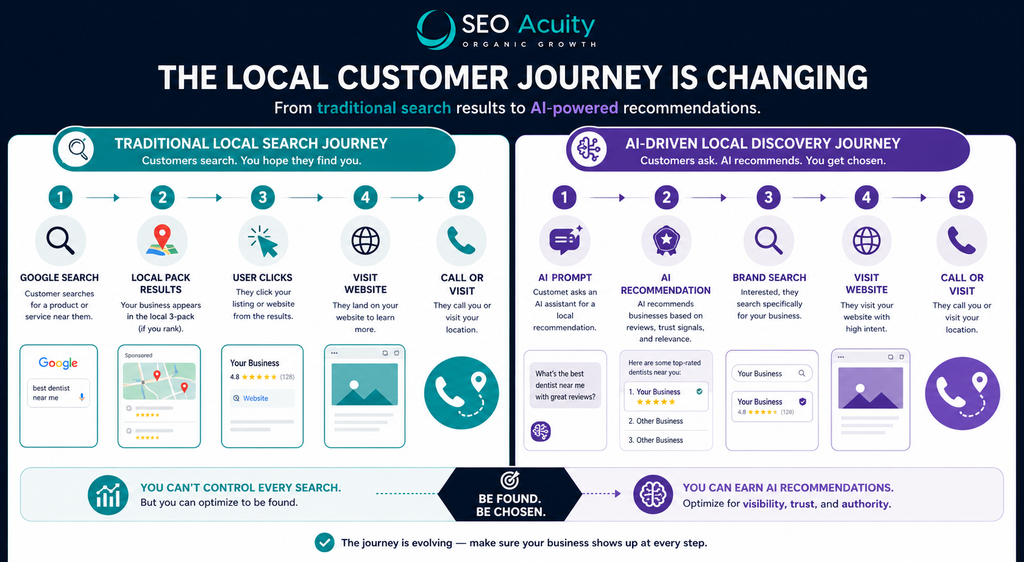
1. How Traditional Local SEO Works
Traditional local SEO focuses on capturing demand from people searching for businesses in a specific geographic area. The key components are:
- Google Business Profile (GBP) — the cornerstone of local SEO; a complete, regularly-updated GBP listing with accurate NAP (name, address, phone number), categories, hours, photos, and review responses signals that your business is active and trustworthy
- Local keyword targeting — optimizing pages and GBP listings for geo-modified queries like “emergency plumber in Austin” or “best Italian restaurant near Union Square”
- Local citations — mentions of your NAP information on directories like Yelp, Bing Places, Apple Maps, and industry-specific directories, reinforcing your location data and contributing to local authority
- Review management — on Google, Yelp, and other platforms; a business with 4.8 stars and 200+ reviews consistently outperforms a competitor with fewer or lower-rated reviews
The goal of local SEO is primarily the “local pack” — the map result with three business listings that appears at the top of Google for location-based searches.
2. How GEO Works for Local Businesses
When someone asks a generative AI tool “who’s the best orthodontist for teens in [city]?” or “what’s the most reliable HVAC company in [neighborhood]?”, the AI synthesizes information from multiple sources:
- Review platforms (Google, Yelp, Healthgrades, Angi, etc.)
- Forum discussions (Reddit, Nextdoor, neighborhood Facebook groups).
- Local news and publication mentions.
- Industry directories and the business’s own website content.
- Social media presence.
A local business that appears consistently across these sources — with positive reviews, clear service descriptions, and mentions in trusted local publications — is significantly more likely to be recommended by AI tools.
The bar for GEO visibility is actually more achievable for local businesses than for national brands.
AI tools responding to hyperlocal queries have a smaller pool of sources to draw from, meaning a well-maintained, widely-cited local business can break through even without massive SEO domain authority.
3. GEO Tactics Specific to Local Businesses
- Create hyperlocal FAQ content. “Do you offer emergency weekend service in [neighborhood]?” “What’s the typical cost of a roof inspection in [city]?” These are exactly the types of questions AI tools receive — clear answers on your website position you to be cited.
- Build neighborhood-specific pages. If you serve multiple areas, create service area pages with genuinely useful, locally relevant content — not just templates with the city name swapped. Include local landmarks, address common local issues, and reference neighborhood-specific needs.
- Manage off-site mentions actively. Monitor and respond to reviews across all platforms. Engage in local forums and community groups. Earn mentions in local press and from local business associations.
- Ensure structured data is comprehensive. Local Business schema — including geo-coordinates, service areas, accepted payment methods, and service descriptions — makes your information easily extractable by AI crawlers.
- Leverage Wikidata and industry directories. Businesses with entries on Wikidata or prominent industry directories (Houzz for home services, Avvo for legal, Zocdoc for healthcare) are more likely to be recognized by AI systems as legitimate, established entities.
The bottom line: the activities that build strong local SEO — consistent listings, genuine reviews, relevant content, community presence — are precisely the activities that build local GEO visibility. At the local level, these two strategies reinforce each other more tightly than in almost any other segment.
GEO SEO vs Traditional SEO Ecommerce Performance
Ecommerce is one of the most commercially significant arenas for GEO vs SEO, because being included — or excluded — from an AI product recommendation can directly translate to revenue won or lost.
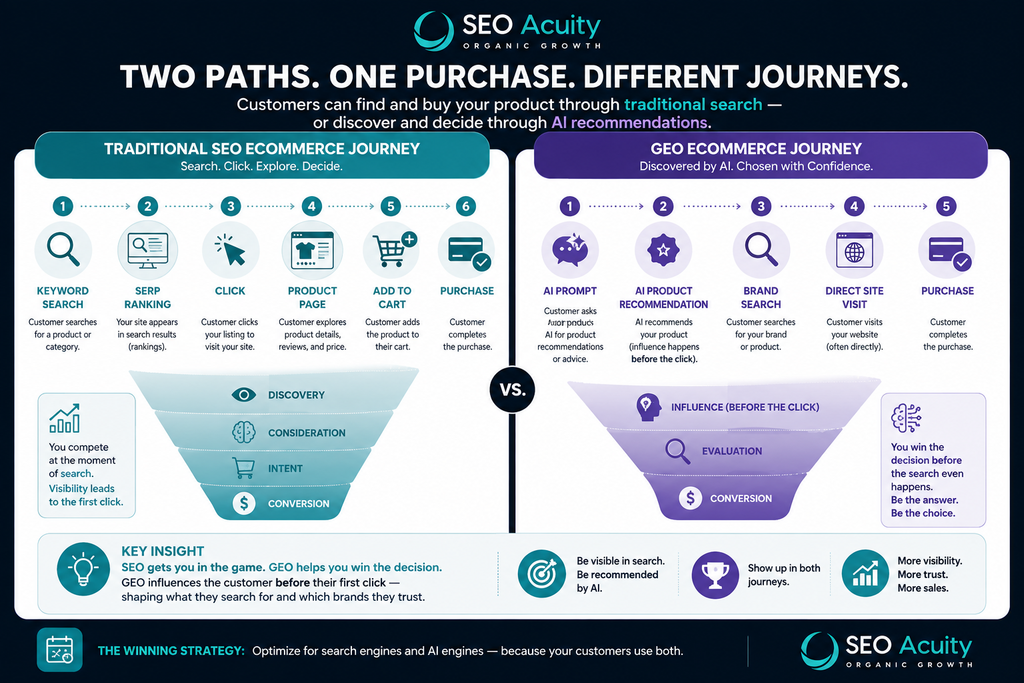
1. How Traditional Ecommerce SEO Works
Ecommerce SEO is built on a hierarchy of product and category pages optimized for transactional and commercial-investigation queries:
- Product page optimization — unique, keyword-rich titles and descriptions, image alt text, Product schema markup (price, availability, ratings, SKU), and fast page load speeds.
- Category page hierarchy — well-structured category pages with strong internal links to subcategory and product pages, signaling relevance for broad category queries.
- Content marketing — buying guides, comparison articles, and review roundups that capture research-stage queries and funnel visitors toward product pages.
- Link acquisition — PR, affiliate partnerships, product review sites, and influencer mentions that build backlink authority.
The strength of ecommerce SEO is that it directly captures purchase intent — someone searching “buy Nike Air Zoom Pegasus 41 size 11” is ready to transact, and ranking for that query has immediate revenue implications.
2. How GEO Works for Ecommerce
GEO in ecommerce changes the nature of product discovery. When a user asks ChatGPT “what’s the best standing desk for a home office under $500?” they want a recommendation, not a list of links.
ChatGPT might respond with specific product suggestions and use-case guidance — and your product earning that recommendation is GEO.
How AI tools build ecommerce recommendations — generative AI synthesizes from multiple sources:
- Review aggregators (Wirecutter, CNET, Consumer Reports, Rtings).
- User reviews on Amazon, Google Shopping, and brand websites
- Tech press and editorial content.
- Social proof signals (Reddit threads, YouTube review channels, forum discussions).
- Product structured data and merchant feeds.
A product that consistently appears positively in editorial content, earns strong user reviews across multiple platforms, and is covered by multiple authoritative sources is far more likely to be recommended by AI tools.
3. GEO Optimization Tactics for Ecommerce Brands
- Prioritize product structured data and merchant feeds. Product schema — including price, availability, ratings, brand, SKU, and product specifications — makes your product data machine-readable and more likely to be accurately cited. Google Merchant Center feeds also flow into Google AI Overviews for product queries.
- Invest in specification-rich product content. Marketing copy is nearly useless for AI citation. Technical specifications, comparison data, and specific use-case descriptions are what AI models extract and quote. Your product description for a camera lens should include focal length, aperture range, minimum focus distance, and comparative notes against similar lenses — not just “captures stunning moments.”
- Create “X vs Y” comparison content. AI tools frequently use comparison structures when recommending products. Detailed comparison content makes the AI’s job easier and positions your product favorably in the structure AI tools prefer to present.
- Build editorial credibility. Get your products into the editorial coverage AI tools draw from: Wirecutter, CNET, specialist publications, and respected YouTube reviewers. A single Wirecutter “Best X” recommendation may do more for GEO than months of on-page optimization.
- Manage reviews across all platforms. Review volume, recency, and sentiment on Amazon, Google Shopping, and third-party review sites are significant AI citation signals. A product with 1,200 reviews averaging 4.6 stars is much more likely to receive an AI recommendation than a technically superior product with 40 reviews.
4. The GEO Traffic Paradox — Traffic Volume vs. Conversion Quality
One important reality for ecommerce brands to plan for: GEO can reduce raw traffic while improving conversion quality — a counterintuitive outcome that requires a shift in how success is measured.
Research shows that 80% of users answer 40% of their queries without clicking a link — meaning AI tools are satisfying research intent without sending the user to your site. Total organic traffic may fall even as your brand gets more AI mentions.
But the users who do arrive after an AI recommendation have already been pre-qualified. They know roughly what your product does and costs, and they arrive with higher purchase intent than the average organic visitor.
SEO expert Wil Reynolds documented this dynamic when he observed a site’s organic traffic declining while email subscribers from organic search remained stable — suggesting that the lost traffic was lower-intent, not genuine buyer interest.
For ecommerce GEO measurement, track beyond sessions:
- Average order value for organic and direct traffic — if it rises, AI pre-qualification may be at work.
- Conversion rate on branded search traffic — new branded searchers who convert well suggest AI-driven discovery.
- Return visit rate — AI-influenced buyers who visited once then came back to purchase represent GEO’s downstream value.
- Branded search volume spikes correlated with AI visibility reports to confirm the attribution link.
GEO Content Optimization – How Each AI Platform Behaves Differently
One of the most practically important — and frequently overlooked — aspects of generative engine optimization is that different AI engines behave differently.
Your content doesn’t perform uniformly across ChatGPT, Perplexity, Google AI Overviews, and Gemini. Understanding how each platform works helps you tailor your content and prioritize where to focus.
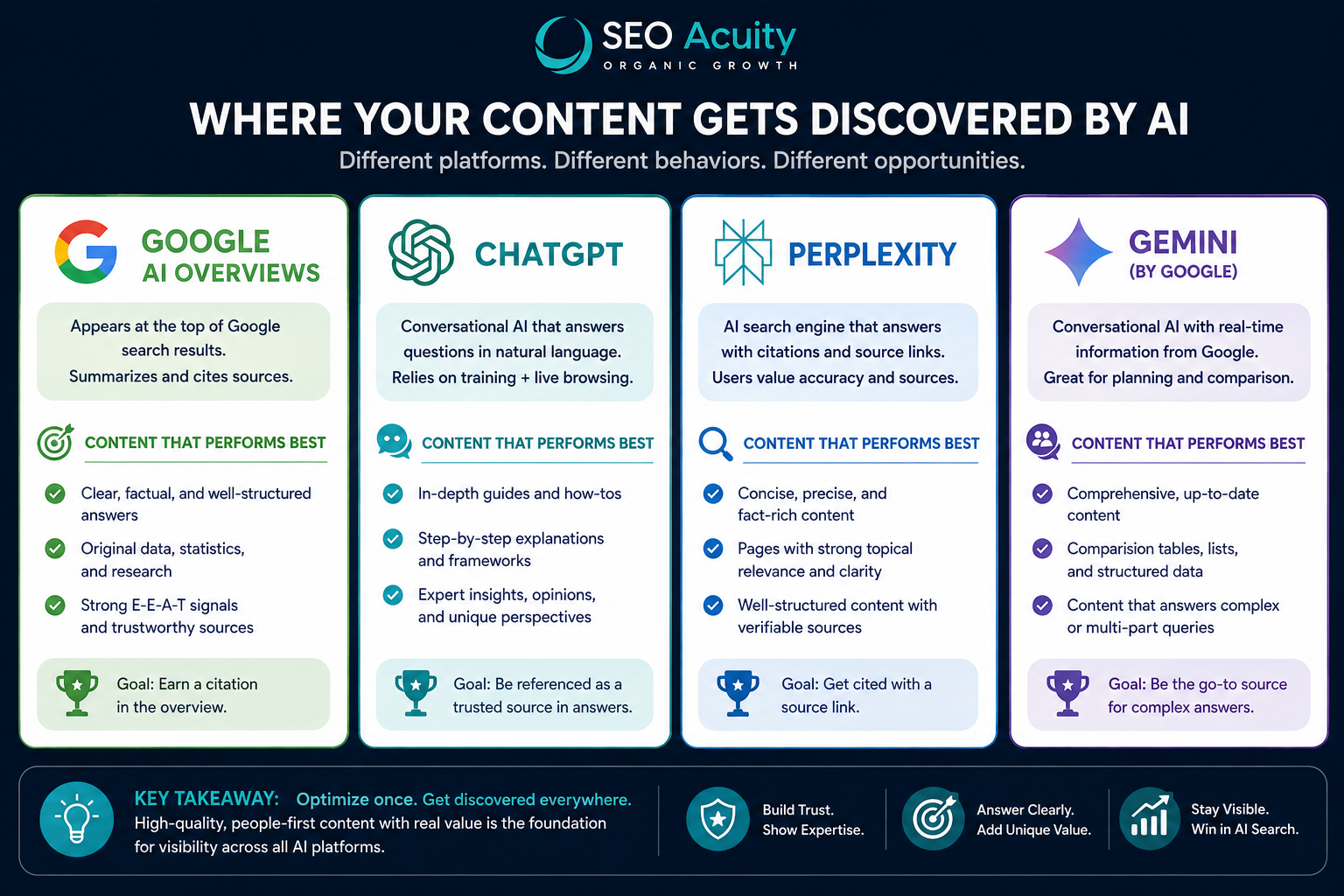
“A Practical Step-by-Step Framework for Appearing in AI Search Results Like ChatGPT and Gemini” .
1. Google AI Overviews and AI Mode
Google AI Overviews are powered by Gemini and use retrieval-augmented generation (RAG) — meaning they pull from Google’s live search index to supplement LLM responses. Key characteristics:
- Most directly influenced by traditional SEO — pages that rank well in organic results are much more likely to appear in AI Overviews.
- Strong traditional SEO ranking directly supports Google AI Overview visibility.
- AI Mode goes further, synthesizing multi-step research tasks and drawing from a broader range of sources, emphasizing recency, factual accuracy, and comprehensive coverage.
Practical takeaway: build and maintain strong organic rankings for your target queries to maximize visibility here. Learn how to rank in Google AI Overviews with our step-by-step guide.
2. ChatGPT
ChatGPT’s search feature and its baseline responses from training data behave quite differently:
- Training-data responses favor sources that were heavily cited and frequently mentioned in the pre-training dataset — older, well-established publications have an advantage.
- Search-augmented responses favor pages that rank well in Bing’s index and are structured for easy extraction.
- ChatGPT often synthesizes without explicitly citing sources — your brand can be recommended without a link appearing, which is valuable for awareness but challenging for attribution.
3. Perplexity AI
Perplexity is the most citation-transparent of the major AI tools:
- Explicitly shows sources and ranks them by how frequently it draws from them.
- Perplexity GEO is the closest analog to traditional SEO — pages that earn many inbound links and appear on authoritative reference lists are surfaced and cited.
- Earning backlinks and appearing in editorial roundups has a direct and visible impact on Perplexity citation frequency
- Its citation behavior is the easiest to monitor and benchmark against competitors.
4. Gemini
Google’s Gemini, when used outside of Google search, has distinct characteristics:
- Gives less structured and less citation-heavy responses compared to Perplexity or ChatGPT.
- Follows Google ranking patterns but produces answers that can be less specific.
- For Gemini GEO, the best strategy mirrors Google in general: strong traditional SEO, E-E-A-T signals, and well-structured conten.t
5. Practical Implication — Don’t Assume Uniform GEO Performance Across Platforms
Don’t optimize for one AI environment and assume it will transfer across all others. The right approach is to:
- Monitor your brand’s visibility in each AI environment separately.
- Identify where you’re underperforming relative to competitors by platform.
- Adapt accordingly — a brand absent from Google AI Overviews likely needs better organic rankings first, while a brand underperforming in ChatGPT may need more training-data-era editorial mentions.
GEO Optimization Checklist
Use this actionable checklist to assess and improve your content’s performance in generative AI environments. For a deeper walkthrough of applying these tactics to build your full strategy, see our guide to GEO SEO strategy for AI search.
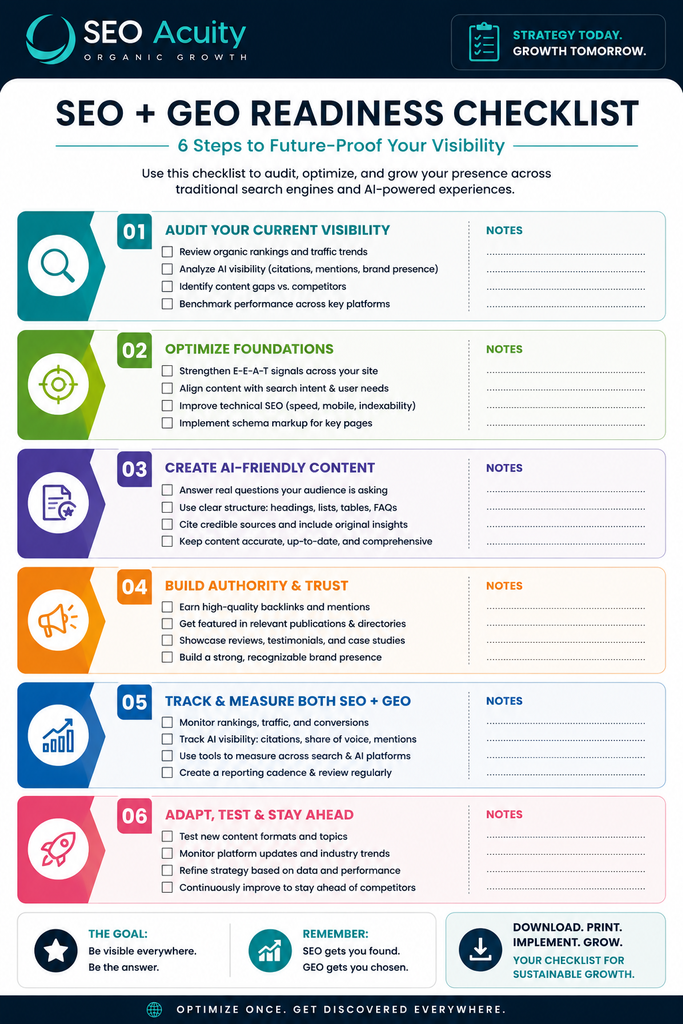
1. Content Quality
Before a single technical optimization matters, the content itself has to earn its place in an AI-generated answer.
The checklist items below focus on the qualities that make content worth citing — clarity, density, accuracy, and the ability to stand alone when pulled out of context.
- Directly answers natural-language questions — each piece of content should have a clear, stated answer to a specific question; not buried in paragraph five.
- Written in clear, precise, human language — conversational and readable, with no unnecessary jargon or filler phrases.
- Factually dense with verifiable claims — statistics, named entities, specific product details, and attributed quotes give AI models material to extract and cite.
- Demonstrates genuine topical authority — deep coverage with expert-level detail, not surface summaries easily found on any other site.
- Up-to-date and accurate — dated statistics, outdated product information, or obsolete advice actively harms GEO performance.
- Context-independent — individual paragraphs and sentences should make sense when quoted without the full article; this is critical for citability.
2. Structure and Formatting
Even high-quality content can go unnoticed by AI tools if it’s poorly organized.
How you structure a page — the headings you choose, the formats you use, and the visual hierarchy you create — directly influences whether a language model can locate, extract, and reproduce your content in its answers.
- One H1 per page used as the primary topic statement — don’t use H1 tags as styling choices.
- Descriptive H2s and H3s that mirror how users ask questions (“What Is GEO?” beats “Section 2: Definitions”).
- FAQ section with short, direct answers — FAQs are the most citable content format for AI; questions mirror prompts, and answers can be extracted verbatim.
- Comparison tables where multiple options are discussed — AI tools frequently use tables in their answers; feeding them well-structured tables helps.
- Definition or summary box near the top of key sections — context-setting definitions help AI tools locate and extract the core answer quickly.
- Numbered lists for processes and step-by-steps — easily extracted and reproduced in AI answers.
- No clever-but-vague headings — “The Secret Sauce” helps no one; “How to Optimize for Google AI Overviews” does.
3. GEO-Specific Semantic Elements
Beyond standard SEO structure, Generative Engine Optimization requires deliberate language choices at the sentence level.
The elements below are designed to make your content semantically legible to large language models — giving them clean facts to quote, clear associations to learn, and related questions to answer from a single source.
- Question-format headings where natural — these directly mirror the prompts AI tools receive.
- Semantic triples — explicit subject-predicate-object statements (“Perplexity cites sources more transparently than ChatGPT”) that give AI models clean, quotable facts.
- Lexical proximity — keep positive descriptors within 2–3 words of your brand name to reinforce associations in LLM training patterns.
- Entity mentions — reference named brands, people, tools, and standards that relate to your topic; entity density signals topical authority to LLMs.
- Query fan-out coverage — identify adjacent questions AI tools ask when processing your primary topic and ensure your content addresses them.
4. Technical Foundations
Content and structure mean nothing if AI crawlers can’t reach or render your pages in the first place.
The technical checks below ensure your site is accessible, fast, and correctly signposted — so that both search engines and AI tools can reliably discover, index, and process what you’ve published.
- Schema markup implemented — FAQ, Article, Product, Review, LocalBusiness, or HowTo schema as appropriate to content type.
- Key facts not gated by JavaScript — if critical information only loads after JavaScript executes, many AI crawlers won’t see it.
- Core Web Vitals passing — LCP under 2.5s, INP under 200ms, CLS under 0.1.
- Mobile-responsive — AI crawlers, like Google, use mobile-first indexing.
- XML sitemap current and submitted — ensures AI-friendly crawlers can discover your content efficiently.
- No disallow rules blocking AI crawlers — check your robots.txt for overly broad rules that may be excluding ChatGPT-User, PerplexityBot, or other AI crawler agents.
5. Trust and Citability Off-Site
AI models don’t form opinions about your brand from your website alone — they draw on the full ecosystem of third-party mentions, reviews, and reference data available across the web.
The items below address how consistently and credibly your brand appears outside your own pages, which is increasingly what determines whether an AI tool treats you as a trustworthy source worth citing.
- Consistent brand information across Google Business Profile, Wikidata, Crunchbase, LinkedIn, and industry directories.
- Reviews actively managed on all major platforms — volume, recency, and response rate all matter.
- Brand mentioned in third-party editorial content — trade publications, industry roundups, expert interviews.
- Author bio with credentials on content pages — named authors with demonstrable expertise signal E-E-A-T to both Google and LLMs.
- Off-site presence on reference sources — Wikidata, industry association listings, and sector-specific databases all feed LLM knowledge.
6. Monitoring
Optimization without measurement is guesswork. The checks below establish a feedback loop that tells you whether AI tools are actually finding and citing your content, which competitors are getting the citations you’re missing, and how AI-driven discovery is translating into measurable brand demand over time.
- Tracking AI citation frequency using dedicated AI visibility tools.
- Monitoring brand mentions in AI answers — including mentions without explicit links.
- Competitor gap analysis — identifying which competitors are cited in AI answers where you aren’t.
- Branded search volume trend — the most reliable indirect signal of AI-driven discovery.
- Log file analysis — confirming which AI crawlers (ChatGPT-User, PerplexityBot, etc.) are accessing your site and which pages they visit most.
How to Build an Integrated GEO and SEO Strategy: A Practical Framework
GEO doesn’t replace SEO — it extends it into a new search environment. The most effective approach isn’t a parallel workstream but an integrated strategy where each discipline reinforces the other.
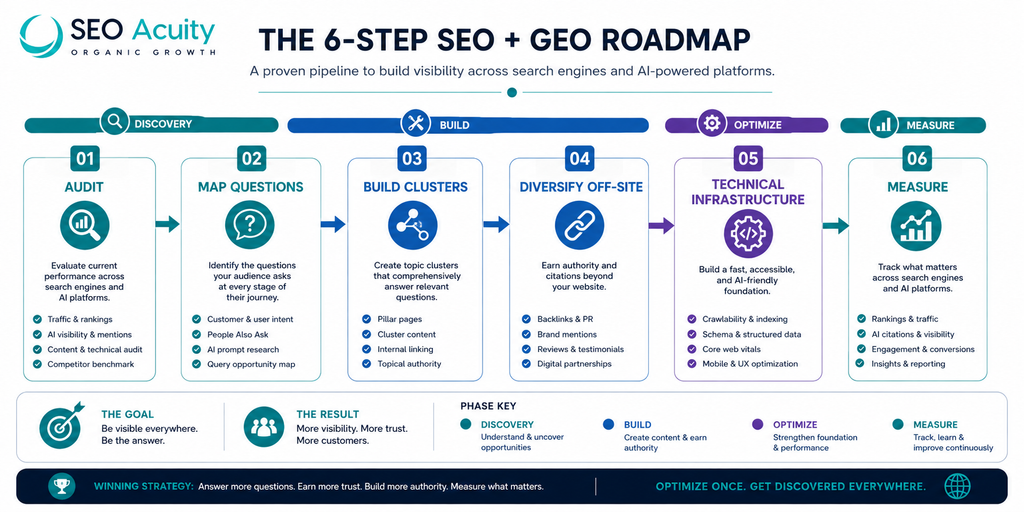
إزاي تبني Organic Growth Strategy تظهر في الـ AI Search والـ SEO مع بعض؟ | خطوة بخطوة
To understand how to adapt your SEO budget for AI search within this integrated approach, see our dedicated budget planning guide.
1. Audit Your Existing Content for Dual-Channel Readiness
Before creating new content, audit what you already have. For each key page or article, assess:
- Does this page rank well in traditional search? (If yes, it’s already a candidate for AI retrieval via RAG).
- Does it have an FAQ section? (If not, add one — this is the single highest-ROI GEO enhancement).
- Are the headings descriptive and question-format where appropriate?
- Is the content factually dense with specific, citable claims?
- Are statistics and claims current?
Pages that already rank well but lack FAQ sections, have vague headings, or contain more marketing language than factual substance are the highest-priority GEO enhancement targets.
2. Map Your Audience’s Full Question Landscape
Traditional SEO keyword research tells you what your audience searches for. GEO content planning requires knowing what they ask.
Supplement keyword tool data with:
- Sales call recordings — what questions come up before a decision?
- Customer support tickets — what do users get confused about?
- Win/loss analysis — what alternatives did prospects consider, and why?
- Reddit, Quora, and industry forums — how do people phrase their questions?
- Competitor FAQ sections — what questions are others addressing that you haven’t?
This first-party and community intelligence identifies the questions AI tools get asked about your category — and helps you build content that gets cited when those questions arise.
3. Build Content Clusters That Cover Both Breadth and Depth
Both Google and LLMs reward topical authority. Content clusters (a central pillar page with supporting detail articles on subtopics) are the most efficient structure for building it.
For GEO specifically:
- The depth of your clusters matters as much as the breadth
- AI tools can tell the difference between a 300-word overview and a genuinely expert treatment of a subtopic.
- Prioritize depth on the questions most likely to appear in AI fan-outs for your category.
4. Diversify Your Off-Site Presence Beyond Backlinks
SEO authority is backlink-centric. GEO authority is broader — it’s about being talked about, mentioned, and referenced across the web.
Develop an off-site presence strategy that includes:
- Digital PR — targeting editorial mentions in trade publications, not just link-building.
- Review management — proactive solicitation and response across all relevant platforms.
- Community participation — contributing usefully to industry forums, Reddit, LinkedIn groups, and Q&A platforms.
- Reference source presence — Wikidata, Crunchbase, LinkedIn company pages, and industry association listings.
- Speaking and awards — conference presence, award nominations, and case study features build brand entity authority.
5. Implement Technical GEO Infrastructure
Ensure your technical foundation supports AI crawler access:
- Review robots.txt to confirm AI crawlers aren’t accidentally blocked.
- Implement comprehensive schema markup relevant to your content type.
- Ensure JavaScript-dependent content has HTML fallbacks for key facts.
- Monitor log files for AI crawler activity and identify crawl gaps.
6. Build Separate But Connected Measurement Frameworks
Track SEO and GEO metrics in parallel, then look for the connections. Rising branded search alongside stable organic traffic and improving conversion rates is a strong signal that GEO is working. Build a quarterly narrative that connects the two:
“Our AI citations increased 40% this quarter. Branded search grew 18%. Organic traffic fell 8% (consistent with the market-wide AI Overview impact). Conversion rate rose 12%. Net revenue from organic + branded search: up 6%.”
That narrative is the story of a GEO strategy working exactly as intended.
Ready to Dominate Search Engine Rankings?
Accelerate your organic growth and scale your business leads with our data-driven SEO strategies.
Get a Free Quote NOW!Does SEO Still Matter If AI Search Keeps Growing?
The short answer is yes — emphatically. And this question deserves a serious answer, not a reassuring platitude.
Traditional search isn’t going anywhere. Google processes an estimated 8.5 billion searches per day. Bing, Yahoo, and DuckDuckGo add hundreds of millions more.
The intent to find specific information through a keyword search is deeply ingrained in user behavior — and for navigational queries, transactional queries, and local searches, traditional search results remain the primary interface.
What is changing is the share of queries handled by AI-generated summaries rather than ranked link lists. For research queries, comparison queries, how-to queries, and general knowledge questions, users are increasingly getting their answer without clicking a link. This is where SEO’s traffic impact is eroding — and where GEO fills the gap.
“Is Google Dead? The Full Truth About AI Search”
Key reasons SEO remains essential alongside GEO:
- Google AI Overviews pull from ranked pages — strong SEO rankings directly support AI Overview visibility.
- High-intent transactional queries still predominantly result in clicks to websites; GEO hasn’t changed purchase behavior for bottom-funnel searches.
- SEO provides the content foundation that GEO builds on — pages that aren’t indexed can’t be cited.
- Organic traffic still converts — the audience that clicks through organic results tends to have high intent and is not going away.
The most accurate framing is that search is becoming multi-channel. Just as social media didn’t replace search but became a parallel discovery channel, generative AI is becoming a parallel search channel.
The most successful brands will be visible in both. For a detailed exploration of this question, see our full analysis: does SEO still matter if AI search keeps growing?
Ready to Dominate Search Engine Rankings?
Accelerate your organic growth and scale your business leads with our data-driven SEO strategies.
Get a Free Quote NOW!Conclusion
The question of GEO vs SEO ultimately comes down to this: search has expanded beyond the ranked list, and your visibility strategy needs to expand with it.
Your potential customers are on Google, and they’re on ChatGPT, Perplexity, and Google AI Mode — often within the same research session. The brands winning in 2026 aren’t choosing between SEO and GEO; they’re building integrated strategies that perform in both environments.
The good news is that the core investment is the same: genuinely authoritative, well-structured, factually rich content that serves real user needs. That content earns rankings in Google and citations in AI answers. The difference is in the execution details — FAQ sections, semantic structure, cross-web presence, fact density, and freshness cadences that specifically serve AI citability.
Start with these three steps:
- Audit your most important existing content against the GEO checklist in this guide. Most pages can be meaningfully improved for AI visibility with targeted enhancements — FAQ additions, heading revisions, specification enrichment — without rebuilding from scratch.
- Build your measurement framework before you optimize at scale. Establish your baseline AI visibility, branded search volume, and conversion rates now, so you can measure the impact of your GEO investments accurately.
- Integrate your SEO and GEO workflows. The same content team, the same topic research, the same E-E-A-T investments serve both channels. GEO is not a parallel budget — it’s an extension of your existing content strategy into a new distribution channel.
The future of search isn’t just about being found. It’s about being trusted, referenced, and recommended — everywhere your audience looks for answers.
Frequently Asked Questions About GEO vs SEO
The questions below cover the most common points of confusion digital marketers encounter when working with GEO and SEO side by side — from the foundational definitions to the practical measurement and strategy decisions that affect real budgets and workflows.
What is the key difference between GEO and SEO?
SEO is the practice of improving your website to rank higher in traditional search engines like Google, driving organic traffic through clicks on ranked links.
GEO is the practice of optimizing your content to be cited, quoted, or recommended in AI-generated answers from tools like ChatGPT, Perplexity, and Google AI Overviews. The core difference: SEO earns you a position in a list; GEO earns you inclusion in an answer.
What is generative engine optimization (GEO) vs SEO — explained simply?
When you search Google and see a list of links, that’s traditional search — and SEO is how you get your page on that list. When you ask ChatGPT a question and it gives you a synthesized answer, that’s a generative engine — and GEO is how you get your brand included in that answer.
Traditional SEO drives clicks; GEO drives recommendations and brand awareness.
Is GEO the same as AEO, AIO, or AIEO?
Functionally, yes. GEO (generative engine optimization), AEO (answer engine optimization), AIO (AI optimization), and AIEO (artificial intelligence engine optimization) all describe the practice of optimizing content for AI systems rather than only traditional search engines. For a detailed comparison of these approaches, see our guide on AEO vs SEO.
GEO is the most precise term — it specifies optimization for generative AI, which is the technology powering the current generation of AI search tools.
What are the KPIs for GEO vs SEO?
SEO KPIs include organic traffic, keyword rankings, click-through rate, bounce rate, backlink growth, and conversion rate from organic search.
GEO KPIs include AI citation rate, brand mentions in AI answers, AI share of voice, content extraction rate, branded search volume growth (a key proxy metric), and conversation-to-conversion rate for AI-driven engagements.
Does GEO work for local businesses?
Yes, and it may be more accessible for local businesses than for national brands. When users ask AI tools for local recommendations (“best plumber in [city],” “most trusted pediatrician near [neighborhood]”), AI tools draw from review platforms, local directories, forum mentions, and local press.
A local business with consistent NAP data, strong reviews, and helpful FAQ content on its website is well-positioned for local GEO visibility without needing to compete on massive domain authority.
How does GEO affect ecommerce SEO performance?
GEO can reduce raw click traffic to ecommerce sites — AI tools sometimes satisfy product research queries without sending users to a brand’s website. However, users who arrive after an AI recommendation tend to be more purchase-ready, often resulting in higher conversion rates and average order values.
Ecommerce brands should track conversion metrics and branded search growth alongside traffic volume to understand GEO’s true business impact.
Does good SEO help with GEO?
Significantly. Google AI Overviews and AI Mode use retrieval-augmented generation (RAG), pulling from Google’s live search index — meaning pages that rank well in traditional search are more likely to be pulled into AI Overview answers.
Strong topical authority, comprehensive content, and technical SEO cleanliness all contribute to both traditional rankings and AI citation likelihood.
How do I measure GEO performance if there are no tracking tools like Google Search Console?
Measurement is the current frontier challenge of GEO. Use a combination of: dedicated AI visibility platforms that sample AI responses and track citation frequency, branded search volume trends in Google Search Console (a reliable proxy for AI-driven discovery), direct traffic trend analysis, and conversion rate monitoring.
Enterprise teams often build custom log file analysis to identify which AI crawlers are accessing their content and correlate that with AI visibility reports.
Is GEO replacing SEO?
No. Billions of traditional searches happen daily, and the intent to search with keywords remains deeply embedded in user behavior.
What’s changing is that AI-generated summaries now intercept a growing share of research, comparison, and informational queries — reducing click-through rates on organic results for those query types.